
A complete issue · 24 pages · 1914
Judge — October 31, 1914
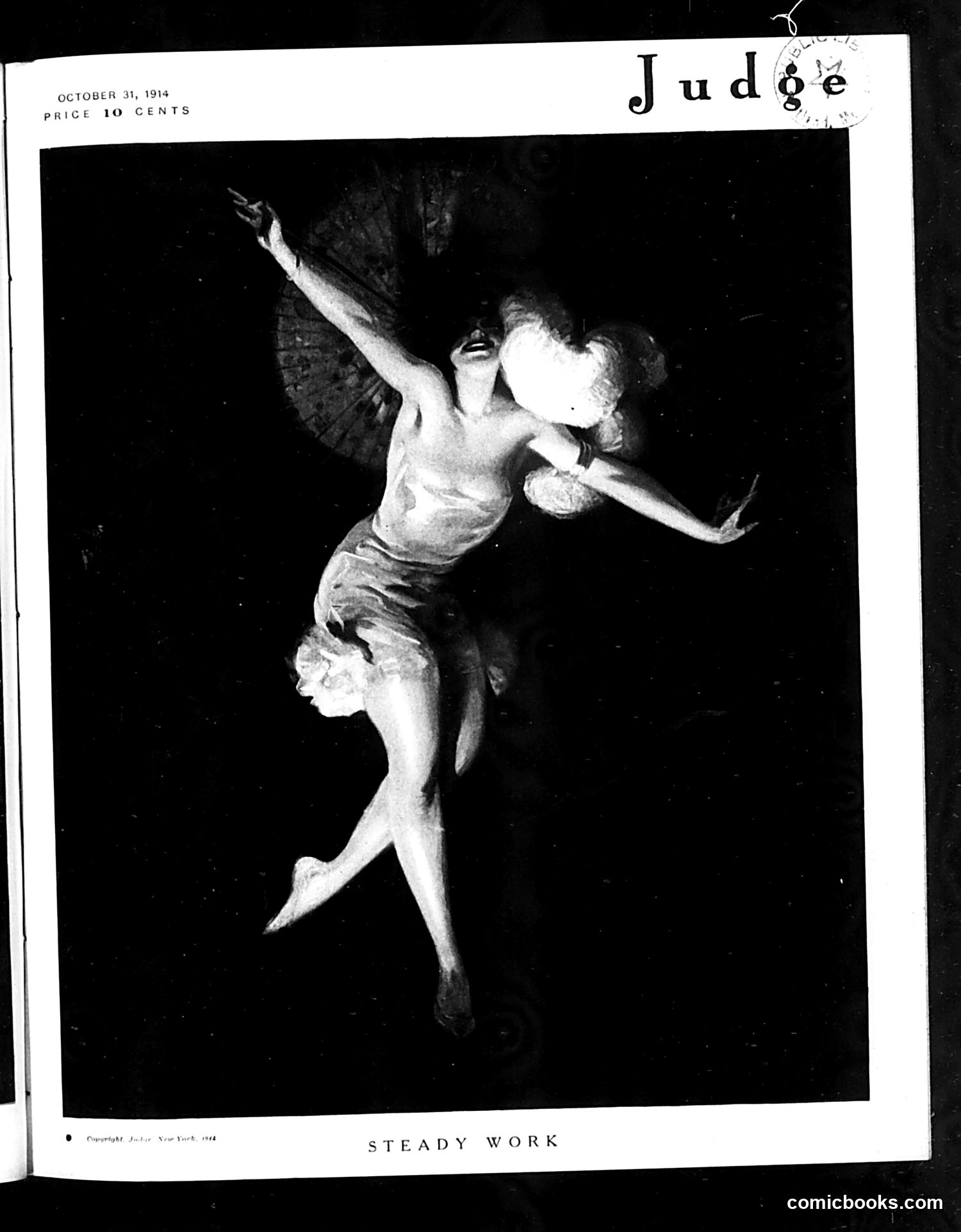
This illustration depicts a woman performing acrobatic labor—balancing precariously while juggling or holding objects. The caption "Steady Work" is ironic commentary on women's employment during World War I. With the U.S. not yet formally involved but the war affecting the economy, this likely satirizes the precarious nature of women's wartime work. Women were entering industrial jobs vacated by men serving in the military, yet their employment was considered temporary and unstable—hence "steady work" as sarcasm. The acrobatic pose suggests the difficult balancing act women performed: maintaining households while performing demanding factory labor, all while their position in the workforce remained uncertain and contingent on war conditions. The image reflects early-1914 anxieties about shifting gender roles during wartime.
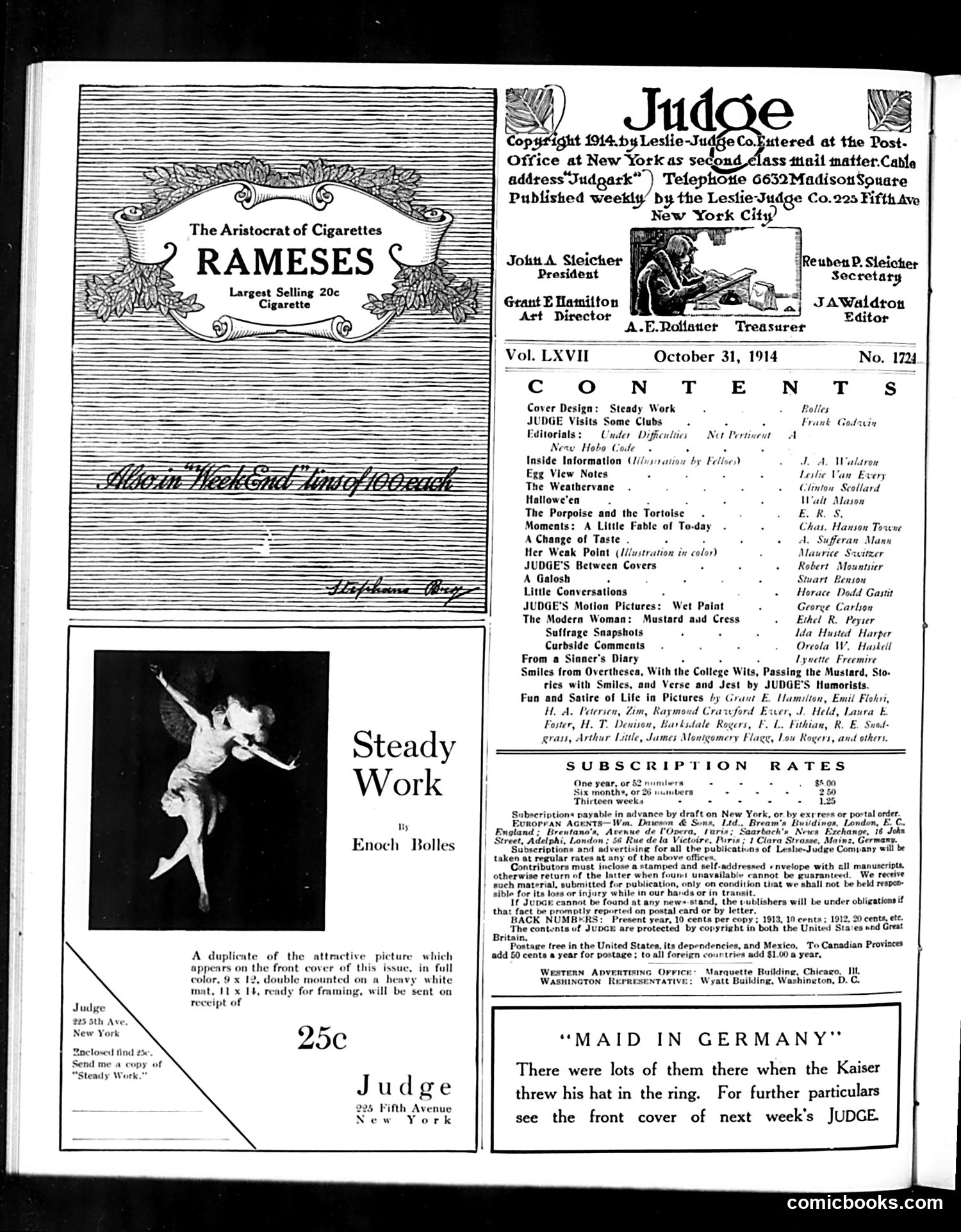
This October 31, 1914 *Judge* page features a cover design by Enoch Bolles titled "Steady Work," depicting a scantily-clad female figure in a dynamic pose. The cartoon appears to be primarily aesthetic rather than explicitly political—it's an art nouveau-style illustration typical of *Judge's* cover designs. The title "Steady Work" likely refers to the figure's physical exertion or labor, playing on the contemporary fascination with the female form in motion. The page is largely advertising, promoting *Judge* magazine subscriptions and a Rameses cigarette advertisement. Given the 1914 date during World War I's early stages, no clear wartime satire is evident on this particular page, though *Judge* was known for its political commentary on contemporary issues.
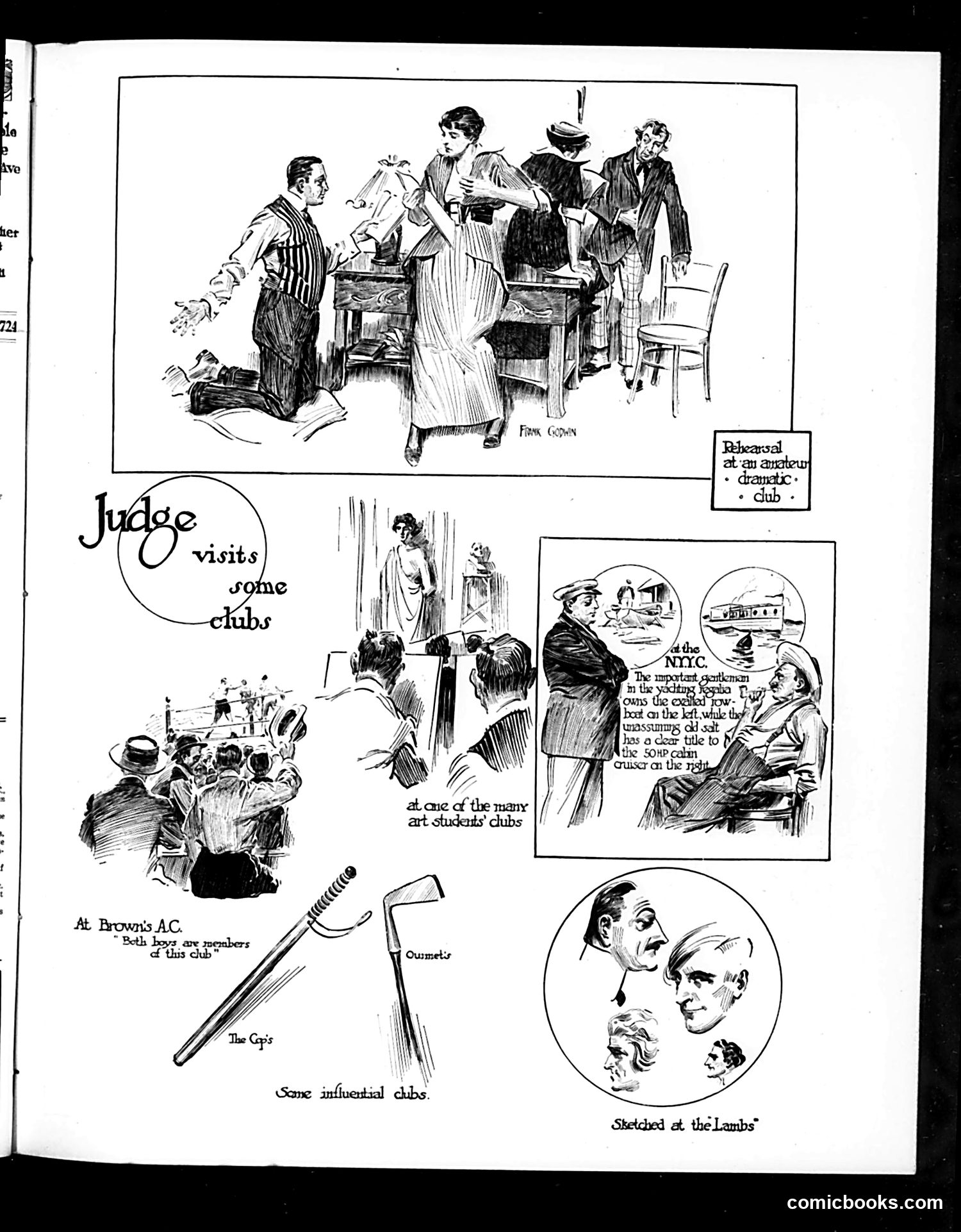
This page satirizes New York's amateur dramatic and arts clubs of the early 20th century. The top panel shows a rehearsal at an amateur dramatic club, depicting theatrical chaos—a woman in costume gestures dramatically while men in suits watch or participate awkwardly, suggesting pretentious amateur theatrics. The page then documents the Judge's visits to various clubs: Brown's Athletic Club (where members practice with sculls and oars), an art students' club, the NYYC (New York Yacht Club, where yachting is discussed), and the Lambs Club (sketched with profile portraits). The satire gently mocks the social pretensions and earnest amateurism of these gentlemen's clubs and their members' artistic aspirations, a common Judge theme targeting upper-class New York leisure culture.
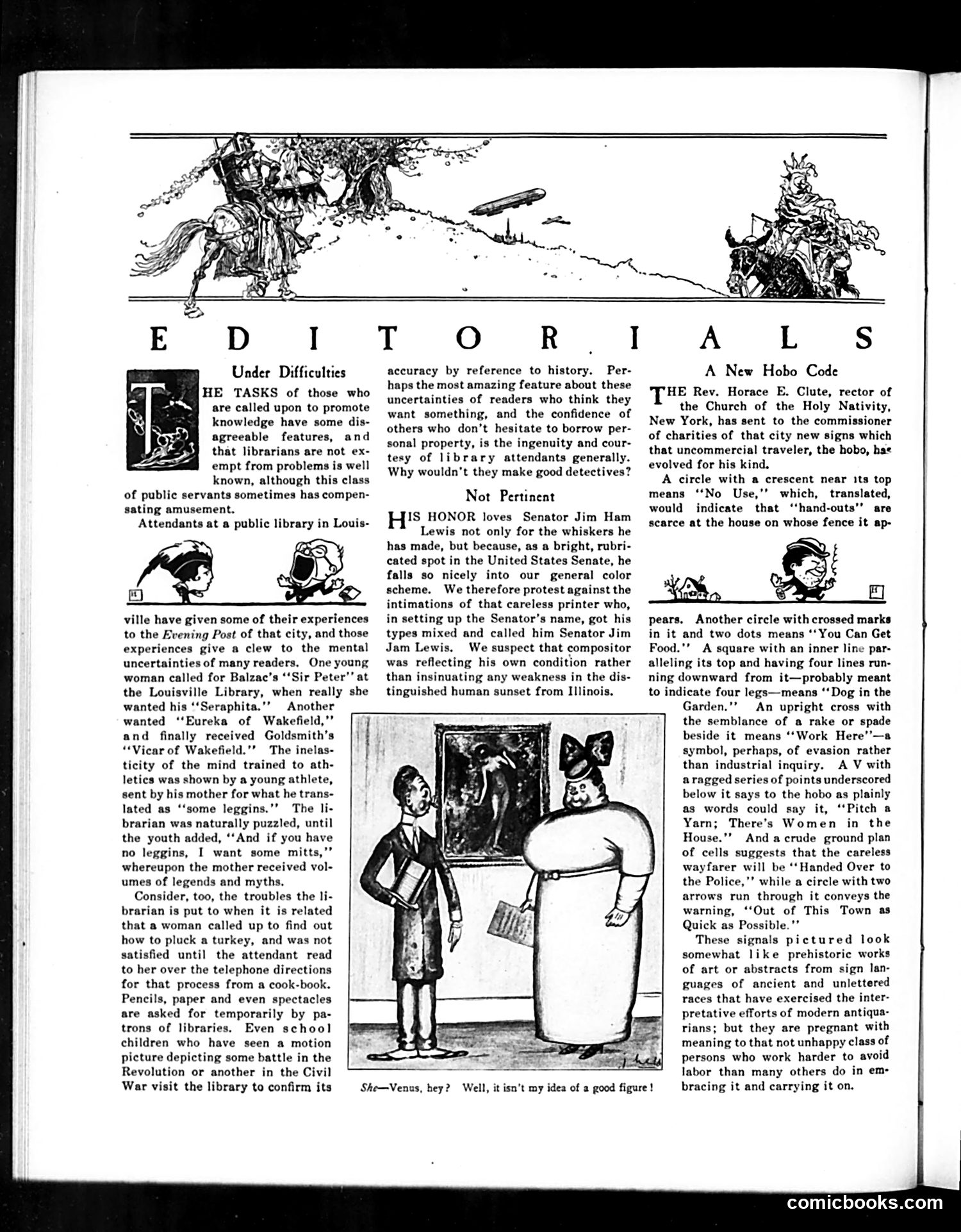
This page contains two distinct pieces: **Left section ("Under Difficulties"):** Discusses librarians' challenges assisting patrons, including humorous anecdotes about unusual requests—someone seeking "Sir Peter" from Balzac, another wanting "Enoch of Wakefield," and a woman asking a cook-book reference via telephone. The piece gently satirizes both public ignorance and librarians' patience. **Right section ("A New Hobo Code"):** Criticizes a printer's error in a newspaper that misspelled Senator Jim Ham Lewis's name as "Jim Jam Lewis." The article then explains various vagrant/hobo symbols—circles, crosses, and marks—used to communicate warnings and information along the road. The satire conflates the careless typographical error with the deliberate coded language of transient communities.
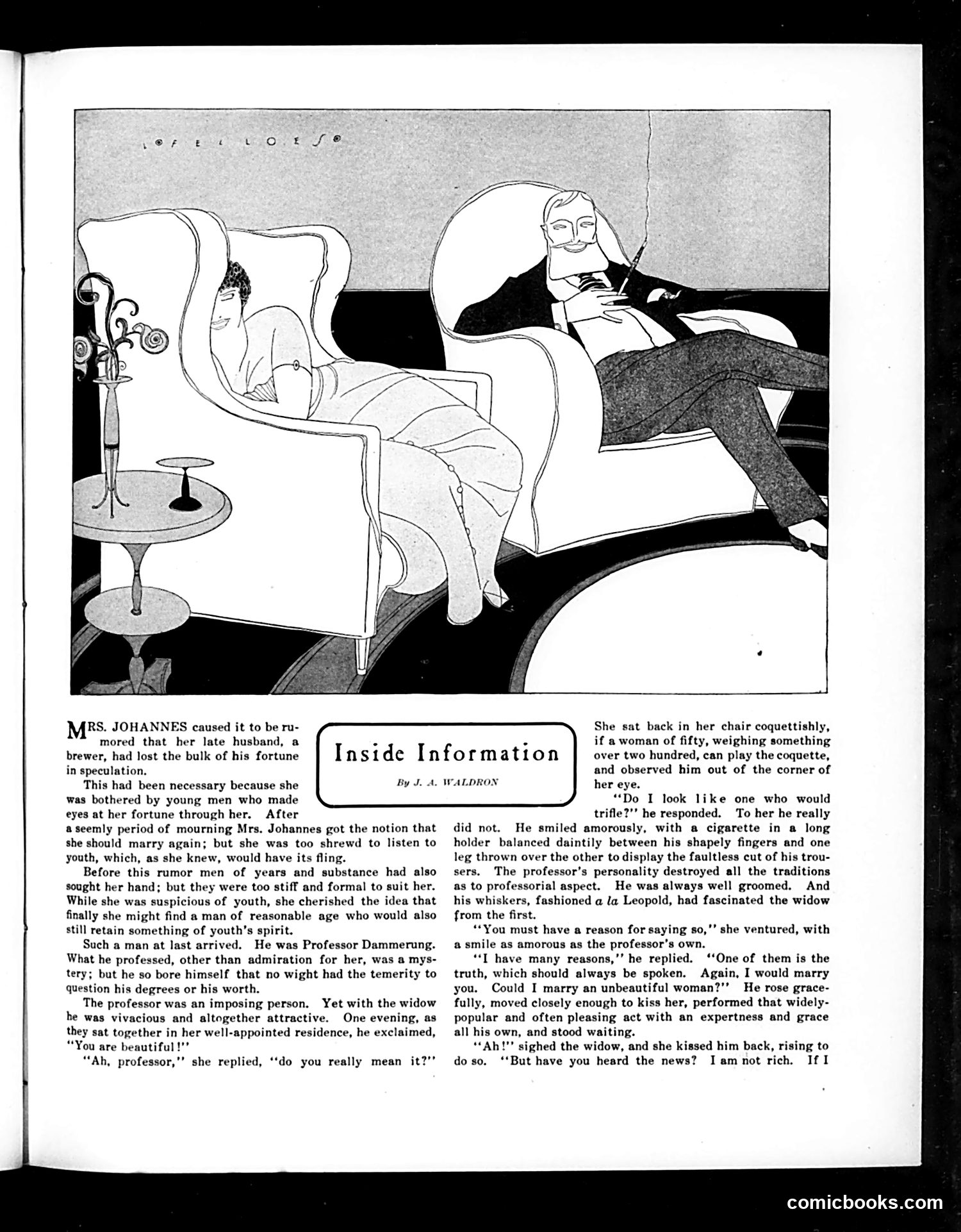
This page from *Judge* magazine presents a satirical story about Mrs. Johannes and Professor Dammerunga. The narrative mocks the widow's romantic pursuit of the professor, despite their age difference and his modest worth. The satire targets the social dynamics of courtship: Mrs. Johannes, a wealthy fifty-year-old widow, pursues the professor relentlessly while he remains ambivalent. The story suggests she's motivated by vanity rather than genuine affection—she wants to "play the coquette" and prove she can attract a man. The cartoon illustrates their domestic scene, with the professor appearing detached (smoking, reading) while she sits attentively. The humor derives from the reversal of traditional gender roles in courtship and the suggestion that wealthy widows of a certain age pursue younger men despite social impropriety—a common *Judge* theme mocking contemporary manners and social pretension.
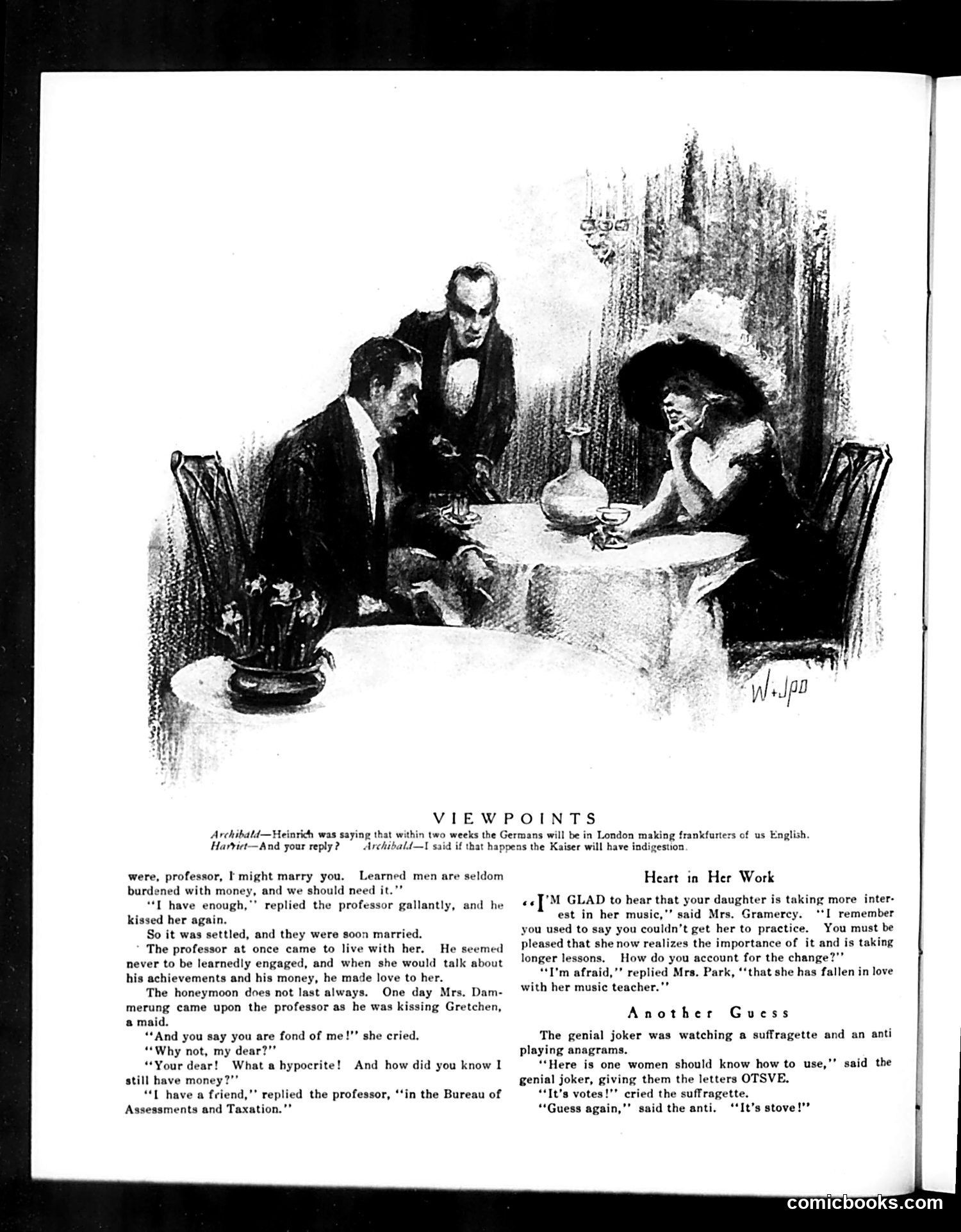
The top cartoon ("Viewpoints") satirizes British anxiety about German military threats during what appears to be the pre-WWI era. Two Englishmen discuss Heinrich's boast that Germans will invade London within two weeks. Archibald's reply—that the Kaiser would get indigestion from eating "frankfurters of us English"—is dark humor about potential invasion and slaughter. The remaining pieces are unrelated humor sections: **"Heart in Her Work"** jokes about a daughter's sudden enthusiasm for music practice—revealed to stem from romantic interest in her male music teacher rather than genuine dedication. **"Another Guess"** plays on the contemporary women's suffrage debate. A suffragette and anti-suffragist woman compete solving anagrams using letters spelling "OTSVE." The suffragette guesses "votes" (linking to voting rights); the anti-suffragist suggests "stove" (implying women belong in the kitchen). The joke mocks anti-suffrage arguments about women's proper domestic role.
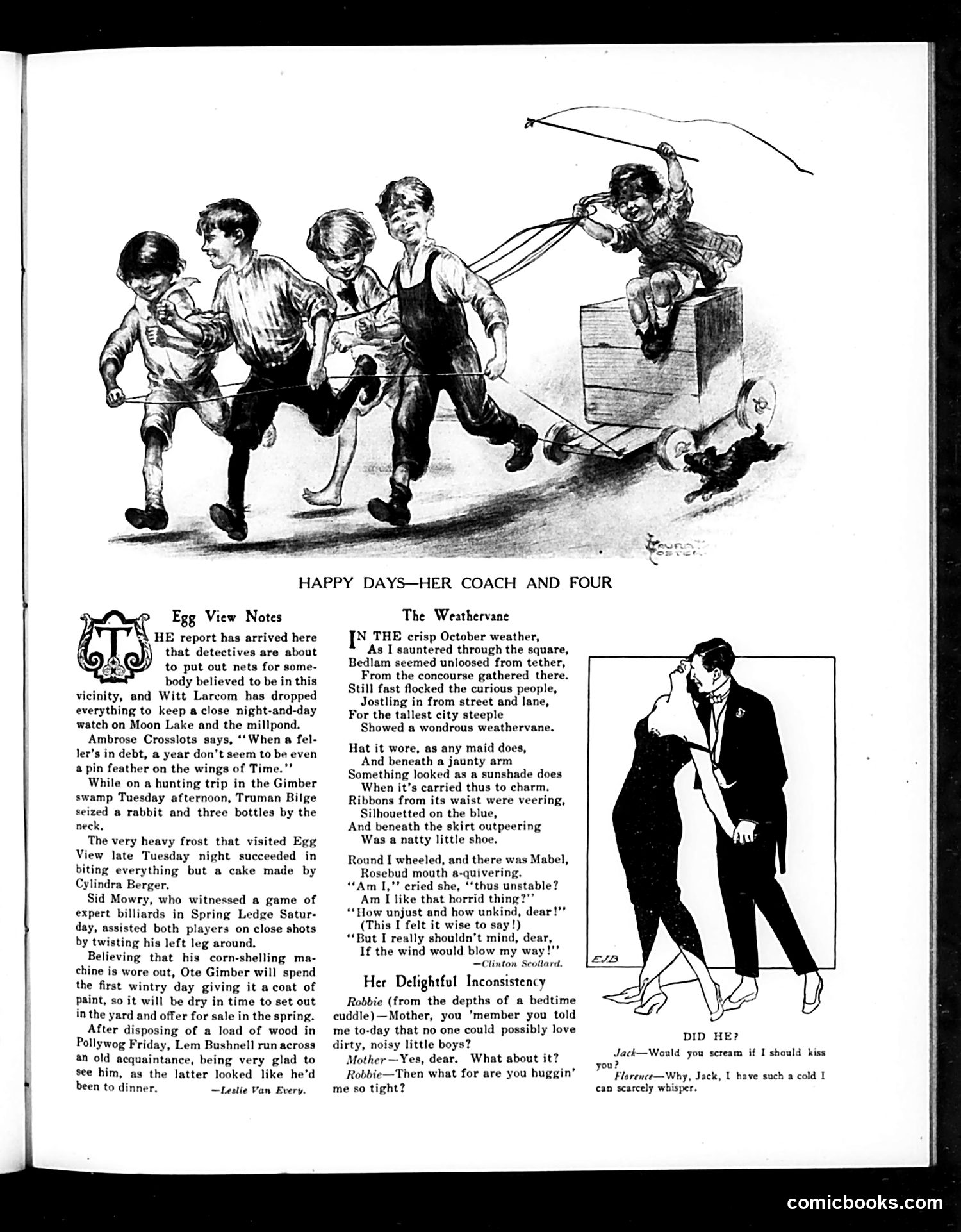
This page from *Judge* contains three separate humorous pieces typical of early 20th-century American satirical magazines: **"Happy Days—Her Coach and Four"** (top): A cartoon showing four boys pulling a girl in a wooden box like a coach-and-four carriage, with one boy wielding a whip. It's a playful visual pun on aristocratic luxury—children creating pretend grandeur from humble materials. **"Egg View Notes"** (left column): Rural gossip presented as humorous anecdotes about small-town characters and their mishaps—a recurring *Judge* feature poking gentle fun at country life and provincial eccentricity. **"The Weathervane"** (center): A poem by Clinton Scollard describing a flirtatious encounter where a woman atop a church weathervane is compared to an unstable romantic interest—period romantic wordplay. **"Her Delightful Inconsistency"** (bottom): Brief comic dialogues exploiting Victorian-era gender dynamics and courtship conventions—the humor relies on expected social behavior being subverted. The page exemplifies *Judge's* mix of visual comedy, rural satire, sentimental poetry, and romantic humor aimed at educated American audiences.
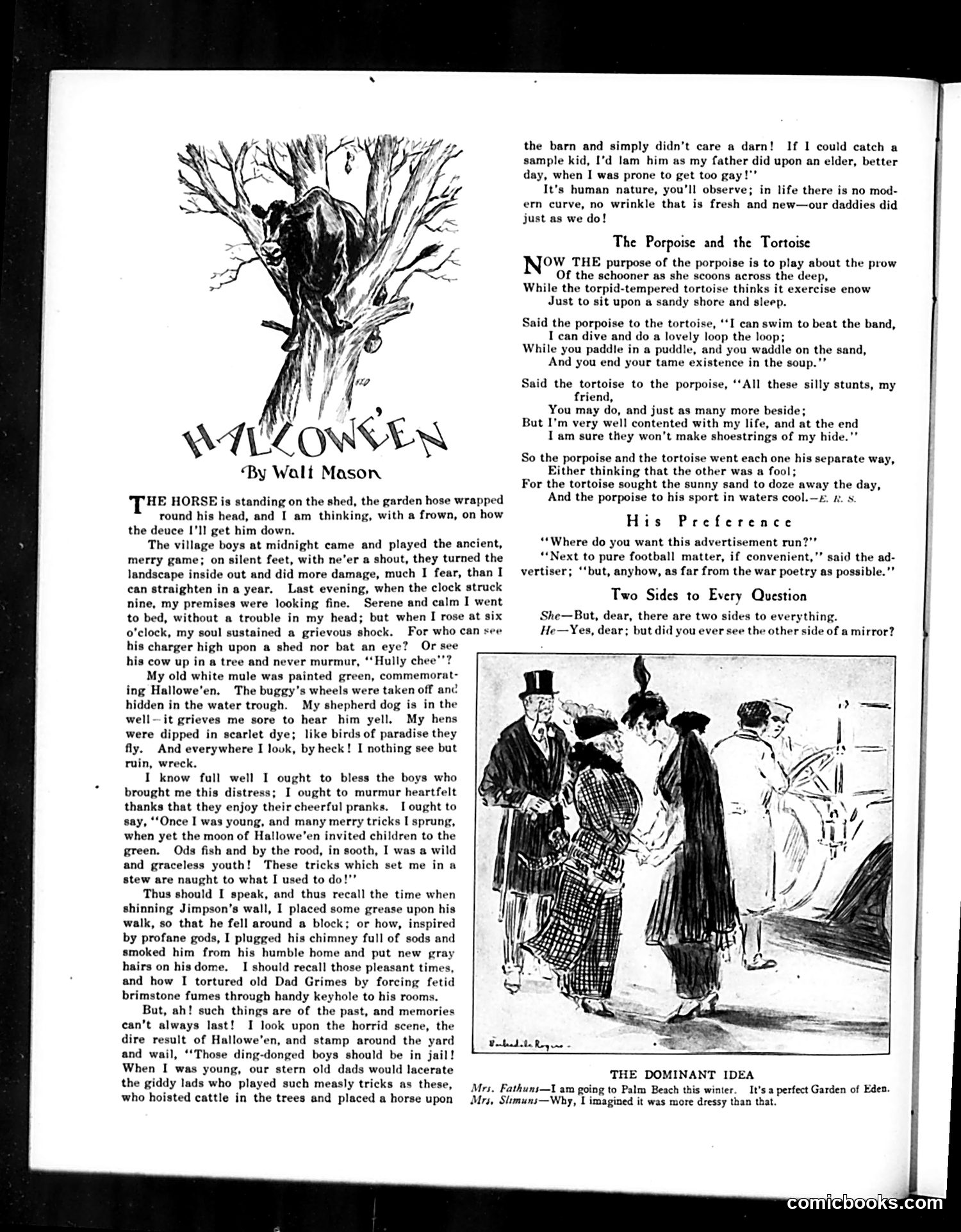
This page contains three distinct pieces of humor: **"Halloween" by Walt Mason** (main story): A farmer's comedic lament about village boys' Halloween pranks—painting his mule green, hiding his buggy wheels, dunking his dog, dyeing his hens. The satire lies in the tension between his frustration and the ironic moral lesson: he should accept the pranks gracefully since *he* committed similar mischief in his youth. The joke critiques hypocrisy—adults forget their own youthful rule-breaking when disciplining the next generation. **"The Porpoise and the Tortoise"** (fable): A moral tale contrasting the showy, energetic porpoise with the content, prudent tortoise. The tortoise refuses to compete with flashy displays, noting the porpoise's "silly stunts" won't prevent being turned into "shoestrings" (a darkly comic reference to animal processing). The satire gently mocks those who confuse activity with accomplishment. **"Two Sides to Every Question"** (small cartoon): A domestic quip—a wife notes everything has two sides; the husband makes a clever retort about mirrors having only one visible side. It's wordplay humor with no political content.
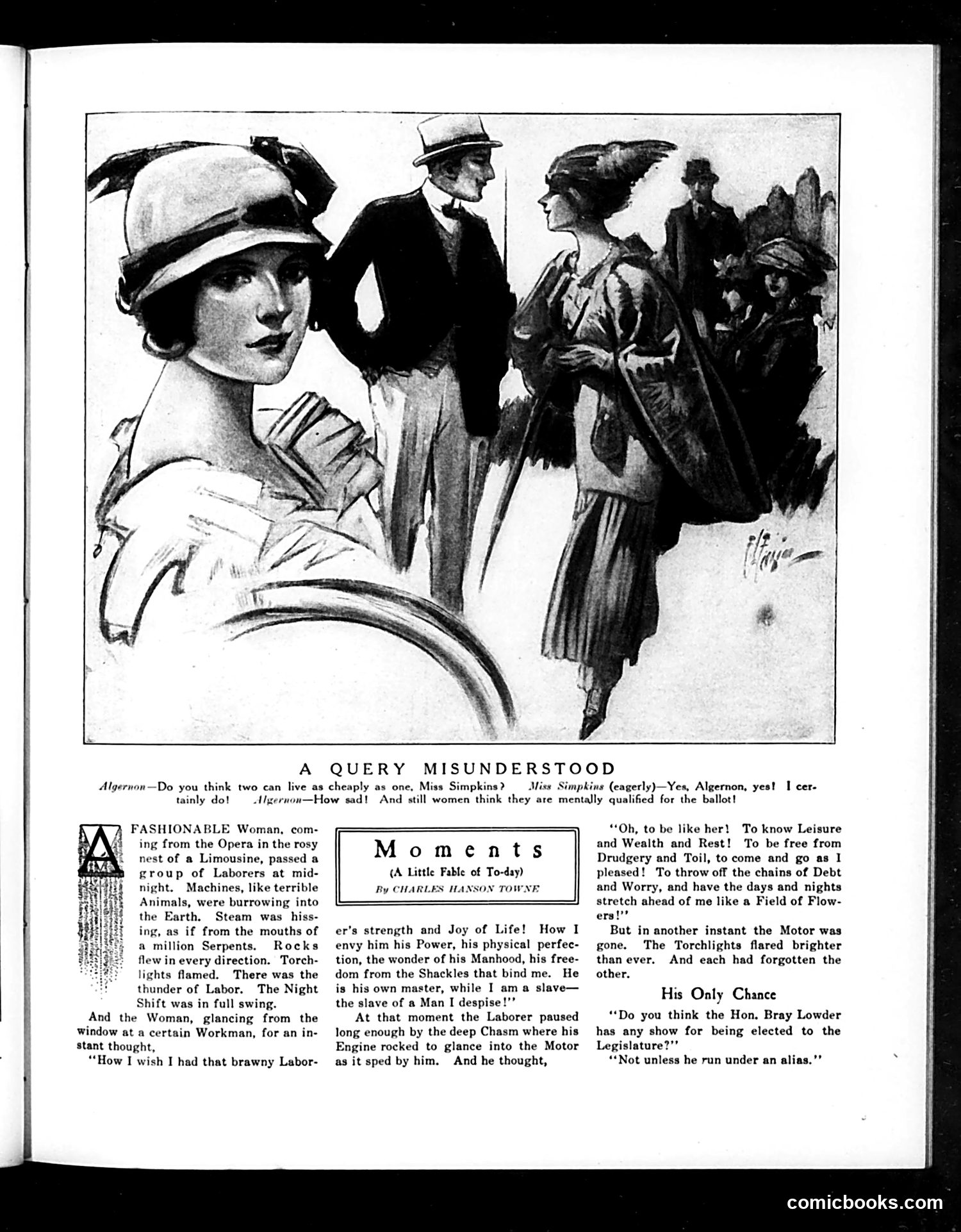
This page contains **three distinct satirical pieces**: 1. **"A Query Misunderstood"** (top): A brief comic dialogue mocking women's suffrage. A man asks if two can live as cheaply as one; a woman eagerly agrees. The caption sneers that women aren't mentally qualified to vote—the implication being she misunderstood his economic question as romantic interest, proving female political incompetence. 2. **"Moments"** (center, by Charles Hanson Towne): A sentimental irony contrasting a wealthy opera-goer and a night-shift laborer. Each envies the other's freedom—she wants his physical strength and independence; he wants her leisure and wealth. They pass unknowingly, each trapped by circumstance. 3. **"His Only Chance"** (bottom): A brief joke suggesting politician "Hon. Bray Lowder" can only win election by running under an assumed name—commentary on his unpopularity or questionable character. The page reflects early-20th-century attitudes: anti-suffrage sentiment, class commentary, and political cynicism.
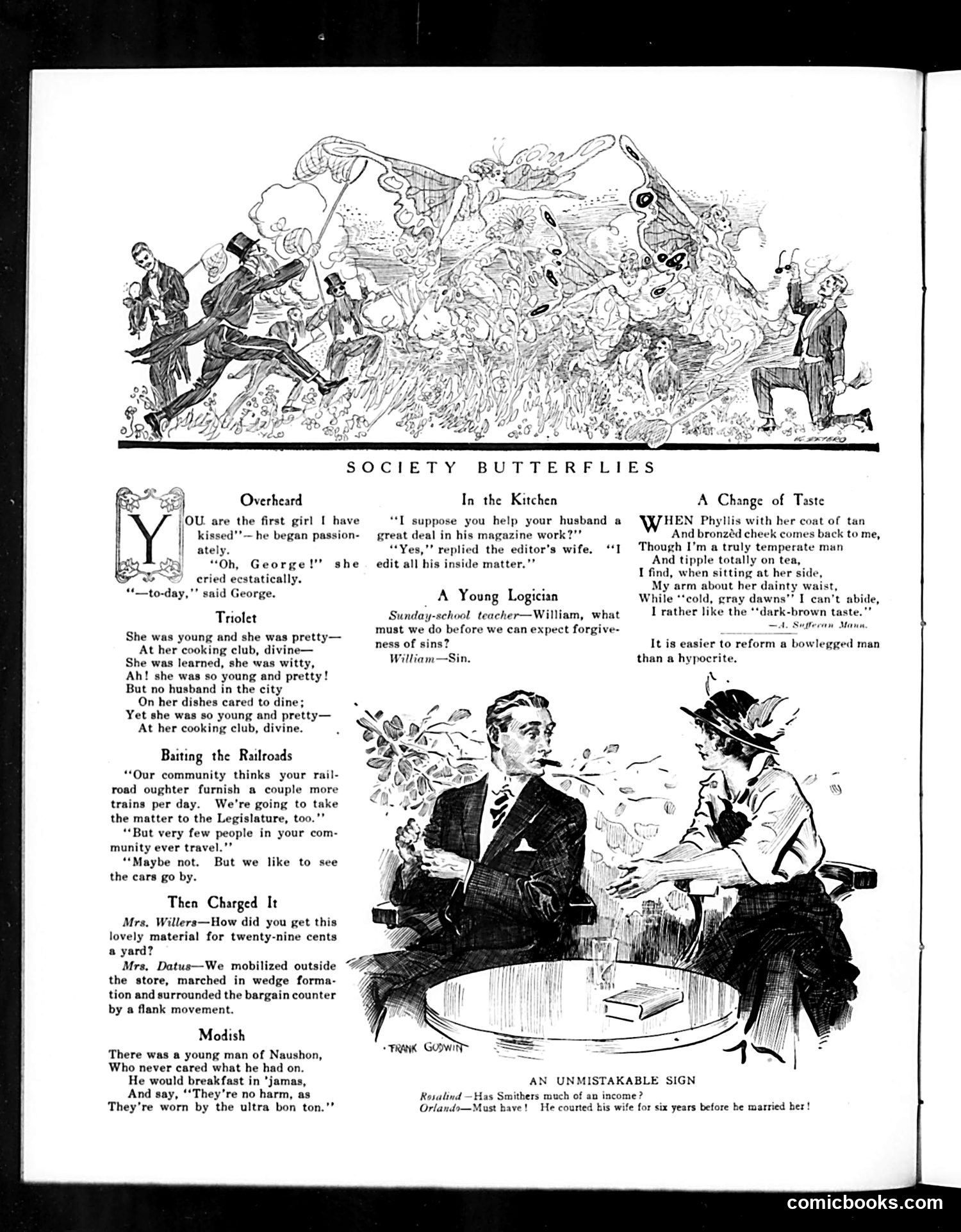
This page from *Judge* magazine contains light satirical humor targeting early 20th-century American social conventions and gender roles. **The cartoons mock:** - **"Overheard"**: A man's casual romantic dishonesty—kissing a woman "for the first time" daily. - **"Triolet"**: A skilled, educated woman who remains unmarried because men won't dine at her home despite her talents, satirizing how domestic ability mattered more than accomplishment. - **"Baiting the Railroads"**: Small-town residents demanding expensive railroad service they don't use, simply enjoying watching trains—poking fun at municipal entitlement. - **"Then Charged It"**: Women using military-style tactics to storm bargain counters, mocking consumerism and aggressive shopping behavior as quasi-warfare. - **"A Young Logician"**: Wordplay on religious instruction—a child's logical (but wrong) answer about sin. - **"An Unmistakable Sign"**: A man must be wealthy if he courted his wife six years before marriage—implying only financial security justifies such patience. The humor targets vanity, class pretension, and changing gender dynamics of the era.
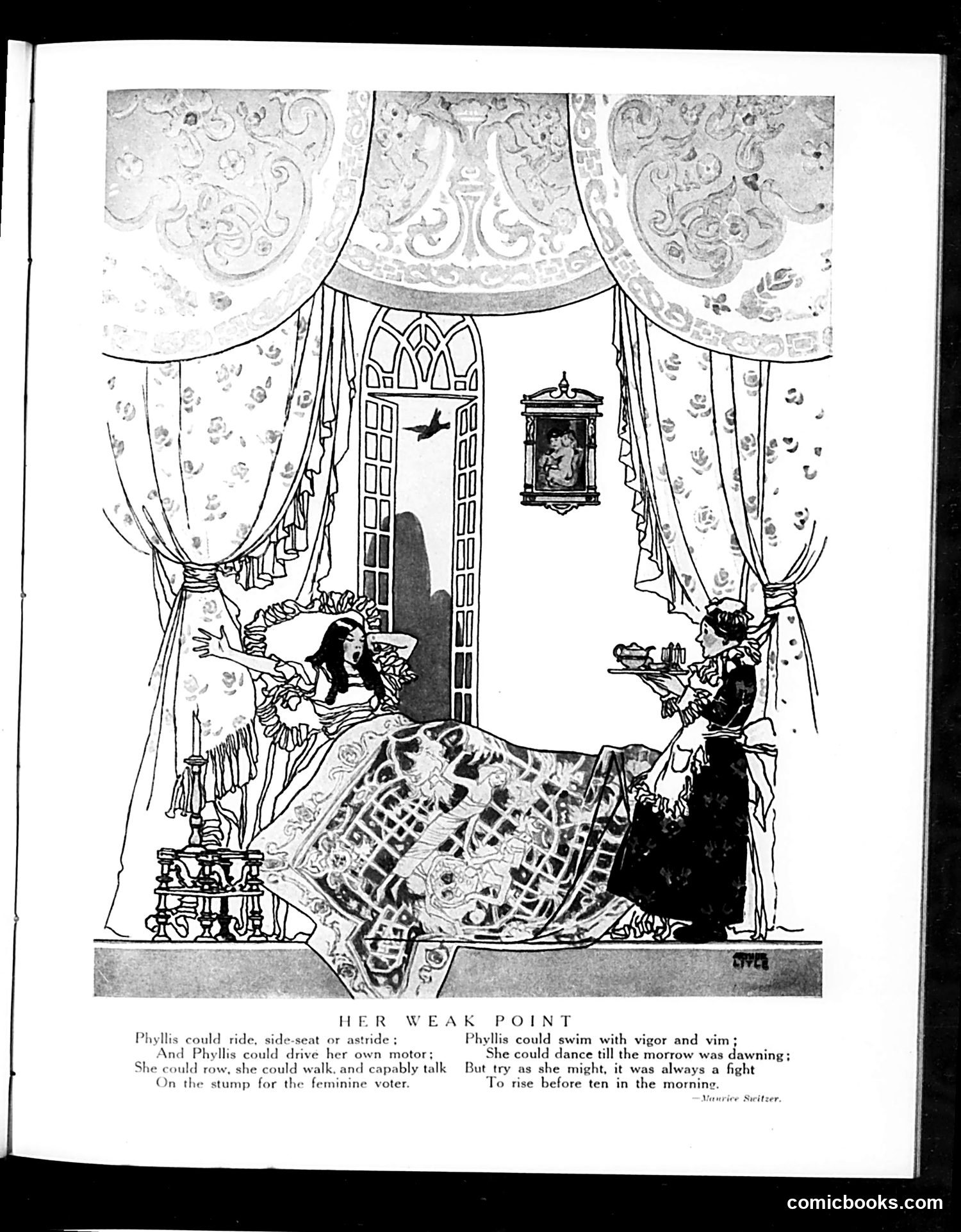
This illustration satirizes women's suffrage through the character Phyllis. The text lists her accomplishments—driving a motor, swimming, dancing, and public speaking on women's voting rights—presenting her as capable and modern. However, the caption's punchline reveals her "weak point": she cannot rise before 10 AM. The satire mocks female suffrage advocates by suggesting that despite women's demonstrated competence in traditionally male activities, they possess a fatal character flaw—laziness or lack of discipline—that disqualifies them from voting. This represents common anti-suffrage propaganda from the early 20th century, which questioned women's fitness for civic participation by emphasizing alleged personal deficiencies rather than engaging substantive arguments about equality.
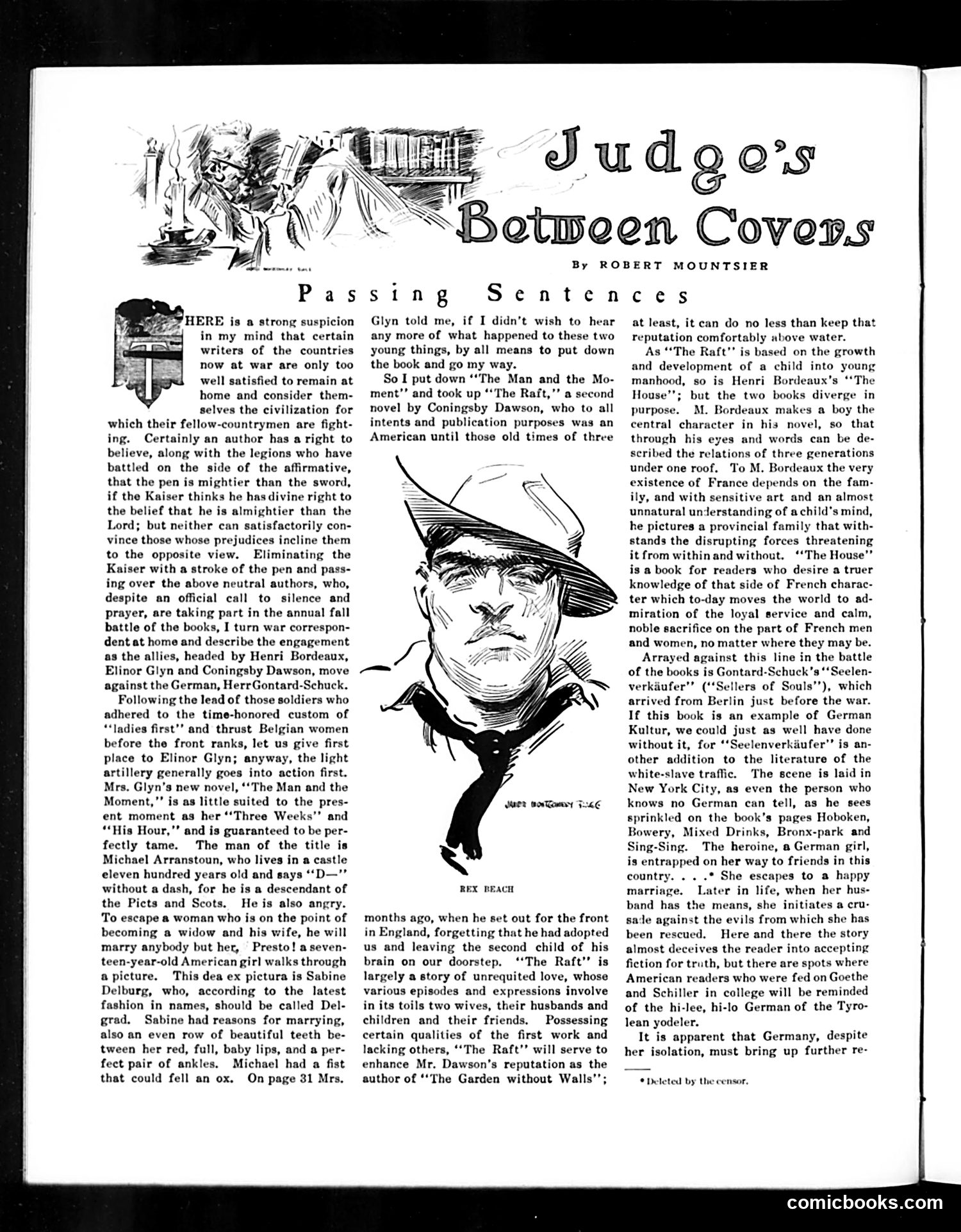
This is a literary review column by Robert Mountsier critiquing three war-era novels published during World War I. The piece discusses books by British/American authors Elinor Glyn, Coningsby Dawson, and Henri Bordeaux, comparing their treatments of contemporary themes. The review opens with commentary on writers who remain home during wartime, debating whether "the pen is mightier than the sword." The cartoon depicts a German military figure (likely representing German literature or culture), positioned as the antagonist against Allied writers. The column humorously dismisses Glyn's romance novel "The Man and the Moment" as frivolous wartime reading, praises Dawson's "The Raft" as adequate, and highlights Bordeaux's exploration of French family life as thematically significant. The satire reflects Judge magazine's pro-Allied stance and skepticism toward escapist entertainment during WWI.
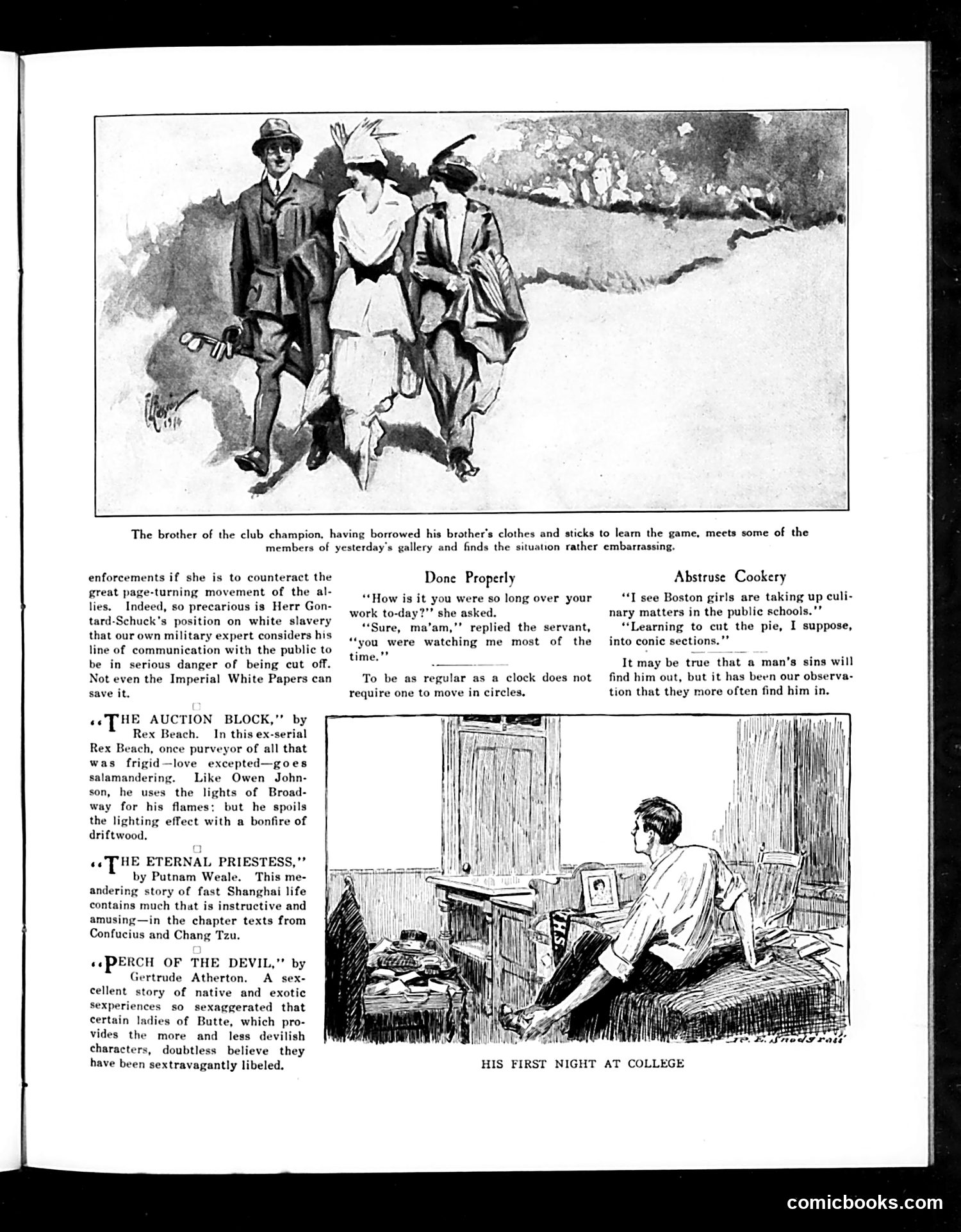
This page contains multiple satirical pieces typical of early 20th-century humor: **Top Cartoon:** Shows a novice golfer (brother of a club champion) embarrassed after borrowing his brother's equipment and clothes to learn the game. The satire mocks social pretension—attempting to pass oneself off as skilled in an exclusive sport. **Book Reviews Section:** Sarcastic critiques of contemporary novels by Rex Beach, Putnam Weale, and Gertrude Atherton. The humor relies on wordplay: "sex-cellent," "sexperiences," "sexaggerated," and "sextravagantly" mock Atherton's sensationalized depiction of Butte, Montana society women. **Comic Vignettes:** Brief humorous exchanges mocking workplace dynamics ("Done Properly") and Boston's educational trends ("Abstruse Cookery"—jokes about teaching calculus in cooking classes). **Bottom Illustration:** "His First Night at College" shows a young man's lonely dormitory scene, likely satirizing college life expectations versus reality. The page targets upper-class pretension, literary excess, and social aspirations typical of Judge's satirical voice.
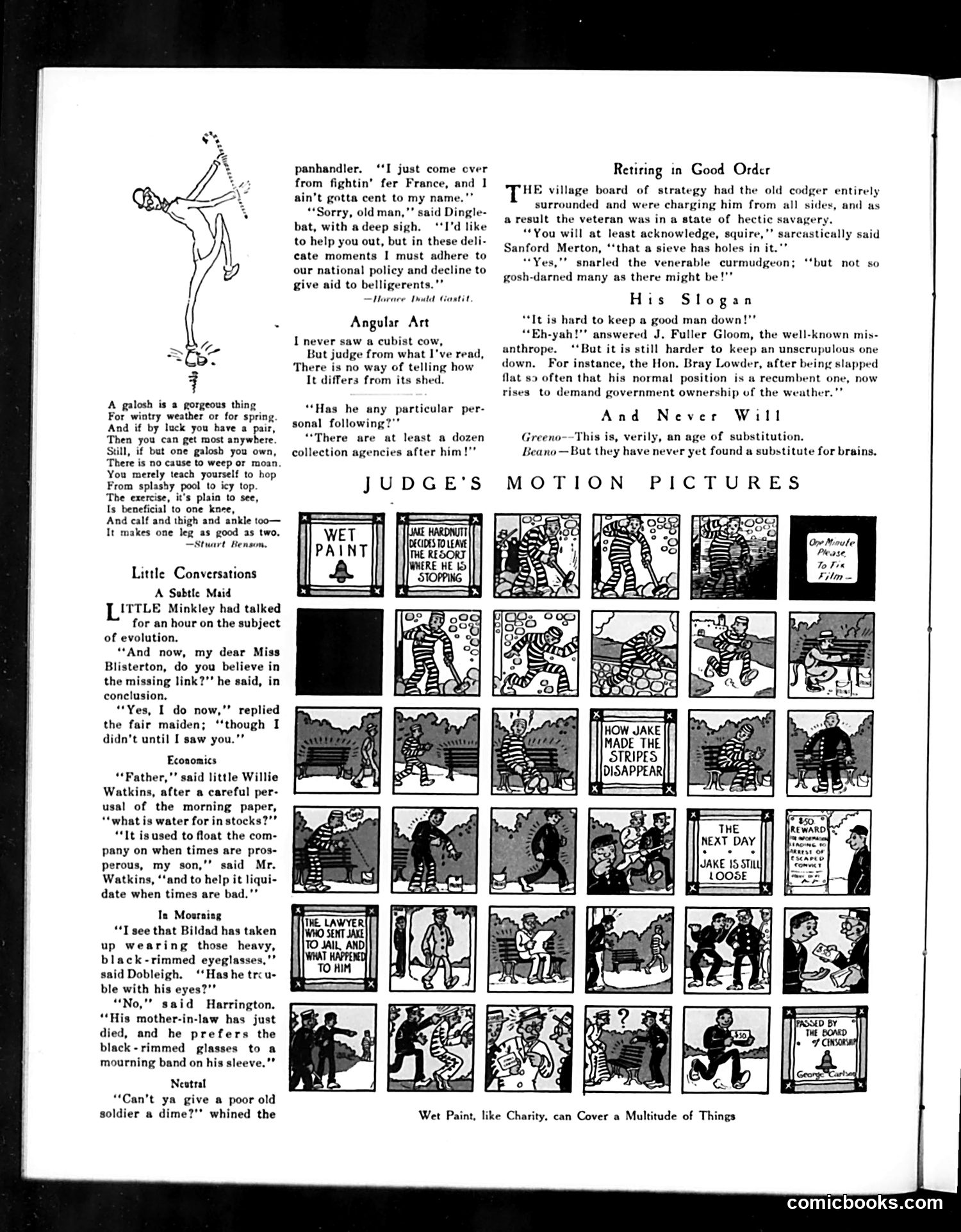
This page from the satirical magazine **Judge** contains several short humorous pieces mocking early 20th-century social and political topics: **"Retiring in Good Order"** satirizes a stubborn old man resisting change—the village board represents modernizing forces, while he represents rigid tradition. His complaint about sieves having "too many holes" is absurdist humor mocking resistance to inevitable progress. **"His Slogan"** jokes about political corruption and government overreach, referencing "Hon. Bray Lowder" (likely a generic politician name) as an example of how even repeatedly discredited bad actors keep rising to power and making absurd demands like "government ownership of the weather." **Other pieces mock**: cubism in art ("Angular Art"), war profiteering and neutrality policies (the panhandler joke), marital dynamics, and economic manipulation ("water" in stocks as fraudulent inflation). The **"Judge's Motion Pictures"** comic strip appears to be unrelated sequential art. The humor relies on recognizing contemporary concerns: artistic modernism, post-WWI disillusionment, political cynicism, and economic anxiety.
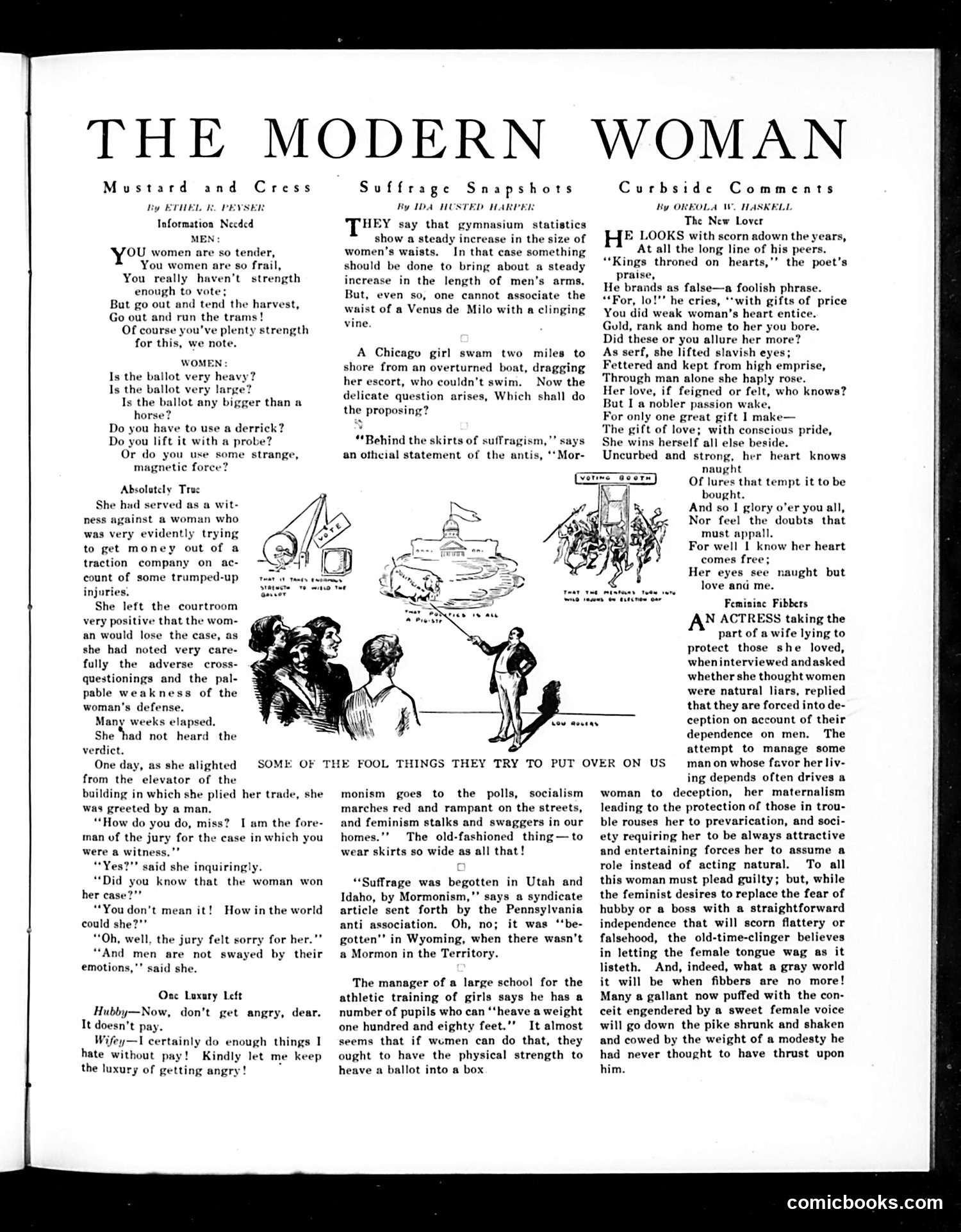
This page satirizes arguments against women's suffrage through three columns of commentary and cartoons. **Left column** ("Mustard and Cress"): Uses ironic contradiction—opponents claim women are too frail to vote, yet strong enough for farm work and operating trams. Women respond with mock-serious questions about the ballot's supposed weight and size, exposing the absurdity of anti-suffrage rhetoric. **Center column** ("Suffrage Snapshots"): Contains anecdotes mocking both women and anti-suffrage logic. One story reveals that a jury—supposedly rational men—voted emotionally (sympathetically) for a woman in a legal case, contradicting claims that only men think rationally. **Right column** ("Curbside Comments"): Poetry celebrating a "new lover" who values women's independence and inner worth rather than material gifts, contrasting with historical male dominance. The cartoons show suffragists and the social upheaval opponents feared. Overall, the page defends women's suffrage by ridiculing anti-suffrage arguments as logically inconsistent and emotionally hypocritical.
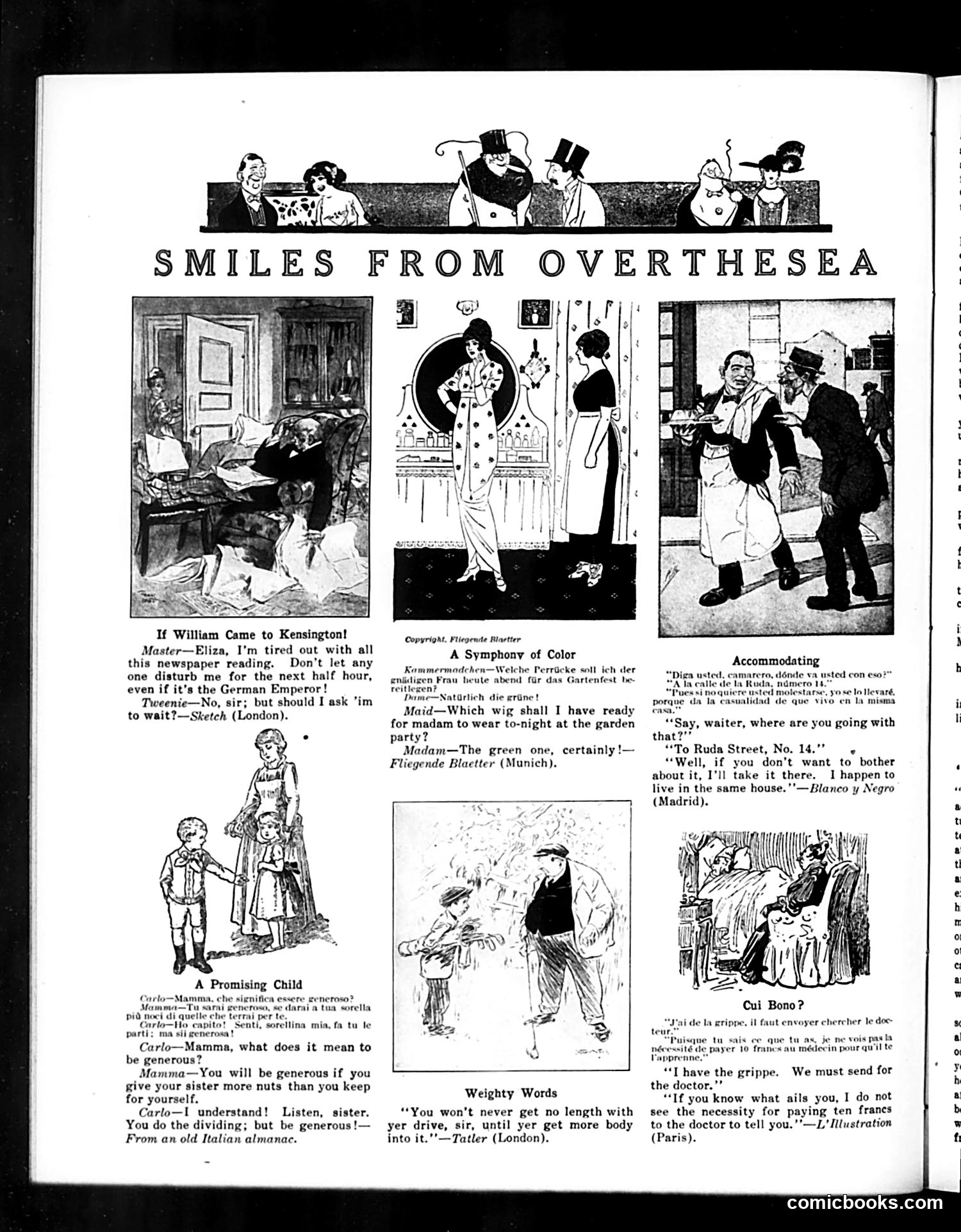
This page collects international humor reprinted from European satirical magazines. Each cartoon presents domestic or class-based comedy: **"If William Came to Kensington"** jokes about British anxiety over German military power (likely referencing pre-WWI tensions), with a servant's cheeky suggestion that even the German Emperor might be kept waiting. **"A Promising Child"** presents Italian family humor about a boy's clever—if self-serving—interpretation of generosity. **"A Symphony of Color"** mocks a wealthy woman's vanity through a maid's exchange about wigs for a garden party. The remaining items satirize working-class or domestic situations: golf instruction, a waiter's convenient residence near a delivery address, and a wife's skepticism about paying a doctor when she already knows her husband's ailment. The page exemplifies Judge's practice of republishing European comic material to entertain American readers with international perspectives on universal human follies.
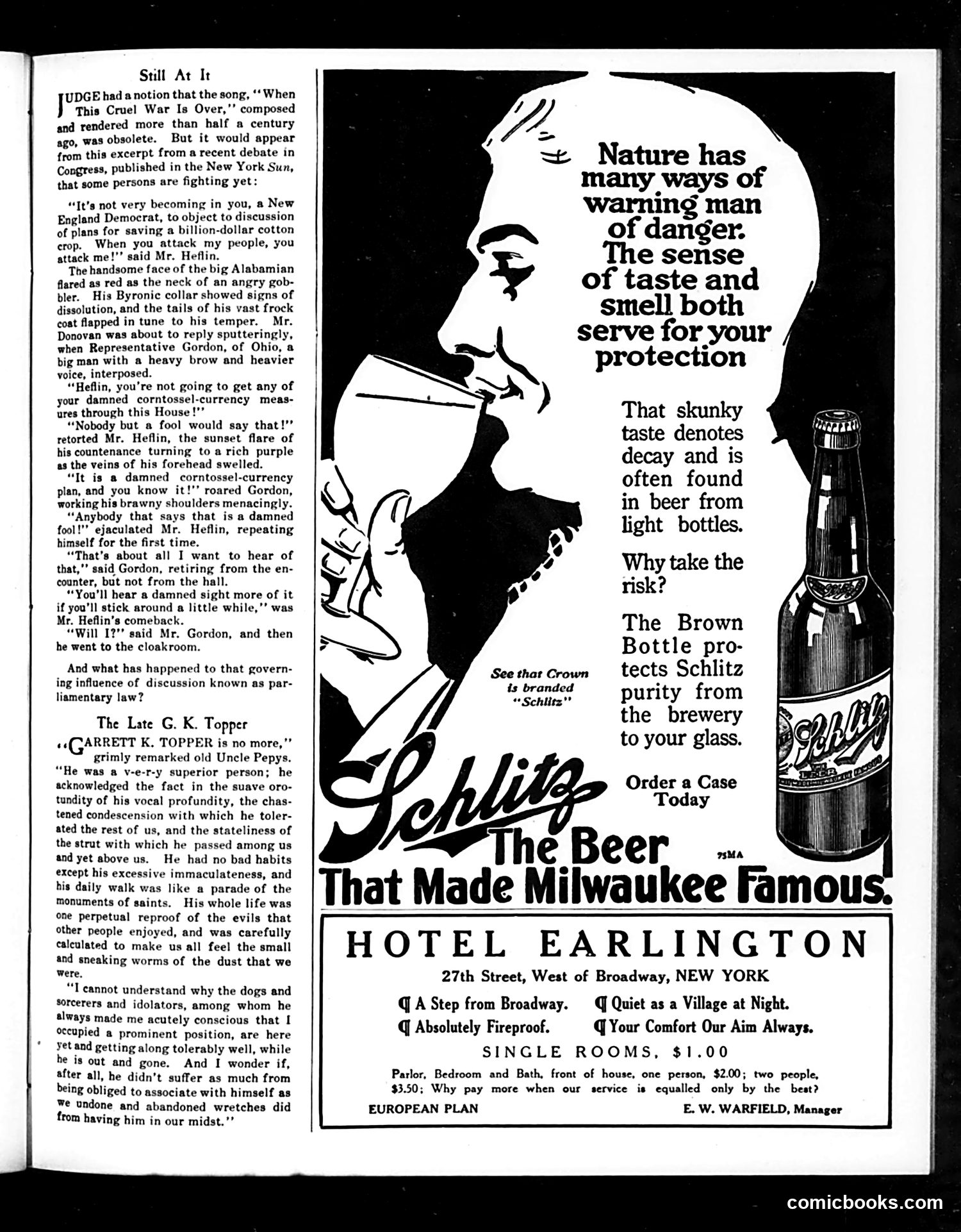
This page contains two distinct pieces: **"Still At It"** (left column): A satirical commentary on Congressional conduct. The text excerpts a heated floor debate between Representatives Heflin (Alabama), Donovan, and Gordon (Ohio) over agricultural policy—specifically a "corntossel-currency" cotton-saving plan. The satire mocks that these congressmen are literally fighting and cursing each other like combatants in a war, despite parliament's governing rules designed to prevent such conduct. The title references the Civil War-era song "When This Cruel War Is Over," suggesting Congress is still engaged in destructive regional conflict rather than productive governance. Judge's point: parliamentary decorum has completely broken down. **Right side**: A Schlitz beer advertisement exploiting fears about product purity, warning that "skunky taste" in light-bottled beer indicates decay, while Schlitz's brown bottle protects quality. This was contemporary advertising strategy. The page also includes a brief character sketch, "The Late G. K. Topper," mocking a deceased superior, sanctimonious person.
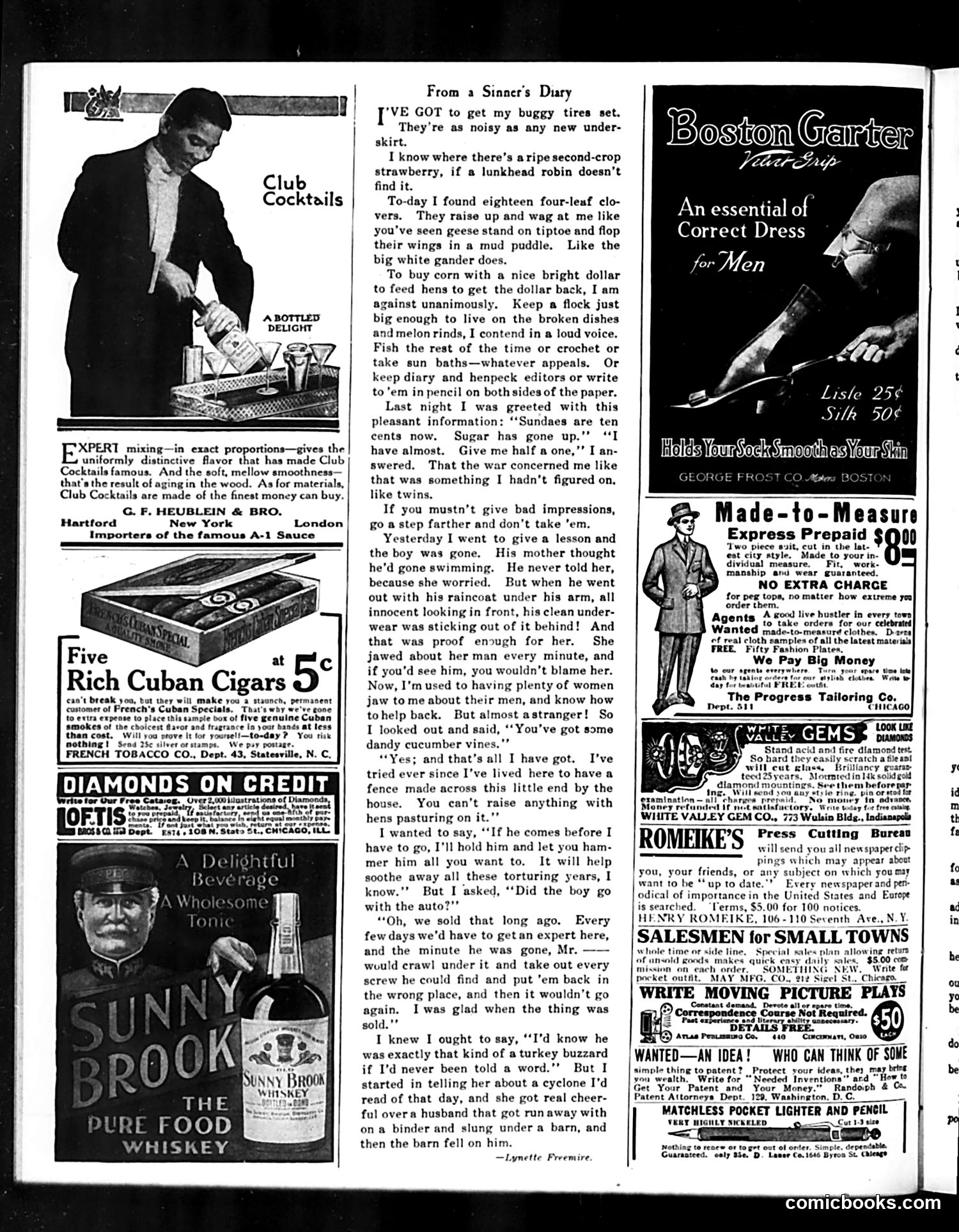
This page features a humorous personal essay masquerading as a "sinner's diary"—a satirical persona making light observations about rural life and domestic frustrations. The unnamed narrator (likely female, given the name "Lynette Freemire" credited at bottom) presents petty grievances and mundane observations in mock-serious tone: noisy car tires, finding clovers, the economics of keeping chickens, rising sugar prices during wartime. The satire targets small-town mentality and domestic complaints. A key anecdote mocks a neighbor wife's chronic nagging about her useless husband, culminating darkly when the narrator tries cheering her up by mentioning a cyclone death—revealing the wife's own marriage misery. The piece satirizes both marital discord and the era's casual, dark humor about disasters. The surrounding advertisements (whiskey, cigars, tailoring services) reflect 1910s-1920s Judge readership: men of modest means seeking self-improvement through consumer goods.
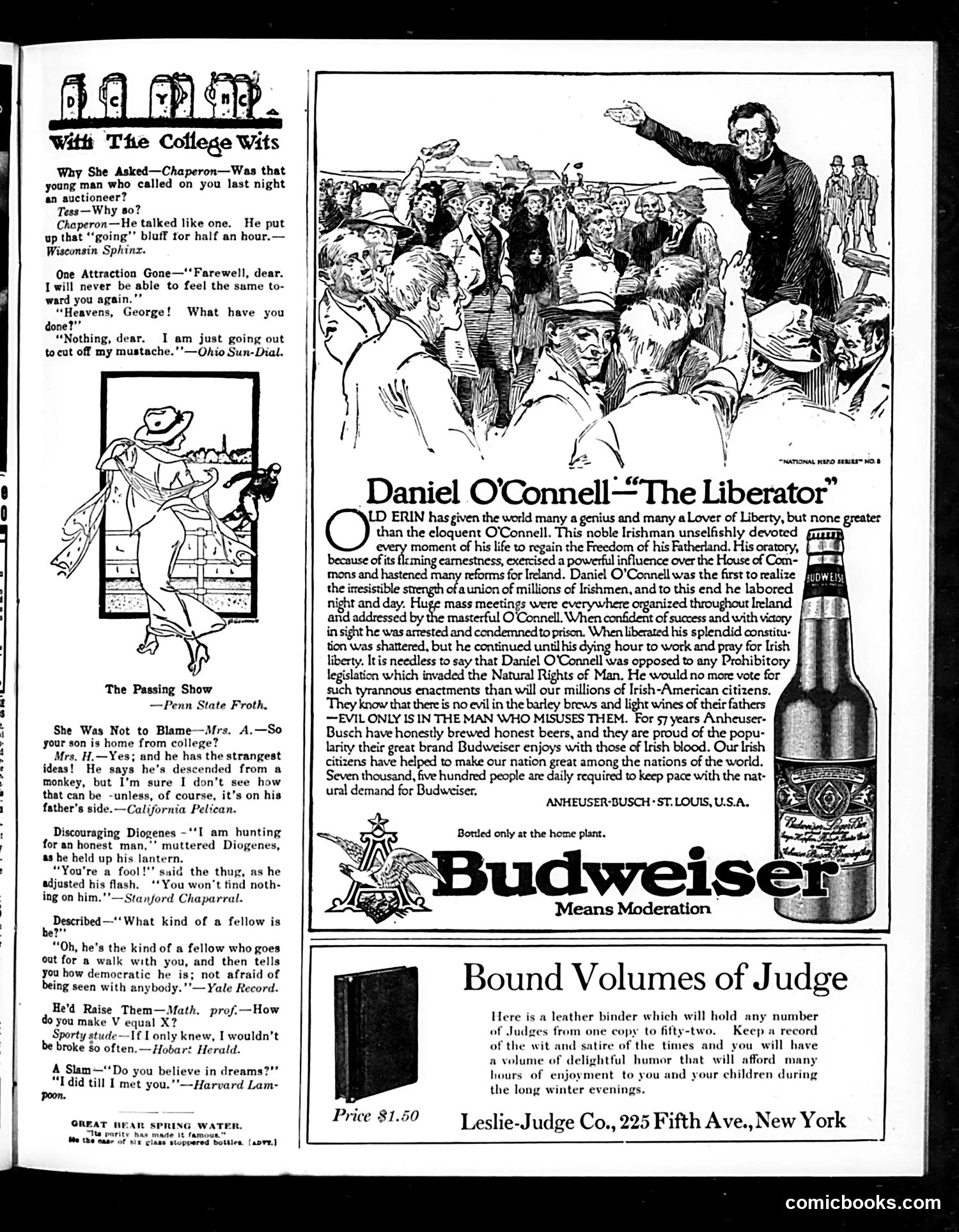
This page mixes college humor with advertising. The left side features brief jokes from college newspapers about dating, evolution, and honesty—typical early-20th-century campus wit. The dominant content is a large **Budweiser advertisement** disguised as editorial content, featuring Daniel O'Connell, the famous Irish nationalist leader and orator. The ad cleverly associates O'Connell with beer consumption by arguing he opposed "Prohibitory legislation" and believed in "Natural Rights of Man"—implying the right to drink alcohol. The text explicitly states O'Connell "would no more vote for such tyrannous enactments" than Irish-Americans would, attempting to link Irish heritage and cultural identity to Budweiser consumption. This is propaganda advertising exploiting ethnic identity during the Prohibition era debates. The page also advertises bound volumes of Judge itself at $1.50—a product for preserving satirical humor.
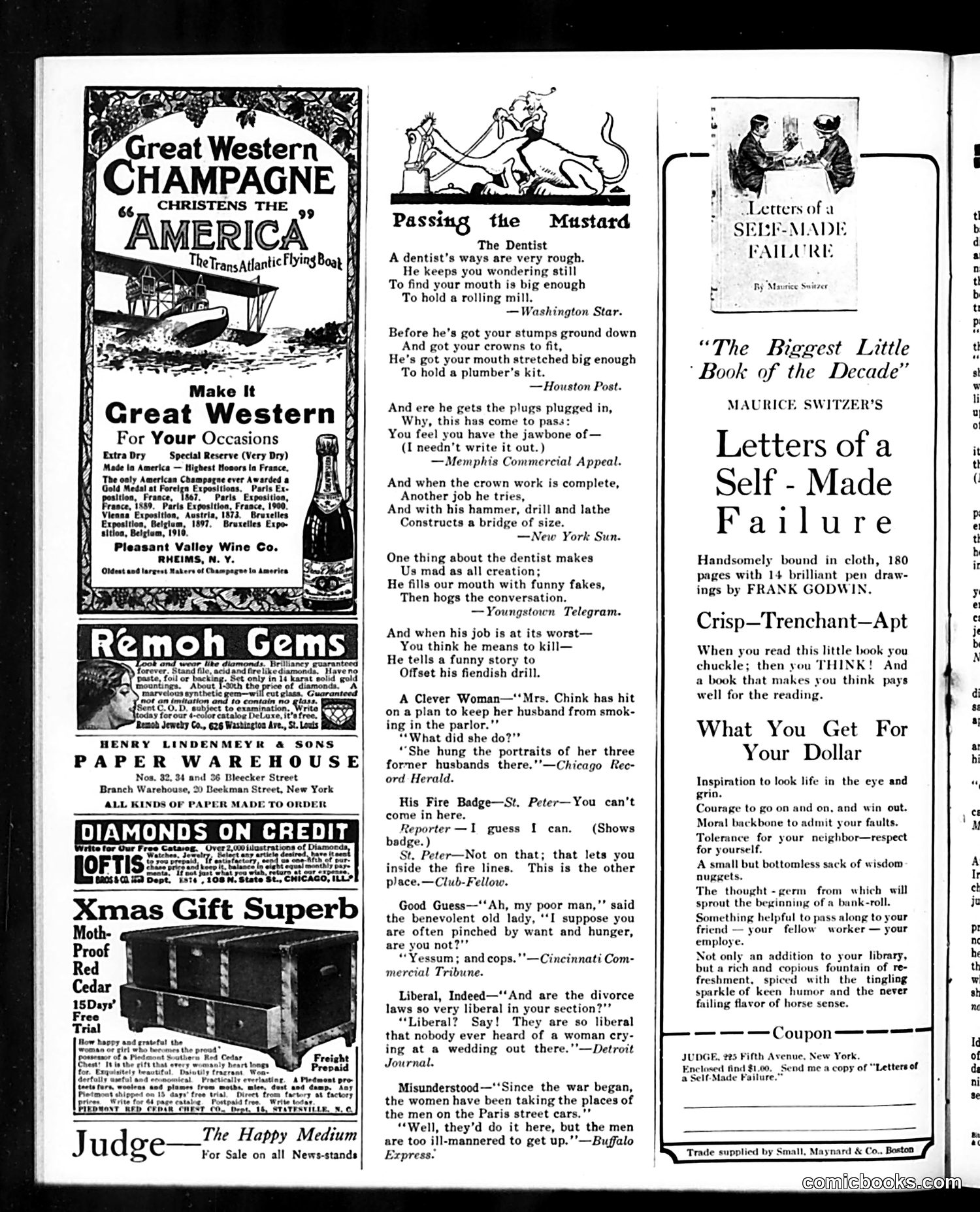
This page features **humorous poetry about dentists**, a popular satirical subject. Multiple newspapers (Washington Star, Houston Post, Memphis Commercial Appeal, New York Sun, Youngstown Telegram) contributed verses mocking dentists' rough methods, stretched-open patient mouths, and tendency to tell jokes while drilling—offsetting "his fiendish drill." Below are brief **joke vignettes**: a woman keeping her husband from smoking by displaying portraits of her three ex-husbands; a reporter's fire badge proving useless in the afterlife; a beggar pinched by both poverty and police; and observations about liberal divorce laws and women replacing men on Paris streetcars. The page is primarily **comic filler and advertising** for champagne, paper warehouses, diamonds, cedar chests, and the book "Letters of a Self-Made Failure." The humor is gentle workplace satire typical of early 20th-century American comedy magazines.
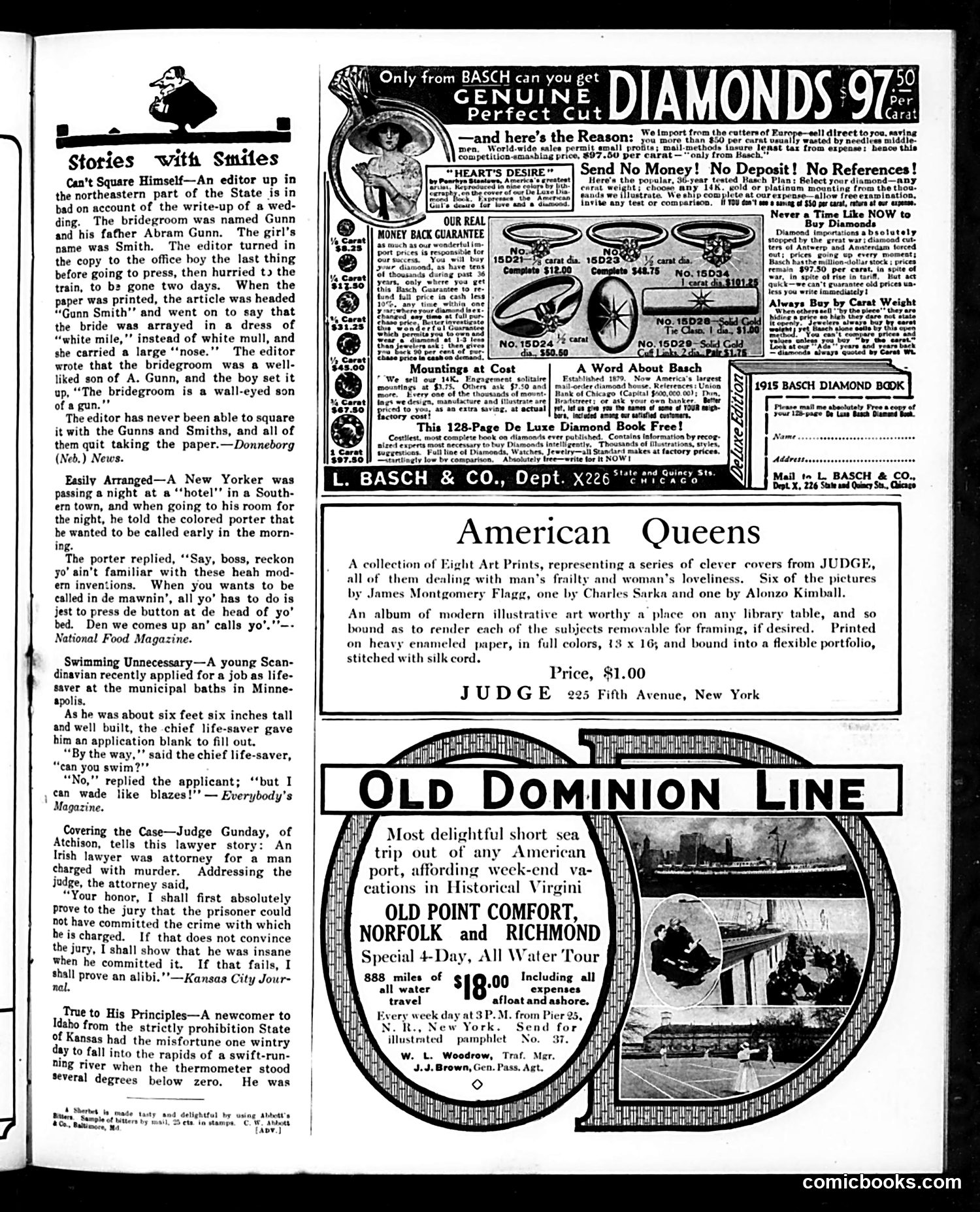
This is primarily a **page of humorous short anecdotes** ("Stories with Smiles") plus advertising, rather than editorial cartooning. The stories are gentle, non-political jokes about everyday mishaps: - A small-town editor's typographical errors that offend a wedding party (bride in "white mile" instead of mull; groom described as "wall-eyed") - A Southern porter's misunderstanding about hotel call buttons - A tall Scandinavian who can "wade like blazes" but can't swim - An Irish lawyer's absurd legal strategy for defending a murder charge The **satire targets** include bureaucratic incompetence, regional dialect humor (popular in the era), and professional bumbling—all genteel comedy for middle-class readers. The rest is **period advertising**: Basch diamonds ($0.97 per carat), the Old Dominion Line steamship tours, and American Queens art prints. These ads reveal what Judge's readers valued: luxury goods, leisure travel, and cultural refinement. There's **no political content** on this page.
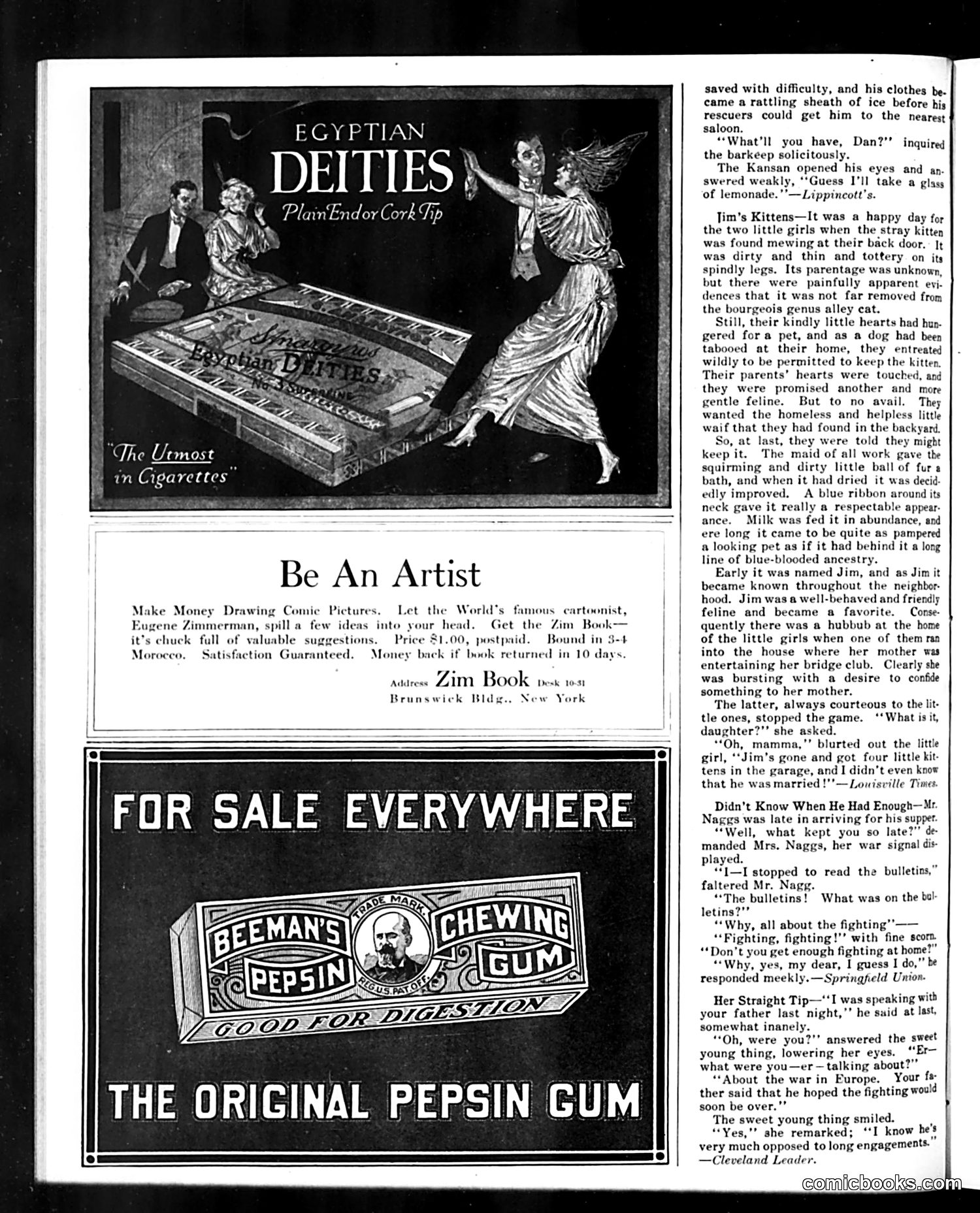
This page is primarily **advertising and filler content** rather than political satire. The main advertisements are: 1. **Egyptian Deities cigarettes** — a product ad using classical imagery 2. **"Be An Artist" — promoting Eugene Zimmerman's cartoon instruction book** ("Zim Book"), offering to teach cartooning for profit 3. **Beeman's Pepsin Chewing Gum** — a digestive aid product The right column contains several **humorous short stories** unrelated to politics: anecdotes about a freezing Kansan requesting lemonade, two girls adopting a stray cat named "Jim" (who turns out to be male and produces kittens), and domestic comedy sketches about Mr. Naggs and war-related dinner conversation. These are lighthearted filler pieces typical of humor magazines of this era — gentle domestic and absurdist humor with no apparent satirical political content. The page reflects Judge's function as entertainment and advertising vehicle rather than serious political commentary.
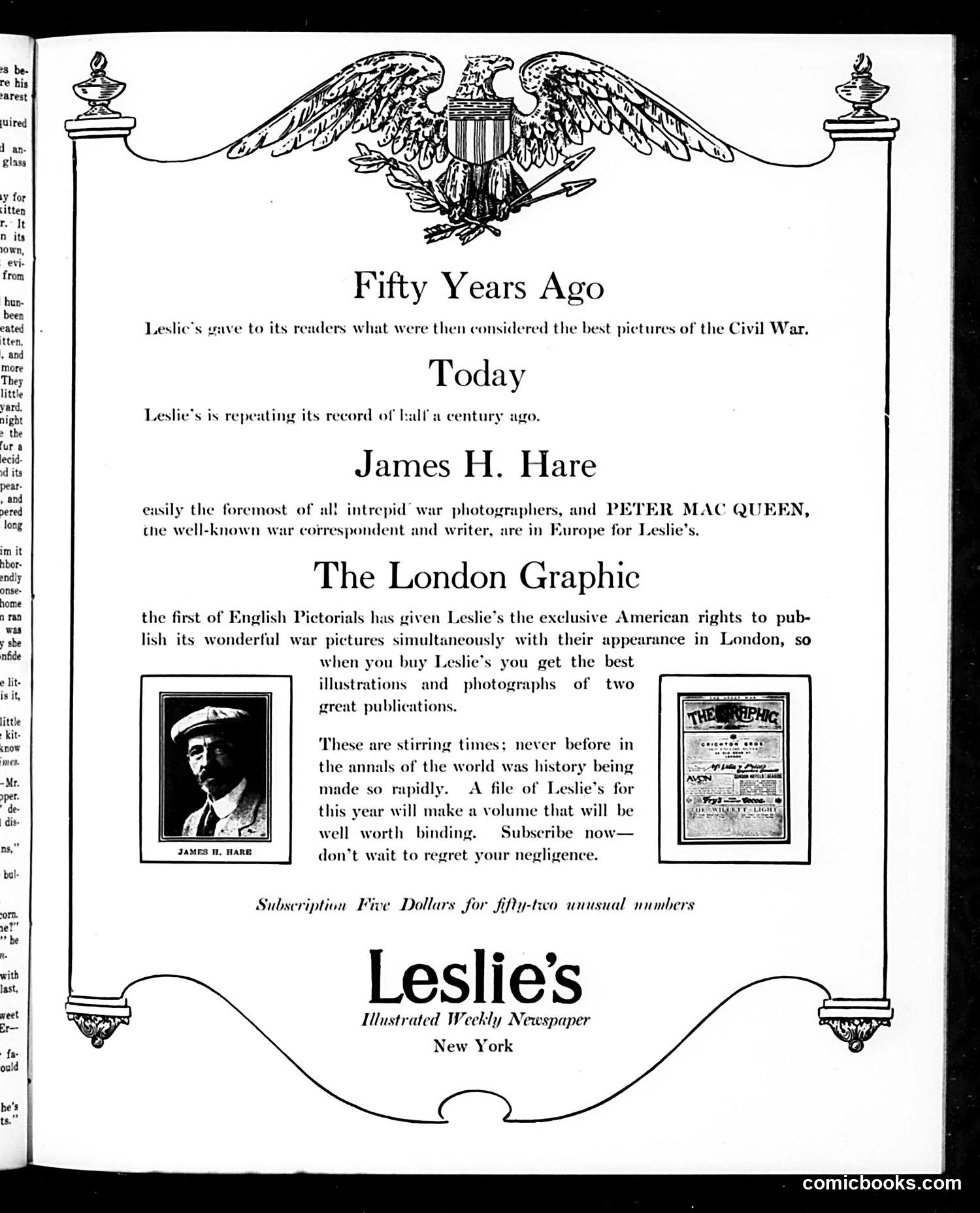
This is primarily an **advertisement**, not a political cartoon. It's a subscription pitch for *Leslie's Illustrated Weekly Newspaper* promoting their coverage of what appears to be **World War I** (referenced as "these stirring times"). The page draws a parallel: fifty years prior, *Leslie's* had published the best Civil War photographs; now they're repeating this feat with war correspondent James H. Hare and writer Peter Mac Queen reporting from Europe. The text emphasizes *Leslie's* has exclusive American rights to publish images from *The London Graphic* simultaneously with London publication. The layout includes portraits of Hare and a sample *London Graphic* cover. The appeal is to readers wanting historical documentation of rapidly-unfolding events—positioning *Leslie's* as the authoritative pictorial record of the war, valuable enough to bind into volumes. **No satire is present here**—it's straightforward marketing leveraging the magazine's historical credibility and exclusive access.
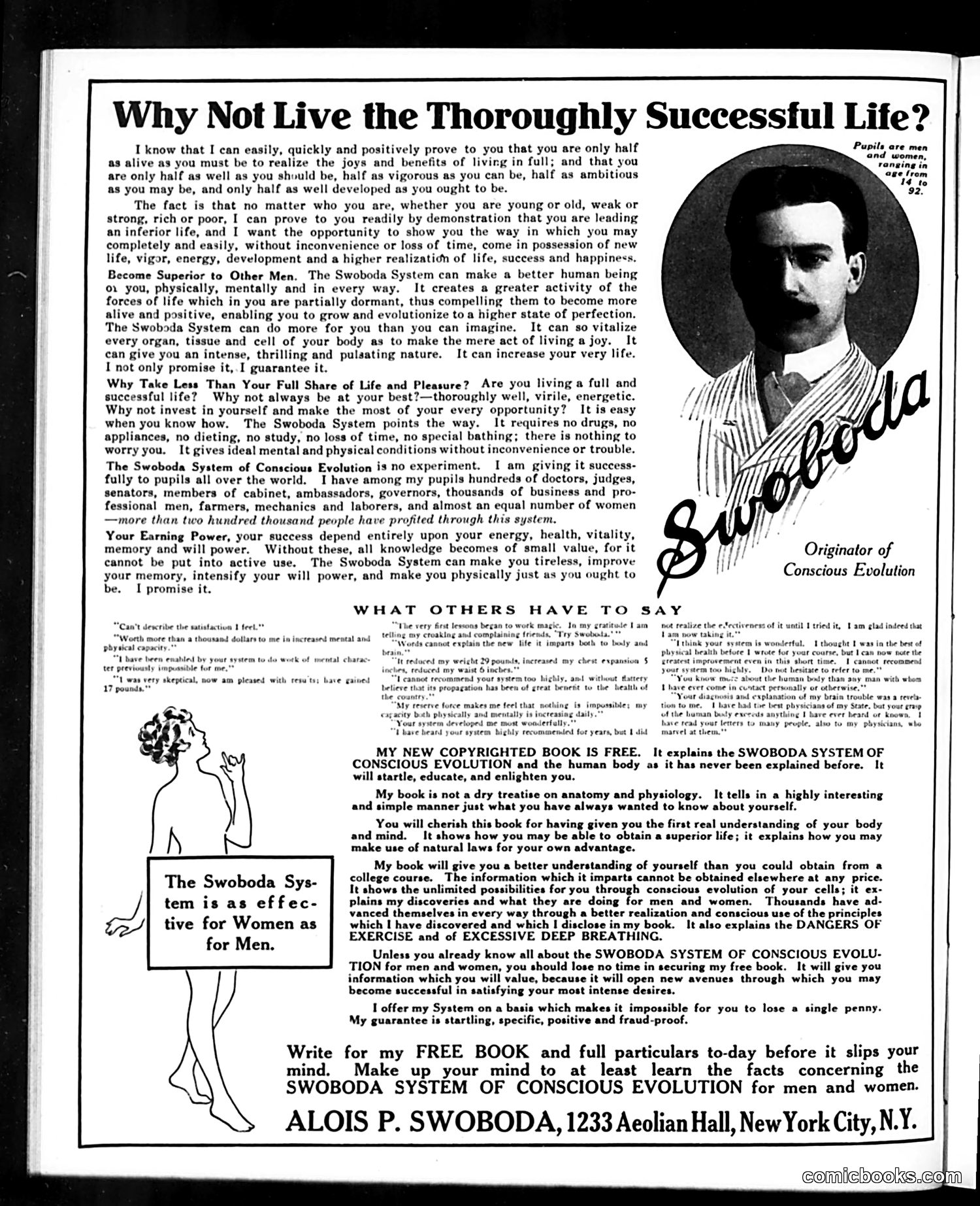
This page is **primarily a full-page advertisement** for the "Swoboda System of Conscious Evolution," a self-improvement mail-order course offered by Alois P. Swoboda of New York City. The content uses grandiose pseudoscientific claims typical of early 20th-century wellness fraud: Swoboda promises to make customers "half as alive" again, improve vitality, energy, and earning power through unnamed methods requiring "no drugs, no appliances, no dieting, no study." He cites hundreds of satisfied customers (doctors, judges, senators, farmers) as testimonials. The satirical element—if this ran in *Judge*, a humor magazine—likely lies in the **absurdity and desperation** of such claims. The testimonials quoted ("I gained 17 pounds") are vague and potentially fabricated. The offer of a "FREE BOOK" is classic direct-mail marketing targeting people's anxieties about health, success, and vitality. **No specific political figures or events are referenced.** This is social satire aimed at gullible consumers and predatory self-help schemes, a recurring target of American humor publications.