
Judge, 1914-10-31 · page 12 of 24
Judge — October 31, 1914 — page 12: what you’re looking at
What you’re looking at
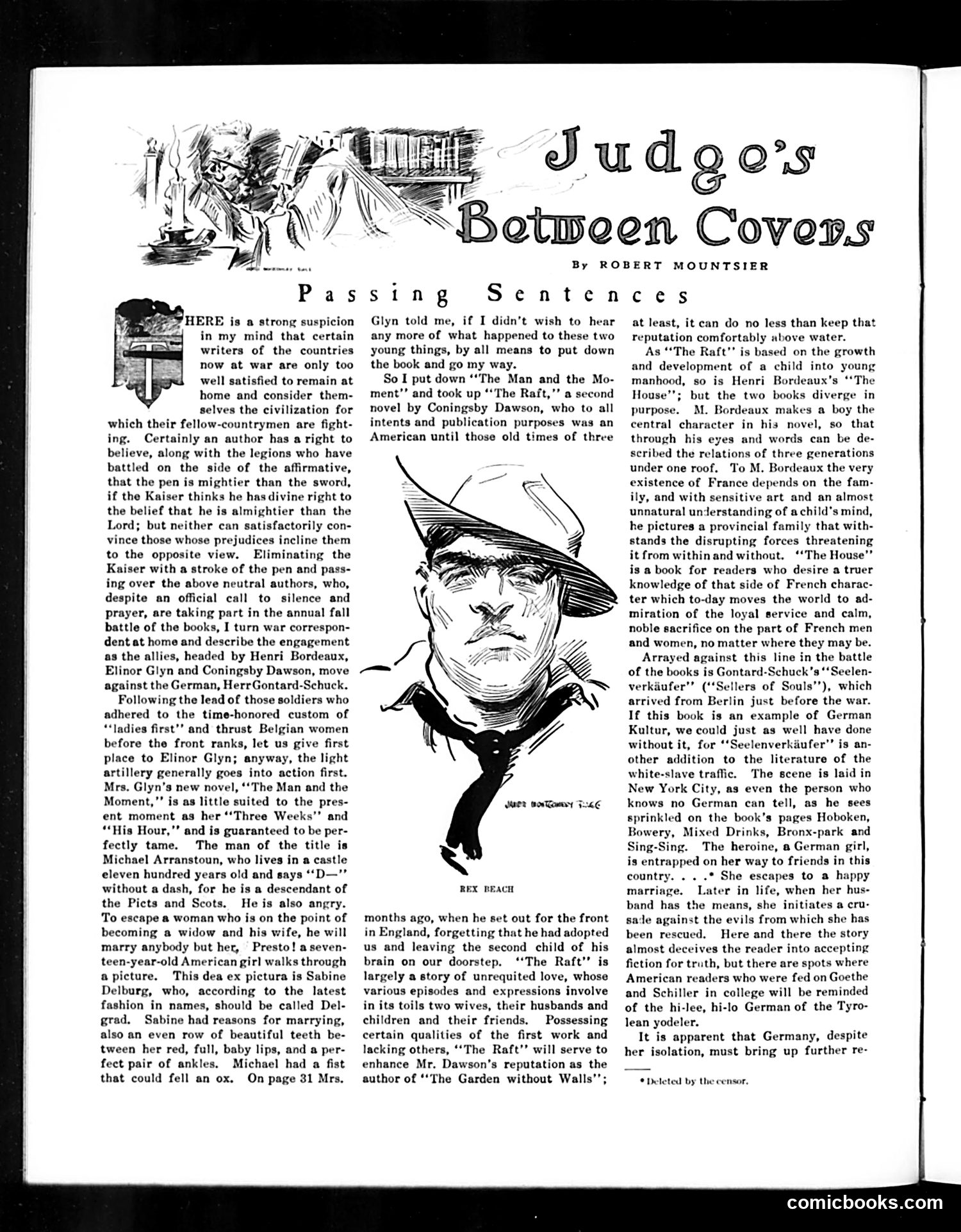
This is a literary review column by Robert Mountsier critiquing three war-era novels published during World War I. The piece discusses books by British/American authors Elinor Glyn, Coningsby Dawson, and Henri Bordeaux, comparing their treatments of contemporary themes. The review opens with commentary on writers who remain home during wartime, debating whether "the pen is mightier than the sword." The cartoon depicts a German military figure (likely representing German literature or culture), positioned as the antagonist against Allied writers. The column humorously dismisses Glyn's romance novel "The Man and the Moment" as frivolous wartime reading, praises Dawson's "The Raft" as adequate, and highlights Bordeaux's exploration of French family life as thematically significant. The satire reflects Judge magazine's pro-Allied stance and skepticism toward escapist entertainment during WWI.
📄 Transcribed text from this page (OCR, searchable)
Machine-transcribed from the original scan — historical spelling and the odd misread are preserved.
HERE is a strong suspicion in my mind that certain writers of the countries now at war are only too well satisfied to remain at home and consider them- selves the civilization for which their fellow-countrymen are fight- ing. Certainly an author has a right to believe, along with the legions who have battled on the side of the affirmative, that the pen is mightier than the sword, if the Kaiser thinks he has divine right to the belief that he is almightier than the Lord; but neither can satisfactorily con- vince those whose prejudices incline them to the opposite view. Eliminating the Kaiser with a stroke of the pen and pass- ing over the above neutral authors, who, despite an official call to silence and prayer, are taking part in the annual fall battle of the books, I turn war correspon- dent at home and describe the engagement as the allies, headed by Henri Bordeaux, Elinor Glyn and Coningsby Dawson, move against the German, HerrGontard-Schuck. Following the lead of those soldiers who adhered to the time-honored custom of “ladies first’’ and thrust Belgian women before the front ranks, let us give first place to Elinor Glyn; anyway, the light artillery generally goes into action first. Mrs. Glyn’s new novel, ‘‘The Man and the Moment,”’ is as little suited to the pres- ent moment as her ‘‘Three Weeks’’ and “His Hour,"’ and is guaranteed to be per- fectly tame. The man of the title is Michael Arranstoun, who lives in a castle eleven hundred years old and says ““D—" without a dash, for he is a descendant of the Picts and Scots. He is also angry. To escape a woman who is on the point of becoming a widow and his wife, he will marry anybody but her, Presto! a seven- teen-year-old American girl walks through apicture. This dea ex pictura is Sabine Delburg, who, according to the latest fashion in names, should be called Del- grad. Sabine had reasons for marrying, also an even row of beautiful teeth be- tween her red, full, baby lips, and a per- fect pair of ankles. Michael had a fist that could fell an ox. On page 31 Mrs, = Between Covon.s By ROBERT MOUNTSIER Sentences Glyn told me, if I didn’t wish to hear any more of what happened to these two young things, by all means to put down the book and go my way. So I put down ‘‘The Man and the Mo- ment”’ and took up ‘‘The Raft,”’ a second novel by Coningsby Dawson, who to all intents and publication purposes was an American until those old times of three MeeR GonTomay TLE REX REACH months ago, when he set out for the front in England, forgetting that he had adopted us and leaving the second child of his brain on our doorstep. ‘‘The Raft’ is largely a story of unrequited love, whose various episodes and expressions involve in its toils two wives, their husbands and children and their friends. Possessing certain qualities of the first work and lacking others, ‘‘The Raft’’ will serve to enhance Mr. Dawson's reputation as the author of ‘‘The Garden without Walls’; at least, it can do no less than keep that reputation comfortably above water. As ‘The Raft"’ is based on the growth and development of a child into young manhood, so is Henri Bordeaux's ‘*The but the two books diverge in purpose. M. Bordeaux makes a boy the central character in his novel, so that through his eyes and words can be de- scribed the relations of three generations under one roof. To M. Bordeaux the very existence of France depends on the fam- ily, and with sensitive art and an almost unnatural understanding of a child's mind, he pictures a provincial family that with- stands the disrupting forces threatening it from within and without. ‘The House”’ is a book for readers who desire a truer knowledge of that side of French charac- ter which to-day moves the world to ad- miration of the loyal service and calm, noble sacrifice on the part of French men and women, no matter where they may be. Arrayed against this line in the battle of the books is Gontard-Schuck’s ‘‘Seelen- verkiufer’’ (‘Sellers of Souls’’), which arrived from Berlin just before the war. If this book is an example of German Kultur, we could just as well have done without it, for ‘‘Seelenverkiufer’’ is an- other addition to the literature of the white-slave traffic. The scene is laid in New York City, as even the person who knows no German can tell, as he sees sprinkled on the book’s pages Hoboken, Bowery, Mixed Drinks, Bronx-park and Sing-Sing. The heroine, a German girl, is entrapped on her way to friends in this country. . . .* She escapes to a happy marriage. Later in life, when her hus- band has the means, she initiates a cru- sade against the evils from which she has been rescued. Here and there the story almost deceives the reader into accepting fiction for truth, but there are spots where American readers who were fed on Goethe and Schiller in college will be reminded of the hi-lee, hi-lo German of the Tyro- lean yodeler. It is apparent that Germany, despite her isolation, must bring up further re- * Deleted by the censor, comicbooks.com