
Judge, 1914-10-31 · page 4 of 24
Judge — October 31, 1914 — page 4: what you’re looking at
What you’re looking at
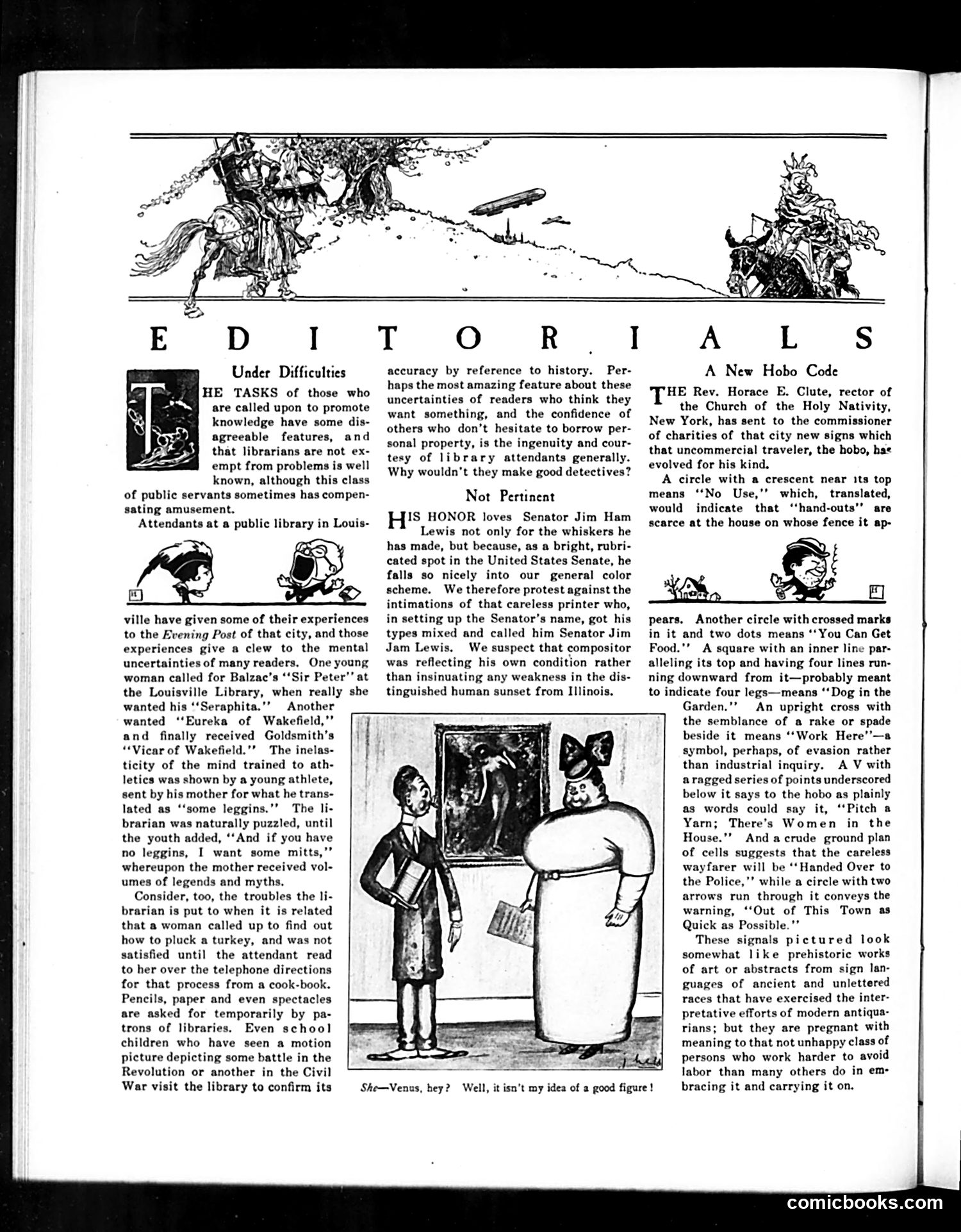
This page contains two distinct pieces: **Left section ("Under Difficulties"):** Discusses librarians' challenges assisting patrons, including humorous anecdotes about unusual requests—someone seeking "Sir Peter" from Balzac, another wanting "Enoch of Wakefield," and a woman asking a cook-book reference via telephone. The piece gently satirizes both public ignorance and librarians' patience. **Right section ("A New Hobo Code"):** Criticizes a printer's error in a newspaper that misspelled Senator Jim Ham Lewis's name as "Jim Jam Lewis." The article then explains various vagrant/hobo symbols—circles, crosses, and marks—used to communicate warnings and information along the road. The satire conflates the careless typographical error with the deliberate coded language of transient communities.
📄 Transcribed text from this page (OCR, searchable)
Machine-transcribed from the original scan — historical spelling and the odd misread are preserved.
Under Difficulties HE TASKS of those who are called upon to promote knowledge have some dis- agreeable features, and that librarians are not ex- empt from problems is well known, although this class of public servants sometimes has compen- sating amusement. Attendants at a public library in Louis- ville have given some of their experiences to the Evening Post of that city, and those experiences give a clew to the mental uncertainties of many readers. One young woman called for Balzac’s ‘‘Sir Peter’’ at the Louisville Library, when really she wanted his ‘‘Seraphita."’ Another wanted ‘Eureka of Wakefield,”’ and finally received Goldsmith's “Vicar of Wakefield." The inelas- ticity of the mind trained to ath- letics was shown by a young athlete, sent by his mother for what he trans- lated as ‘‘some leggins.’’ The li- brarian was naturally puzzled, until the youth added, ‘‘And if you have no leggins, I want some mitts,”’ whereupon the mother received vol- umes of legends and myths. Consider, too, the troubles the li- brarian is put to when it is related that a woman called up to find out how to pluck a turkey, and was not satisfied until the attendant read to her over the telephone directions for that process from a cook-book. Pencils, paper and even spectacles are asked for temporarily by pa- trons of libraries. Even school children who have seen a motion picture depicting some battle in the I accuracy by reference to history. Per- haps the most amazing feature about these uncertainties of readers who think they want something, and the confidence of others who don’t hesitate to borrow per- sonal property, is the ingenuity and cour- tesy of library attendants generally. Why wouldn't they make good detectives? Not Pertinent H's HONOR loves Senator Jim Ham Lewis not only for the whiskers he has made, but because, as a bright, rubri- cated spot in the United States Senate, he falls so nicely into our general color scheme. We therefore protest against the intimations of that careless printer who, in setting up the Senator’s name, got his types mixed and called him Senator Jim Jam Lewis. We suspect that compositor was reflecting his own condition rather than insinuating any weakness in the dis- tinguished human sunset from Illinois. A New Hobo Code HE Rev. Horace E. Clute, rector of the Church of the Holy Nativity, New York, has sent to the commissioner of charities of that city new signs which that uncommercial traveler, the hobo, hae evolved for his kind, A circle with a crescent near its top means ‘‘No Use,’’ which, translated, would indicate that ‘‘hand-outs’’ are scarce at the house on whose fence it ap- pears. Another circle with crossed marks in it and two dots means ‘‘You Can Get Food."’ A square with an inner line par- alleling its top and having four lines run- ning downward from it—probably meant to indicate four legs—means ‘Dog in the Garden.”” An upright cross with the semblance of a rake or spade beside it means ‘‘Work Here’’—a symbol, perhaps, of evasion rather than industrial inquiry. A V with aragged series of points underscored below it says to the hobo as plainly as words could say it, ‘‘Pitch a Yarn; There’s Women in the House.” And acrude ground plan of cells suggests that the careless wayfarer will be ‘‘Handed Over to the Police,’’ while a circle with two arrows run through it conveys the warning, ‘‘Out of This Town as Quick as Possible."’ These signals pictured look somewhat like prehistoric works of art or abstracts from sign lan- guages of ancient and unlettered races that have exercised the inter- pretative efforts of modern antiqua- rians; but they are pregnant with meaning to that not unhappy class of persons who work harder to avoid Revolution or another in the Civil War visit the library to confirm its She—Venus, hey? labor than many others do in em- Well, it isn’t my idea of a good figure ! bracing it and carrying it on. comicbooks.com