
A complete issue · 24 pages · 1914
Judge — October 17, 1914
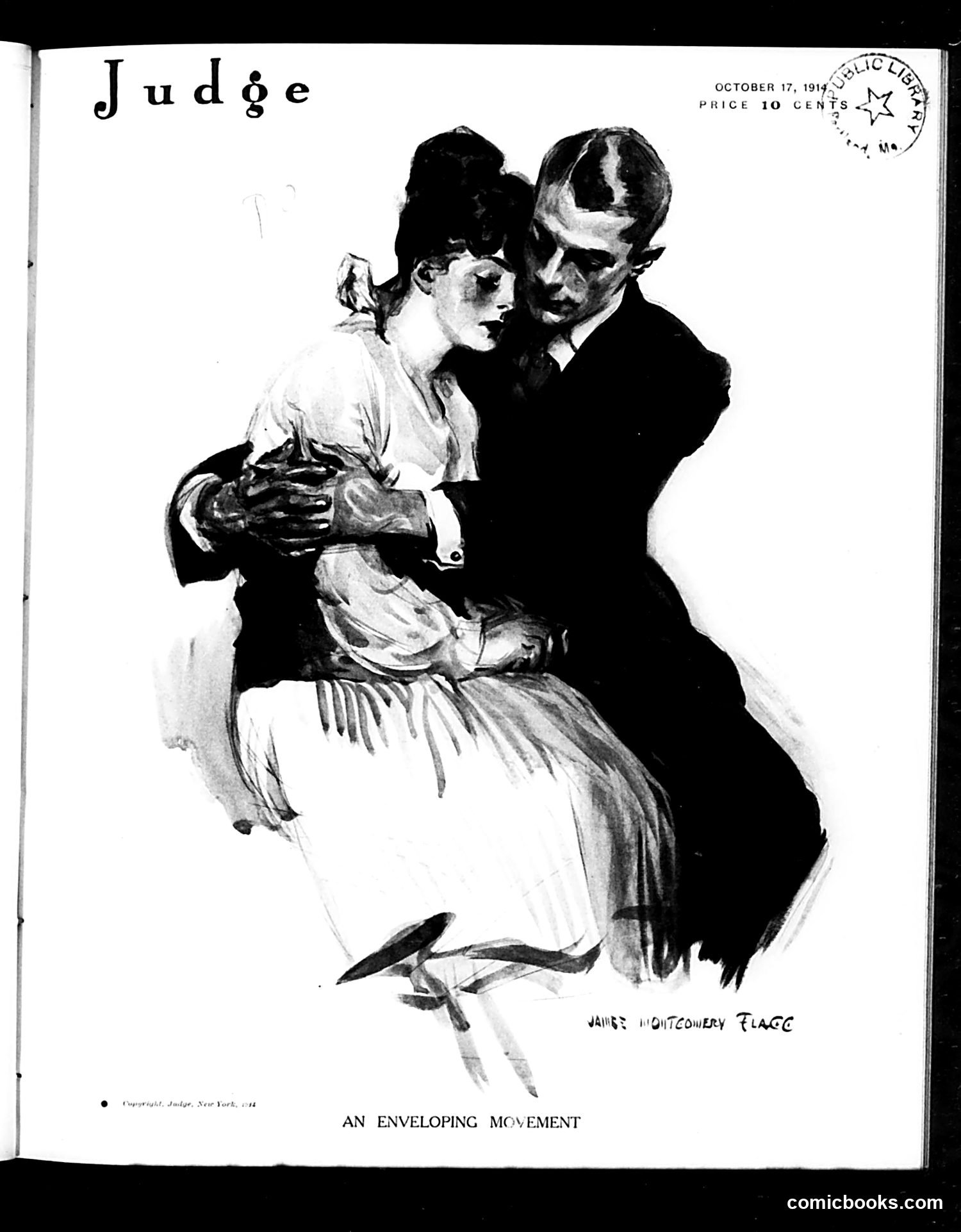
This satirical illustration, titled "An Enveloping Movement," depicts a man in formal attire embracing or restraining a woman in a white dress. The caption's military metaphor suggests a strategic maneuver. Given the 1919 date, this likely comments on post-WWI social dynamics or emerging women's rights issues. The "enveloping movement" may satirize either male attempts to constrain women's newfound freedoms following wartime changes, or conversely, women's advancing social position "enveloping" traditional male authority. The artist James Montgomery Flagg was known for social commentary on gender relations. Without additional context, the specific political event or social debate referenced remains unclear, though it evidently concerns shifting gender dynamics in post-war America.
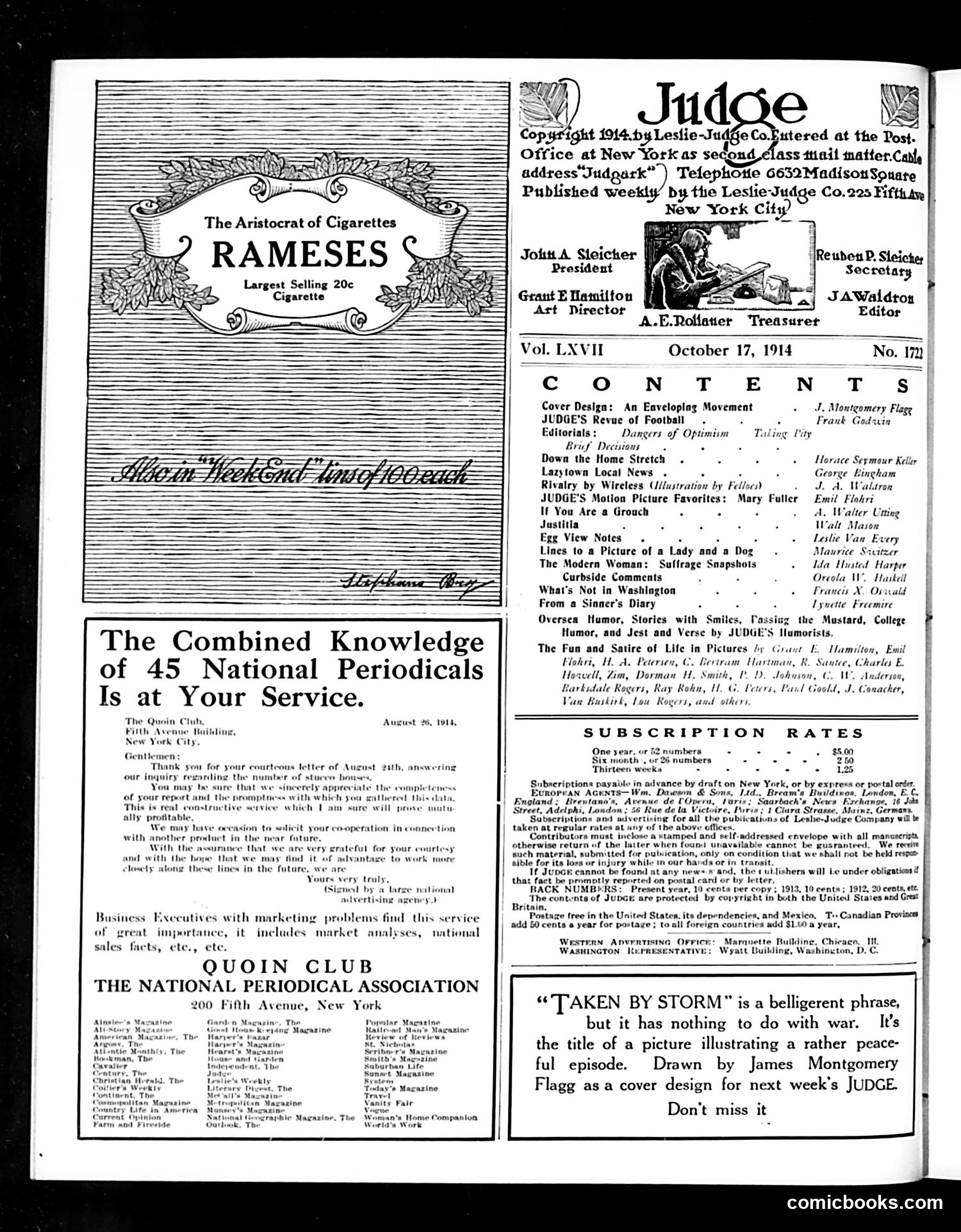
This page is predominantly **advertising and masthead material** rather than political cartoon content. The main visual elements are: 1. **Rameses Cigarettes ad** - a period product advertisement claiming to be the "Largest Selling 20¢ Cigarettes" 2. **Quoin Club/National Periodical Association notice** - a business letter thanking subscribers and advertising the combined reach of 45 national periodicals 3. **A teaser for next week's cover** - promoting an upcoming James Montgomery Flagg illustration titled "Taken by Storm," described as depicting "a rather peaceful episode" The **content listing** indicates Judge covered football, optimism, and lifestyle topics typical of 1914 American satire. The page itself contains no identifiable political cartoons or satirical commentary visible in the image.
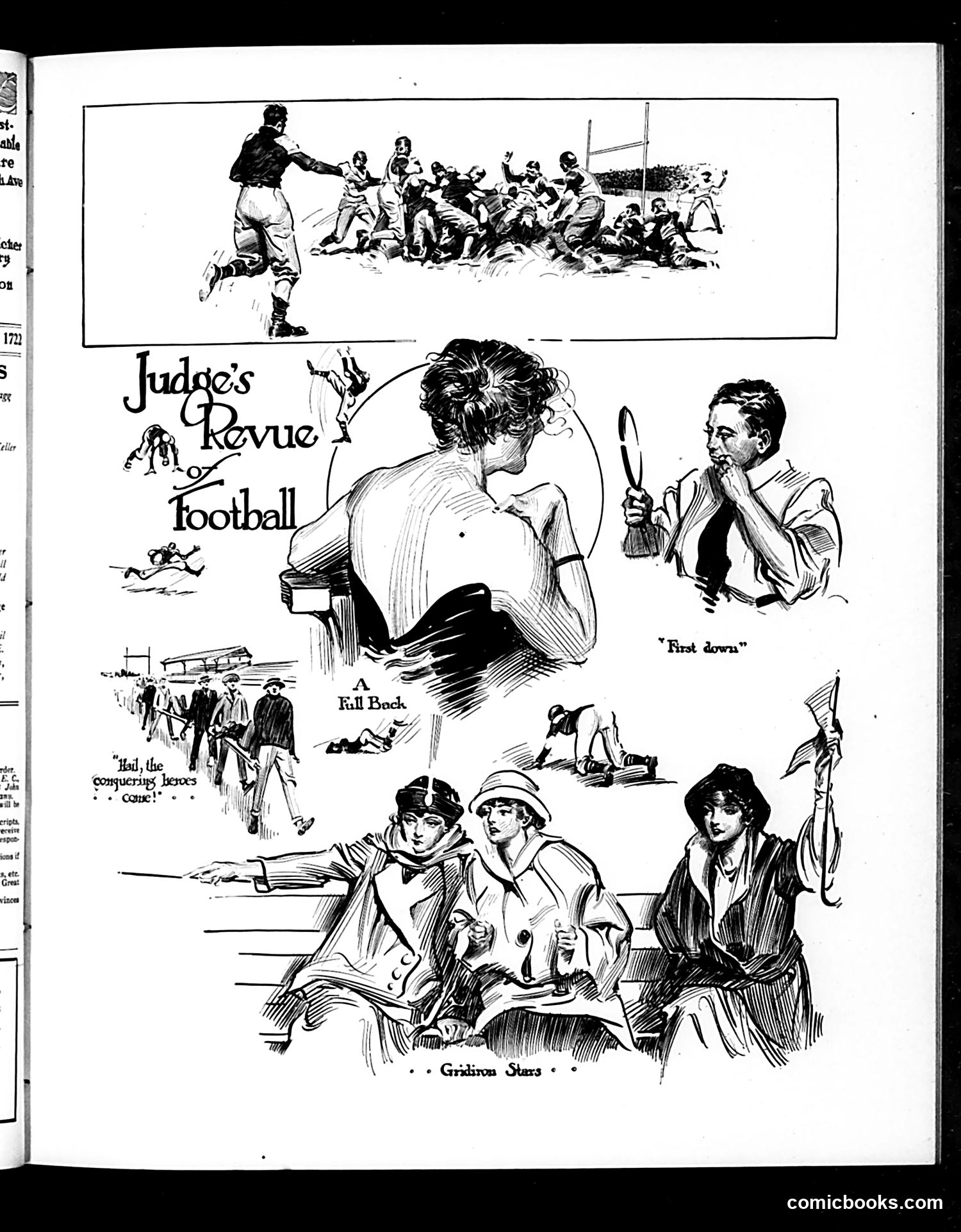
This page satirizes American football through various sketches. The top panel shows a rugby-style scrum, establishing football as the subject. The central caricature depicts "A Full Back"—a player with an enormously muscular back, suggesting the physical brutality of the sport. The figure labeled "First down" appears to reference football terminology. "Gridiron Stars" at bottom depicts three figures in fashionable clothing, likely satirizing how professional football players were becoming celebrity figures and cultural icons. The sketch captioned "Had, the conquering heroes come!" shows formally-dressed spectators, suggesting the social pretension surrounding football spectatorship. Overall, the page mocks football's growing popularity, its violent nature, and the celebrity culture developing around the sport during the early 20th century.
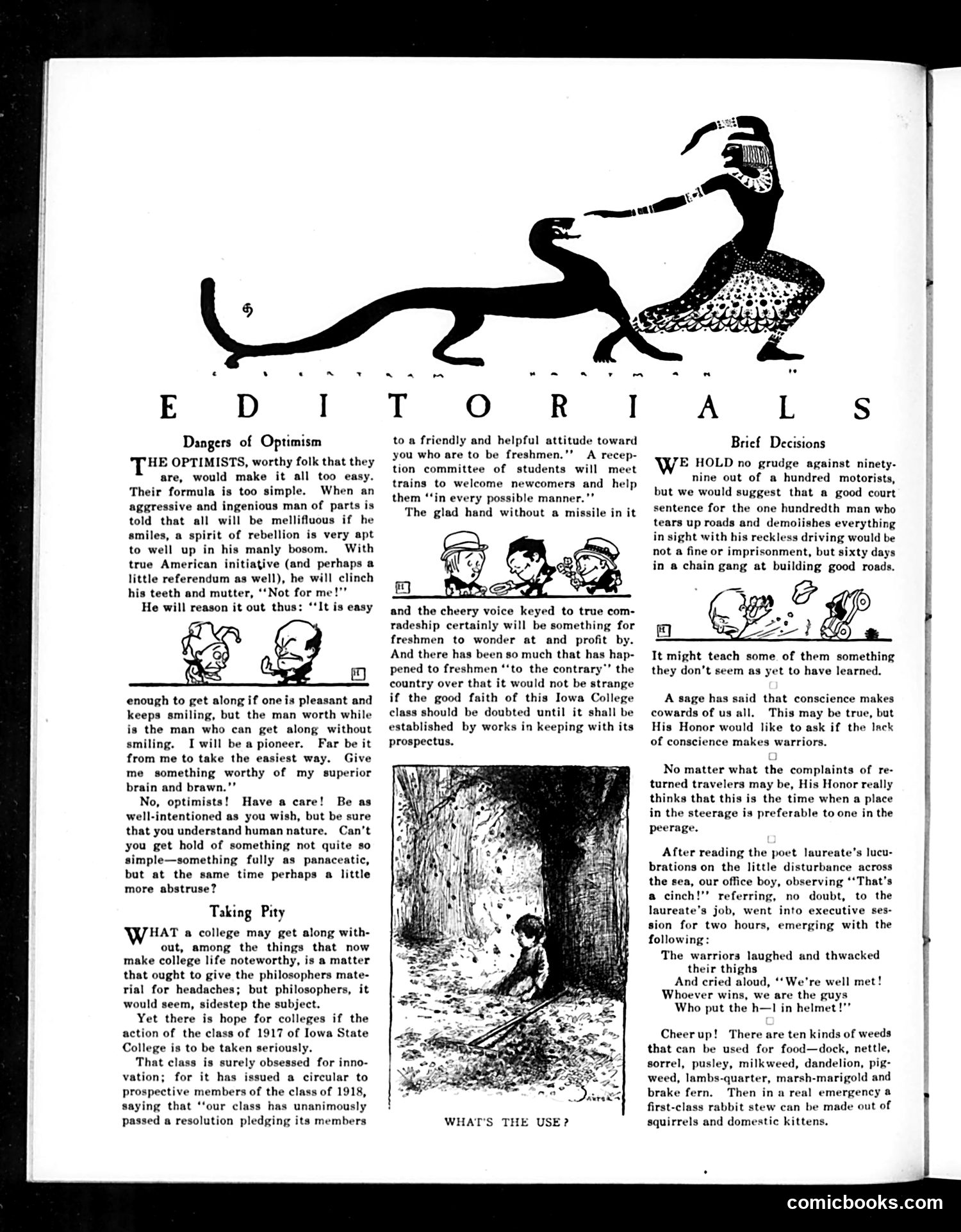
This page contains three opinion pieces about college life, likely from around 1917 (referencing Iowa State College's class of 1917). **"Dangers of Optimism"** critiques overly idealistic freshmen, warning against naive rebelliousness and excessive confidence. The accompanying caricature shows two exaggerated figures in conflict. **"Taking Pity"** discusses college administrators' challenges managing student behavior and innovation, suggesting that while classes generate useful ideas, they also create headaches requiring careful oversight. **"Brief Decisions"** addresses reckless driving among motorists, advocating for harsh penalties to discourage dangerous behavior on roads—a contemporary social concern. The woodcut illustration labeled "WHAT'S THE USE?" depicts a child examining something on the ground, though its connection to the surrounding text remains unclear from this excerpt.
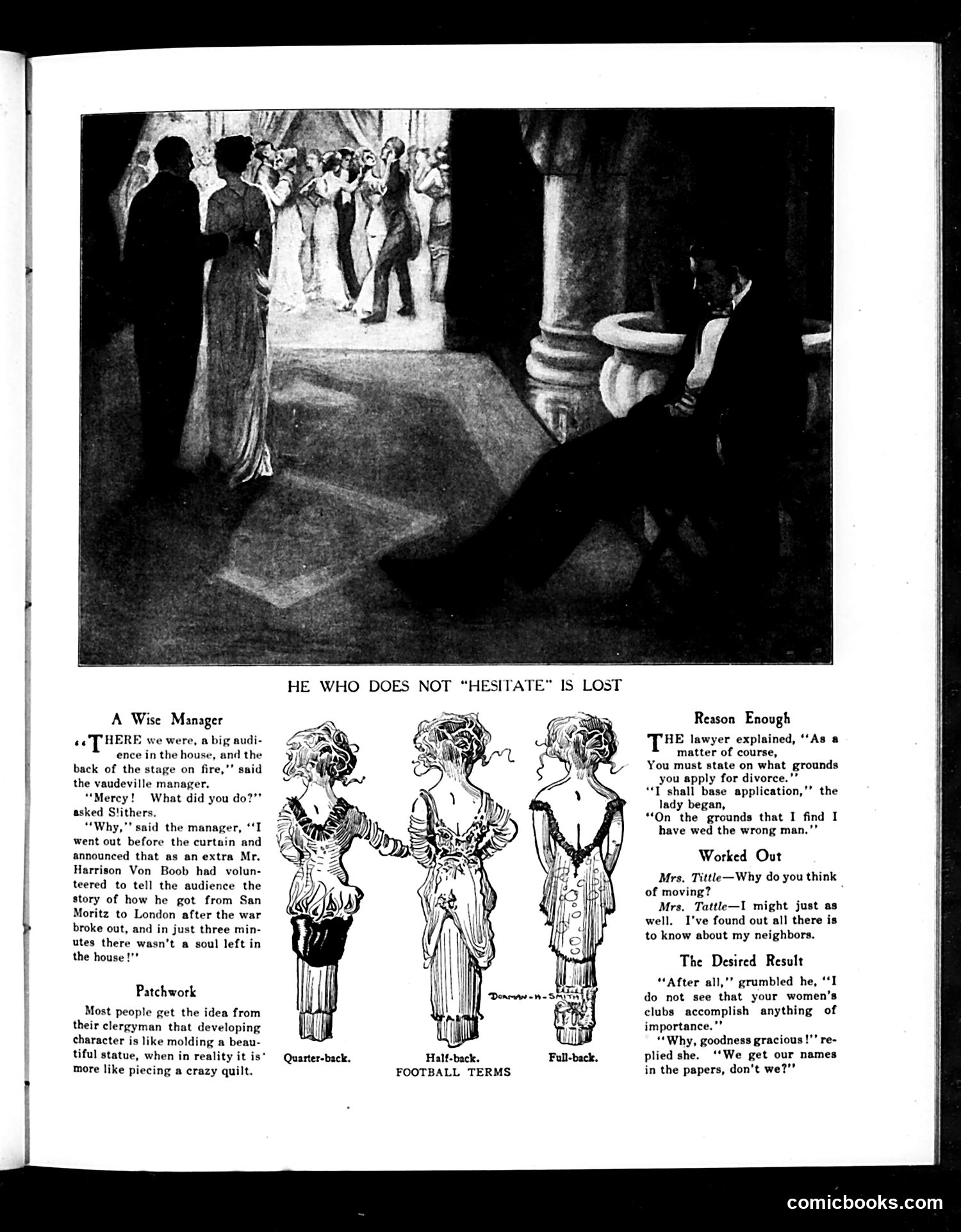
This page from *Judge* magazine contains several unrelated satirical pieces: **Top photograph** ("He Who Does Not 'Hesitate' Is Lost"): Shows a theater scene, likely illustrating a story about a vaudeville manager named Mr. Harrison Von Bood who announced a soldier's war story to an audience. The caption suggests the piece mocks hesitation or indecision. **"A Wise Manager" / "Patchwork"**: Satirizes character development, comparing it to "piecing a crazy quilt"—suggesting people develop character haphazardly rather than systematically. **"Football Terms" illustration**: Shows three women labeled with football terminology (Quarter-back, Half-back, Full-back), making a joke comparing female anatomy or social positioning to football positions. **"Reason Enough" / "Worked Out" / "The Desired Result"**: Brief comedic dialogues about divorce grounds and women's social clubs—period humor about marital and social dynamics. The page appears to be a miscellaneous humor collection rather than unified satire.
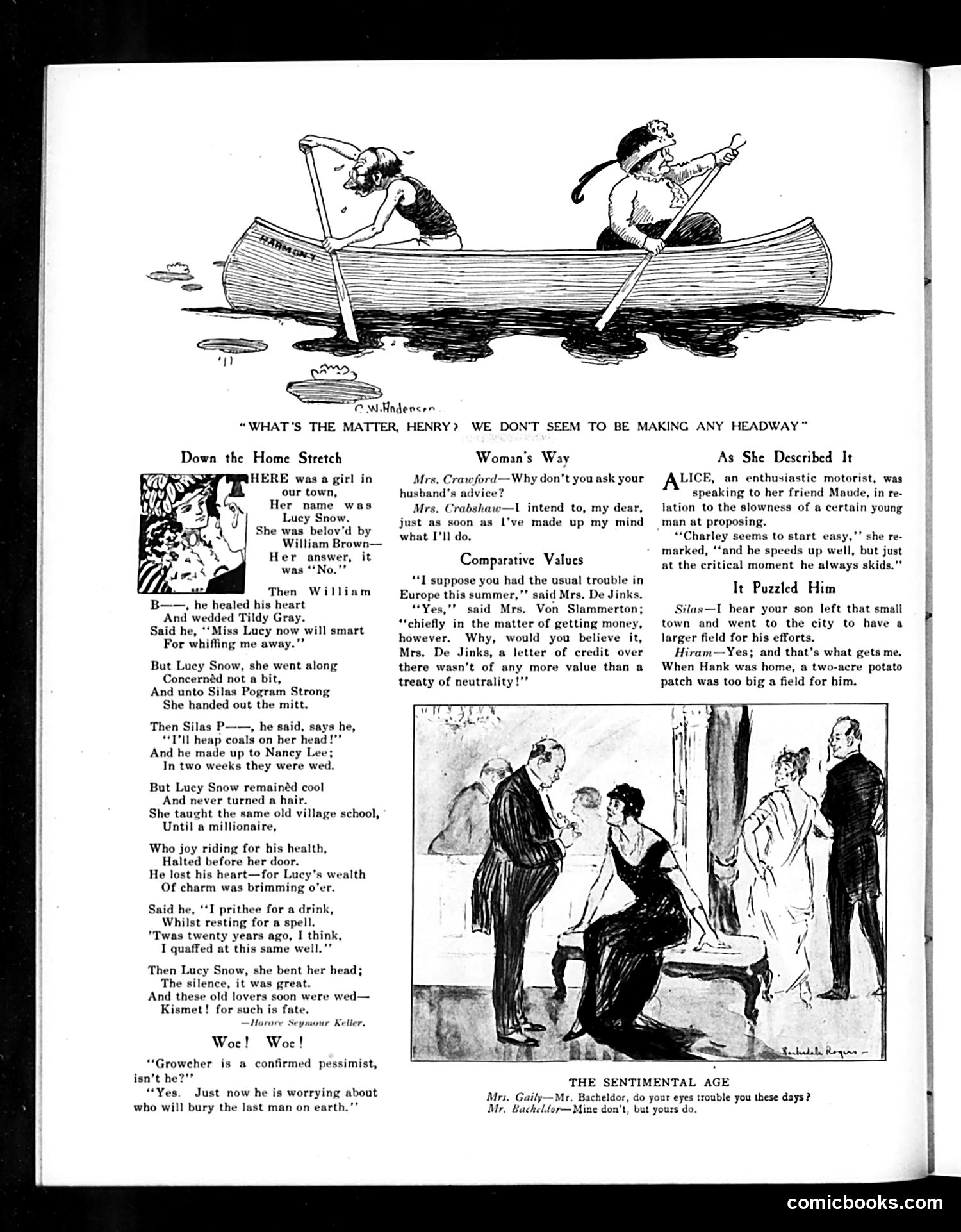
This page from the satirical magazine *Judge* contains several humor pieces mocking early 20th-century social conventions: **Top cartoon**: Two figures in a canoe appear stuck—a visual pun on the phrase "making headway," illustrating relationship stagnation. **"Down the Home Stretch"**: A poem satirizing small-town romantic melodrama. Lucy Snow rejects suitor William Brown, who marries to spite her. When Silas Pogram attempts similar revenge, Lucy remains indifferent. The joke: she ultimately wins by ignoring the petty games, eventually marrying a wealthy stranger. The satire mocks overwrought small-town romantic scheming. **"Woman's Way"**: Brief jokes about female decision-making and marriage dynamics—Mrs. Crabshaw won't ask her husband's advice until she's already decided what to do. **"Comparative Values"**: Satire on WWI-era European financial chaos, comparing a letter of credit's worthlessness to a "treaty of neutrality"—likely referencing broken neutrality agreements during the war. **"The Sentimental Age"**: A flirtation joke about eyesight and attraction. The overall tone is lighthearted domestic and social satire typical of Judge's era.
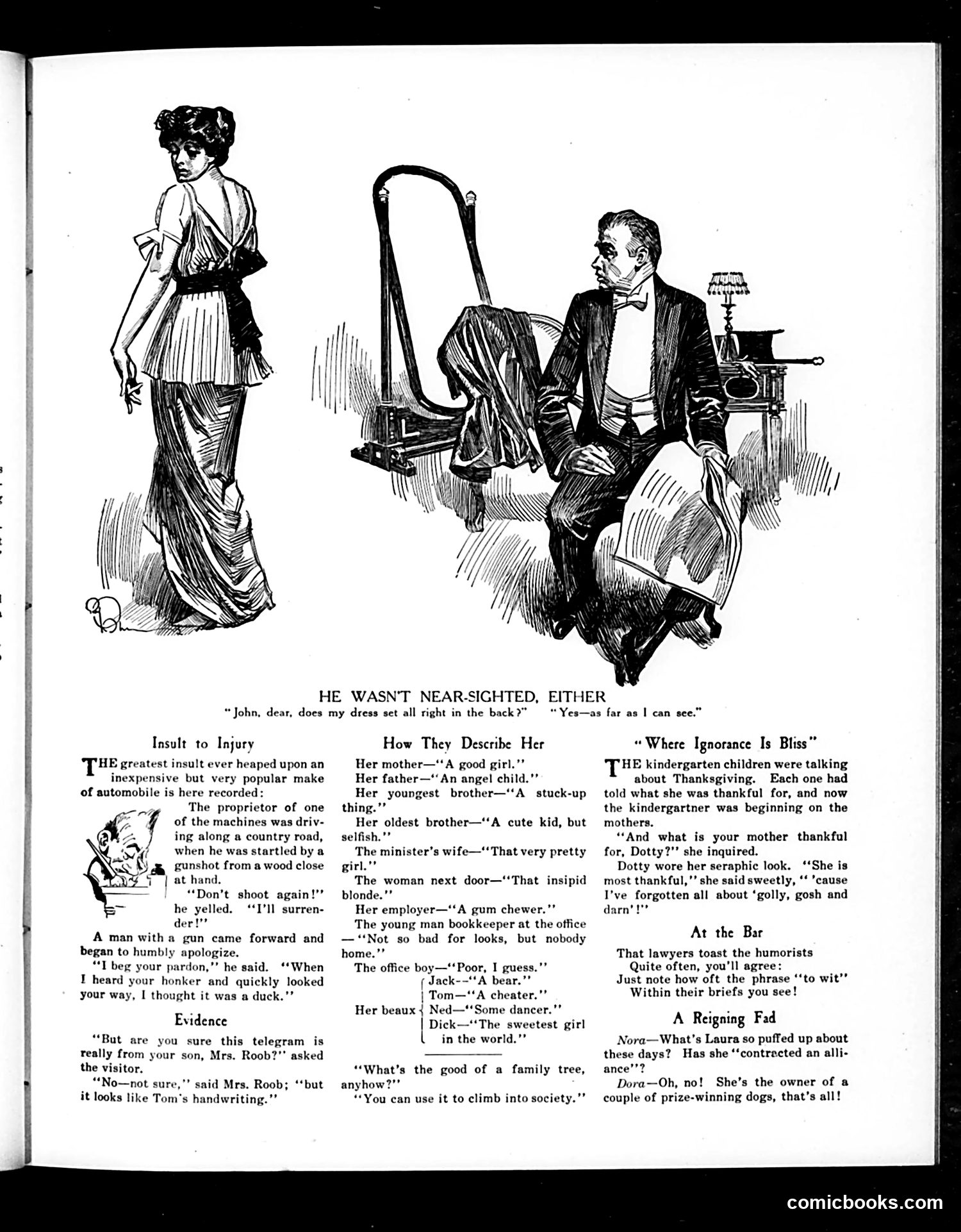
This page contains several independent humor pieces typical of early 20th-century American satirical magazines. **"Insult to Injury"** mocks an inexpensive automobile's horn (honker) so quiet that a hunter mistakes it for a duck's call and nearly shoots at it—satirizing cheap cars' poor quality. **"How They Describe Her"** shows the contradiction between how a woman is described by different people in her life (good girl, angel child, gum chewer, etc.), humorously highlighting social hypocrisy and subjective judgment. **"Where Ignorance Is Bliss"** presents a child innocently proud that her mother appreciates her forgetting curse words—the joke being the mother's relief at this "improvement." Additional pieces satirize family genealogy pretension, legal jargon, and the contemporary fad of women owning prize-winning dogs as status symbols. The overall tone reflects Belle Époque-era middle-class social observations and gentle domestic humor typical of Judge's readership.
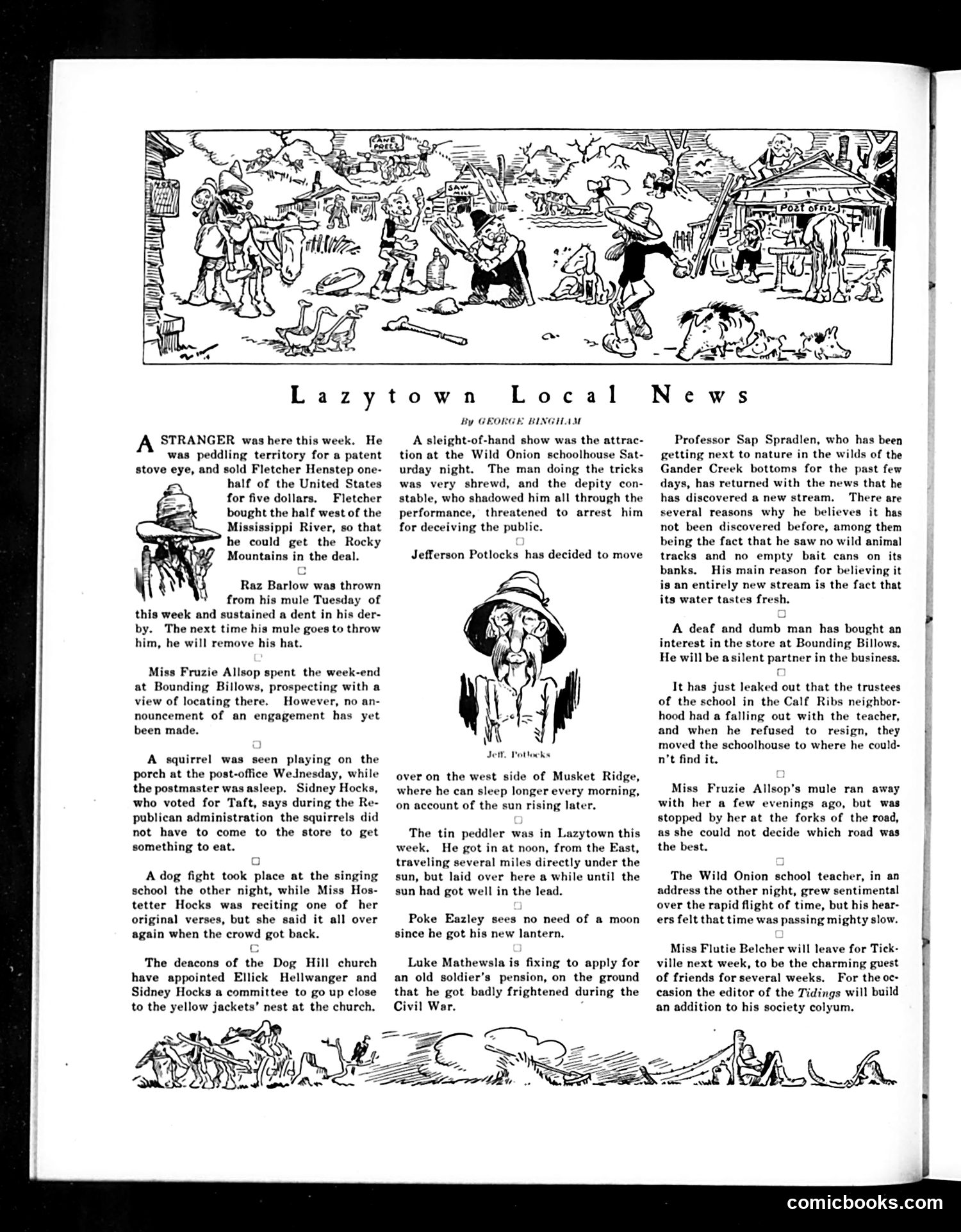
This is a humorous rural gossip column by George Bingham, lampooning small-town life through absurdist anecdotes. The satire targets rural naivety and illogic: a man sells half the USA for five dollars; a deputy threatens arrest for magic tricks (deception); a farmer moves to sleep later because the sun "rises later" on the western ridge; a man needs no moon since buying a lantern. Political reference: One joke mentions voting for Taft (President William Howard Taft, 1909-1913), implying Republicans provided better conditions even for squirrels—likely gentle mockery of partisan loyalty. The humor relies on exaggerated rural simplicity—characters making nonsensical decisions presented deadpan. The column satirizes small-town gossip culture itself, treating trivial local events as "news" worthy of publication, poking fun at both rural communities and small-town newspapers.
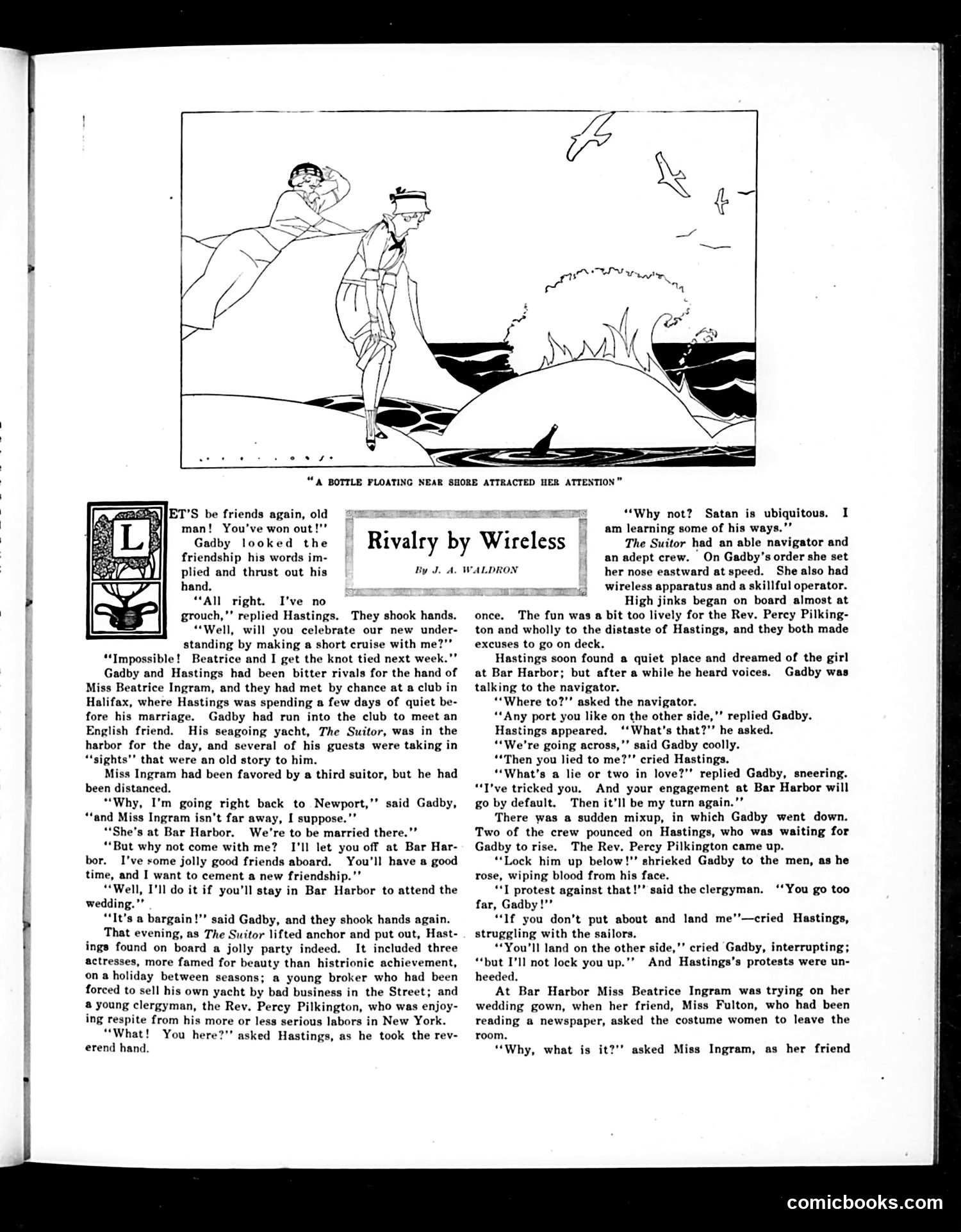
This is a serialized fiction story (not primarily political satire) about romantic rivalry and betrayal. Two former rivals for Miss Beatrice Ingram's hand—Gadby and Hastings—reconcile at a club in Halifax. Gadby invites Hastings aboard his yacht, *The Suitor*, ostensibly to drop him at Bar Harbor for his wedding, but secretly plans to sail across the Atlantic instead, stranding Hastings and leaving the field clear to win Beatrice. The cartoon shows Beatrice discovering evidence of the plot (a bottle washed ashore). The title "Rivalry by Wireless" references the yacht's wireless apparatus, which enables ship-to-shore communication—a contemporary technological marvel. The story exemplifies early 1900s popular magazine fiction: gentlemen rivals, a beautiful prize, deception, nautical adventure, and dramatic confrontation. The Rev. Pilkington provides moral commentary.
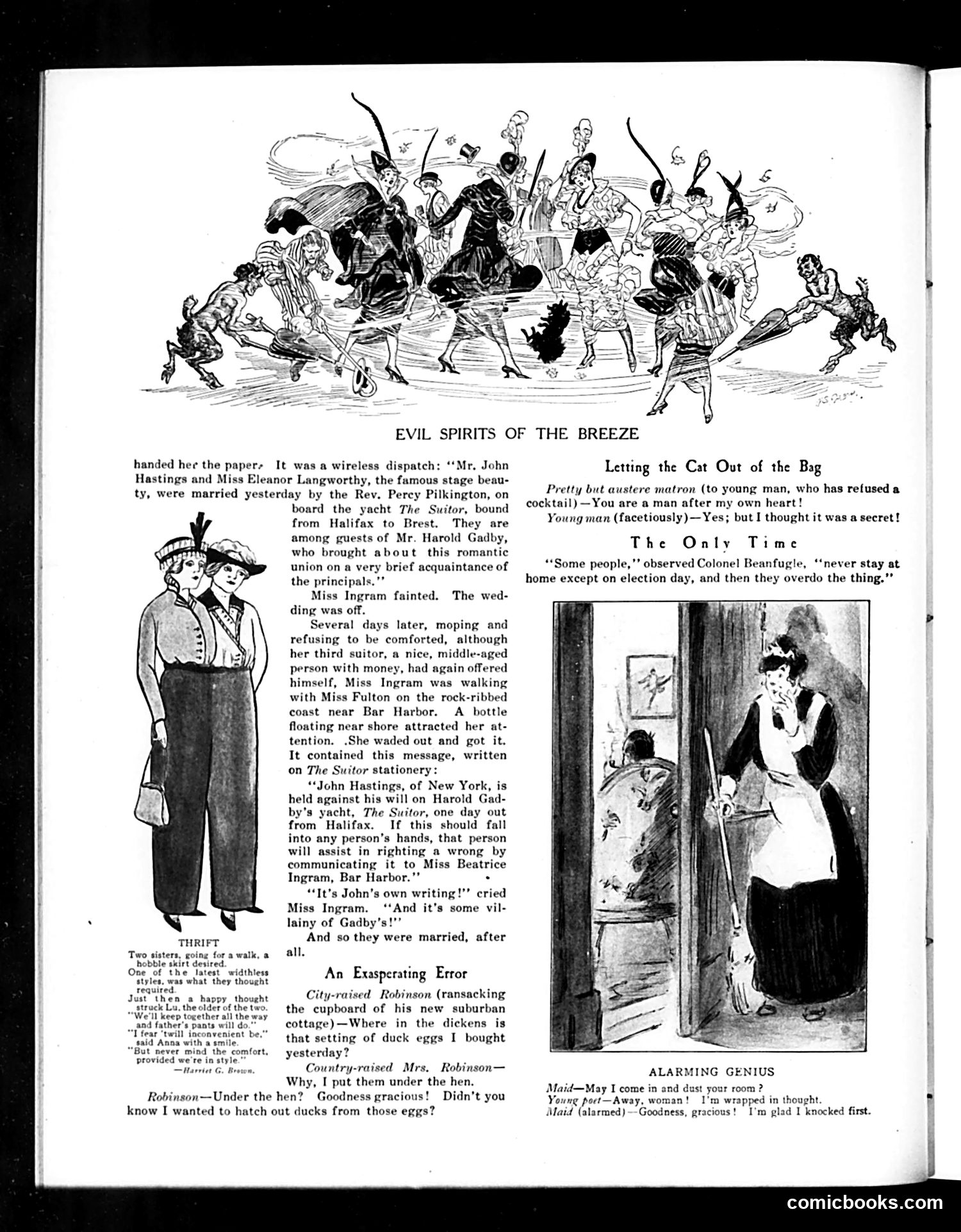
This page contains several brief satirical pieces typical of early 20th-century humor magazines: **"Evil Spirits of the Breeze"** is a romantic comedy about a wireless telegram announcing a shipboard wedding that causes the bride's fainting fit and cancellation—until a mysterious message in a bottle (supposedly from the groom claiming kidnapping) prompts her to marry him after all. The satire mocks both wireless technology's disruption of privacy and the melodramatic conventions of romantic fiction. **"Letting the Cat Out of the Bag"** jokes about a austere woman praising a young man for refusing cocktails, only for him to sarcastically note she seems to have other secrets. **"The Only Time"** quips that Colonel Beanfugle only stays home on election day, then overdoes it. **"Thrift"** mocks young women wearing restrictively narrow skirts. **"An Exasperating Error"** presents the classic rural/urban divide: a city man brought duck eggs to his new cottage but his country wife cooked them, not realizing he wanted to hatch them—humor based on class and cultural differences.
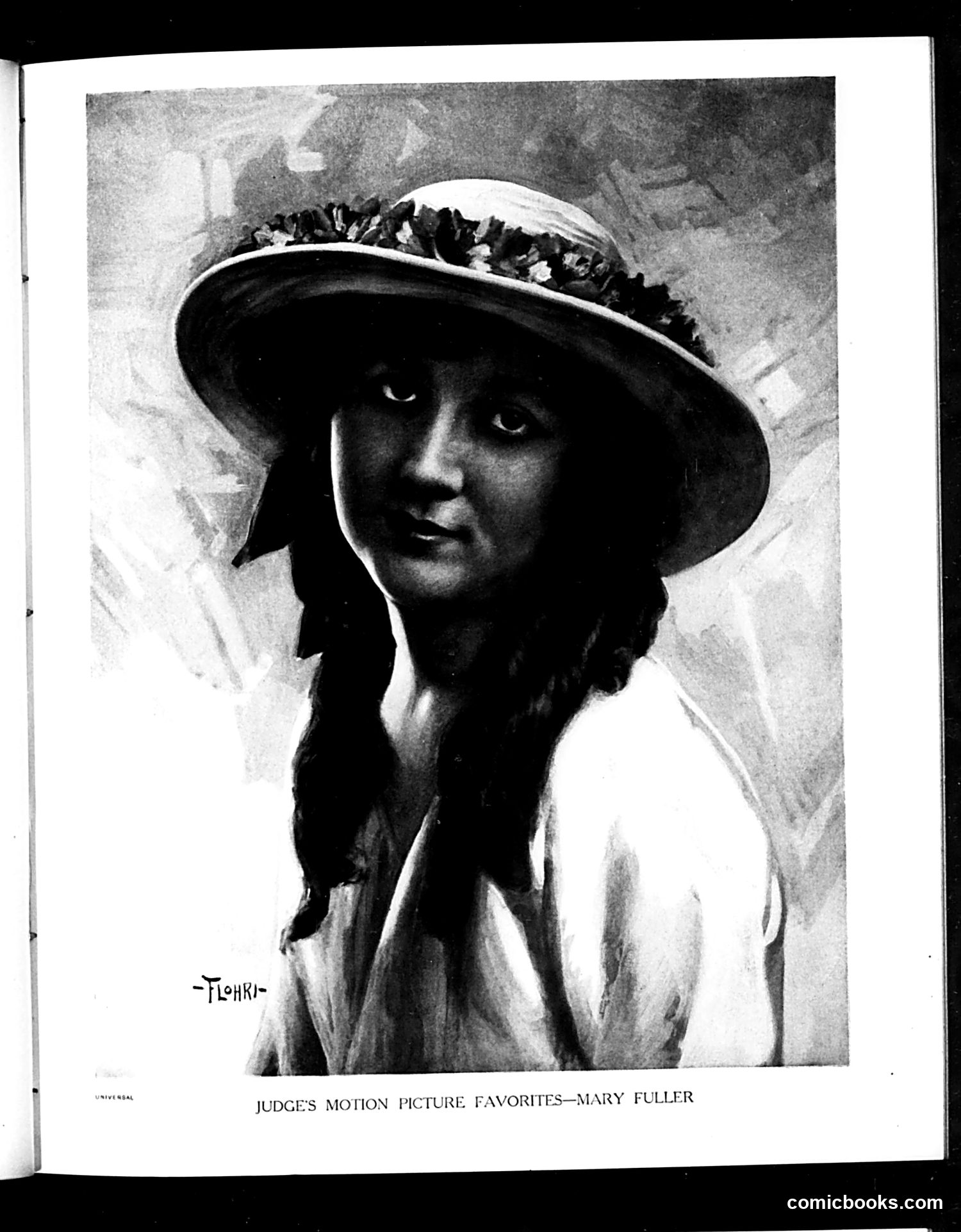
This is a portrait photograph from Judge magazine's "Motion Picture Favorites" feature, showcasing actress Mary Fuller. The image shows a woman in early 1900s attire—a wide-brimmed hat decorated with feathers and a white blouse—posed for a studio photograph. Mary Fuller was a silent film actress popular during that era. Judge magazine, known for satire and humor, regularly featured entertainment industry personalities in this section. The portrait itself isn't satirical; rather, it represents Judge's coverage of popular culture and the emerging film industry. The photographic style and fashion reflect early cinema's prominence in American entertainment during the silent film period.
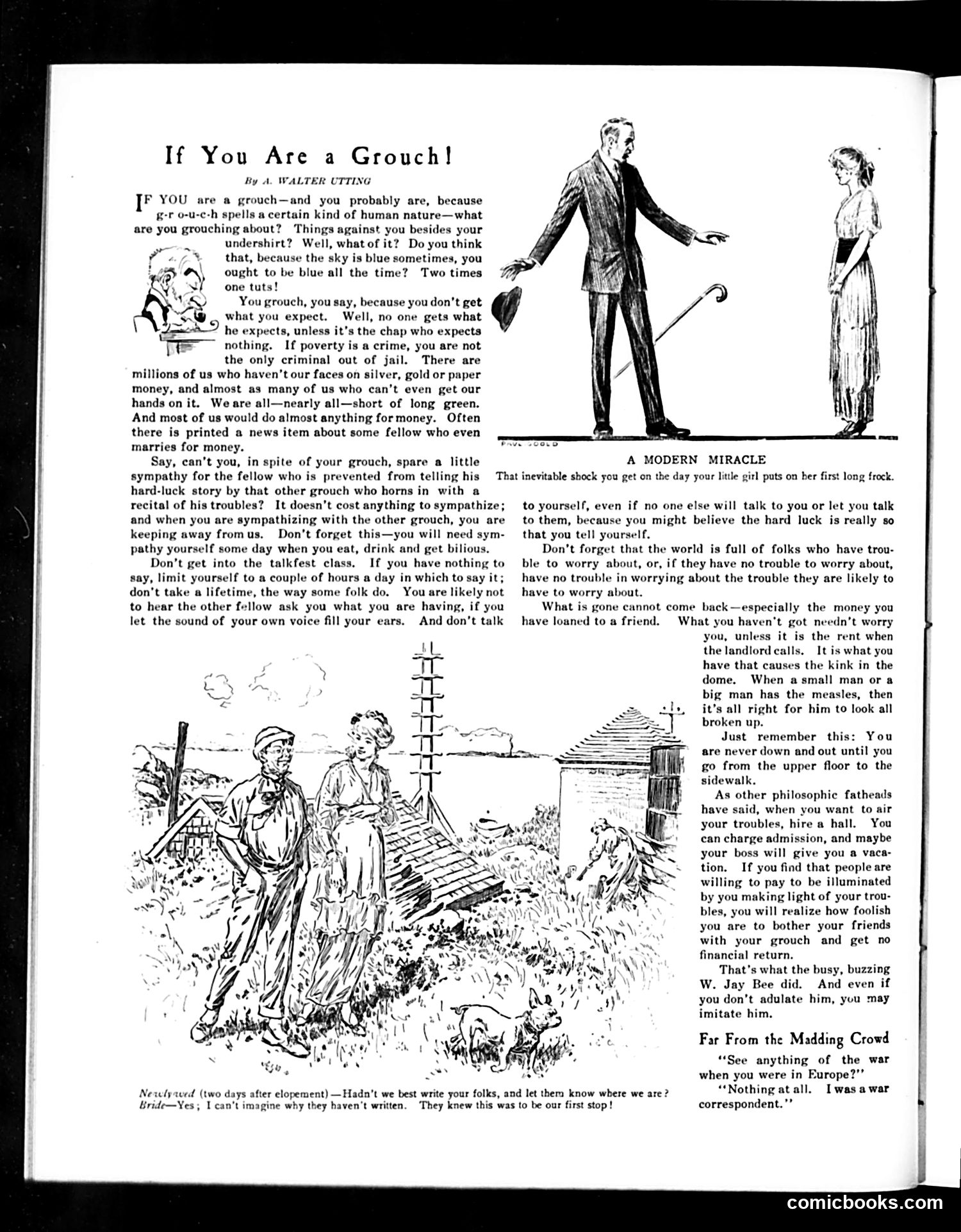
This article by A. Walter Utting satirizes chronic complainers and pessimists. The writer argues that grouching is pointless: poverty is widespread, no one gets what they expect, and complaining drives away sympathy from others. The piece mocks people who monopolize conversations with sob stories and those who "hire a hall" to air grievances. The accompanying cartoons reinforce this: one shows a newlywed couple (captioned "A Modern Miracle") where the bride has worn her first long dress—a humorous, trivial "shock." Another depicts laborers, likely illustrating working-class grouchiness about economic hardship. The closing anecdote references W. Jay Bee (likely a contemporary public figure, unclear which one) as someone who avoids complaining. The final cartoon shows an elopement, with the bride's parent complaint being ignored. The satire targets early 20th-century American pessimism and self-pity while promoting stoic acceptance and positive outlook.
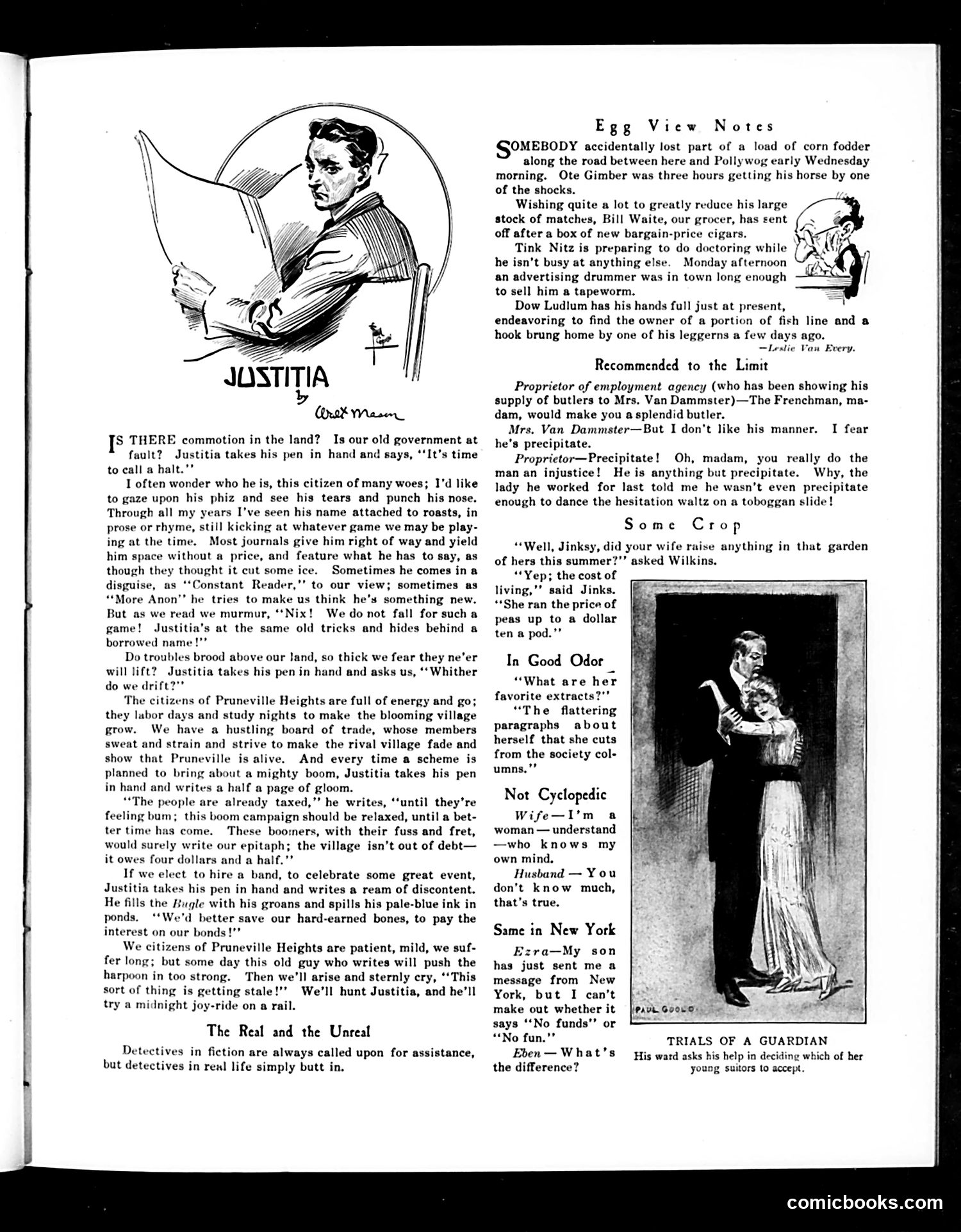
This page from *Judge* magazine contains several satirical pieces: **"Justitia"** (main cartoon): A pen-and-ink drawing accompanies a piece mocking a recurring anonymous newspaper columnist who signs various pseudonyms ("Constant Reader," "More Anon," etc.). The satire targets this perpetually complaining voice who writes doom-and-gloom letters to editors about civic issues. The piece lampoons both the columnist's transparent name-switching and small-town civic boosterism—specifically how "Justitia" constantly opposes the town of Pruneville Heights' development schemes with warnings about debt and taxes. **"Egg View Notes"**: Rural gossip column with light humor about small-town life (lost corn fodder, a grocer promoting cigars to reduce matches inventory). **Side sections** ("Recommended to the Limit," "Some Crop," "In Good Odor," etc.): Brief joke vignettes about butlers, gardening, newspaper advice columns, and marriage—typical period humor. The underlying satire targets anonymous newspaper complainers and small-town boosterism versus pessimism.
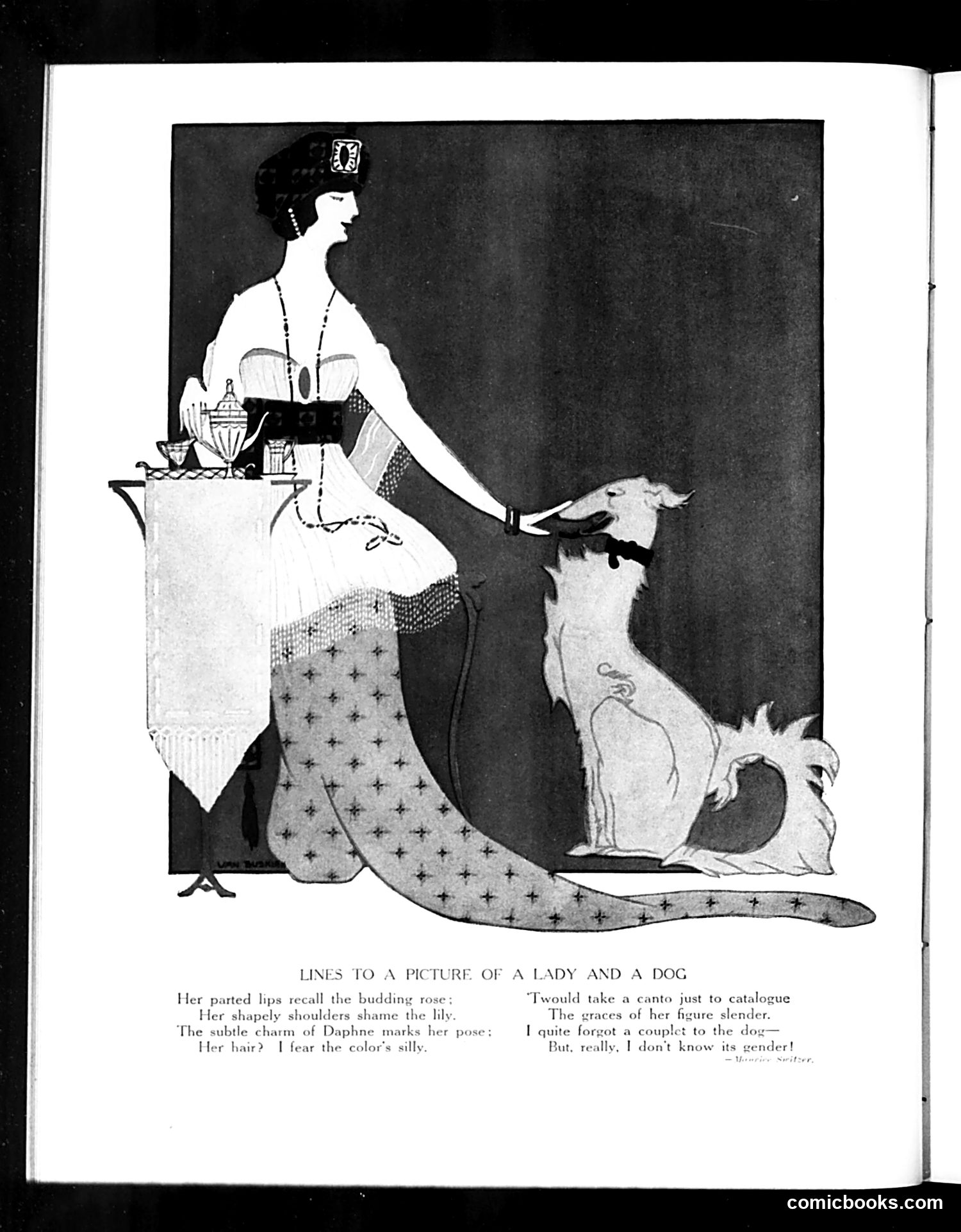
This is a satirical illustration and poem from *Judge* magazine titled "Lines to a Picture of a Lady and a Dog." The image depicts an elegantly dressed, fashionable woman in a classical pose with elaborate clothing and jewelry, attending to a small dog. The poem mockingly contrasts romantic, flowery descriptions of the woman's beauty (her lips, shoulders, hair, figure) with a humorous admission about the dog: the speaker "quite forgot a couplet to the dog—But really, I don't know its gender!" The satire targets overwrought romantic poetry and the pretentious aestheticism popular in early 20th-century high society. By dedicating elaborate verses to a woman's appearance while admitting complete indifference to an accessory pet, it ridicules both the superficiality of social portraiture and the gender-obsessed nature of period literature. The joke suggests that fashionable women were themselves treated as decorative objects, no more individualized than their lap dogs.
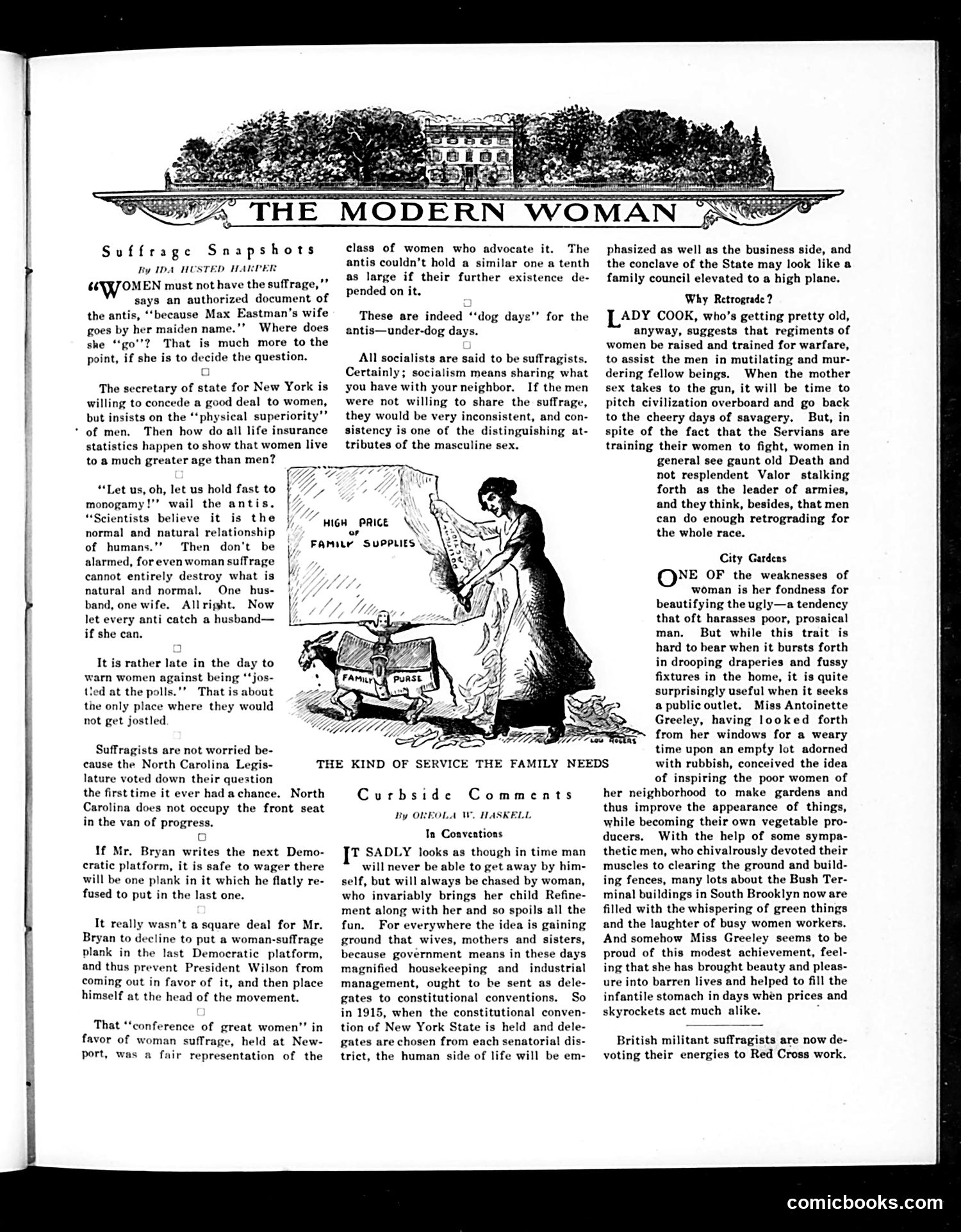
This page satirizes anti-suffrage arguments through Ida Husted Harper's column "Suffrage Snapshots." The cartoonist mocks opponents' logic—for instance, that women shouldn't vote because Max Eastman's wife uses her maiden name, or that men are "physically superior" despite women's longer lifespans. The illustration shows a woman managing household finances and supplies, satirizing the contradiction that women handle complex family budgeting but allegedly lack capacity for political decisions. The accompanying sections ridicule anti-suffrage hypocrisy: if monogamy is "natural," why fear women voting? Why worry about women being "jostled at polls" when they're jostled elsewhere? Harper also attacks William Bryan for refusing a suffrage plank in one platform, then championing it later. The commentary on constitutional conventions suggests including women would bring practical "human side" perspective to governance, not radicalism. The overall tone dismisses anti-suffrage arguments as logically inconsistent.
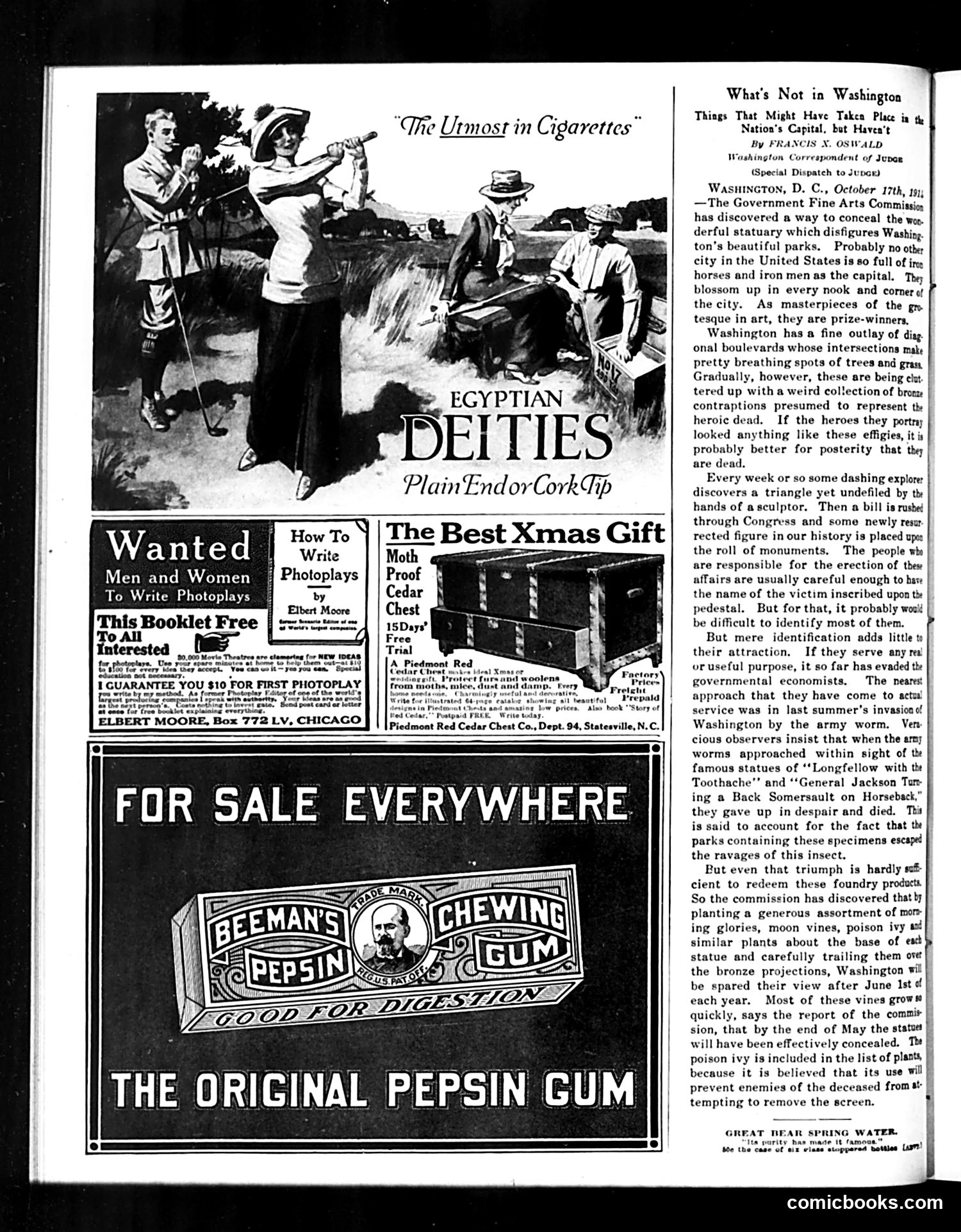
This page features a satirical column mocking Washington, D.C.'s public statuary. The author (Francis X. Oswald) argues that the city is cluttered with poorly executed bronze monuments to historical figures—"heroic dead" depicted in unflattering ways. He sarcastically suggests the statues are so ugly that if the actual heroes resembled them, "it is probably better for posterity that they are dead." The satire intensifies with absurd examples: statues titled "Longfellow with the Toothache" and "General Jackson Turning a Back Somersault on Horseback." The punchline involves a fictional government solution—concealing these eyesores by June 1st each year with climbing vines, poison ivy, and morning glories, implying the monuments serve no purpose except as targets for vandals. The critique reflects early 20th-century debates about public art quality and Washington's aesthetic disorder amid rapid monument construction.
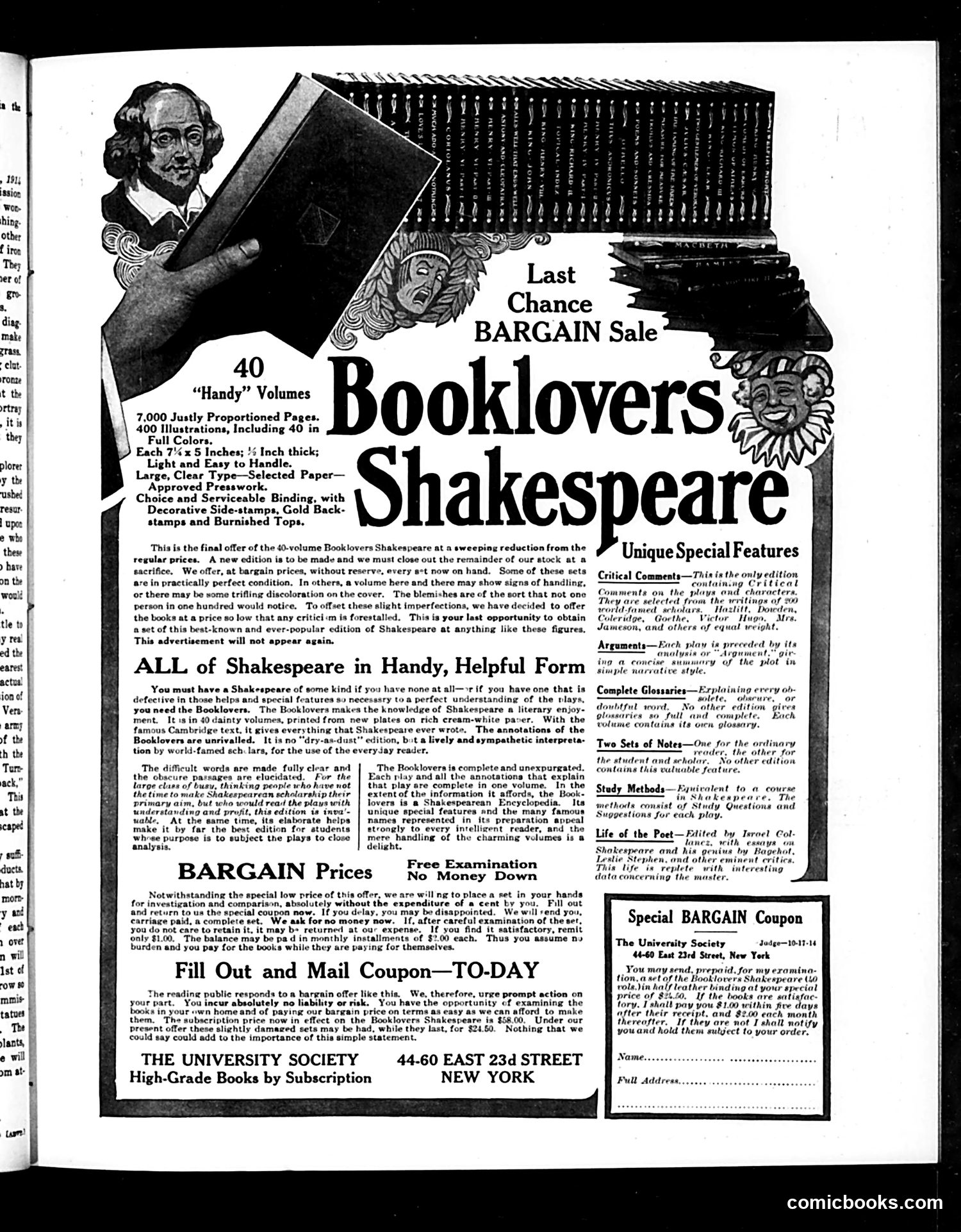
This is primarily a **mail-order advertisement**, not political satire. It promotes a discounted 40-volume Shakespeare set by The University Society (New York). The decorative header features classical imagery—a bust of Shakespeare and theatrical masks—designed to convey literary refinement and cultural value. The "Last Chance BARGAIN Sale" framing creates urgency. The advertisement emphasizes accessibility: the volumes are "handy" and "helpful," with annotations making Shakespeare comprehensible to "everyday reader[s]" rather than scholars alone. This reflects early 20th-century democratization of "high culture"—making canonical literature available to middle-class homes. The payment scheme ("no money down," installments of $2 monthly) targets working-to-middle-class consumers who couldn't afford large upfront purchases. Notably, the text addresses potential buyer hesitation about "slightly damaged" sets, attempting to normalize quality compromise for bargain prices. This reflects Judge magazine's commercial function: advertising products to its educated readership while maintaining satirical editorial content elsewhere.
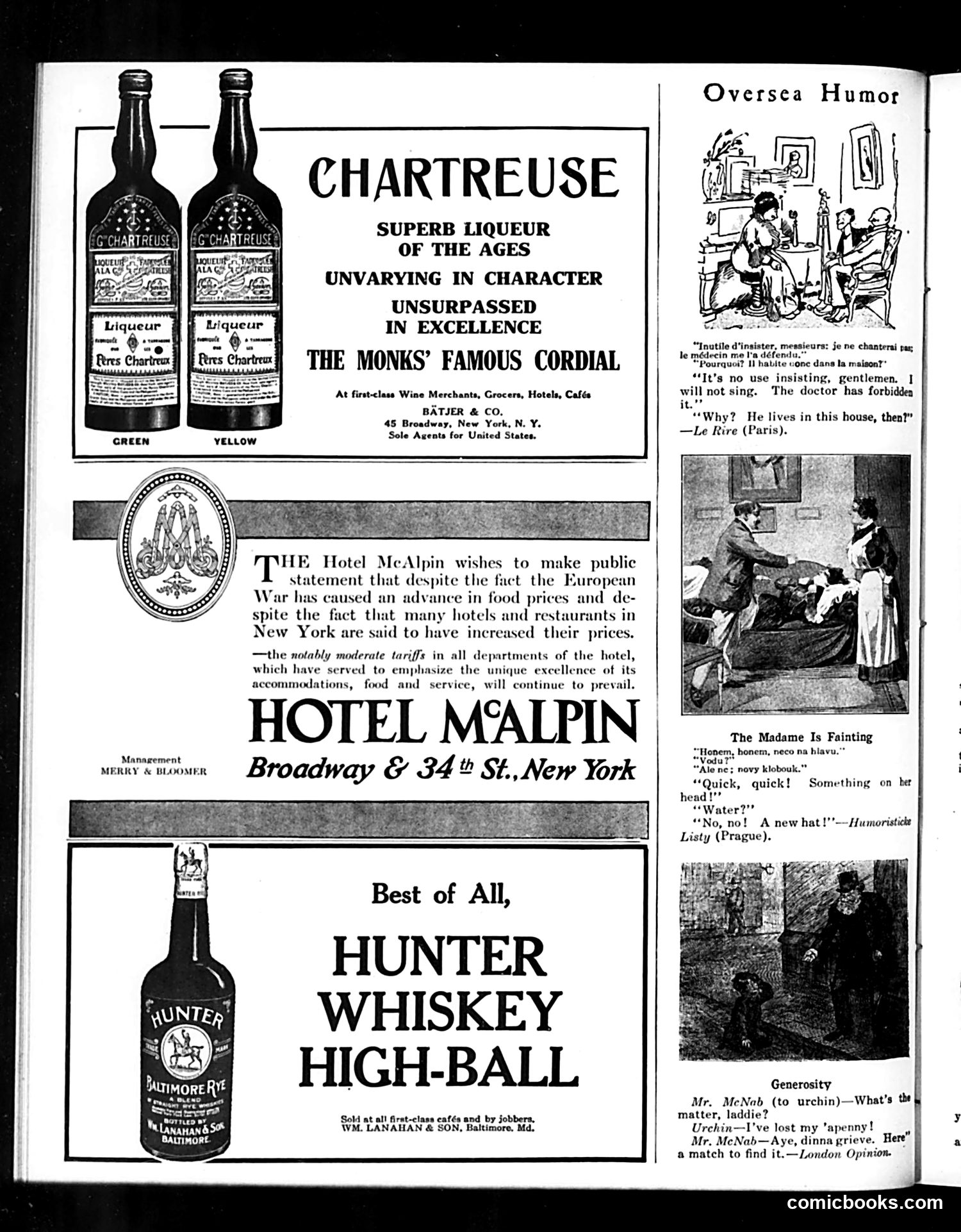
This page is primarily **advertising**, not editorial content. Three liquor ads dominate (Chartreuse, Hotel Malpin's mention of Hunter Whiskey), surrounding the main editorial feature. The right column, titled "Oversea Humor," reprints translated jokes from European publications—French (*Le Rire*), Czech (*Humoristické Listy*), and British (*London Opinion*). This was a common Judge feature showcasing international humor to American readers. The jokes are mild domestic comedies: a woman refusing to sing because her doctor forbids it (living in the same house), a fainting woman needing a new hat rather than water, and a Scotsman's miserly "generosity" (offering to help find a lost penny by searching with a match). The **Hotel Malpin advertisement** uses WWI context (referencing "European War" food price inflation) to boast of maintaining moderate prices—a patriotic/practical appeal during wartime rationing concerns. No political satire or caricature is present; this is commercial and light entertainment content.
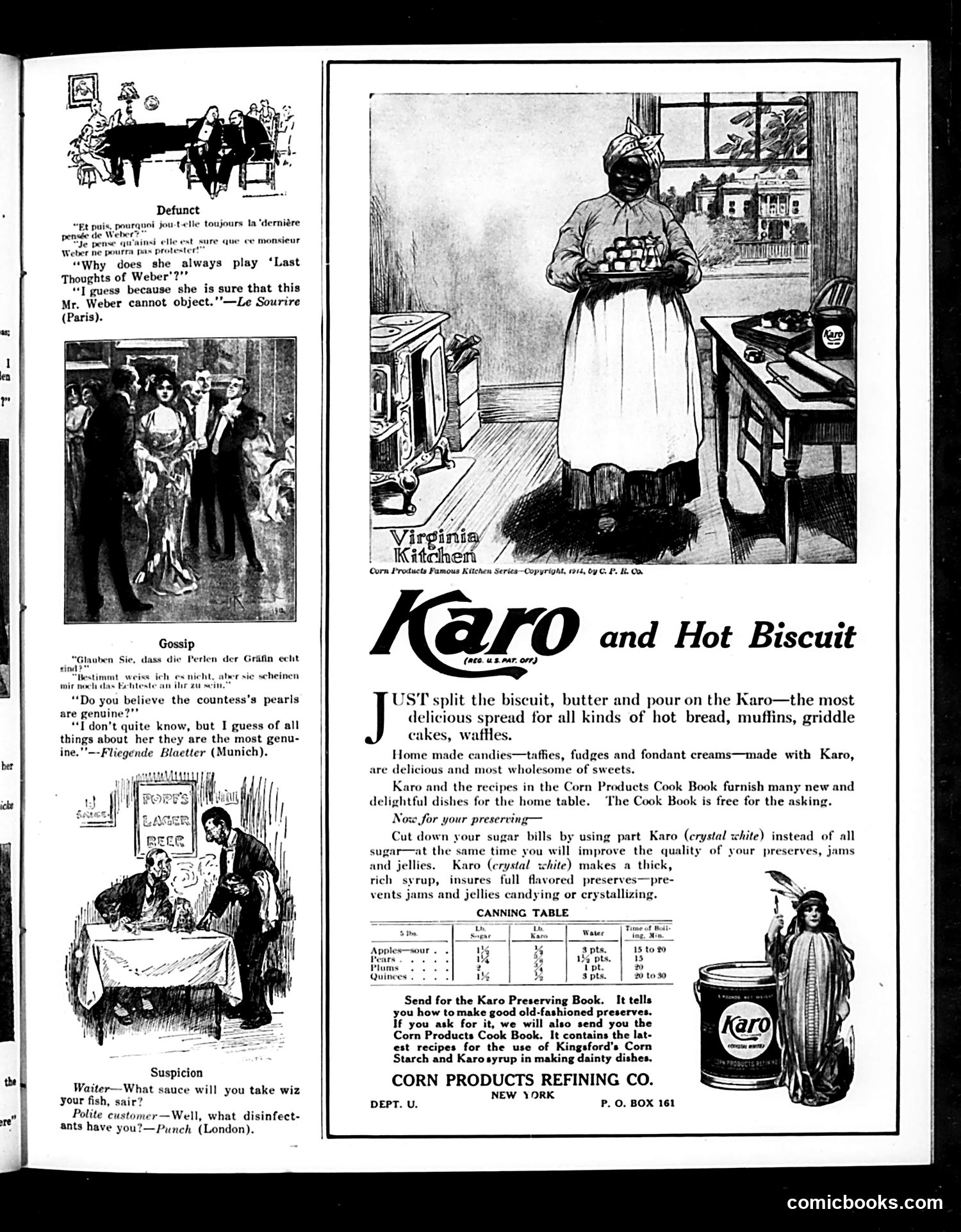
This page contains **three short satirical jokes** (translated from European sources) and a **full-page Karo syrup advertisement**. The jokes mock social pretension and hypocrisy: 1. **"Defect"**: A woman always plays the same classical piano piece because the composer (Weber) cannot object to her performance—satirizing how people exploit the dead to avoid criticism. 2. **"Gossip"**: A countess's pearls are "genuine" among her many fake attributes—mocking aristocratic fraud. 3. **"Suspicion"**: A diner asks what "disinfectants" come with fish, implying restaurant food is so suspect it needs sanitizing—a joke about food safety concerns or restaurant quality. The **Karo advertisement** dominates the right side, promoting corn syrup as a sugar substitute for preserves and baking, with a "Virginia Kitchen" illustration showing domestic food preparation. This reflects early 20th-century marketing connecting branded products to home economics.
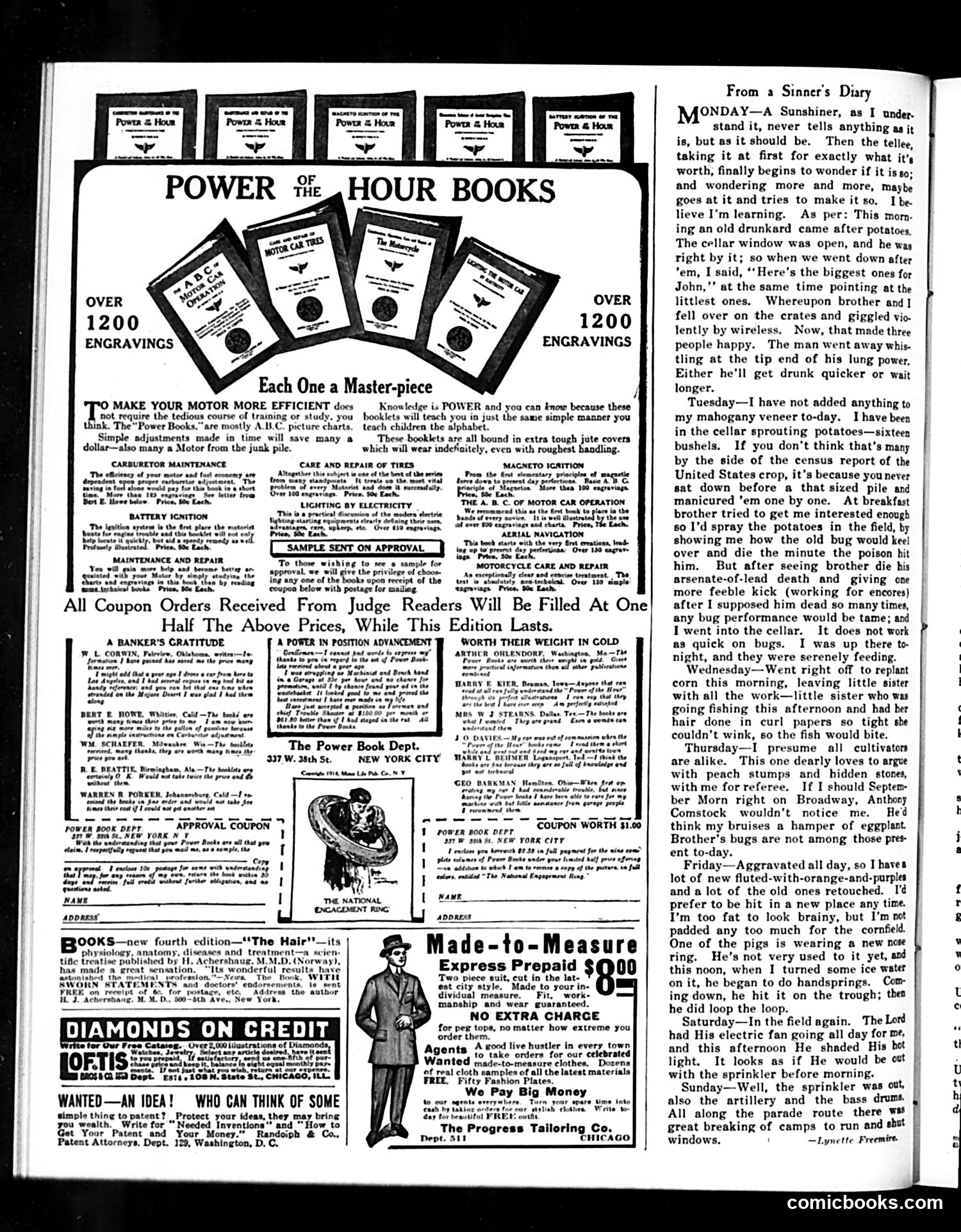
This is primarily a **commercial advertisement page** rather than political satire. The dominant content promotes "Power Books"—instructional manuals with over 1,200 engravings teaching practical skills like carburetor maintenance, motorcycle repair, and electrical work. The page reflects **early 20th-century American attitudes about self-improvement and technical knowledge**. The marketing emphasizes that complex mechanical knowledge can be learned simply "as you teach children the alphabet"—democratizing expertise for ordinary workers and motorists. The smaller testimonial boxes feature customers praising the books' clarity. One banker credits them with career advancement; others highlight practical value. The surrounding advertisements (tailored suits, patent services, inventions) reinforce the page's theme: **self-made success through accessible education and entrepreneurship**—a distinctly American commercial ideal of this era. The "From a Sinner's Diary" column (right side) appears unrelated filler content common in periodicals.
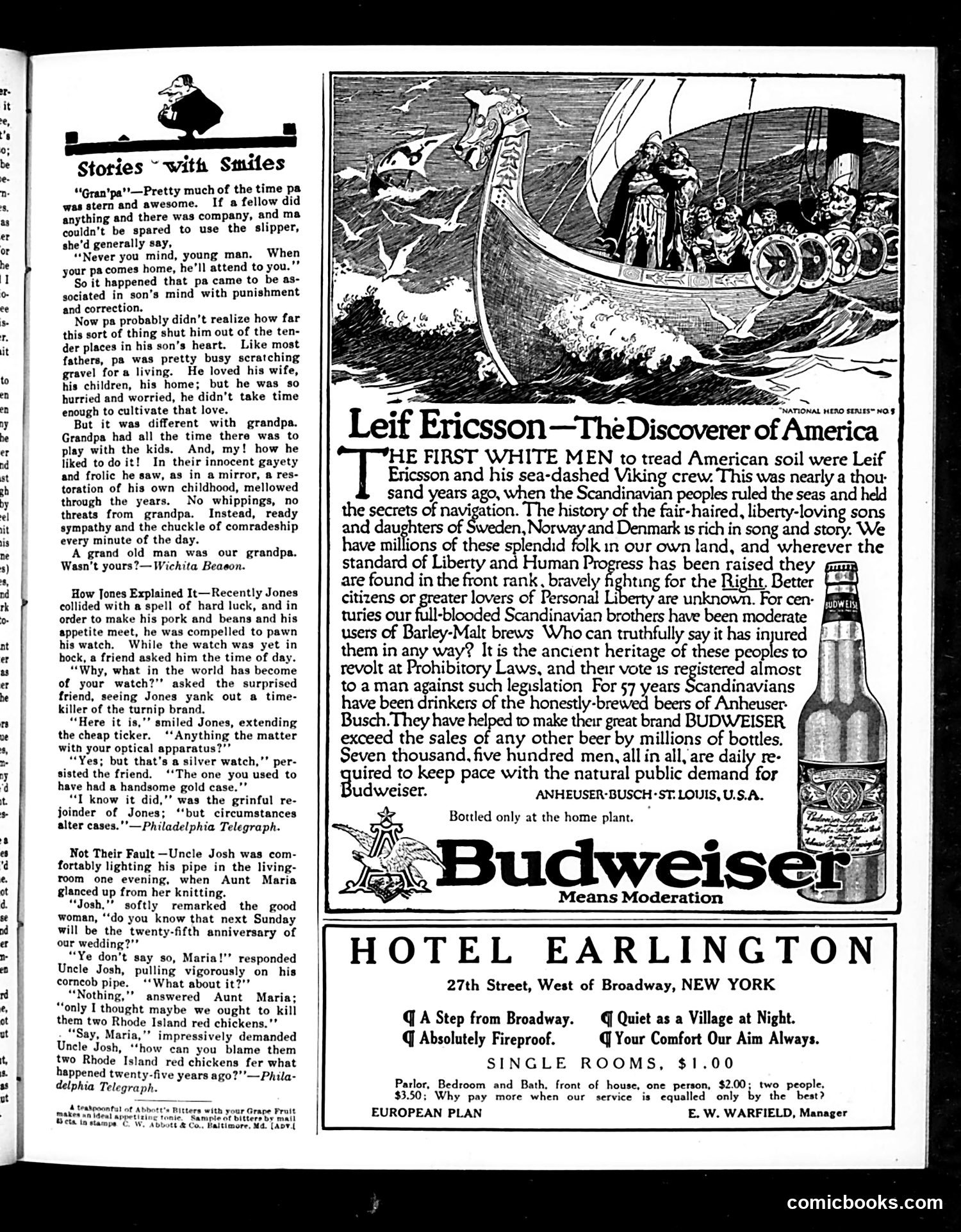
This page contains three unrelated humor stories (left column) and two advertisements (right side). The **main visual element** is a Budweiser beer advertisement featuring Leif Erikson and Viking ships. The ad makes an explicit political argument: it claims Scandinavian immigrants are "liberty-loving" people with a historical heritage of resisting prohibition laws, and therefore deserve to drink beer. This is **Prohibition-era advertising** (likely 1920s), designed to mobilize ethnic voters against alcohol bans by appealing to cultural identity and ancestral "freedom." The three short humorous stories on the left are domestic/family vignettes with no political content—one about a stern father versus a loving grandfather, another about a man who pawned his watch, and a third about a couple's anniversary. Below the beer ad is a Hotel Earlington advertisement. **Key context for moderns**: The Budweiser ad represents how breweries fought Prohibition by framing beer consumption as ethnic heritage and personal liberty—a strategy targeting immigrant communities.
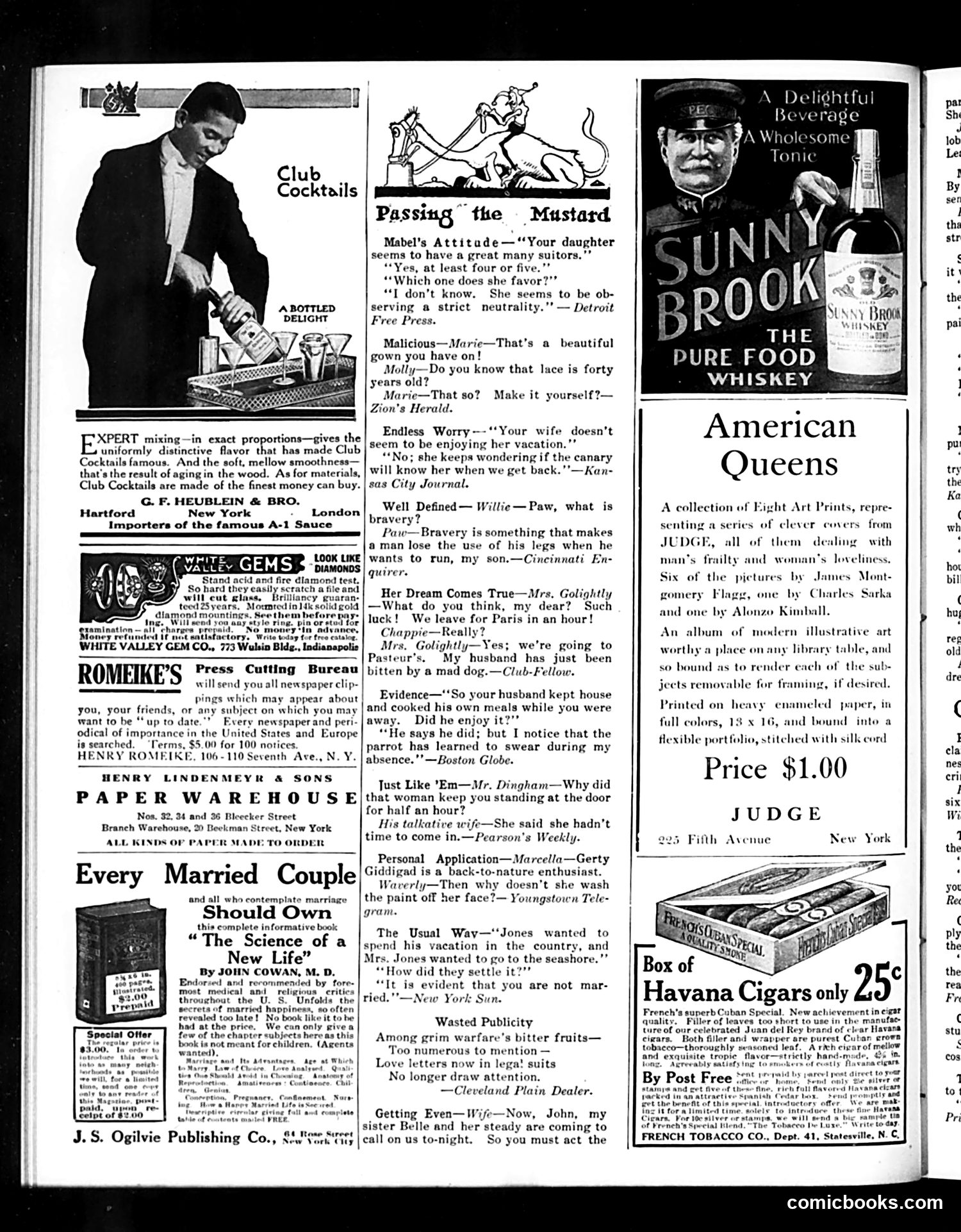
This is primarily an **advertising page** from Judge magazine with several brief humorous anecdotes scattered throughout. The main cartoon titled **"Passing the Mustard"** features dialogue jokes about courtship and marriage—typical domestic humor of the era. The jokes mock married life anxieties (wives worrying about canaries during vacation), bravery defined as losing leg-use when wanting to run, and marital miscommunications. One notable anecdote references **Pasteur** (the rabies treatment), joking that a woman is eager to go there after her husband was bitten by a mad dog—dark humor playing on contemporary medical knowledge. The page is dominated by ads for **Club Cocktails** (liquor), a press-clipping service, marriage advice books, cigars, and art prints—reflecting 1910s consumer culture and Prohibition-era attitudes toward alcohol advertising. The **"American Queens"** art-print advertisement promotes illustrations by contemporary artists like Montgomery Flagg, marketed as respectable home decoration. The content reflects period gender attitudes and domestic concerns.
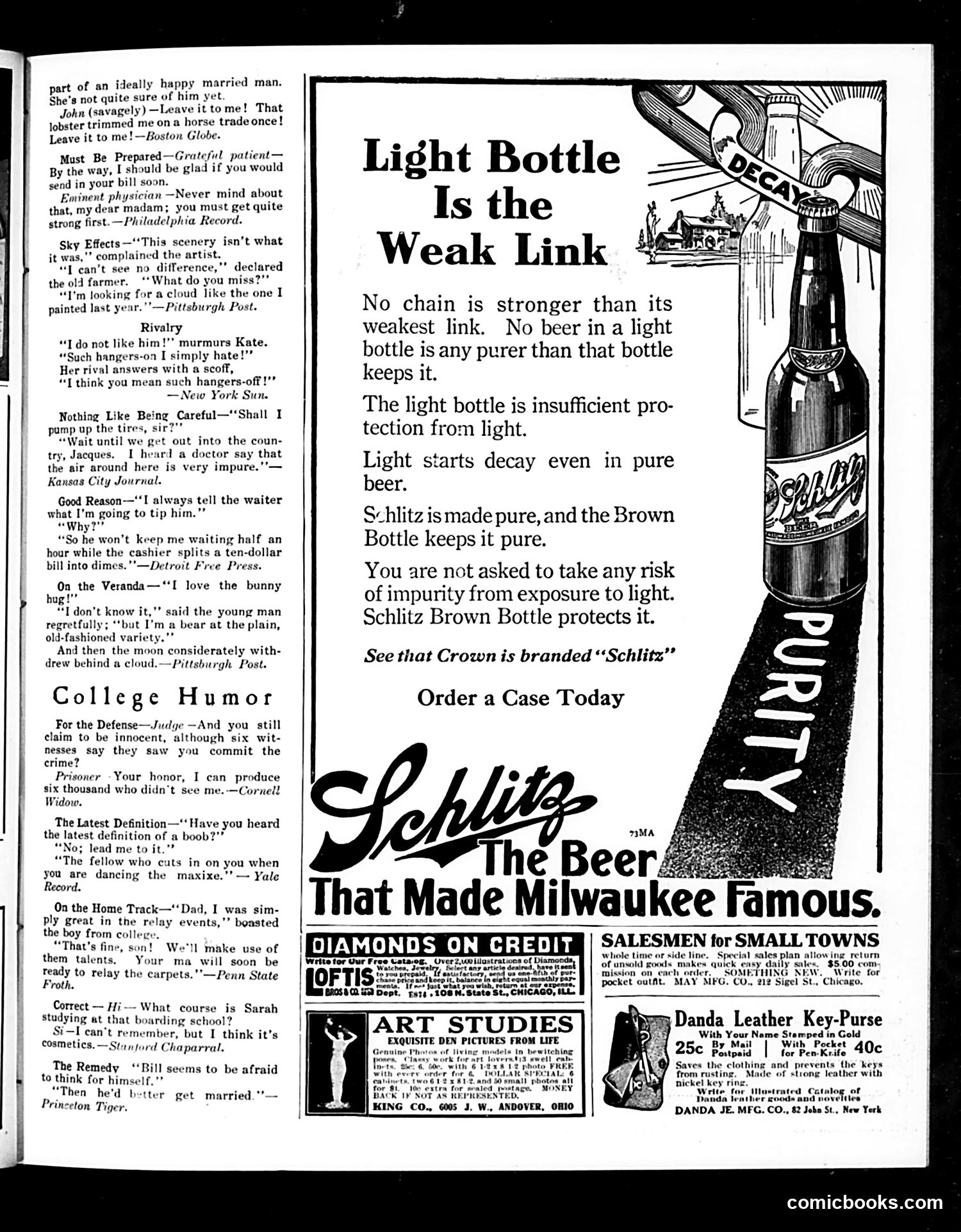
This page combines satirical humor with period advertising. The left side features "College Humor"—brief jokes on topics like marriage, medical advice, and dancing fashions (the "maxixe," a popular dance). These jokes mock human pretension and social conventions typical of early 20th-century American life. The dominant right-side advertisement for Schlitz beer promotes its brown bottle as superior protection against light damage to beer quality. This reflects genuine concerns of the era: before refrigeration and modern preservation, light exposure caused beer to spoil. The ad uses scientific rhetoric ("No chain is stronger than its weakest link") to market a practical product advantage. The page also advertises diamonds on credit, art studies, and leather key-purses—typical consumer goods of the period. The overall layout represents Judge's business model: satirical content supporting commercial advertisements aimed at educated, middle-class readers.
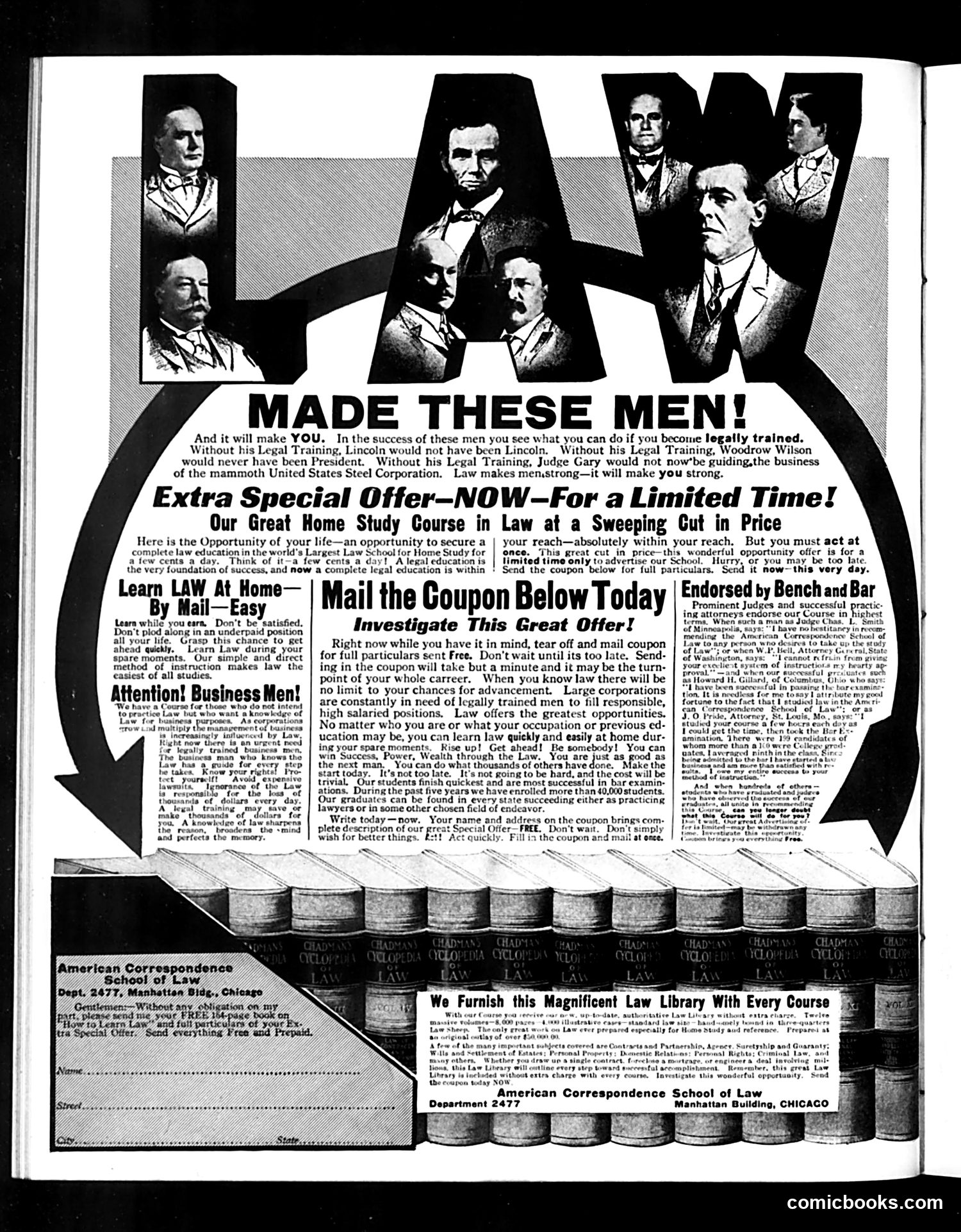
This page is primarily a **commercial advertisement**, not political satire. It promotes the American Correspondence School of Law's home-study program. The top section uses **testimonial advertising**, featuring portraits of famous men (Lincoln, Woodrow Wilson, and Judge Gary of U.S. Steel) with the claim that legal training made them successful. This appeals to ambition—suggesting that by taking their correspondence course, ordinary people could rise to prominence. The advertisement emphasizes affordability ("a few cents a day") and convenience (learning by mail in spare time), targeting business people and working men eager to advance. The "Endorsed by Bench and Bar" section uses credibility-building quotes from judges to legitimize the program. The extensive text, coupon format, and repeated urgency ("act at once," "limited time") are characteristic of aggressive early-20th-century direct-mail marketing. There is no satire here—Judge magazine is simply providing paid advertising space, which was common for popular publications of that era.