
Judge, 1914-10-17 · page 12 of 24
Judge — October 17, 1914 — page 12: what you’re looking at
What you’re looking at
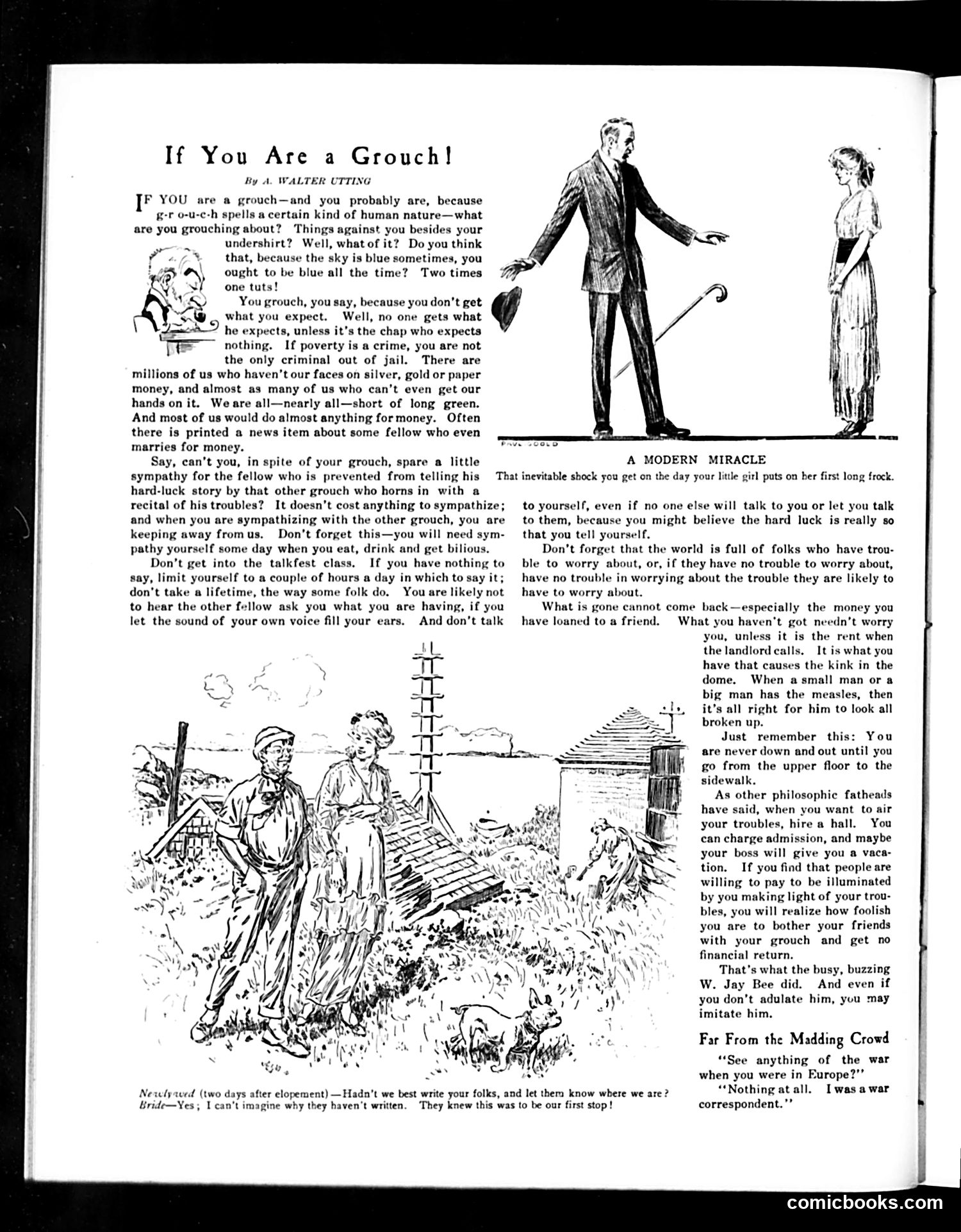
This article by A. Walter Utting satirizes chronic complainers and pessimists. The writer argues that grouching is pointless: poverty is widespread, no one gets what they expect, and complaining drives away sympathy from others. The piece mocks people who monopolize conversations with sob stories and those who "hire a hall" to air grievances. The accompanying cartoons reinforce this: one shows a newlywed couple (captioned "A Modern Miracle") where the bride has worn her first long dress—a humorous, trivial "shock." Another depicts laborers, likely illustrating working-class grouchiness about economic hardship. The closing anecdote references W. Jay Bee (likely a contemporary public figure, unclear which one) as someone who avoids complaining. The final cartoon shows an elopement, with the bride's parent complaint being ignored. The satire targets early 20th-century American pessimism and self-pity while promoting stoic acceptance and positive outlook.
📄 Transcribed text from this page (OCR, searchable)
Machine-transcribed from the original scan — historical spelling and the odd misread are preserved.
If You Are a Grouch! By A. WALTER UTTING F YOU are a grouch—and you probably are, because g-r o-u-c-h spells a certain kind of human nature—what are you grouching about? Things against you besides your undershirt? Well, what of it? Do you think that, because the sky is blue sometimes, you ought to be blue all the time? Two times one tuts! You grouch, you say, because you don’t get what you expect. Well, no one gets what he expects, unless it’s the chap who expects nothing. If poverty is a crime, you are not the only criminal out of jail. There are millions of us who haven’t our faces on silver, gold or paper money, and almost as many of us who can’t even get our hands on it. We are all—nearly all—short of long green. And most of us would do almost anything formoney. Often there is printed a news item about some fellow who even marries for money. Say, can’t you, in spite of your grouch, spare a little sympathy for the fellow who is prevented from telling his hard-luck story by that other grouch who horns in with a recital of his troubles? It doesn’t cost anything to sympathize; and when you are sympathizing with the other grouch, you are keeping away fromus. Don't forget this—you will need sym- pathy yourself some day when you eat, drink and get bilious. Don’t get into the talkfest class. If you have nothing to say, limit yourself to a couple of hours a day in which to say it; don’t take a lifetime, the way some folk do. You are likely not to hear the other fellow ask you what you are having, if you let the sound of your own voice fill your ears. And don’t talk ye = Sat5t=|=| oF ale 5 Ways * &, - ; ts SON welds . Me ule! That's what the busy, buzzing A MODERN MIRACLE That inevitable shock you get on the day your little girl puts on ber first long frock. to yourself, even if no one else will talk to you or let you talk to them, because you might believe the hard luck is really so that you tell yourself. Don’t forget that the world is full of folks who have trou- ble to worry about, or, if they have no trouble to worry about, have no trouble in worrying about the trouble they are likely to have to worry about. What is gone cannot come back—especially the money you have loaned to a friend. What you haven't got needn’t worry you, unless it is the rent when the landlordcalls. It is what you have that causes the kink in the dome, When a small man or a big man has the measles, then it’s all right for him to look all broken up. Just remember this: You are never down and out until you go from the upper floor to the sidewalk, As other philosophic fatheads have said, when you want to air your troubles, hire a hall. You can charge admission, and maybe your boss will give you a vaca- tion. If you find that people are willing to pay to be illuminated by you making light of your trou- bles, you will realize how foolish you are to bother your friends with your grouch and get no financial return. W. Jay Bee did. And even if you don’t adulate him, you may imitate him, Far From the Madding Crowd “See anything of the war when you were in Europe?’’ “Nothing atall. Iwas awar Nexclyaved (two days after elopement) —Hadn't we best write your folks, and let them know where we are? Bride—Yes , I can't imagine why they haven't written. ‘They knew this was to be our first stop! correspondent.’” comicbooks.com