
Judge, 1914-10-17 · page 4 of 24
Judge — October 17, 1914 — page 4: what you’re looking at
What you’re looking at
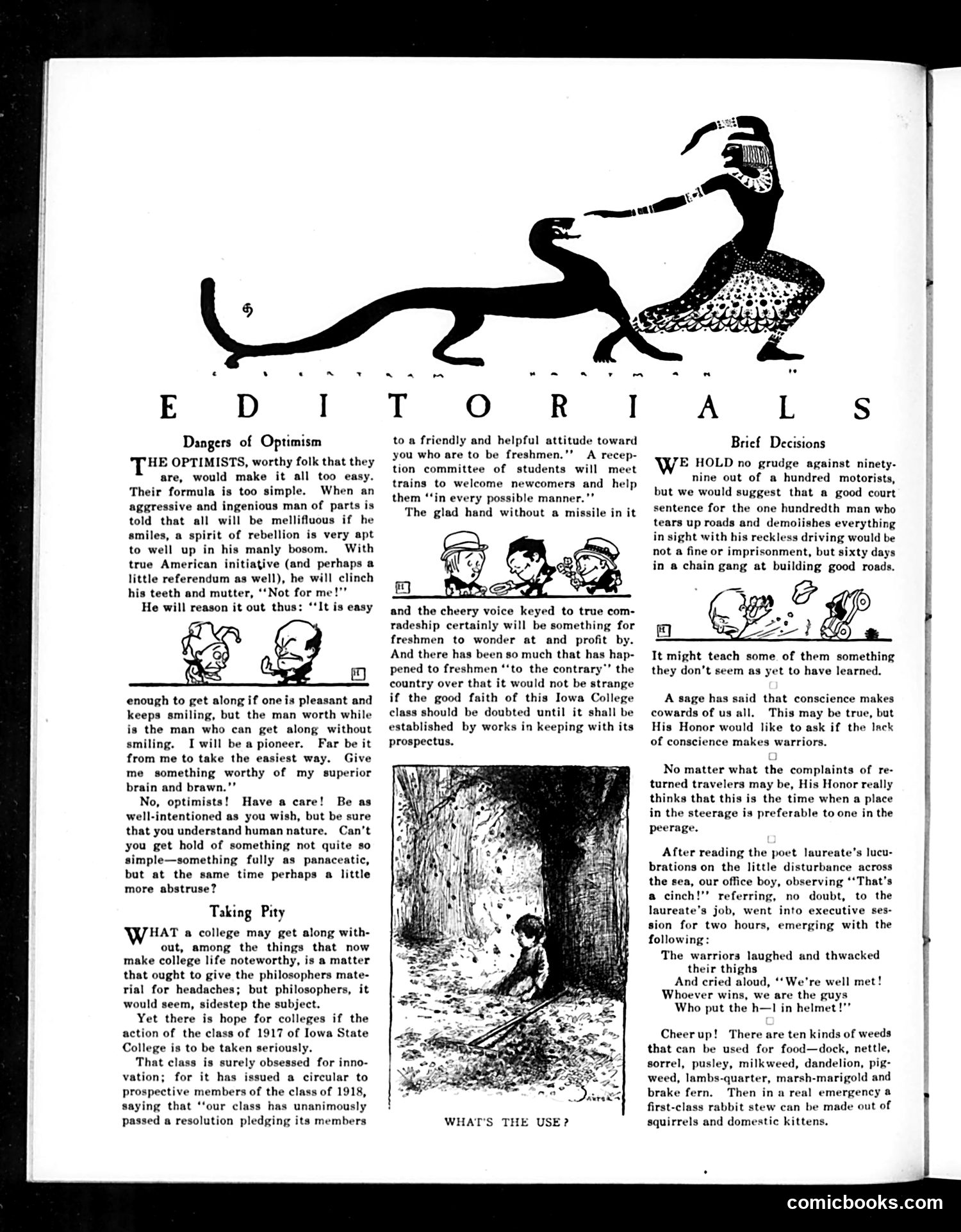
This page contains three opinion pieces about college life, likely from around 1917 (referencing Iowa State College's class of 1917). **"Dangers of Optimism"** critiques overly idealistic freshmen, warning against naive rebelliousness and excessive confidence. The accompanying caricature shows two exaggerated figures in conflict. **"Taking Pity"** discusses college administrators' challenges managing student behavior and innovation, suggesting that while classes generate useful ideas, they also create headaches requiring careful oversight. **"Brief Decisions"** addresses reckless driving among motorists, advocating for harsh penalties to discourage dangerous behavior on roads—a contemporary social concern. The woodcut illustration labeled "WHAT'S THE USE?" depicts a child examining something on the ground, though its connection to the surrounding text remains unclear from this excerpt.
📄 Transcribed text from this page (OCR, searchable)
Machine-transcribed from the original scan — historical spelling and the odd misread are preserved.
Dangers of Optimism THE OPTIMISTS, worthy folk that they are, would make it all too easy. Their formula is too simple. When an aggressive and ingenious man of parts is told that all will be mellifluous if he smiles, a spirit of rebellion is very apt to well up in his manly bosom. With true American initiative (and perhaps a little referendum as well), he will clinch his teeth and mutter, ‘‘Not for me!"" He will reason it out thus: ‘It is easy enough to get along if oneis pleasant and keeps smiling, but the man worth while is the man who can get along without smiling. Iwill be a pioneer. Far be it from me to take the easiest way. Give me something worthy of my superior brain and brawn.’’ No, optimists! Have a care! Be as well-intentioned as you wish, but be sure that you understand human nature. Can’t you get hold of something not quite so simple—something fully as panaceatic, but at the same time perhaps a little more abstruse? Taking Pity wat a college may get along with- out, among the things that now make college life noteworthy, is a matter that ought to give the philosophers mate- rial for headaches; but philosophers, it would seem, sidestep the subject. Yet there is hope for colleges if the action of the class of 1917 of Iowa State College is to be taken seriously. That class is surely obsessed for inno- vation; for it has issued a circular to prospective members of the class of 1918, saying that ‘‘our class has unanimously passed a resolution pledging its members to a friendly and helpful attitude toward you who are to be freshmen.’’ A recep- tion committee of students will meet trains to welcome newcomers and help them ‘‘in every possible manner."’ The glad hand without a missile in it and the cheery voice keyed to true com- radeship certainly will be something for freshmen to wonder at and profit by. And there has been so much that has hap- pened to freshmen ‘‘to the contrary’’ the country over that it would not be strange if the good faith of this Iowa College class should be doubted until it shall be established by works in keeping with its prospectus. WHAT'S THE USE? Brief Decisions WE HOLD no grudge against ninety- nine out of a hundred motorists, but we would suggest that a good court sentence for the one hundredth man who tears up roads and demolishes everything in sight with his reckless driving would be not a fine or imprisonment, but sixty days in a chain gang at building good roads. It might teach some of them something they don’t seem as yet to have learned. A sage has said that conscience makes cowards of us all. This may be true, but His Honor would like to ask if the lack of conscience makes warriors. No matter what the complaints of re- turned travelers may be, His Honor really thinks that this is the time when a place in the steerage is preferable to one in the peerage. After reading the poet laureate’s lucu- brations on the little disturbance across the sea, our office boy, observing ‘That's a cinch!’”’ referring, no doubt, to the laureate’s job, went into executive ses- sion for two hours, emerging with the following: The warriors laughed and thwacked their thighs And cried aloud, ‘‘ We're well met! Whoever wins, we are the guy Who put the h—I in helmet Cheerup! There are ten kinds of weeds that can be used for food—dock, nettle, sorrel, pusley, milkweed, dandelion, pig- weed, lambs-quarter, marsh-marigold and brake fern. Then ina real emergency @ first-class rabbit stew can be made out of squirrels and domestic kittens. , i comicbooks.com