
A complete issue · 24 pages · 1914
Judge — July 11, 1914
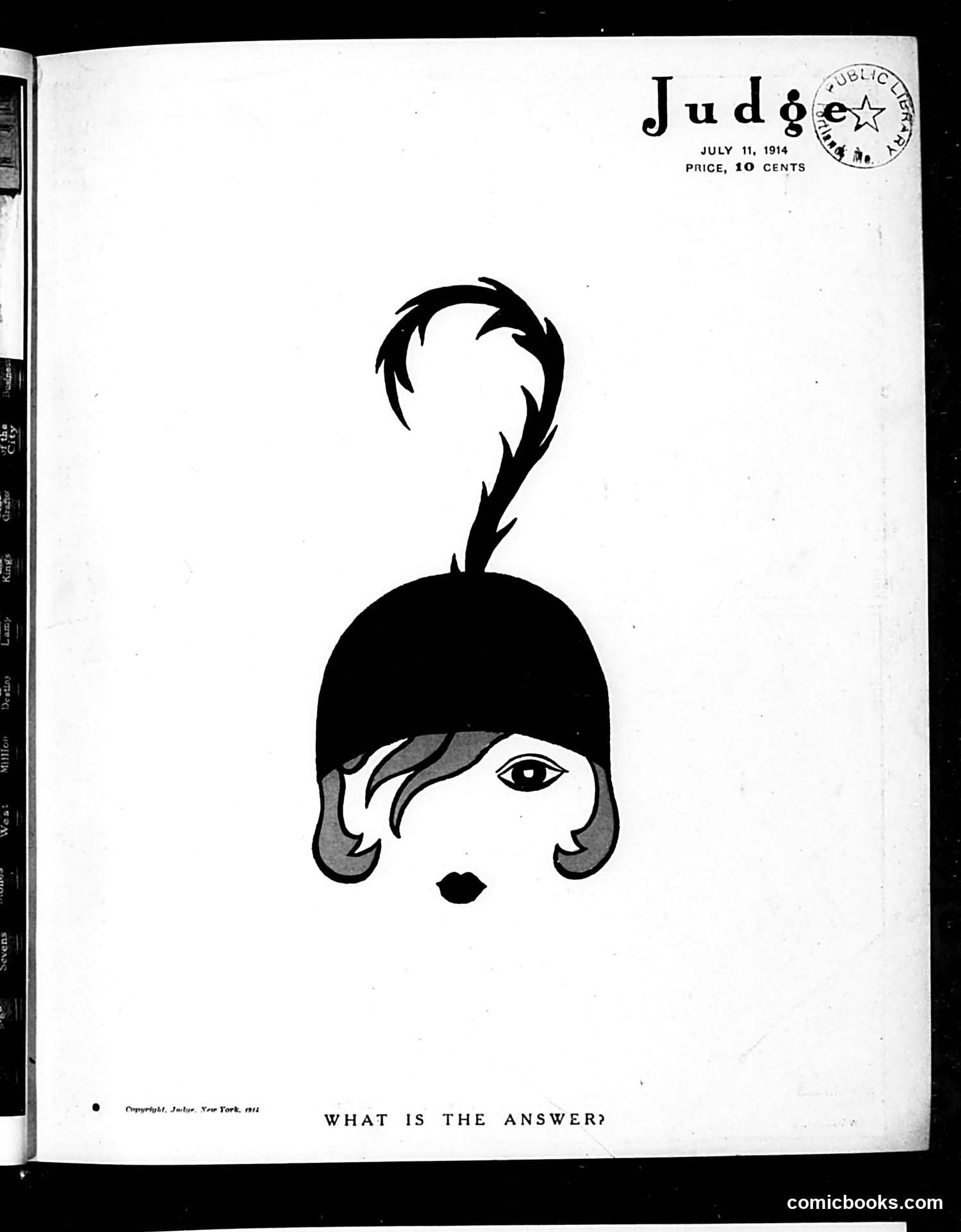
This cover presents a stylized female head with an elaborate feathered headdress and the text "WHAT IS THE ANSWER?" The imagery appears to reference early 1910s fashion and aesthetics, particularly the elaborate millinery styles popular among wealthy women of that era. The "question mark" formed by the feathered plume suggests satirical commentary, likely critiquing either: - Extravagant women's fashion trends of the period - Questions about women's social roles or suffrage (active debates in 1914) - The superficiality or impracticality of contemporary style Without additional context or visible captions, the specific target remains unclear, though Judge's typical focus was social and political satire aimed at upper-class pretension and contemporary controversies.
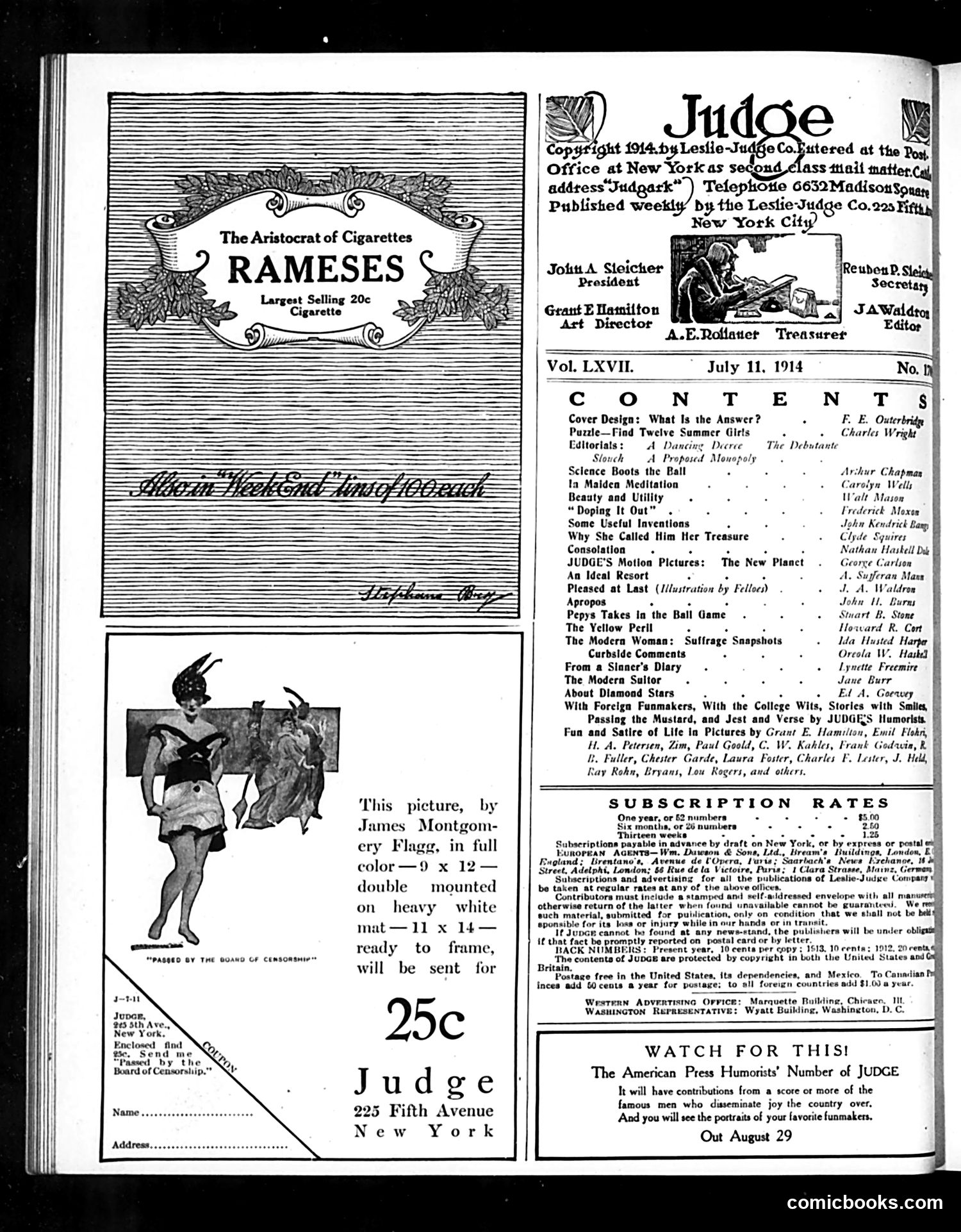
This page is primarily **advertising and masthead information** rather than satirical content. The left side features a Ramses cigarette advertisement (a luxury brand of the era) and below it, an illustration with the caption "Passed by the Board of Censorship." This image appears to show a figure in minimal clothing, likely satirizing overly strict censorship boards by depicting something they would have forbidden. The right page shows Judge's masthead and table of contents for Vol. LVII, listing various humor pieces and contributors typical of the magazine's satirical format. The "Watch For This!" section advertises an upcoming American Press Humorists' special number. The overall page reflects **1914 popular culture and publishing conventions** rather than specific political commentary.
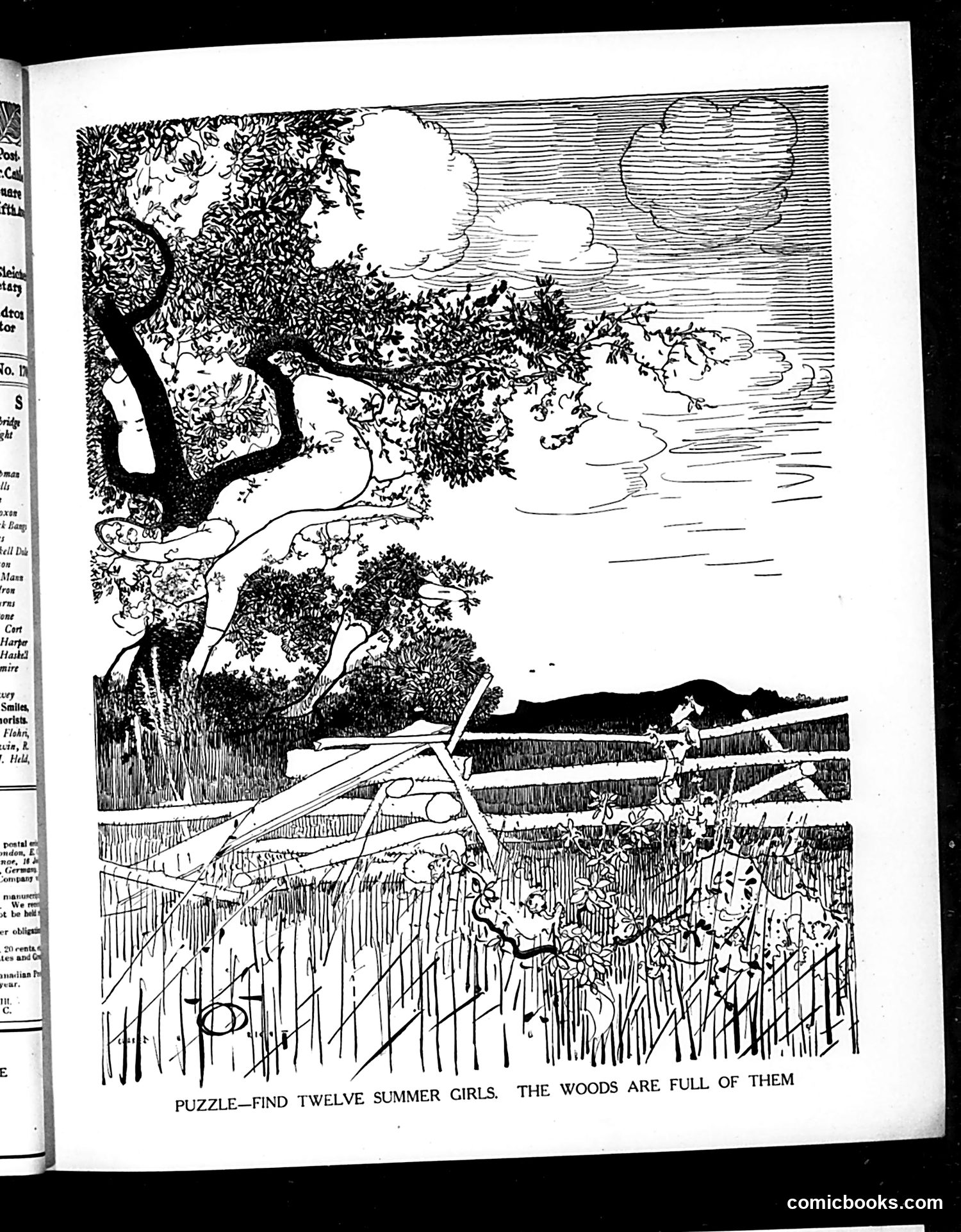
This page from *Judge* magazine presents a visual puzzle game rather than political satire. The caption reads "PUZZLE—FIND TWELVE SUMMER GIRLS. THE WOODS ARE FULL OF THEM." The illustration depicts a pastoral summer landscape with a large tree, fence, field, and distant hills. The artwork uses intricate cross-hatching and line work typical of early-to-mid 20th century magazine illustration. The joke appears to be a visual "hide and seek" challenge where female figures are obscured within the dense foliage and landscape details—readers were invited to locate twelve girls hidden throughout the scene. This represents leisure entertainment content common in illustrated magazines of the era, offering interactive amusement rather than commentary on current events or social issues.
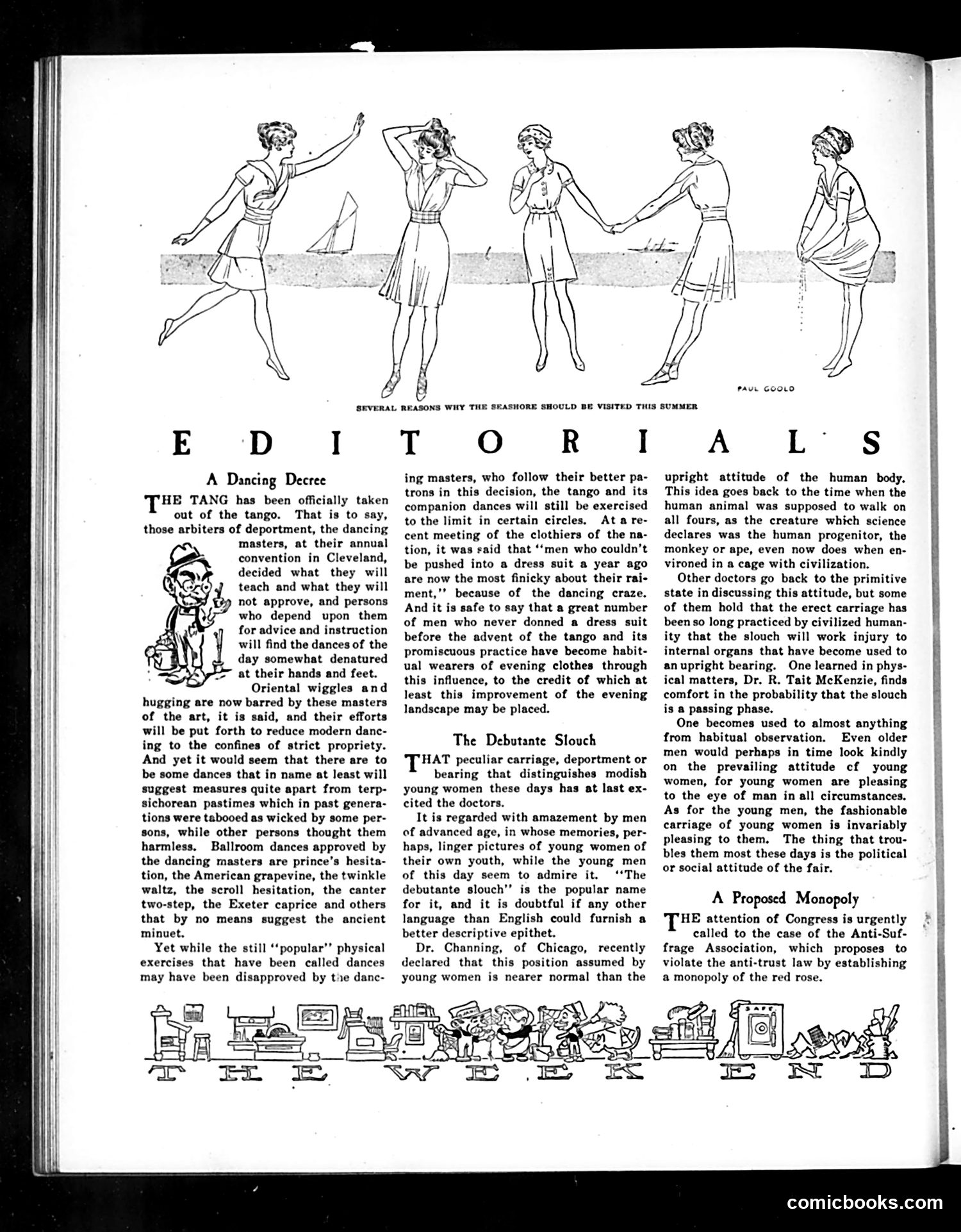
This page contains three satirical commentary pieces on 1920s social issues: 1. **"A Dancing Decree"**: Critiques the tango's popularity and its influence on fashion and deportment. The piece mocks how dance teachers were promoting the tango while some deemed it improper, and notes that the "dancing craze" prompted men to wear evening clothes more frequently—presented as both amusing and slightly absurd. 2. **"The Debutante Slouch"**: Satirizes young women's posture, specifically their fashionable "slouching" carriage. The author notes this posture was considered more "normal" than previous rigid standards, reflecting changing attitudes about women's physical bearing and deportment. 3. **"A Proposed Monopoly"**: A brief item about Congressional attention to the Anti-Suffrage Association's proposal regarding red roses—likely a minor political controversy. The illustrations show women in various dance poses, emphasizing the era's preoccupation with modern dance and changing social conventions.
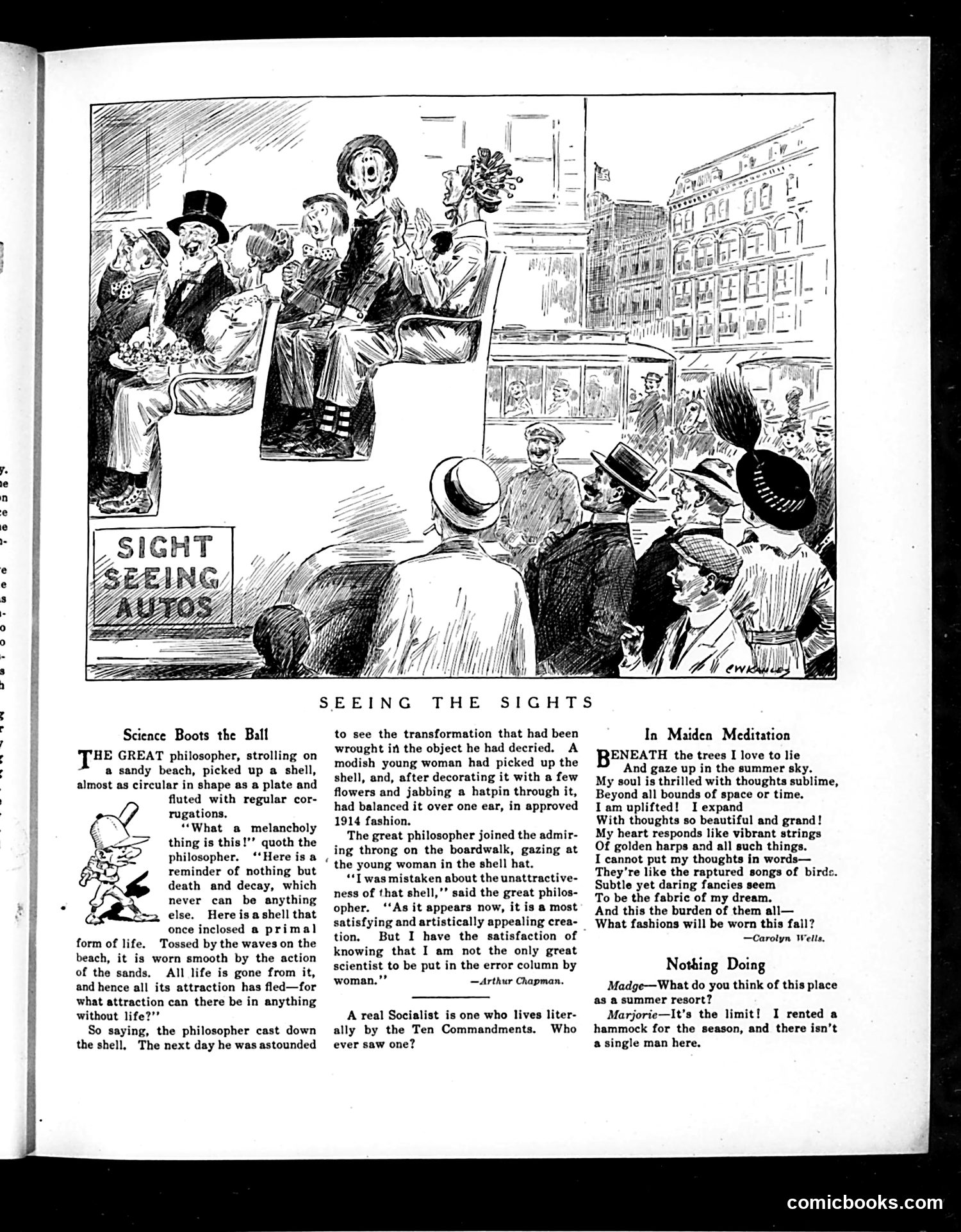
This Judge magazine page satirizes early 1900s urban tourism and shallow intellectualism. The top cartoon shows "Sightseeing Autos"—tourists in a vehicle gawking at city sights while conducting superficial observations. The left column's "Science Boots the Ball" mocks a pompous philosopher who reduces life's complexity to a shell's shape, then discards the object when proven wrong. The satire critiques pretentious intellectuals who adopt grandiose theories without genuine understanding. The right column's poem "In Maiden Meditation" romanticizes daydreaming, while "Nothing Doing" jokes about summer resort boredom—a woman complains a resort is overcrowded even with just one man present, suggesting sparse clientele. Overall, the page ridicules superficial thinking, pompous philosophy, and vacation ennui among the upper classes.
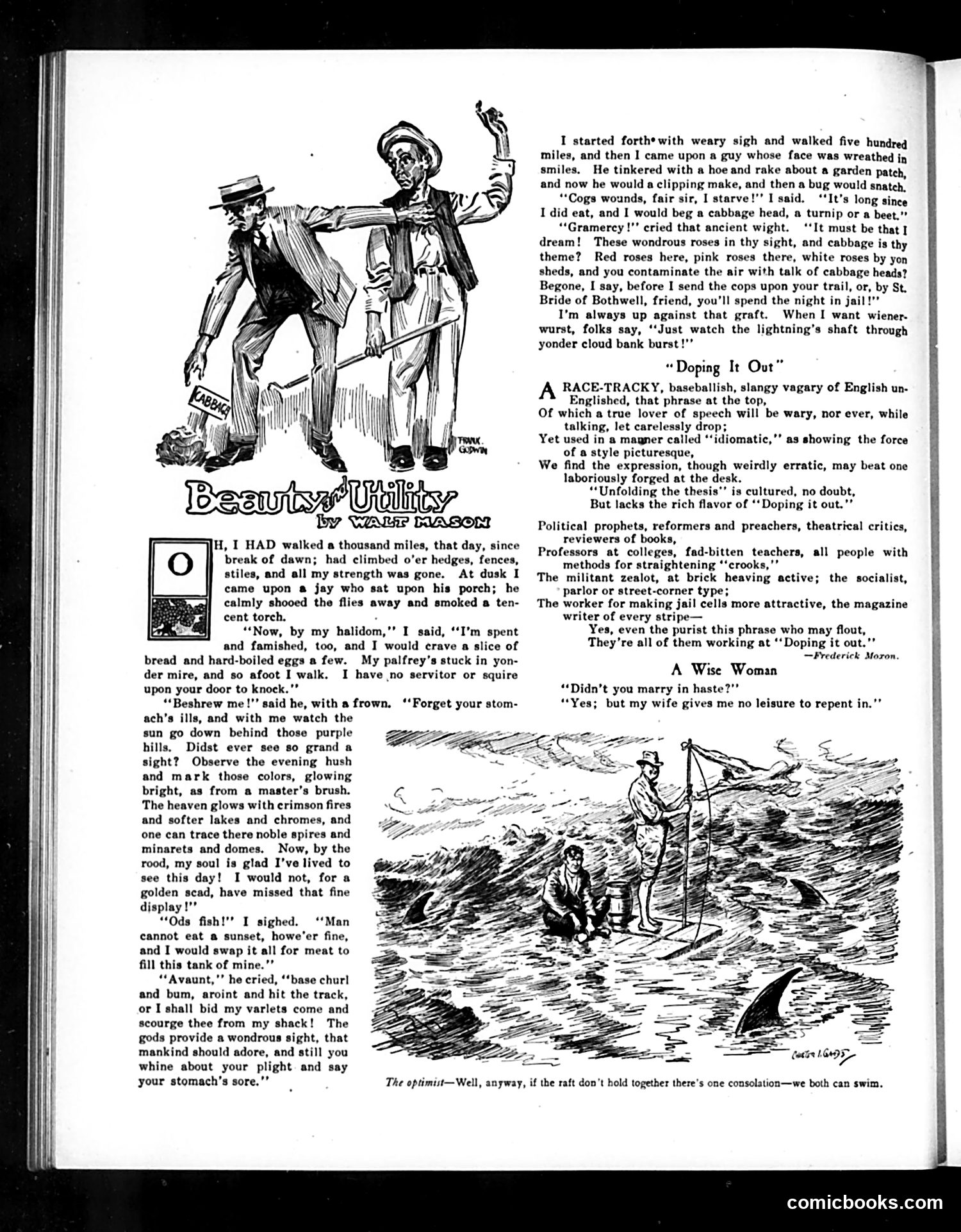
This *Judge* page contains three satirical pieces. The main cartoon "Beauty and Utility" contrasts two figures: an aesthete who dismisses a starving traveler's pleas for food while waxing poetic about sunsets and garden roses, and a second character obsessed with his roses who likewise refuses sustenance to a beggar. The satire targets Gilded Age elites who prioritize art, beauty, and property over human welfare—a critique of class indifference during economic hardship. "Doping It Out" is a linguistic commentary praising American slang phrases over formal speech, celebrating colloquial vigor. The final joke about hasty marriage is straightforward domestic humor: marrying quickly means no time for regret because the spouse keeps one busy. Overall, the page reflects Progressive-Era concerns about wealth inequality and artistic pretension divorced from social responsibility.
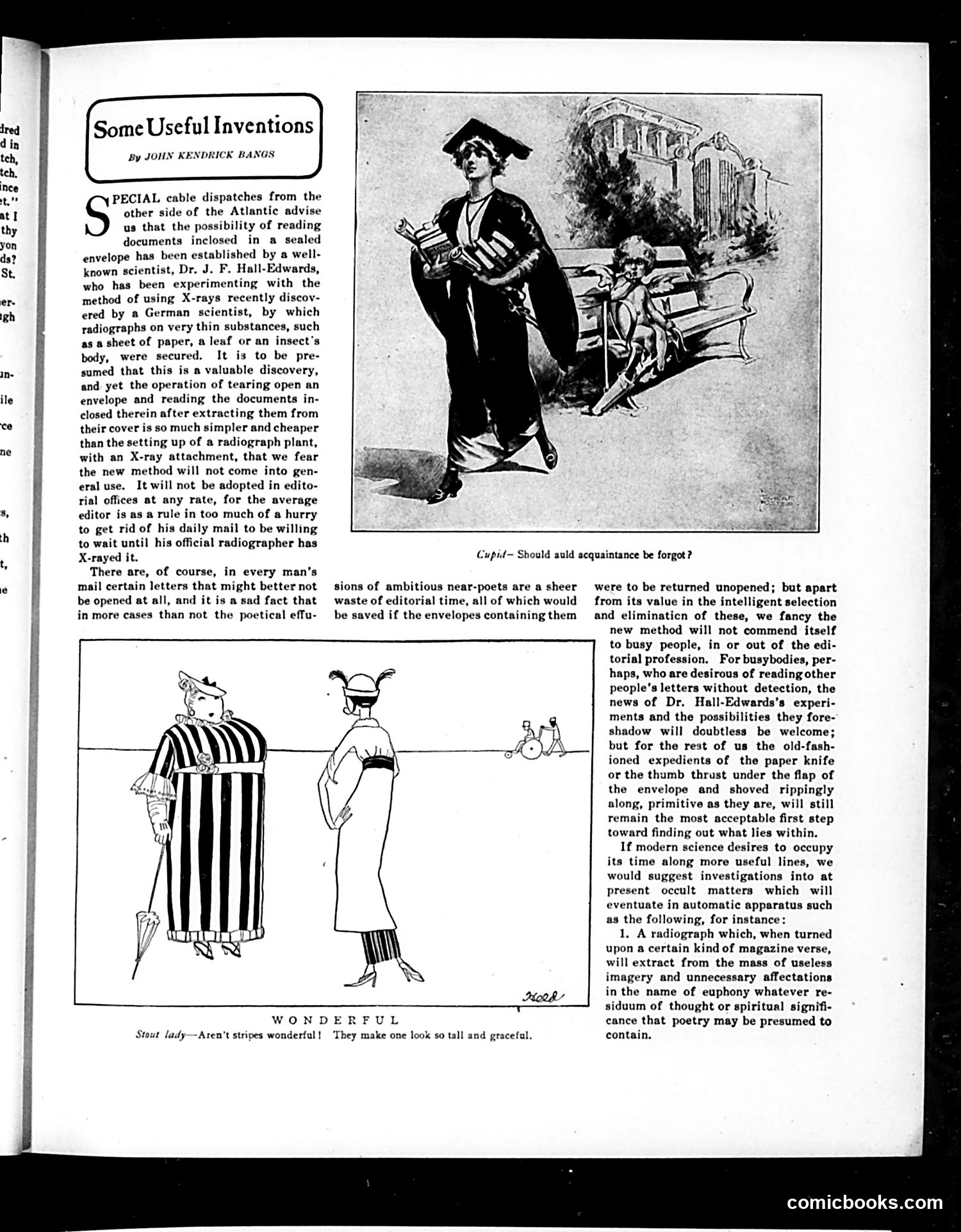
This satirical piece by John Kendrick Bangs mocks the impracticality of new X-ray technology for reading sealed letters. Dr. J.F. Hall-Edwards, a real scientist, had demonstrated X-rays could photograph contents through envelopes—a genuine technical achievement. Bangs argues humorously that editors are too busy to wait for X-ray processing when a simple letter opener works fine. He suggests X-rays might appeal only to "busybodies" wanting to read others' mail secretly. The cartoons are unrelated quips: the top shows a postman with an armful of mail; the bottom depicts two women where one compliments the other's vertical stripes as slimming—typical period fashion humor. The piece satirizes both the gap between scientific innovation and practical utility, and the gossipy impulse to read private correspondence.
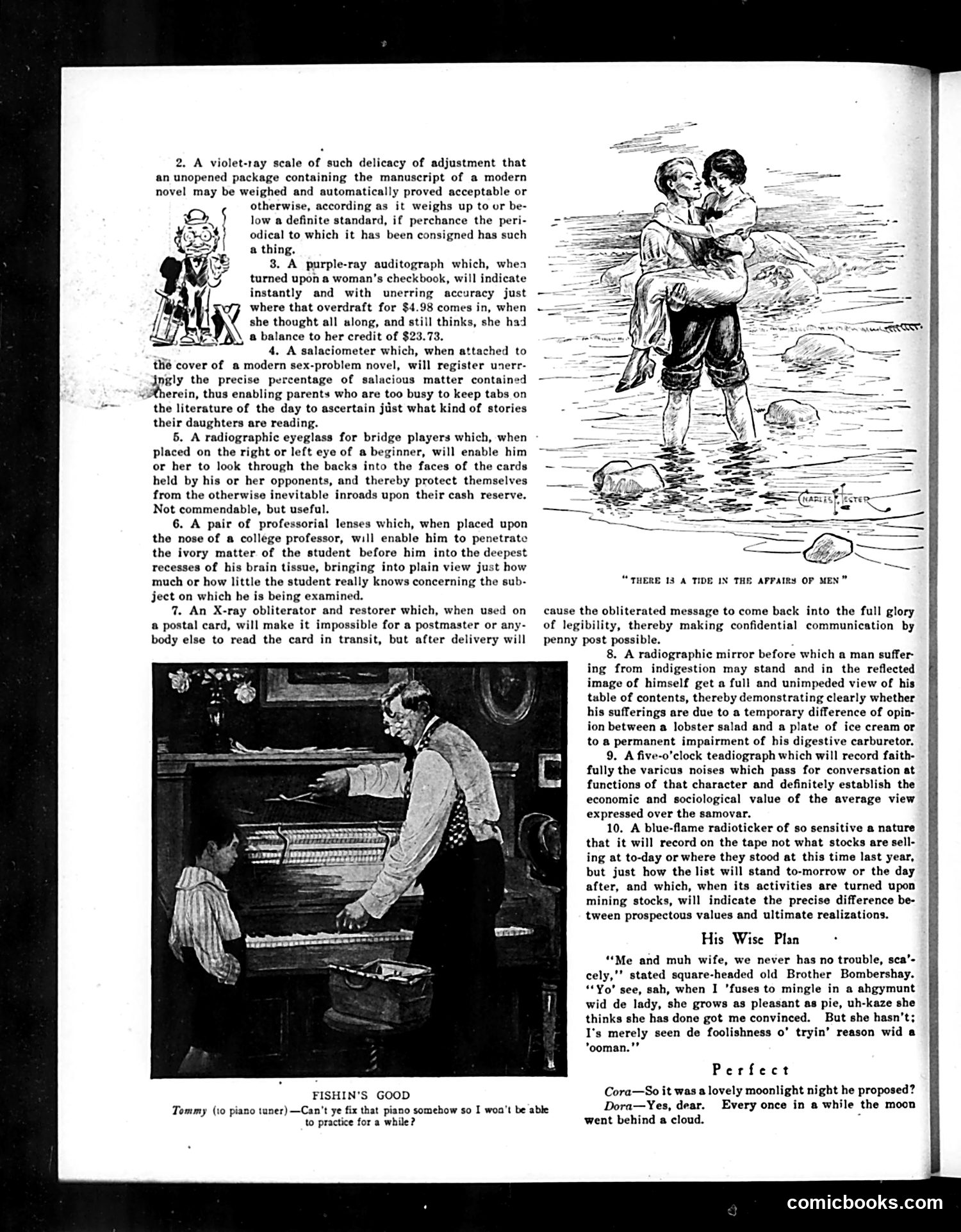
This Judge magazine page is primarily **satirical mock-inventions** poking fun at early 20th-century anxieties and social pretensions. Items 2-10 describe absurd "ray" and "graph" devices (playing on then-trendy X-ray and wireless telegraph technology) to solve embarrassing middle-class problems: detecting trashy novels, exposing women's overdrafts, monitoring daughters' reading, cheating at bridge, evaluating students' knowledge, and predicting stock prices. The satire mocks: - **Parental anxiety** about what daughters read - **Gender stereotypes** (wives' spending habits) - **Professional vanity** (professors unable to assess students honestly) - **Get-rich-quick schemes** (stock market prediction) The bottom sketches are separate jokes: a child requesting a broken piano, a crude dialect joke about marital conflict, and a romantic cliché about moonlight proposals. The "FISHIN'S GOOD" and "THERE IS A TIDE" illustrations are unrelated visual humor. The overall tone: mocking contemporary obsessions with technology and modern anxieties about class, family, and propriety.
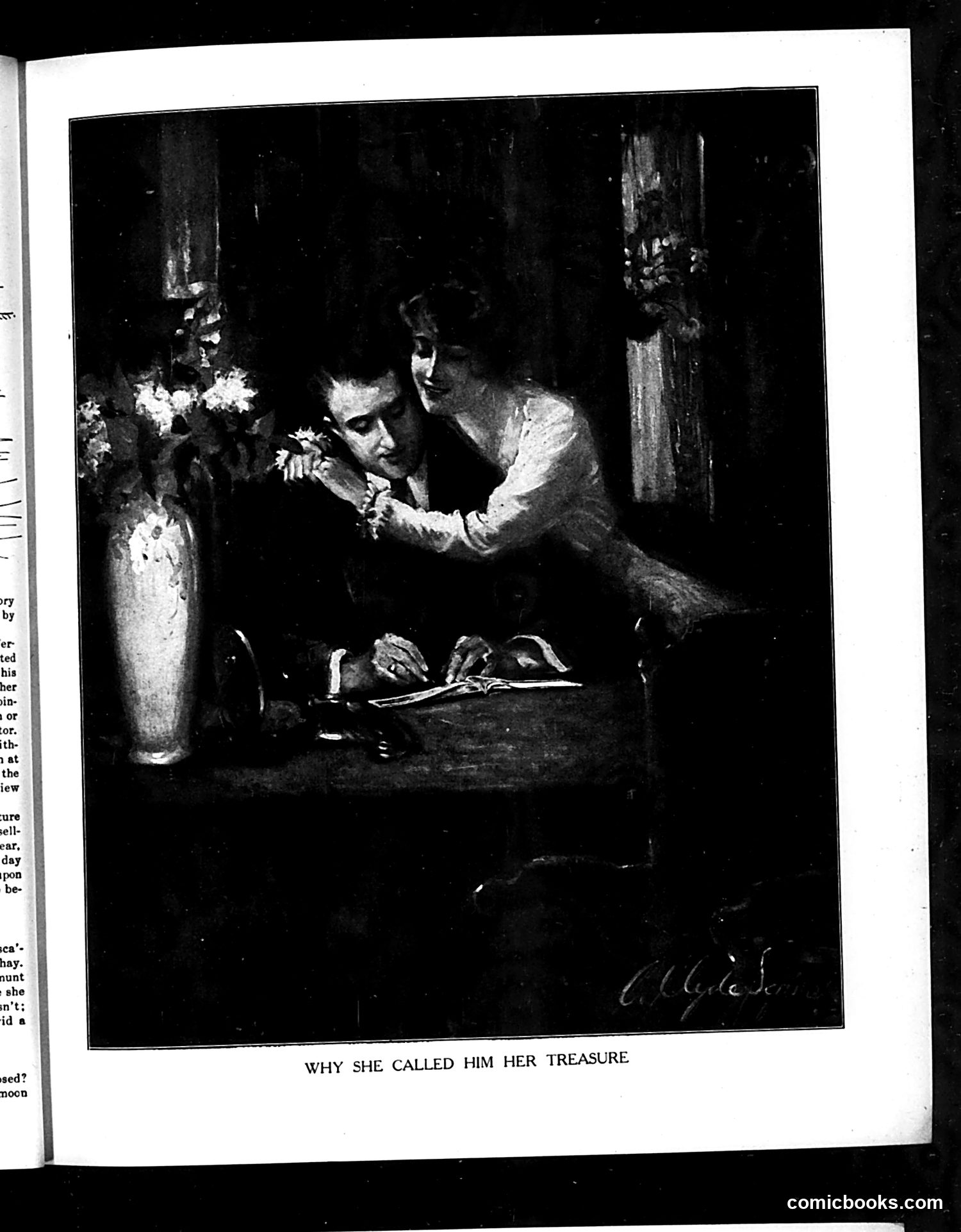
This appears to be a romantic scene from an early 20th-century Judge magazine illustration, captioned "Why She Called Him Her Treasure." The black-and-white image shows a man and woman in intimate proximity, with the woman leaning toward the man in what appears to be a domestic or bedroom setting. There are flowers visible and objects on a table before them. The caption's wordplay suggests the humor: the woman calls him "her treasure," likely because he's literally handling or displaying actual treasure or valuables (the objects on the table). The satire appears to comment on materialism in romantic relationships—that a woman's affection is motivated by wealth or material goods rather than genuine sentiment. This reflects period attitudes about gender, romance, and financial motivations in courtship.
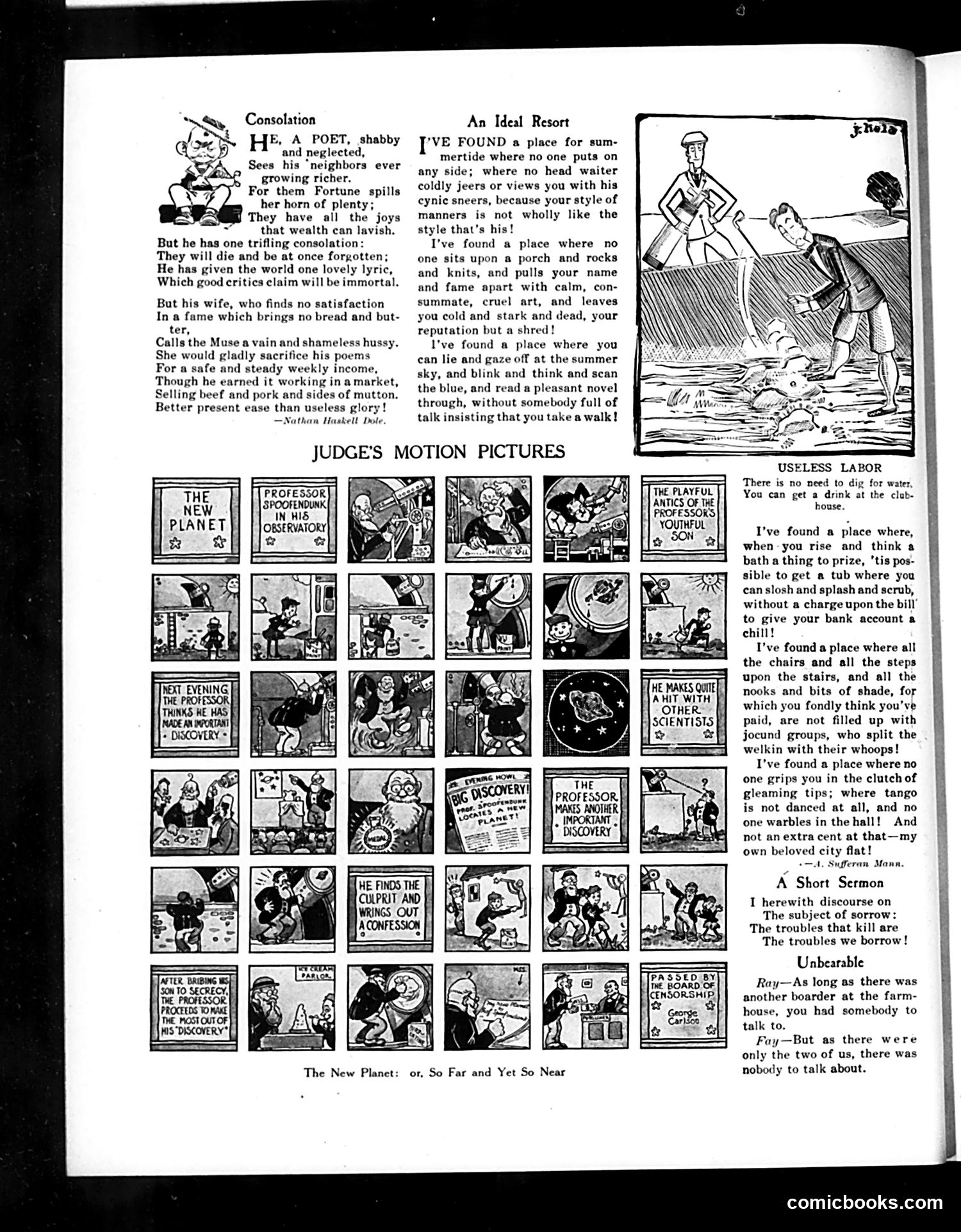
This page contains three distinct satirical pieces typical of early 20th-century humor: **"Consolation"**: A poem mocking the romantic notion of artistic immortality. It contrasts a poor, neglected poet who claims his work will endure forever with his pragmatic wife, who values steady income over literary legacy. The satire targets impractical bohemianism and the gap between artistic ambition and domestic financial reality. **"An Ideal Resort"**: A tongue-in-cheek poem describing a perfect vacation spot where one avoids social pretension, status-conscious service workers, intrusive socialites, and excessive tipping. It's satirizing the nouveau riche's anxieties about appearing foolish in fashionable settings. **"Judge's Motion Pictures"**: A film strip showing "The New Planet" (unclear narrative details from this image quality). **"A Short Sermon" and the closing dialogue**: Brief jokes about borrowing troubles and the necessity of gossip for conversation. These pieces reflect upper-middle-class anxieties of the era: financial insecurity among intellectuals, social climbing, service industry friction, and leisure-class boredom.
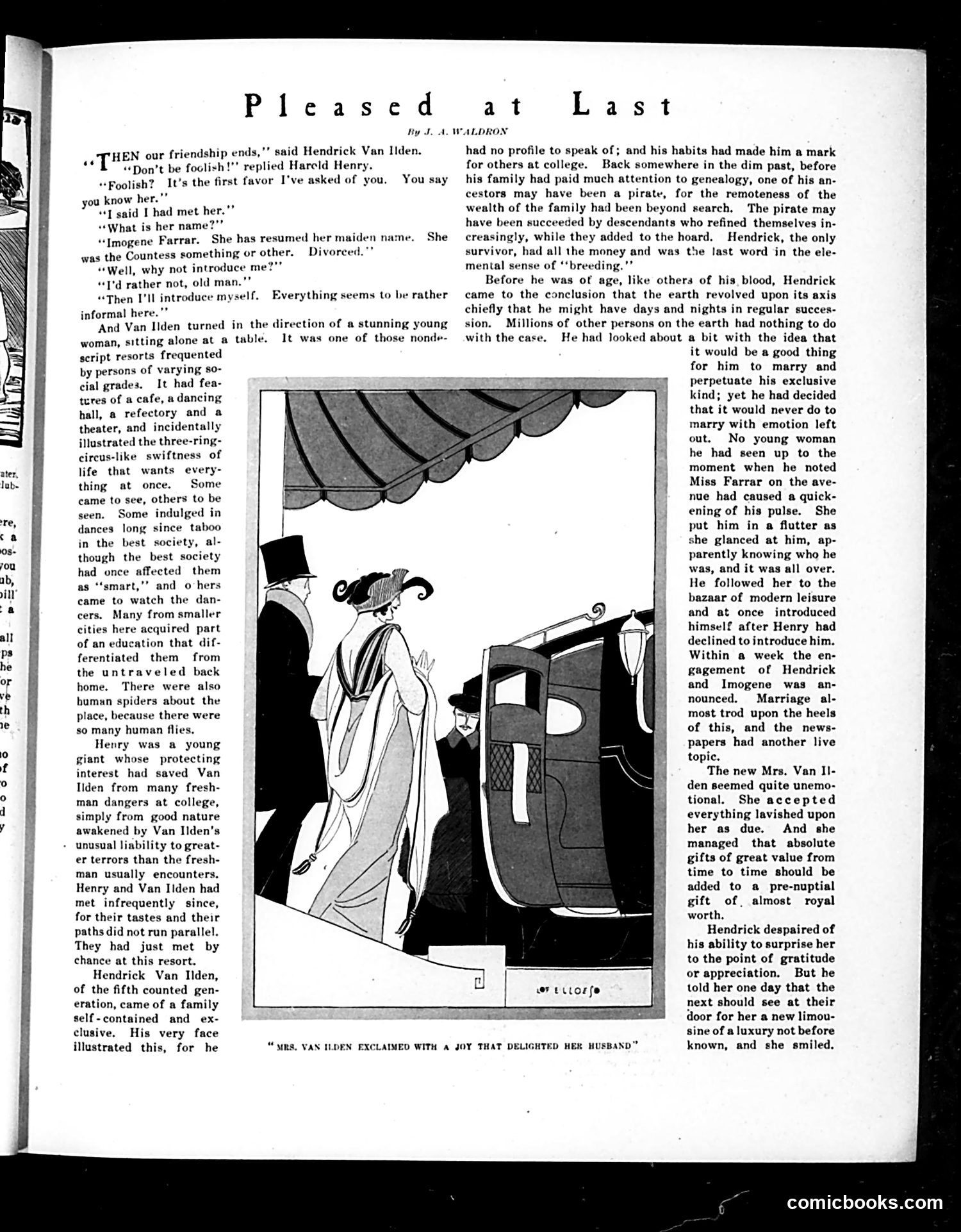
This story illustrates the contrast between American aristocratic pretension and genuine human emotion. Hendrick Van Ilden represents fifth-generation wealth—a man from an "exclusive" family whose ancestor was possibly a pirate, now obsessed with genealogy and "breeding." He's emotionally cold, viewing marriage as a duty to perpetuate his class rather than an affair of the heart. When he meets the divorced Imogene Farrar (a woman of lower social standing who has "resumed her maiden name"), he experiences unexpected passion—his pulse quickens. The satire lies in showing how this supposedly refined gentleman is undone by genuine feeling, breaking his own rigid social codes. The illustration captures the moment where emotion disrupts his carefully ordered world. Judge is mocking both Van Ilden's snobbery and the arbitrary nature of class distinctions in Gilded Age America.
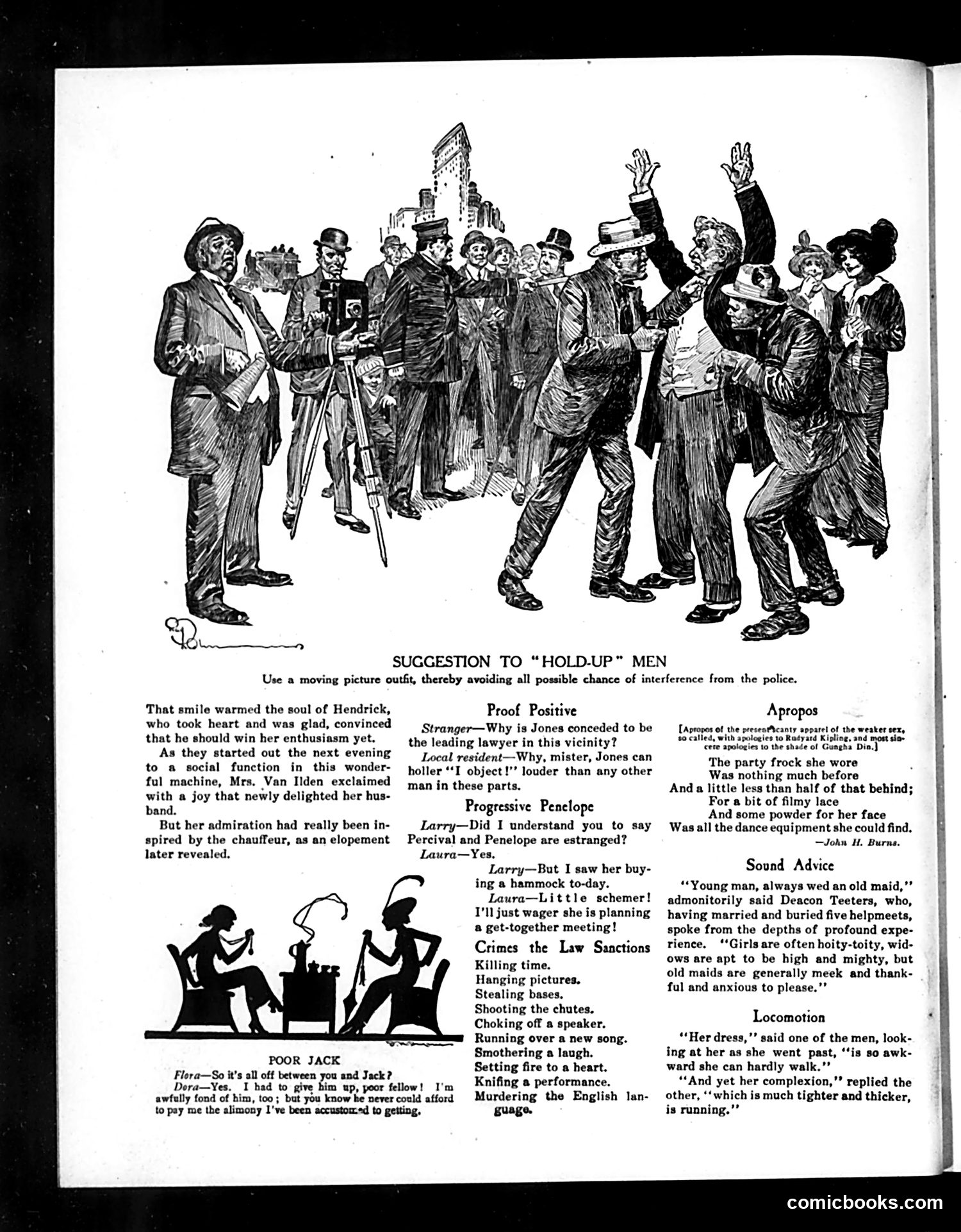
This page contains multiple satirical pieces mocking early 20th-century American society: **Top cartoon**: "Suggestion to 'Hold-Up' Men" satirizes both criminals and the new motion picture industry by suggesting robbers use film equipment to avoid police interference—a joke about cinema's novelty and perhaps police ineffectiveness. **Other sketches mock**: - Marital infidelity and materialism ("Poor Jack," where a woman values alimony over love) - Legal pomposity (a lawyer's success measured by loud objections, not actual skill) - Women's fashion trends (barely-there dresses requiring only "filmy lace" and powder) - Courtship games and deception - Marriage itself (the "sound advice" about marrying old maids assumes they're more obedient) The humor relies on period-specific references: automobiles as status symbols, emerging cinema, Edwardian women's liberation anxieties, and cynicism about law and romance. The overall tone is conservative social commentary disguised as humor.
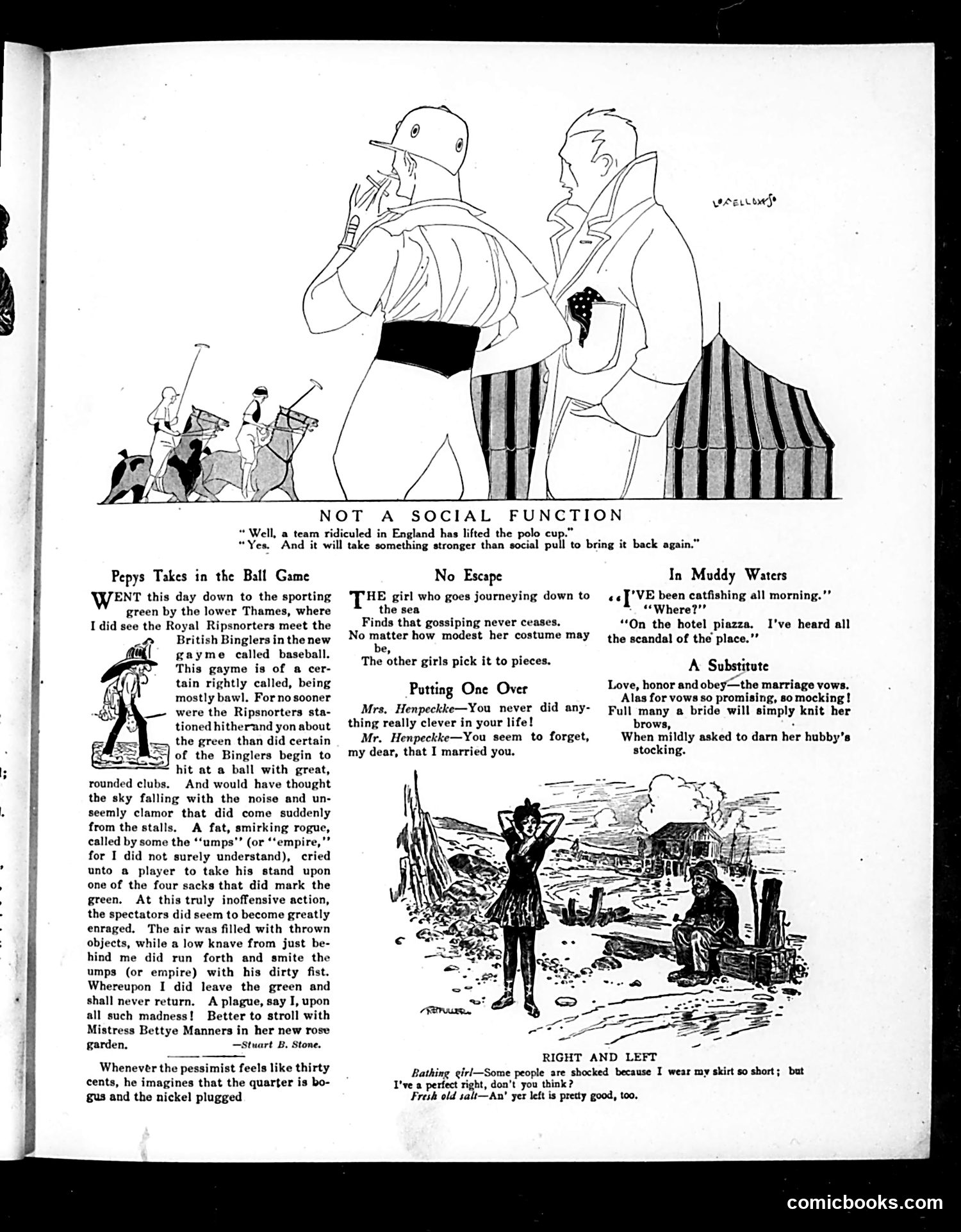
This page contains multiple short humorous pieces typical of early 20th-century American satirical magazines. **"Not a Social Function"** (top cartoon): A giant polo player towers over tiny figures. The joke references England's polo team winning a cup—the caption suggests only something "stronger than social pull" could restore American pride, mocking how social status dominated sports discourse. **"Pepys Takes in the Ball Game"**: A parody using 17th-century diarist Samuel Pepys's style to describe a baseball game as chaotic and violent—spectators throwing objects, fans hitting umpires. The satire mocks both baseball's rowdiness and pretentious literary imitation. **Other brief pieces**: "No Escape" jokes about women's catty gossip; "Putting One Over" presents a husband's retort about marrying a bossy woman; "In Muddy Waters" mocks newlyweds; "Right and Left" contains a mildly risqué beach joke about a woman's bathing suit. The overall tone reflects Jazz Age attitudes toward sports, marriage, and changing social behaviors—gently satirizing American manners and gender dynamics.
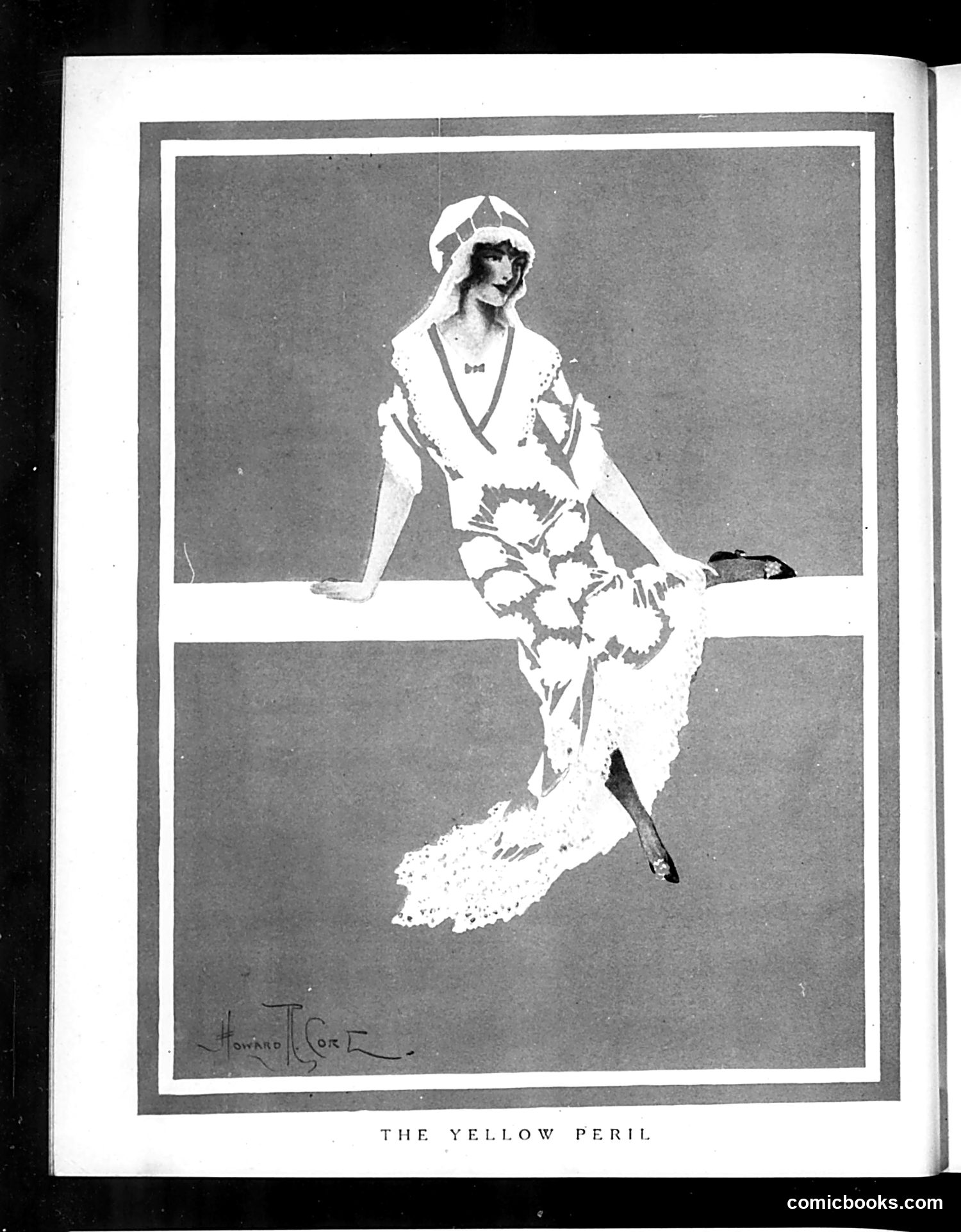
This illustration by Howard Cole depicts a woman in elaborate white costume with an ornate headdress, seated in a dramatic pose. The title "The Yellow Peril" references late 19th/early 20th-century anxieties about Asian (particularly Chinese and Japanese) immigration and influence in America. However, the actual visual satire is unclear from the image alone. The woman's costume suggests either theatrical performance or exotic fashion. Without additional context from the Judge magazine issue, it's uncertain whether this mocks anti-Asian hysteria itself, critiques Western fascination with "Oriental" aesthetics, or participates in the xenophobic "Yellow Peril" discourse of the era. The disconnect between title and depicted figure requires the original article text to determine the cartoon's actual satirical intent.
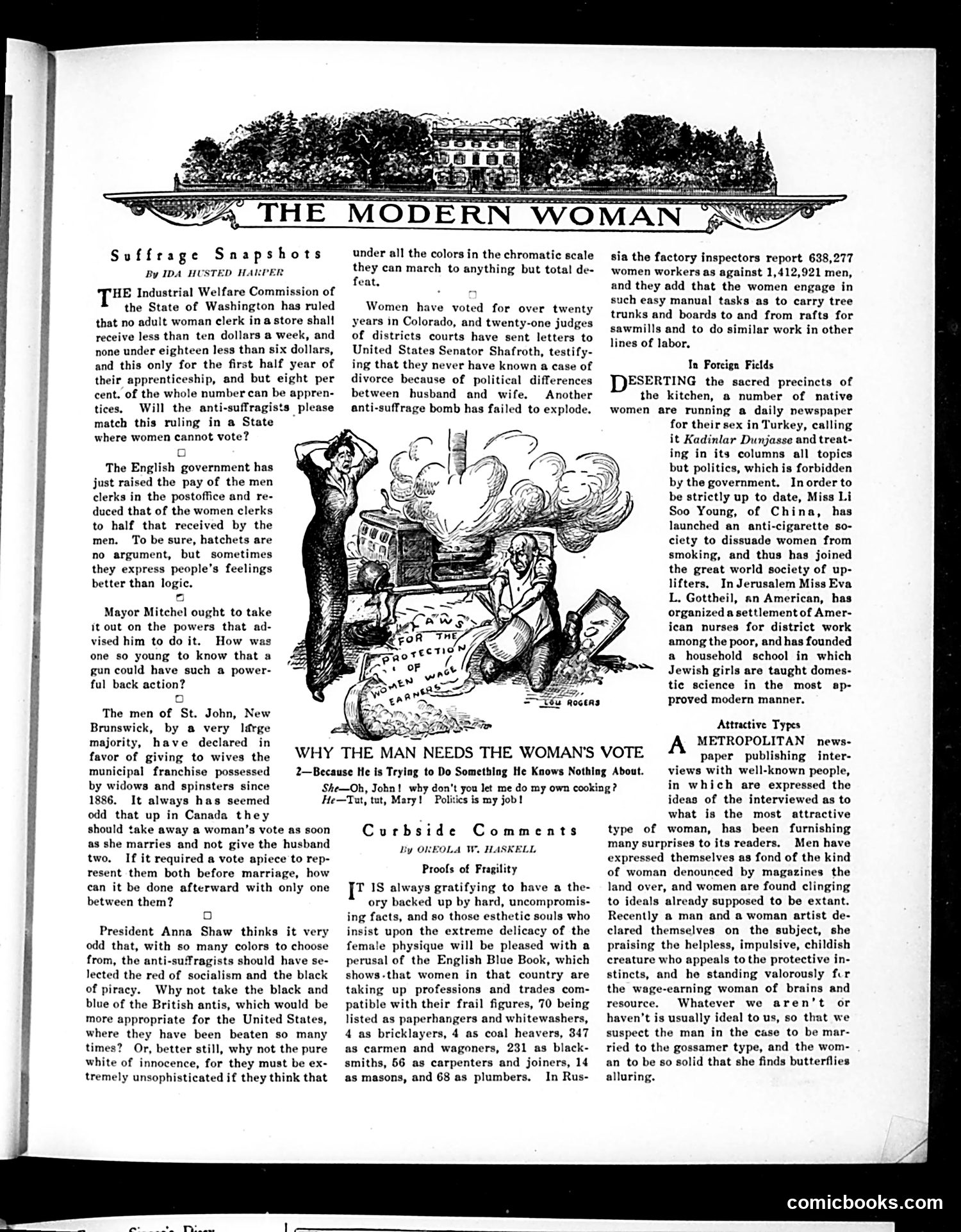
This page advocates for women's suffrage through satirical arguments, circa early 1910s. The author Ida Husted Harper presents "suffrage snapshots"—brief anecdotes comparing outcomes in places where women can vote versus cannot. The central cartoon depicts a woman asking her husband why he won't let her cook, since "Politics is my job!"—inverting traditional gender roles to mock anti-suffragist arguments about women's incapacity. Harper's arguments use concrete evidence: Washington State (with female voters) mandated fair wages for women clerks; England reduced women postal workers' pay. Colorado women voters for 20+ years report zero divorces caused by political disagreement—debunking the "suffrage destroys families" claim. The "Proofs of Fragility" section sarcastically catalogs women working as bricklayers, blacksmiths, and coal heavers in Britain and Russia, undermining claims that voting would overtax delicate female constitutions. The satire's point: women already demonstrate competence in demanding physical labor and governance; denying them the ballot is logically inconsistent.
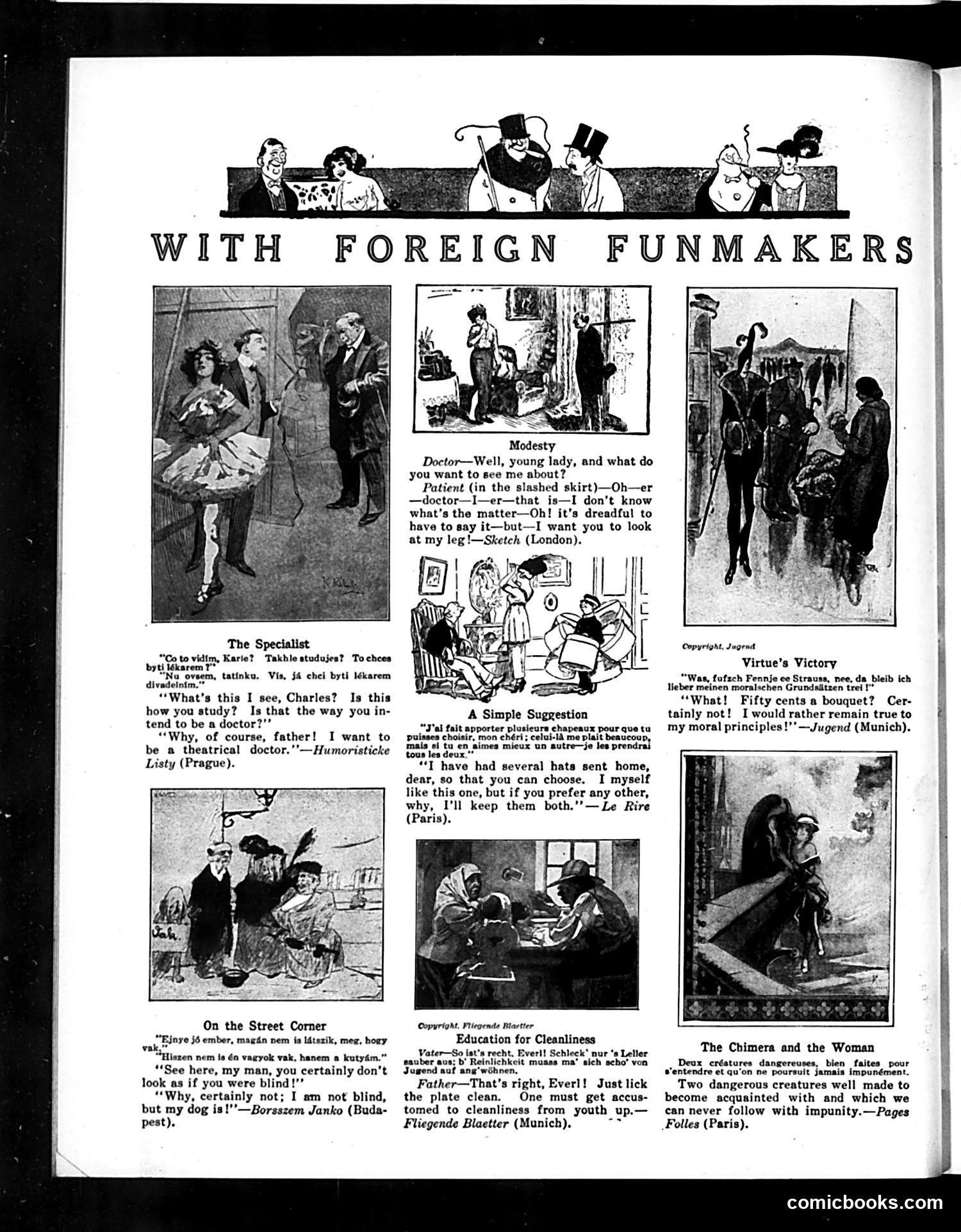
This page collects humorous strips and jokes translated from European satirical magazines, showcasing international humor of the era. **Key content:** - **"The Specialist"** (Prague): A son explains he wants to be a "theatrical doctor"—satirizing pretentious career aspirations. - **"On the Street Corner"** (Budapest): A blind beggar's dog is actually the blind one—a role-reversal joke about deception. - **"Modesty"** (London): A woman in a fashionably slashed skirt asks a doctor to examine her leg, implying the exposure is embarrassing—mockery of contemporary fashion trends. - **"A Simple Suggestion"** (Paris): A husband tactfully suggests his wife keep multiple hats—gentle marital satire about women's shopping habits. - **"Education for Cleanliness"** (Munich): A father encourages his son to lick his plate clean—ironic commentary on teaching hygiene through questionable methods. - **"Virtue's Victory"** (Munich): A woman refuses expensive flowers to maintain "moral principles"—sarcastic commentary on selective virtue. The page demonstrates how American publications shared European humor, emphasizing universal domestic and social comedy.
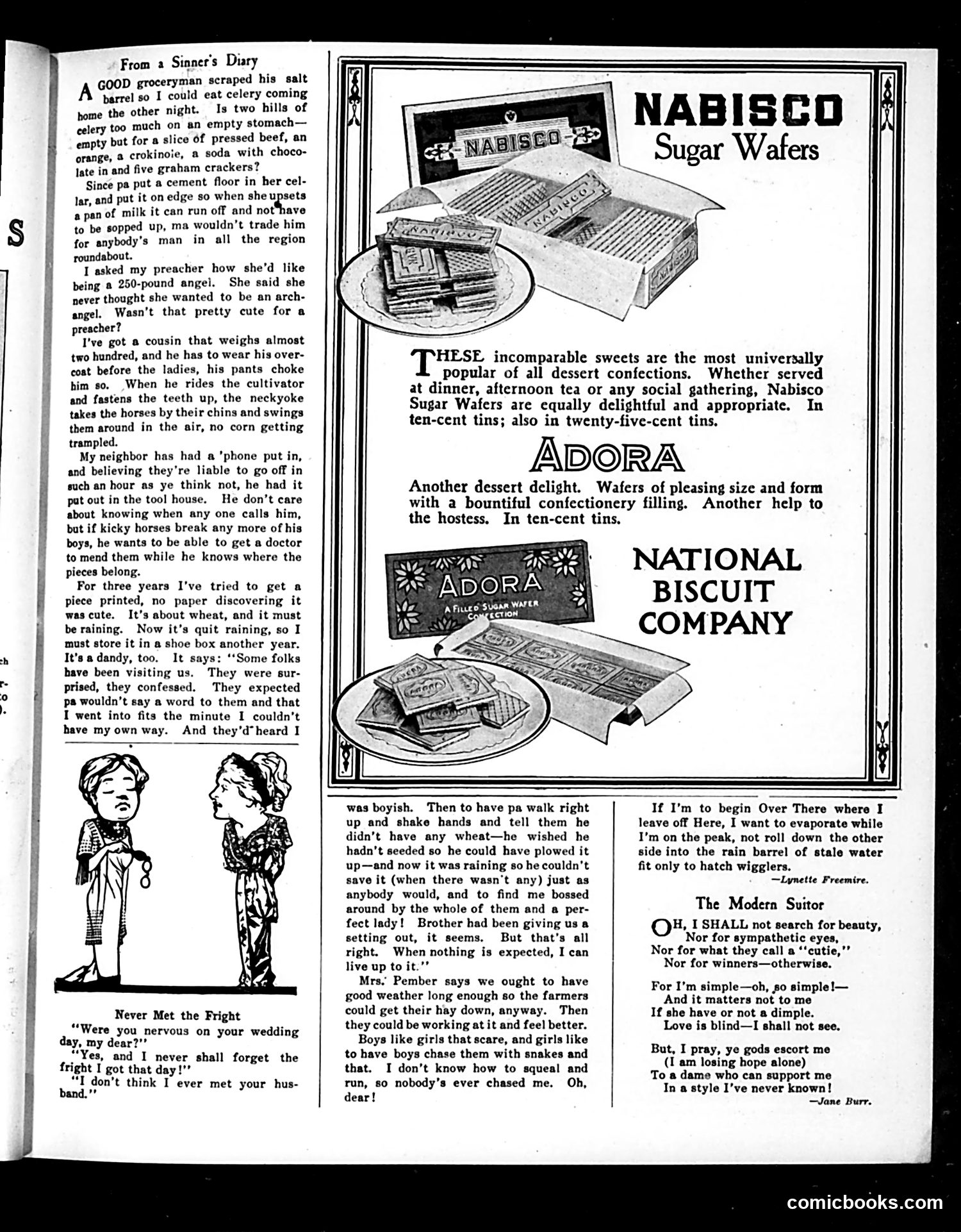
This page is primarily **humorous rural/domestic commentary** rather than political satire. The left column contains anecdotal observations about small-town life—awkward family moments, eccentric neighbors, and farming folk. The humor relies on understated Midwestern deadpan delivery: a preacher's bland response about being a "250-pound angel," a neighbor's paranoia about telephones, a farmer's tendency to bore visitors with crop complaints. The cartoon "Never Met the Fright" (bottom left) is a simple visual joke about a newlywed woman's nervousness—she expected her husband to be different from how he actually behaves. The **right side is advertising**: Nabisco Sugar Wafers and Adora wafers, targeted at "hostesses" for social gatherings. **For modern readers**: This reflects early 20th-century American rural humor—self-deprecating, focused on domestic inconveniences and social awkwardness rather than political targets. It captures period attitudes toward farming life, courtship, and domestic labor as fodder for gentle comedy.
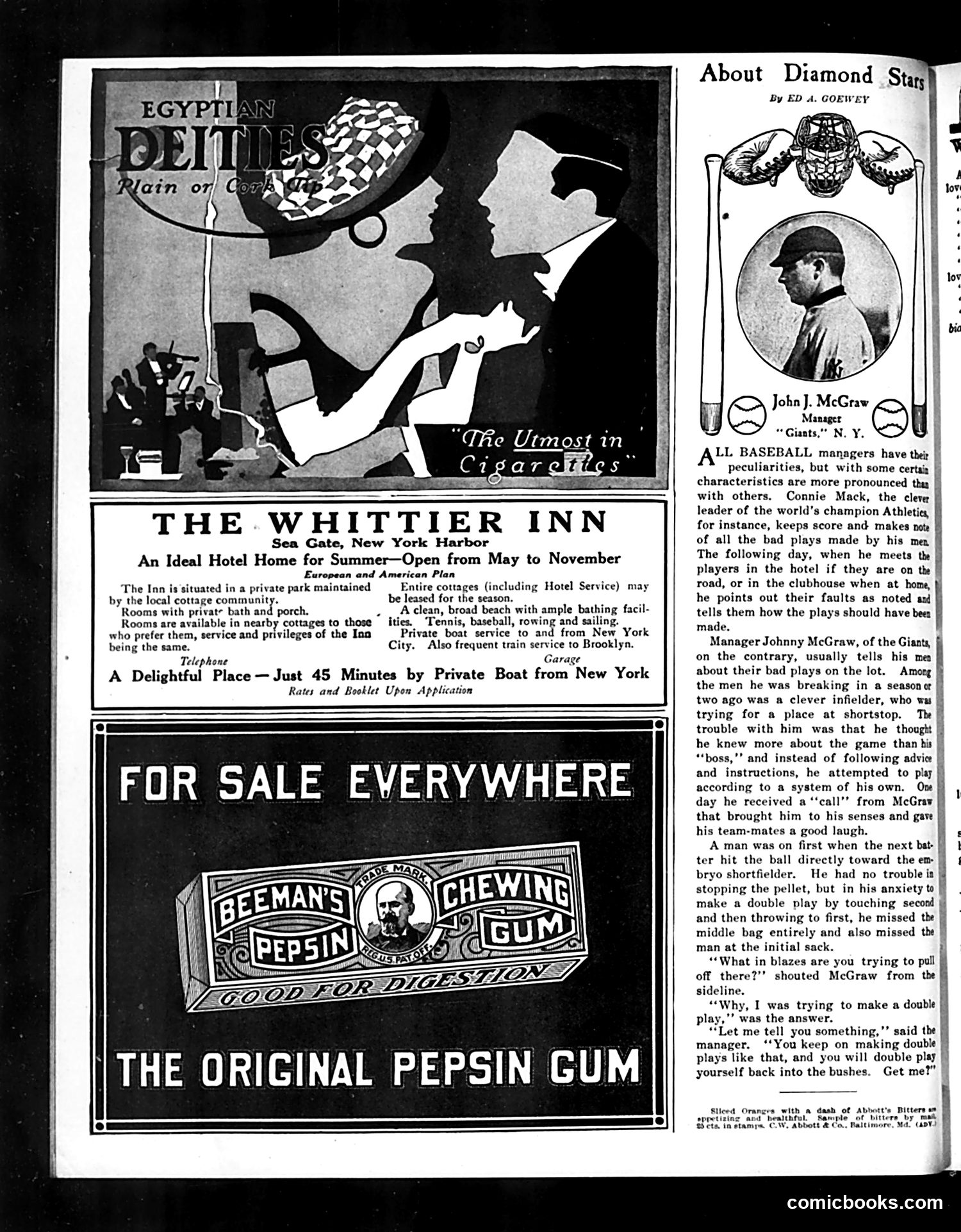
This page contains three distinct elements: **Top Left — Egyptian Deities Cigarette Advertisement**: A stylized Art Deco advertisement showing a fashionable woman in profile smoking cigarettes, with Egyptian-themed imagery. It's purely commercial with no satirical content. **Center — The Whittier Inn Advertisement**: A resort hotel listing for Sea Gate, New York Harbor, offering summer accommodations. This is straightforward advertising, not satire. **Right — "About Diamond Stars" Article**: A profile of John J. McGraw, manager of the New York Giants baseball team. The piece humorously illustrates McGraw's management style through an anecdote about a young shortstop who makes poor decisions on the field, ignoring McGraw's coaching. McGraw's cutting remark — telling the player he'll "double play yourself back into the bushes" — means he'll be demoted back to minor leagues. This celebrates McGraw's blunt, no-nonsense approach to disciplining players, presenting it as effective and entertaining. The page is primarily advertising with one sports-humor piece. No political satire is present.
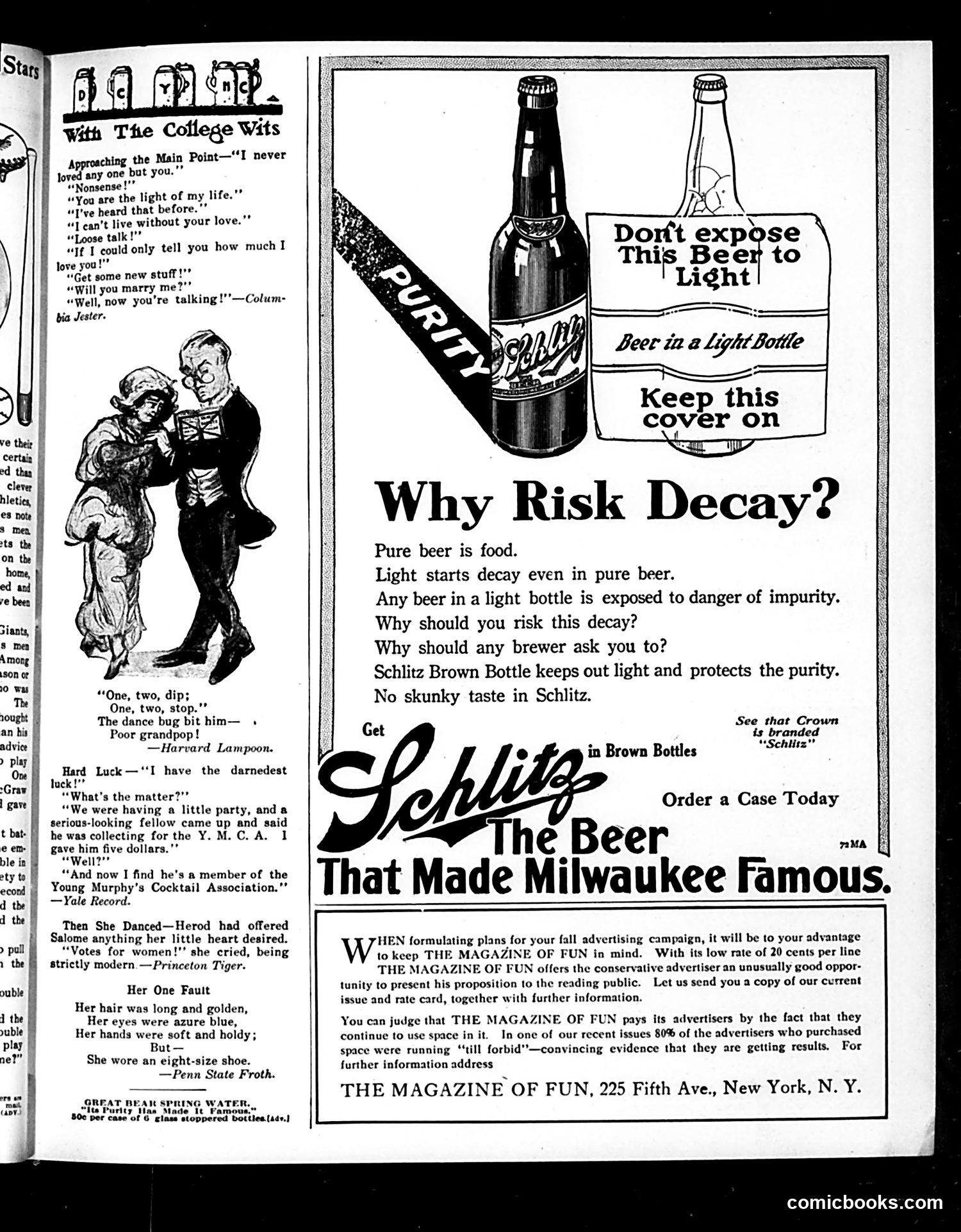
**Left Side - "College Wits" Humor Section:** This section mocks romantic clichés through brief comic dialogues. Young couples exchange worn-out declarations of love ("You are the light of my life," "I can't live without you"), which the other person dismisses as hackneyed. The joke culminates when a woman finally responds positively—not to romance, but to the suggestion of "new stuff," revealing mercenary rather than sentimental motivations. Additional short jokes about dancing, bad luck at a charity party, and a woman with oversized feet follow, typical of period college humor magazines. **Right Side - Schlitz Beer Advertisement:** A full-page ad warning consumers not to buy beer in clear glass bottles, claiming light exposure causes "decay" and "skunky taste." The ad promotes Schlitz's brown bottles as superior protection. This appears to be early beer marketing emphasizing product quality through packaging innovation—a significant selling point before modern refrigeration and distribution. **Bottom - Magazine Promotion:** The Magazine of Fun advertises to potential advertisers, citing high advertiser retention rates (80% of advertisers maintain continuous campaigns).
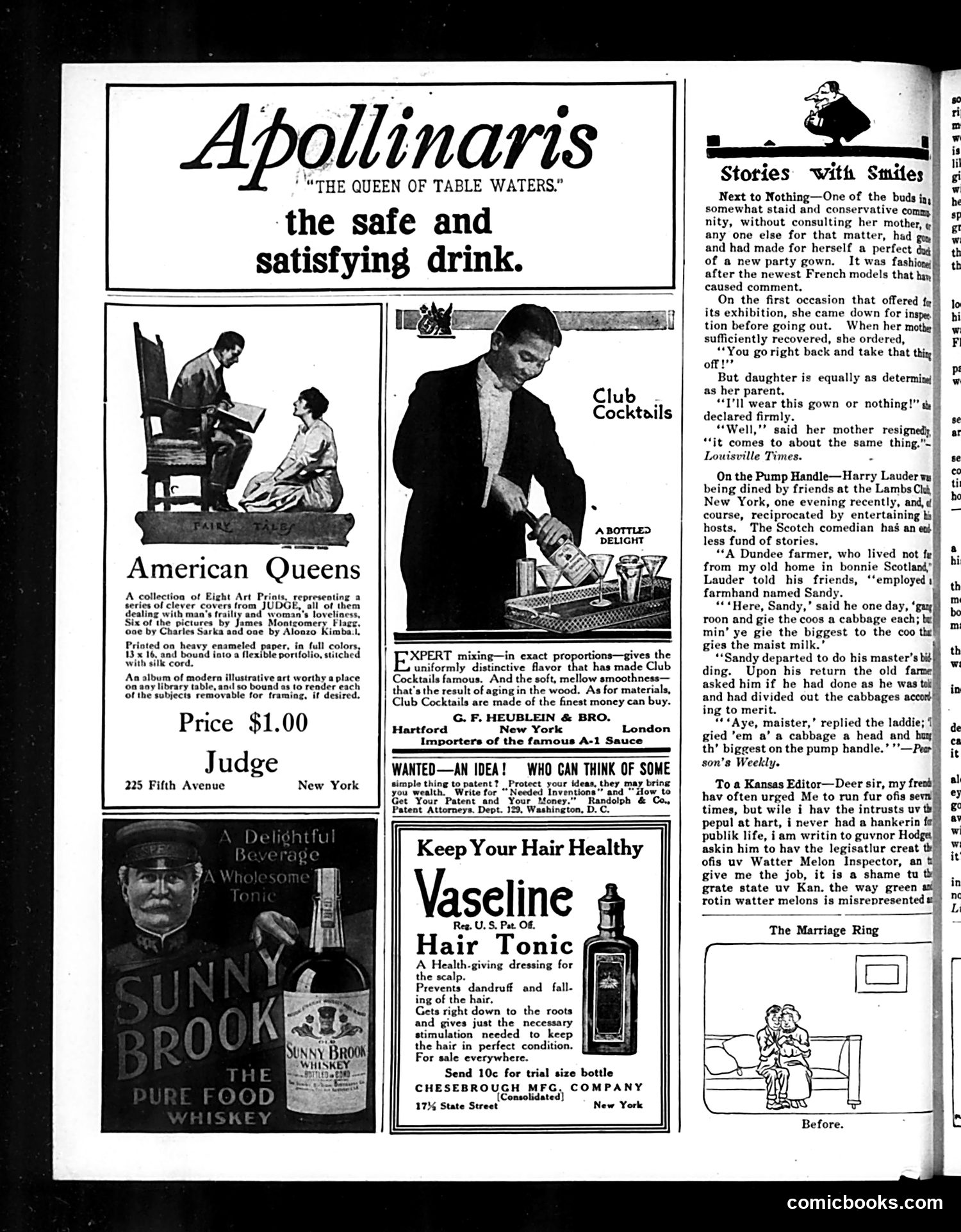
This page is primarily **advertising with minimal editorial content**. The advertisements dominate, promoting products like Apollinaris water, Club Cocktails, Sunny Brook whiskey, and Vaseline Hair Tonic—typical of early 20th-century magazines. The right column contains brief humorous anecdotes under "Stories with Smiles," including a Scottish dialect story about Harry Lauder and a farmer's farmhand named Sandy. These are gentle, folksy humor pieces rather than political satire. **No clear political cartoons appear on this page.** The small illustration labeled "Before" under "The Marriage Ring" is too vague to interpret definitively—it appears to show a domestic scene but lacks context. The page reflects Judge's mixed format: primarily a vehicle for advertisements and light, non-partisan humor rather than the sharp political satire the magazine was known for. The content suggests this is from the early-to-mid 20th century based on product types and dialect humor conventions.
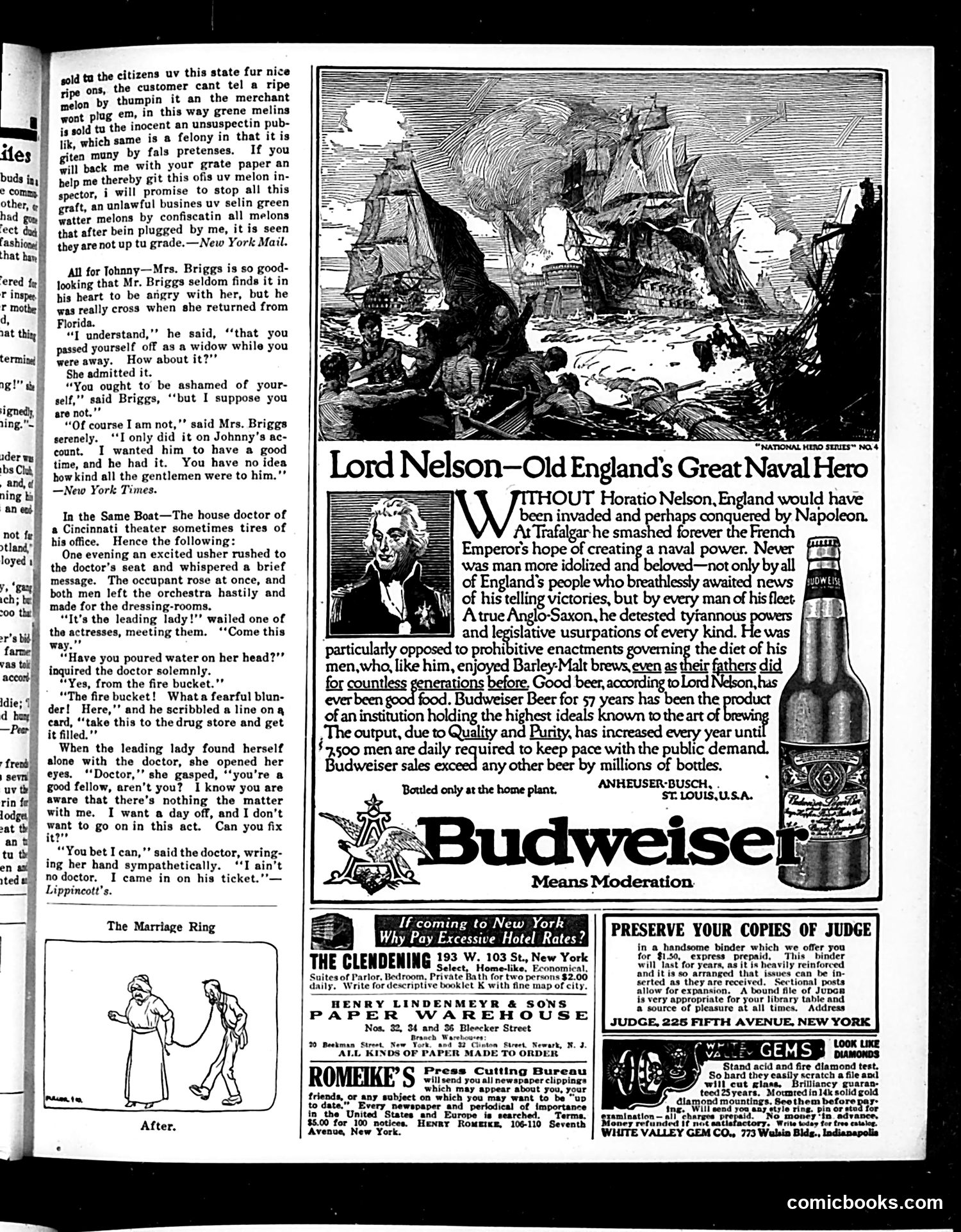
This page contains multiple short humor pieces and advertisements typical of early 20th-century Judge magazine. **The cartoons/stories** are brief anecdotes: one about a melon inspector combating fraud; another about Mrs. Briggs pretending to be a widow in Florida for social advantage; and a third about a theater doctor and leading lady faking illness for a day off. These are gentle satirical observations of everyday deceptions and social behavior. **The dominant visual element** is a large **Budweiser advertisement** featuring Lord Nelson, England's famous naval hero. The ad argues that Nelson opposed "prohibitive enactments governing the diet of his men" and enjoyed beer—thus attempting to associate beer-drinking with patriotism and masculine virtue. This is notably a **pre-Prohibition era advertisement** (before 1920), when such beer promotions were common. The ad emphasizes "Moderation" and positions Budweiser as quality American brewing. The page also includes smaller advertisements for hotel rates, a paper warehouse, and gem dealers—standard magazine filler of the period.
This page is primarily **advertising and humorous anecdotes**, not political satire. The main content consists of: **Advertisements:** Hamburg-American Line cruise ship voyages around the world via Panama Canal (newly opened, circa 1915); 1000 Island House resort; and hotel advertisements including one for "Mothersill's Seasickness Remedy." **Humor Section:** A collection of brief jokes and witty exchanges on domestic life, relationships, and social situations. These include observations about unexpected visitors, fake nobility, unhappy marriages, and romantic disappointments. The humor relies on wordplay and gentle social commentary rather than political content. **Notable joke type:** Several anecdotes mock courtship and marriage dynamics—particularly women's expectations versus reality, and men's practicality versus sentiment. The page reflects **early 20th-century middle-class concerns**: travel aspirations, domestic relationships, and commercial leisure. There is no identifiable political cartooning or satirical commentary on current events visible here.
This page is primarily **advertising**, with brief satirical humor snippets in the left column. The short jokes mock everyday absurdities: a woman praising a suitor who steals (baseball) "second base," a lawyer promising to make the state spend money prosecuting his client, a burglar stealing a watchdog because superstition demands he take *something*. One joke uses **racial dialect humor** (the "Admonished" section), reflecting common—but offensive to modern readers—early 20th-century comedy conventions mocking Black speech patterns. The advertisements promote New York hotels and a cruise line, typical of Judge's commercial content. The Hotel McAlpin ad features an illustration of two fashionable travelers, emphasizing leisure travel planning. **No political cartoon appears on this page.** The humor is lighthearted social satire about human foibles rather than political commentary. The page represents Judge's blend of brief jokes and paid advertising typical of the era's magazine format.
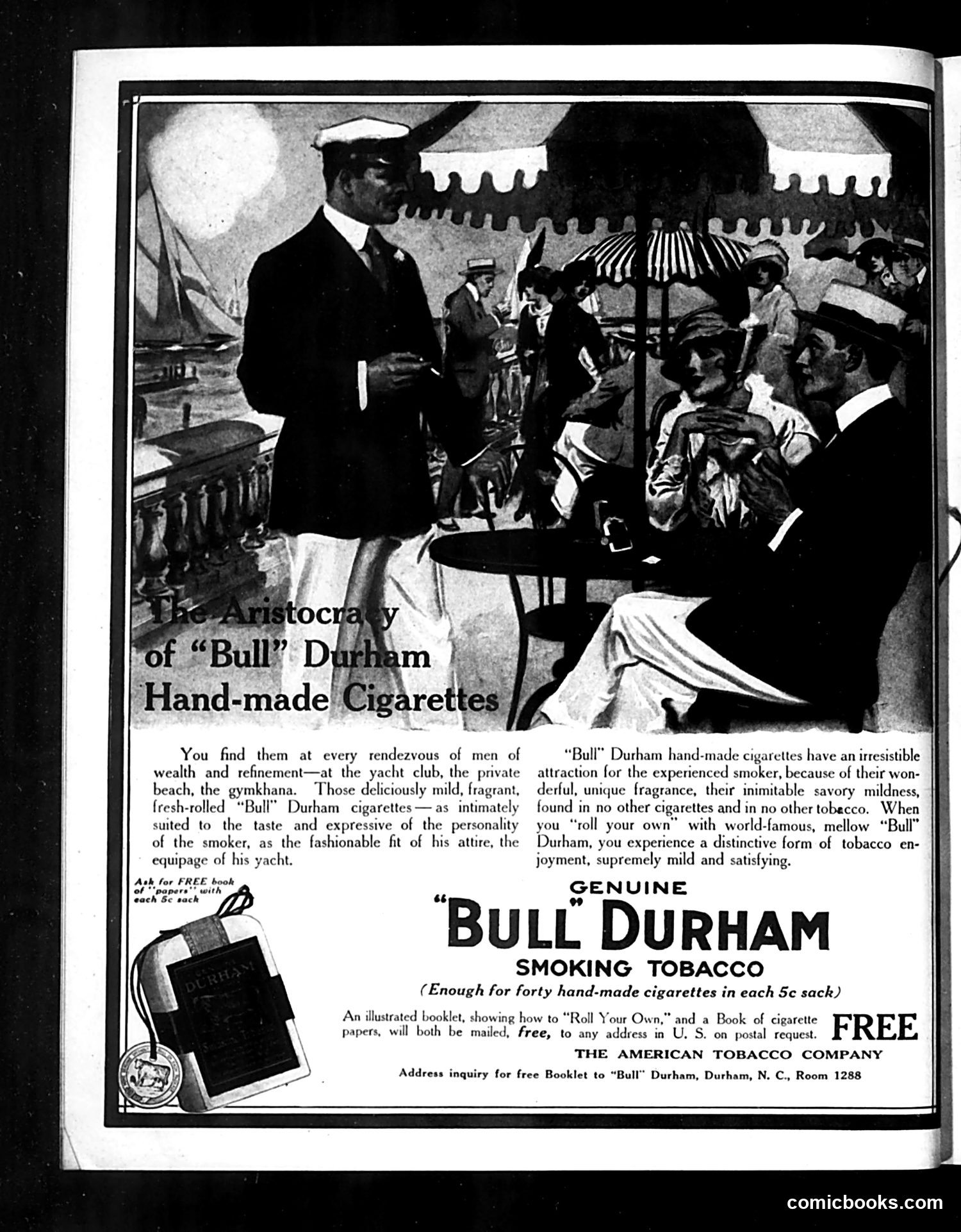
This is primarily a **cigarette advertisement**, not satire or political commentary. It depicts "Bull" Durham hand-rolled smoking tobacco being enjoyed at an aristocratic social gathering—appearing to show a yacht club or similar exclusive venue with well-dressed men and women under an awning. The ad's appeal targets **wealthy, refined consumers**, associating the product with sophistication and social status. The text emphasizes that rolling one's own cigarettes with Bull Durham is a mark of personality and taste, "as intimately suited" to the smoker as fashionable clothing. The key marketing angle: Bull Durham cost only 5¢ per sack, containing enough tobacco for forty hand-made cigarettes. The company offered free instructional booklets on rolling technique. **For modern readers**: This reflects early 20th-century advertising that equated tobacco consumption with class, refinement, and leisure—before health warnings existed. The "aristocracy of 'Bull' Durham" headline uses ironic language to position an affordable product as luxurious.