
Judge, 1914-07-11 · page 10 of 24
Judge — July 11, 1914 — page 10: what you’re looking at
What you’re looking at
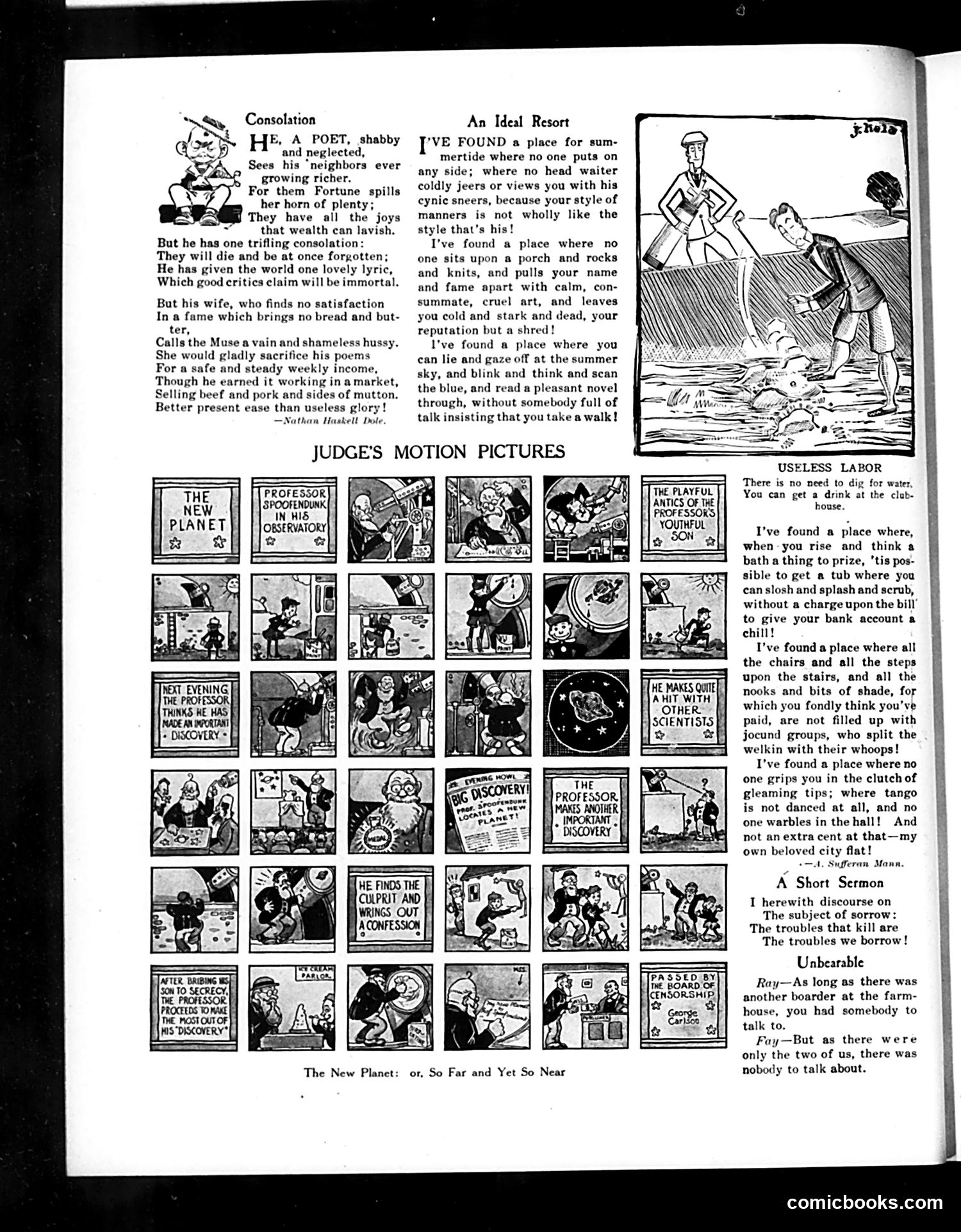
This page contains three distinct satirical pieces typical of early 20th-century humor: **"Consolation"**: A poem mocking the romantic notion of artistic immortality. It contrasts a poor, neglected poet who claims his work will endure forever with his pragmatic wife, who values steady income over literary legacy. The satire targets impractical bohemianism and the gap between artistic ambition and domestic financial reality. **"An Ideal Resort"**: A tongue-in-cheek poem describing a perfect vacation spot where one avoids social pretension, status-conscious service workers, intrusive socialites, and excessive tipping. It's satirizing the nouveau riche's anxieties about appearing foolish in fashionable settings. **"Judge's Motion Pictures"**: A film strip showing "The New Planet" (unclear narrative details from this image quality). **"A Short Sermon" and the closing dialogue**: Brief jokes about borrowing troubles and the necessity of gossip for conversation. These pieces reflect upper-middle-class anxieties of the era: financial insecurity among intellectuals, social climbing, service industry friction, and leisure-class boredom.
📄 Transcribed text from this page (OCR, searchable)
Machine-transcribed from the original scan — historical spelling and the odd misread are preserved.
ay Consolation I yor WS E, A POET, shabby Q2*9 H and neglected, Sees his ‘neighbors ever growing richer. For them Fortune spills her horn of plenty; They have all the joys that wealth can lavish, But he has one trifling consolation: They will die and be at once forgotten; He has given the world one lovely lyric, Which good critics claim will be immortal. But his wife, who finds no satisfaction In a fame which brings no bread and but- ter, Calls the Muse a vain and shameless hussy. She would gladly sacrifice his poems For a safe and steady weekly income, Though he earned it working in a market, Selling beef and pork and sides of mutton. Better present ease than useless glory! Nathan Haskell Dole The New Planet: JUDGE'S MOTION PICTURES or, So Far and Yet So Near An Ideal Resort I'VE FOUND a place for sum- mertide where no one puts on any side; where no head waiter coldly jeers or views you with his cynic sneers, because your style of manners is not wholly like the style that’s his! I’ve found a place where no one sits upon a porch and rocks and knits, and pulls your name and fame apart with calm, con- summate, cruel art, and leaves you cold and stark and dead, your reputation but a shred! I've found a place where you can lie and gaze off at the summer sky, and blink and think and scan the blue, and read a pleasant novel through, without somebody full of talk insisting that you take a walk! USELESS LABOR There is no need to dig for water, You can get a drink at the club- house. I’ve found a place where, when -you rise and think a bath a thing to prize, 'tis pos- sible to get a tub where you can slosh and splash and scrub, without a charge upon the bill to give your bank account a chill! I’ve found a place where all the chairs and all the steps upon the stairs, and all the nooks and bits of shade, for which you fondly think you've paid, are not filled up with jocund groups, who split the welkin with their whoops! I've found a place where no one grips you in the clutch of gleaming tips; where tango is not danced at all, and no one warbles in the hall! And not an extra cent at that—my own beloved city flat! +A. Sufferan Mann, A Short Sermon I herewith discourse on The subject of sorrow: The troubles that kill are The troubles we borrow! Unbearable Ray—As long as there was another boarder at the farm- house, you had somebody to talk to. Fay—But as there were only the two of us, there was nobody to talk about. comicbooks.com