
Judge, 1914-07-11 · page 4 of 24
Judge — July 11, 1914 — page 4: what you’re looking at
What you’re looking at
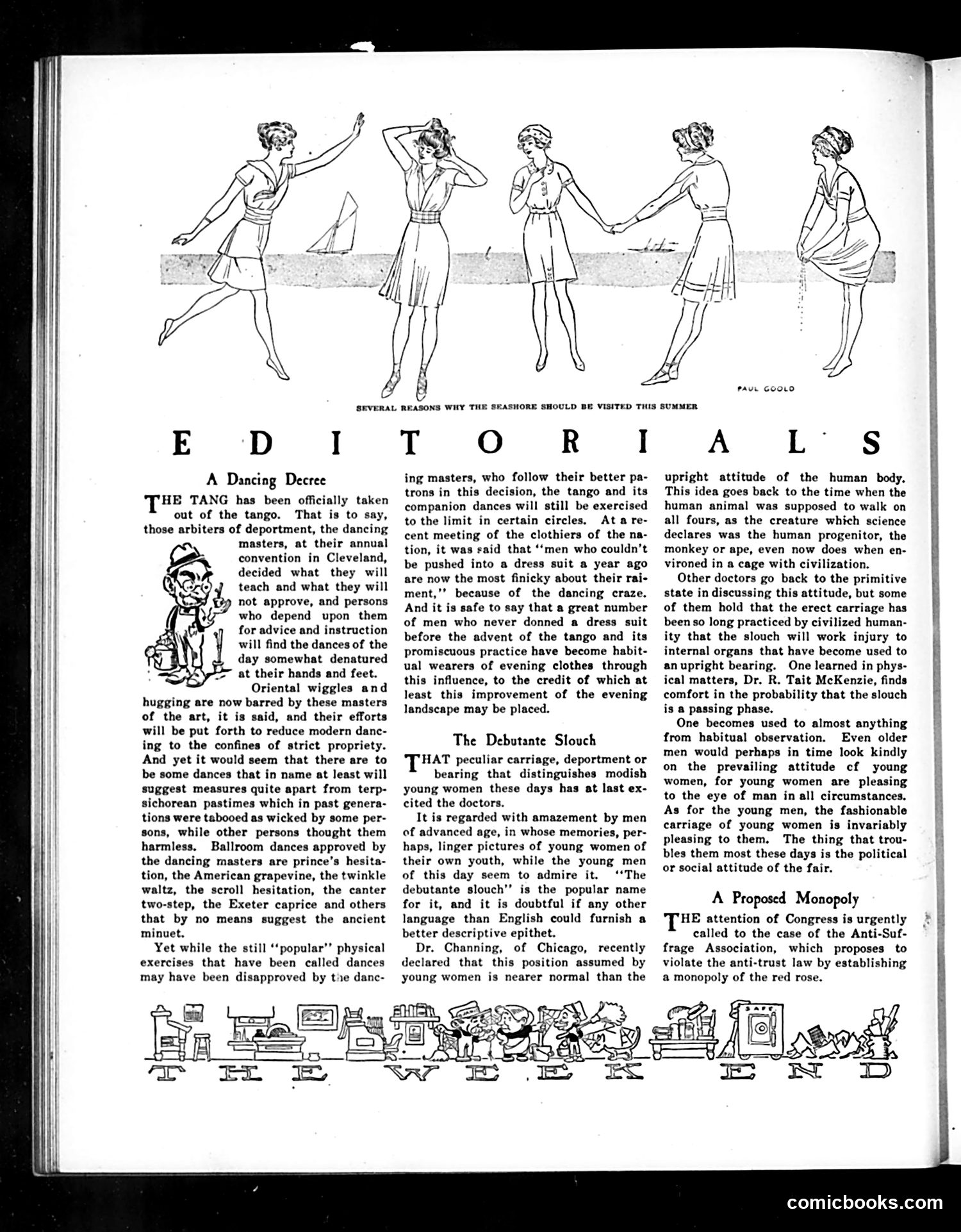
This page contains three satirical commentary pieces on 1920s social issues: 1. **"A Dancing Decree"**: Critiques the tango's popularity and its influence on fashion and deportment. The piece mocks how dance teachers were promoting the tango while some deemed it improper, and notes that the "dancing craze" prompted men to wear evening clothes more frequently—presented as both amusing and slightly absurd. 2. **"The Debutante Slouch"**: Satirizes young women's posture, specifically their fashionable "slouching" carriage. The author notes this posture was considered more "normal" than previous rigid standards, reflecting changing attitudes about women's physical bearing and deportment. 3. **"A Proposed Monopoly"**: A brief item about Congressional attention to the Anti-Suffrage Association's proposal regarding red roses—likely a minor political controversy. The illustrations show women in various dance poses, emphasizing the era's preoccupation with modern dance and changing social conventions.
📄 Transcribed text from this page (OCR, searchable)
Machine-transcribed from the original scan — historical spelling and the odd misread are preserved.
pave GOOLo SEVERAL REASONS WHY THE SEASHORE SHOULD BE VISITED THIS SUMMER | | A Dancing Decree THE TANG has been officially taken out of the tango. That is to say, those arbiters of deportment, the dancing masters, at their annual convention in Cleveland, decided what they will teach and what they will not approve, and persons who depend upon them for advice and instruction will find the dances of the day somewhat denatured at their hands and feet. Oriental wiggles and hugging are now barred by these masters of the art, it is said, and their efforts will be put forth to reduce modern danc- ing to the confines of strict propriety. And yet it would seem that there are to be some dances that in name at least will suggest measures quite apart from terp- sichorean pastimes which in past genera- tions were tabooed as wicked by some per- sons, while other persons thought them harmless. Ballroom dances approvell by the dancing masters are prince's hesita- tion, the American grapevine, the twinkle waltz, the scroll hesitation, the canter two-step, the Exeter caprice and others that by no means suggest the ancient minuet. Yet while the still ‘‘popular’’ physical exercises that have been called dances may have been disapproved by tie danc- T O R I ing masters, who follow their better pa- trons in this decision, the tango and its companion dances will still be exercised to the limit in certain circles. Ata re- cent meeting of the clothiers of the na- tion, it was said that ‘‘men who couldn't be pushed into a dress suit a year ago are now the most finicky about their rai- ment,’’ because of the dancing craze. And it is safe to say that a great number of men who never donned a dress suit before the advent of the tango and its promiscuous practice have become habit- ual wearers of evening clothes through this influence, to the credit of which at least this improvement of the evening landscape may be placed. The Debutante Slouch HAT peculiar carriage, deportment or bearing that distinguishes modish young women these days has at last ex- cited the doctors. It is regarded with amazement by men of advanced age, in whose memories, per- haps, linger pictures of young women of their own youth, while the young men of this day seem to admire it. ‘‘The debutante slouch”? is the popular name for it, and it is doubtful if any other language than English could furnish a better descriptive epithet. Dr. Channing, of Chicago, recently declared that this position assumed by young women is nearer normal than the A L’§ upright attitude of the human body. This idea goes back to the time when the human animal was supposed to walk on all fours, as the creature which science declares was the human progenitor, the monkey or ape, even now does when en- vironed in a cage with civilization. Other doctors go back to the primitive state in discussing this attitude, but some of them hold that the erect carriage has been so long practiced by civilized human- ity that the slouch will work injury to internal organs that have become used to an upright bearing. One learned in phys- ical matters, Dr. R. Tait McKenzie, finds comfort in the probability that the slouch is a passing phase. One becomes used to almost anything from habitual observation. Even older men would perhaps in time look kindly on the prevailing attitude cf young women, for young women are pleasing to the eye of man in all circumstances. As for the young men, the fashionable carriage of young women is invariably pleasing to them. The thing that trou- bles them most these days is the political or social attitude of the fair. A Proposed Monopoly THE attention of Congress is urgently called to the case of the Anti-Suf- frage Association, which proposes to violate the anti-trust law by establishing a monopoly of the red rose. comicbooks.com