
Judge, 1914-07-11 · page 7 of 24
Judge — July 11, 1914 — page 7: what you’re looking at
What you’re looking at
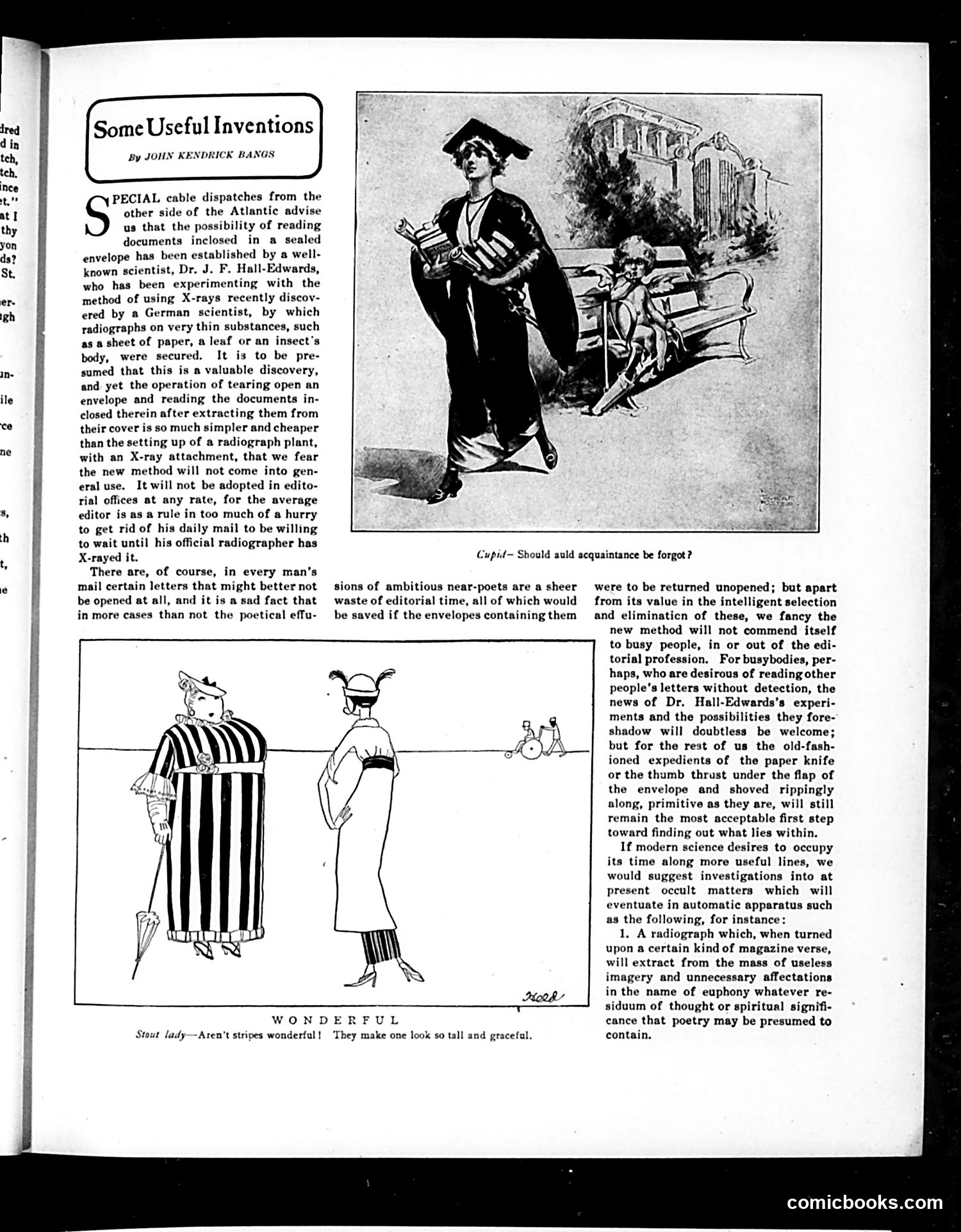
This satirical piece by John Kendrick Bangs mocks the impracticality of new X-ray technology for reading sealed letters. Dr. J.F. Hall-Edwards, a real scientist, had demonstrated X-rays could photograph contents through envelopes—a genuine technical achievement. Bangs argues humorously that editors are too busy to wait for X-ray processing when a simple letter opener works fine. He suggests X-rays might appeal only to "busybodies" wanting to read others' mail secretly. The cartoons are unrelated quips: the top shows a postman with an armful of mail; the bottom depicts two women where one compliments the other's vertical stripes as slimming—typical period fashion humor. The piece satirizes both the gap between scientific innovation and practical utility, and the gossipy impulse to read private correspondence.
📄 Transcribed text from this page (OCR, searchable)
Machine-transcribed from the original scan — historical spelling and the odd misread are preserved.
Some Useful Inventions By JOHN KENDRICK BANGS other side of the Atlantic advise us that the possibility of reading documents inclosed in a sealed ‘envelope has been established by a well- known scientist, Dr. J. F. Hall-Edwards, who has been experimenting with the method of using X-rays recently discov- ered by a German scientist, by which radiographs on very thin substances, such as a sheet of paper, a leaf or an insect’s body, were secured. It is to be pre- sumed that this is a valuable discovery, and yet the operation of tearing open an envelope and reading the documents in- closed therein after extracting them from their cover is so much simpler and cheaper than the setting up of a radiograph plant, with an X-ray attachment, that we fear the new method will not come into gen- eral use. It will not be adopted in edito- rial offices at any rate, for the average editor is as a rule in too much of a hurry to get rid of his daily mail to be willing to wait until his official radiographer has X-rayed it. There are, of course, in every man’s mail certain letters that might betternot sions of ambitious near-poets are a sheer were to be returned unopened; but apart be opened at all, and it is a sad fact that waste of editorial time, all of which would from its value in the intelligent selection in more cases than not the poetical effu- be saved if the envelopes containingthem and eliminaticn of these, we fancy the new method will not commend itself to busy people, in or out of the edi- torial profession. For busybodies, per- haps, who are desirous of readingother people’s letters without detection, the news of Dr. Hall-Edwards’s experi- ments and the possibilities they fore- shadow will doubtless be welcome; but for the rest of us the old-fash- ioned expedients of the paper knife or the thumb thrust under the flap of the envelope and shoved rippingly along, primitive as they are, will still remain the most acceptable first step toward finding out what lies within. If modern science desires to occupy its time along more useful lines, we would suggest investigations into at present occult matters which will eventuate in automatic apparatus such as the following, for instance: 1, A radiograph which, when turned upon a certain kind of magazine verse, will extract from the mass of useless imagery and unnecessary affectations in the name of euphony whatever re- siduum of thought or spiritual signifi- WONDERFUL cance that poetry may be presumed to Stout lady—Aren’t stripes wonderful! They make one look so tall and graceful, contain. ies cable dispatches from the Cupid— Should auld acquaintance be forgot? comicbooks.com