
A complete issue · 24 pages · 1914
Judge — June 13, 1914
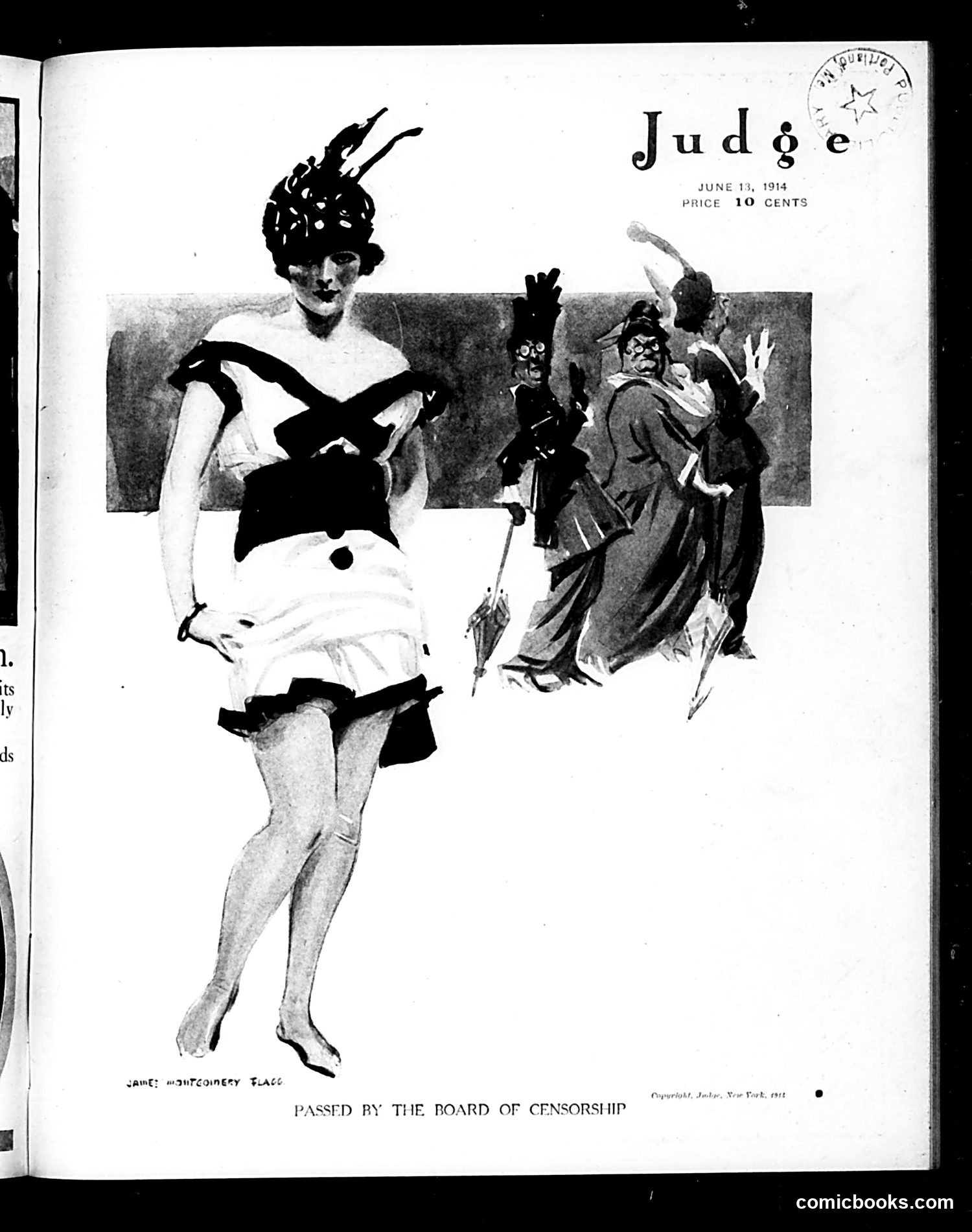
This June 11, 1914 Judge cover satirizes women's fashion and suffrage activism. The central figure is a fashionably dressed woman with an elaborate feathered hat, wearing a black bow and white dress—representing the "New Woman" of the era. On the right, caricatured figures (likely suffragettes or political activists) appear disheveled and aggressive, wielding weapons or implements. The contrast suggests satire: the elegant woman represents conventional femininity, while the chaotic figures mock women's political movements as unladylike and violent. The subtitle "PASSED BY THE BOARD OF CENSORSHIP" is ironic—common on Judge covers to humorously suggest the magazine's controversial content. The overall message appears to mock both modern fashion excess and women's suffrage activism, portraying the latter as incompatible with proper femininity.
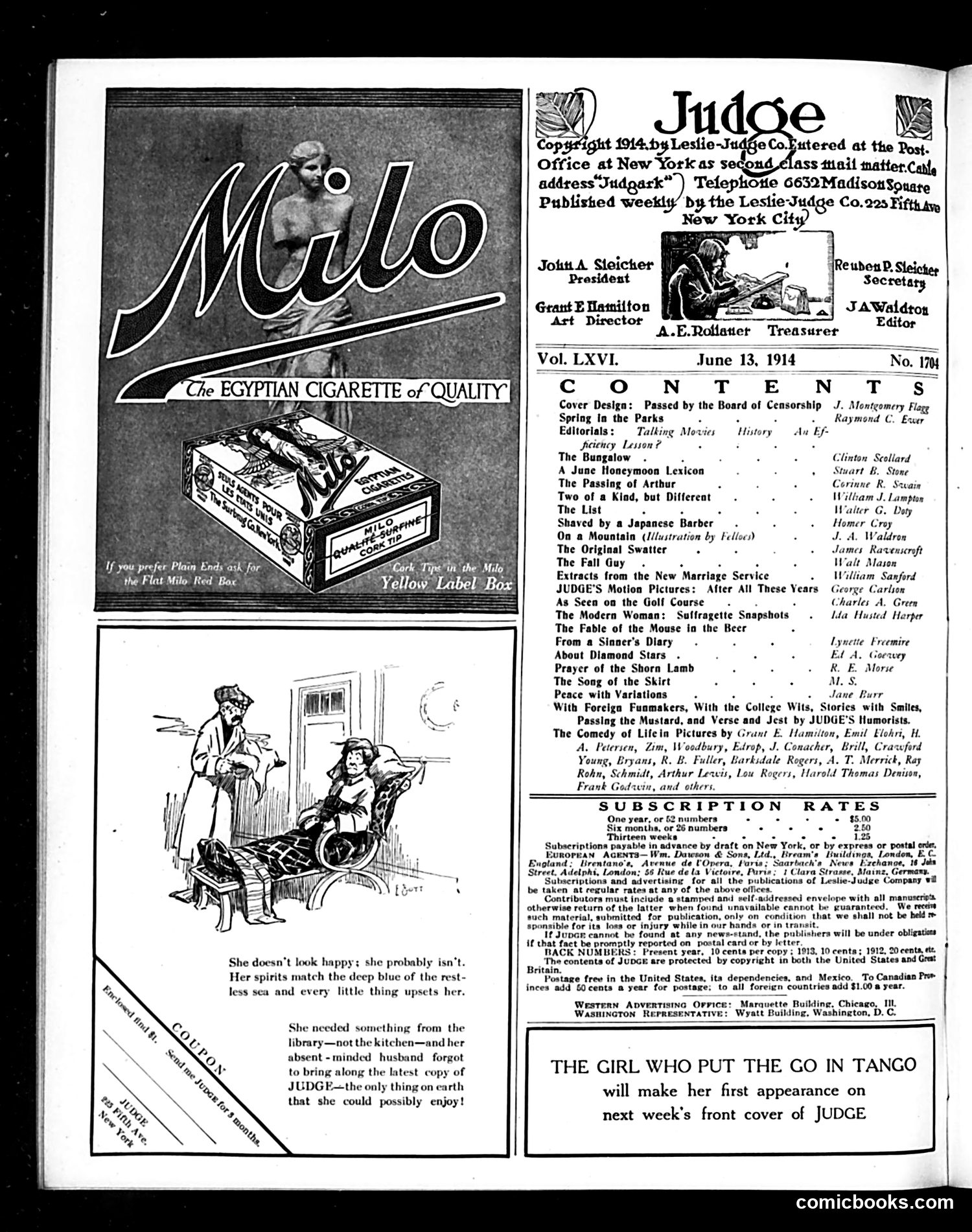
This page is primarily **advertising and editorial content** rather than political satire. The dominant feature is a **Milo cigarette advertisement** promoting "Egyptian cigarettes of quality," with packaging imagery and marketing copy about preferred smoking options. Below that is a **domestic humor cartoon** showing a woman with a spinning wheel and an inattentive husband, illustrating marital discord. The caption suggests the wife needs intellectual stimulation (Judge magazine) rather than domestic tasks—a gentle jab at unengaged husbands and a pitch for the magazine's content as necessary household reading. The right page contains **table of contents and subscription information**, indicating this is standard magazine layout from 1914, focused on commerce and circulation rather than satirical commentary on contemporary political events.
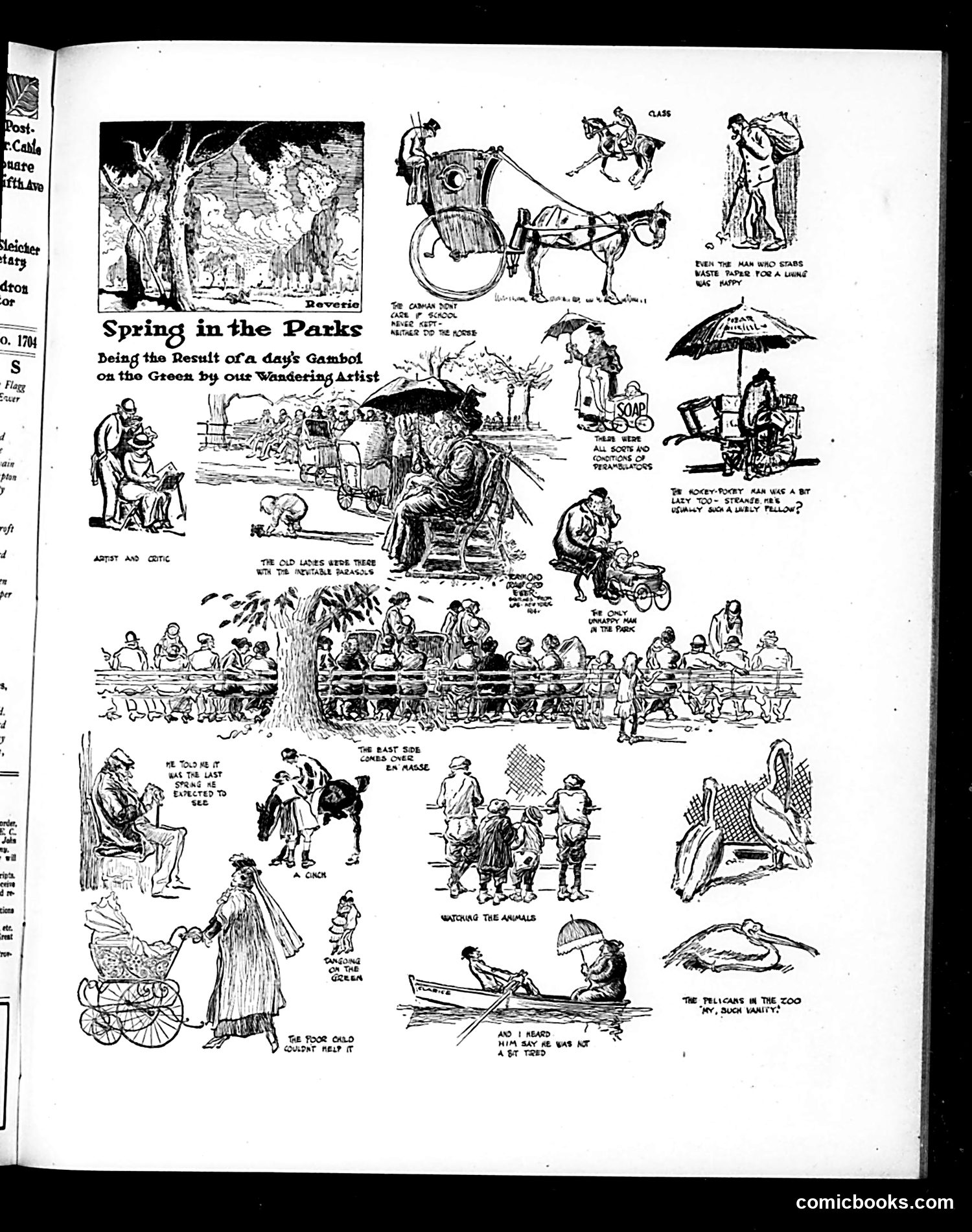
This page presents a collection of sketches capturing urban park life during spring, drawn by "our Wandering Artist." The scenes depict everyday leisure activities of the era: people relaxing on benches, children playing, nannies with carriages, couples courting under umbrellas, and men fishing. The humor is gentle and observational rather than political. Captions like "The old loves seek their kin in the revived meadows" and "Even the man who stares hates being a using war party" suggest wry commentary on human nature and social behavior during warmer months. The sketches satirize park culture and class dynamics—showing wealthy individuals, working-class people, and various social encounters—but without targeting specific political figures or events. It's straightforward social satire about spring leisure habits.
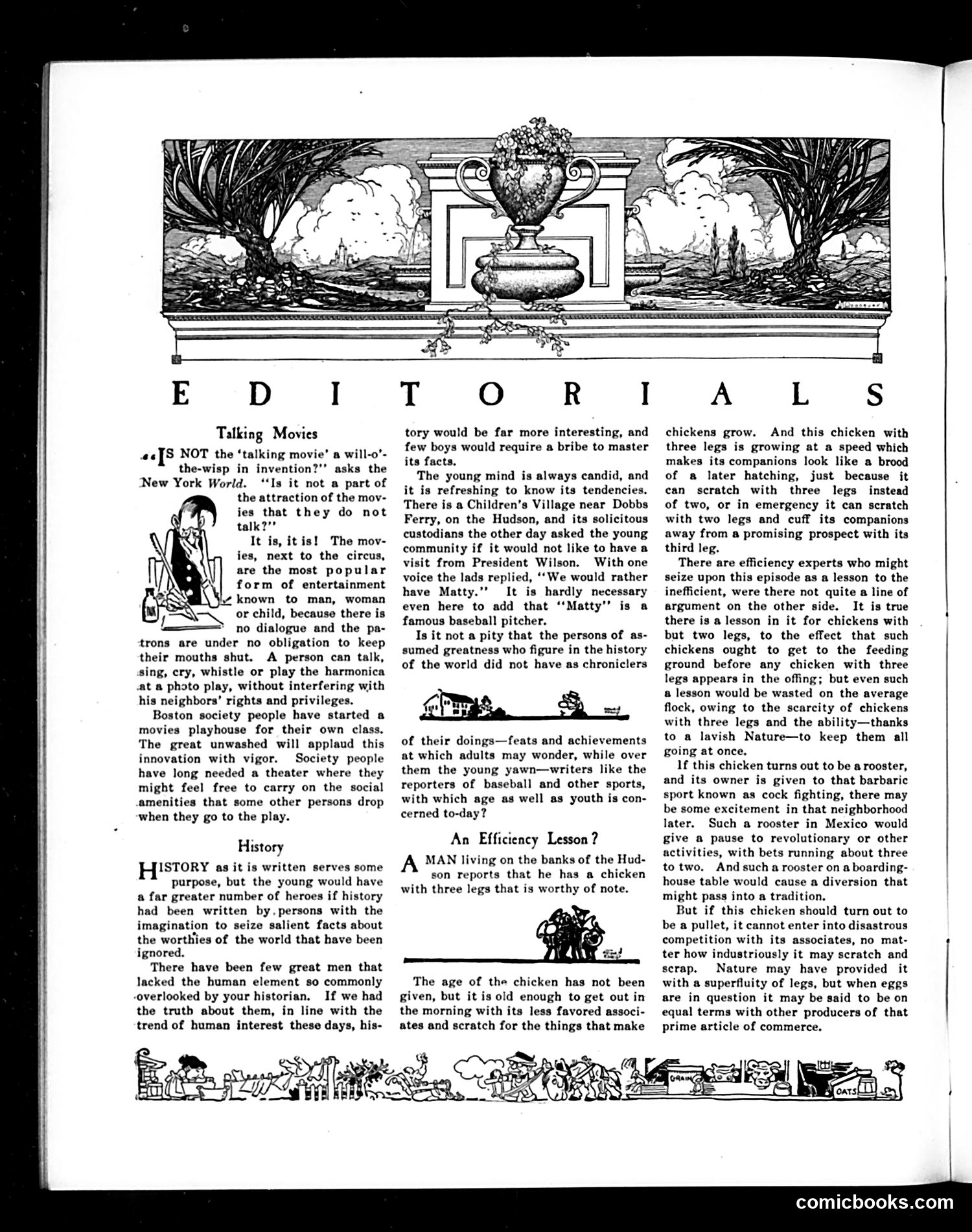
This editorial page contains three sections—"Talking Movies," "History," and "An Efficiency Lesson?"—satirizing contemporary American culture circa 1910s-1920s. **"Talking Movies"** mocks the film industry's resistance to developing sound technology, suggesting moviemakers fear innovation despite audience demand. **"History"** critiques how historians overlook common people's experiences, arguing great leaders dominate narratives while ordinary citizens' achievements disappear from records. **"An Efficiency Lesson?"** uses absurdist humor about a three-legged chicken to satirize American obsession with industrial efficiency and productivity. The piece suggests that while nature provides surplus (extra legs), this doesn't necessarily improve commercial viability—a subtle critique of blind pursuit of "efficiency" without practical consideration. The cartoons and illustrations reinforce each section's satirical point through visual commentary.
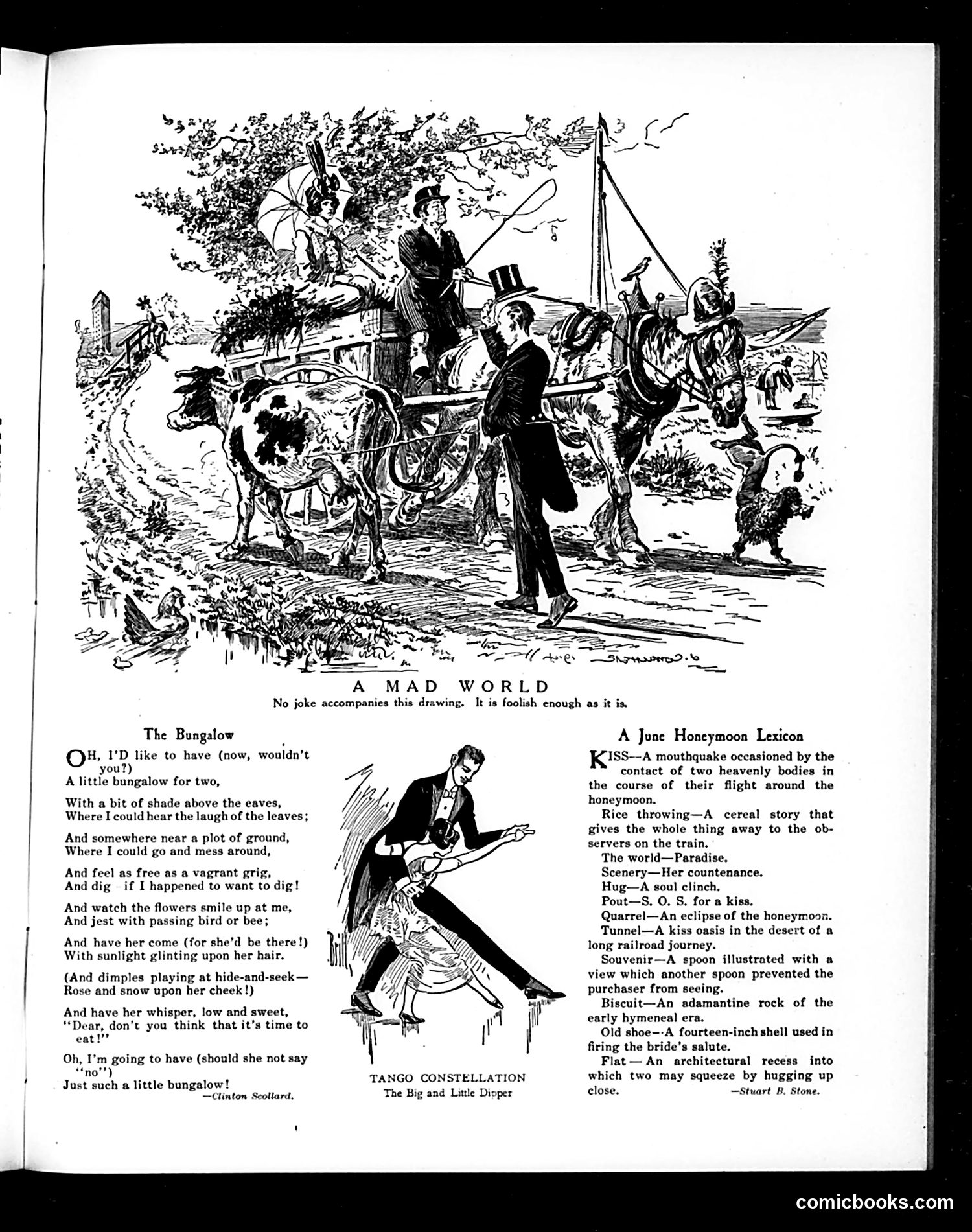
The top cartoon titled "A Mad World" depicts a chaotic riverside scene with well-dressed figures in a carriage pulled by oxen, accompanied by horses and dogs. The subtitle states "No joke accompanies this drawing. It is foolishly enough as it is"—suggesting the image's absurdity speaks for itself without explanation. Below are two pieces: a poem called "The Bungalow" by Clinton Scollard expressing pastoral domestic wishes, and "Tango Constellation" illustrating a couple dancing the tango—a controversial dance of the era. The right column contains "A June Honeymoon Lexicon," humorous definitions mocking newlywed euphemisms and honeymoon clichés, including satirical takes on romantic activities and wedding souvenirs. The page satirizes Gilded Age courtship, marriage customs, and popular dance crazes.
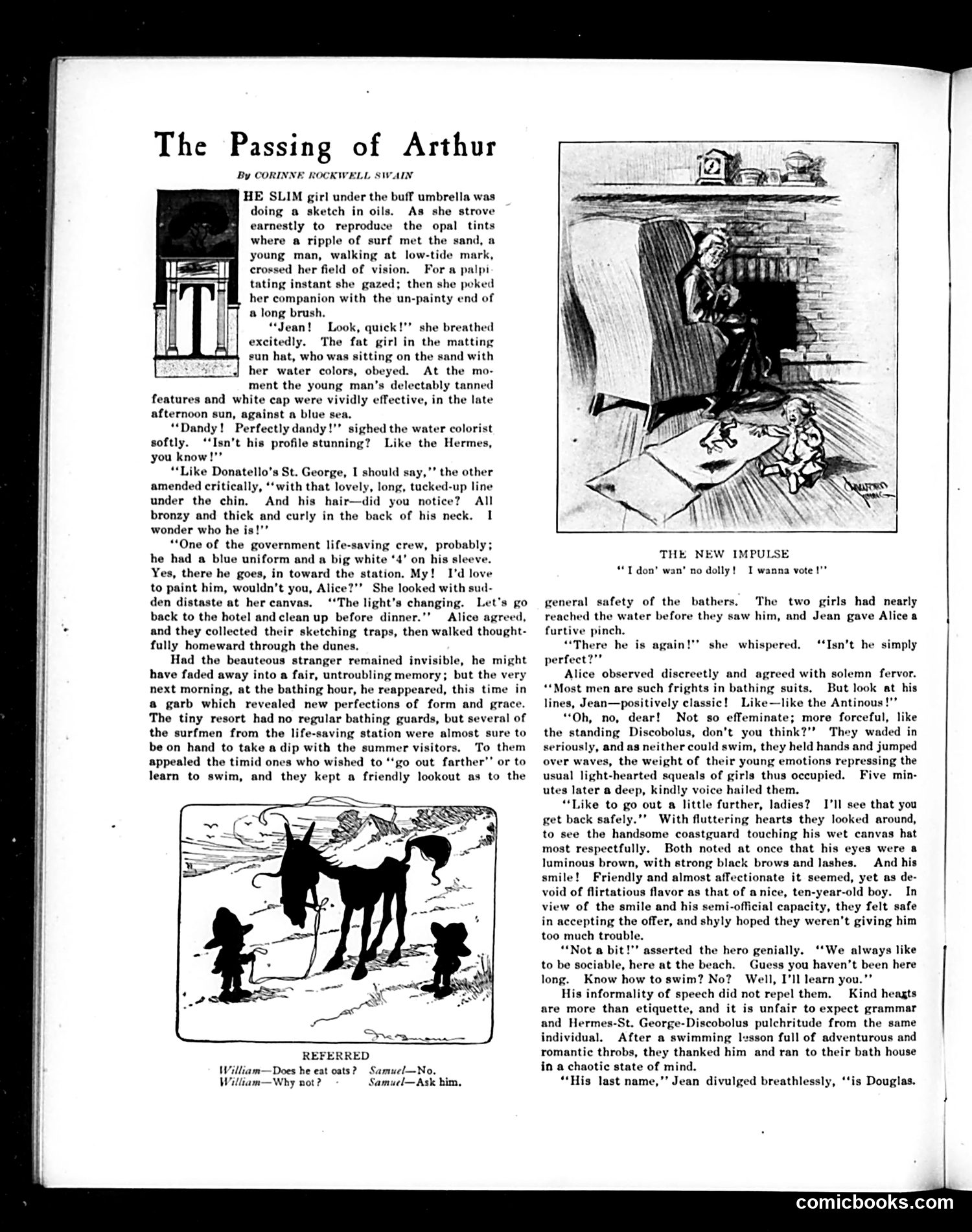
This is a humorous short story, not political satire. It depicts two young female artists vacationing at a beach resort who become infatuated with an attractive government lifeguard. They compare his physical appearance to classical sculptures (Hermes, Donatello's St. George, the Antinous, Discobolus), revealing period attitudes about aesthetic appreciation and feminine propriety. The narrative gently satirizes the romantic fantasies of genteel young women and their attempts to maintain dignified composure around an attractive man. The lifeguard's genuine friendliness and "semi-official capacity" allow them to rationalize accepting his assistance without compromising their respectability. The separate cartoon below, titled "The New Impulse," appears unrelated—a political joke involving voting rights, likely referencing women's suffrage debates of the era.
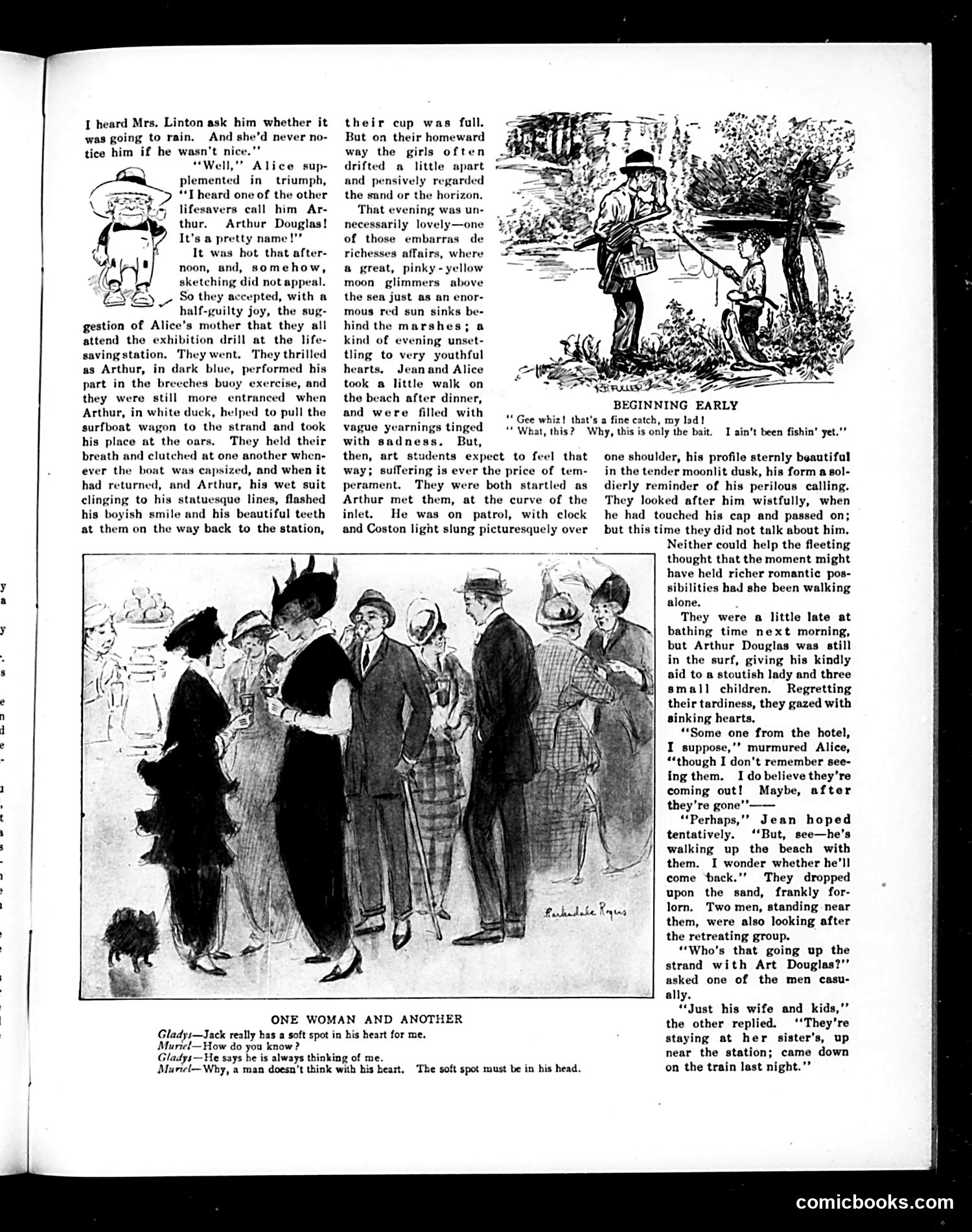
This page contains a romantic fiction story with satirical commentary. The main narrative follows two art students, Alice and Jean, who become infatuated with Arthur Douglas, a handsome lifesaver they observe at a beach station. The story builds romantic tension as they admire him during rescue drills and moonlit beach encounters, imagining romantic possibilities. The satire culminates in the final panel's dialogue: two men casually reveal that Arthur is already married with children visiting from out of town. The joke mocks the girls' romantic fantasies and the common literary trope of idealized, mysterious strangers—deflating their elaborate emotional investment with mundane reality. The accompanying cartoon "One Woman and Another" satirizes women's reasoning, with Muriel's quip that a man's declarations of thinking about a woman must originate in his head, not heart, suggesting women mistake male attention for romantic interest. Together, these pieces gently ridicule both youthful romantic delusion and feminine logic.
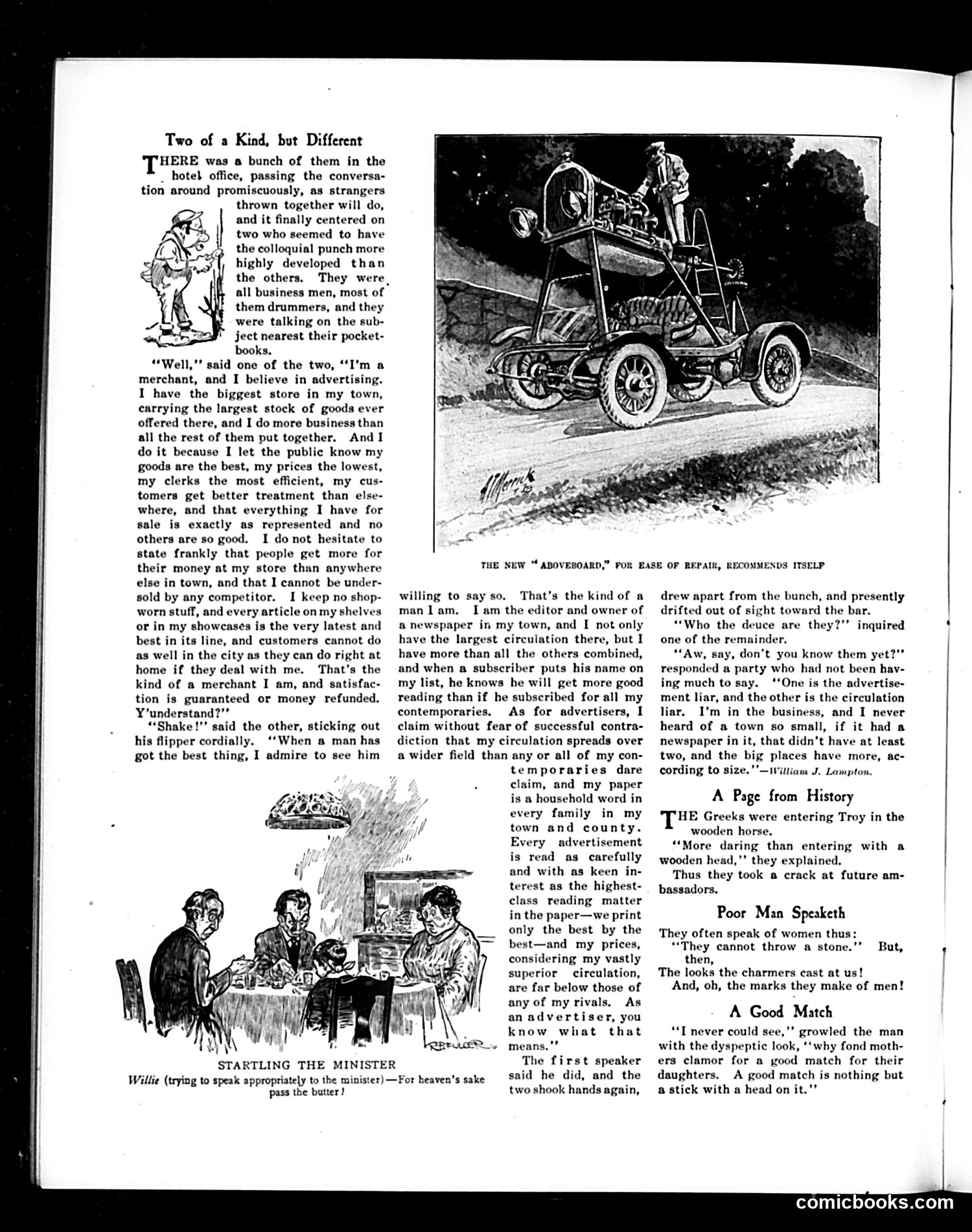
This page satirizes two common types of business liars in Gilded Age America. The main story features two "drummers" (traveling salesmen/businessmen) boasting in a hotel lobby—one a merchant claiming to run the town's best store with unbeatable prices and service, the other a newspaper editor claiming superior circulation and advertising value. The joke's punchline reveals both are notorious liars: they're identified as "the advertisement liar" and "the circulation liar"—archetypes apparently so familiar that even small towns supposedly had two of each. The satire targets exaggerated advertising claims common in the era, when newspapers and merchants made outlandish, unverifiable assertions. The cartoon mocks business culture's shameless self-promotion and the public's cynical acceptance of such falsehoods as inevitable. The page also includes unrelated brief jokes about Greek history and gender relations—typical filler content for magazines of this period.
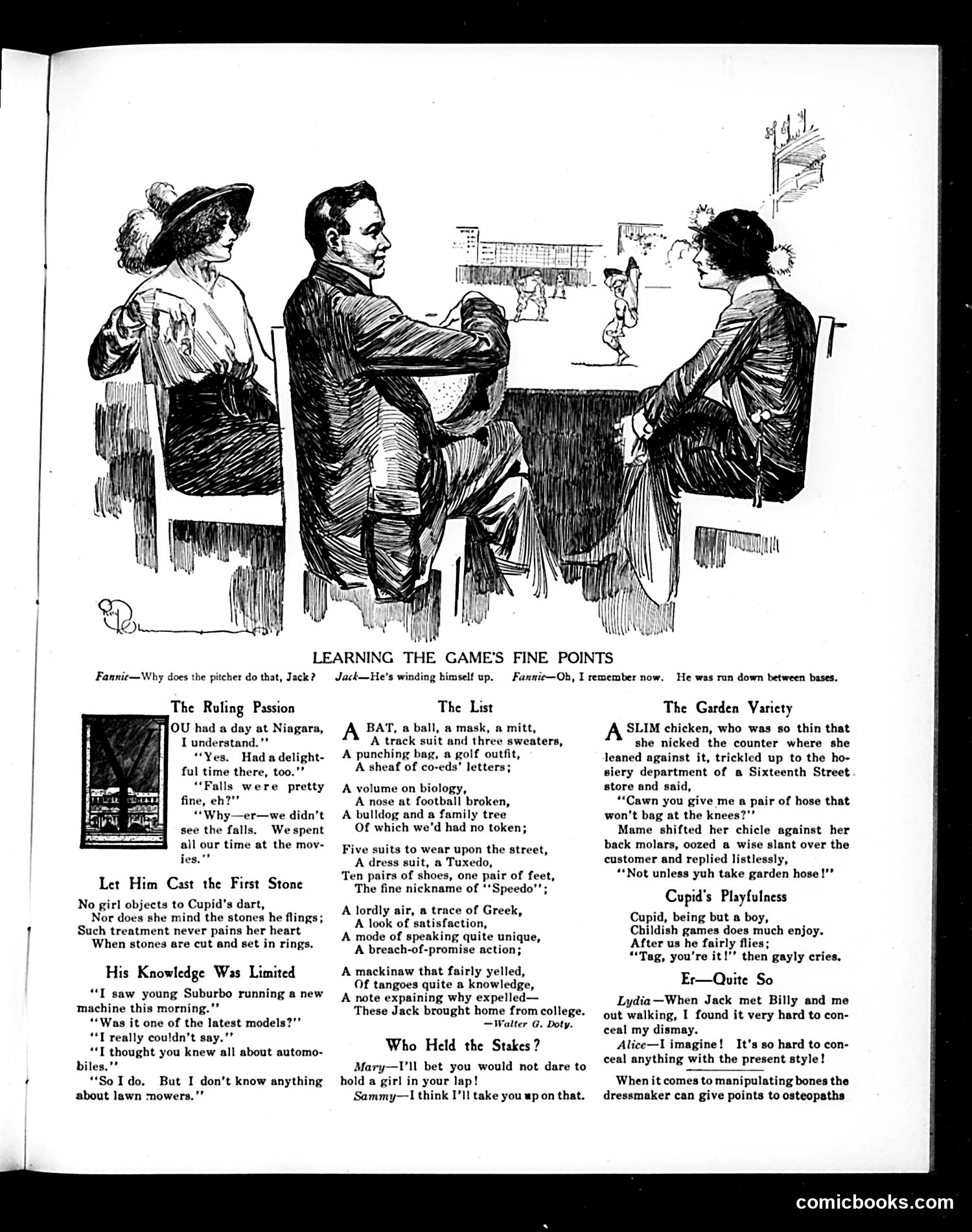
This page from Judge presents multiple brief satirical sketches mocking early 20th-century American society and manners. **Main cartoon** shows people discussing baseball, with the joke hinging on a woman's ignorance of sports terminology—she mistakes "winding himself up" (pitching motion) for something else, playing on gender stereotypes about women's athletic knowledge. **Surrounding vignettes** mock various social absurdities: - A couple visiting Niagara Falls who spent all their time at movies instead - A man knowledgeable about automobiles but ignorant about lawn mowers - A college student returning home with numerous possessions and romantic entanglements - Store clerk mockery of a thin customer - A flirtation involving a bet about lap-sitting **The satire targets**: male ignorance, female materialism and fashion obsession, shallow entertainment preferences, and period-specific social pretensions. The humor relies on exaggeration and physical comedy typical of early 20th-century American journalism.
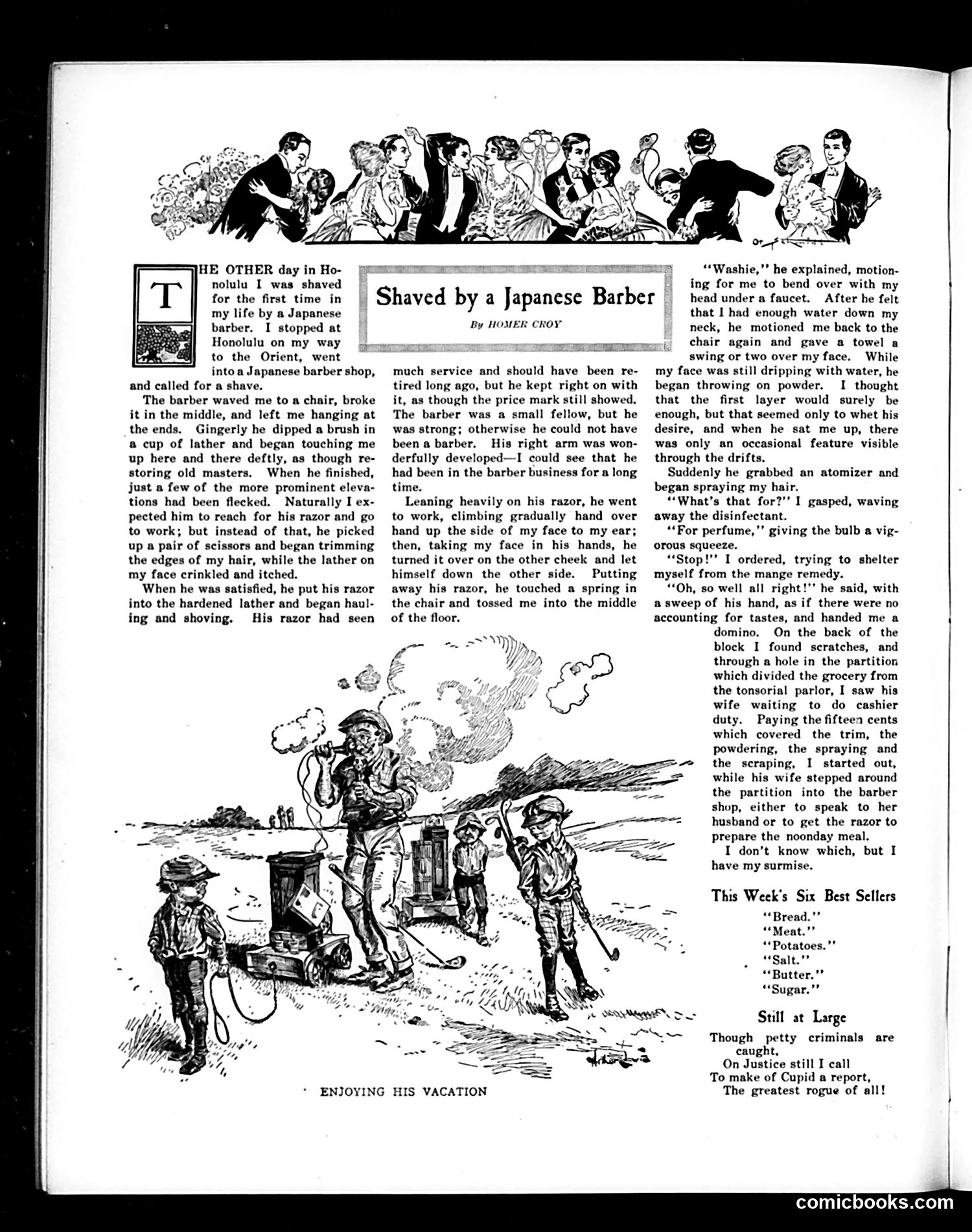
This is a humorous travel narrative by Homer Croy describing an absurdly incompetent haircut in Honolulu from a Japanese barber. The satire works through exaggerated physical comedy: the barber uses scissors before lather, shaves with an ancient dull razor "as though the price mark still showed," physically manhandles the narrator's face ("climbing gradually hand over hand"), and then drowns him in powder and perfume spray. The joke relies on ethnic caricature—portraying the Japanese barber as comically inept through broken English ("Washie") and bizarre procedures. The accompanying illustration shows men in vacation/leisure settings, likely contrasting relaxation with the narrator's misadventure. The bottom section lists bestselling foods (bread, meat, potatoes, salt, butter, sugar), likely referencing wartime rationing or economic concerns contemporary to the magazine's publication.
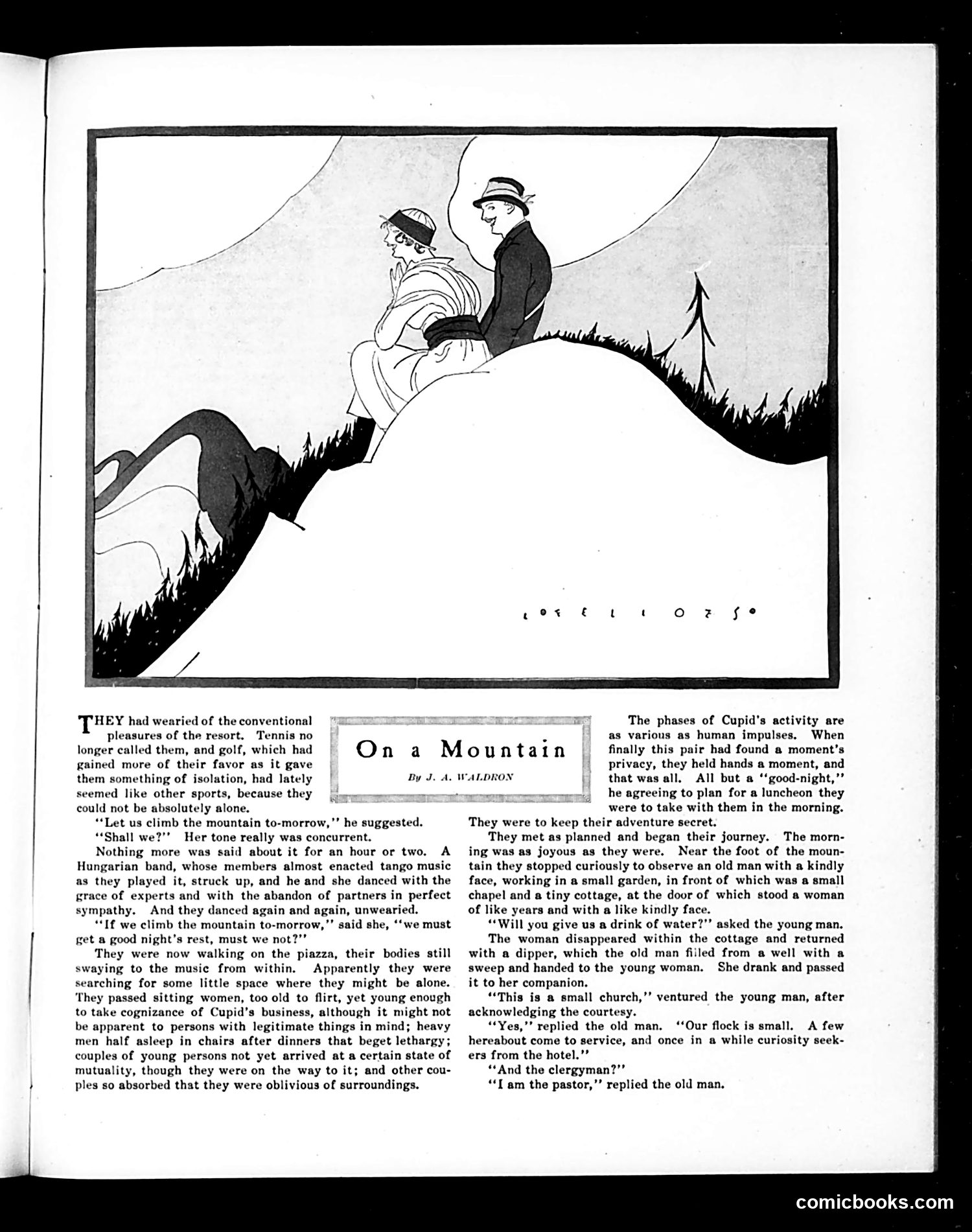
This is a romantic short story, not political satire. The illustration shows a young couple climbing a mountain together—depicted in the art at top. The narrative describes two resort guests who've grown bored with conventional activities (tennis, golf) and seek isolation and romance. They sneak away for a secret mountain excursion, presenting themselves as properly chaperoned ("luncheon in the morning") while clearly pursuing romantic adventure. The story's gentle satire targets the hypocrisy of Edwardian-era resort culture: the couple wants privacy for romance but must maintain appearances of propriety. Secondary humor involves elderly resort observers who recognize "Cupid's business" while pretending not to. The couple encounters a humble pastor and his wife at a mountain chapel—likely foreshadowing a moral or spiritual lesson about simple virtue versus sophisticated deception, though the page cuts off before resolution. The piece exemplifies Judge magazine's typical blend of social observation and romantic comedy aimed at upper-middle-class readers.
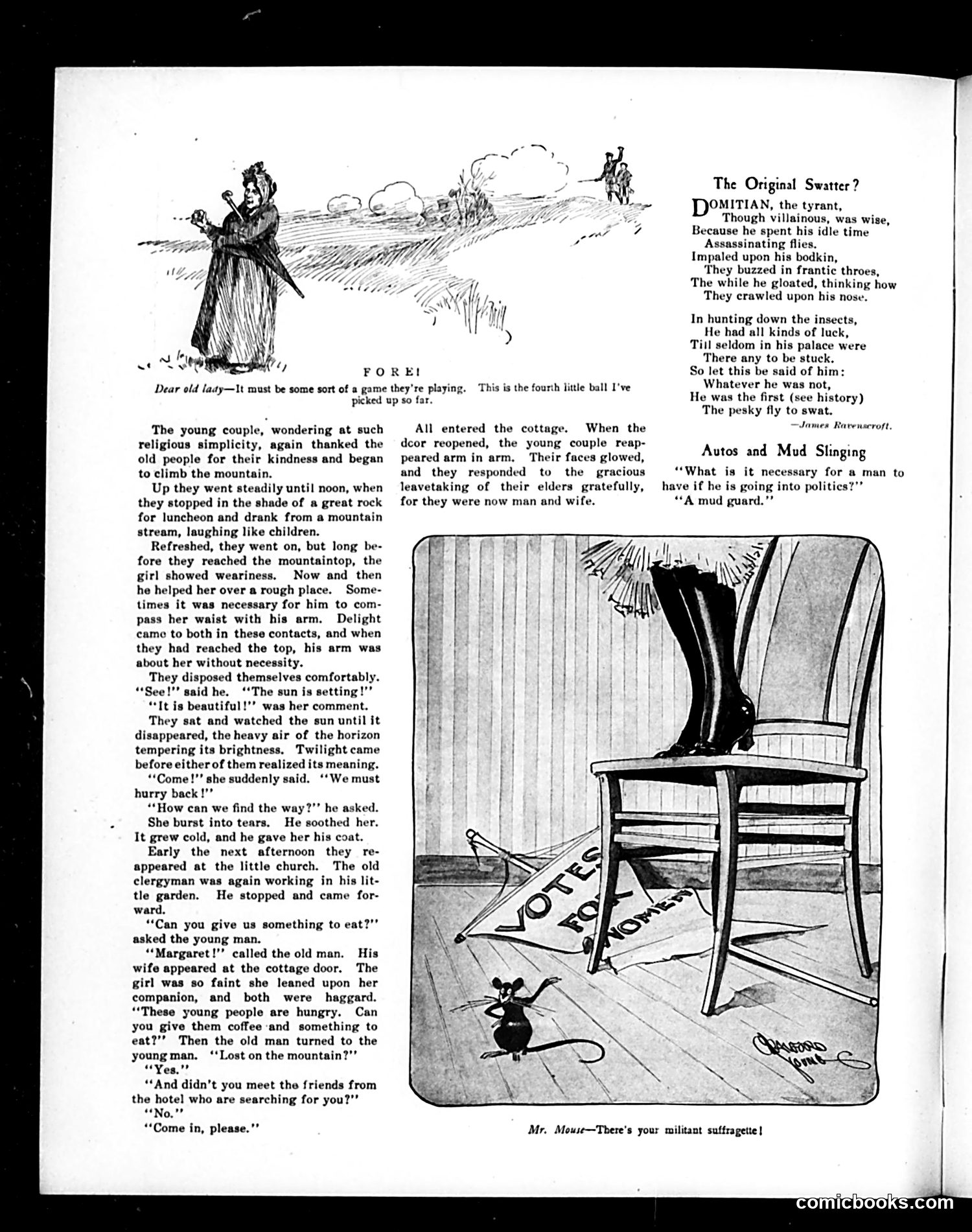
This page contains three separate humorous pieces: **"Fore!" (top left):** A golf joke. An elderly woman watches golfers on a course, naively believing the sport involves retrieving balls—she's picked up four so far. The humor plays on generational incomprehension of modern leisure activities. **Mountain Romance (center/left column):** A sentimental short story about a young couple who get lost on a mountain, spending the night together. They return the next morning married. The piece satirizes romantic melodrama and the old clergyman's innocent misunderstanding of what kept them occupied. **"The Original Swatter" (right):** A poem crediting the Roman tyrant Domitian as history's first person to swat flies—a playful take on finding virtue in unexpected places. **"Autos and Mud Slinging" (bottom right):** A one-panel cartoon depicting a mouse on political campaign materials, with a pun: to succeed in politics, one needs a "mud guard"—both literally (for automobile travel) and figuratively (protection against character attacks). The page exemplifies Judge's mix of genteel satire, puns, and social observation circa the early 20th century.
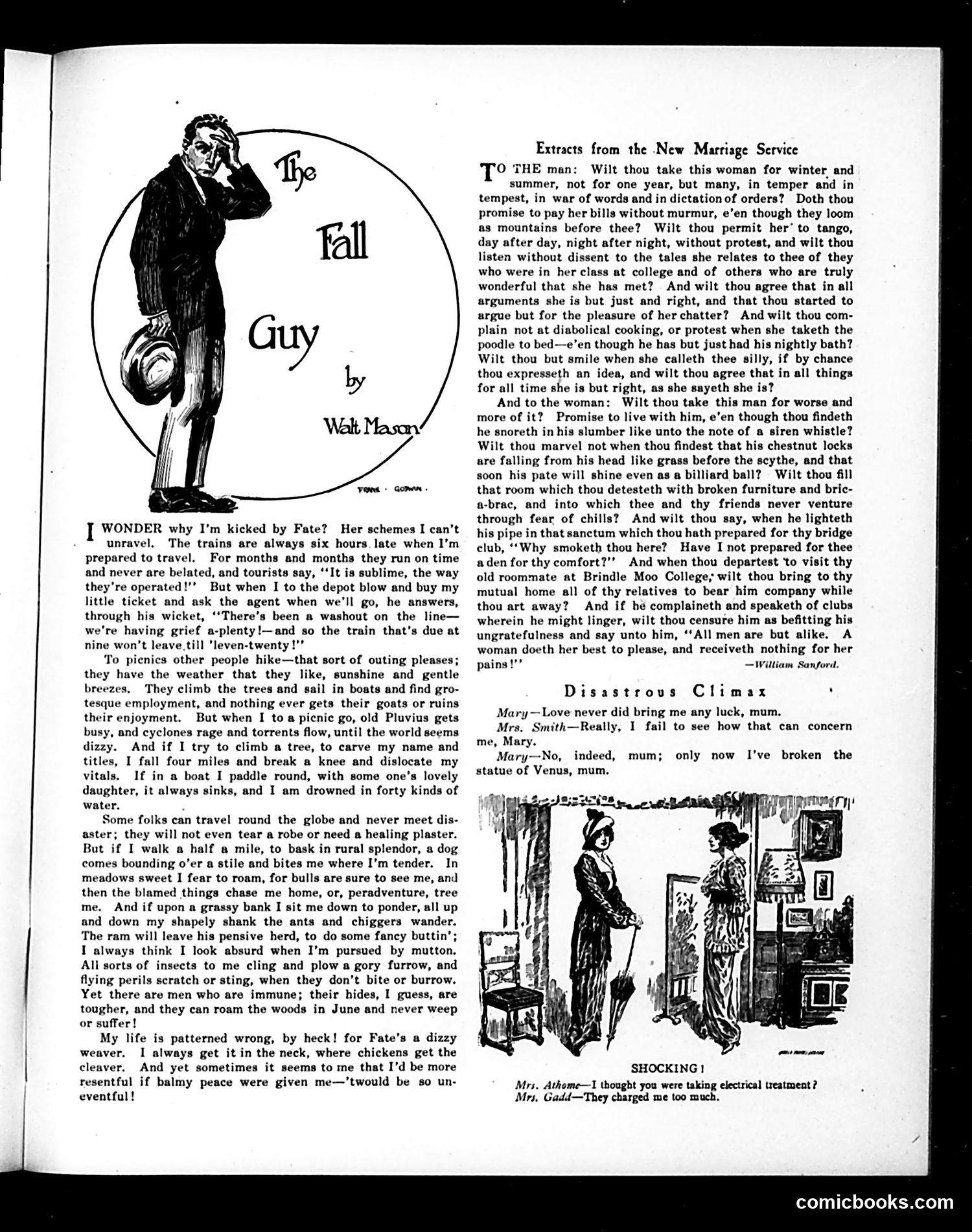
**"The Fall Guy"** (left) is a humorous poem by Walt Mason about a man perpetually cursed by bad luck. The illustration shows a disheveled gentleman plagued by misfortune—trains run late only for him, picnics flood when he attends, animals attack him. The satire mocks the universal human tendency to blame fate for personal mishaps rather than accepting responsibility. **"Extracts from the New Marriage Service"** (right) is marital satire written as mock-vows. It parodies contemporary gender dynamics: the groom promises endless financial and emotional tolerance of his wife's superiority and demands; the bride's vows humorously address the husband's snoring and physical decline. The piece satirizes both the institution of marriage and rigid gender roles—suggesting wives expect complete male subservience while husbands must accept wives' infallibility. The tone is cynical humor about marital compromise and domestic power imbalances of the era. Both pieces reflect Judge magazine's characteristic early-20th-century humor targeting human folly and social conventions.
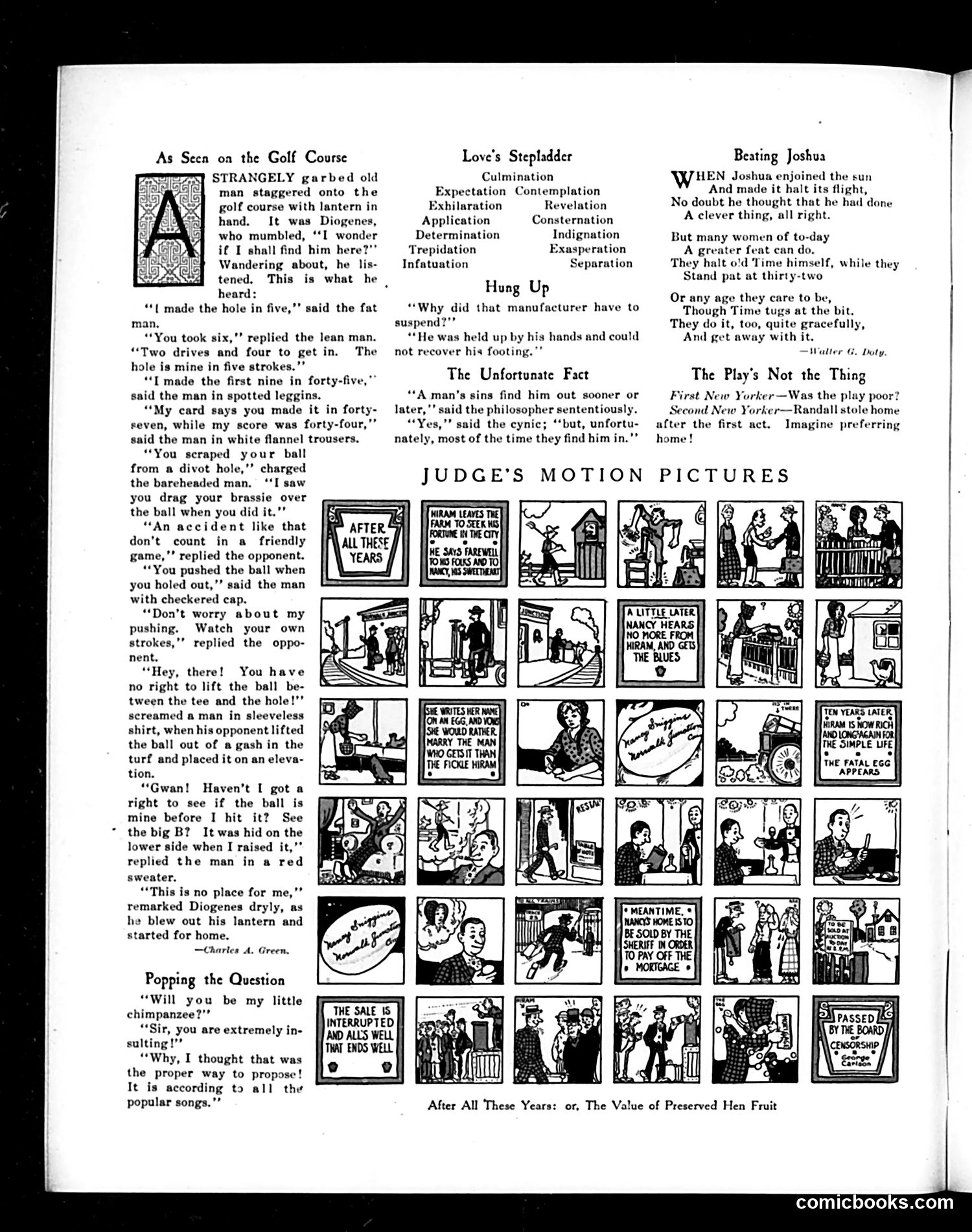
This page contains several satirical pieces mocking early 20th-century social behaviors: **"As Seen on the Golf Course"** uses the classical figure of Diogenes (who famously searched for an honest man) to satirize golfers' dishonesty. Golfers argue about scores, accuse each other of cheating, and move balls illegally. Diogenes abandons his search—implying golfers represent the antithesis of honesty. The satire targets golf's competitive culture and players' casual disregard for rules. **"Popping the Question"** mocks modern romance, where a suitor proposes using the sentimental language of popular songs (comparing the beloved to a "chimpanzee"), revealing how formulaic and insincere courtship has become. **"Beating Joshua"** satirizes women's vanity, joking that while Joshua stopped the sun, modern women can stop time itself—staying perpetually "thirty-two" through cosmetics or deception. **"Judge's Motion Pictures"** is a comic strip sequence (title visible but content unclear without better resolution). The page reflects early 1900s attitudes about golf culture, romance, and female vanity.
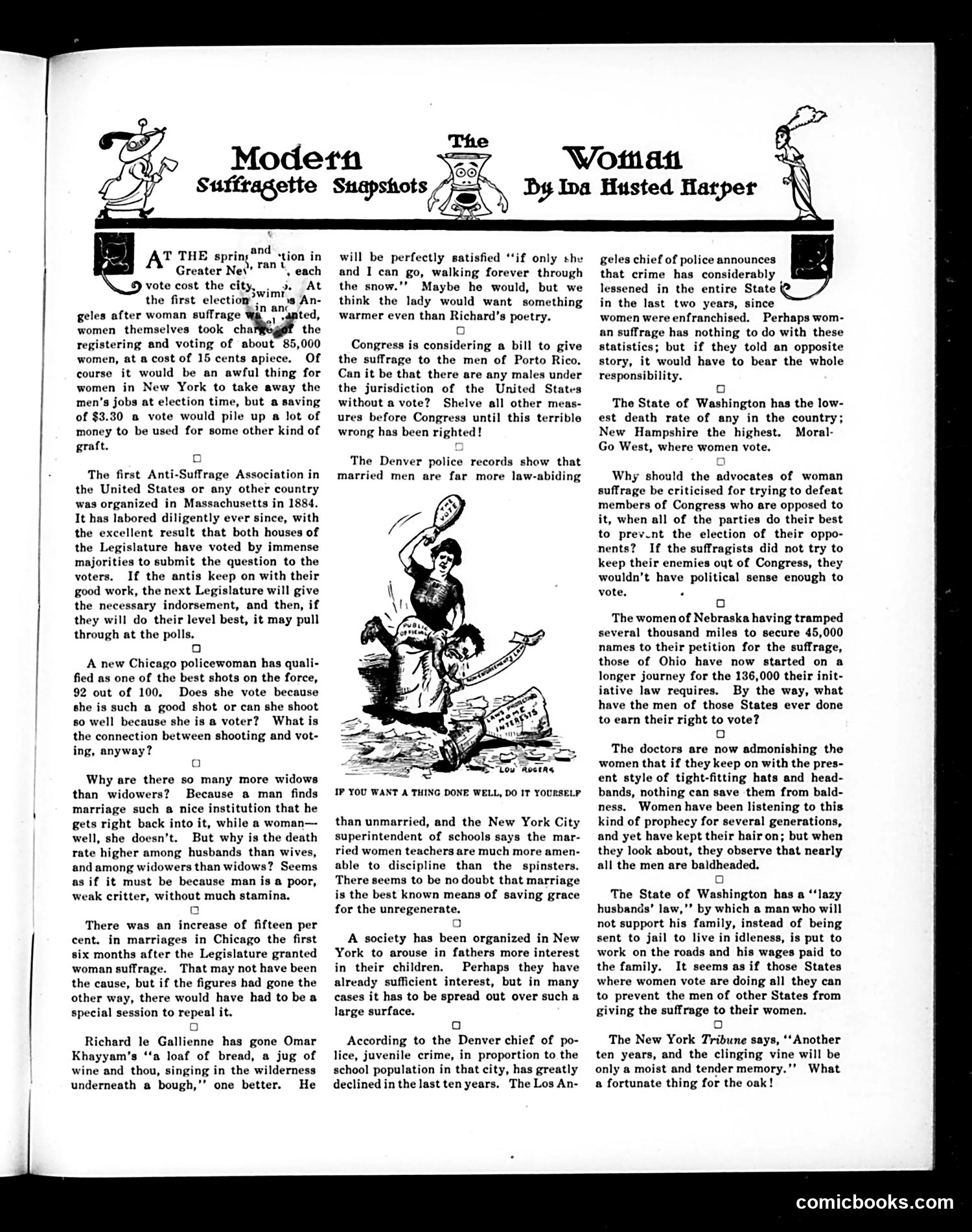
This page from *Judge* magazine uses sardonic humor to mock **anti-suffrage arguments** while appearing to support women's voting rights. The column, attributed to Ina Husted Harper, employs ironic logic: it praises women voters in western states (Washington, California) where crime allegedly decreased, then sarcastically suggests opponents can't claim credit for crime *increases* elsewhere. The satire targets absurd anti-suffrage talking points—like concerns that women voting threatens men's election jobs, or that a female police officer's marksmanship somehow connects to voting rights. It mocks the "Anti-Suffrage Association" by noting their efforts paradoxically *advance* the cause they oppose. The illustrated cartoon (center) likely depicts a suffragist, though details are unclear from the image quality. Overall, this is **pro-suffrage satire**: using ridicule to expose the illogic and hypocrisy of opponents, while celebrating women's demonstrated competence as voters.
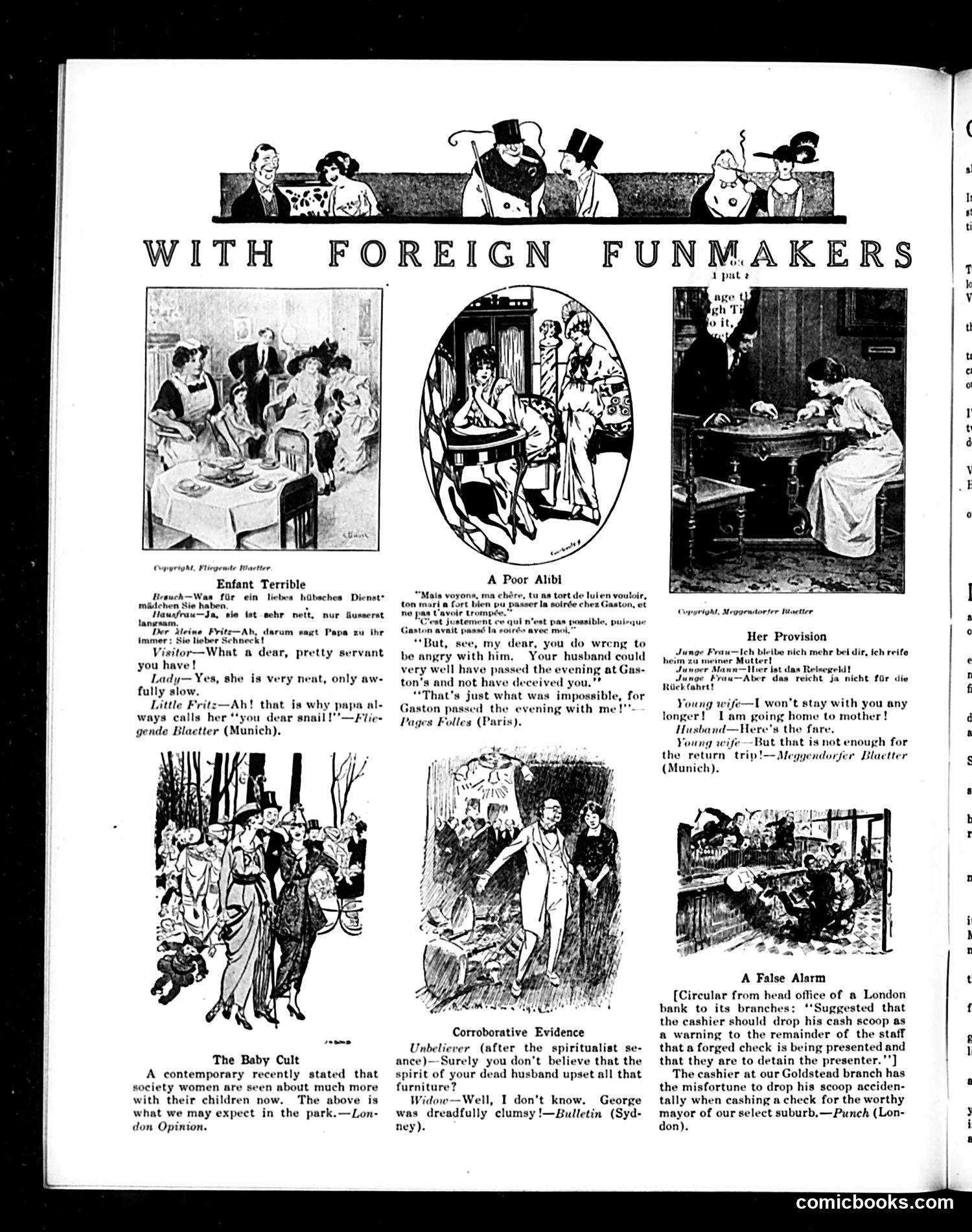
This page collects brief comedic anecdotes translated from European satirical magazines, presented as cultural humor. **Key sketches:** - **"Enfant Terrible"** (Munich): A child innocently reveals his mother's hypocrisy—she calls the slow maid a "snail," which the father uses as a pet name, implying he knew about her slowness. - **"A Poor Alibi"** (Paris): A wife catches her husband in an affair; he claims he was at a restaurant, but she was there that evening—an ironically airtight trap. - **"Her Provision"** (Munich): A wife leaves her husband, taking only travel fare home, but the money isn't enough for the return trip—dark humor about marital discord and dependency. - **"The Baby Cult"** and **"Corroborative Evidence"**: Domestic humor about modern parenting trends and widows excusing dead husbands' clumsiness. - **"A False Alarm"** (Punch): A bank's security measure backfires when an honest cashier accidentally triggers the alarm, embarrassing a respectable local official. The page emphasizes marital conflict, class observation, and practical ironies typical of early 20th-century satirical magazines.
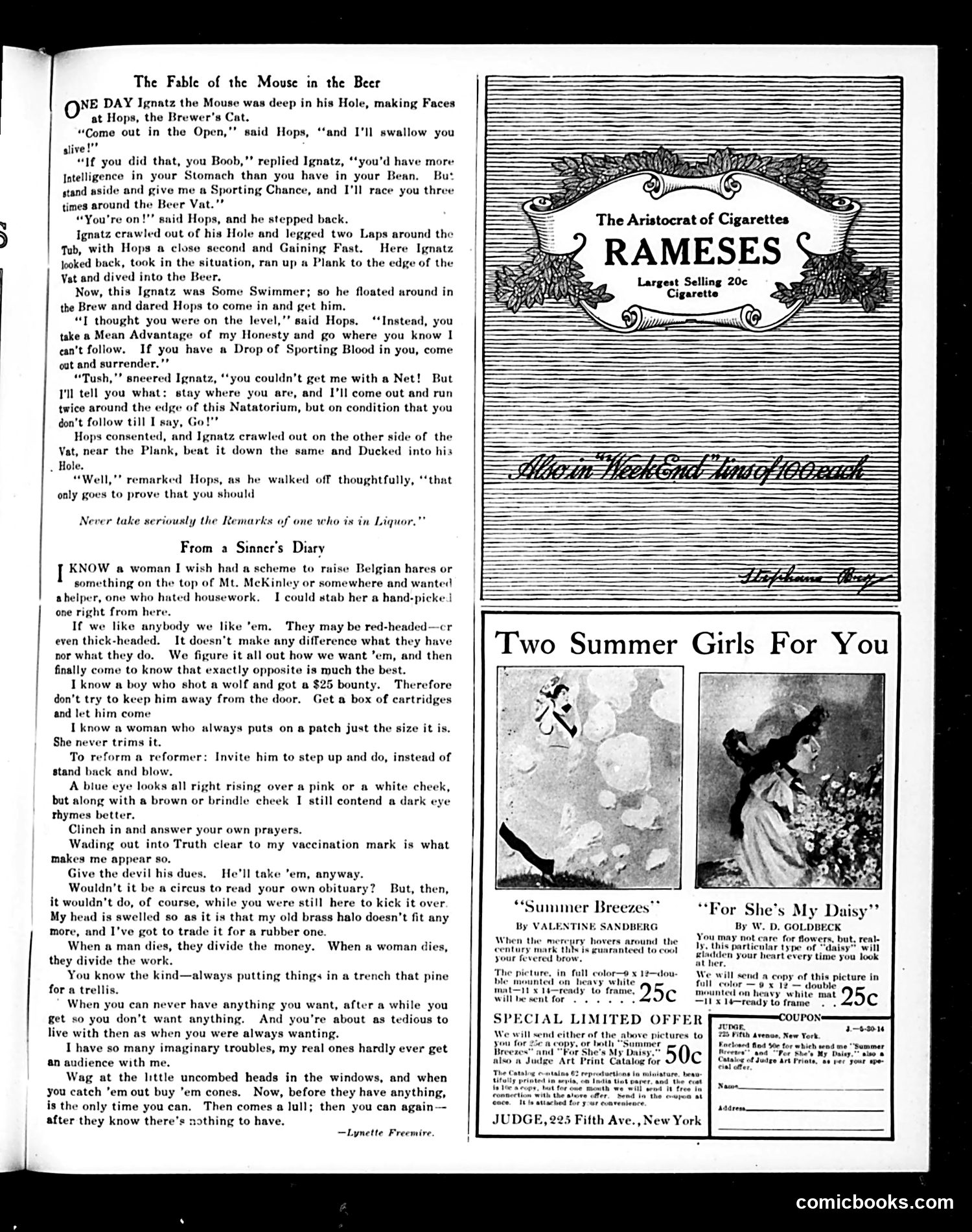
This page contains two distinct pieces from *Judge* magazine: **"The Fable of the Mouse in the Beer"** is a moral fable where Ignatz the Mouse outwits Hops the Cat through cunning and deception. The mouse exploits the cat's "honesty" and trust, repeatedly tricking him into chasing while ultimately escaping. The moral—"Never take seriously the Remarks of one who is in Liquor"—suggests distrust of intoxicated individuals' judgment. It's a cautionary tale about naïveté. **"From a Sinner's Diary"** is a cynical, aphoristic column offering observations on human nature and relationships. It contains sardonic commentary: people overlook flaws in those they love; reformed criminals shouldn't be denied opportunities; women inherit housework burdens while men inherit money; people become bored once they get what they want. The writing is misanthropic but witty. The page also features cigarette and summer romance photo advertisements, typical of early 20th-century magazine layouts.
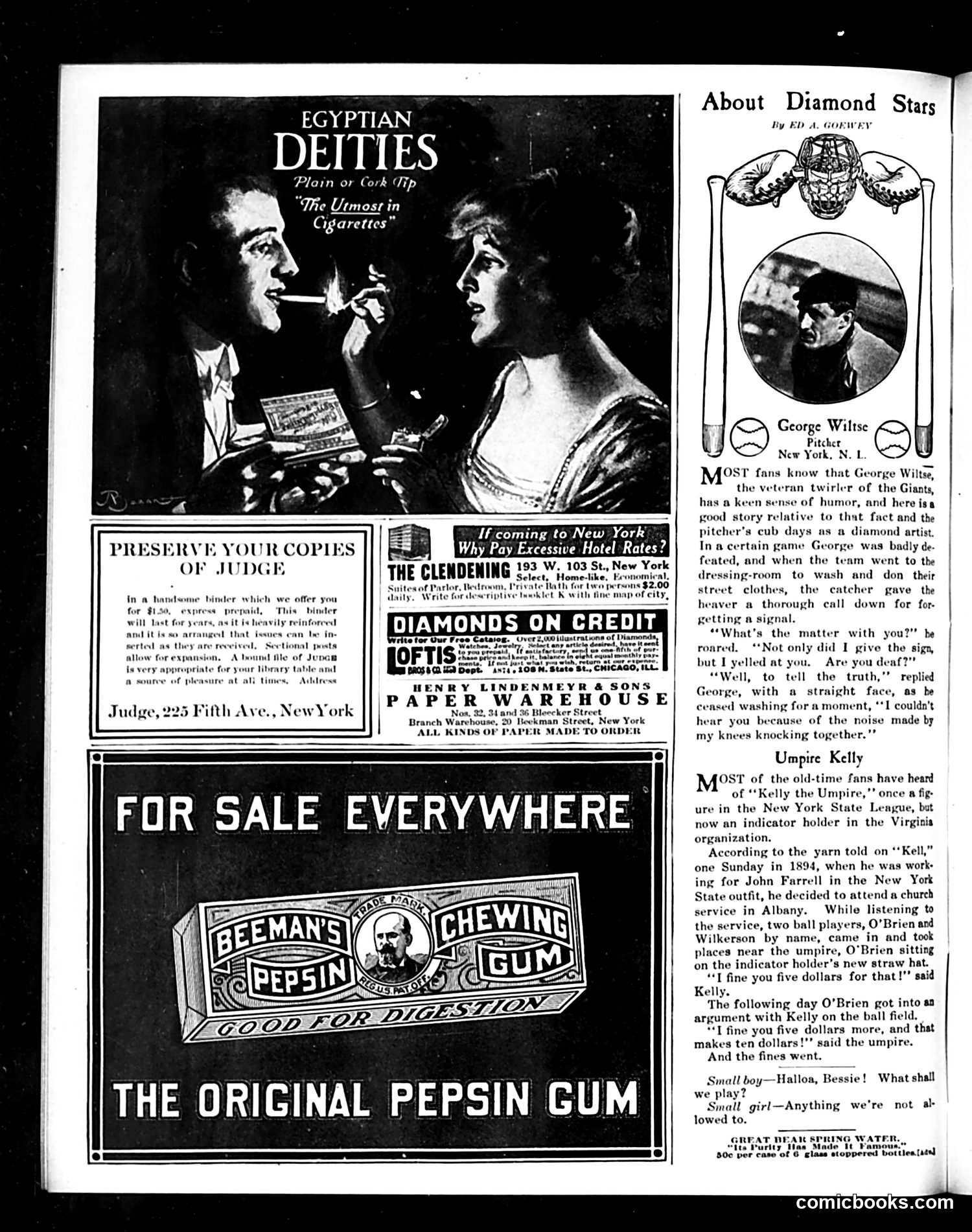
**The Main Content:** This is primarily a **advertising and humor page** from Judge magazine. The left side features ads for Egyptian Deities cigarettes (with a stylized illustration of two figures), Judge binder preservation, hotel rates, diamonds on credit, and Beeman's Pepsin Chewing Gum. **The Right Side - "About Diamond Stars":** This section contains two anecdotes about baseball players: 1. **George Wiltse** (Giants pitcher): A humorous story about Wiltse deliberately playing poorly during a game, then admitting to the catcher that he couldn't hear signals because his knees were knocking together from nervousness—a self-deprecating joke about his own performance anxiety. 2. **Umpire Kelly**: An old-time baseball anecdote about an umpire who fined a player $5 for sitting on his hat in church, then fined him another $5 the next day during a game argument—satirizing overzealous authority figures and the absurdity of carrying personal grievances into official duties. These are gentle sports humor pieces typical of early 1900s magazines.
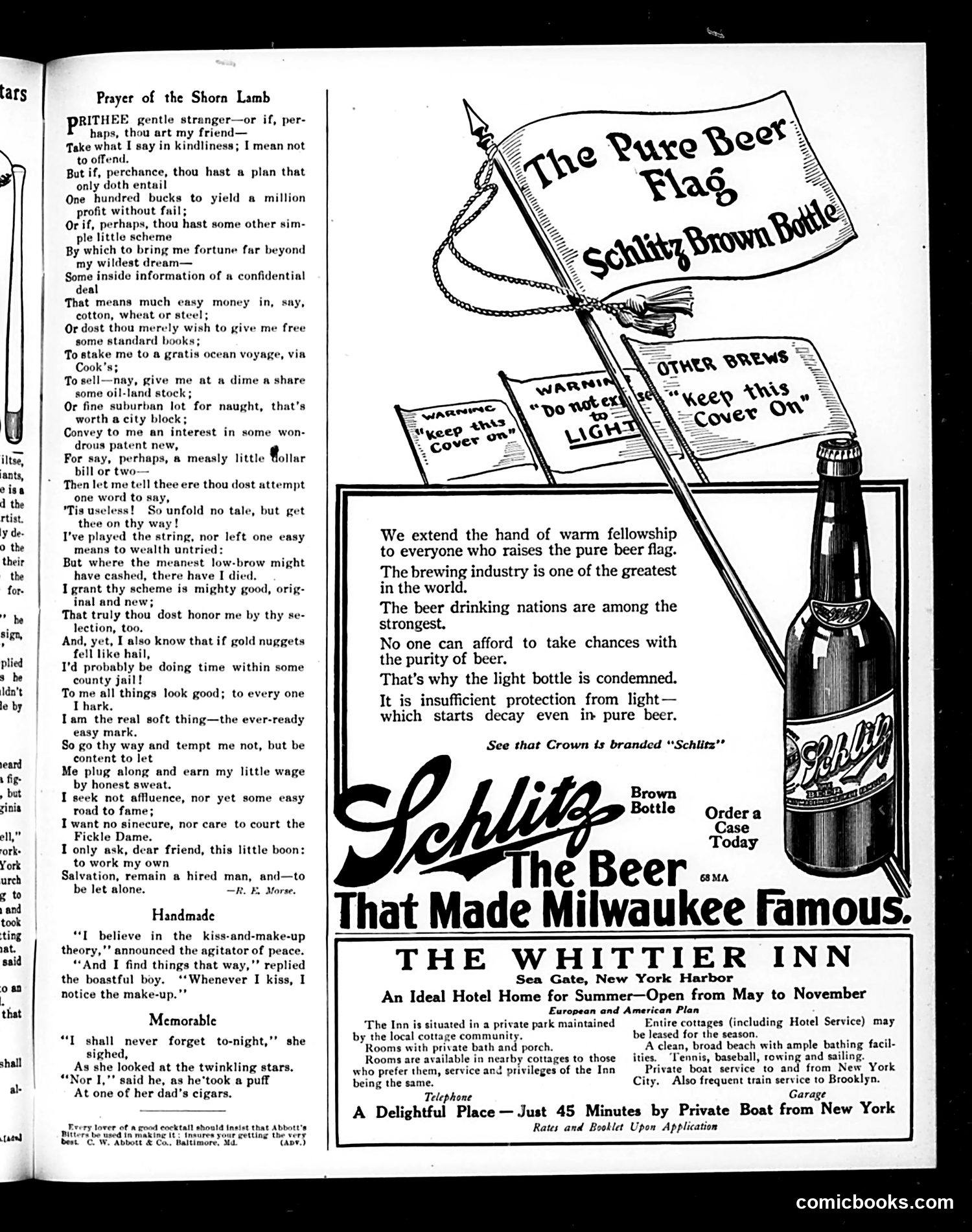
This page contains primarily **advertisements and light humor pieces**, not political satire. **"Prayer of the Shorn Lamb"** is a humorous poem about a perpetual "easy mark"—a man who has been duped by every get-rich-quick scheme imaginable (oil stocks, free ocean voyages, patent deals, real estate). He's begging strangers to leave him alone because he's already lost money to every type of con. The satire targets naive people susceptible to financial schemes popular in the early 20th century. **The dominant content is a Schlitz beer advertisement** promoting brown bottles over light bottles, claiming light bottles allow beer to decay. This was genuine product differentiation marketing. Below that: a hotel advertisement for "The Whittier Inn" in Sea Gate, New York. At bottom: brief humor pieces ("Handmade," "Memorable") about kissing and makeup, plus an Abbott's Bitters advertisement. The page reflects early 1900s consumer culture and common financial scams targeting ordinary people.
This page is primarily **advertisements and light verse** rather than political satire. The content includes: **"The Song of the Skirt"** — a humorous poem lamenting the economic pressures on working men whose wives don't contribute domestically or financially. The repeated "work, work, work" refrain mocks both the exhausted bookkeeper and his boss, suggesting that financial anxiety and status-consciousness trap all classes. The "wop" reference reflects period ethnic stereotyping common in early 20th-century humor. **"Peace with Variations"** — a satirical letter from someone fantasizing about rural escape while parenthetical asides reveal the reality: no actual peace exists because domestic obligations and family needs persist everywhere. The **advertisements** promote travel guides, hotels, whiskey, diamonds, and other consumer goods—typical Judge content targeting middle-class readers. No specific political figures are caricatured. Rather, the satire targets **gender relations and consumer anxiety** of the era: wives portrayed as parasitic dependents, and breadwinners trapped by social expectations to maintain appearances regardless of financial strain.
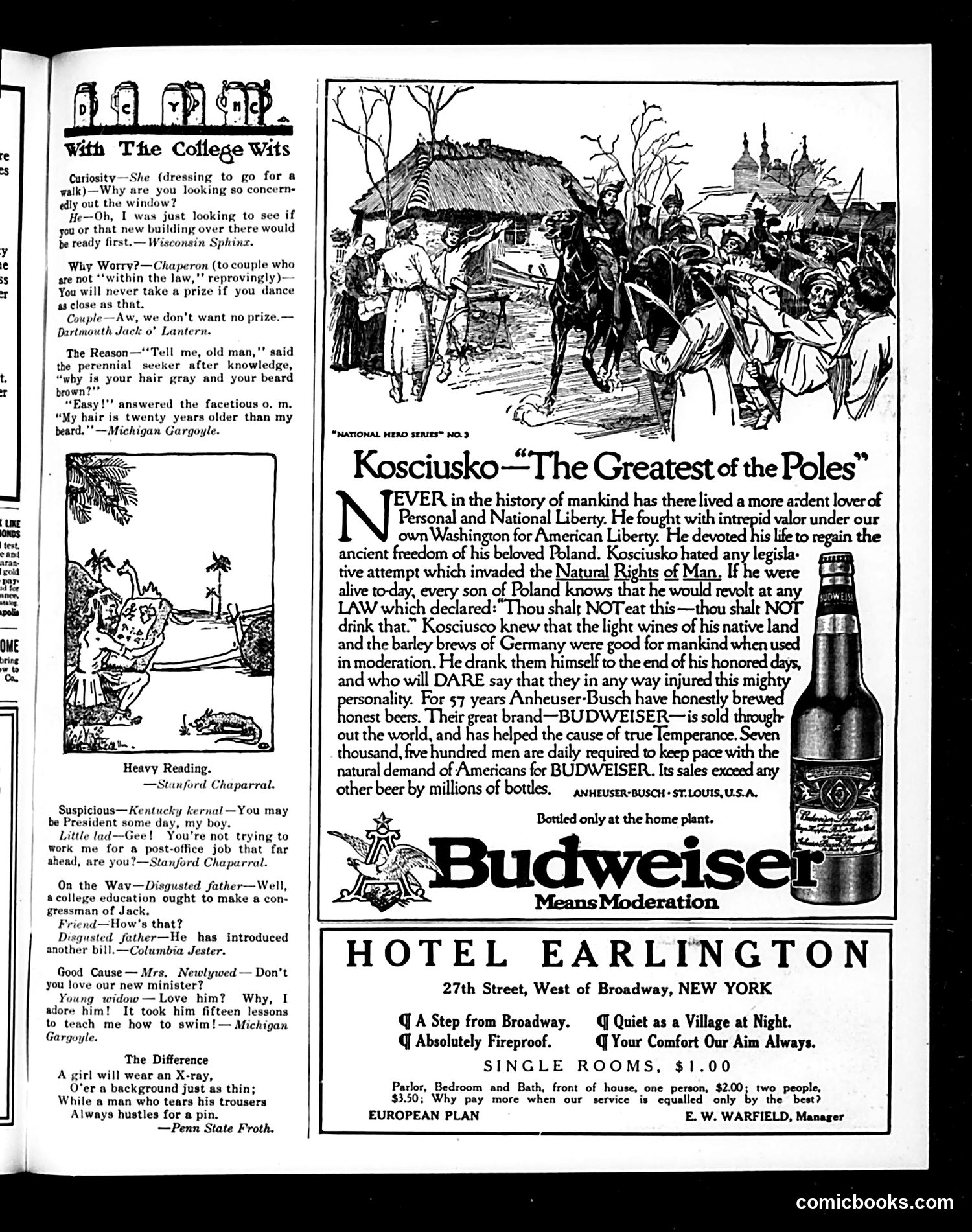
This page contains college humor reprints and two advertisements. The main satirical content mocks college life—dating rules ("dancing close"), academic pretension, and marital dynamics. One joke suggests a suspicious Kentucky father fears a visiting dignitary wants to secure a post-office job for his son, satirizing patronage politics. The dominant feature is a Budweiser advertisement using Polish military hero Kosciusko as a "National Hero." The ad absurdly co-opts Kosciusko's revolutionary legacy fighting for liberty and freedom to argue that his legacy supports beer consumption. It claims Kosciusko would "revolt" against prohibition laws, implying he'd support drinking rights. This appears timed to Prohibition debates (likely pre-1920), using patriotic imagery to oppose alcohol restrictions by suggesting temperance laws violate "Natural Rights of Man." The Hotel Earlington advertisement offers budget lodging near Broadway. The satire's effectiveness relied on readers recognizing Kosciusko and understanding contemporary Prohibition politics.
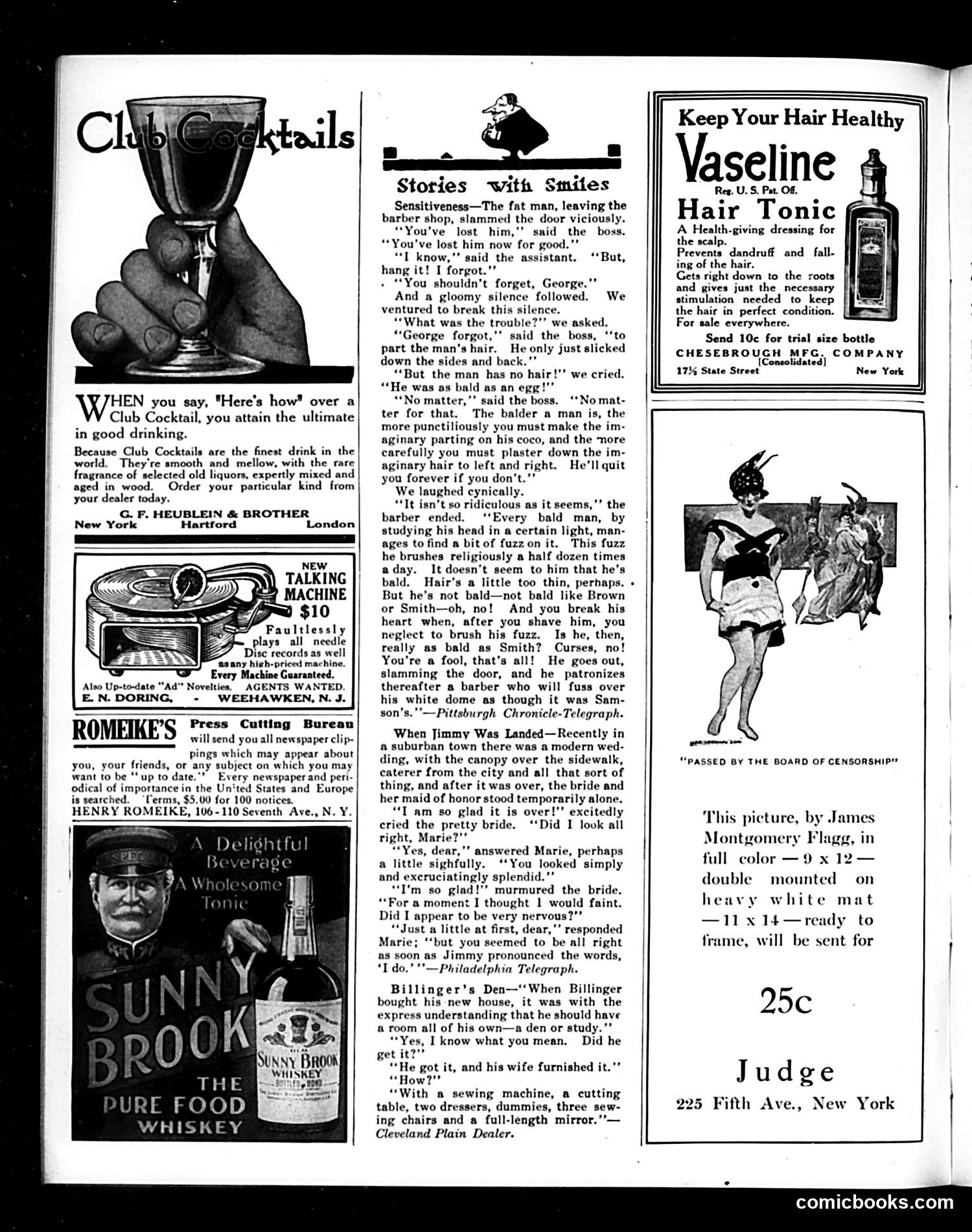
This page is primarily **advertising with humorous filler stories**, typical of early 20th-century satirical magazines. The main advertisements include cocktails, talking machines, newspaper clipping services, and whiskey—products marketed to affluent readers. The "Stories with Smiles" section contains three brief jokes reflecting contemporary social anxieties: 1. **The Barber Story**: A critique of male vanity. A bald customer abandons his barber because the barber failed to ceremoniously "part" and groom his nonexistent hair. The joke satirizes how men psychologically deny baldness and require barbers to participate in this fiction. 2. **The Wedding Story**: Mocks both a bride's nervousness and her maid's insincere reassurance—social pretense during modern weddings. 3. **The Den Story**: Mocks the concept of male domestic autonomy. Though promised a personal study, Billinger's wife furnishes it entirely with sewing equipment, suggesting wives control household space despite husbands' assumptions of authority. Overall, these are gentle satires of masculine pride, social pretense, and changing domestic power dynamics in early 20th-century America.
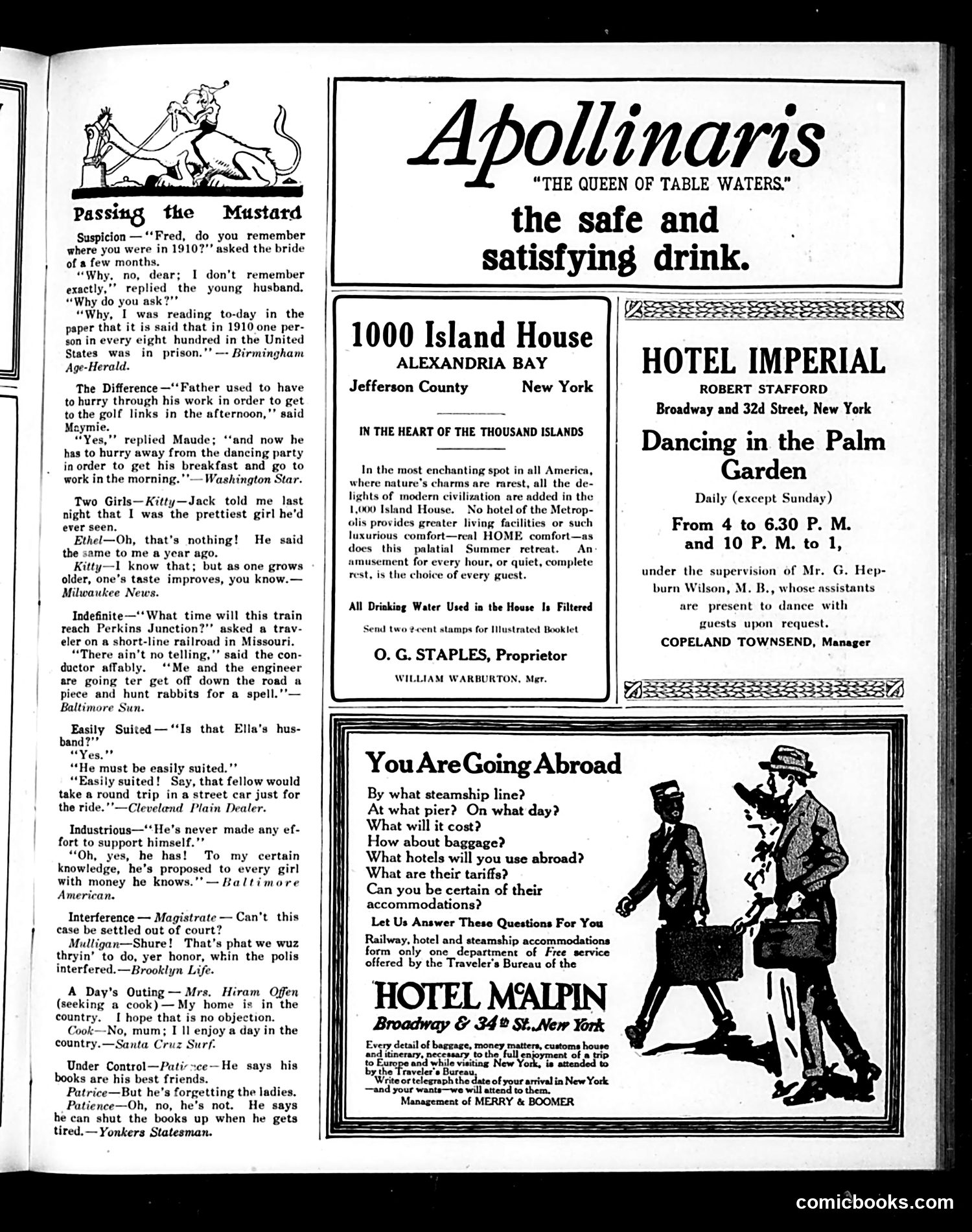
This page is primarily **advertising and humor columns** from *Judge* magazine, not political satire. The left side contains brief **humorous anecdotes** on everyday topics: a suspicious bride questioning her husband's whereabouts in 1910 (implying infidelity); observations about changing social habits (fathers rushing to golf, now rushing to work); witty exchanges about romance and domestic life. These reflect early 1900s American social concerns—marriage fidelity, gender roles, courtship—presented as light comedic observations rather than satire. The advertisements promote luxury travel destinations (1000 Island House resort, Hotel Imperial with dancing), the bottled water brand Apollinaris, and Hotel Malpin's travel bureau services—typical period advertising aimed at affluent readers. The cartoons and jokes assume readers share middle-class anxieties about modern life, romance, and social propriety, but contain no identifiable political figures or major satirical targets beyond gentle mockery of human nature.
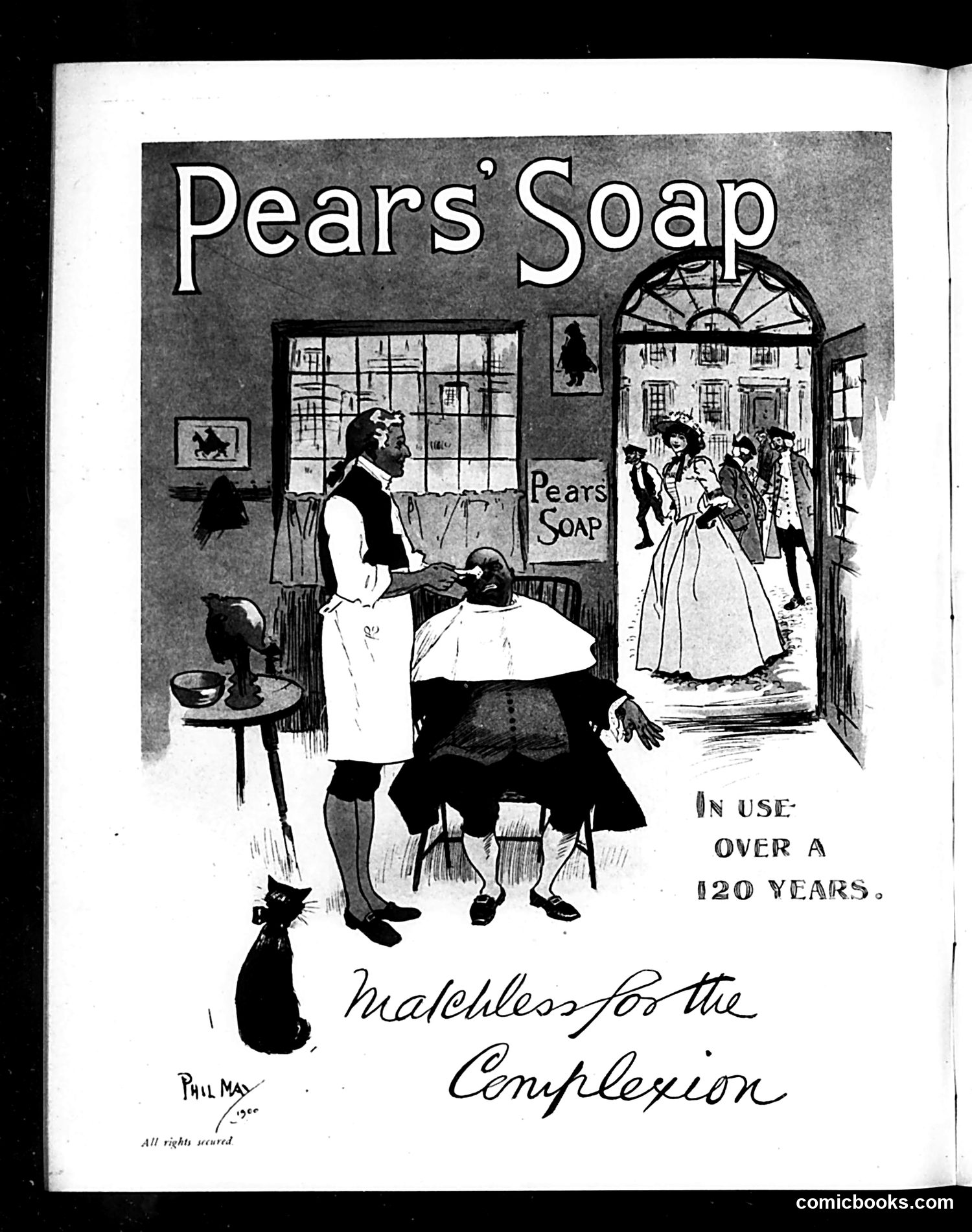
This is a vintage advertisement for Pears' Soap, a real British brand that existed for over 120 years. The ad depicts a barber shop scene where a barber applies soap to a customer's face before shaving, while fashionable people enter through a doorway in the background. The tagline "Matchless for the Complexion" is a pun—it means both that the soap is superior for facial care and that it's unmatched (without equal). The image suggests Pears' Soap's gentleness and quality through the domestic, respectable barber shop setting. This appears to be a straightforward product advertisement rather than political satire, using the prestigious Judge magazine's pages to reach affluent readers.