
Judge, 1914-06-13 · page 13 of 24
Judge — June 13, 1914 — page 13: what you’re looking at
What you’re looking at
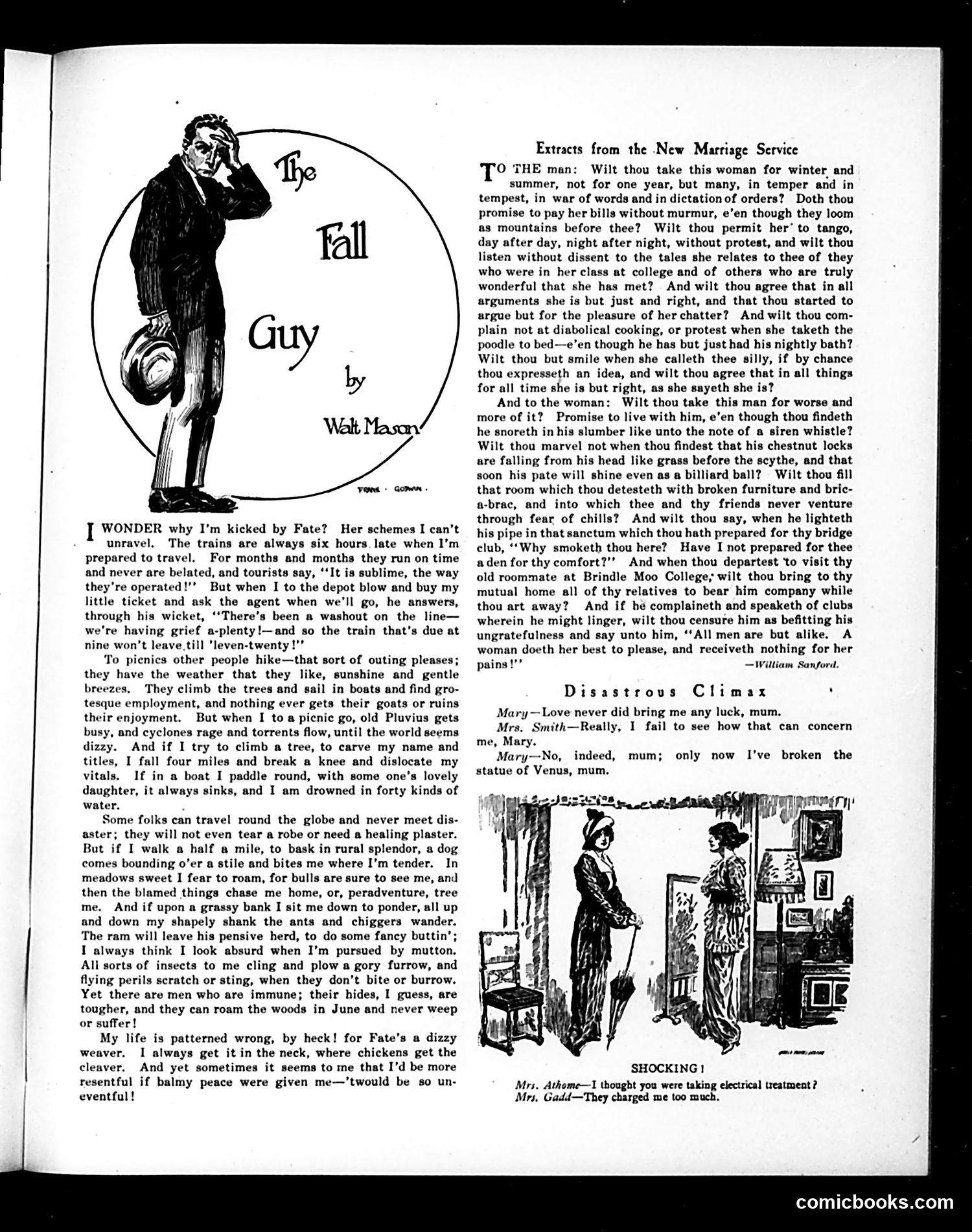
**"The Fall Guy"** (left) is a humorous poem by Walt Mason about a man perpetually cursed by bad luck. The illustration shows a disheveled gentleman plagued by misfortune—trains run late only for him, picnics flood when he attends, animals attack him. The satire mocks the universal human tendency to blame fate for personal mishaps rather than accepting responsibility. **"Extracts from the New Marriage Service"** (right) is marital satire written as mock-vows. It parodies contemporary gender dynamics: the groom promises endless financial and emotional tolerance of his wife's superiority and demands; the bride's vows humorously address the husband's snoring and physical decline. The piece satirizes both the institution of marriage and rigid gender roles—suggesting wives expect complete male subservience while husbands must accept wives' infallibility. The tone is cynical humor about marital compromise and domestic power imbalances of the era. Both pieces reflect Judge magazine's characteristic early-20th-century humor targeting human folly and social conventions.
📄 Transcribed text from this page (OCR, searchable)
Machine-transcribed from the original scan — historical spelling and the odd misread are preserved.
why I'm kicked by Fate? Her schemes I can’t unravel. The trains are always six hours. late when I’m prepared to travel. For months and months they run on time and never are belated, and tourists say, ‘‘It is sublime, the way they're operated!’’ But when I to the depot blow and buy my little ticket and ask the agent when we'll go, he answers, through his wicket, ‘‘There’s been a washout on the line— we're having grief a-plenty!—and so the train that’s due at nine won't leave.till "leven-twenty !'" To picnics other people hike—that sort of outing pleases; they have the weather that they like, sunshine and gentle breezes, They climb the trees and sail in boats and find gro- tesque employment, and nothing ever gets their goats or ruins their enjoyment. But when I to a picnic go, old Pluvius gets busy, and cyclones rage and torrents flow, until the world seems dizzy. And if I try to climb a tree, to carve my name and titles, I fall four miles and break a knee and dislocate my vitals. If in a boat I paddle round, with some one’s lovely daughter, it always sinks, and I am drowned in forty kinds of water. j Some folks can travel round the globe and never meet dis- aster; they will not even tear a robe or need a healing plaster. But if I walk a half a mile, to bask in rural splendor, a dog comes bounding o’er a stile and bites me where I’m tender. In meadows sweet I fear to roam, for bulls are sure to see me, and then the blamed things chase me home, or, peradventure, tree me. And if upon a grassy bank I sit me down to ponder, all up and down my shapely shank the ants and chiggers wander. The ram will leave his pensive herd, to do some fancy buttin’; I always think I look absurd when I’m pursued by mutton. All sorts of insects to me cling and plow a gory furrow, and flying perils scratch or sting, when they don’t bite or burrow. Yet there are men who are immune; their hides, I guess, are tougher, and they can roam the woods in June and never weep or suffer! My life is patterned wrong, by heck! for Fate’s a dizzy weaver. I always get it in the neck, where chickens get the cleaver. And yet sometimes it seems to me that I’d be more I WONDER resentful if balmy peace were given me—’twould be so un- eventful! Extracts from the New Marriage Service T° THE man: Wilt thou take this woman for winter and summer, not for one year, but many, in temper and in tempest, in war of words and in dictation of orders? Doth thou promise to pay her bills without murmur, e’en though they loom as mountains before thee? Wilt thou permit her’ to tango, day after day, night after night, without protest, and wilt thou listen without dissent to the tales she relates to thee of they who were in her class at college and of others who are truly wonderful that she has met? And wilt thou agree that in all arguments she is but just and right, and that thou started to argue but for the pleasure of her chatter? And wilt thou com- plain not at diabolical cooking, or protest when she taketh the poodle to bed—e’en though he has but just had his nightly bath? Wilt thou but smile when she calleth thee silly, if by chance thou expresseth an idea, and wilt thou agree that in all things for all time she is but right, as she sayeth she is? And to the woman: Wilt thou take this man for worse and more of it? Promise to live with him, e’en though thou findeth he snoreth in his slumber like unto the note of a siren whistle? Wilt thou marvel not when thou findest that his chestnut locks are falling from his head like grass before the scythe, and that soon his pate will shine even as a billiard ball? Wilt thou fill that room which thou detesteth with broken furniture and bric- a-brac, and into which thee and thy friends never venture through fear of chills? And wilt thou say, when he lighteth his pipe in that sanctum which thou hath prepared for thy bridge club, ‘Why smoketh thou here? Have I not prepared for thee aden for thy comfort?!’ And when thou departest to visit thy old roommate at Brindle Moo College, wilt thou bring to thy mutual home all of thy relatives to bear him company while thou art away? And if he complaineth and speaketh of clubs wherein he might linger, wilt thou censure him as befitting his ungratefulness and say unto him, ‘‘All men are but alike. A woman doeth her best to please, and receiveth nothing for her pains !’’ —William Sanford. Disastrous Climax ’ Mary—Love never did bring me any luck, mum. Mrs. Smith—Really, I fail to see how that can concern me, Mary. Mary—No, indeed, statue of Venus, mum. mum; only now I’ve broken the SHOCKING! Mrs, Athome—I thought you were taking electrical treatment? Mrs, Gadd—They charged me too much, comicbooks.com