
A complete issue · 24 pages · 1914
Judge — March 28, 1914
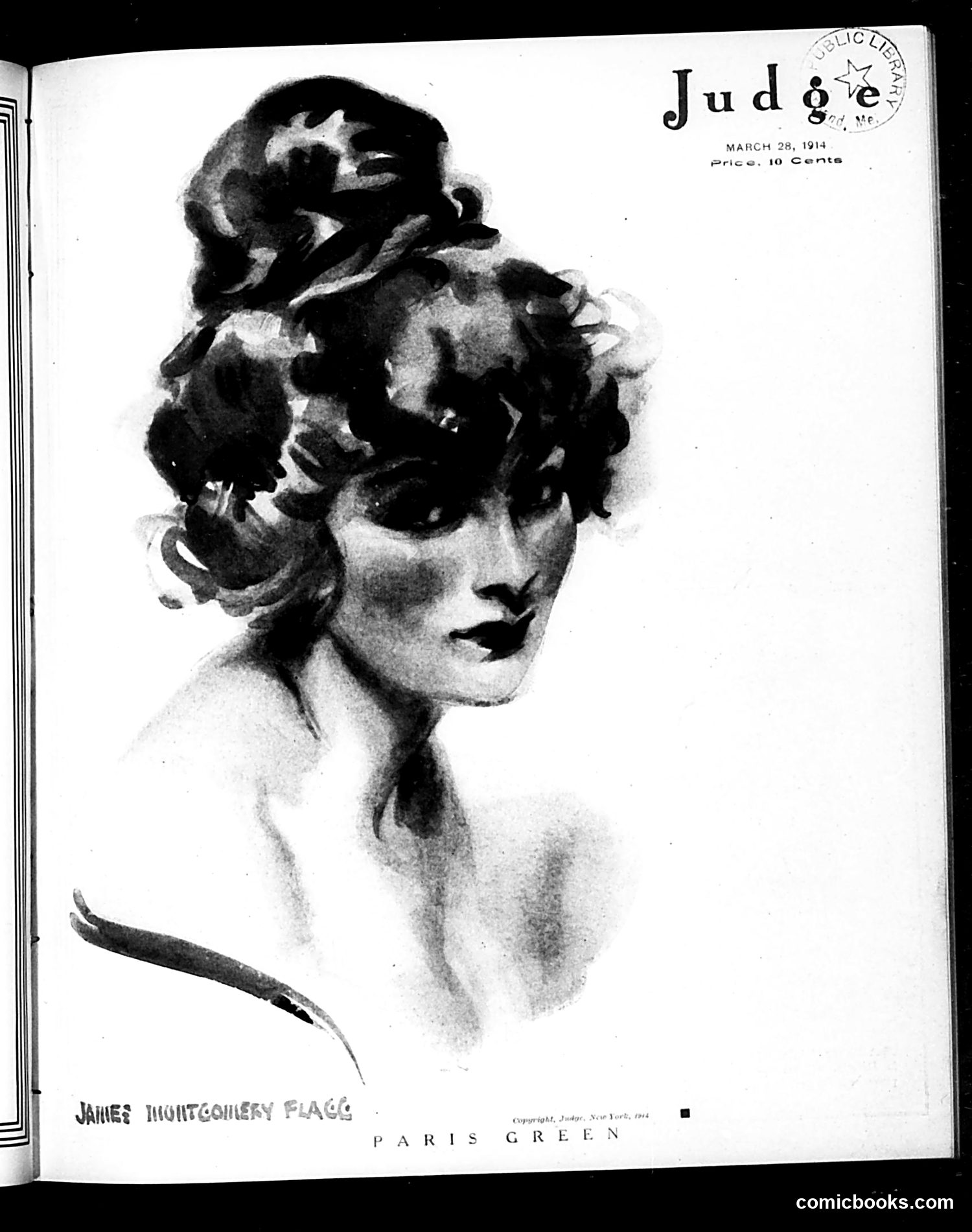
This is a **fashion/society cover**, not political satire. The illustration by James Montgomery Flagg depicts an elegant woman's profile in fashionable 1914 styling—notably her elaborate upswept hairstyle with decorative elements and fashionable dress. The caption "PARIS GREEN" likely references both the woman's fashionable appearance (Paris being the fashion capital) and possibly a contemporary color trend or cosmetic product. The price of 10 cents and "PUBLIC LIBRARY" stamp indicate this is a preserved library copy. Rather than satirizing a political figure or event, Judge is showcasing high-society fashion and beauty standards of the early 20th century, targeting its affluent readership interested in style and culture.
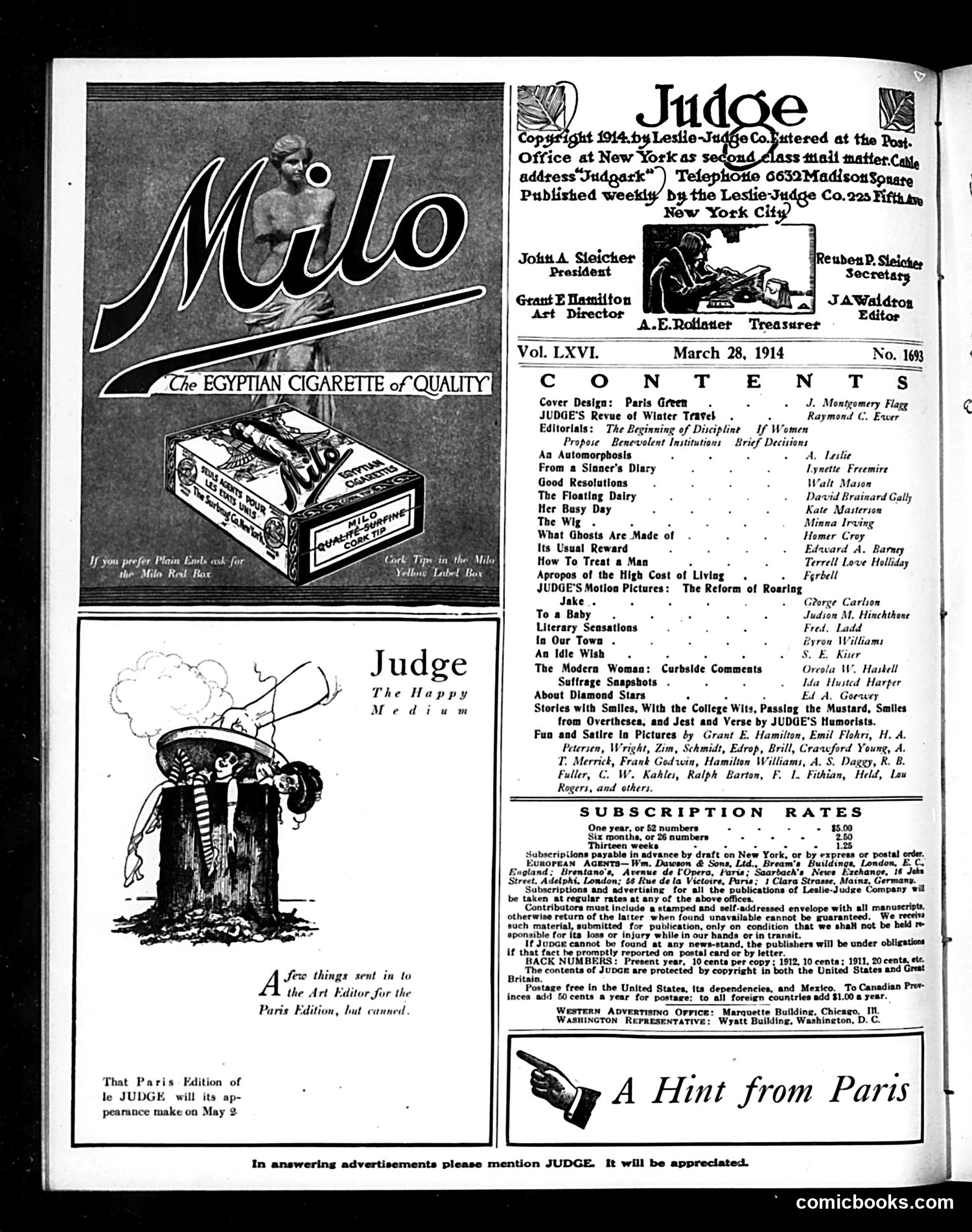
This page is primarily **advertising and masthead information** rather than political satire. The dominant image is a **Milo cigarette advertisement** featuring an Egyptian-themed design with a woman's face and product packaging. Below that is a small cartoon labeled "Judge—The Happy Medium" showing a figure in period dress, apparently illustrating the magazine's self-description as a balanced satirical publication. The right side contains the magazine's **table of contents, masthead, and subscription rates**. Notable editors include J.A. Waldrop (Editor) and Grant E. Hamilton (Art Director). The page's primary function is commercial—promoting Milo cigarettes and providing publication details—rather than delivering political commentary or satire typical of Judge's core content.
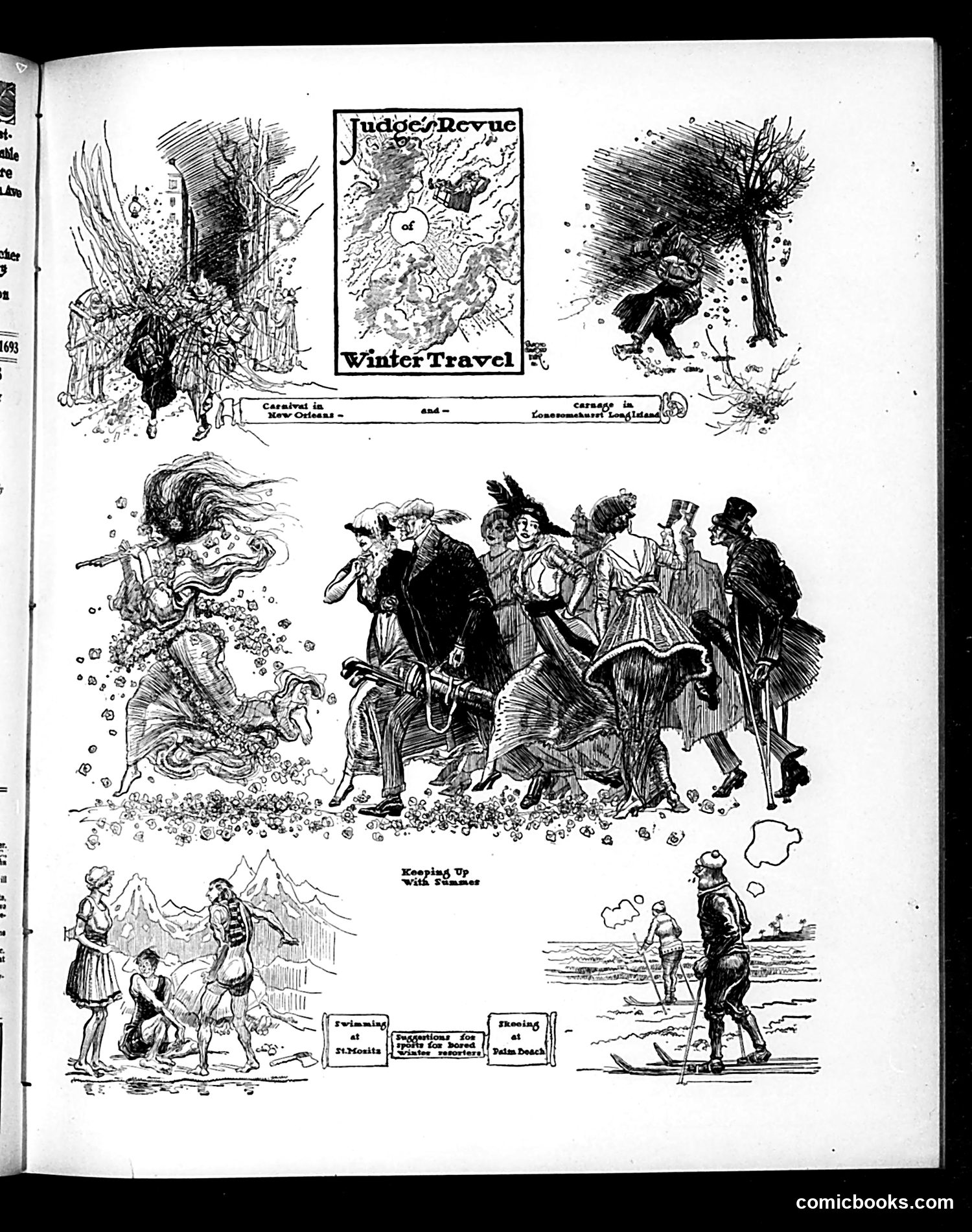
This page titled "Judge's Revue: Winter Travel" contains six satirical illustrations about winter recreation and travel, circa early 1900s. The top panel contrasts "Carnival in New Orleans" with "Carnage in Commonweal[th] Islands" — likely critiquing travel destinations and their safety conditions. The center scene depicts well-dressed travelers encountering snow and winter weather, with the wind literally blowing them about — satirizing the unprepared or foolish winter tourist. Lower panels show "Keeping Up With Fashion" and scenes of "Fishing at Pinckills" and "Fishing at Palm Beach," apparently contrasting fashionable winter destinations with more modest locations. The satire targets wealthy Americans' winter travel pursuits and the gap between expectation and reality when venturing into harsh weather.
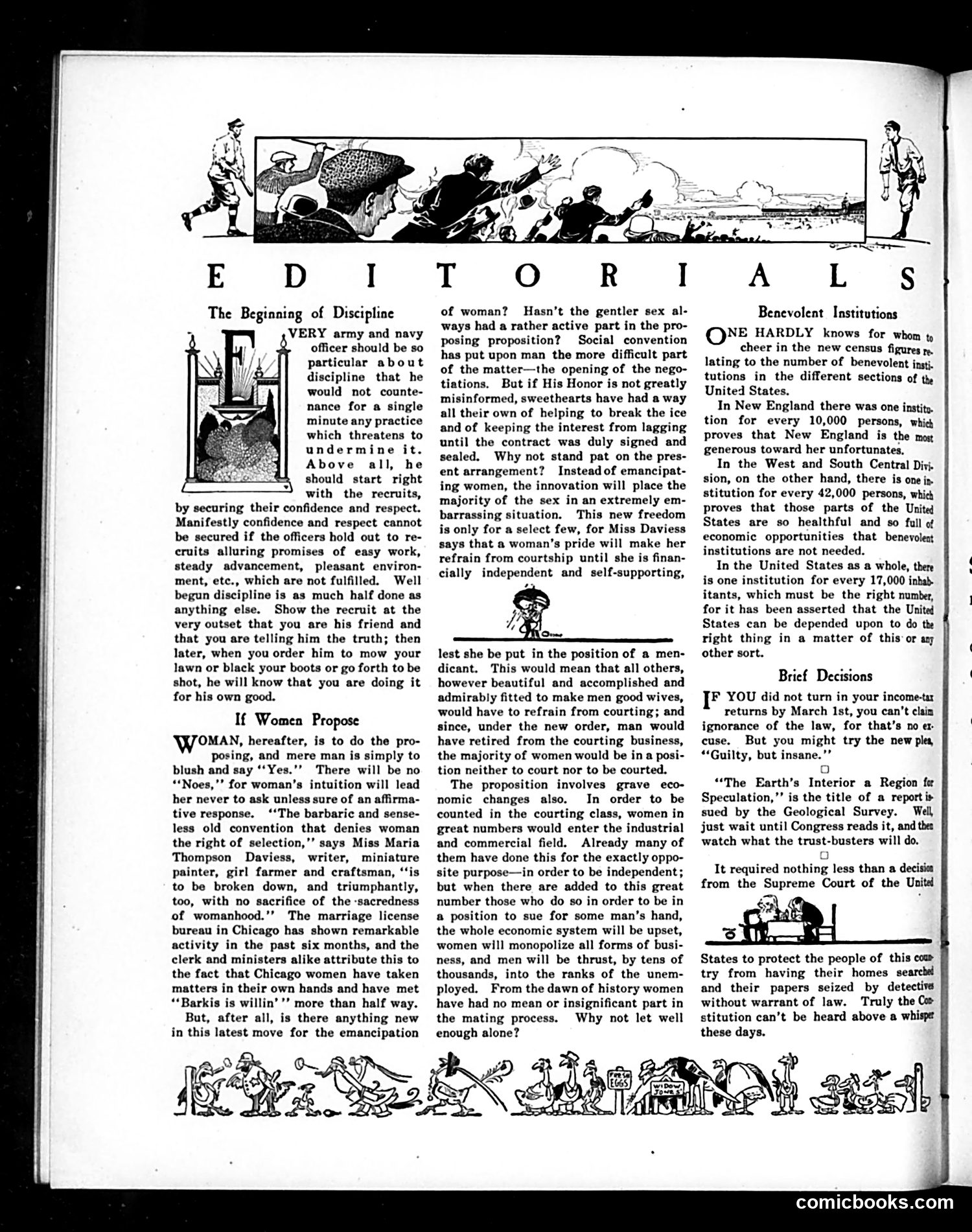
This editorial page satirizes women's suffrage and expanding women's rights circa early 1900s. The main article, "The Beginning of Discipline," argues against women's independence, claiming military-style discipline should control women's behavior. It mocks proposals that women work and be financially independent, predicting chaos—women monopolizing business, men becoming unemployed, and the entire economic system collapsing. The "If Women Propose" section ridicules the idea of women initiating courtship, suggesting it violates natural order and propriety. The cartoonist's position is conservative and anti-feminist: the satire defends traditional gender hierarchies by exaggerating feminist proposals to absurdity. The page reflects genuine contemporary anxiety about women's liberation movements and changing social roles.
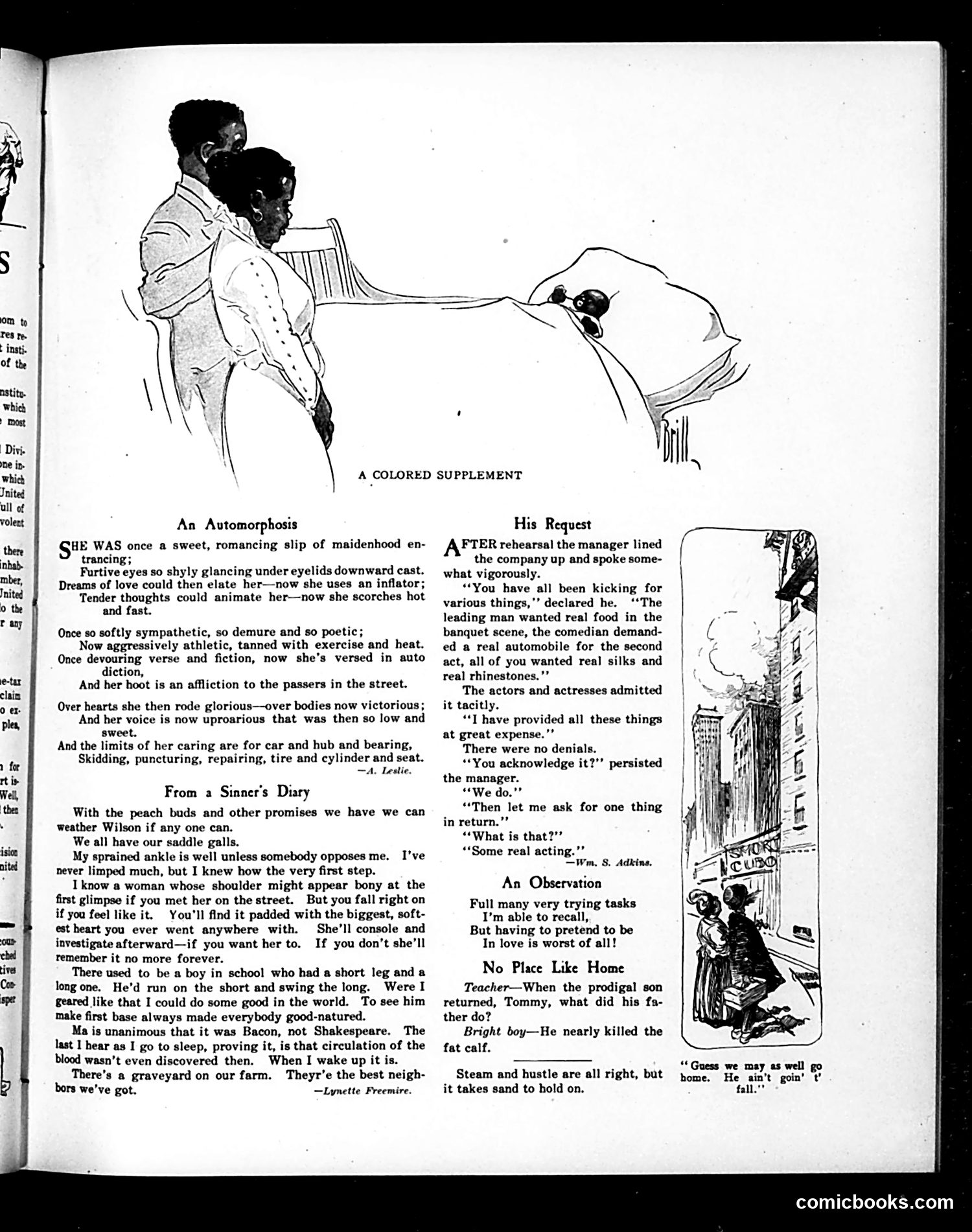
This page from *Judge* magazine contains satirical poetry and sketches rather than a single political cartoon. The content appears to target early 20th-century social trends: **"An Automorphosis"** satirizes women's changing roles—transforming from "sweet, romancing slip of maidenhood" into athletic, automobile-driving figures. The accompanying sketch shows a woman in a car, commenting on this modernization. **"His Request"** depicts a theater manager demanding actors provide real automobiles and rhinestones for performances, suggesting complaints about mounting production costs. The remaining pieces—"From a Sinner's Diary," "An Observation," and "No Place Like Home"—offer social commentary on contemporary life, though their specific targets are unclear without fuller context. The overall tone mocks rapid social change and commercialization of entertainment during the automobile age.
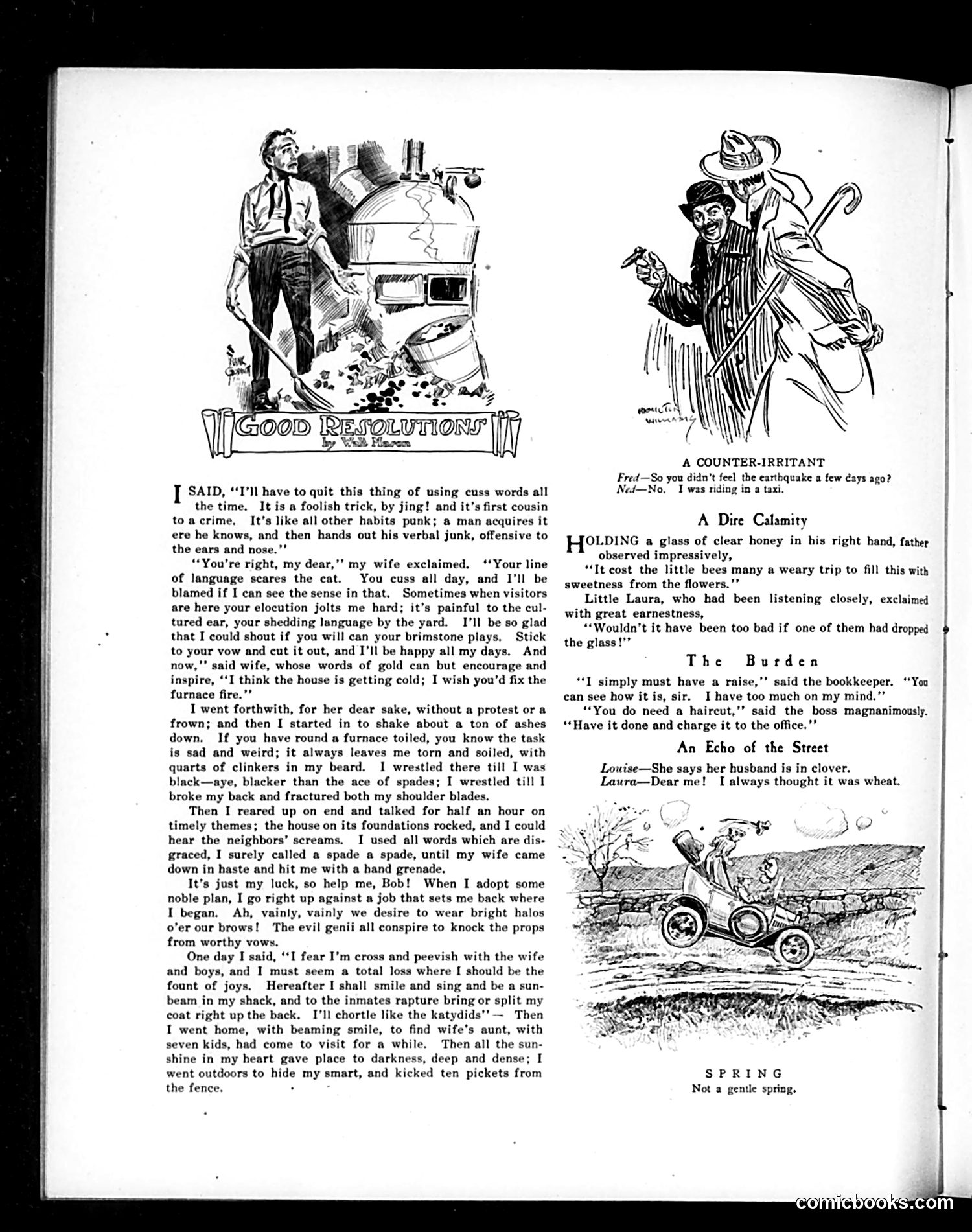
This page from *Judge* satirizes the gap between good intentions and human weakness. The lead story depicts a man who swears off cursing after his wife's complaint. He succeeds temporarily, but when forced to clean the furnace—a genuinely frustrating task—he explodes into profanity so severe his wife attacks him with a "hand grenade." The joke's point: noble resolutions collapse immediately under real-world pressure. The accompanying brief comics reinforce this theme of life's ironies and disappointments. "A Counter-Irritant" suggests you can't feel an earthquake in a taxicab's chaos. "A Dire Calamity" uses a child's literalism for humor. "The Burden" plays on a boss's dismissive sarcasm about stress. "An Echo of the Street" exploits confusion between "clover" (prosperity) and "wheat" (mundane life). The satire targets human nature itself—our repeated failure at self-improvement, not specific political figures.
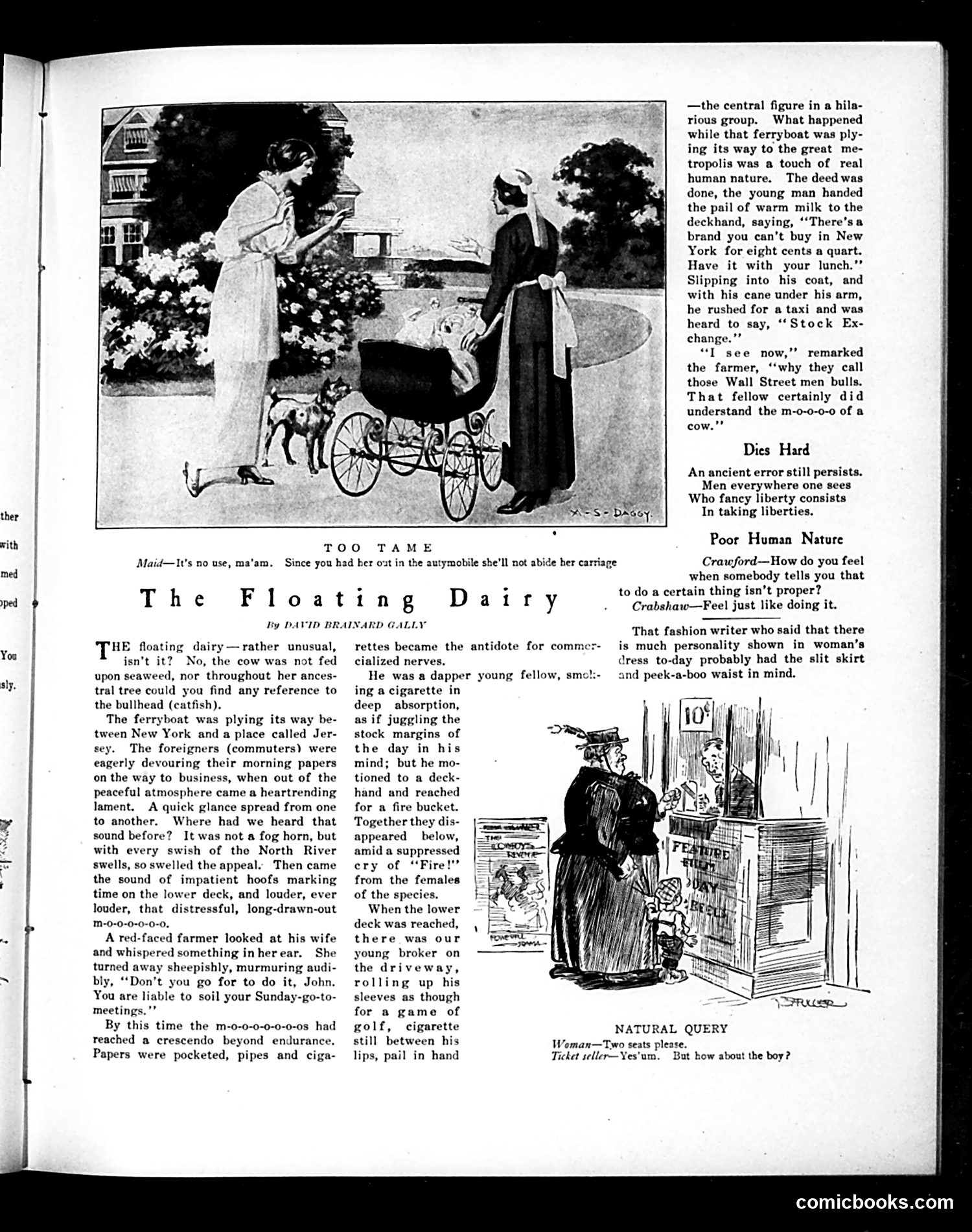
This satirical story mocks the pretensions of Wall Street stockbrokers masquerading as gentlemen farmers. A young broker accepts fresh milk from a farmer commuting to Jersey, then rushes to the Stock Exchange—revealing he's merely performing rural authenticity for social cachet. The joke centers on the farmer's punchline: Wall Street men are called "bulls" because this broker truly understood the "moo" of a cow—suggesting the brokers are actually bovine themselves, stupid and herd-like in their market behavior. The accompanying cartoon "Too Tame" critiques how automobiles have spoiled proper behavior; once a woman rides in a car, she refuses her carriage. This reflects early 20th-century anxieties about automobiles liberalizing social conventions and female independence. Both pieces satirize how modern urban life corrupts traditional values and authentic character.
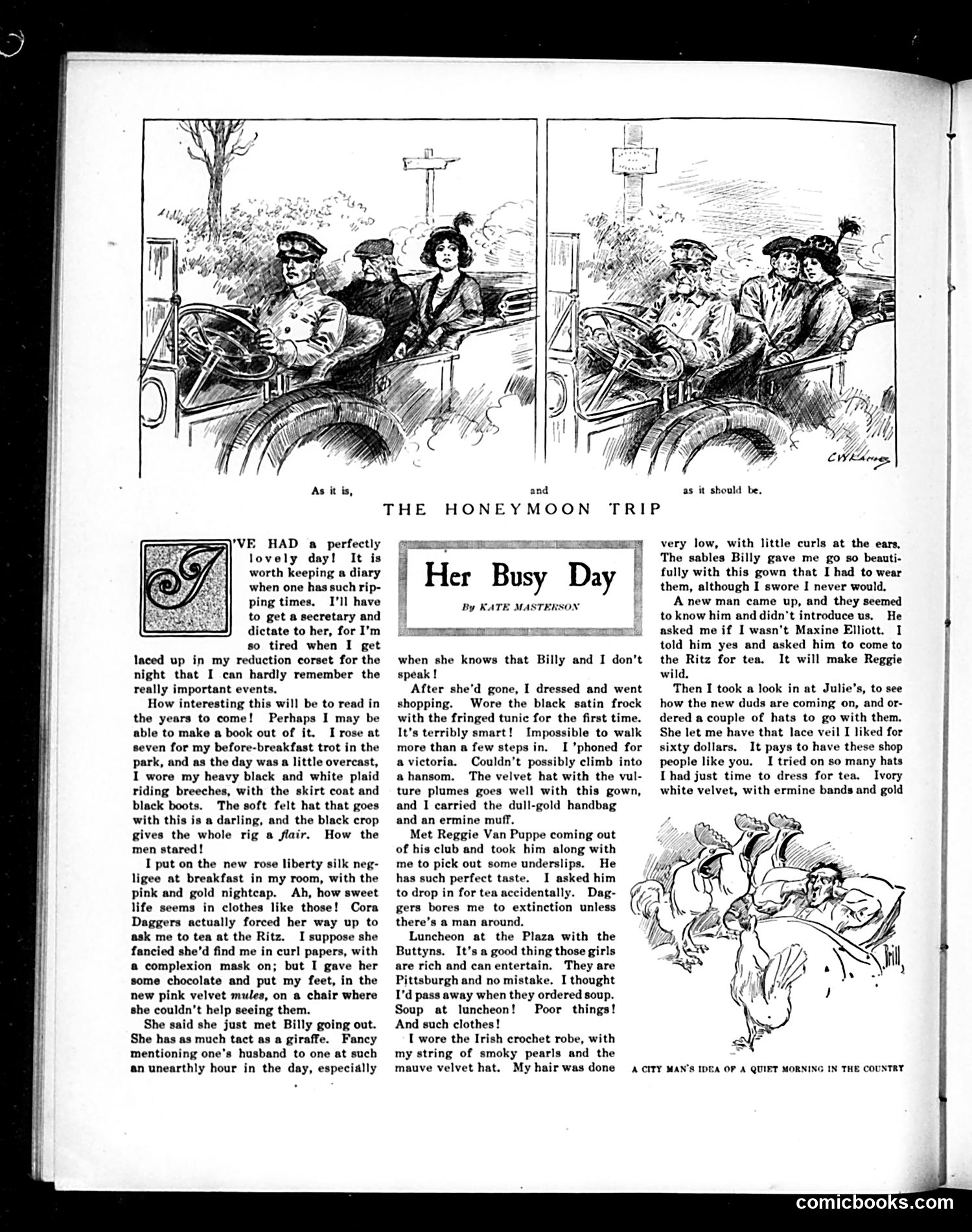
The two cartoons contrast marital harmony: the left shows a couple driving together peacefully; the right shows them separated and quarreling. The accompanying story, "Her Busy Day" by Kate Masterson, satirizes the shallow, self-absorbed lifestyle of a wealthy married woman. The narrator obsesses over clothes, cosmetics, and social status while neglecting her husband ("Billy"). She deliberately flaunts her interactions with other men (Reggie Van Puppe, a mysterious stranger) to provoke jealousy. She spends lavishly on luxury items—sables, hats, lace veils costing sixty dollars—and focuses entirely on appearance and social climbing. The satire targets the idle rich, particularly wives who prioritize fashion and male attention over their marriages. The "busy day" involves shopping, tea, and self-display rather than meaningful activity. The contrast between the two opening scenes suggests this superficiality destroys relationships. The joke is that what she considers an important, eventful life is actually trivial and marital poison.
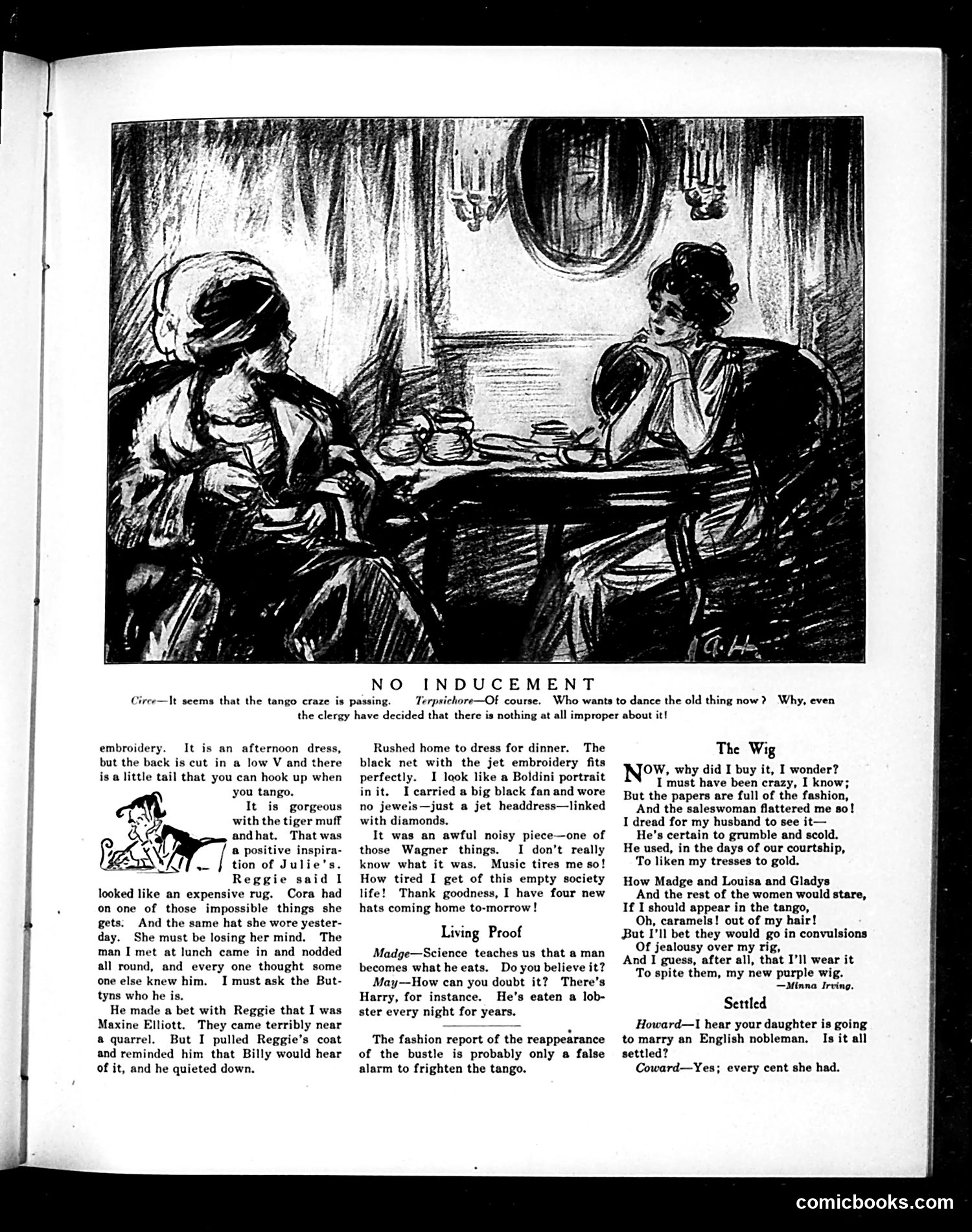
This page from *Judge* satirizes early 1900s society and fashion obsessions through interconnected pieces. **"No Inducement"** (top cartoon and dialogue) mocks the tango craze's decline. The joke: the dance was scandalous precisely because clergy opposed it as improper. Now that even clergy approve it, society finds it boring—respectability kills its appeal. **The fashion and social commentary sections** ridicule wealthy women's vanity: obsessing over dress details, dropping names (Maxine Elliott, a famous actress), and their shallow priorities. The lobster joke plays on the pseudo-scientific "you are what you eat" fad. **"The Wig"** poem satirizes women's fashion insecurity—buying an expensive purple wig because newspapers promote it and saleswomen flatter them, despite husbands' disapproval. It's peer pressure disguised as style. **"Settled"** delivers a sharp class satire: an American heiress marrying a titled Englishman isn't about romance—it's a financial transaction where she literally pays ("every cent she had") for his noble status. The overall theme: wealthy American society is vain, easily manipulated by fashion and advertising, and driven by social competition rather than genuine values.
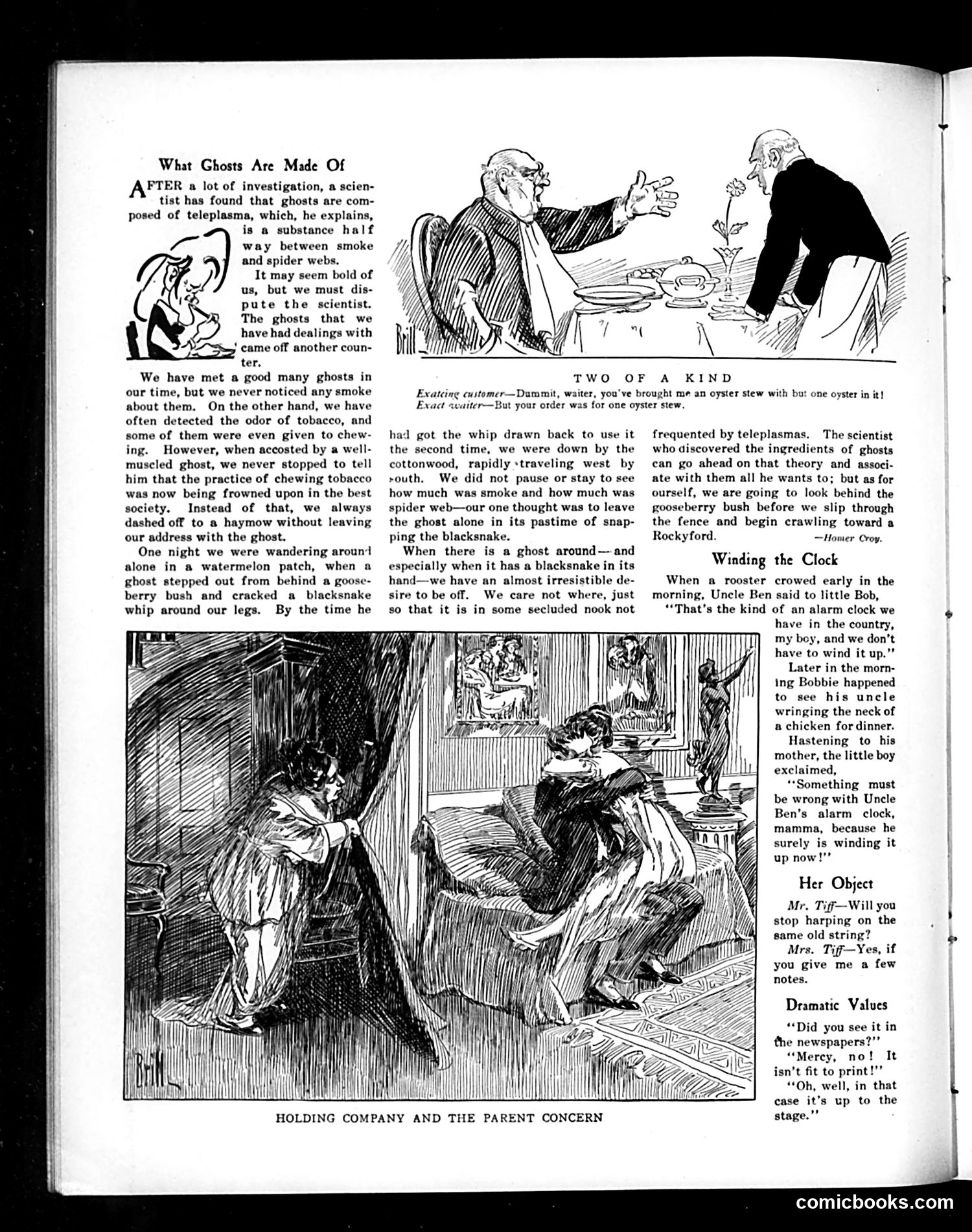
This page contains several humorous short pieces typical of early 20th-century American satire magazines: **"What Ghosts Are Made Of"**: A tongue-in-cheek essay debunking a scientist's claim that ghosts are composed of "teleplasma" (a real spiritualist concept of the era). The author humorously counters that based on personal experience, ghosts smell of tobacco and chewing tobacco, and are generally best avoided rather than studied. **"Two of a Kind"**: A cartoon showing an exacting customer complaining about a one-oyster oyster stew. The satire appears to critique unreasonable customer expectations or the absurdity of literal complaint-fulfillment. **Smaller pieces** ("Winding the Clock," "Her Object," "Dramatic Values"): Brief joke snippets about rural life, marital banter, and theatrical criticism respectively. The overall tone reflects Judge magazine's style: urbane mockery of both pseudoscience and everyday human foibles, with particular amusement at rural/country life contrasts.
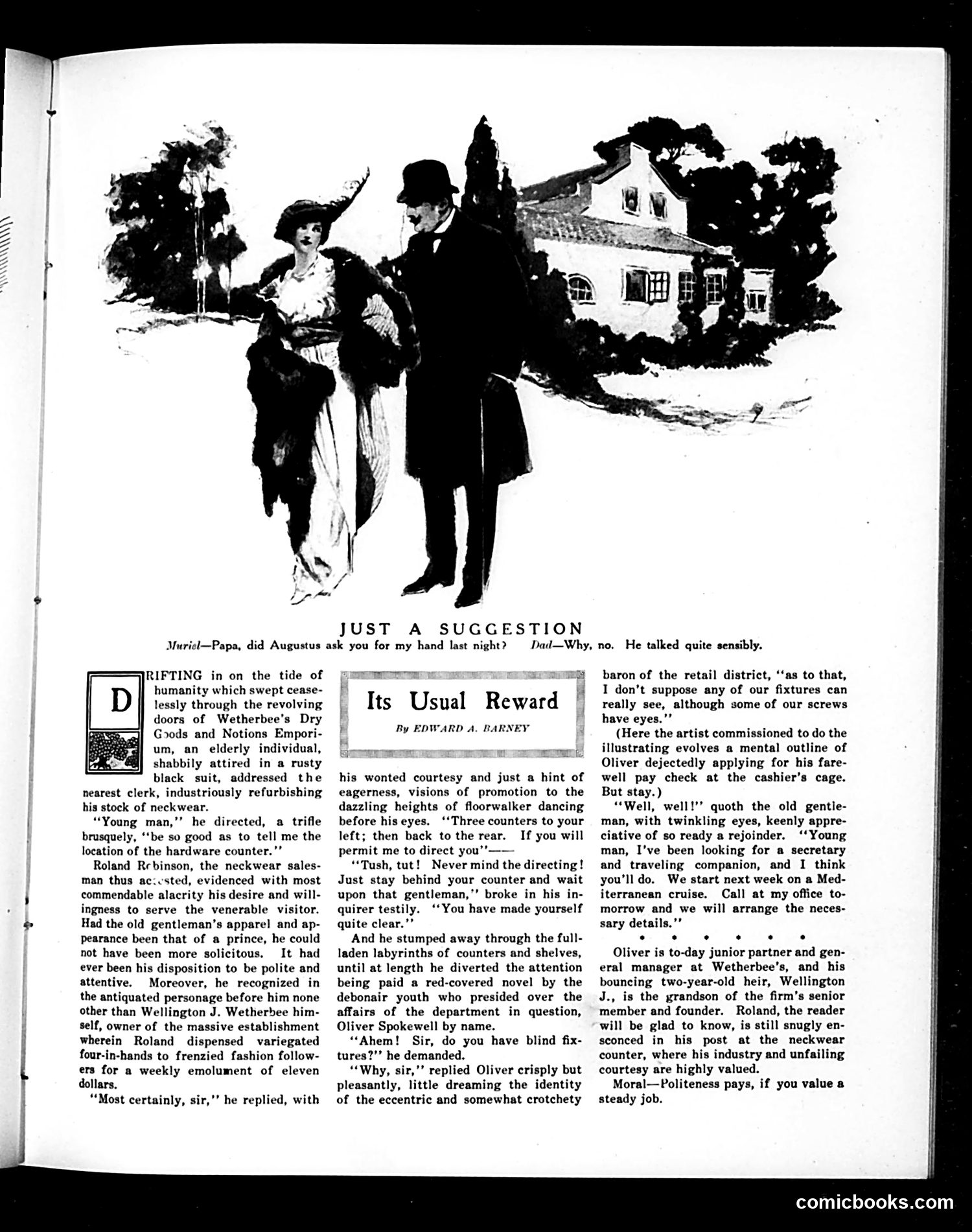
This satirical story illustrates the era's belief in the power of politeness and deference as a path to social advancement. **The Setup:** A poorly-dressed elderly customer enters a department store. Neckwear salesman Roland treats him with exceptional courtesy despite his shabby appearance, while a second clerk, Oliver, makes a witty joke to another customer without knowing the visitor's identity. **The Twist:** The old man is Wellington J. Wetherbee, the store's wealthy owner. Roland's unfailing politeness goes unrewarded. Oliver, whose clever quip momentarily impresses Wetherbee, is offered a lucrative position as secretary and traveling companion—eventually becoming junior partner. **The Satire:** The moral states "Politeness pays," yet the story actually demonstrates that *wit and personality* impress the boss more than mere obedience. Oliver's irreverent humor (a pun about fixtures having "eyes") appeals to Wetherbee's sense of humor far more than Roland's rigid deference. The satire mocks both the conventional wisdom about politeness *and* suggests that employers reward personality and cleverness over safe compliance.
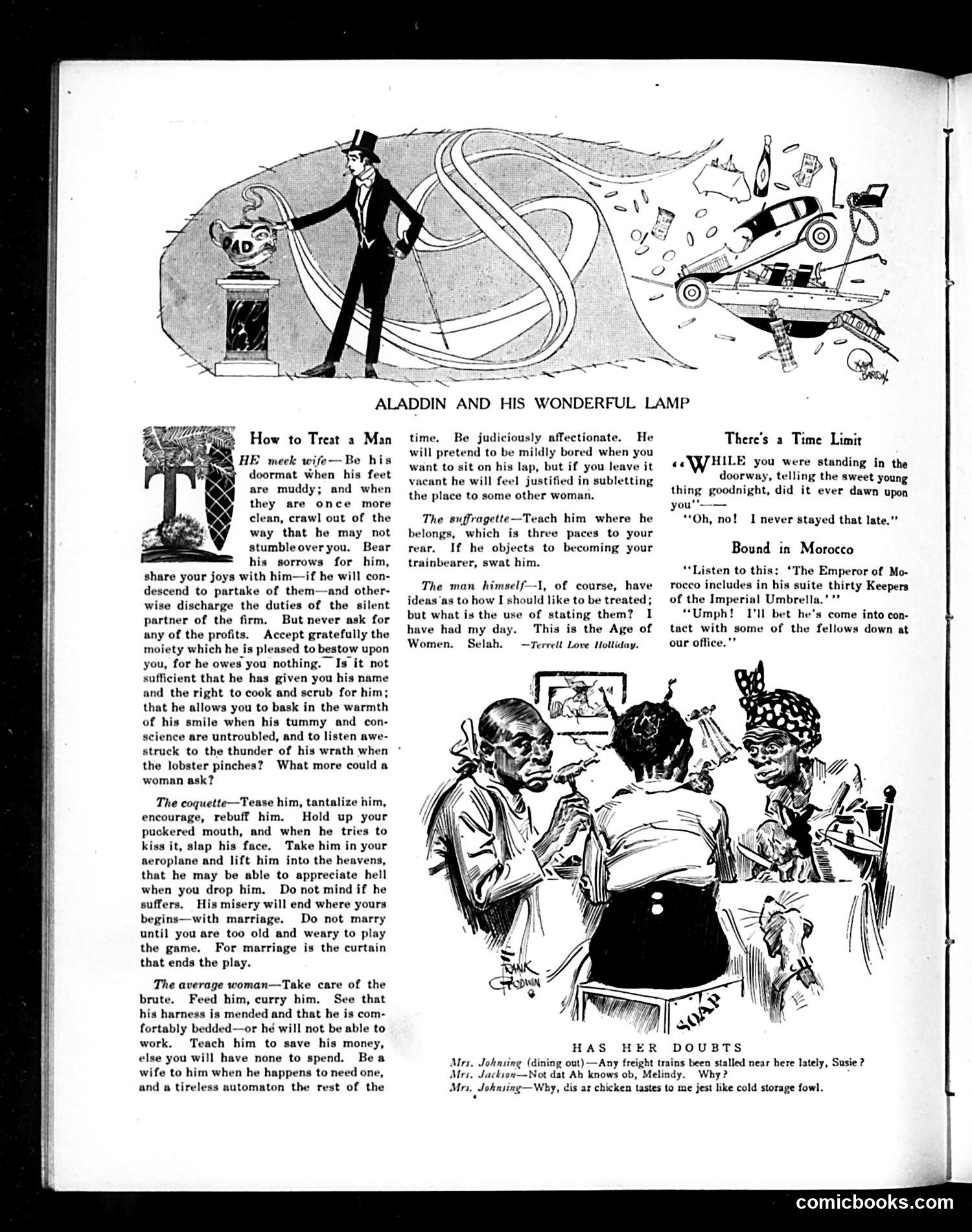
This page satirizes gender relations and marriage through contrasting "how to treat a man" advice directed at different types of women. The main cartoon shows a man wielding a magical lamp (referencing Aladdin), conjuring chaos—visualizing his power when women comply with his wishes. The text presents four female archetypes with biting irony: 1. **The meek wife**—accepts servitude without compensation 2. **The coquette**—manipulates through seduction, then traps him in marriage 3. **The average woman**—treats him like livestock requiring maintenance 4. **The suffragette**—demands male subordination The man's own perspective concludes resignedly: women now rule ("This is the Age of Women"), his preferences irrelevant. The sidebar jokes mock courtship time-limits and colonial pretension. The final cartoon references a woman suspecting her chicken is old/spoiled—implying men are similarly "worn goods." The overall satire critiques both traditional male entitlement and emerging feminist assertiveness, presenting marriage as mutually adversarial rather than cooperative.
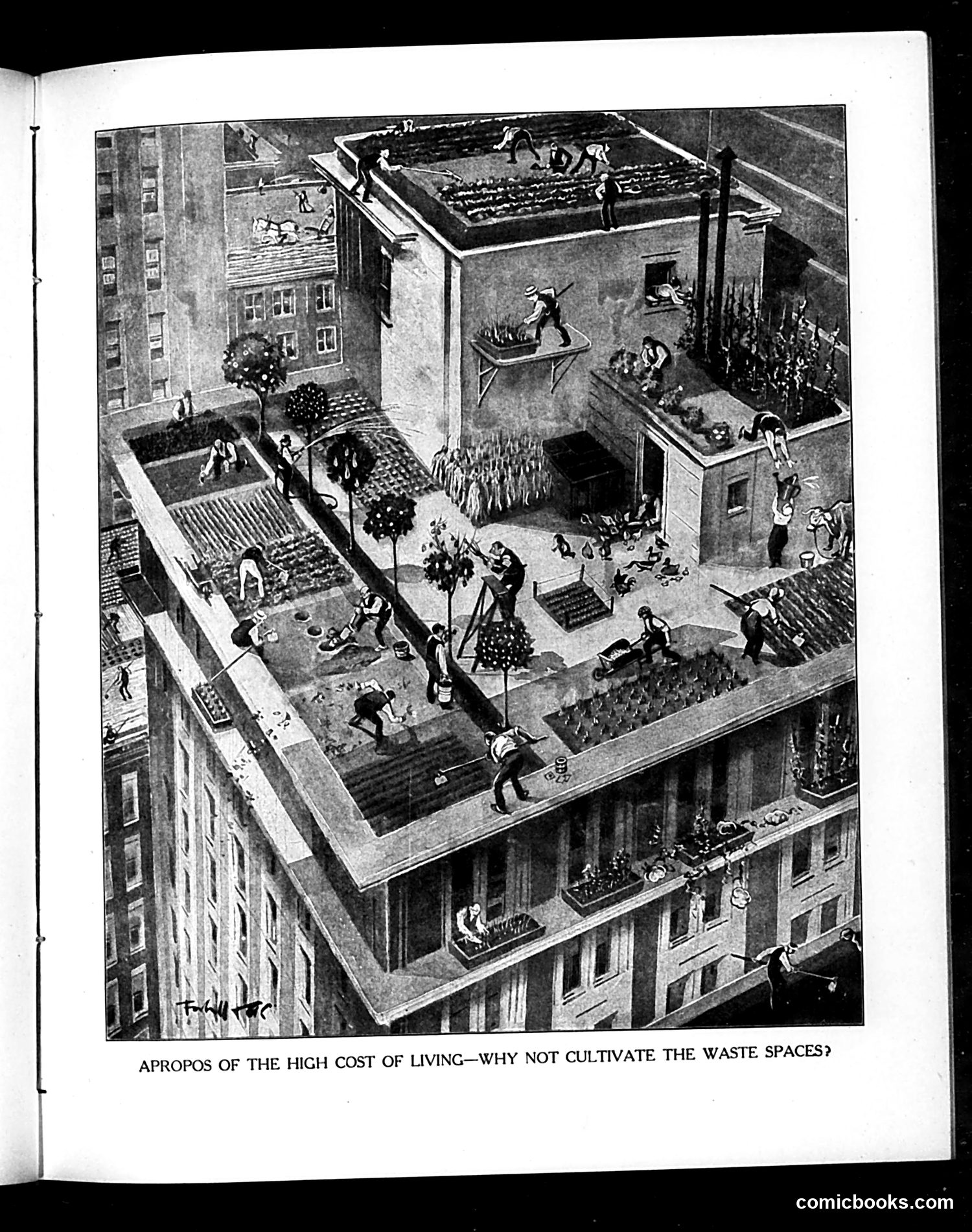
This cartoon satirizes urban living costs by proposing rooftop gardening as a solution. The illustration shows an aerial view of a city building's roof transformed into a productive farm with multiple garden beds, planted rows, and people actively cultivating vegetables. Smaller rooftop gardens are visible on surrounding buildings. The caption's rhetorical question challenges wealthy city dwellers: if food prices are so high, why not use their building's unused rooftop space for farming? This reflects early 20th-century Progressive Era concerns about urban poverty and inflation. The satire mocks the impracticality of such suggestions—expecting busy urbanites to become farmers—while highlighting the disconnect between proposed solutions and real working-class struggles with food affordability. The cartoon suggests well-meaning but unrealistic approaches to addressing economic inequality.
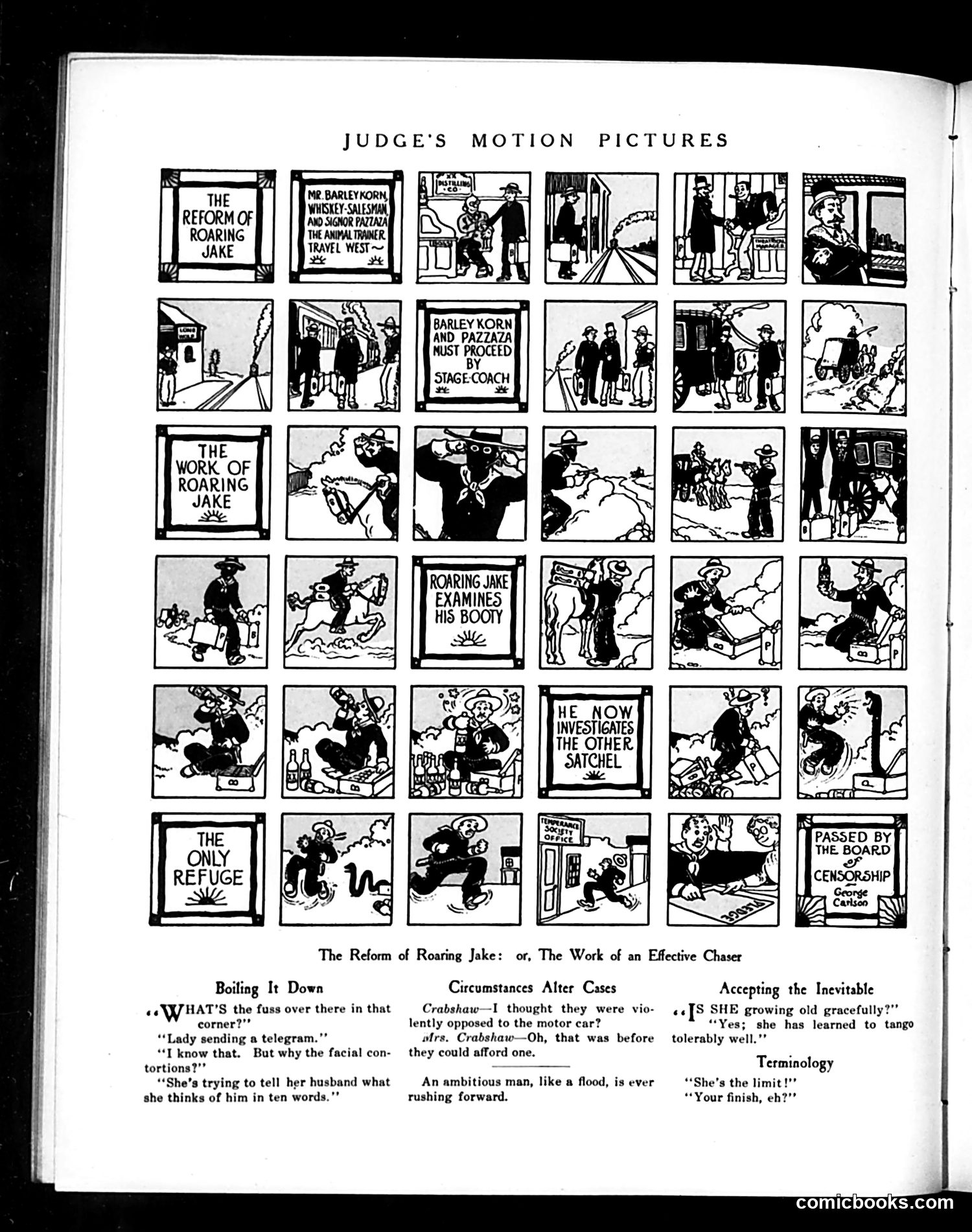
This page presents three separate satirical jokes typical of early 20th-century American humor: **"Boiling It Down"** mocks the difficulty wives face condensing marital complaints into telegraph messages (limited by word count and cost), suggesting women's tendency toward lengthy grievances. **"Circumstances Alter Cases"** satirizes hypocrisy about automobiles—people who previously opposed motor cars reverse their stance once they can afford one, reflecting class aspiration and inconsistent principles. **"Accepting the Inevitable"** jokes about aging: a woman learning the tango (a contemporary dance craze) represents graceful acceptance of growing old, suggesting dancing serves as a distraction from or denial of aging. The top section titled "Judge's Motion Pictures" appears to be a comic strip synopsis about "Roaring Jake," though specific plot details aren't clear from the visible captions. The humor relies on early 1900s domestic situations, gender stereotypes, and consumer culture references recognizable to period readers.
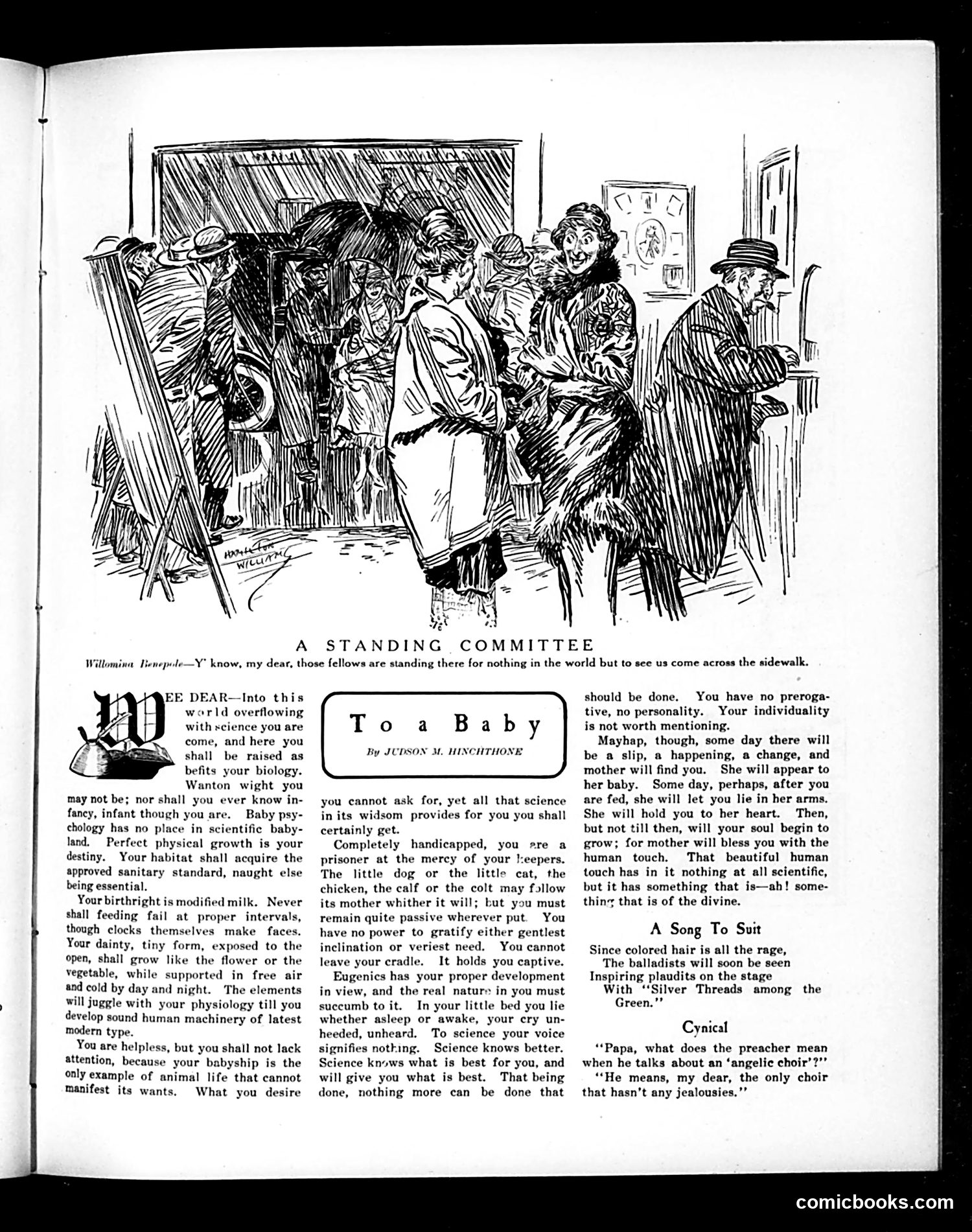
The top cartoon depicts men deliberately loitering on a sidewalk to ogle women passing by. "Willomina Benepole" comments that these idlers are stationed there solely to watch women cross—a commentary on public harassment and male behavior toward women in public spaces. Below, "To a Baby" is a satirical essay mocking the emerging "scientific parenting" movement of the early 20th century. The author ridicules rigid, clock-based baby care that ignores the child's actual needs and emotional development. The satire argues that over-scientization removes maternal warmth—suggesting that a mother's natural human touch and affection ("of the divine") matters more than cold scientific methodology. The piece critiques how science-obsessed parenting denies infants agency, comfort, and personality, treating them as biological specimens rather than human beings deserving love and responsiveness. It's a defense of traditional maternal instinct against mechanistic modern child-rearing ideology.
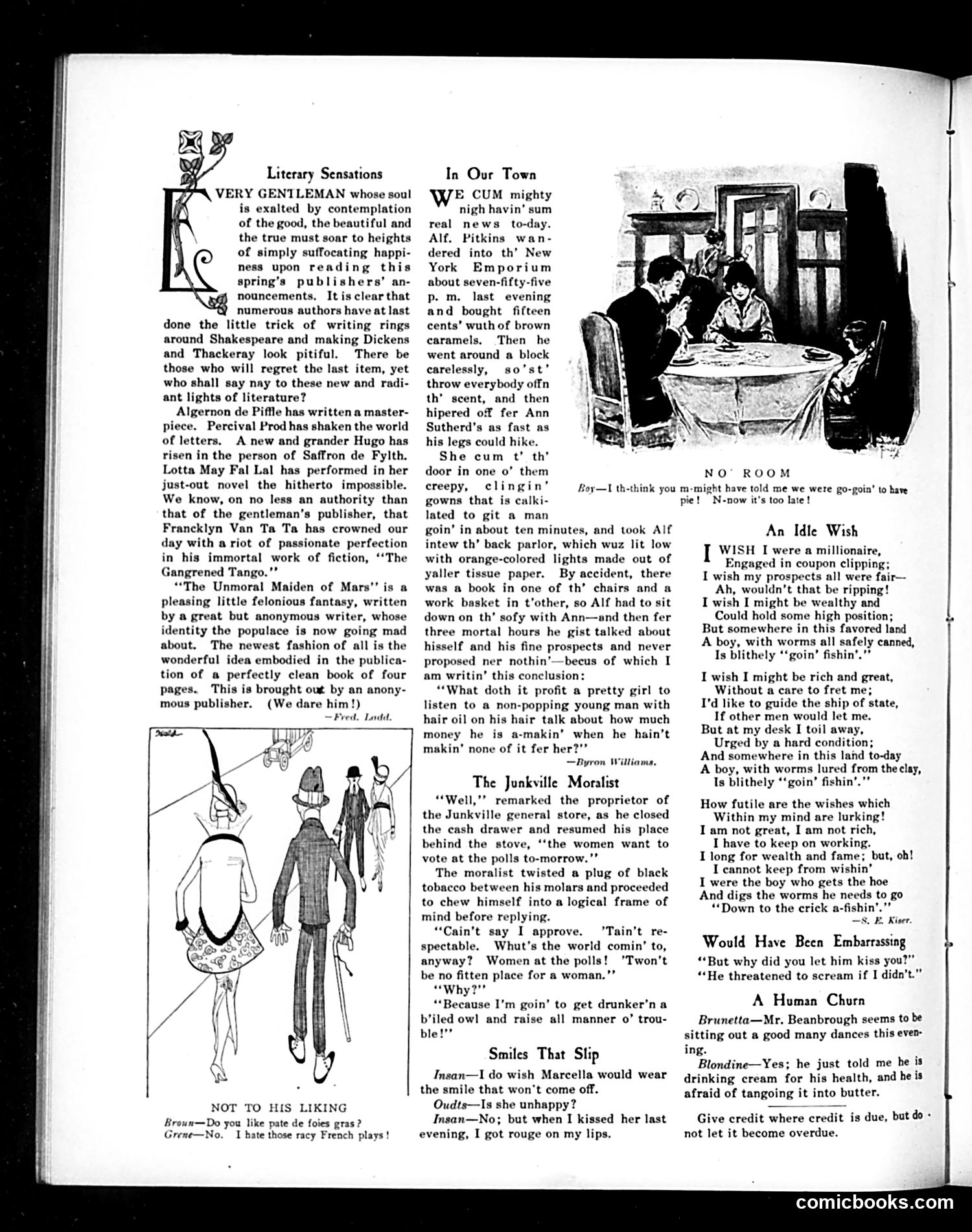
This page satirizes contemporary literary pretensions and small-town gossip circa early 20th century. **"Literary Sensations"** mocks publishers' extravagant claims about new authors. The piece ridicules invented names ("Algernon de Piffle," "Saffron de Fylth") and absurd titles ("The Gangrened Tango," "The Unmoral Maiden of Mars"), suggesting publishers shamelessly oversell mediocre work as superior to Shakespeare and Dickens. The final anecdote—where someone mistakes "pate de foies gras" for a "racy French play"—jokes about pretentious cultural misunderstanding. **"In Our Town"** humorously chronicles mundane small-town drama: a man buying candy and visiting a woman, then boring her by talking about himself for hours instead of proposing marriage. **"The Junkville Moralist"** presents a store proprietor opposing women's suffrage—not on principle, but because he plans to get drunk and cause trouble at the polls, suggesting absurd male entitlement. Smaller items ("Smiles That Slip," "An Idle Wish") offer light romantic humor about cosmetics and wealth fantasies.
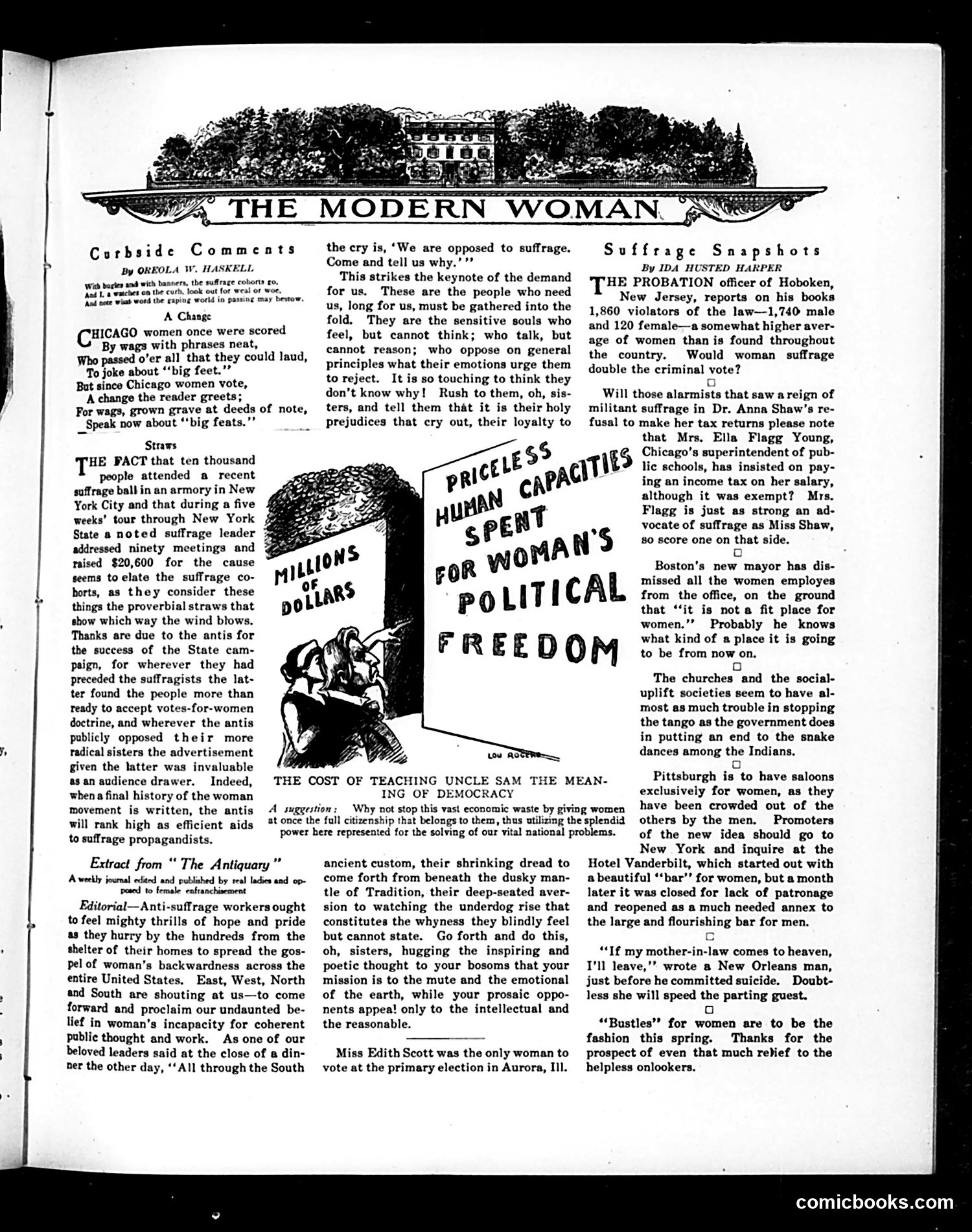
This *Judge* page satirizes **anti-suffrage arguments** through mock endorsement. The central cartoon shows Uncle Sam as a confused figure labeled "The Cost of Teaching Uncle Sam the Meaning of Democracy"—suggesting suffrage reform wastes resources. The "Antiquary" editorial parodies anti-suffrage rhetoric by pretending to be an anti-suffrage publication. It mockingly advises women to convince others that women lack reasoning ability and should remain bound by "tradition"—exposing these as hollow arguments. The "Suffrage Snapshots" section counters anti-suffrage claims with concrete evidence: a Hoboken probation officer's data shows women don't commit disproportionate crimes (120 female vs. 1,740 male violators), refuting the fear that suffrage would "double the criminal vote." Overall, the page uses irony and satire to defend women's voting rights by ridiculing anti-suffrage positions as irrational, emotion-based, and factually wrong.
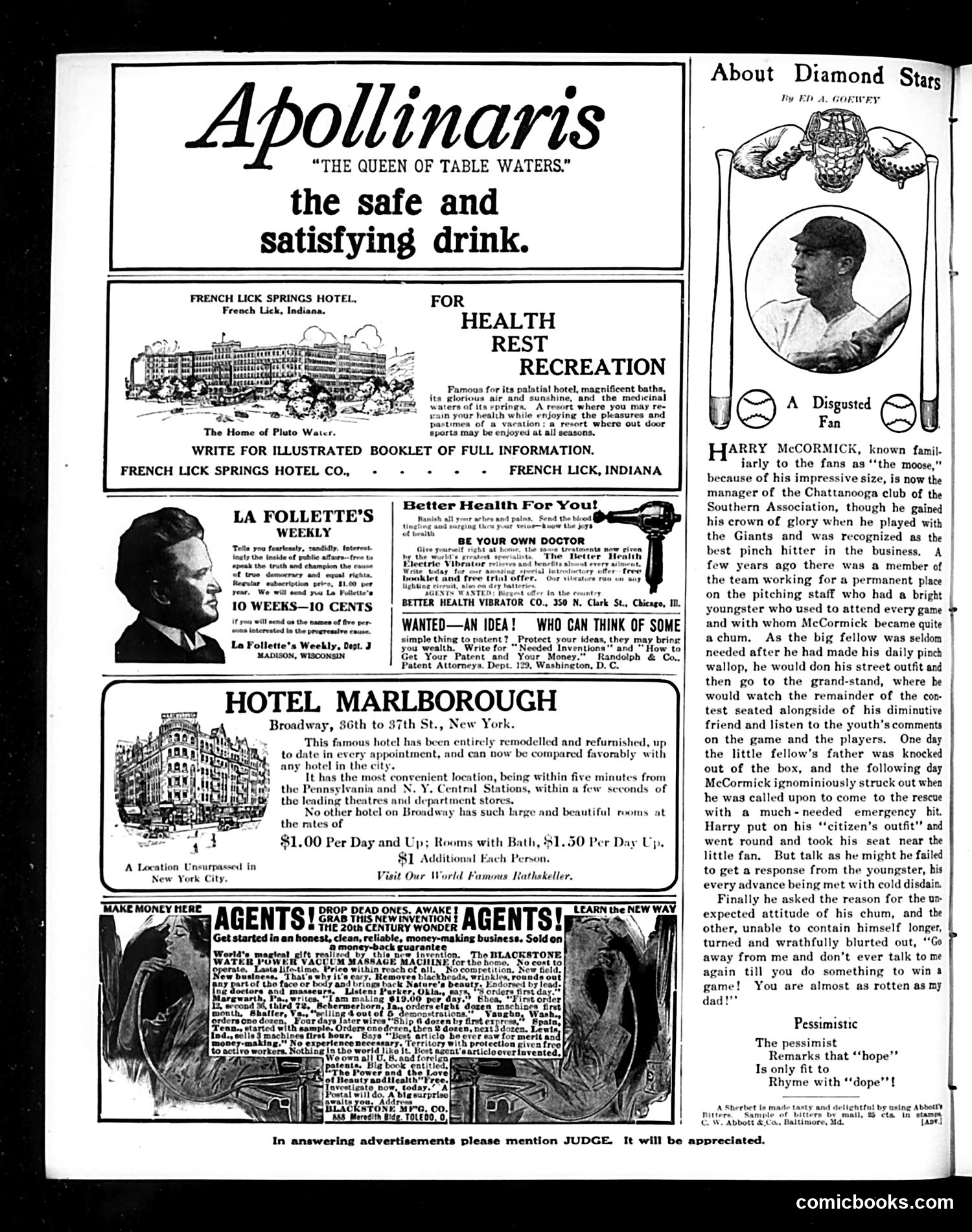
This page is primarily **advertising**, featuring hotel promotions (French Lick Springs, Hotel Marlborough), patent services, and health products typical of early 20th-century magazines. The substantive content is "About Diamond Stars" by Ed A. Goewey—a baseball anecdote about **Harry McCormick**, a real player known as "the moose" for his size. McCormick managed the Chattanooga club of the Southern Association and was celebrated as the Giants' best pinch hitter. The story illustrates a moral lesson about humility: McCormick befriended a young boy who attended games, but struck out during an important moment. The narrative suggests McCormick's subsequent embarrassment taught him a lesson about ego—the text cuts off mid-thought, but the setup implies comeuppance for his earlier indifference when not needed as a player. The piece reflects **early sports journalism's moralizing tone**, using baseball narratives to instruct readers about character and conduct rather than merely reporting statistics.
This page is primarily **advertising with humor content**, typical of Judge magazine's format. The main satirical content is "Stories with Smiles," two brief humorous anecdotes: 1. **"Classifying Him"**: A father-son golf conversation where the boy asks progressively better golf distances, each time the father rates the golfer higher—until the boy suggests 325 yards, when the father concludes he's "probably a liar." The joke mocks exaggeration in golf boasting and the absurdity of claiming superhuman athletic feats. 2. **"Father and Son"**: A Scottish immigrant story about a drunken father locked out of his son's store. The father's indignant response—that he comes from "a better family"—is the punchline, mocking Scottish pride and the irony of his inebriation undercutting his claim to respectability. Both jokes reflect early 20th-century American humor: gentle mockery of social pretension, immigrant stereotypes (Scots in particular), and the gap between aspiration and reality. The surrounding advertisements (whiskey, hair tonic, hotels) are period-standard.
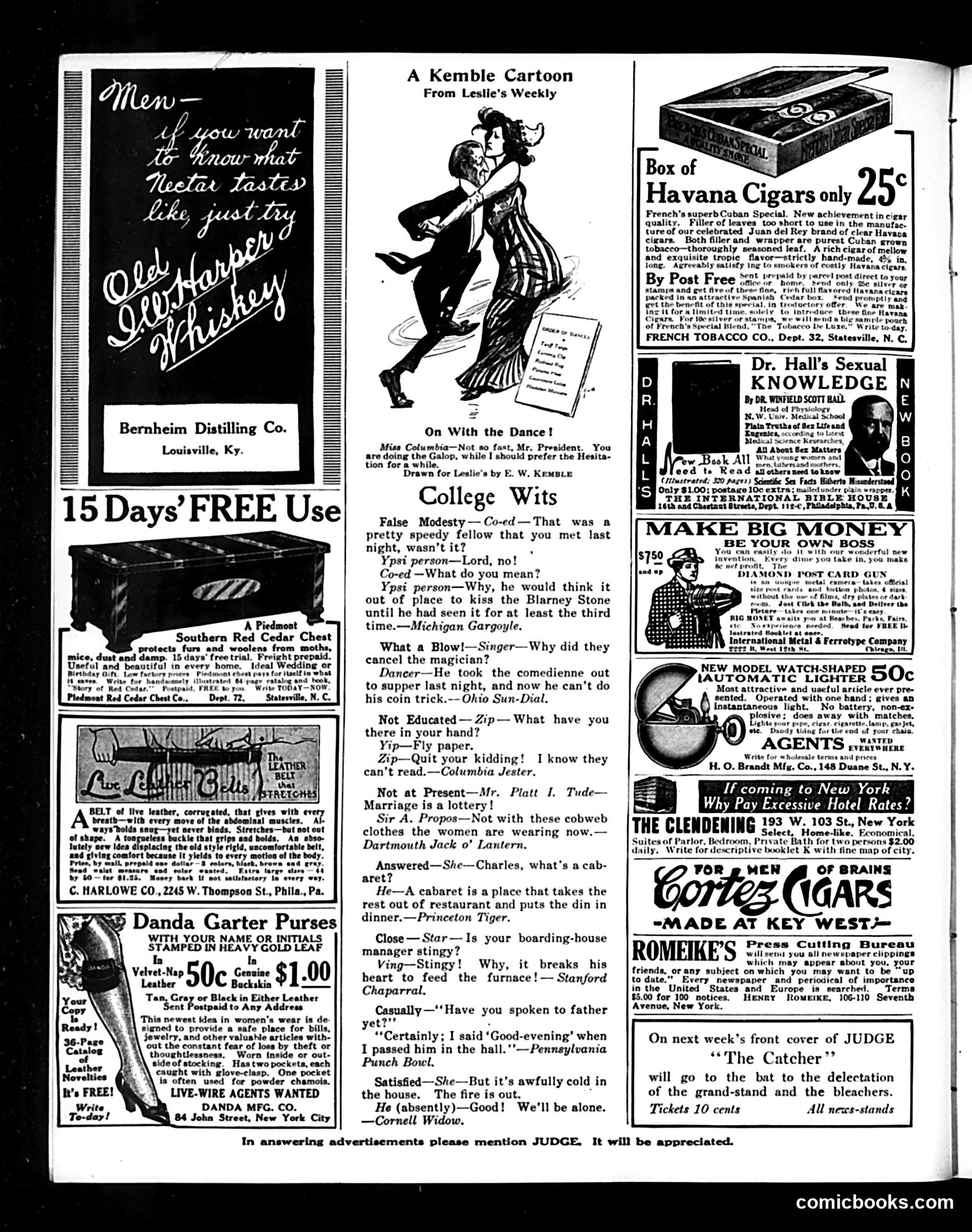
This page is primarily **advertising** rather than editorial content, though it includes one political cartoon and several college humor items. ## The Political Cartoon (Top Center) E.W. Kemble's cartoon titled "On With the Dance!" depicts **Miss Columbia** (personification of America) cautioning **Mr. President** (likely Theodore Roosevelt, given the era) against dancing too fast. Columbia prefers the "Hesitation" while the President does the "Galop"—a metaphor for foreign policy restraint versus aggressive action, likely referencing Roosevelt's expansionist tendencies and interventions. ## College Humor Section The "College Wits" items are joking dialogues from university publications, featuring typical early-20th-century campus humor about dating, engagement, and misunderstandings between students. ## Advertisements The remaining content consists of product ads: whiskey, cedar chests, cigars, belts, watches, hotels, and medical/educational books—typical period advertising emphasizing practical goods and dubious health products.
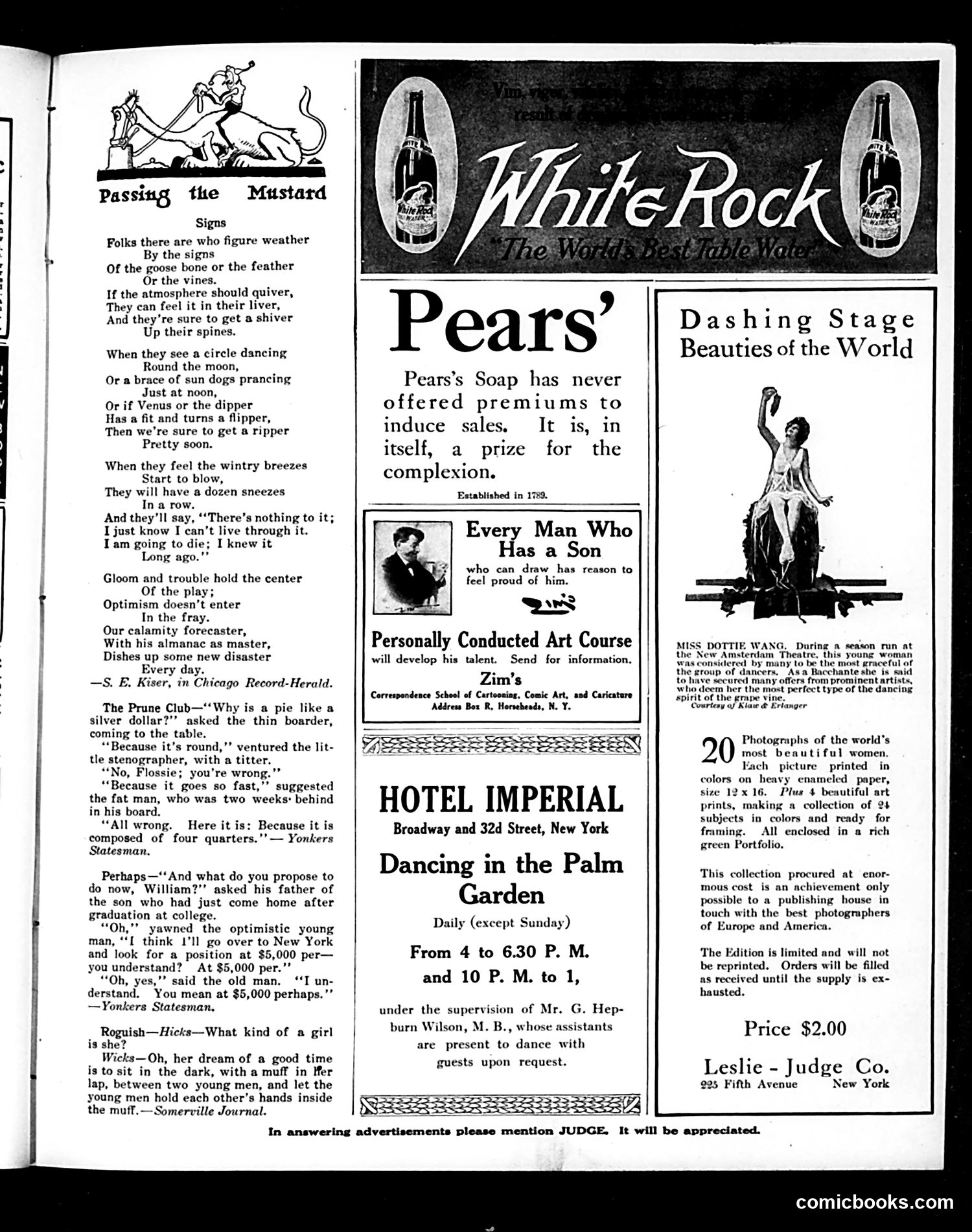
This is primarily an **advertising and humor page** from an early 1900s *Judge* magazine, not a political cartoon page. The main content includes: **Poetry/Humor Pieces:** "Passing the Mustard" is a comic poem about people who obsessively read weather signs (moon halos, sun dogs, etc.) to predict disasters, always expecting the worst. It satirizes pessimistic fortune-tellers and amateur meteorologists who "dish up some new disaster every day." The other short jokes mock: - A boarding house filled with broke residents making puns about food - An overly optimistic college graduate expecting high pay - A girl's questionable romantic behavior **Advertisements** dominate the page, promoting Pears' Soap (established 1789), an art correspondence school (Zim's), the Hotel Imperial's palm garden dancing, and a photo collection of beautiful stage actresses. The page reflects early 20th-century concerns: weather superstition, economic anxiety among working-class boarders, and entertainment culture. The tone is lighthearted rather than pointed social criticism.
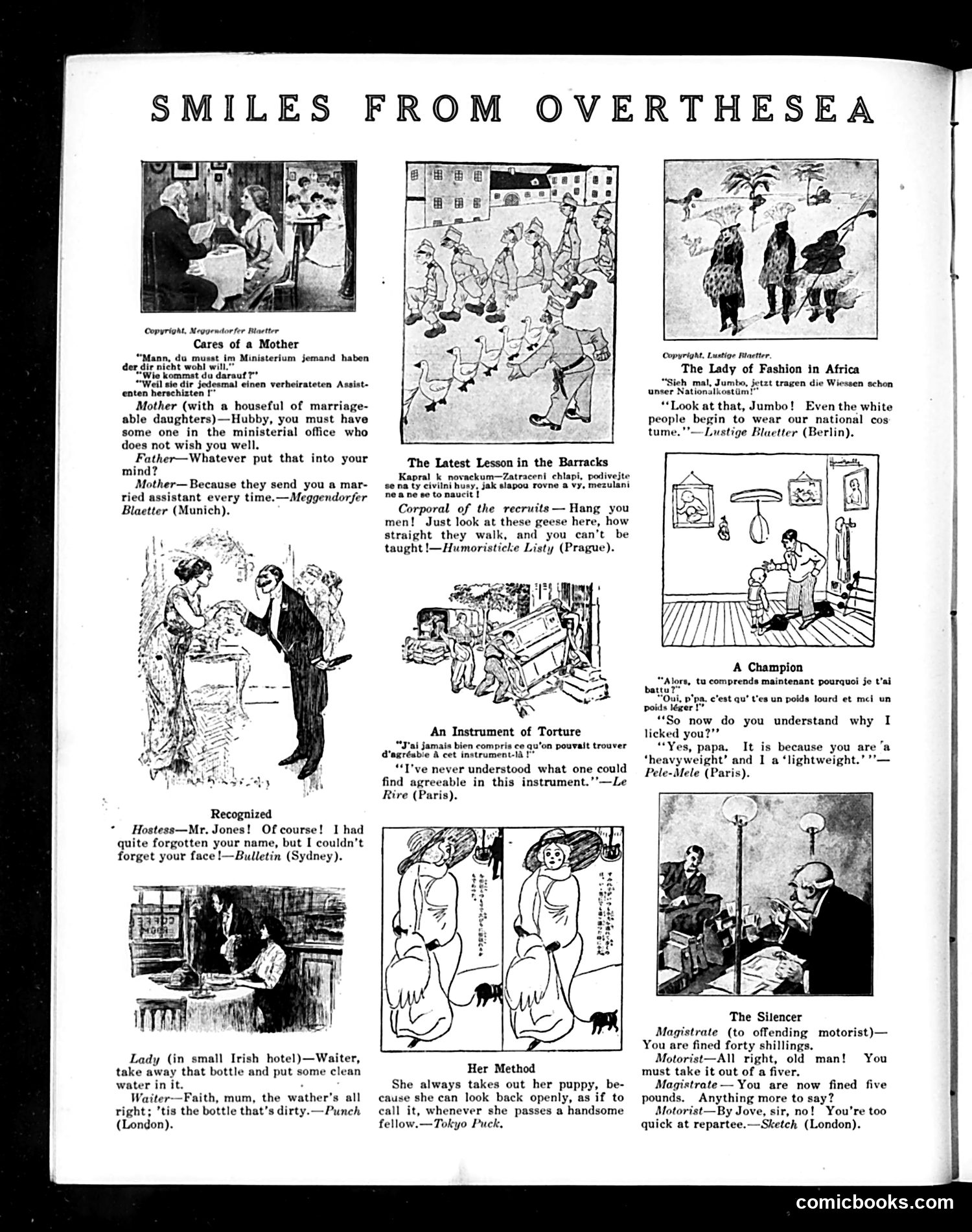
This page collects humorous anecdotes translated from European satirical magazines, arranged as brief comic sketches with illustrations. The humor relies on domestic and social situations: **Key themes:** - **Marital dynamics**: A wife suspects her husband's ministerial office sends married assistants to sabotage him (implying they distract him) - **Social embarrassment**: A hostess forgets a guest's name but pretends to remember his face - **Class/service humor**: An Irish waiter's literal interpretation creates comedy from miscommunication - **Military discipline**: A corporal criticizes recruits' marching by comparing them unfavorably to geese - **Fashion/colonialism**: An African elephant comments on white people adopting indigenous dress - **Boxing/sports**: A father explains beating his son using boxing terminology ("heavyweight" vs "lightweight") - **Motor-vehicle culture**: A motorist faces escalating fines for talking back to a magistrate The page demonstrates Judge's practice of reprinting European humor, showcasing early 20th-century preoccupations with marriage, class, emerging automotive culture, and imperialism.
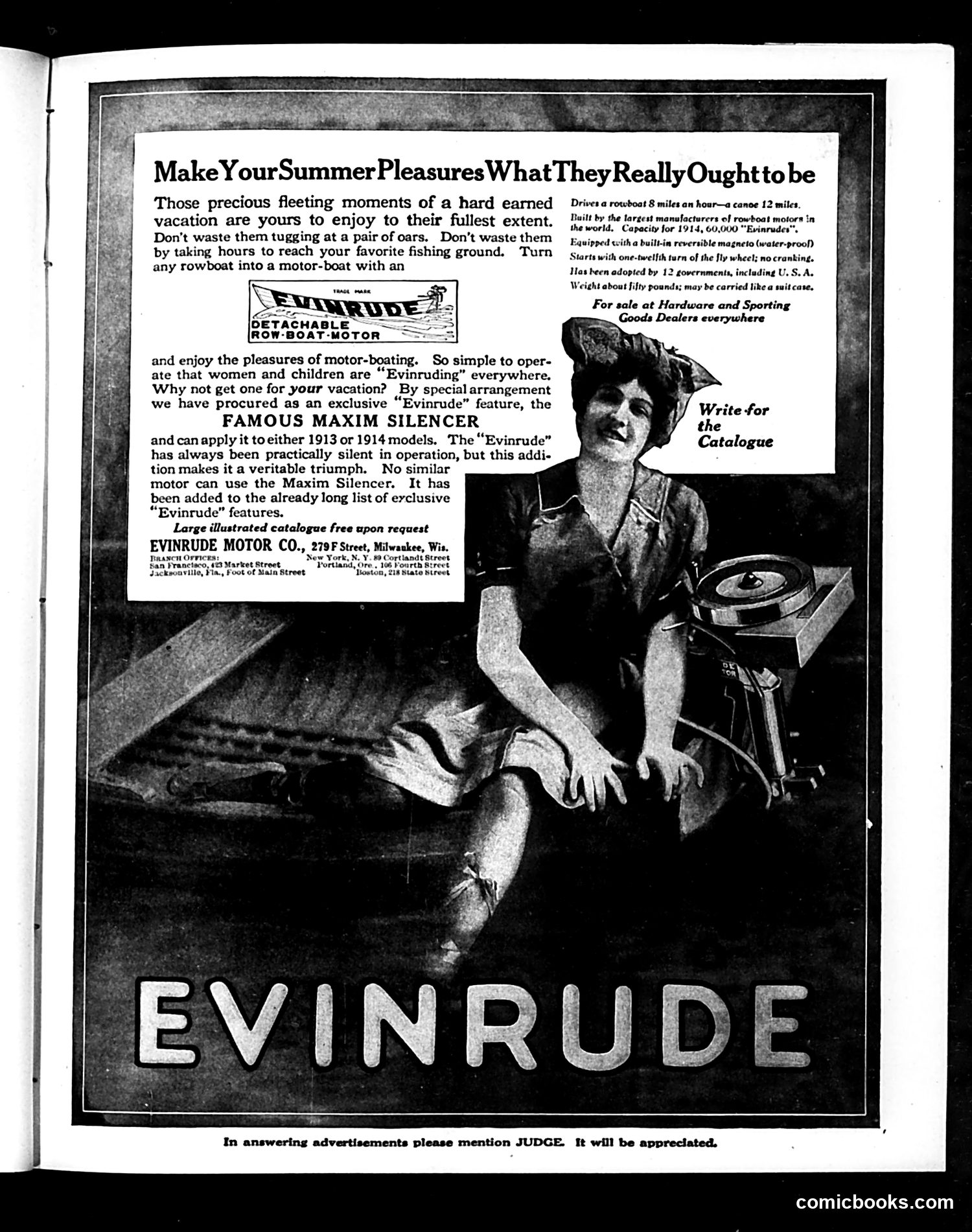
This page is primarily **advertising, not political satire**. It features a full-page advertisement for Evinrude detachable rowboat motors, appearing in *Judge* magazine (likely early 1910s based on the 1913-1914 model references). The image shows a woman in a boat holding the motor's control mechanism, positioned to appeal to leisure-class summer vacationers. The ad's rhetoric emphasizes convenience and accessibility—the motor is "so simple to operate that women and children are 'Evinruding' everywhere," a gendered marketing approach typical of the era. The "Famous Maxim Silencer" is highlighted as an exclusive feature, addressing a practical concern about early motorboat noise. While *Judge* was a satirical publication, this particular page contains straightforward commercial messaging rather than political commentary or cartoon satire. The appeal is to upper-middle-class Americans with leisure time and disposable income for vacation equipment.
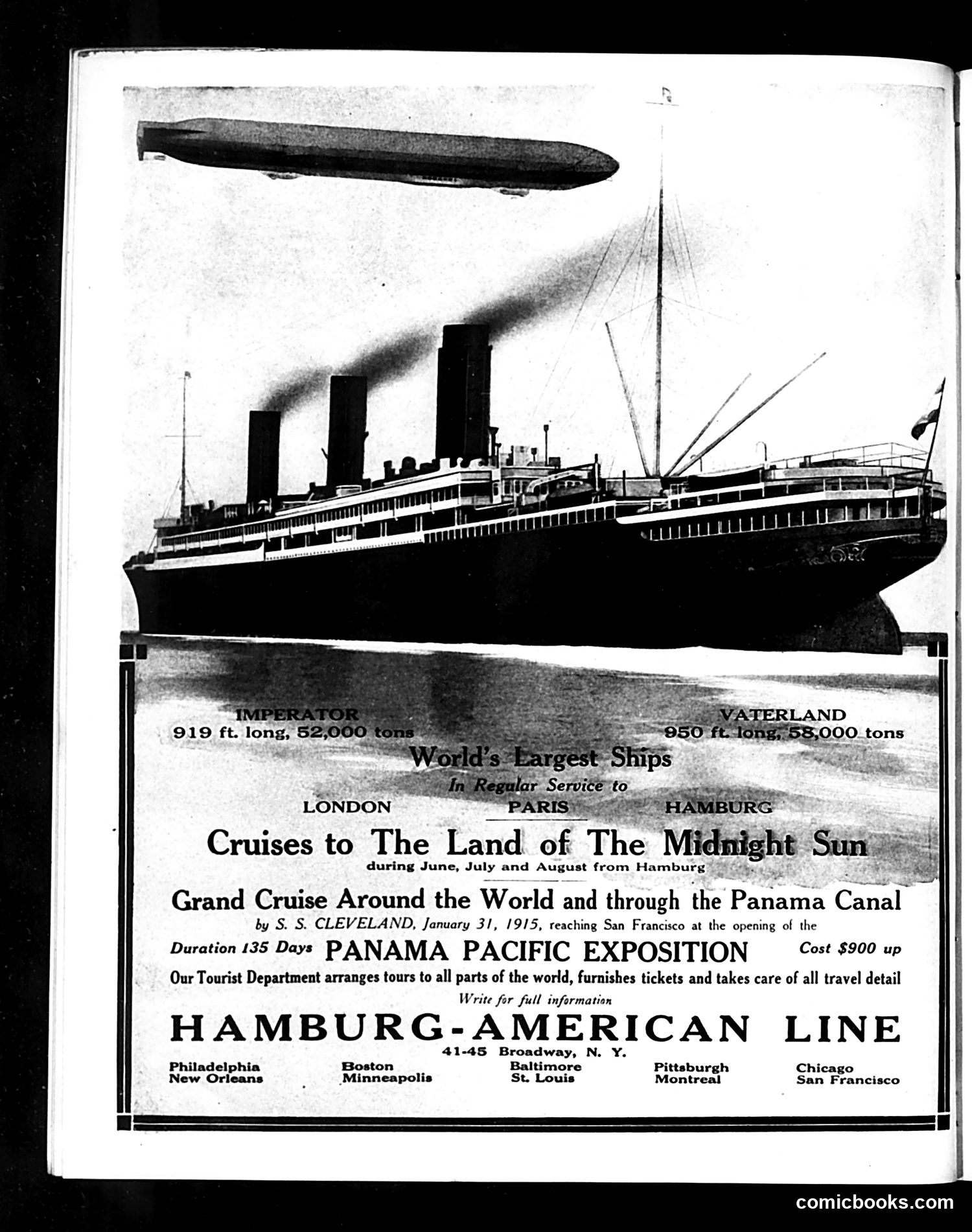
This is primarily a **commercial advertisement**, not political satire. The Hamburg-American Line promotes luxury ocean cruises using two massive steamships—the *Imperator* (919 ft, 52,000 tons) and *Vaterland* (950 ft, 58,000 tons)—described as the "World's Largest Ships." The ad highlights cruises to Scandinavia ("Land of the Midnight Sun") and an ambitious 135-day world voyage departing January 31, 1915, via the newly-opened Panama Canal to reach San Francisco's Panama-Pacific Exposition. **Historical context**: This advertisement is notable for its **timing**—World War I had begun in Europe (August 1914), yet a German shipping company still aggressively marketed transatlantic luxury travel to American clients. The *Vaterland* would soon be seized by the U.S. government in 1917 when America entered the war. The page demonstrates how pre-war commercial confidence persisted despite global conflict, and how German companies maintained American operations before hostilities directly involved the U.S.