
Judge, 1914-03-28 · page 10 of 24
Judge — March 28, 1914 — page 10: what you’re looking at
What you’re looking at
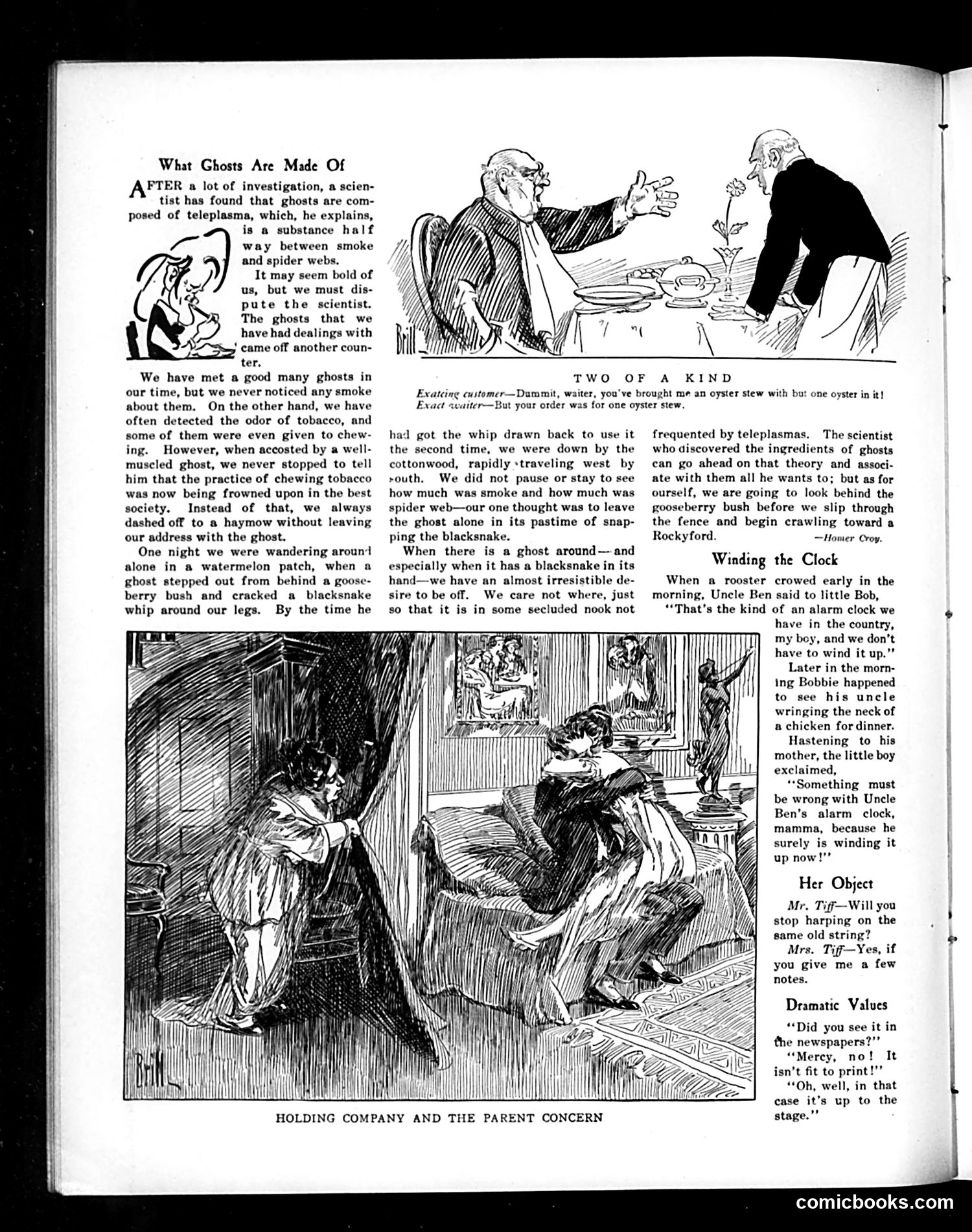
This page contains several humorous short pieces typical of early 20th-century American satire magazines: **"What Ghosts Are Made Of"**: A tongue-in-cheek essay debunking a scientist's claim that ghosts are composed of "teleplasma" (a real spiritualist concept of the era). The author humorously counters that based on personal experience, ghosts smell of tobacco and chewing tobacco, and are generally best avoided rather than studied. **"Two of a Kind"**: A cartoon showing an exacting customer complaining about a one-oyster oyster stew. The satire appears to critique unreasonable customer expectations or the absurdity of literal complaint-fulfillment. **Smaller pieces** ("Winding the Clock," "Her Object," "Dramatic Values"): Brief joke snippets about rural life, marital banter, and theatrical criticism respectively. The overall tone reflects Judge magazine's style: urbane mockery of both pseudoscience and everyday human foibles, with particular amusement at rural/country life contrasts.
📄 Transcribed text from this page (OCR, searchable)
Machine-transcribed from the original scan — historical spelling and the odd misread are preserved.
What Ghosts Are Made Of FTER a lot of investigation, a scien- tist has found that ghosts are com- posed of teleplasma, which, he explains, is a substance half Ln way between smoke 4 and spider webs. F vy It may seem bold of wy us, but we must dis- pute the scientist. The ghosts that we 3 have had dealings with y came off another coun- ter. We have met a good many ghosts in our time, but we never noticed any smoke about them. On the other hand, we have often detected the odor of tobacco, and some of them were even given to chew- ing. However, when accosted by a well- muscled ghost, we never stopped to tell him that the practice of chewing tobacco was now being frowned upon in the best society. Instead of that, we always dashed off to a haymow without leaving our address with the ghost. One night we were wandering around alone in a watermelon patch, when a ghost stepped out from behind a goose- berry bush and cracked a_blacksnake whip around our legs. By the time he HOLDING COMPANY AND THE PARENT CONCERN TWO OF A KIND Exatcing customer—Dammit, waiter, you've brought me an oyster stew with but one oyster in it! Exact ccaiter—But your order was for one oyster stew. had got the whip drawn back to use it the second time, we were down by the cottonwood, rapidly straveling west by south. We did not pause or stay to see how much was smoke and how much was spider web—our one thought was to leave the ghost alone in its pastime of snap- ping the blacksnake. When there is a ghost around— and especially when it has a blacksnake in its hand—we have an almost irresistible de- sire to be off. We care not where, just so that it is in some secluded nook not frequented by teleplasmas. The scientist who discovered the ingredients of ghosts can go ahead on that theory and associ- ate with them all he wants to; but as for ourself, we are going to look behind the gooseberry bush before we slip through the fence and begin crawling toward a Rockyford. —Homer Croy. Winding the Clock When a rooster crowed early in the morning, Uncle Ben said to little Bob, “That's the kind of an alarm clock we have in the country, my boy, and we don’t have to wind it up.”” Later in the morn- ing Bobbie happened to see his uncle wringing the neck of a chicken for dinner. Hastening to his mother, the little boy exclaimed, “Something must be wrong with Uncle Ben's alarm clock, mamma, because he surely is winding it up now!”” Her Object Mr, Tiff—Will you stop harping on the same old string? Mrs. Tiff—Yes, if you give me a few notes. Dramatic Values “Did you see it in the newspapers?”’ “Mercy, no! It isn’t fit to print!’’ “Oh, well, in that case it’s up to the stage.”” comicbooks.com