
Judge, 1914-03-28 · page 5 of 24
Judge — March 28, 1914 — page 5: what you’re looking at
What you’re looking at
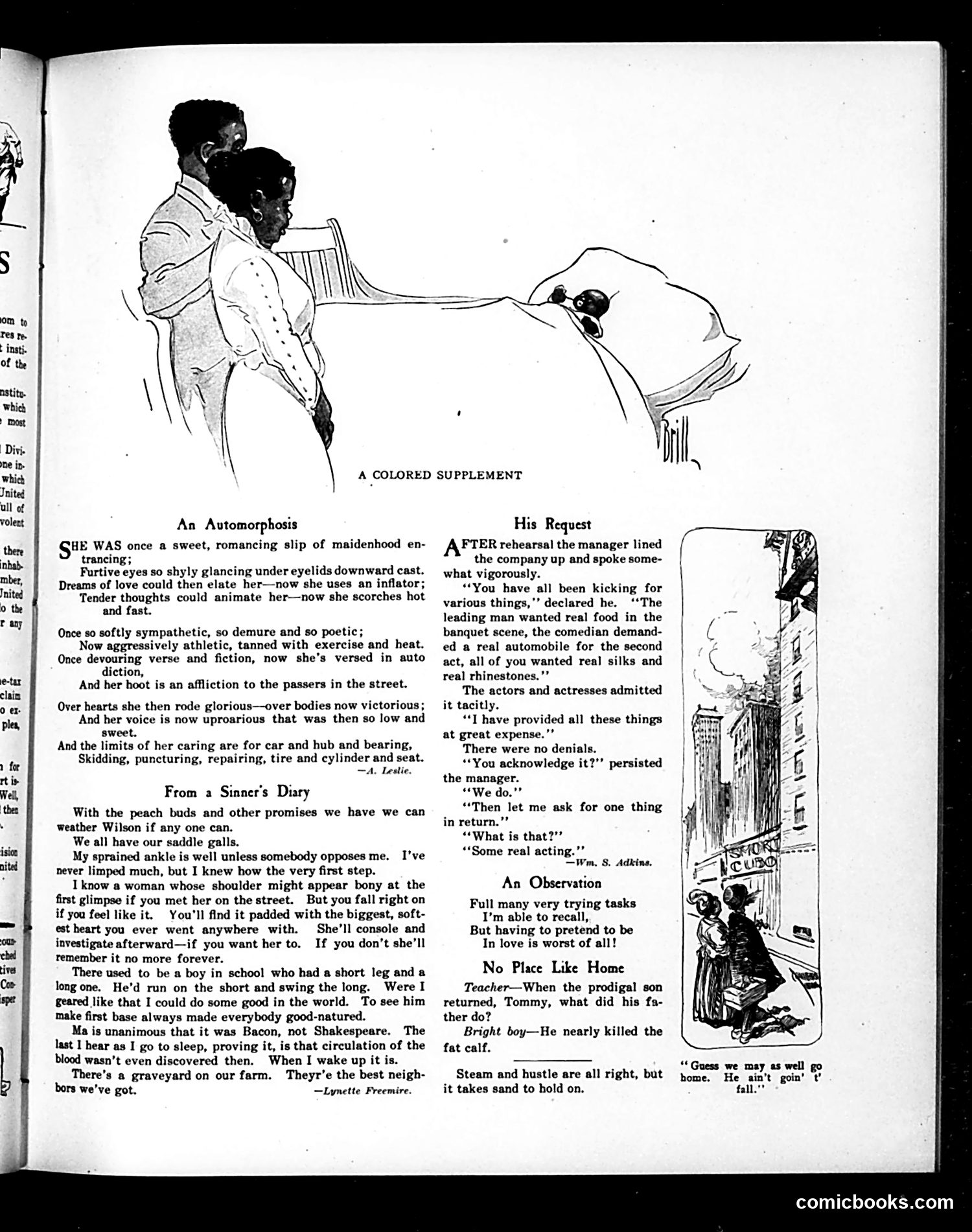
This page from *Judge* magazine contains satirical poetry and sketches rather than a single political cartoon. The content appears to target early 20th-century social trends: **"An Automorphosis"** satirizes women's changing roles—transforming from "sweet, romancing slip of maidenhood" into athletic, automobile-driving figures. The accompanying sketch shows a woman in a car, commenting on this modernization. **"His Request"** depicts a theater manager demanding actors provide real automobiles and rhinestones for performances, suggesting complaints about mounting production costs. The remaining pieces—"From a Sinner's Diary," "An Observation," and "No Place Like Home"—offer social commentary on contemporary life, though their specific targets are unclear without fuller context. The overall tone mocks rapid social change and commercialization of entertainment during the automobile age.
📄 Transcribed text from this page (OCR, searchable)
Machine-transcribed from the original scan — historical spelling and the odd misread are preserved.
A COLORED SUPPLEMENT An Automorphosis See WAS once a sweet, romancing slip of maidenhood en- trancing; Furtive eyes so shyly glancing under eyelids downward cast. Dreams of love could then elate her—now she uses an inflator; Tender thoughts could animate her—now she scorches hot and fast. Once so softly sympathetic, so demure and so poetic; Now aggressively athletic, tanned with exercise and heat. Once devouring verse and fiction, now she’s versed in auto diction, And her hoot is an affliction to the passers in the street. Over hearts she then rode glorious—over bodies now victorious ; And her voice is now uproarious that was then so low and sweet. And the limits of her caring are for car and hub and bearing, Skidding, puncturing, repairing, tire and cylinder and seat. —A. Leslie. From a Sinner’s Diary With the peach buds and other promises we have we can weather Wilson if any one can. We all have our saddle galls. My sprained ankle is well unless somebody opposes me. I've never limped much, but I knew how the very first step. I know a woman whose shoulder might appear bony at the first glimpse if you met her on the street. But you fall right on if you feel like it. You'll find it padded with the biggest, soft- est heart you ever went anywhere with. She'll console and investigate afterward—if you want her to. If you don’t she’ll temember it no more forever. There used to be a boy in school who had a short leg and a long one. He'd run on the short and swing the long. Were I geared like that I could do some good in the world. To see him make first base always made everybody good-natured. Ma is unanimous that it was Bacon, not Shakespeare. The last I hear as I go to sleep, proving it, is that circulation of the blood wasn’t even discovered then. When I wake up it is. There’s a graveyard on our farm. Theyr’e the best neigh- bors we’ve got. —Lynette Freemire. His Request AFTER rehearsal the manager lined the company up and spoke some- what vigorously. “*You have all been kicking for various things,"’ declared he. ‘‘The leading man wanted real food in the banquet scene, the comedian demand- ed a real automobile for the second act, all of you wanted real silks and real rhinestones.’’ The actors and actresses admitted it tacitly. “T have provided all these things at great expense."’ There were no denials. “*You acknowledge it?’’ persisted the manager. “We do.”” “Then let me ask for one thing in return.’’ “What is that?’’ “Some real acting.’’ —Wm, 8, Adkins, An Observation Full many very trying tasks I’m able to recall,, But having to pretend to be In love is worst of all! No Place Like Home Teacher—When the prodigal son returned, Tommy, what did his fa- ther do? Bright boy—He nearly killed the fat calf. Steam and hustle are all right, but it takes sand to hold on. “Guess we may as well go He ain't goin’ t’ fall.” oe comicbooks.com