
Judge, 1914-03-28 · page 4 of 24
Judge — March 28, 1914 — page 4: what you’re looking at
What you’re looking at
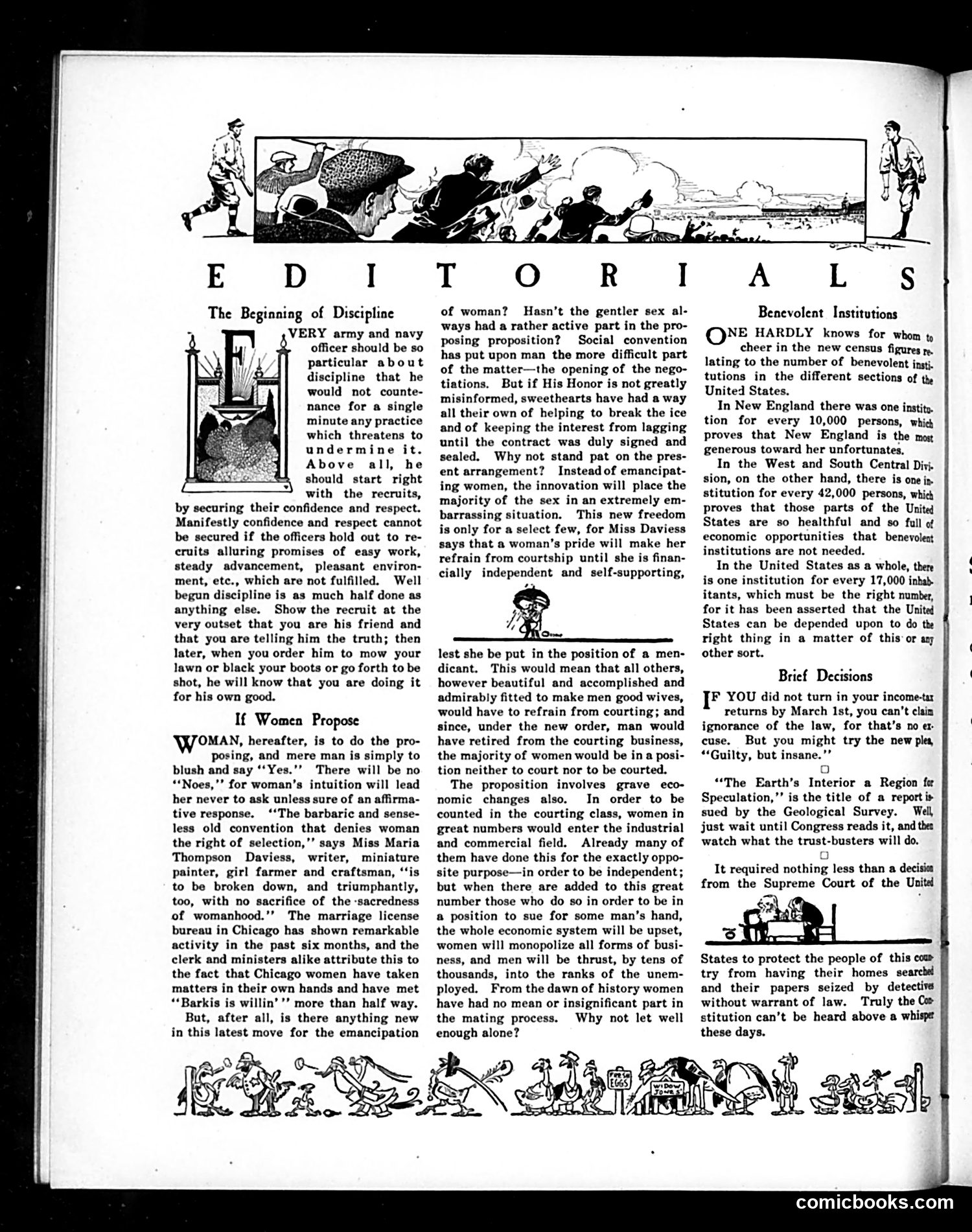
This editorial page satirizes women's suffrage and expanding women's rights circa early 1900s. The main article, "The Beginning of Discipline," argues against women's independence, claiming military-style discipline should control women's behavior. It mocks proposals that women work and be financially independent, predicting chaos—women monopolizing business, men becoming unemployed, and the entire economic system collapsing. The "If Women Propose" section ridicules the idea of women initiating courtship, suggesting it violates natural order and propriety. The cartoonist's position is conservative and anti-feminist: the satire defends traditional gender hierarchies by exaggerating feminist proposals to absurdity. The page reflects genuine contemporary anxiety about women's liberation movements and changing social roles.
📄 Transcribed text from this page (OCR, searchable)
Machine-transcribed from the original scan — historical spelling and the odd misread are preserved.
The Beginning of Discipline VERY army and navy officer should be so particular about discipline that he would not counte- nance for a single minute any practice which threatens to undermine it. Above all, he should start right with the recruits, by securing their confidence and respect. Manifestly confidence and respect cannot be secured if the officers hold out to re- cruits alluring promises of easy work, steady advancement, pleasant environ- ment, etc., which are not fulfilled. Well begun discipline is as much half done as anything else. Show the recruit at the very outset that you are his friend and that you are telling him the truth; then later, when you order him to mow your lawn or black your boots or go forth to be shot, he will know that you are doing it for his own good. If Women Propose Woman, hereafter, is to do the pro- posing, and mere man is simply to blush and say ‘‘Yes.’’ There will be no “‘Noes,’’ for woman's intuition will lead her never to ask unless sure of an affirma- tive response. ‘‘The barbaric and sense- less old convention that denies woman the right of selection,’’ says Miss Maria Thompson Daviess, writer, miniature painter, girl farmer and craftsman, ‘‘is to be broken down, and triumphantly, too, with no sacrifice of the ‘sacredness of womanhood.’’ The marriage license bureau in Chicago has shown remarkable activity in the past six months, and the clerk and ministers alike attribute this to the fact that Chicago women have taken matters in their own hands and have met “Barkis is willin’’’ more than half way. But, after all, is there anything new in this latest move for the emancipation of woman? Hasn’t the gentler sex al- ways had a rather active part in the pro- posing proposition? Social convention has put upon man the more difficult part of the matter—the opening of the nego- tiations. But if His Honor is not greatly misinformed, sweethearts have had a way all their own of helping to break the ice and of keeping the interest from lagging until the contract was duly signed and sealed. Why not stand pat on the pres- ent arrangement? Instead of emancipat- ing women, the innovation will place the majority of the sex in an extremely em- barrassing situation. This new freedom is only for a select few, for Miss Daviess says that a woman’s pride will make her refrain from courtship until she is finan- cially independent and self-supporting, lest she be put in the position of a men- dicant. This would mean that all others, however beautiful and accomplished and admirably fitted to make men good wives, would have to refrain from courting; and since, under the new order, man would have retired from the courting business, the majority of women would be in a posi- tion neither to court nor to be courted. The proposition involves grave eco- nomic changes also. In order to be counted in the courting class, women in great numbers would enter the industrial and commercial field. Already many of them have done this for the exactly oppo- site purpose—in order to be independent; but when there are added to this great number those who do so in order to be in a position to sue for some man’s hand, the whole economic system will be upset, women will monopolize all forms of busi- ness, and men will be thrust, by tens of thousands, into the ranks of the unem- ployed. From the dawn of history women have had no mean or insignificant part in the mating process. Why not let well enough alone? Benevolent Institutions ONE HARDLY knows for whom tp cheer in the new census figures re. lating to the number of benevolent insti. tutions in the different sections of the United States. In New England there was one instito. tion for every 10,000 persons, which proves that New England is the most generous toward her unfortunates. In the West and South Central Diy. sion, on the other hand, there is one in. stitution for every 42,000 persons, whic proves that those parts of the United States are so healthful and so full of econo! opportunities that benevolent institutions are not needed. In the United States as a whole, there is one institution for every 17,000 inhab- itants, which must be the right number, for it has been asserted that the United States can be depended upon to do the right thing in a matter of this or any other sort. Brief Decisions IF YOU did not turn in your income-tar returns by March Ist, you can’t clain ignorance of the law, for that’s no ex cuse. But you might try the new ples “Guilty, but insane.’’ o “The Earth’s Interior a Region fe Speculation,”’ is the title of a report i» sued by the Geological Survey. Well, just wait until Congress reads it, and the. watch what the trust-busters will do. a It required nothing less than a decisia from the Supreme Court of the Unite s States to protect the people of this cow try from having their homes searched and their papers seized by detective without warrant of law. Truly the Coe stitution can’t be heard above a whispt these days. comicbooks.com