
A complete issue · 24 pages · 1914
Judge — January 31, 1914
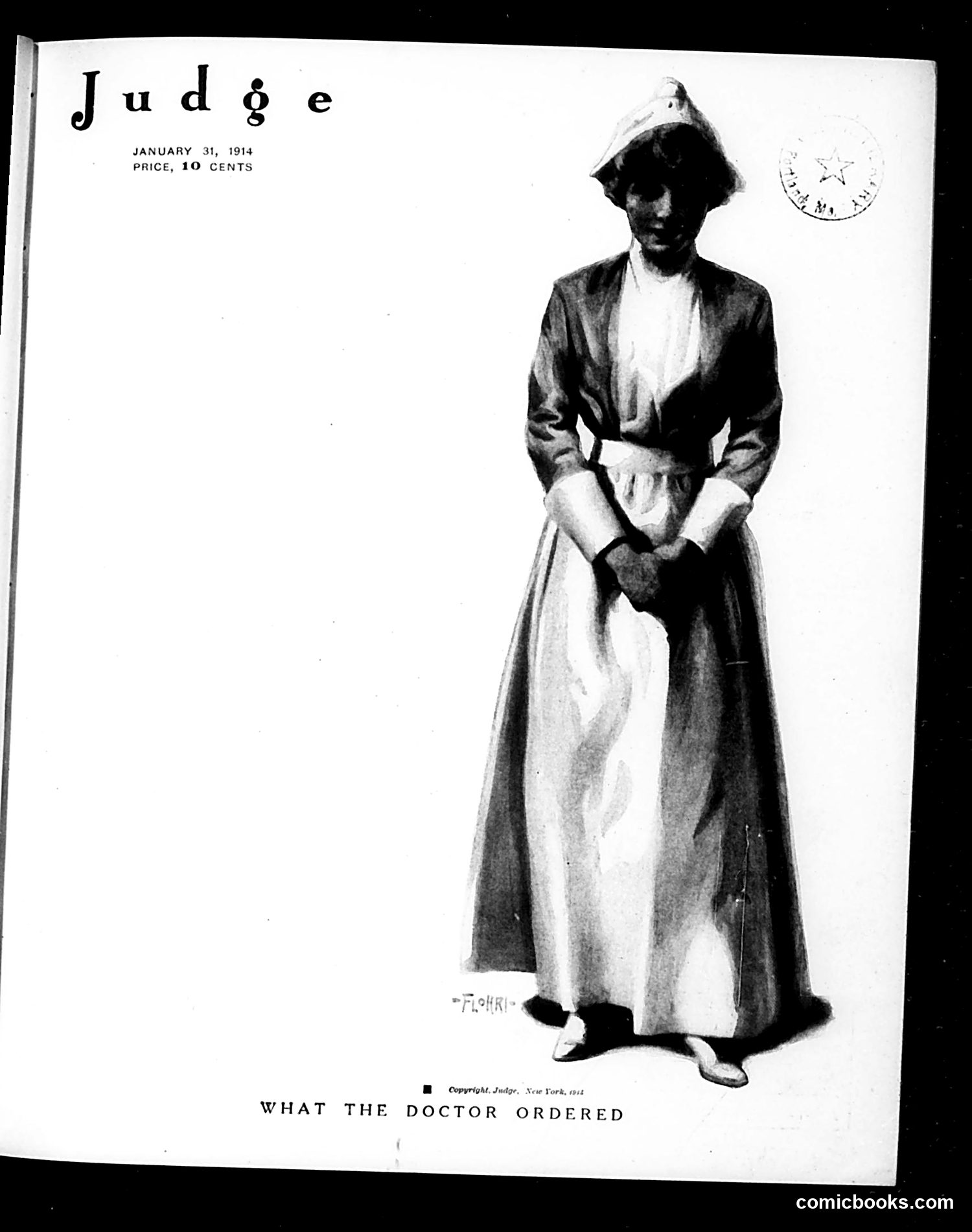
This satirical illustration titled "What the Doctor Ordered" depicts a woman in early 1900s dress—long skirt, jacket, and wide-brimmed hat—standing in a somewhat awkward, constrained posture with her hands clasped. The satire likely references women's fashion restrictions of the era, particularly corsetry and constrictive clothing that doctors sometimes prescribed as "healthful." The woman's rigid stance and formal attire suggest the physical limitations imposed by period fashion conventions. The caption implies ironic commentary: what medical professionals supposedly "ordered" as beneficial is actually shown as producing an uncomfortable, unnatural pose. This reflects ongoing Progressive-era debates about women's health, fashion reform, and bodily autonomy during this period.
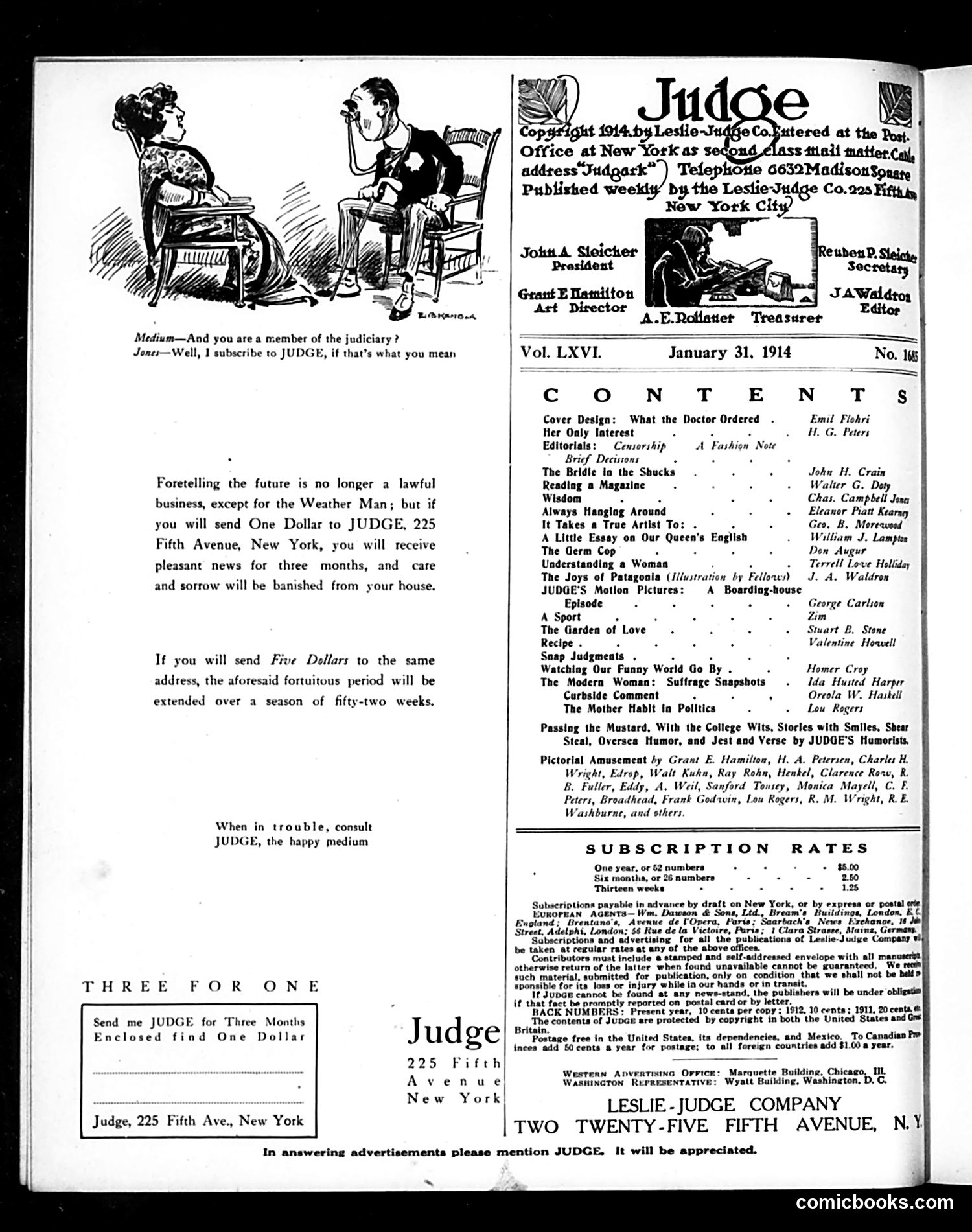
The main cartoon shows two men in conversation. The caption reads: "Medium—And you are a member of the judiciary? / Jones—Well, I subscribe to JUDGE, if that's what you mean." **The joke:** A "medium" (spiritualist) is consulting with a man named Jones, asking if he's a member of the judiciary (courts/legal profession). Jones misinterprets the question, thinking the medium is asking if he subscribes to *Judge* magazine—playing on the double meaning of "judiciary" versus "Judge" (the publication). This is self-promotional advertising humor, using wordplay to humorously suggest that reading *Judge* is equivalent to being legally informed or sophisticated. The cartoon appears on a subscription advertisement page encouraging readers to subscribe.
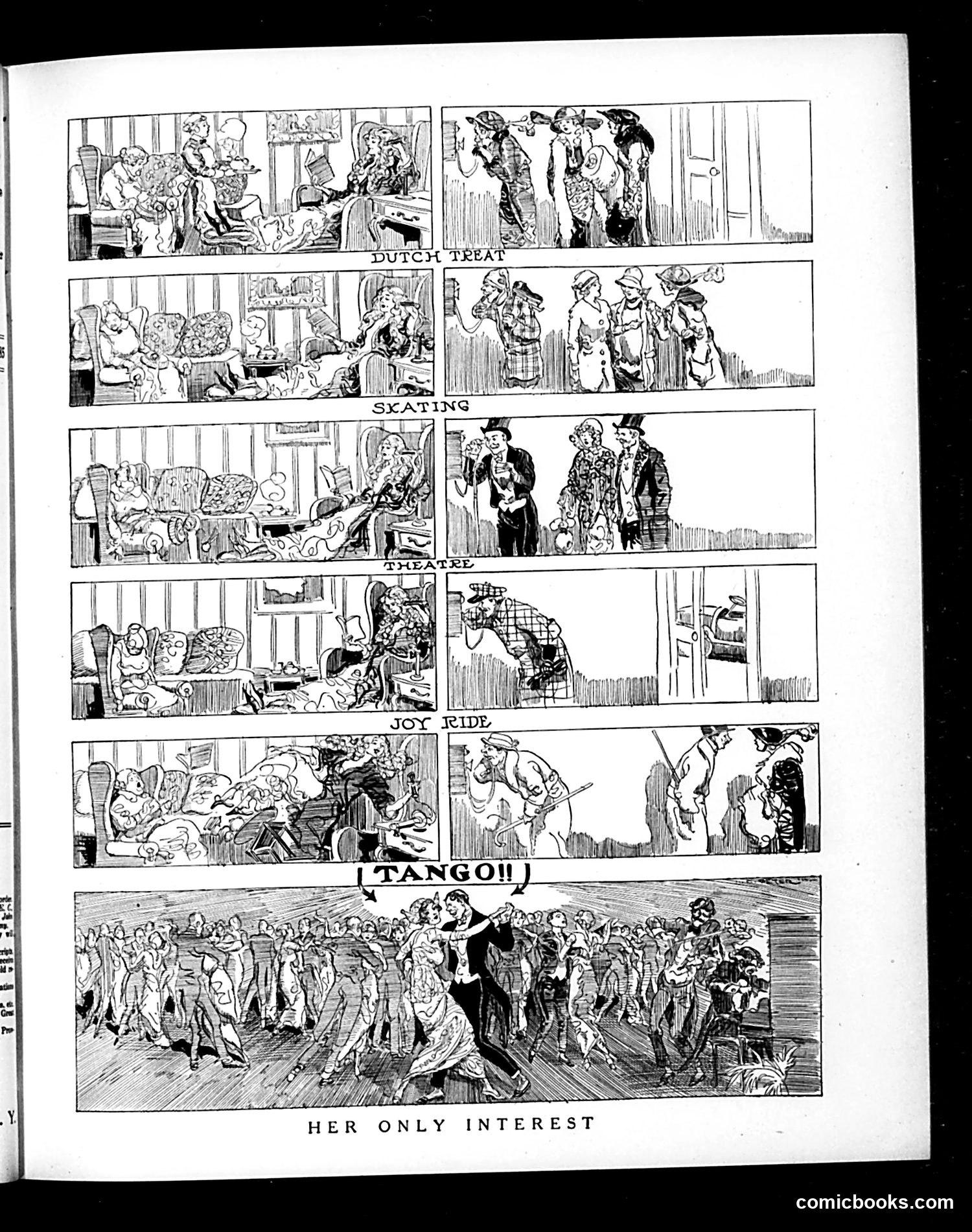
This satirical comic strip traces a woman's activities throughout winter leisure activities—Dutch treat dining, skating, theater, and a joy ride—culminating in a tango dance scene. The title "Her Only Interest" suggests ironic commentary on women's priorities or social engagement. The satire appears to critique upper-class women's focus on entertainment and social dancing rather than more substantive concerns. The progression from casual outings to the energetic tango finale emphasizes frivolity. The large final panel showing numerous couples dancing underscores how completely absorbed society women were in this fashionable dance craze. This likely reflects early 20th-century anxieties about changing gender roles and women's increasing independence in public social spaces, presented here as shallow materialism rather than meaningful advancement.
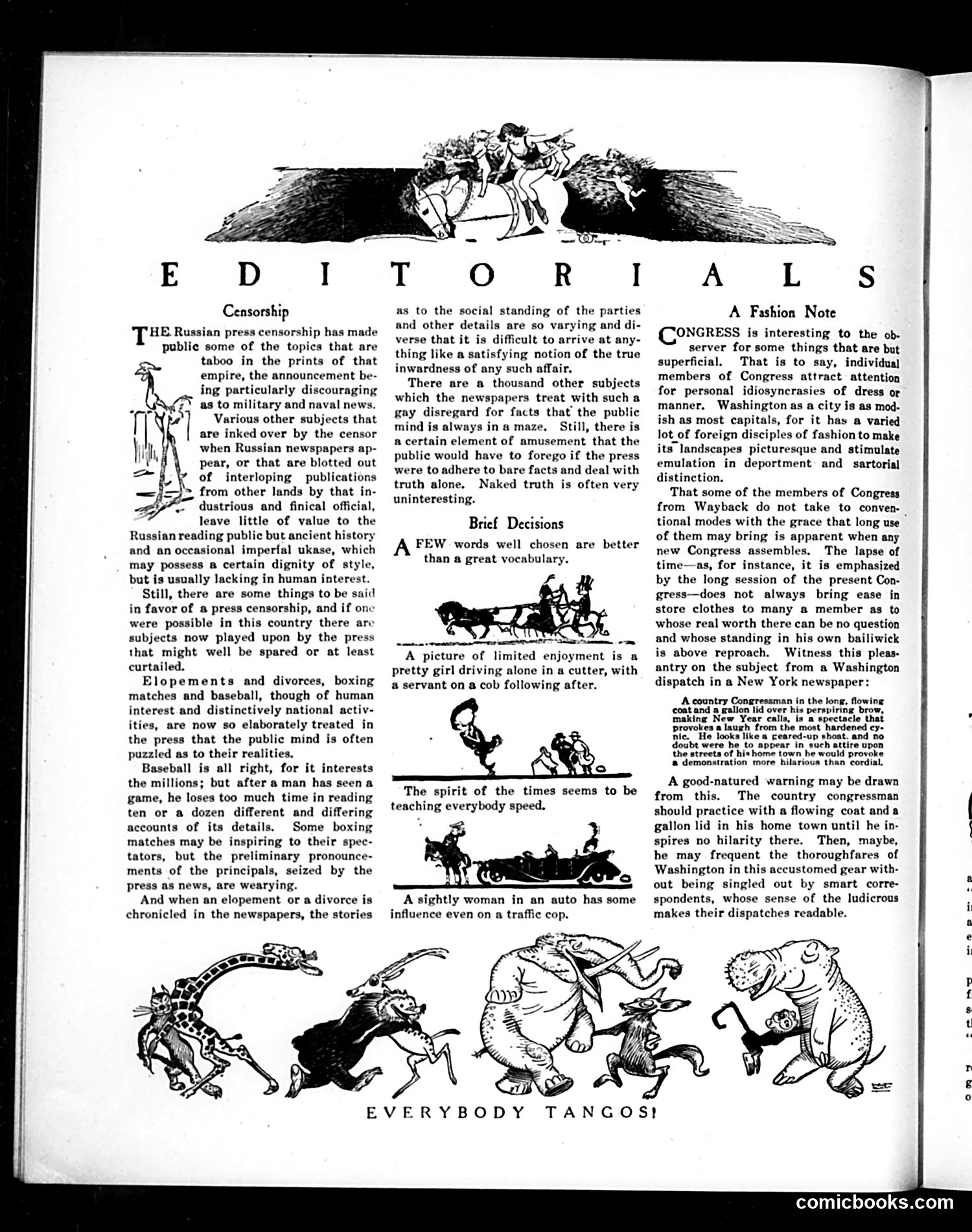
This page contains several brief satirical pieces and illustrations. The main sections include: **"Censorship"** - Criticizes Russian press censorship, arguing newspapers should report facts rather than hide truth. The piece suggests American papers could learn restraint about certain topics (elopements, divorces, boxing matches, baseball) that puzzle the public. **"A Fashion Note"** - Mocks Congress members from Wayback for unconventional dress, suggesting their appearance draws unnecessary attention during sessions. **Bottom cartoons** - Labeled "EVERYBODY TANGOS!" appears to depict various figures (possibly politicians or social types) doing the tango dance, likely satirizing the popular dance craze's widespread adoption across society. The overall tone suggests early 20th-century social commentary on press freedom, decorum, and fads.
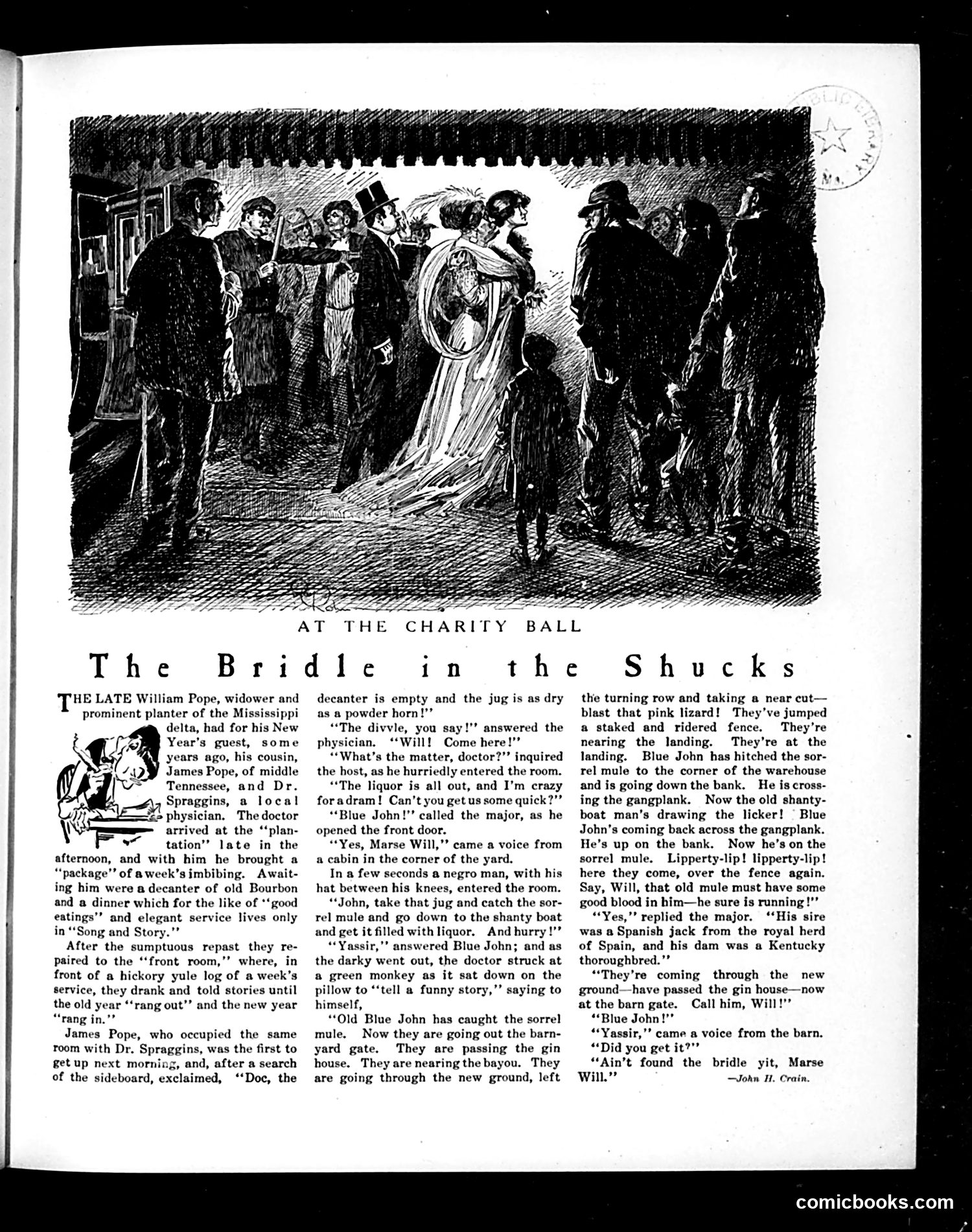
This humorous short story, illustrated at top, satirizes the chaos of a charity ball among wealthy socialites. The narrative mocks the pretensions of "prominent planter of the Mississippi delta" William Pope and his nouveau riche relatives, who become intoxicated and increasingly unruly. The satire centers on their loss of genteel composure: guests drink excessively, servants chase livestock (a sorrel mule and blue jay), and the refined ball descends into barnyard pandemonium. The title's metaphor—"bridle in the shucks"—suggests attempting to maintain control in rustic, unsuitable circumstances. The piece ridicules both the aspirations of wealthy Southerners and their inability to maintain proper decorum when alcohol is involved, presenting them as fundamentally coarse despite their pretensions.
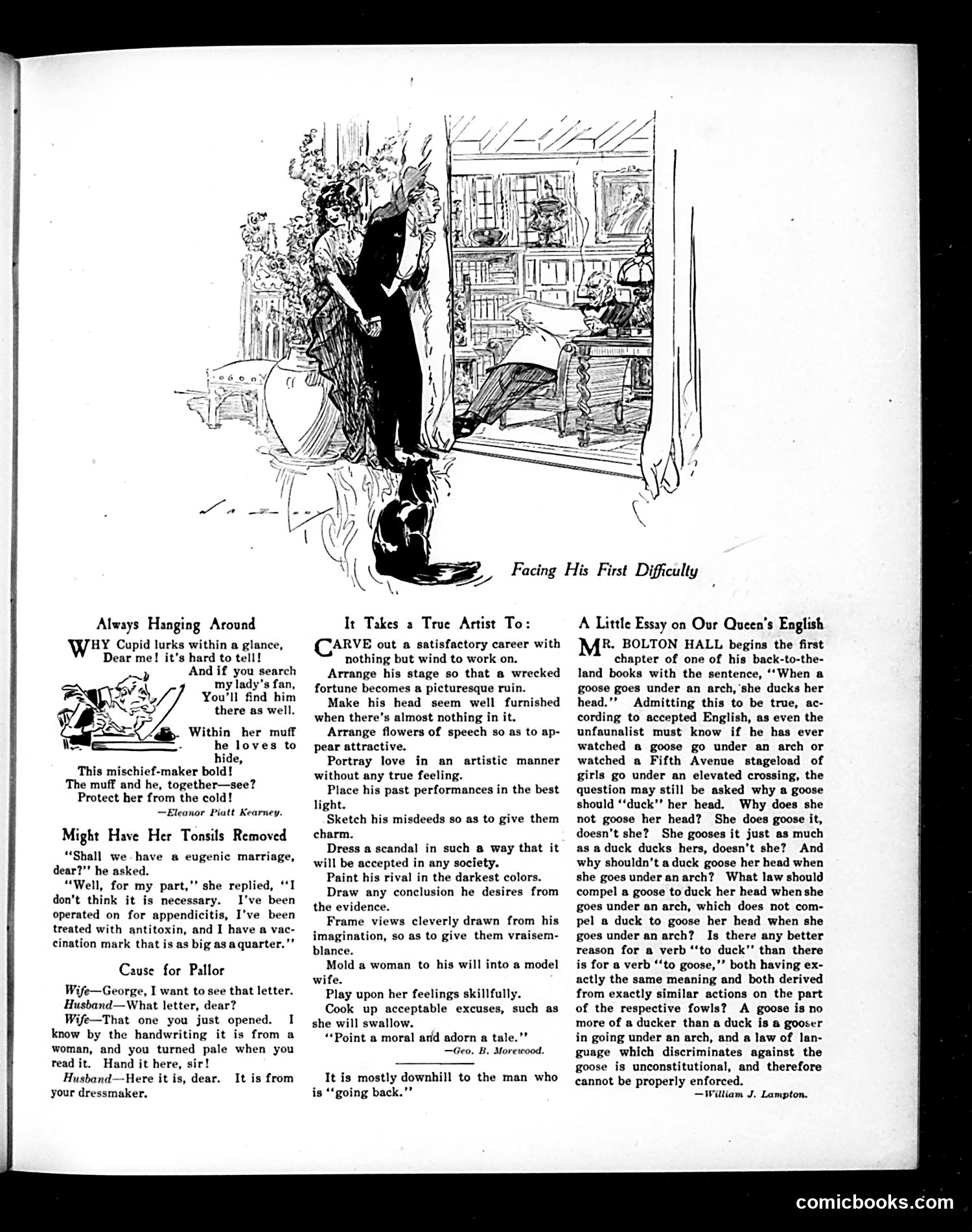
This page contains three unrelated humorous pieces typical of early 20th-century satirical journalism: **"Always Hanging Around"** and **"Might Have Her Tonsils Removed"** are brief romantic/domestic humor pieces with no particular political content—just jokes about courtship and marriage anxieties. **"It Takes a True Artist To"** satirizes theatrical performers and con artists, listing dishonest practices (fabricating evidence, manipulating women, hiding scandals) as skills required for a "successful" career. This reflects period skepticism toward theater and entertainment professionals. **"A Little Essay on Our Queen's English"** is linguistic satire by William J. Lampton. It humorously argues that English is illogical: if geese legitimately "duck" under arches, why can't ducks "goose"? The piece absurdly invokes constitutional law to mock arbitrary grammar rules, playing on progressive-era debates about standardization and authority. None addresses specific political events or figures—all represent general social satire and wordplay characteristic of Judge's style.
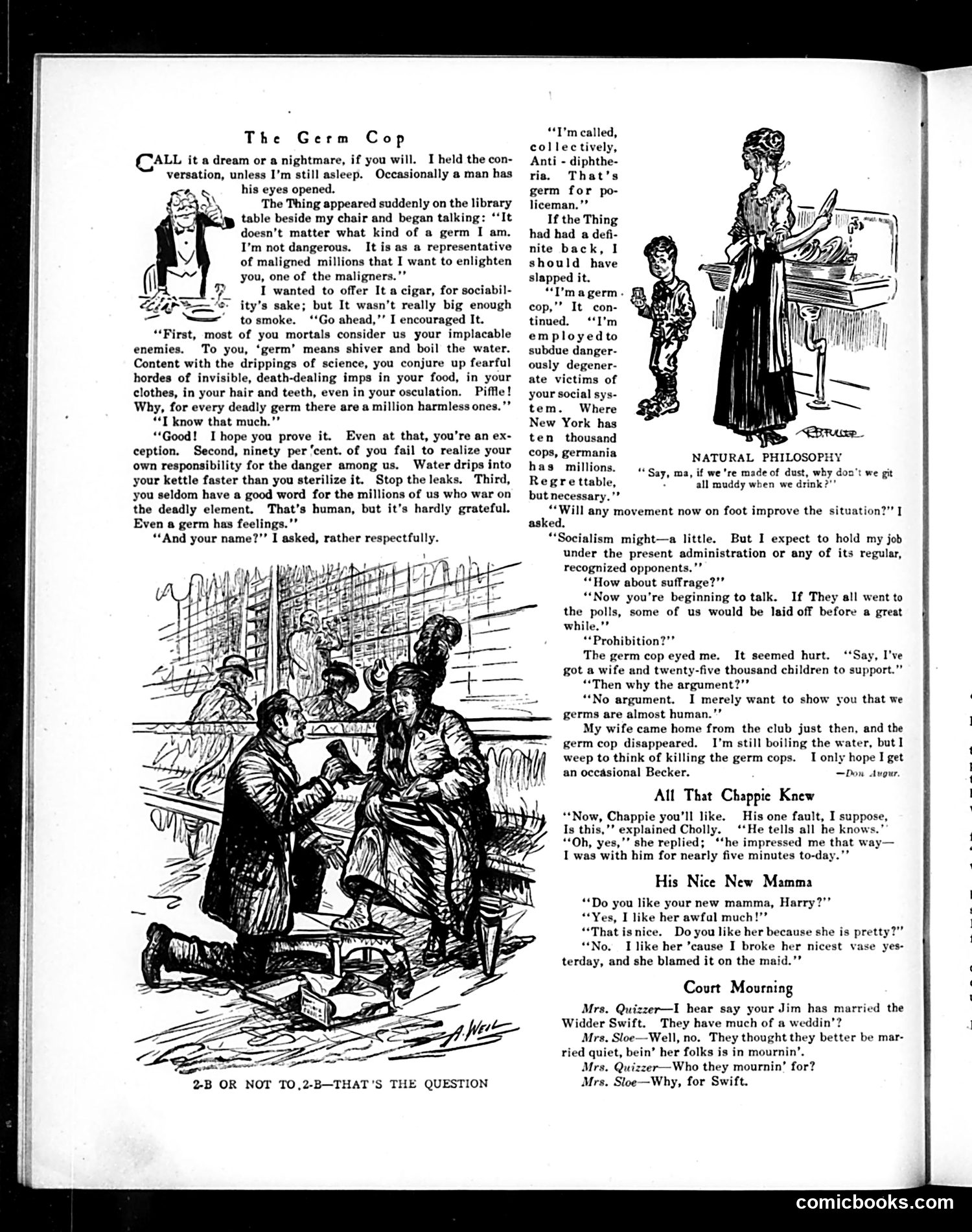
This satirical story presents a personified anti-diphtheria bacterium as a "germ cop"—a protective microorganism that argues germs deserve respect. The satire targets progressive-era anxieties about germ theory and public health. The germ makes three arguments: (1) humans unfairly demonize all germs despite many being harmless; (2) humans bear responsibility for unsanitary conditions; (3) beneficial germs receive no gratitude. The piece's real target is socialism and women's suffrage. The germ cop claims socialism might help but expects job security under any administration. When asked about suffrage, it warns that women voting would reduce the "need" for germs by improving social conditions—suggesting Judge's editors opposed both reform movements. The accompanying humor pieces are unrelated short jokes about children, remarriage, and a child's logical question about drinking water. The cartoon's political message is unmistakable: progressive reforms are unnecessary and threatening to the status quo.
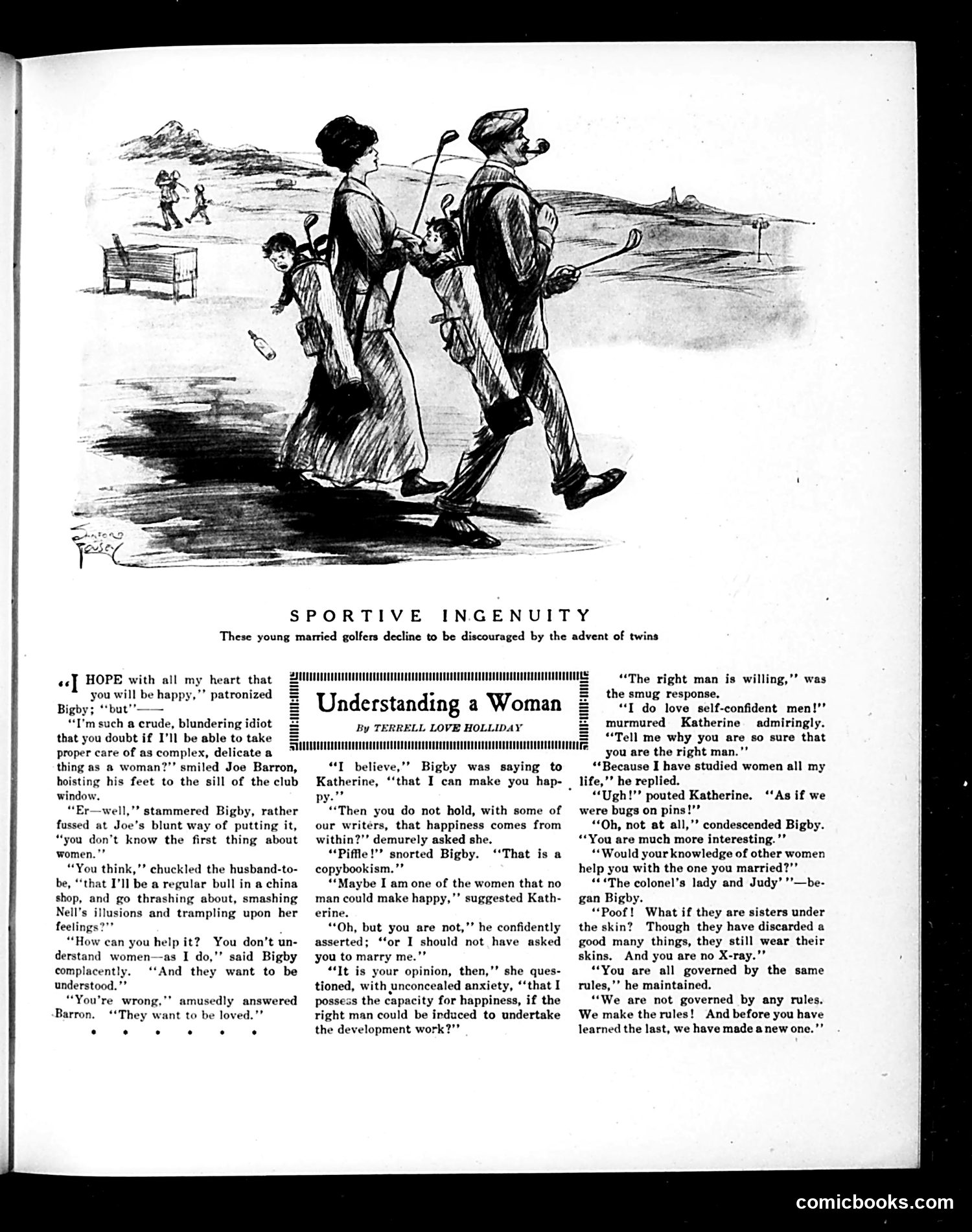
**The Cartoon:** The top illustration shows a couple with golf clubs and two small children on a golf course, captioned that young married golfers are undeterred by twins. This appears to be visual commentary on modern married life and leisure. **The Story:** Two men—Joe Barron and Bigby—debate whether understanding women requires scholarly knowledge or simply love. Bigby condescendingly claims he has "studied women" and can "develop" a woman's capacity for happiness through his superior knowledge. Katherine, whom Bigby is courting, initially seems impressed by his confidence but grows skeptical, ultimately arguing that women aren't governed by fixed rules—they "make the rules" and change them constantly. **The Satire:** The joke mocks men's arrogant assumption that women are knowable systems to be mastered through study. Katherine's final retort—that women are unpredictable and constantly redefine the terms—undercuts Bigby's pompous certainty. It's satire of masculine overconfidence about understanding the "opposite sex."
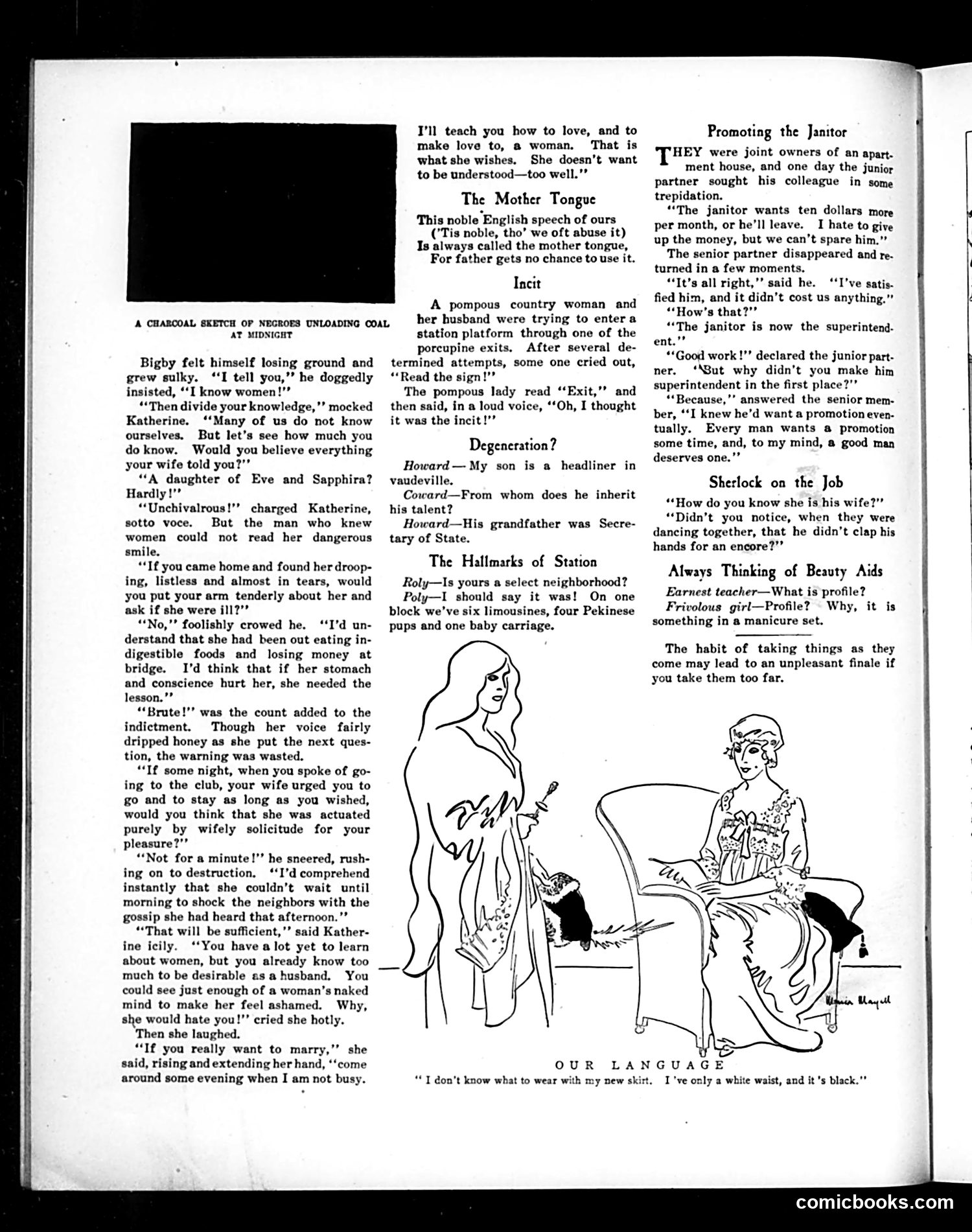
This page contains several short satirical pieces typical of early 20th-century American humor: **"The Mother Tongue"**: A brief joke about how fathers never get to speak because mothers dominate conversation—a common domestic humor trope of the era. **"Incit"**: Mocks a pompous country woman who misreads the word "Exit" as "Incit," playing on class-based humor about provincial ignorance. **"Degeneration?"**: Comments on social decline by suggesting a vaudeville headliner's talent comes from his grandfather being Secretary of State—implying entertainment is a step down socially. **"The Hallmarks of Station"**: Satirizes wealthy neighborhoods by defining status through luxury cars and lap dogs rather than substantive qualities. **"Promoting the Janitor"** and **"Sherlock on the Job"**: Brief anecdotes about workplace management and relationships. **"Always Thinking of Beauty Aids"**: Features an illustration of women discussing fashion/appearance—typical period humor about female vanity. The page reflects Edwardian-era satirical conventions: domestic comedy, class commentary, and gentle mockery of modern life's absurdities.
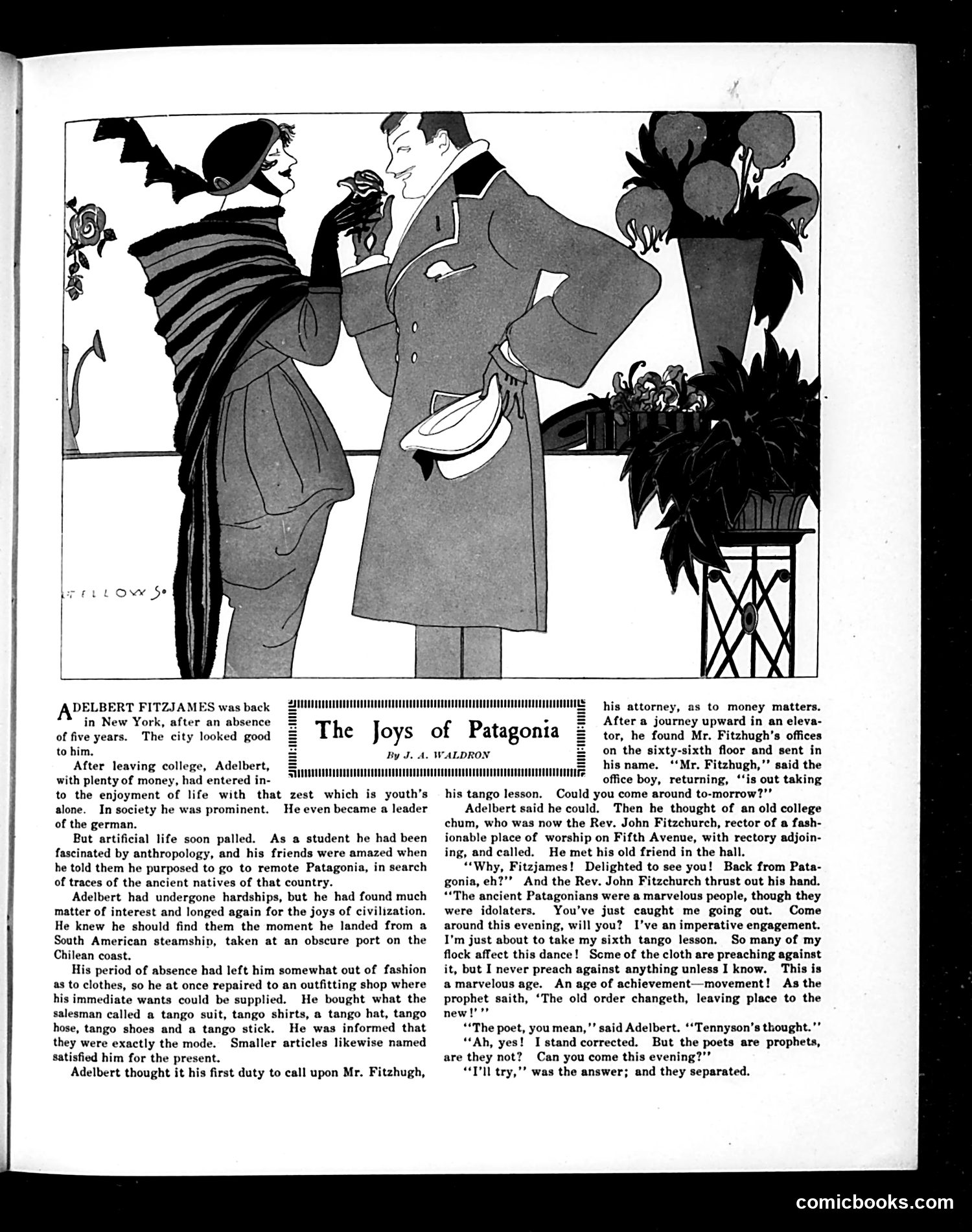
This 1910s satirical story mocks the "tango craze" that had swept American society. Adelbert Fitzjames, a wealthy young man returning from anthropological study in Patagonia, finds New York society obsessed with the tango—a sensual Argentine dance considered scandalous by traditionalists. The satire targets how completely the fad has penetrated even respectable institutions: his attorney is taking tango lessons instead of working; a prominent clergyman is similarly distracted and justifies the dance through pseudo-philosophical rhetoric about "progress" and "achievement." The joke is that Adelbert escaped to remote Patagonia seeking authentic culture, only to return home where superficial fashion-following has replaced genuine civilization. Even religious authority figures have abandoned their principles for trendy entertainment. The "tango suit" he purchases—every garment branded "tango"—epitomizes how thoroughly commercial interests exploit social fads.
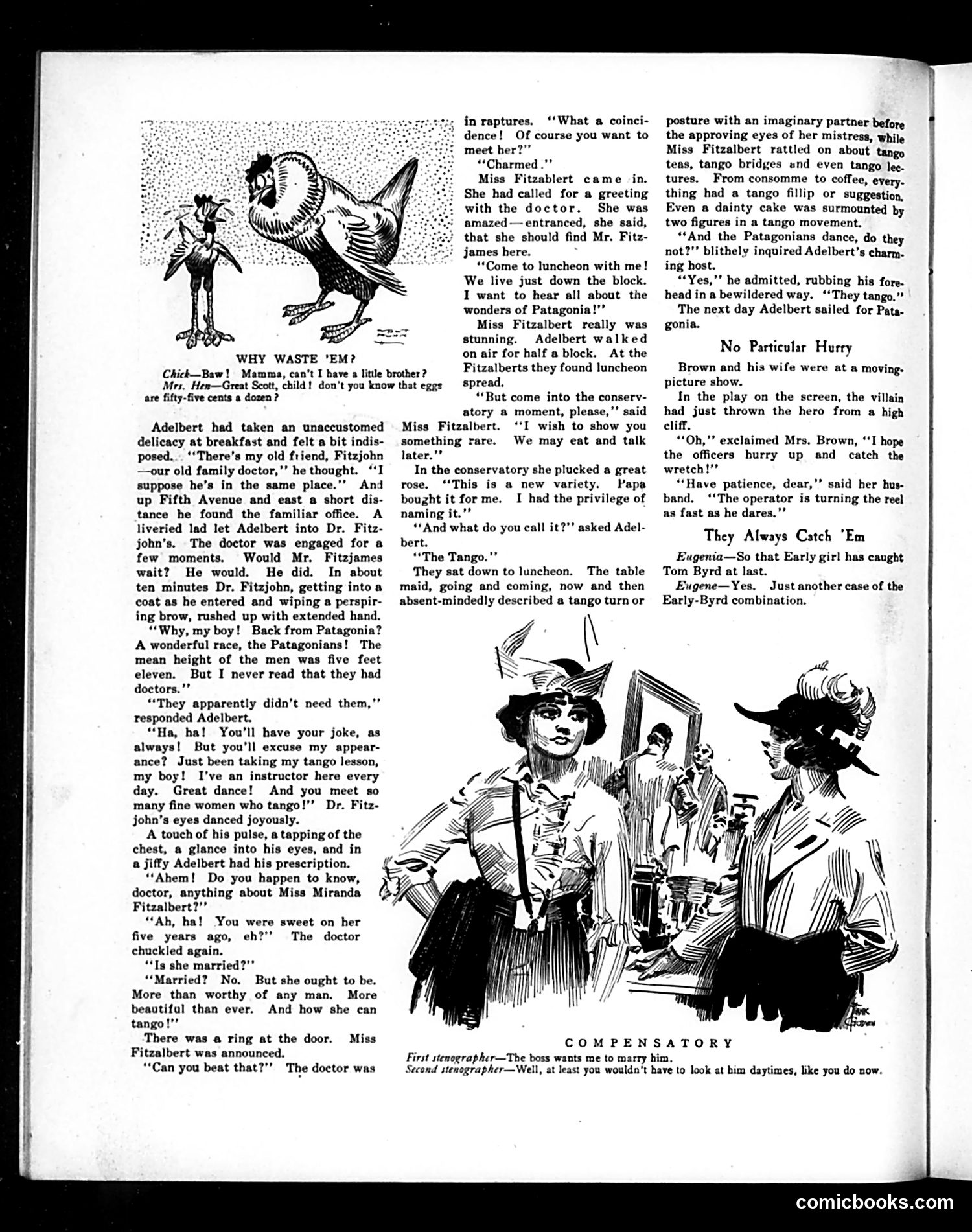
This Judge magazine page contains two satirical stories mocking early 1900s social trends. **"Why Waste 'Em?"** ridicules the tango craze that swept America around 1910-1913. Doctor Fitzjohn is so obsessed with tango dancing—taking daily lessons and socializing with women through the dance—that he neglects his medical practice. When Adelbert visits, the doctor is literally wiping perspiration from a tango lesson. The satire culminates when every element of lunch at the Fitzalberts' home (cake decorations, the maid's movements, even the rose) is tango-themed. Adelbert's escape to Patagonia represents fleeing this social mania. **"No Particular Hurry"** jokes about motion picture technology. Mrs. Brown worries a villain won't be caught quickly; her husband responds the movie operator can only turn the film reel "as fast as he dares"—acknowledging that early cinema's frame rate literally limited action speed. It's humor about the technical limitations of primitive film technology. Both stories satirize contemporary fads and modern technology through absurdist situations.
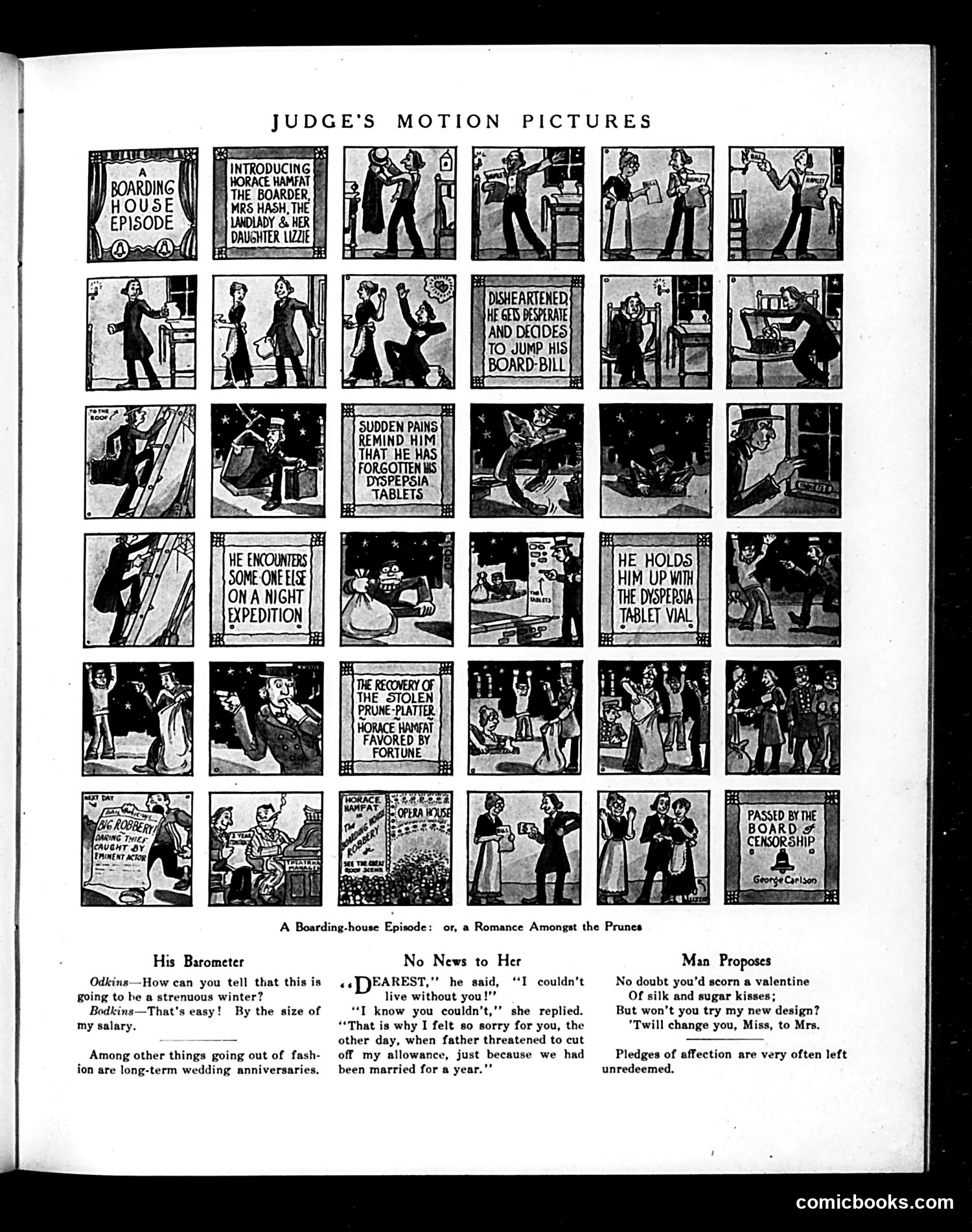
This page contains three separate comic vignettes satirizing early 20th-century marriage and economic anxieties: **"His Barometer"** mocks economic insecurity—a man judges winter's severity by his salary size, suggesting financial precarity. **"No News to Her"** depicts a cynical marriage where the wife reveals her husband depends entirely on her father's allowance. The satire suggests that romantic declarations ("I couldn't live without you") mask financial dependence, and that even a year of marriage hasn't changed this dynamic. **"Man Proposes"** plays on marriage proposals, with the closing observation that romantic promises ("pledges of affection") are frequently broken—a commentary on hollow courtship rituals. The strip at top, "A Boarding-house Episode," appears to involve mishaps among boarding-house residents, though specific plot details are unclear from the frames alone. Collectively, these pieces critique marriage as economically motivated rather than romantic, and mock both male economic vulnerability and the gap between courtship promises and married reality.
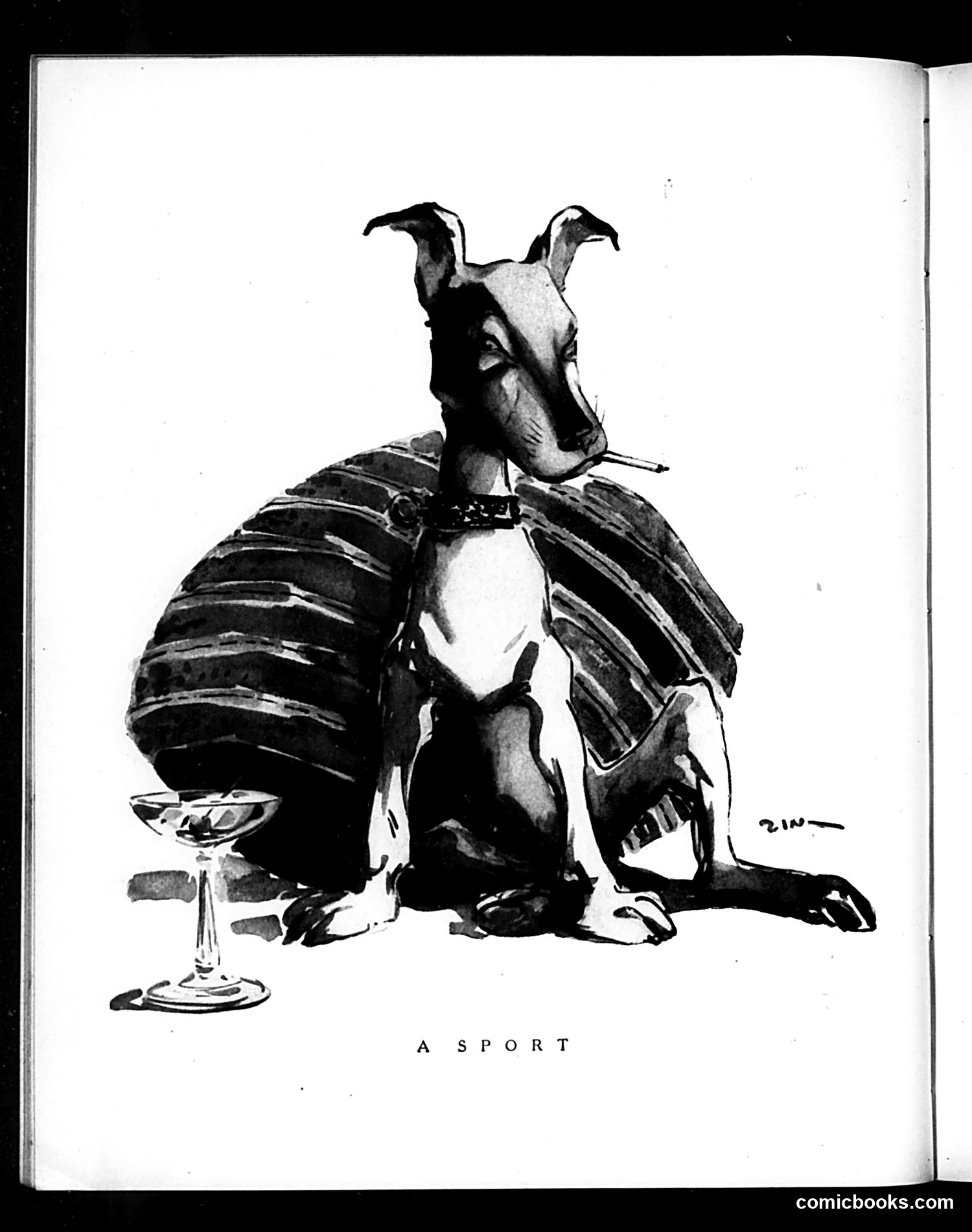
This black and white illustration depicts a dog dressed in formal attire—wearing a striped jacket and collar with a cigarette in its mouth—posed with a martini cocktail. The title "A Sport" is the sole text. The cartoon satirizes wealthy or upper-class leisure culture, using the dog as a caricature of a "sport"—slang for a flashy, dissolute man who frequents bars and pursues pleasure. By rendering this character as an animal in human clothing, the artist mocks the pretensions and absurdity of such lifestyle and behavior. The martini and cigarette emphasize indulgence and excess. This appears to be social satire targeting frivolous aristocratic or nouveau-riche behavior, likely from Judge's characteristic commentary on class and morality.
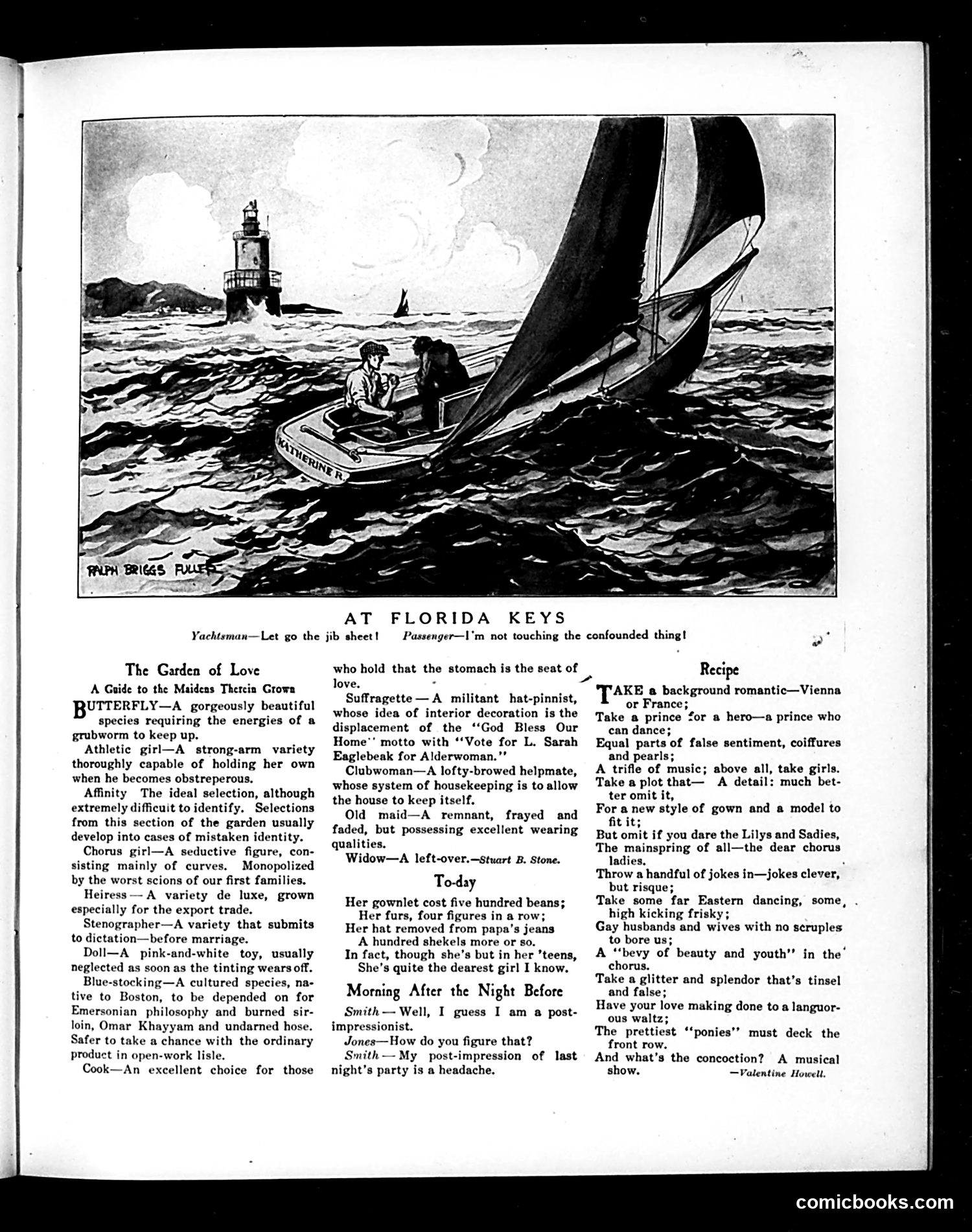
The page contains a satirical cartoon at top (by Ralph Briggs Fuller) showing a yacht at Florida Keys, with the joke being a passenger refusing to touch the jib sheet—a humorous misunderstanding of sailing terminology. Below is a comprehensive satirical "guide" to female types by Stuart B. Stone, mocking early 1900s attitudes toward women. Each entry ridicules stereotypes: the "Butterfly" (beautiful but helpless), "Chorus girl" (seductive, exploited), "Suffragette" (militant feminist—note the derisive "hat-pinnist" reference to hatpin-wielding activists), "Clubwoman" (negligent housewife), and "Old maid" (worthless). The "Cook" entry dismissively suggests choosing a woman based on culinary skills. The remaining items are brief comic anecdotes, including one about a "post-impressionist" headache after a party. The "Recipe" section parodies theatrical musical comedies, listing their formulaic ingredients: princes, false sentiment, chorus girls ("ponies"), risqué humor, and spectacle. The overall message satirizes both female stereotypes and contemporary entertainment conventions.
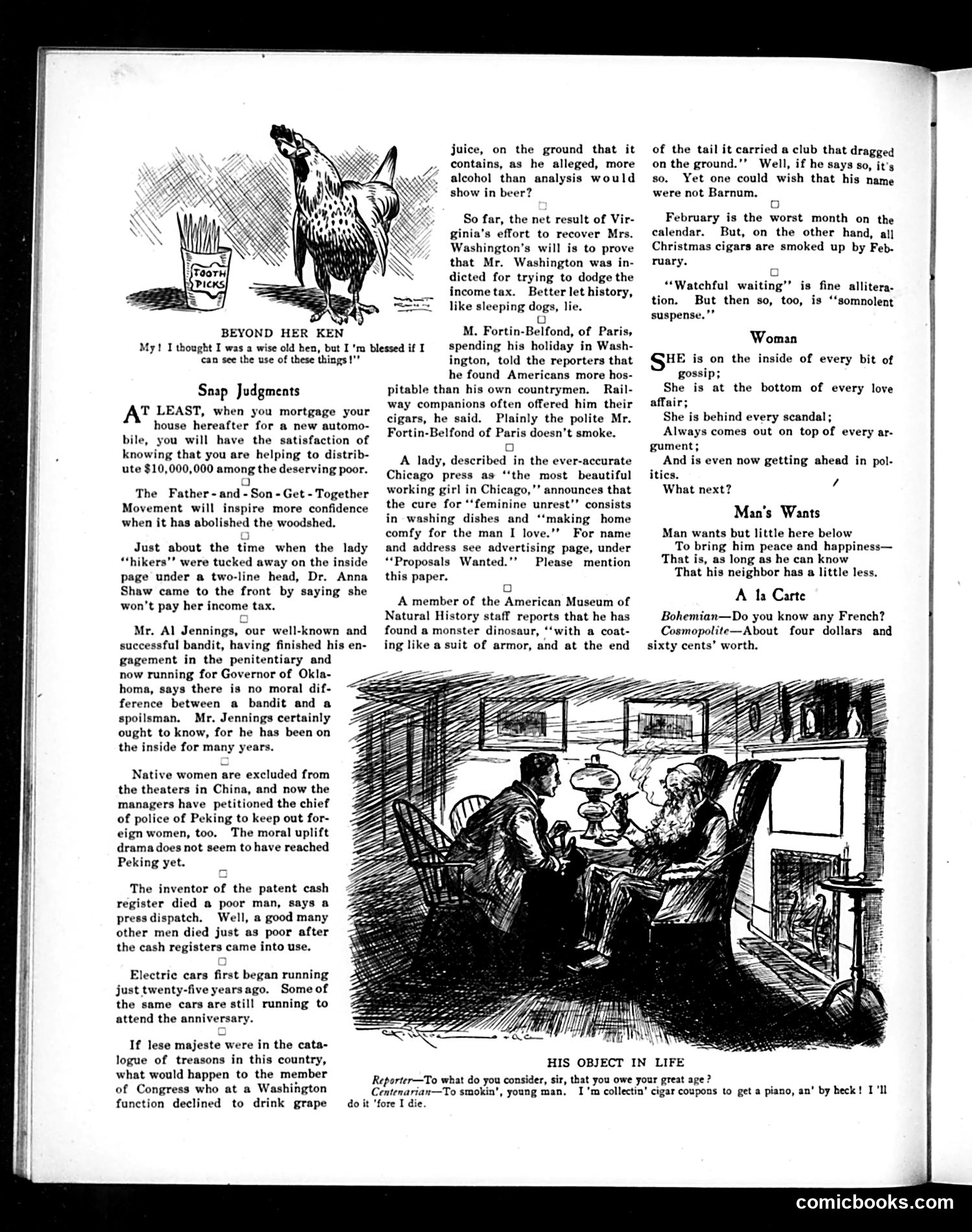
**Main Cartoon ("Beyond Her Ken"):** An elderly hen examines an automobile with bewilderment, captioned about not understanding "these things." This mocks early-20th-century resistance to automobiles, particularly among older generations and women unfamiliar with new technology. **"Snap Judgments" Section:** A series of brief satirical quips targeting contemporary figures and issues: - **Al Jennings reference**: A real former bandit running for Oklahoma Governor—the joke being his claim that bandits and politicians are morally equivalent - **Dr. Anna Shaw**: Likely the women's suffrage activist; the joke implies women's rights advocates are tax-resistant - **Dinosaur discovery "Barnum"**: Skeptical mockery of a museum scientist's sensational fossil claim, comparing him to P.T. Barnum (famous for hoaxes) - **Income tax evasion**: References Prohibition-era tensions around alcohol taxation **Lower sections** include humorous observations about women's roles, male desires for dominance, and satirical "translations" (a Frenchman's value reduced to currency). The overall tone reflects pre-WWI American anxieties about modernity, female empowerment, and tax policy.
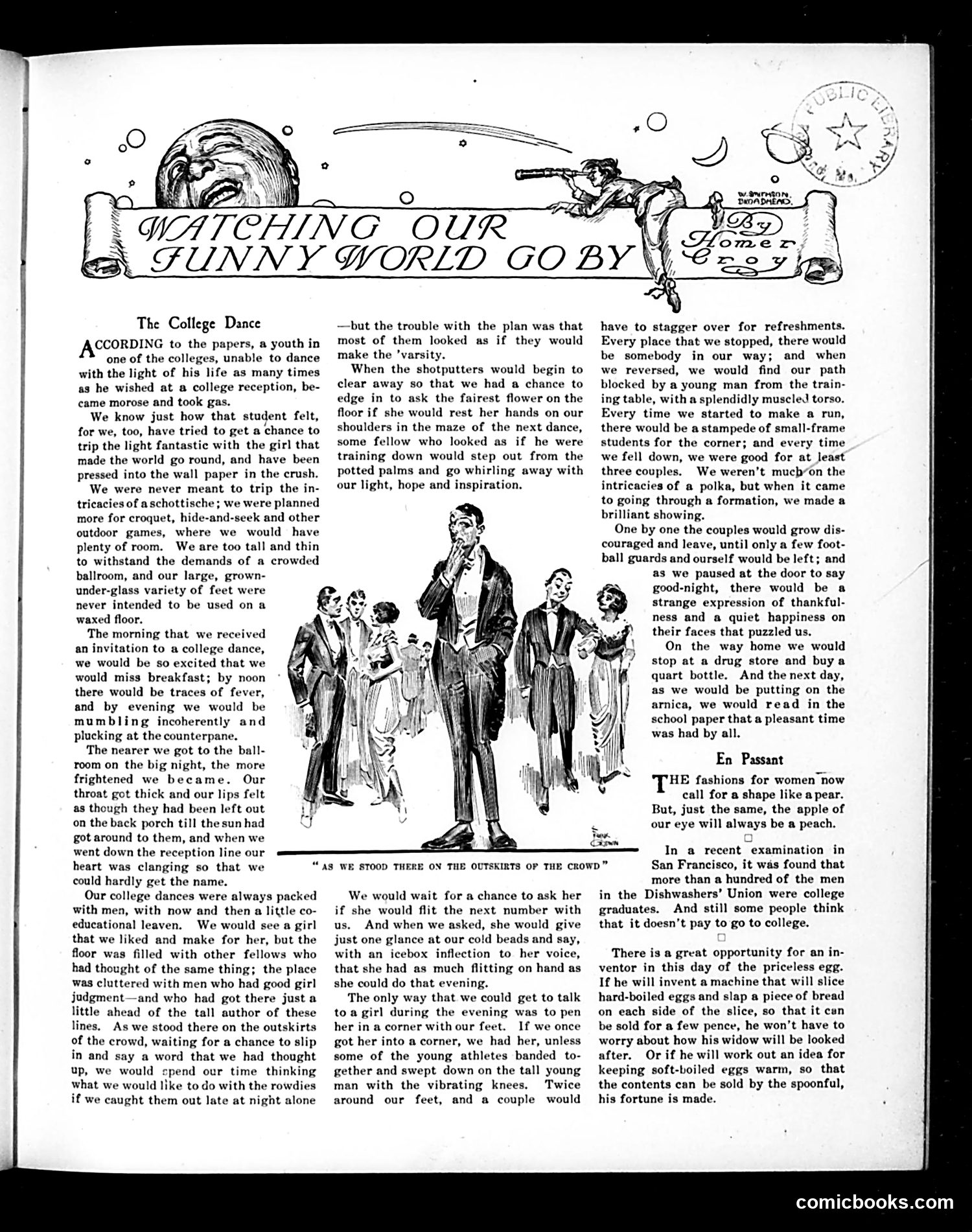
This humorous essay satirizes the awkwardness of tall, lanky men at crowded college dances in the early 20th century. The narrator (representing the magazine's male readership) laments being physically unsuited for ballroom dancing—too tall, too thin, with oversized feet designed for croquet, not waltzing. The satire targets the social hierarchy of college life: athletic "varsity" types monopolize the desirable female partners, while the narrator remains perpetually stuck on the ballroom's periphery. The piece mocks the intense anxiety surrounding courtship rituals, opening with a reference to a college student who reportedly became suicidal over dance-related romantic frustration. The accompanying illustration depicts a formal gathering where the narrator unsuccessfully navigates the social maze. The humor derives from self-deprecating realism about masculine inadequacy in romantic competition—the athletic, muscular men always claim the girls, leaving bashful, ungainly fellows to awkwardly corner their dance partners or contemplate revenge against their rivals.
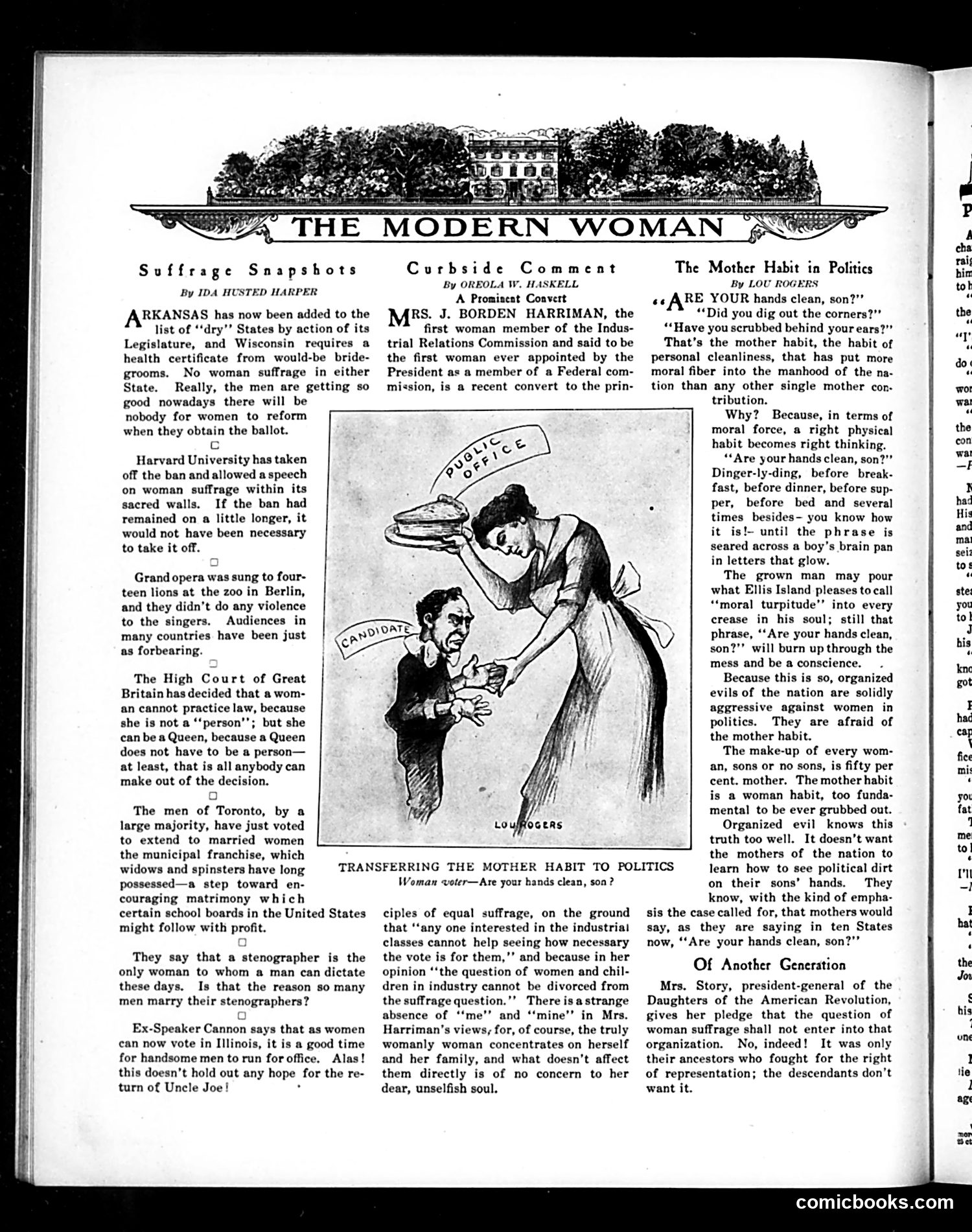
This Judge magazine page satirizes women's suffrage debates circa 1910s through three columns and a central cartoon. **The Cartoon:** Lou Rogers depicts a woman voter as a nagging mother, scrubbing a male politician's face with the caption "Are your hands clean, son?" The satire attacks anti-suffrage arguments: Rogers argues that the "mother habit"—instilling moral cleanliness and conscience—is women's greatest civilizing force. By opposing women's political participation, organized evil fears mothers will apply this moral scrutiny to politics itself. **Context:** The surrounding "Suffrage Snapshots" column by Ida Husted Harper reports state-level suffrage victories (Arkansas, Wisconsin) and legal absurdities (British courts denying women lawyers as non-"persons" while accepting queens). **The Point:** Rogers defends women's suffrage by reframing motherhood not as disqualifying women from politics, but as precisely what politics needs—maternal moral oversight—directly countering contemporary claims that political participation violated women's natural domestic role.
This page contains several short humorous anecdotes reflecting early 20th-century racial attitudes, plus period advertisements. **The Cartoons/Stories:** The three main jokes use racist dialect and stereotypes typical of the era: - A Black man accused of stealing chickens refuses a court-appointed lawyer, wanting to enjoy the stolen chickens himself - A Black laborer, widowed seven years, tells his employer he needs "a rest" before remarrying - A white child learns that punishment after dinner is better than before **Social Context:** These jokes rely on dehumanizing caricatures and dialect-heavy speech common in early Judge magazine, reflecting widespread racial prejudice of the period. The humor punches down at Black Americans, portraying them as morally questionable or simple-minded. **Advertisements:** The page also shows period ads: Apollinaris bottled water, Hotel Earlington, and dubious patent medicines ("20th Century Wonder"), typical of Judge's revenue sources. Modern readers should understand this represents discarded attitudes—the page documents historical racism rather than endorsing it.
This page is primarily **advertisements and humor filler**, not political satire. The central content features "With The College Wits"—brief, disconnected jokes about marriage, religion, prison, and social situations. These appear designed as light magazine fodder for educated readers. The humor is genteel and topical rather than satirical: a husband congratulating other homes over his wife's; a child's punny misunderstanding of Eve's sin; a prisoner claiming hypnosis rather than accepting stoicism about incarceration. Surrounding the jokes are product advertisements typical of era magazines—hair tonic, foot powder, bookcases, soap, hotels—targeting middle-class consumers. The cartoons showing two identical dancing figures accompany the "waived rights" legal term joke but lack political meaning; they're decorative. This represents Judge's lighter editorial content between its more pointed satirical pieces.
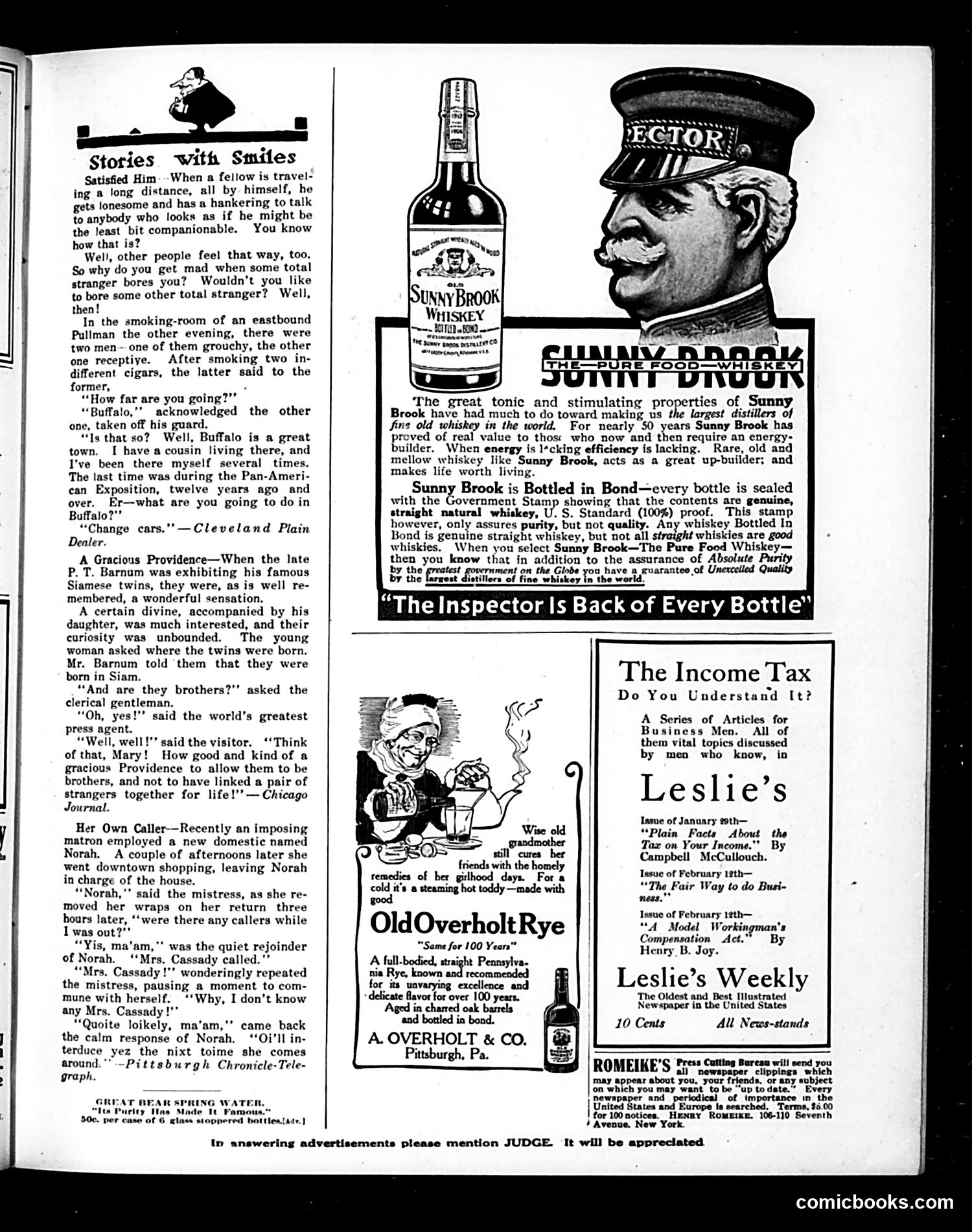
This page primarily contains **humorous anecdotes** and **advertisements** rather than political cartoons. The three short stories mock social awkwardness: a boring train passenger who won't stop talking, P.T. Barnum's clever response to a naïve clergyman asking if Siamese twins are "brothers" (implying surprise they weren't strangers), and an Irish maid named Norah who casually reveals an unknown "Mrs. Cassady" visited—implying she either made up the visitor or misunderstood. The **visual cartoons** are minimal—mainly decorative mastheads and an advertisement featuring an "Inspector" character for Old Overholt Rye whiskey (emphasizing government quality control) and Sunny Brook Whiskey. A small illustration shows an old grandmother figure with Old Overholt Rye. The page reflects early-1900s American humor emphasizing class differences, ethnic stereotypes (Irish dialect), and gentle social satire. The income tax advertisement references recent U.S. tax legislation, making this post-1913.
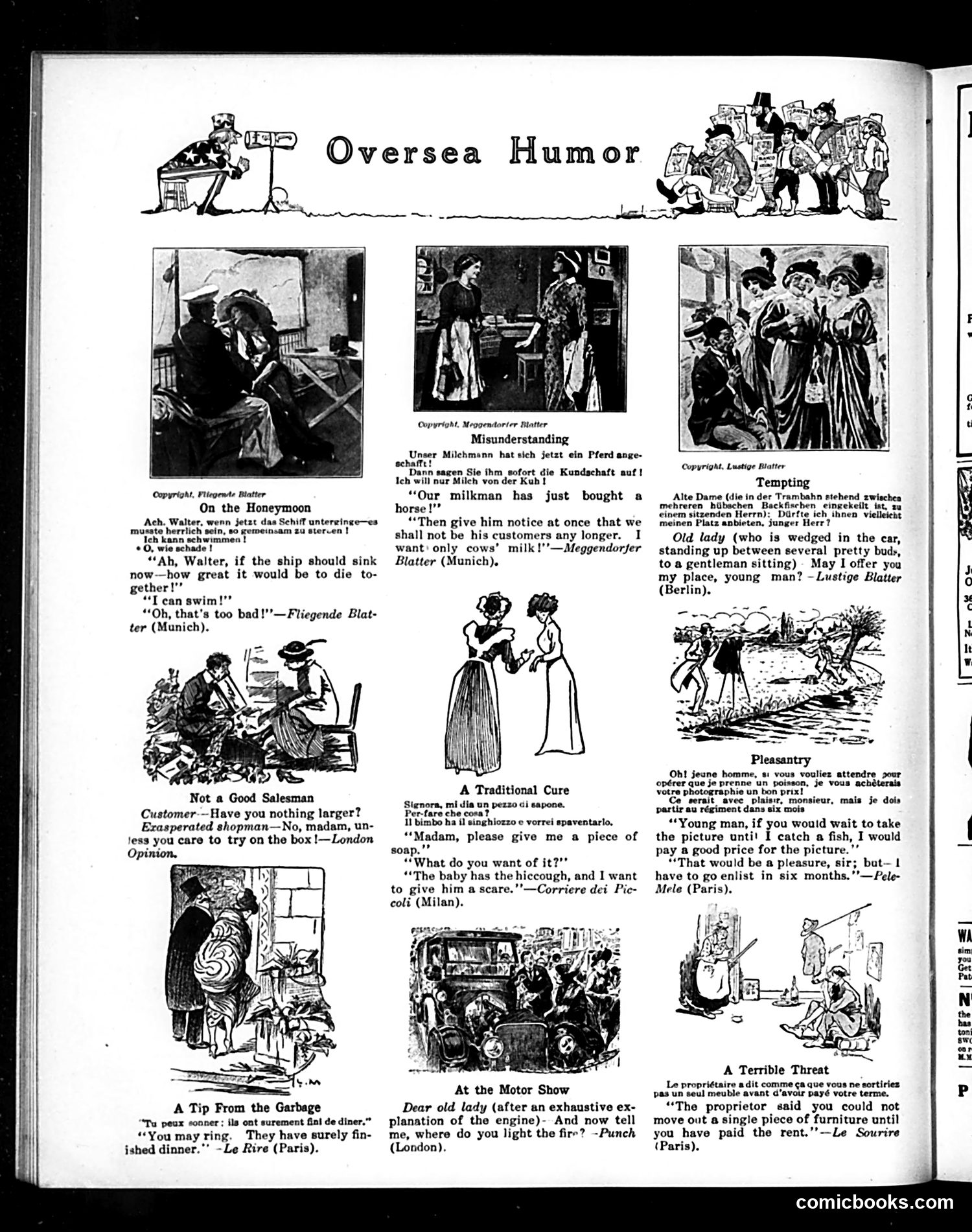
This page collects humorous cartoons from European publications (Munich, Milan, Paris, Berlin, London), showcasing period comedy about everyday life. The jokes target recognizable social situations: a newlywed wife's dark humor about shipwrecks; a shopper frustrated by limited sizes; a milkman's career change alarming customers who distrust non-cow milk; elderly confusion about automobile engines; working-class housing disputes. The satirical edge is gentle—mocking human absurdities rather than specific political figures. Notable recurring themes include class dynamics (servants, shopkeepers, landlords), gender relations, and the disruption caused by modern technology (automobiles, motors). The page's multilingual nature reflects Judge's educated, cosmopolitan readership, celebrating how similar human folly transcends borders. These aren't sophisticated political cartoons but rather observational humor about domestic life, social anxieties, and the gap between expectations and reality.
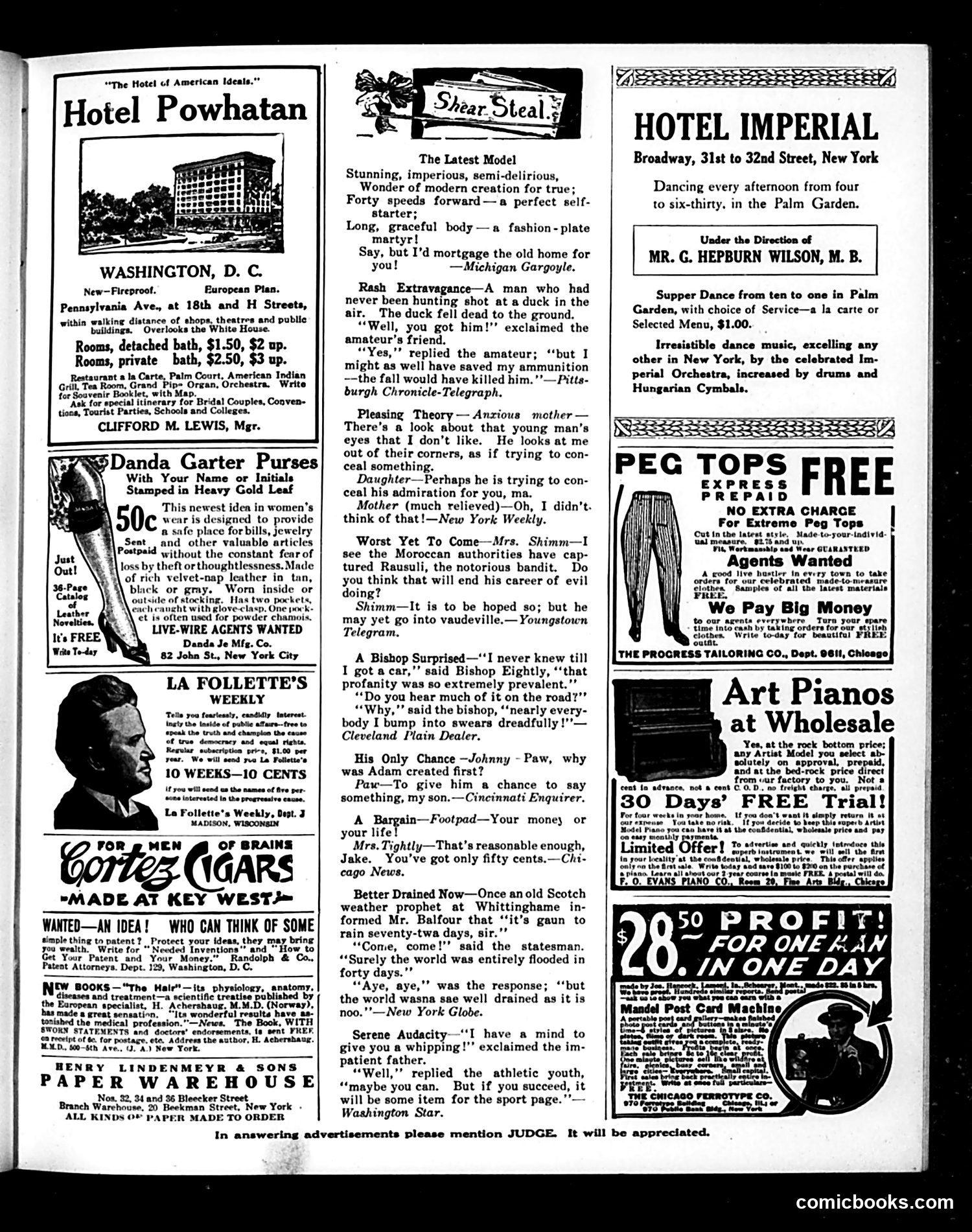
This page is primarily **advertising and humor content**, not political cartoons. The page features: **Advertisements** for hotels (Powhatan in Washington D.C., Imperial in New York), women's accessories (Danda Carter Purses), and various products and services typical of the era. **Humorous anecdotes** in a "Shear Steal" section, including: - A joke about a car ("The Latest Model") described in flowery language - "Rash Extravagance"—a hunting story mocking an amateur who kills a duck but credits his poor aim rather than luck - "Pleasing Theory"—a mother worried about a young man's suspicious glance, relieved when her daughter suggests he's hiding admiration **Progressive political content**: La Follette's Weekly advertisement promoting democratic causes and truth-telling in public affairs. The humor is gentle domestic/social comedy rather than biting satire. The page reflects early 20th-century advertising aesthetics and concerns (women's safety, courtship anxieties, automotive novelty).
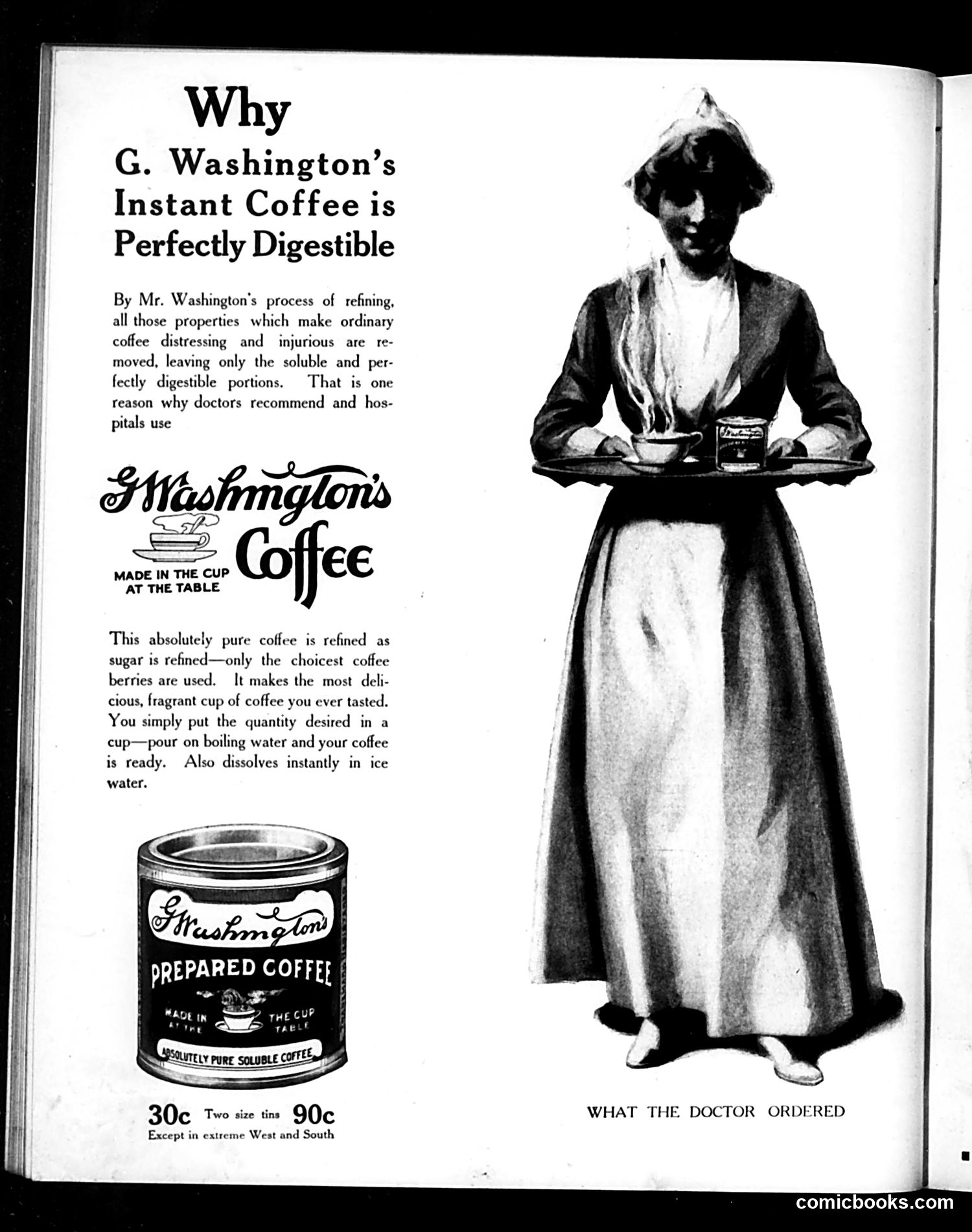
This is a **product advertisement**, not political satire. It promotes G. Washington's instant coffee, a real brand from the early 20th century. The page uses the rhetoric of medical authority to sell coffee. The ad claims the product is "perfectly digestible" because Mr. Washington's refining process removes harmful properties, leaving only soluble portions. It emphasizes doctors' recommendations and hospital use—positioning instant coffee as health-conscious rather than a luxury indulgence. The illustration labeled "WHAT THE DOCTOR ORDERED" shows a woman servant presenting the coffee, reinforcing the medical/health angle. The phrase suggests doctors would prescribe this product. This reflects early-1900s advertising strategy: marketing consumer goods through pseudoscientific health claims and professional endorsements. Modern readers might find it ironic that coffee was marketed primarily as medicinal and digestible, when today we emphasize caffeine content and taste.