
Judge, 1914-01-31 · page 8 of 24
Judge — January 31, 1914 — page 8: what you’re looking at
What you’re looking at
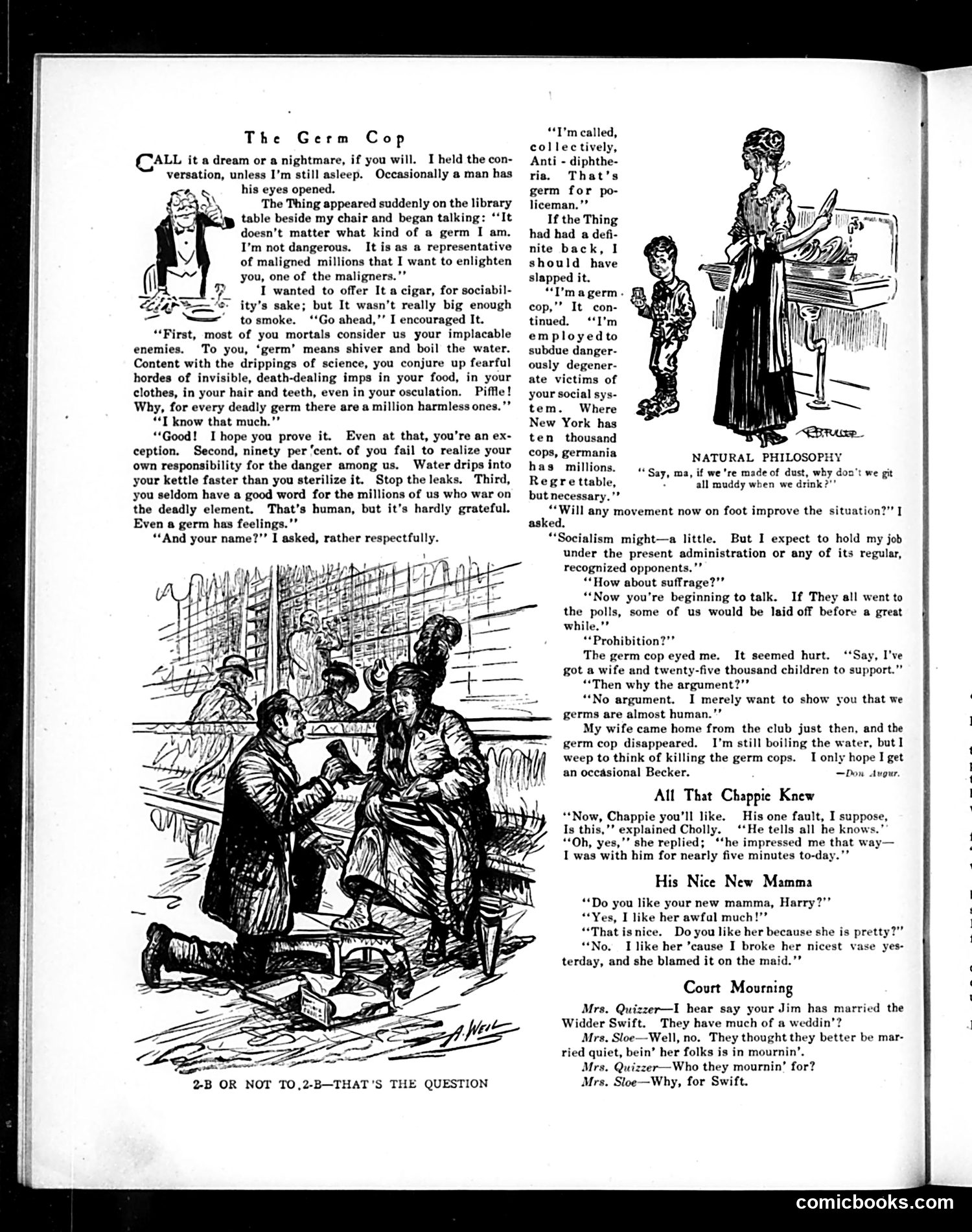
This satirical story presents a personified anti-diphtheria bacterium as a "germ cop"—a protective microorganism that argues germs deserve respect. The satire targets progressive-era anxieties about germ theory and public health. The germ makes three arguments: (1) humans unfairly demonize all germs despite many being harmless; (2) humans bear responsibility for unsanitary conditions; (3) beneficial germs receive no gratitude. The piece's real target is socialism and women's suffrage. The germ cop claims socialism might help but expects job security under any administration. When asked about suffrage, it warns that women voting would reduce the "need" for germs by improving social conditions—suggesting Judge's editors opposed both reform movements. The accompanying humor pieces are unrelated short jokes about children, remarriage, and a child's logical question about drinking water. The cartoon's political message is unmistakable: progressive reforms are unnecessary and threatening to the status quo.
📄 Transcribed text from this page (OCR, searchable)
Machine-transcribed from the original scan — historical spelling and the odd misread are preserved.
The Germ Cop ‘ALL it a dream or a nightmare, if you will. I held the con- versation, unless I’m still asleep. Occasionally a man has his eyes opened. The Thing appeared suddenly on the library table beside my chair and began talking: ‘‘It doesn’t matter what kind of a germ I am. I’m not dangerous. It is as a representative of maligned millions that I want to enlighten you, one of the maligners.’’ I wanted to offer It a cigar, for sociabil- ity’s sake; but It wasn’t really big enough to smoke. ‘‘Go ahead,’’ I encouraged It. “First, most of you mortals consider us your implacable enemies. To you, ‘germ’ means shiver and boil the water. Content with the drippings of science, you conjure up fearful hordes of invisible, death-dealing imps in your food, in your clothes, in your hair and teeth, even in your osculation. Piffle! Why, for every deadly germ there are a million harmless ones."’ “I know that much." “Good! I hope you prove it. Even at that, you’re an ex- ception. Second, ninety per ‘cent. of you fail to realize your own responsibility for the danger among us. Water drips into your kettle faster than you sterilize it. Stop the leaks. Third, you seldom have a good word for the millions of us who war on the deadly element. That’s human, but it’s hardly grateful. Even a germ has feelings.’’ “And your name?”’ I asked, rather respectfully. 2B OR NOT TO,2-B—THAT'S THE QUESTION “I'm called, collectively, Anti - diphthe- ria. That’s germ for po- liceman.”” If the Thing had had a defi- nite back, I should have slapped it. “’magerm. cop,’’ It con- tinued. ‘I'm employedto subdue danger- ously degener- ate victims of your social sys- tem. Where New York has ten thousand cops, germania has_ millions. Regrettable, but necessary.’’ “Will any movement now on foot improve the situation?” I asked, “Socialism might—a little. But I expect to hold my job under the present administration or any of its regular, recognized opponents. ’” “‘How about suffrage?’ “Now you're beginning to talk. If They all went to the polls, some of us would be laid off before a great while.”’ “*Prohibition?’’ The germ cop eyed me. It seemed hurt. ‘‘Say, I've got a wife and twenty-five thousand children to support.” “Then why the argument?”’ “‘No argument. I merely want to show you that we germs are almost human.’’ My wife came home from the club just then, and the germ cop disappeared. I'm still boiling the water, but I weep to think of killing the germ cops. I only hope I get an occasional Becker. All That Chappie Knew **Now, Chappie you'll like. His one fault, I suppose, Is this,’’ explained Cholly. ‘*He tells all he knows. “Oh, yes,’’ she replied; “he impressed me that way— I was with him for nearly five minutes to-day.”’ His Nice New Mamma “Do you like your new mamma, Harry?’’ “Yes, I like her awfal much!”” “That isnice. Do you like her because she is pretty?” “No. I like her ’cause I broke her nicest vase yes- terday, and she blamed it on the maid.’’ Court Mourning Mrs. Quizzer—I hear say your Jim has married the Widder Swift. They have much of a weddin’? Mrs, Sloe—Well, no. They thought they better be mar- ried quiet, bein’ her folks is in mournin’. Mrs. Quizzer—Who they mournin’ for? Mrs. Sloe—Why, for Swift. NATURAL PHILOSOPHY “ Say, ma, if we 're made of dust, why don't we git ~ "all muddy when we drink ?”” —Don Avour. comicbooks.com