
Judge, 1914-01-31 · page 5 of 24
Judge — January 31, 1914 — page 5: what you’re looking at
What you’re looking at
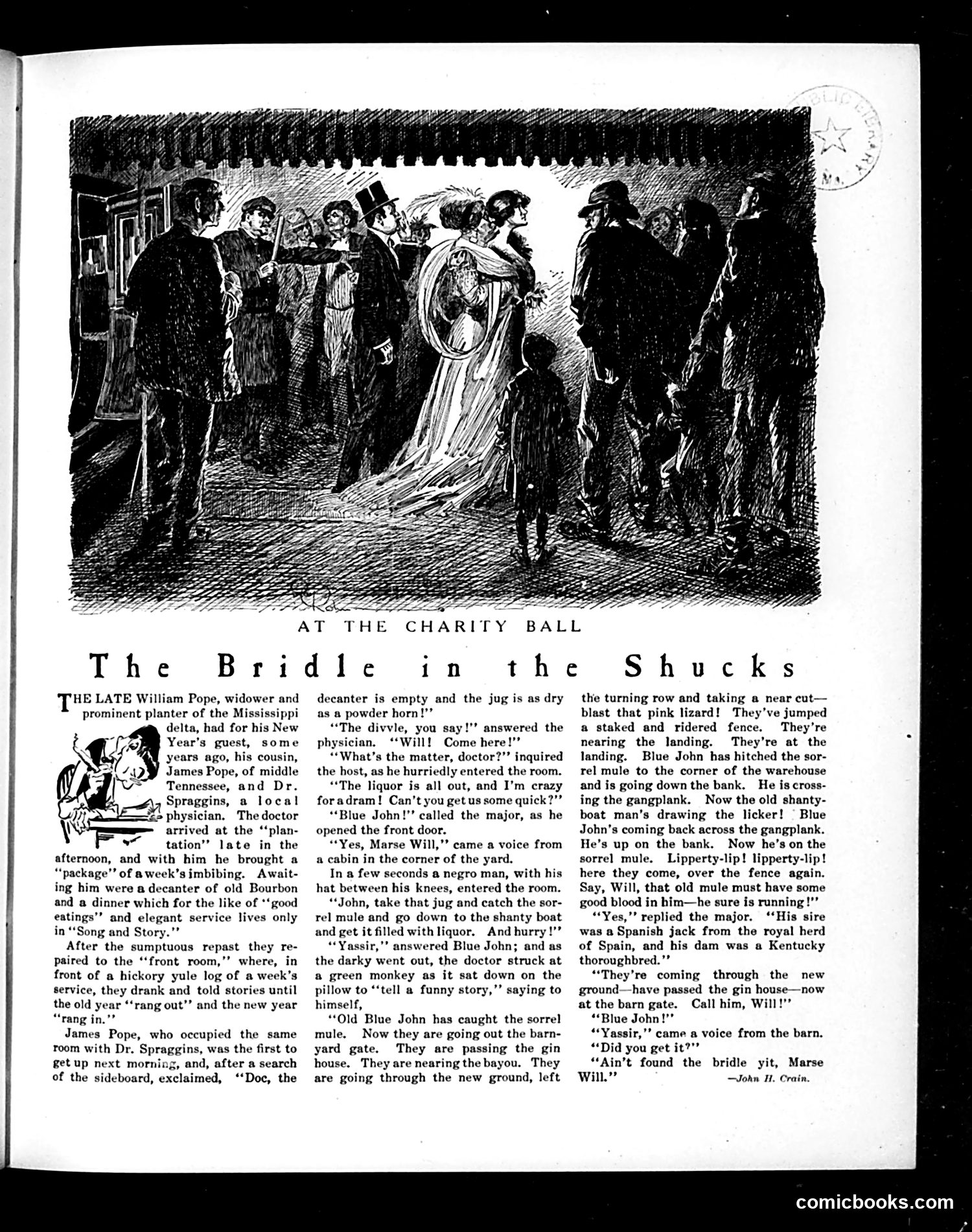
This humorous short story, illustrated at top, satirizes the chaos of a charity ball among wealthy socialites. The narrative mocks the pretensions of "prominent planter of the Mississippi delta" William Pope and his nouveau riche relatives, who become intoxicated and increasingly unruly. The satire centers on their loss of genteel composure: guests drink excessively, servants chase livestock (a sorrel mule and blue jay), and the refined ball descends into barnyard pandemonium. The title's metaphor—"bridle in the shucks"—suggests attempting to maintain control in rustic, unsuitable circumstances. The piece ridicules both the aspirations of wealthy Southerners and their inability to maintain proper decorum when alcohol is involved, presenting them as fundamentally coarse despite their pretensions.
📄 Transcribed text from this page (OCR, searchable)
Machine-transcribed from the original scan — historical spelling and the odd misread are preserved.
The HE LATE William Pope, widower and prominent planter of the Mississippi delta, had for his New Year’s guest, some years ago, his cousin, James Pope, of middle Tennessee, and Dr. Spraggins, a local 2 physician. The doctor arrived at the ‘‘plan- tation’’ late in the afternoon, and with him he brought a “package’’ of aweek’s imbibing. Await- ing him were a decanter of old Bourbon and a dinner which for the like of *‘good eatings’” and elegant service lives only in “Song and Story.”” After the sumptuous repast they re- Paired to the “‘front room,’’ where, in front of a hickory yule log of a week’s service, they drank and told stories until the old year ‘‘rang out” and the new year “rang in.’’ James Pope, who occupied the same room with Dr. Spraggins, was the first to getup next morning, and, after a search of the sideboard, exclaimed, ‘‘Doc, the Bridle in the decanter is empty and the jug is as dry as a powder horn!"” “The divvle, you say!"’ answered the physician. ‘Will! Come here!” “‘What’s the matter, doctor?’’ inquired the host, as he hurriedly entered the room. “The liquor is all out, and I’m crazy foradram! Can’t you get us some quick?’ “Blue John!’ called the major, as he opened the front door. “Yes, Marse Will,’? came a voice from a cabin in the corner of the yard. In a few seconds a negro man, with his hat between his knees, entered the room. “John, take that jug and catch the sor- rel mule and go down to the shanty boat and get it filled with liquor. And burry !’? “Yassir,’’ answered Blue John; and as the darky went out, the doctor struck at a green monkey as it sat down on the pillow to ‘‘tell a funny story,”’ saying to himself, “Old Blue John has caught the sorrel mule. Now they are going out the barn- yard gate. They are passing the gin house. They are nearing the bayou. They are going through the new ground, left Shucks the turning row and taking a near cut— blast that pink lizard! They’ve jumped a staked and ridered fence. They’re nearing the landing. They’re at the landing. Blue John has hitched the sor- rel mule to the corner of the warehouse and is going down the bank. He is cross- ing the gangplank. Now the old shanty- boat man’s drawing the licker! " Blue John's coming back across the gangplank. He’s up on the bank. Now he’s on the sorrel mule. Lipperty-lip! lipperty-lip! here they come, over the fence again. Say, Will, that old mule must have some good blood in him—he sure is running!’’ “Yes,’’ replied the major. ‘‘His sire was a Spanish jack from the royal herd of Spain, and his dam was a Kentucky thoroughbred.’’ “They’re coming through the new ground—have passed the gin house—now at the barn gate. Call him, Will!’’ “Blue John!"" “Yassir,’’ came a voice from the barn. “Did you get it?” “‘Ain’t found the bridle yit, Marse Will.” John H. Crain. comicbooks.com