
Judge, 1914-01-31 · page 7 of 24
Judge — January 31, 1914 — page 7: what you’re looking at
What you’re looking at
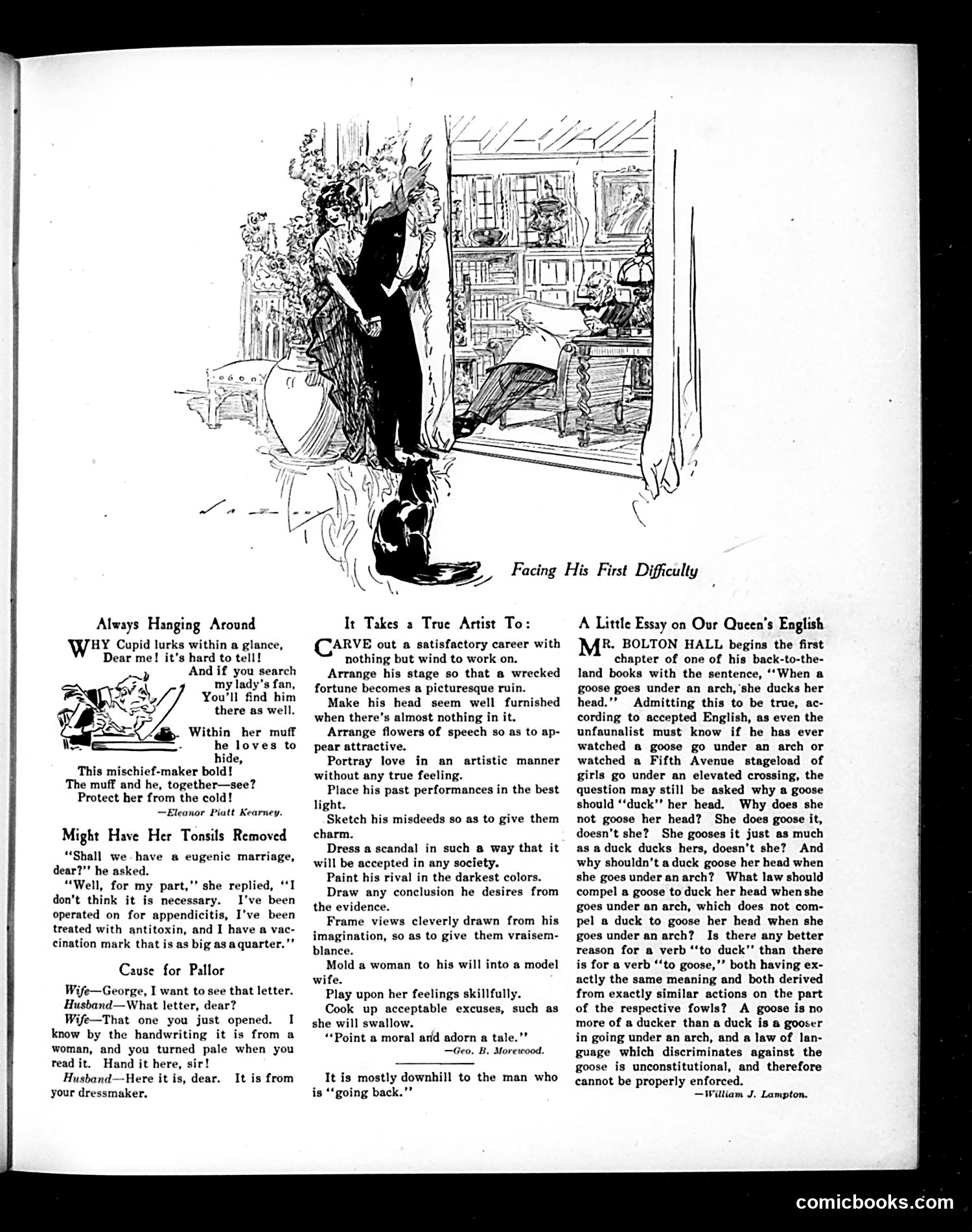
This page contains three unrelated humorous pieces typical of early 20th-century satirical journalism: **"Always Hanging Around"** and **"Might Have Her Tonsils Removed"** are brief romantic/domestic humor pieces with no particular political content—just jokes about courtship and marriage anxieties. **"It Takes a True Artist To"** satirizes theatrical performers and con artists, listing dishonest practices (fabricating evidence, manipulating women, hiding scandals) as skills required for a "successful" career. This reflects period skepticism toward theater and entertainment professionals. **"A Little Essay on Our Queen's English"** is linguistic satire by William J. Lampton. It humorously argues that English is illogical: if geese legitimately "duck" under arches, why can't ducks "goose"? The piece absurdly invokes constitutional law to mock arbitrary grammar rules, playing on progressive-era debates about standardization and authority. None addresses specific political events or figures—all represent general social satire and wordplay characteristic of Judge's style.
📄 Transcribed text from this page (OCR, searchable)
Machine-transcribed from the original scan — historical spelling and the odd misread are preserved.
Always Hanging Around Ww Cupid lurks within a glance, Dear me! it’s hard to tell! And if you search my lady’s fan, You'll find him there as well. Within her muff he loves to hide, This mischief-maker bold! The muff and he, together—see? Protect her from the cold! —Eleanor Piatt Kearney. Might Have Her Tonsils Removed “Shall we have a eugenic marriage, dear?”’ he asked. “Well, for my part,’’ she replied, ‘‘I don’t think it is necessary. I’ve been operated on for appendicitis, I’ve been treated with antitoxin, and I have a vac- cination mark that is as big as aquarter.’’ Cause for Pallor Wife—George, I want to see that letter. Husband—What letter, dear? Wife—That one you just opened. I know by the handwriting it is from a woman, and you turned pale when you read it. Hand it here, sir! Husband—Here it is, dear. your dressmaker. It is from Facing His First Difficulty It Takes a True Artist To: CARVE out a satisfactory career with nothing but wind to work on. Arrange his stage so that a wrecked fortune becomes a picturesque ruin. Make his head seem well furnished when there’s almost nothing in it. Arrange flowers of speech so as to ap- pear attractive. Portray love in an artistic manner without any true feeling. Place his past performances in the best light. Sketch his misdeeds so as to give them charm. Dress a scandal in such a way that it will be accepted in any society. Paint his rival in the darkest colors. Draw any conclusion he desires from the evidence. Frame views cleverly drawn from his imagination, so as to give them vraisem- blance. Mold a woman to his will into a model wife. Play upon her feelings skillfully. Cook up acceptable excuses, such as she will swallow. “‘Point a moral and adorn a tale.’” —Geo. B. Morewood. It is mostly downhill to the man who is ‘‘going back.”’ A Little Essay on Our Queen’s English R. BOLTON HALL begins the first chapter of one of his back-to-the- land books with the sentence, ‘‘When a goose goes under an arch, ‘she ducks her head.’’ Admitting this to be true, ac- cording to accepted English, as even the unfaunalist must know if he has ever watched a goose go under an arch or watched a Fifth Avenue stageload of girls go under an elevated crossing, the question may still be asked why a goose should ‘‘duck’’ her head. Why does she not goose her head? She does goose it, doesn’t she? She gooses it just as much as a duck ducks hers, doesn’t she? And why shouldn’t a duck goose her head when she goes underanarch? What law should compel a goose to duck her head when she goes under an arch, which does not com- pel a duck to goose her head when she goes under an arch? Is there any better reason for a verb ‘‘to duck’’ than there is for a verb ‘‘to goose,’’ both having ex- actly the same meaning and both derived from exactly similar actions on the part of the respective fowls? A goose is no more of a ducker than a duck is @ gooser in going under an arch, and a law of lan- guage which discriminates against the goose is unconstitutional, and therefore cannot be properly enforced. —William J. Lampton, comicbooks.com