
Judge, 1914-01-31 · page 17 of 24
Judge — January 31, 1914 — page 17: what you’re looking at
What you’re looking at
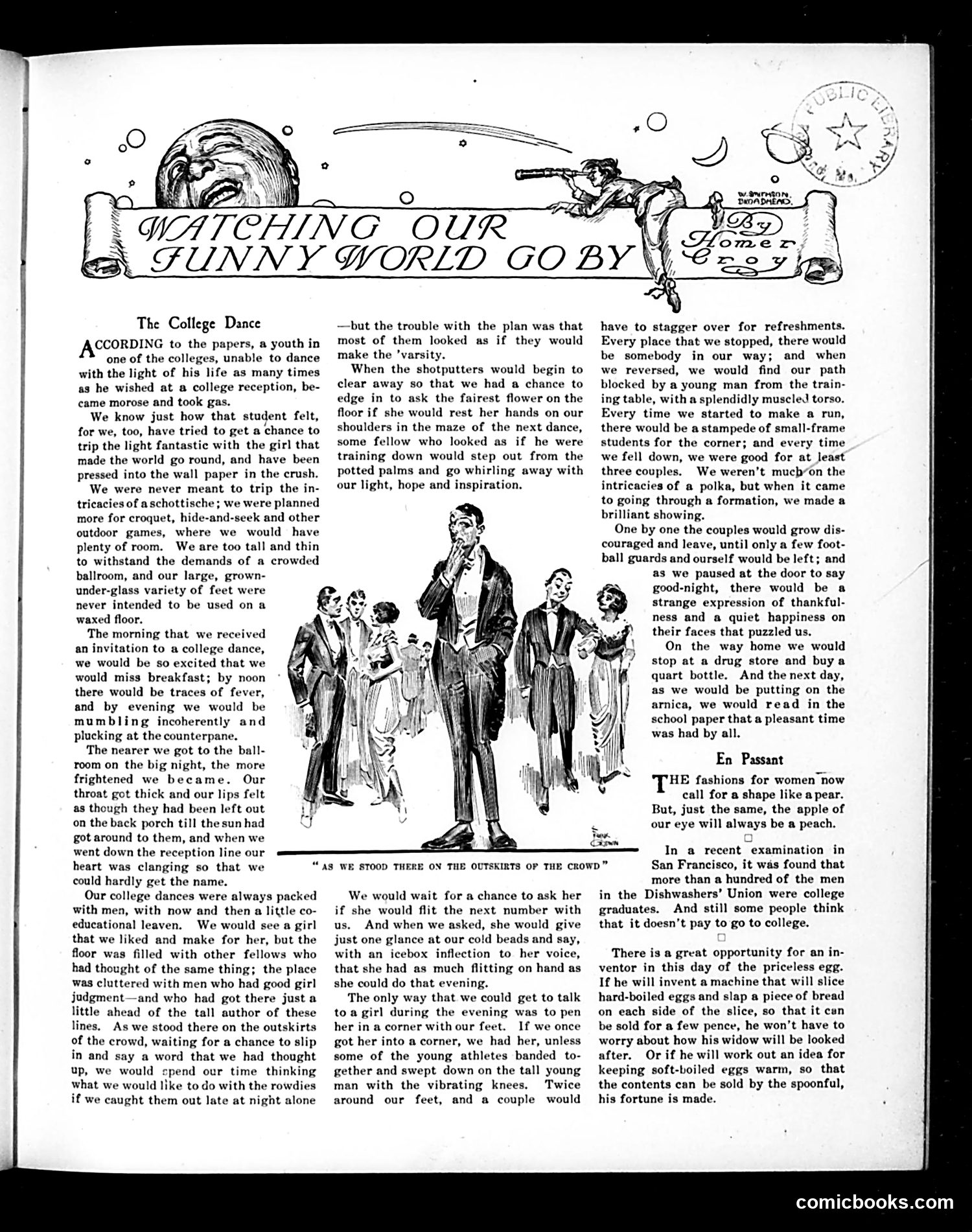
This humorous essay satirizes the awkwardness of tall, lanky men at crowded college dances in the early 20th century. The narrator (representing the magazine's male readership) laments being physically unsuited for ballroom dancing—too tall, too thin, with oversized feet designed for croquet, not waltzing. The satire targets the social hierarchy of college life: athletic "varsity" types monopolize the desirable female partners, while the narrator remains perpetually stuck on the ballroom's periphery. The piece mocks the intense anxiety surrounding courtship rituals, opening with a reference to a college student who reportedly became suicidal over dance-related romantic frustration. The accompanying illustration depicts a formal gathering where the narrator unsuccessfully navigates the social maze. The humor derives from self-deprecating realism about masculine inadequacy in romantic competition—the athletic, muscular men always claim the girls, leaving bashful, ungainly fellows to awkwardly corner their dance partners or contemplate revenge against their rivals.
📄 Transcribed text from this page (OCR, searchable)
Machine-transcribed from the original scan — historical spelling and the odd misread are preserved.
The College Dance ACCORDING to the papers, a youth in one of the colleges, unable to dance with the light of his life as many times as he wished at a college reception, be- came morose and took gas. We know just how that student felt, for we, too, have tried to get a chance to trip the light fantastic with the girl that made the world go round, and have been pressed into the wall paper in the crush. We were never meant to trip the in- tricacies of aschottische; we were planned more for croquet, hide-and-seek and other outdoor games, where we would have plenty of room. We are too tall and thin to withstand the demands of a crowded ballroom, and our large, grown- under-glass variety of feet were never intended to be used on a waxed floor. The morning that we received an invitation to a college dance, we would be so excited that we would miss breakfast; by noon there would be traces of fever, and by evening we would be mumbling incoherently and plucking at the counterpane. The nearer we got to the ball- room on the big night, the more frightened we became. Our throat got thick and our lips felt as though they had been left out on the back porch till the sun had got around to them, and when we went down the reception line our heart was clanging so that we could hardly get the name. Our college dances were always packed with men, with now and then a little co- educational leaven. We would see a girl that we liked and make for her, but the floor was filled with other fellows who had thought of the same thing; the place was cluttered with men who had good girl judgment—and who had got there just a little ahead of the tall author of thi lines, As we stood there on the outs! of the crowd, waiting for a chance to slip in and say a word that we had thought up, we would cpend our time thinking what we would like to do with the rowdies if we caught them out late at night alone —but the trouble with the plan was that most of them looked as if they would make the ’varsity. When the shotputters would begin to clear away so that we had a chance to edge in to ask the fairest flower on the floor if she would rest her hands on our shoulders in the maze of the next dance, some fellow who looked as if he were training down would step out from the potted palms and go whirling away with our light, hope and inspiration. We would wait for a chance to ask her if she would flit the next number with us. And when we asked, she would give just one glance at our co!d beads and say, with an icebox inflection to her voice, that she had as much flitting on hand as she could do that evening. The only way that we could get to talk toa girl during the evening was to pen her in a corner with our feet. If we once got her into a corner, we had her, unless some of the young athletes banded to- gether and swept down on the tall young man with the vibrating knees. Twice around our feet, and a couple would o ‘eG mo L f i have to stagger over for refreshments. Every place that we stopped, there would be somebody in our way; and when we reversed, we would find our path blocked by a young man from the train- ing table, with a splendidly muscled torso. Every time we started to make a run, there would be a stampede of small-frame students for the corner; and every time we fell down, we were good for at least three couples. We weren’t mucb/on the intricacies of a polka, but when it came to going through a formation, we made a brilliant showing. One by one the couples would grow dis- couraged and leave, until only a few foot- ball guards and ourself would be left; and as we paused at the door to say good-night, there would be a strange expression of thankful- ness and a quiet happiness on their faces that puzzled us. On the way home we would stop at a drug store and buy a quart bottle. And the next day, as we would be putting on the arnica, we would read in the school paper that a pleasant time was had by all. En Passant HE fashions for women now call for a shape like a pear. But, just the same, the apple of our eye will always be a peach. In a recent examination in San Francisco, it was found that more than a hundred of the men in the Dishwashers’ Union were college graduates. And still some people think that it doesn’t pay to go to college. There is a great opportunity for an in- ventor in this day of the priceless egg. If he will invent a machine that will slice hard-boiled eggs and slap a piece of bread on each side of the slice, so that it cun be sold for a few pence, he won't have to worry about how his widow will be looked after. Or if he will work out an idea for keeping soft-boiled eggs warm, so that the contents can be sold by the spoonful, his fortune is made. comicbooks.com