
A complete issue · 24 pages · 1914
Judge — January 3, 1914
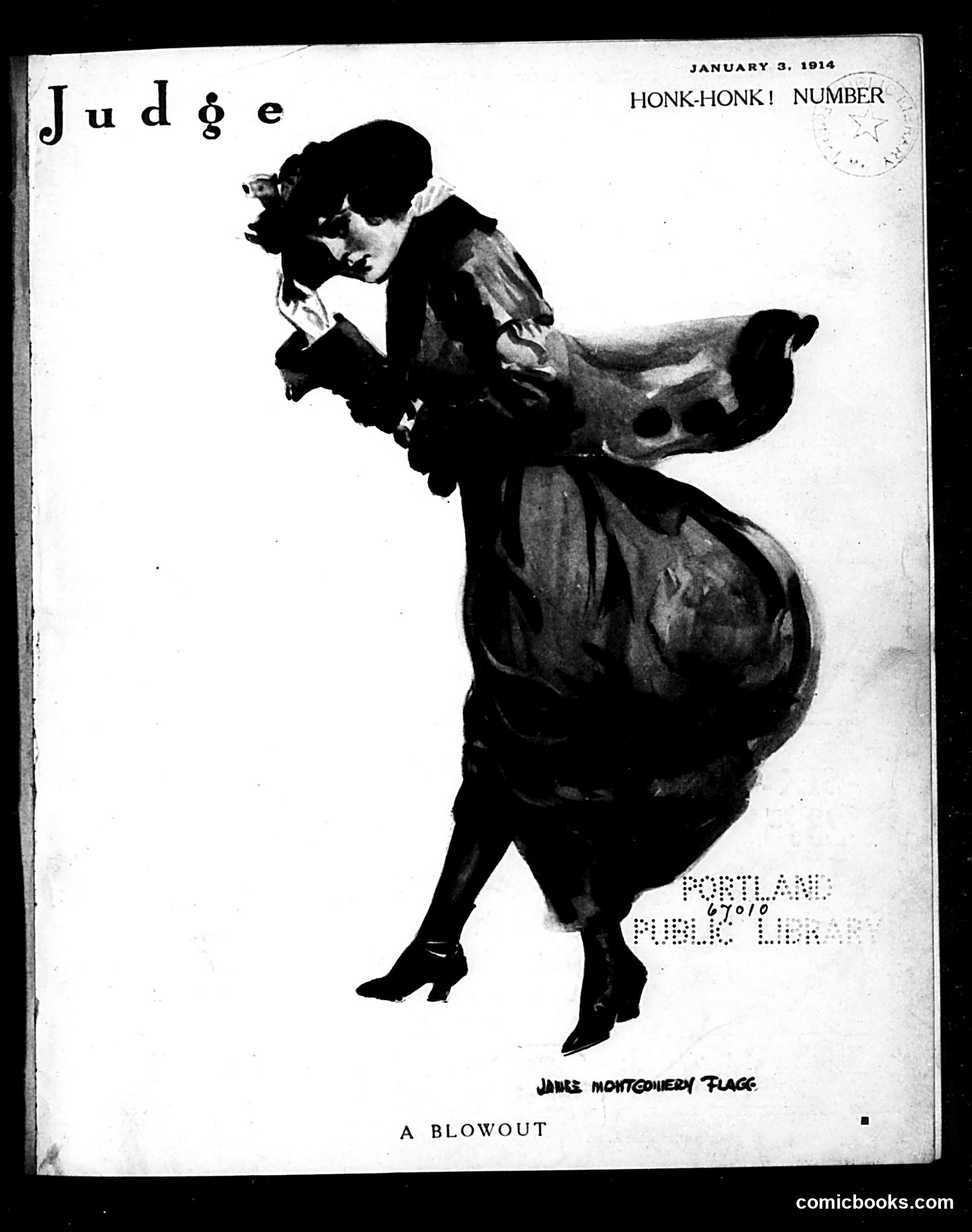
This cover illustration by James Montgomery Flagg depicts a woman being blown upward by wind, her skirt billowing dramatically. The caption "A Blowout" appears to be a visual pun. The exact satirical target is unclear from the image alone, but the illustration likely references contemporary concerns about women's fashion, public decorum, or possibly a specific news event from early 1914. The dramatic pose and emphasis on the woman's loss of control suggests the humor plays on notions of impropriety or chaos. Without additional context, the specific political or social reference remains uncertain. The piece represents typical Judge magazine content: visual wordplay combined with commentary on American social conventions of the era.
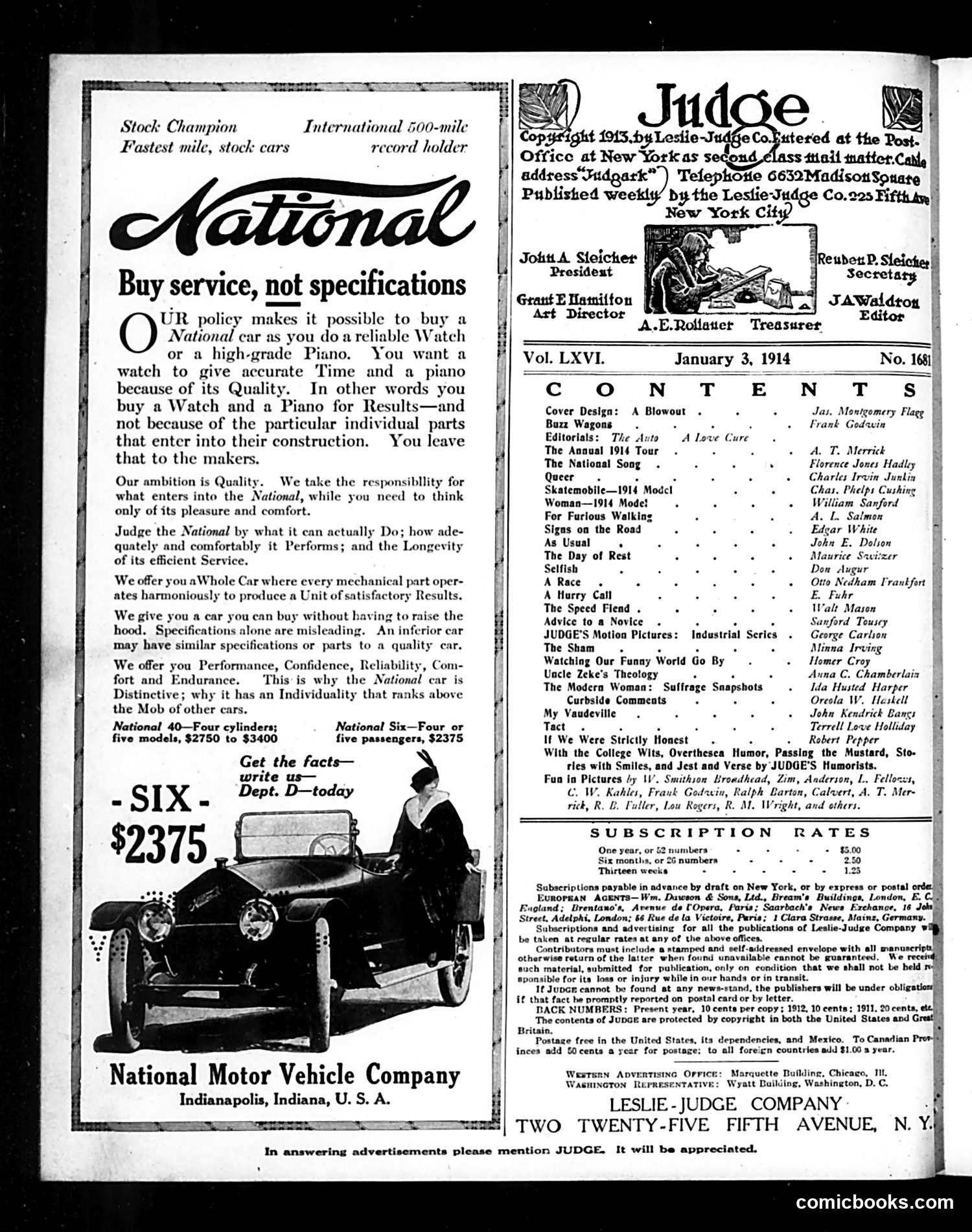
This page is primarily a **National Motor Vehicle Company advertisement** for their "National Six" automobile, priced at $2375. The ad emphasizes buying "service, not specifications"—positioning the National car as reliable and quality-focused rather than defined by technical specs alone. The ad features an illustration of a well-dressed couple with a National Six automobile, suggesting the car appeals to affluent consumers seeking dependable performance and comfort over flashy features. The right side contains the magazine's masthead and table of contents listing various satirical articles and editorial content typical of Judge's humor-focused format. No specific political cartoons or satirical commentary is visible on this particular page—it's dominated by automobile advertising and magazine administrative information.
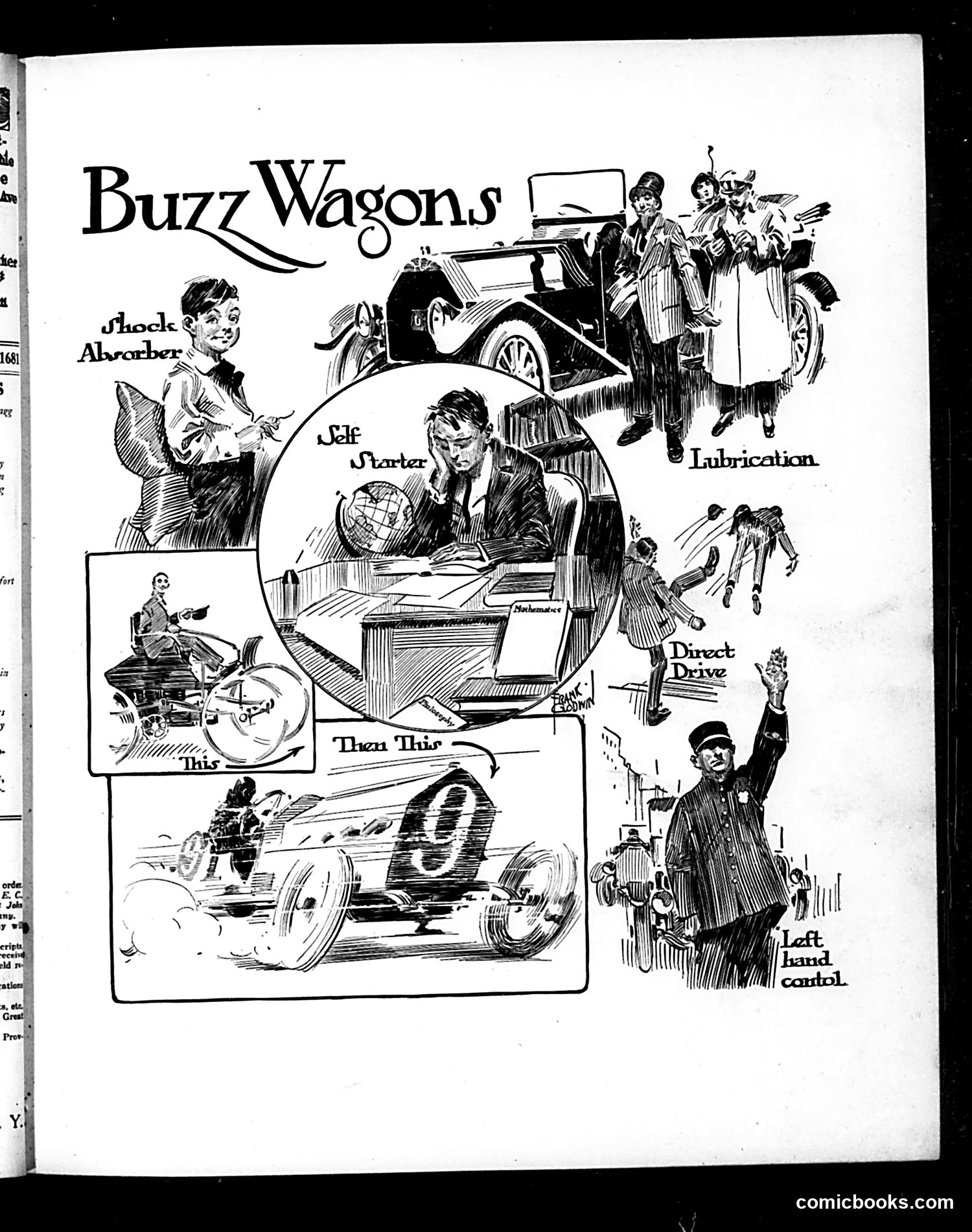
This Judge magazine page satirizes the "Buzz Wagon"—slang for an early automobile—by highlighting its innovative features through caricatured figures and demonstrations. The labeled components include: **Shock Absorber**, **Self Starter**, **Lubrication**, **Direct Drive**, and **Left-hand control**. Each illustration shows how these features work or benefit drivers. The central figure appears to be an engineer or salesman explaining the vehicle's mechanics at a desk. The smaller panels demonstrate practical applications: one shows someone on a motorcycle-like device, another depicts a racing scene labeled "Then This," suggesting the progression of automotive technology. The satire targets early cars' complexity and the marketing hype surrounding new mechanical innovations that were still novel to the general public in the early 1900s.
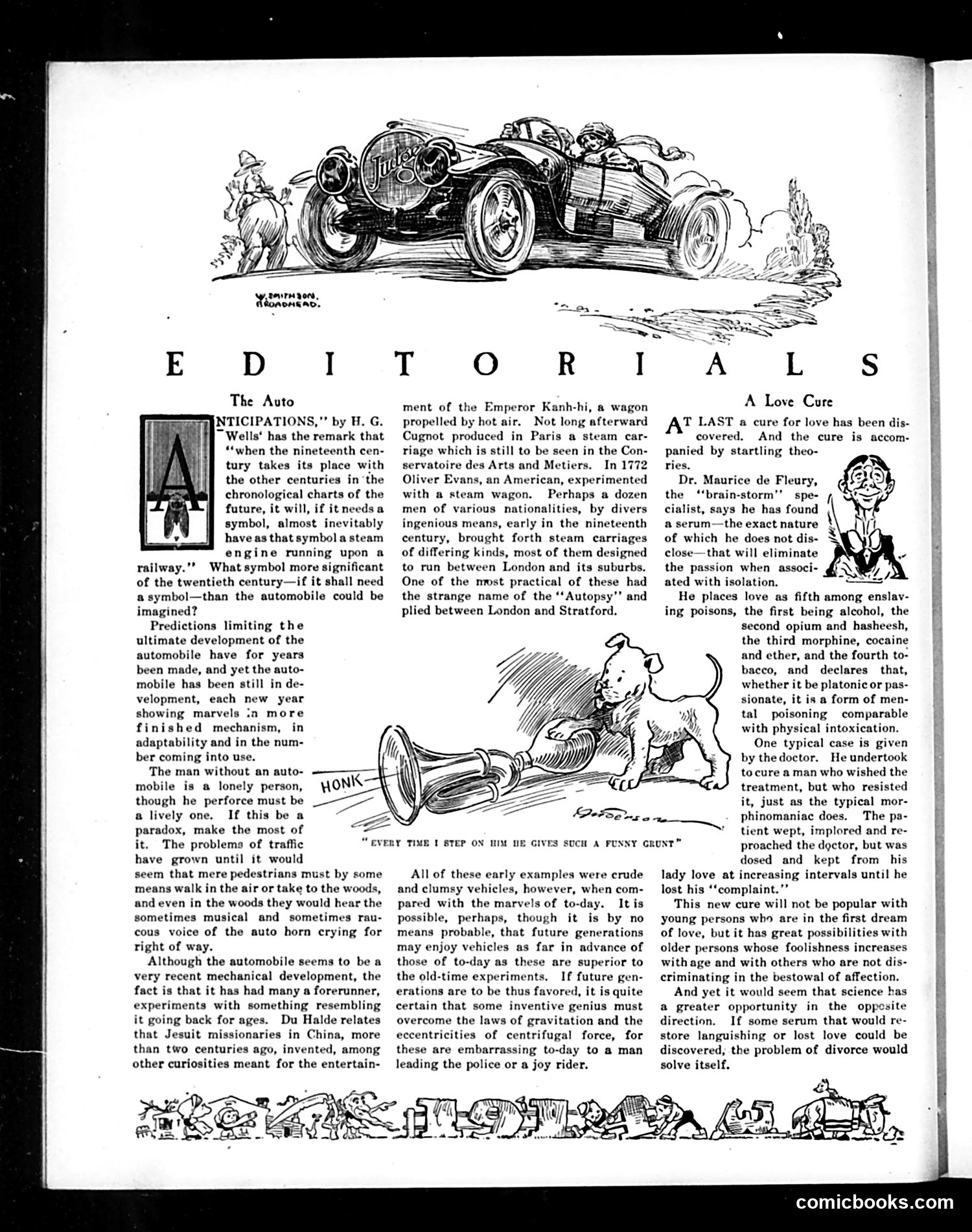
This page contains two distinct pieces: **"The Auto"** (left): H.G. Wells's essay reflects on the automobile as the twentieth century's defining symbol—comparing it to the steam engine's role in the nineteenth. Wells discusses the auto's evolution from crude early vehicles to modern marvels, noting its transformative impact on society. He addresses traffic problems and pedestrian safety concerns while celebrating mechanical progress. **"A Love Cure"** (right): A satirical medical piece by Dr. Maurice de Fleury claims to have discovered a love cure through enslaving poisons (opium, hashish, cocaine, tobacco, alcohol). The absurdist humor mocks pseudoscientific medical fads and questionable treatments of the era. The cartoon of a horn-honking dog illustrates automotive culture's intrusive novelty in urban life.
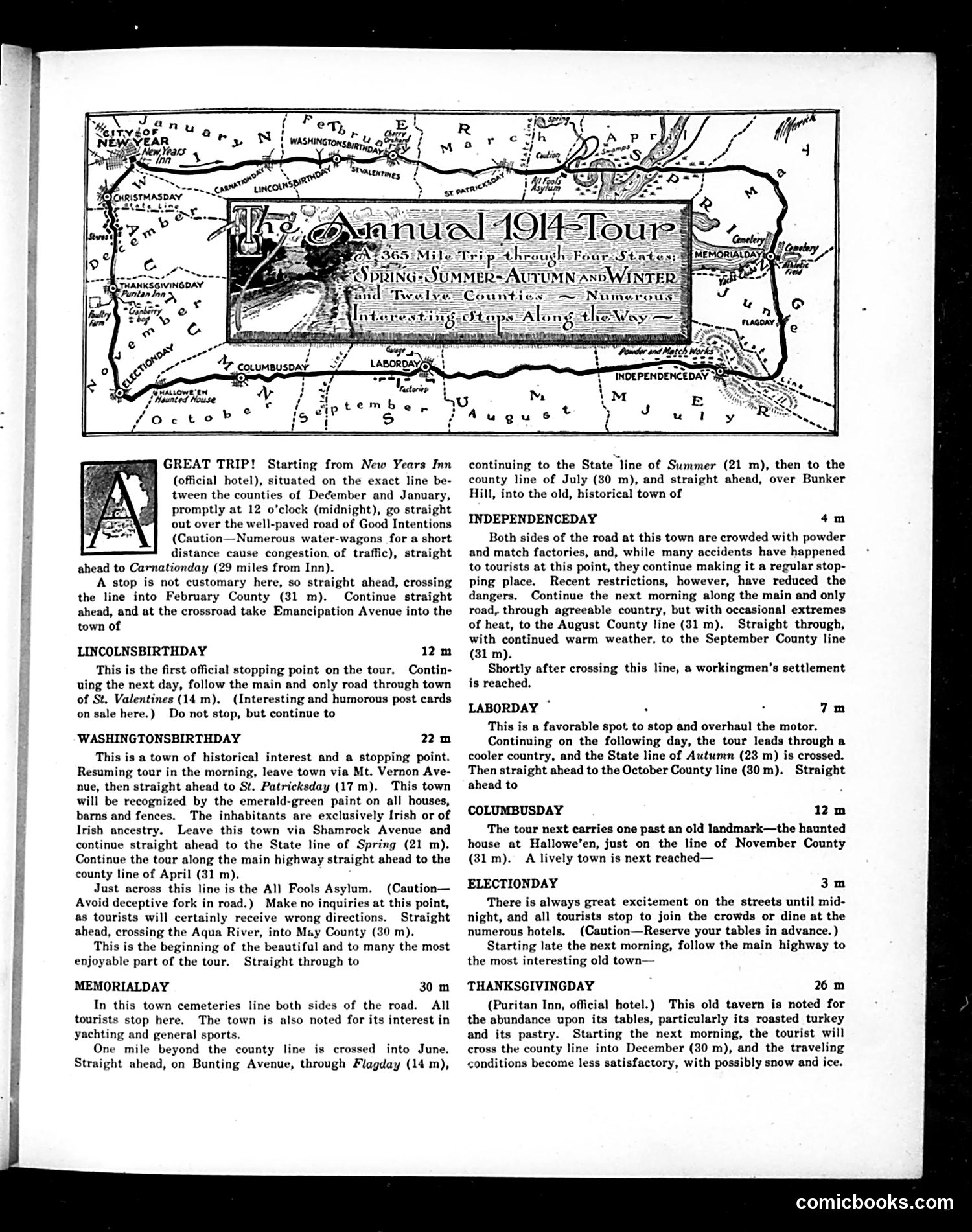
This page is not a political cartoon or satirical content. It's a **travel guide** for "The Annual 1914 Tour"—a 3,365-mile automobile trip through four states across all seasons, visiting twelve counties. The decorative header with the touring car and map is promotional material for what appears to be an organized tourist journey. The text provides detailed driving directions and stopping points, describing each town's attractions, accommodations, and notable features (hotels, historical sites, local industries). This represents early automotive tourism and leisure travel in 1914. The "Judge" magazine likely published this as travel content for its affluent readers interested in modern automobile adventures. There is no political satire or caricature present on this page.
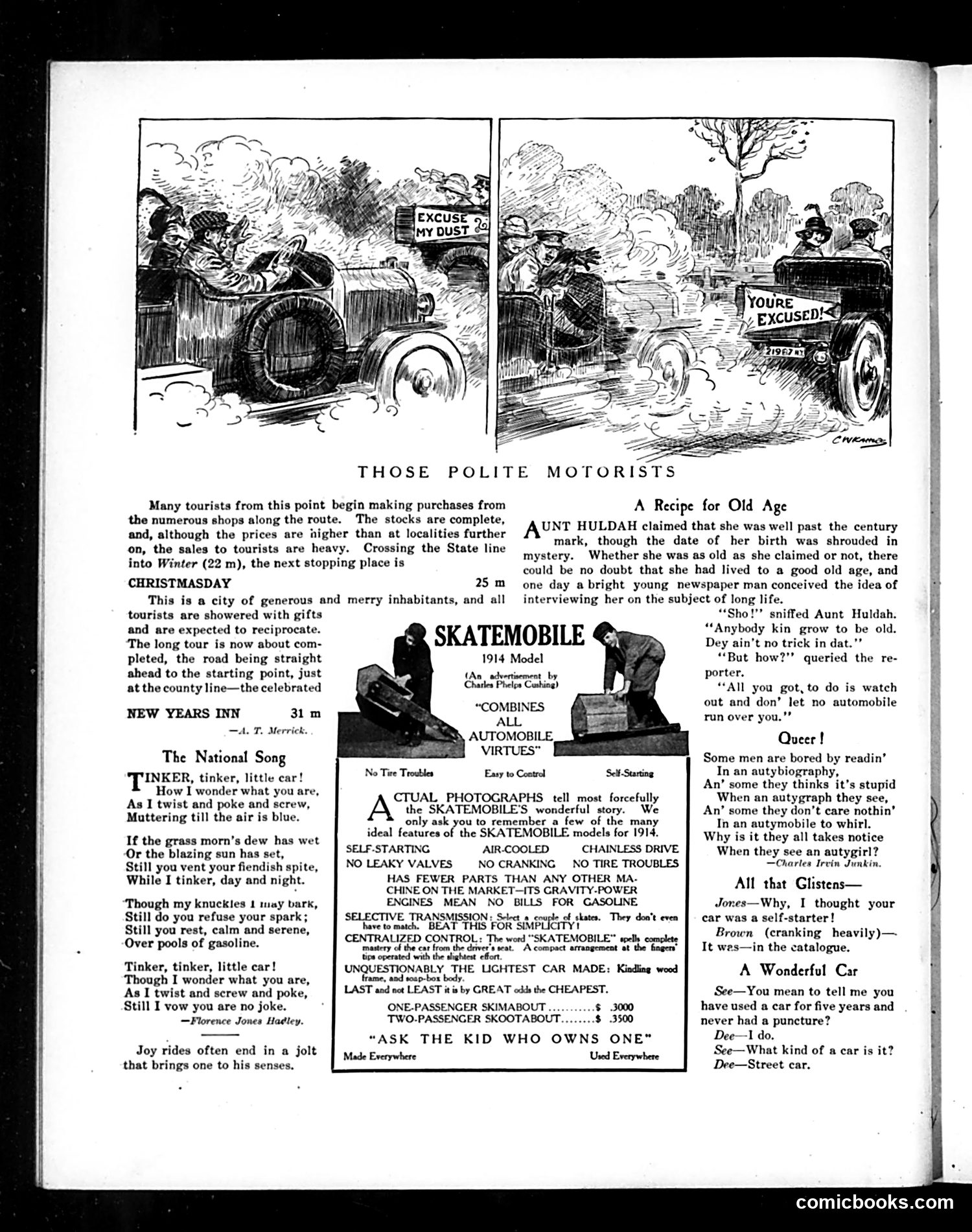
The top cartoon satirizes early automobile drivers' rudeness. Two panels show motorists kicking up dust clouds while dismissing pedestrians' complaints with "Excuse my dust" and "You're excused!" The joke mocks the entitled behavior of wealthy car owners toward common people on roads—a frequent complaint in the 1910s as automobiles proliferated. The page also features extensive advertising for the "Skatemobile," a 1914 automobile model, using hyperbolic claims about its simplicity and low cost. This advertisement parodies the overblown marketing language typical of early auto manufacturers. Below is humorous poetry mocking car owners' frustrations with unreliable vehicles ("Tinker, tinker, little car"), reflecting the widespread mechanical problems plaguing early automobiles. The remaining content includes light humor about automobiles and aging, typical of Judge's satirical commentary on contemporary life and emerging consumer culture around motorcars.
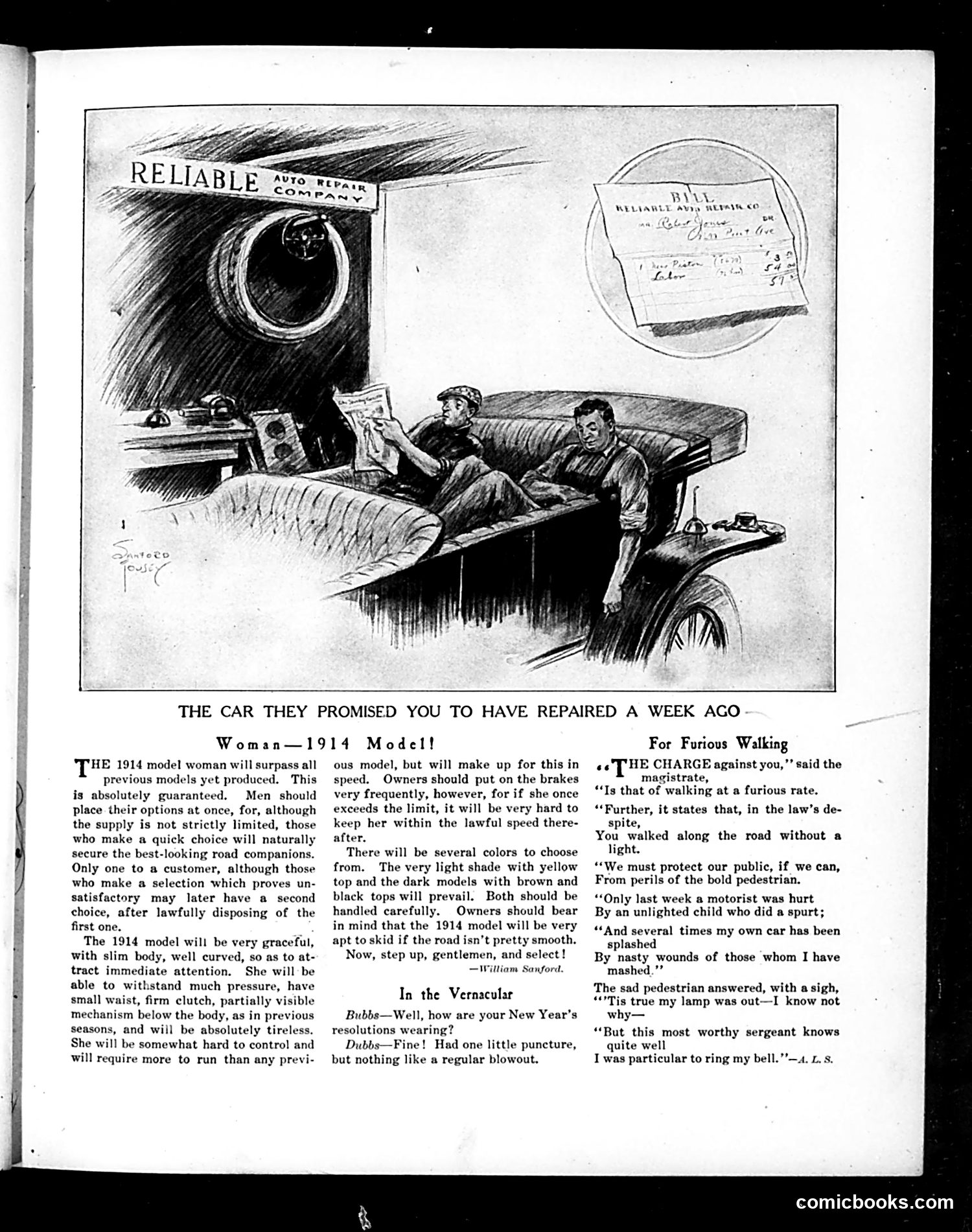
This page contains three satirical pieces mocking early 20th-century attitudes: **"The Car They Promised" cartoon**: The top illustration depicts a couple waiting at "Reliable Auto Repair Company" for their car—promised a week ago but still unrepaired. The satire targets the unreliability of early automobile repair shops, a common frustration of the era. **"Woman—1914 Model" advertisement parody**: The text humorously presents women as consumer products, using automotive sales language ("options," "models," "speed"). It satirizes both the commodification of women and the era's anxieties about women's independence—describing the "1914 model woman" as faster, harder to control, and requiring more fuel than previous versions. The joke critiques both misogyny and changing gender roles. **"For Furious Walking" dialogue**: This mocks overzealous traffic enforcement by depicting a magistrate charging a pedestrian with "walking at a furious rate" without a light, while casually admitting he's "mashed" pedestrians with his motorcar. The satire exposes the absurdity of blaming pedestrians rather than dangerous drivers. All three pieces lampoon modern technology's social disruptions.
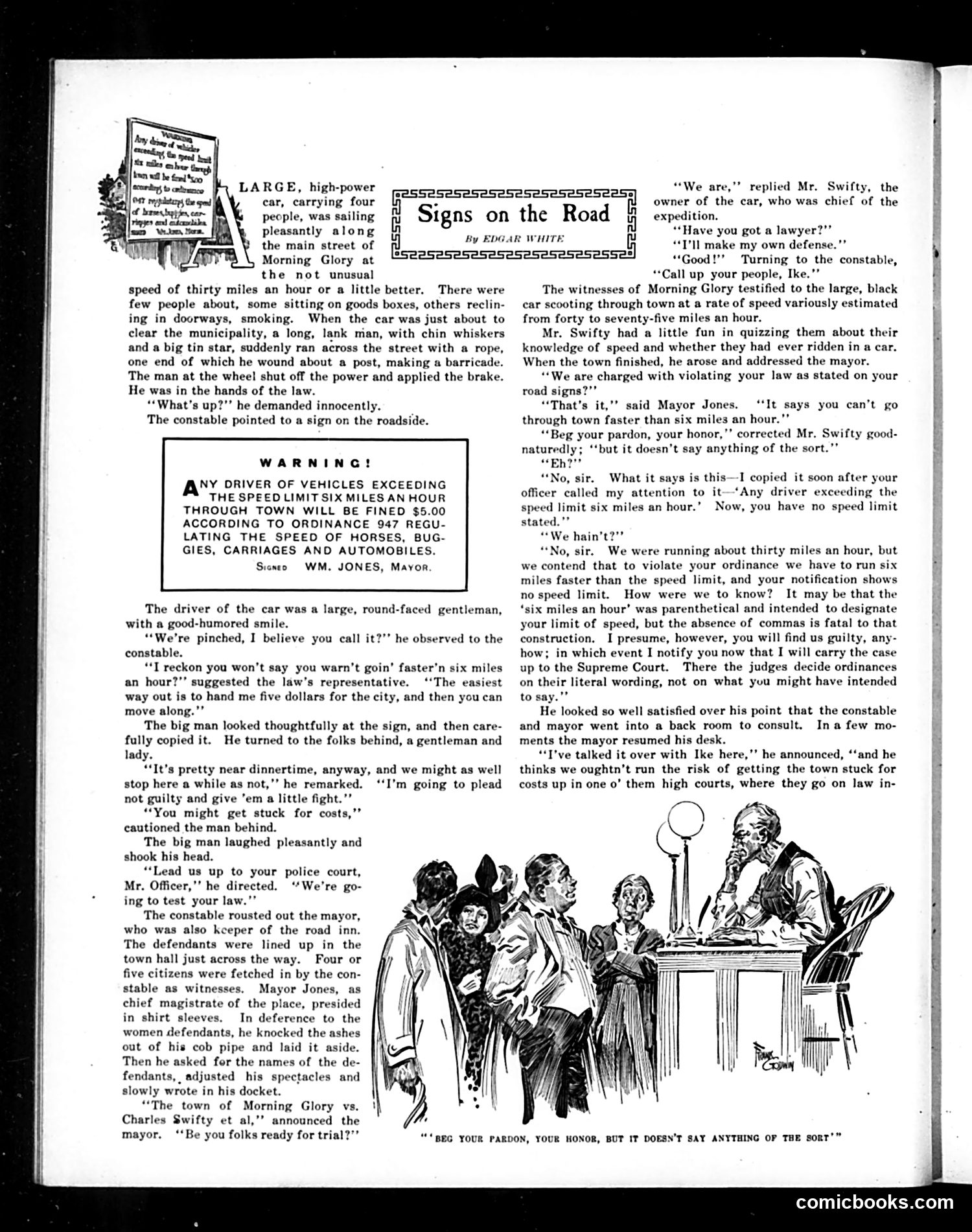
This story satirizes small-town America's ad-hoc speed enforcement during the early automobile era. A wealthy motorist ("Mr. Swifty") is stopped by a constable in the fictional town of Morning Glory for exceeding a six-mile-per-hour speed limit. The satire targets corrupt local governance: the mayor doubles as innkeeper and judge, witnesses give wildly inconsistent accounts (40-75 mph), and the constable tries extracting a $5 bribe. Swifty outsmarts them by literally reading the town ordinance, which regulates "horses, buggies, carriages and automobiles" but fails to specify that automobiles must obey the limit—an oversight reflecting how hastily rural towns adapted old horse-and-buggy laws to the new technology. The humor mocks small-town officials' incompetence and greed, while celebrating the clever motorist's legal victory. It reflects contemporary anxieties about automobiles disrupting rural communities and the law's struggle to address them.
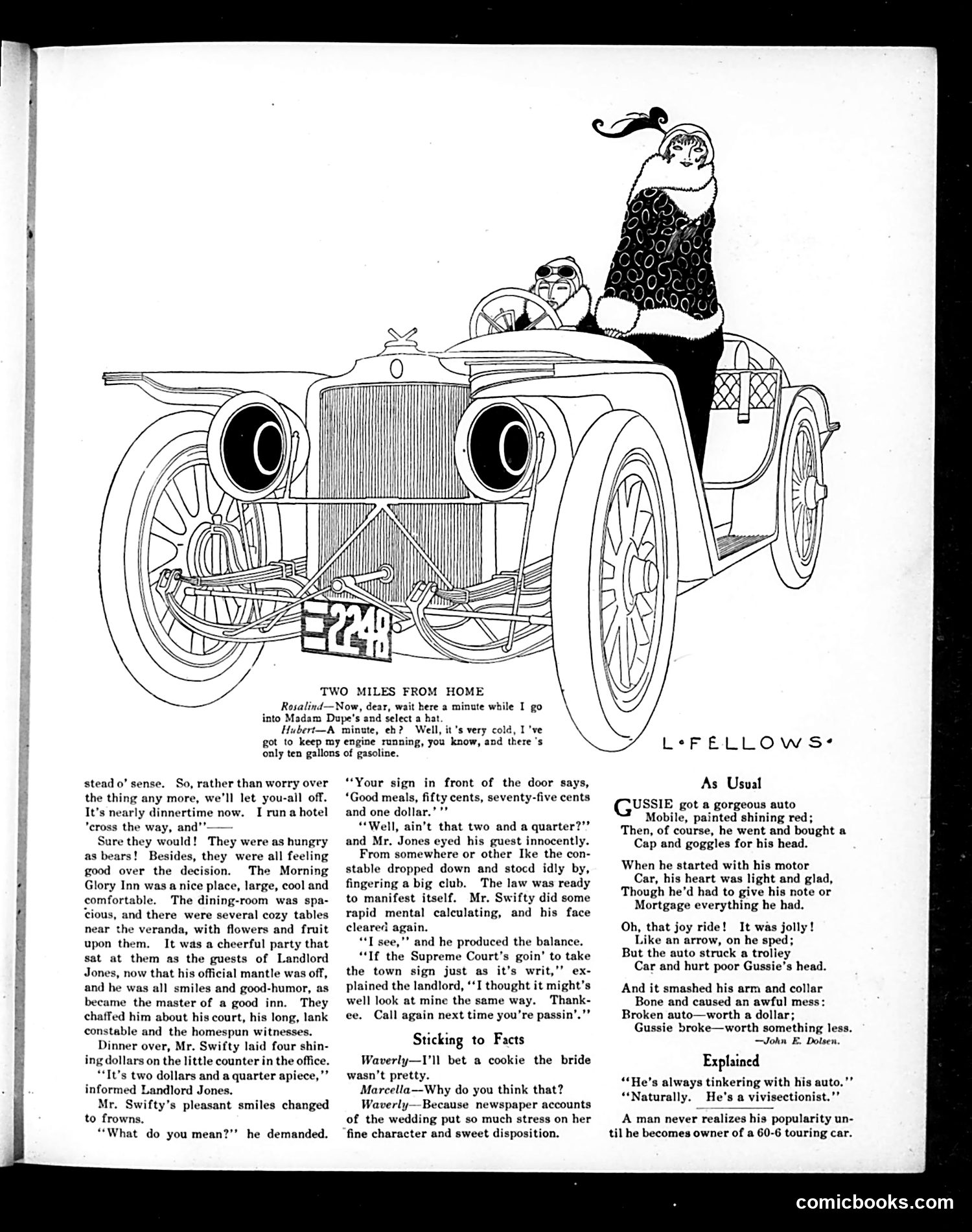
This page from Judge contains several automobile-themed satirical pieces typical of the early 20th century, when cars were still novel luxuries. **"Two Miles from Home"** depicts a married couple in an early motorcar. The humor centers on the husband's anxiety: while his wife shops, he must keep the engine running to stay warm, and he's worried about depleting his ten-gallon fuel tank—highlighting both the inefficiency and expense of early automobiles. **"As Usual"** mocks a young man (Gussie) who purchases a flashy red automobile but must mortgage everything to afford it. The satirical point: he immediately crashes it into a trolley car, destroying the vehicle while injuring himself. The poem's closing suggests cars are status symbols that bankrupt their owners while providing only dangerous "joy rides." The remaining brief jokes continue this theme: automobiles are expensive, unreliable, and attract social climbers. The satire targets both the impracticality of early cars and the vanity of owners who sacrifice financial security for conspicuous consumption and modern status.
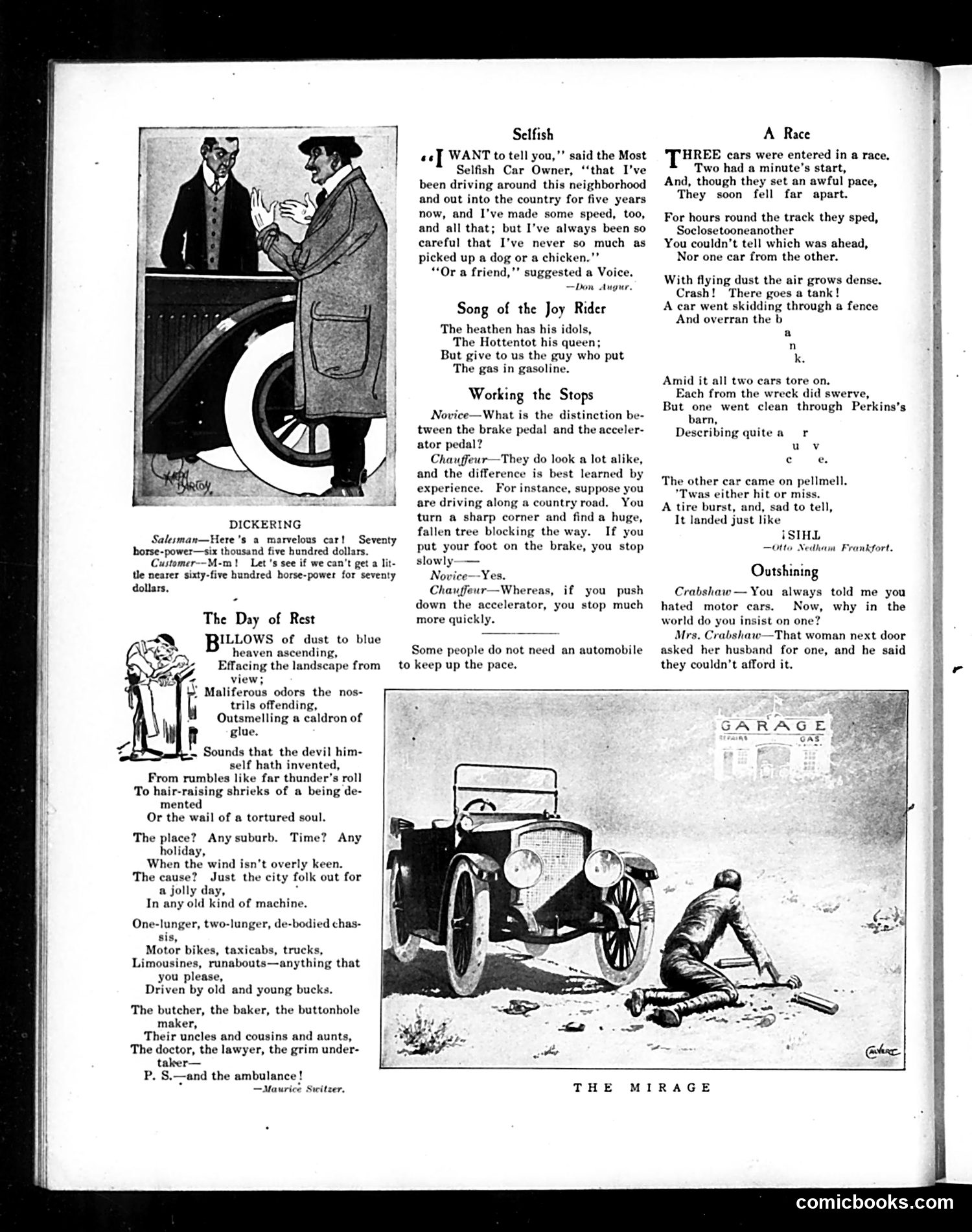
This page satirizes early automobile culture through multiple pieces. The main cartoon "Dickering" mocks the nouveau riche haggling over car prices—a salesman pitches a powerful vehicle at $6,500, and the customer tries negotiating down to $70 less, revealing the absurdity of penny-pinching over luxury purchases. "The Day of Rest" by Maurice Switzer is a scathing poem attacking suburban leisure drives. It condemns the noise, dust, and smells of automobiles invading quiet communities on holidays—mocking "city folk" of all professions (butcher, baker, doctor, lawyer) recklessly driving "any old kind of machine" for amusement. "A Race" presents a darkly comic poem about a chaotic car race ending in crashes and property damage (a barn destroyed), reflecting contemporary anxieties about reckless driving. The "Outshining" dialogue jokes about conspicuous consumption—a woman demands a car simply because her neighbor bought one, exposing the competitive materialism driving automobile adoption among the middle class. Overall, the page critiques automobile excess, dangerous driving, and class-conscious consumption.
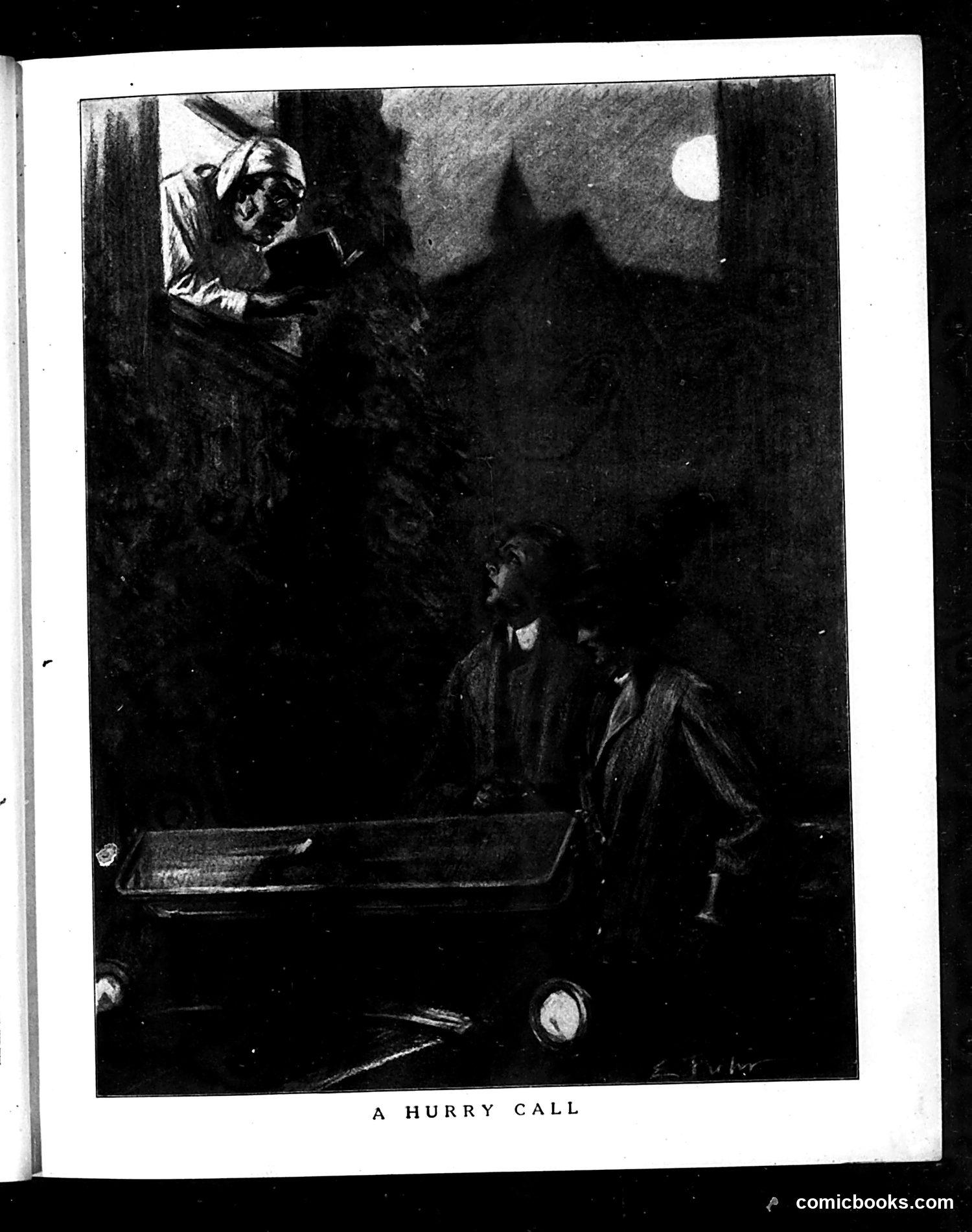
This nighttime scene depicts what appears to be an emergency medical visit. A doctor (identifiable by his bag and formal attire, perched on an upper level) responds urgently to a patient below, likely in a tenement or modest home setting. The stark black-and-white illustration emphasizes the dramatic urgency of the situation. The cartoon's social commentary likely critiques either: the inadequate living conditions of poor urban dwellers requiring emergency midnight calls, or the desperation of those unable to afford proper daytime medical care. The visual contrast between the doctor's elevated position and the patient's lower space may underscore class divisions in healthcare access during the early 20th century when *Judge* published social satire addressing industrial-era urban poverty and medical inequality.
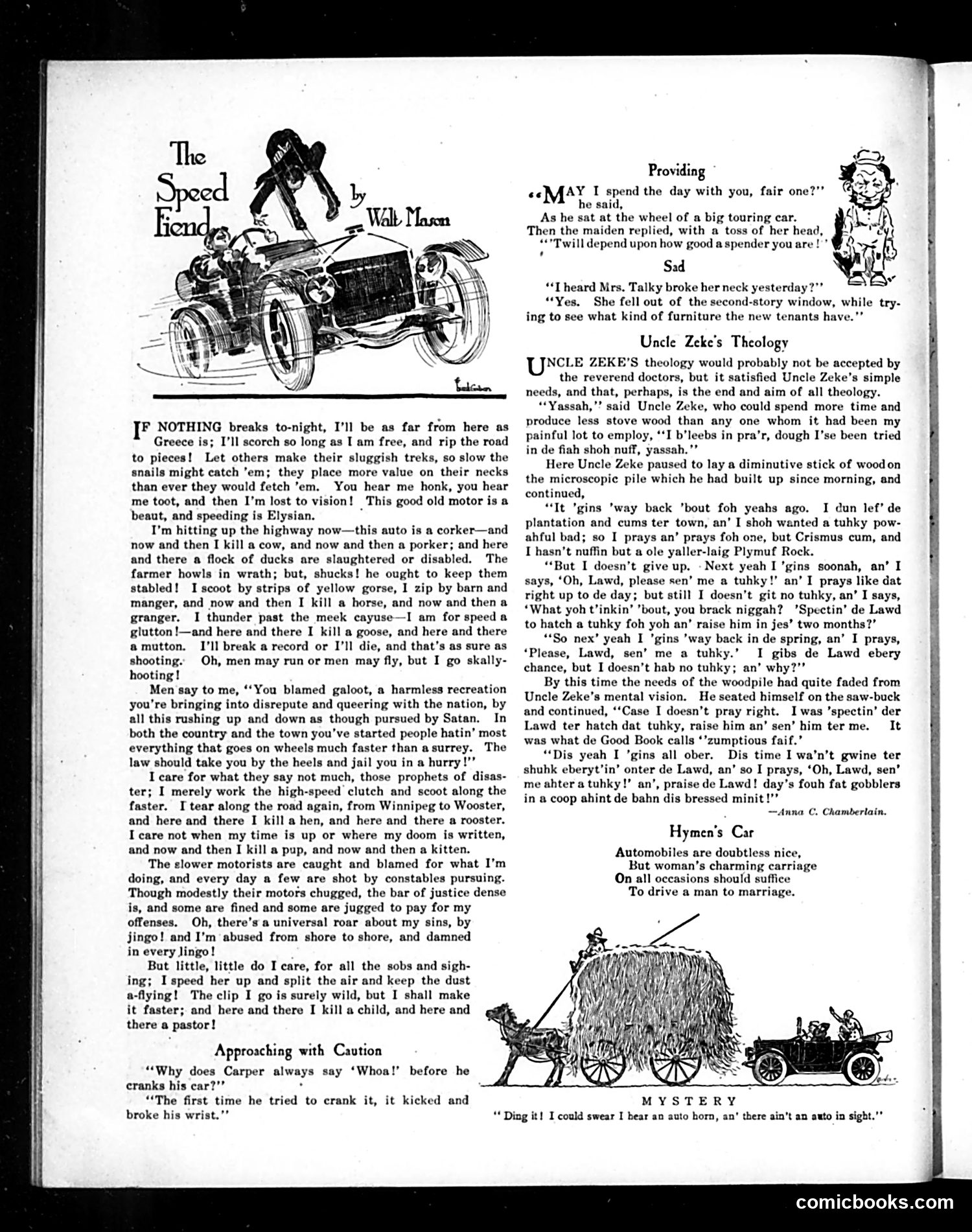
This page satirizes the emerging danger of reckless automobile drivers in early 20th-century America. The main story, "The Speed Fiend" by Walt Mason, mocks a driver who boasts of dangerously speeding, killing livestock and pedestrians (including a child and pastor) while dismissing all criticism and legal consequences. The satire targets both the driver's arrogance and society's struggle with automobiles—a new technology causing deaths and social disruption. The smaller anecdotes reinforce the theme: drivers causing accidents, women interested only in wealthy suitors with cars, and jokes about automobile dangers. The humor is dark by modern standards, treating deaths casually to emphasize how recklessly some early motorists drove and how unprepared society was for automotive fatalities. This was topical satire responding to real contemporary concerns about unregulated speeding and inadequate traffic laws.
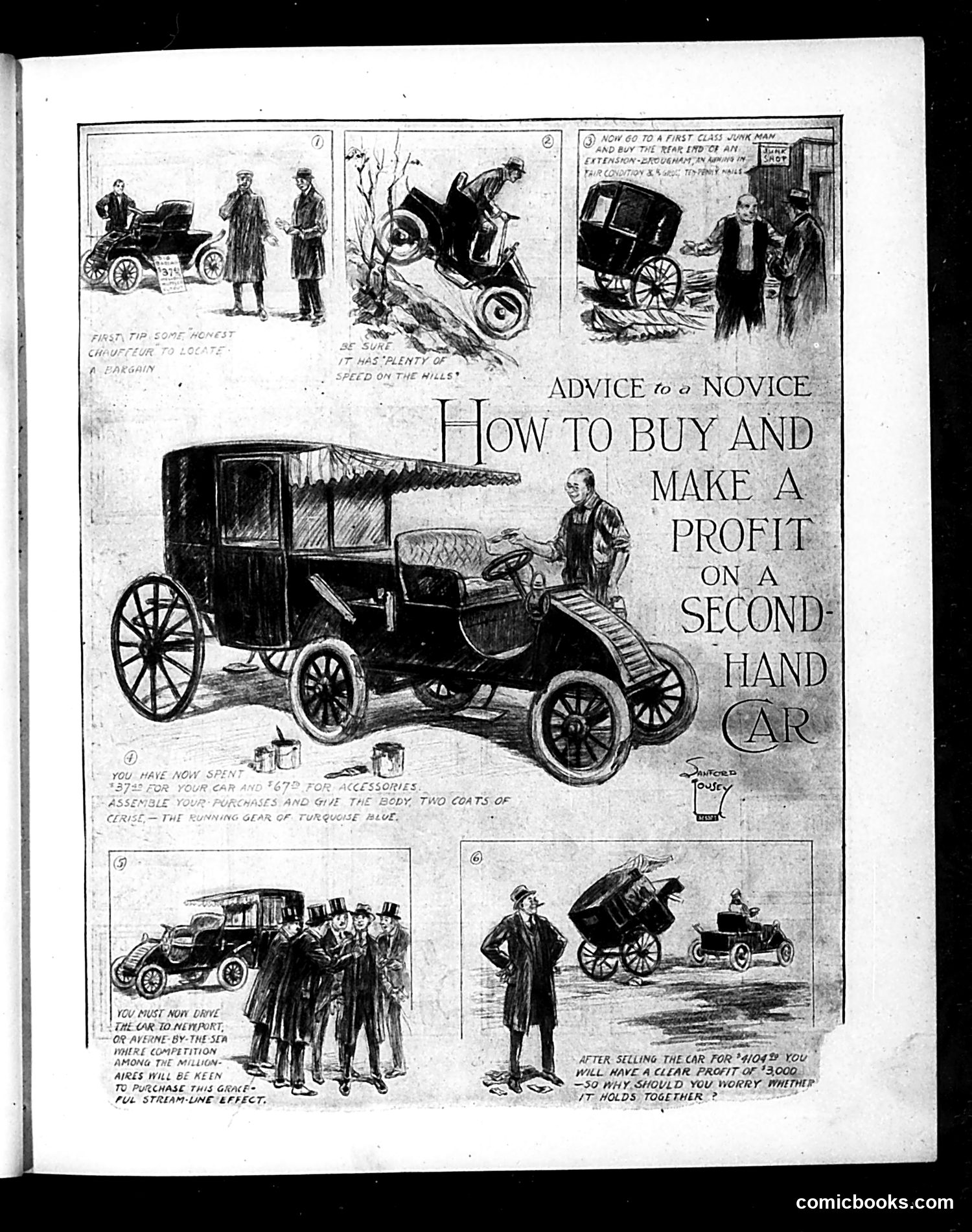
This is a satirical guide mocking used-car dealers and naive buyers in the early automobile era. The comic shows six steps depicting a scheme: (1) an honest chauffeur's pitch; (2) a crash; (3) deceptive sales tactics; (4) spending money on cosmetic fixes; (5) misrepresenting the vehicle to other buyers through competitive showmanship; (6) flipping it for profit while ignoring mechanical damage. The satire targets both dishonest dealers who hide a car's deteriorated condition under new paint and "turquoise blue" varnish, and gullible purchasers. The punchline—making $3,000 profit despite spending $275 on the car and $670 on accessories—exposes the absurdity of profiting from fraud. Judge ridicules the get-rich-quick mentality surrounding the booming automobile industry and caveat emptor (buyer beware) ethics.
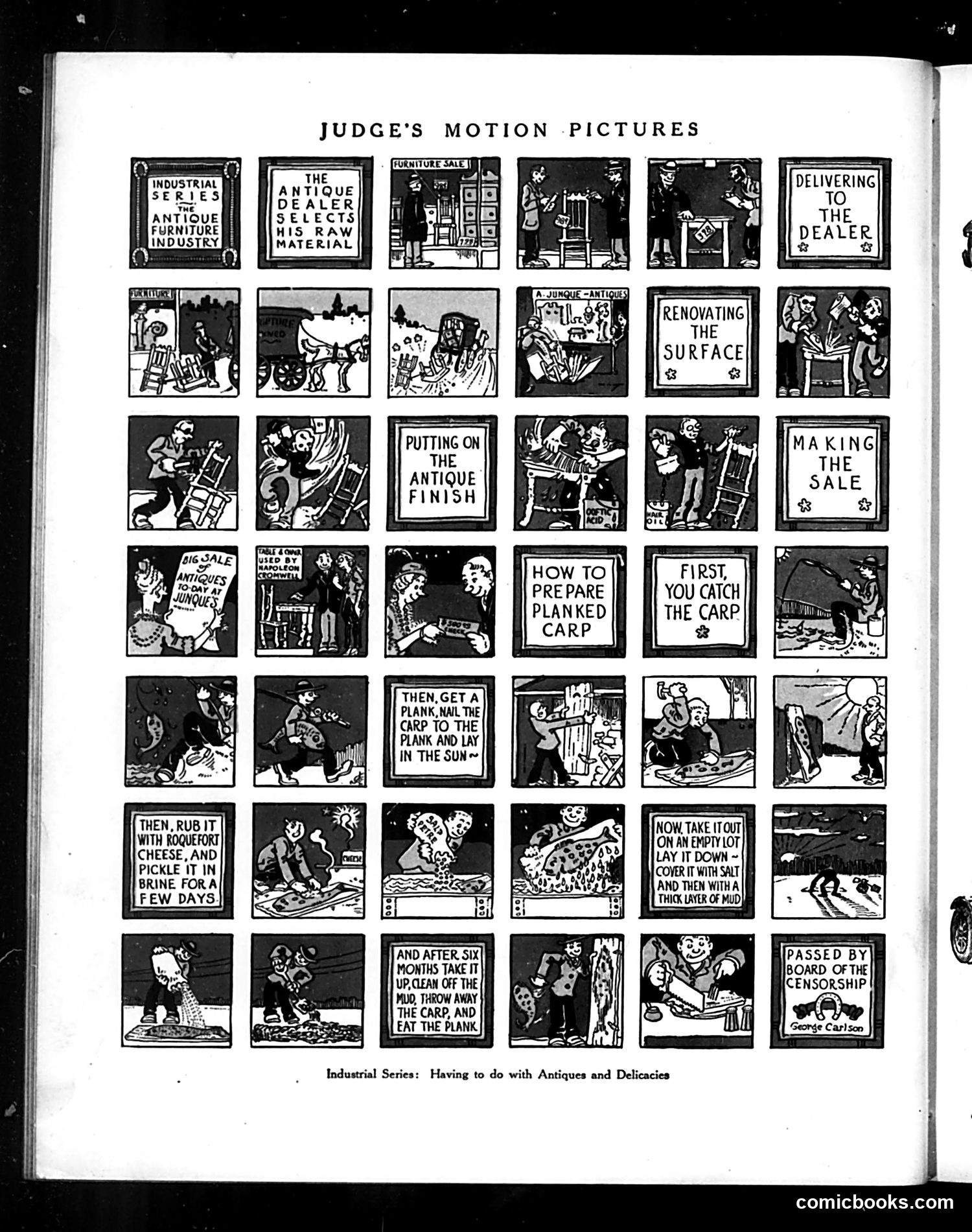
This is a satirical comic strip sequence titled "Judge's Motion Pictures" from the Industrial Series about "Antiques and Delicacies." The narrative appears to be a humorous, absurdist instruction manual for preparing carp (a fish considered less desirable). The visible text fragments show increasingly ridiculous preparation steps: rubbing it with Roquefort cheese, pickling it in brine, getting a plank and nails, and laying it on an empty lot covered with salt and mud. The satire targets both pretentious culinary practices (using expensive Roquefort on common fish) and absurd, overly-complicated recipes. The sequential format parodies industrial instruction manuals and cooking guides popular in early 20th-century magazines, mocking their pseudo-scientific, elaborate approaches to simple tasks. The humor relies on the escalating ridiculousness of the preparation method.
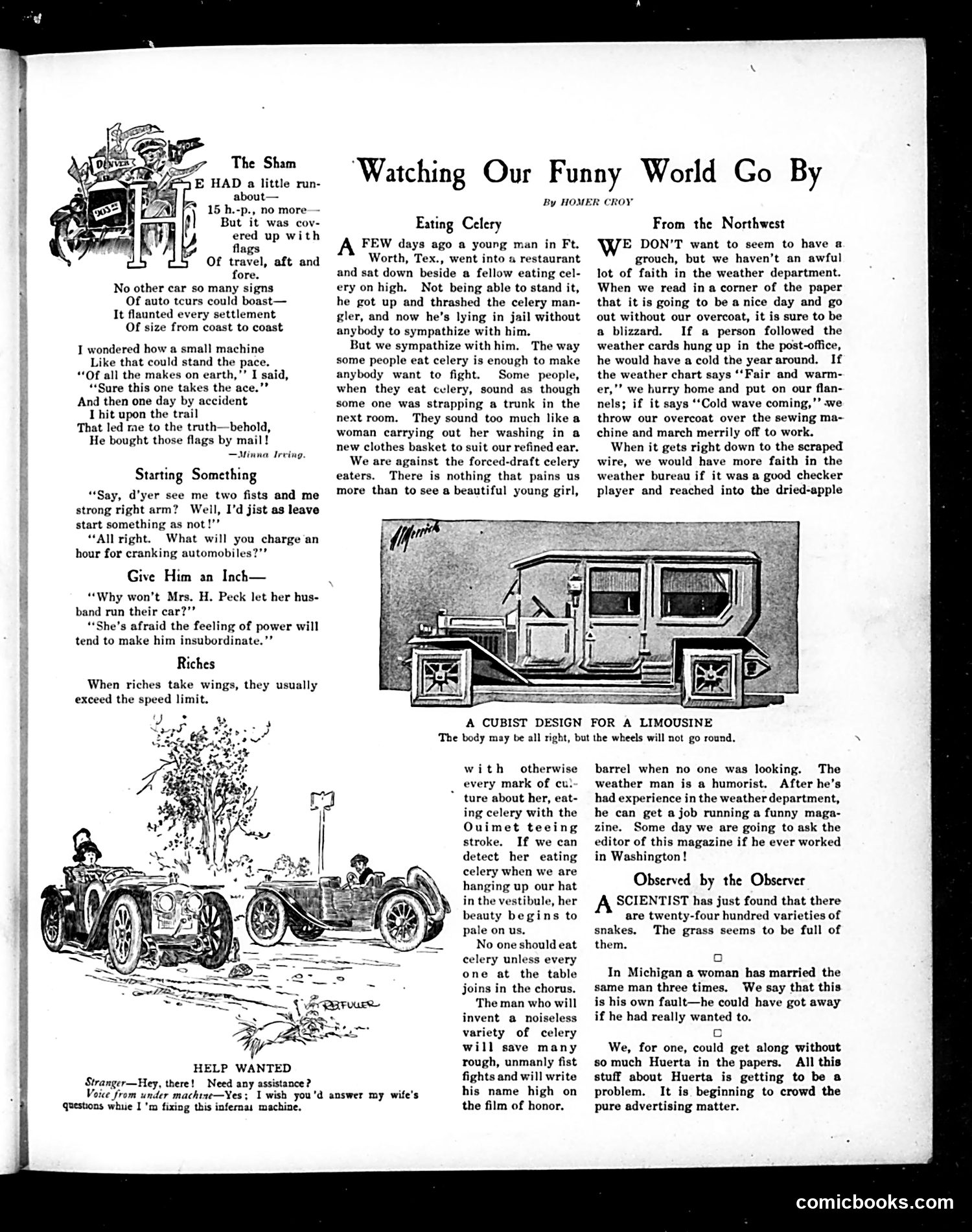
This page from *Judge* contains humorous social commentary typical of early 20th-century American satirical journalism. The content includes: **"The Sham"** (poem): Mocks tourists who decorate their automobiles with travel flags to appear well-traveled, then reveals the protagonist bought his flags by mail—satirizing pretense and false status symbols. **"Eating Celery"**: A short essay humorously criticizing people who eat celery noisily in public, comparing the sound to trunk-packing and laundry-carrying. It references an actual Fort Worth incident where a man assaulted someone over celery-eating noise, using this absurd event to mock social refinement and etiquette violations. **"From the Northwest"**: Lampooning weather forecasting as unreliable, suggesting meteorologists would be better suited to magazine editing or humor writing. **"Cubist Design for a Limousine"**: A cartoon satirizing cubism (the avant-garde art movement) by applying its geometric, fragmented style to an impractical automobile design with non-functional wheels. The recurring theme: mocking pretension, unreliability, and emerging modern absurdities.
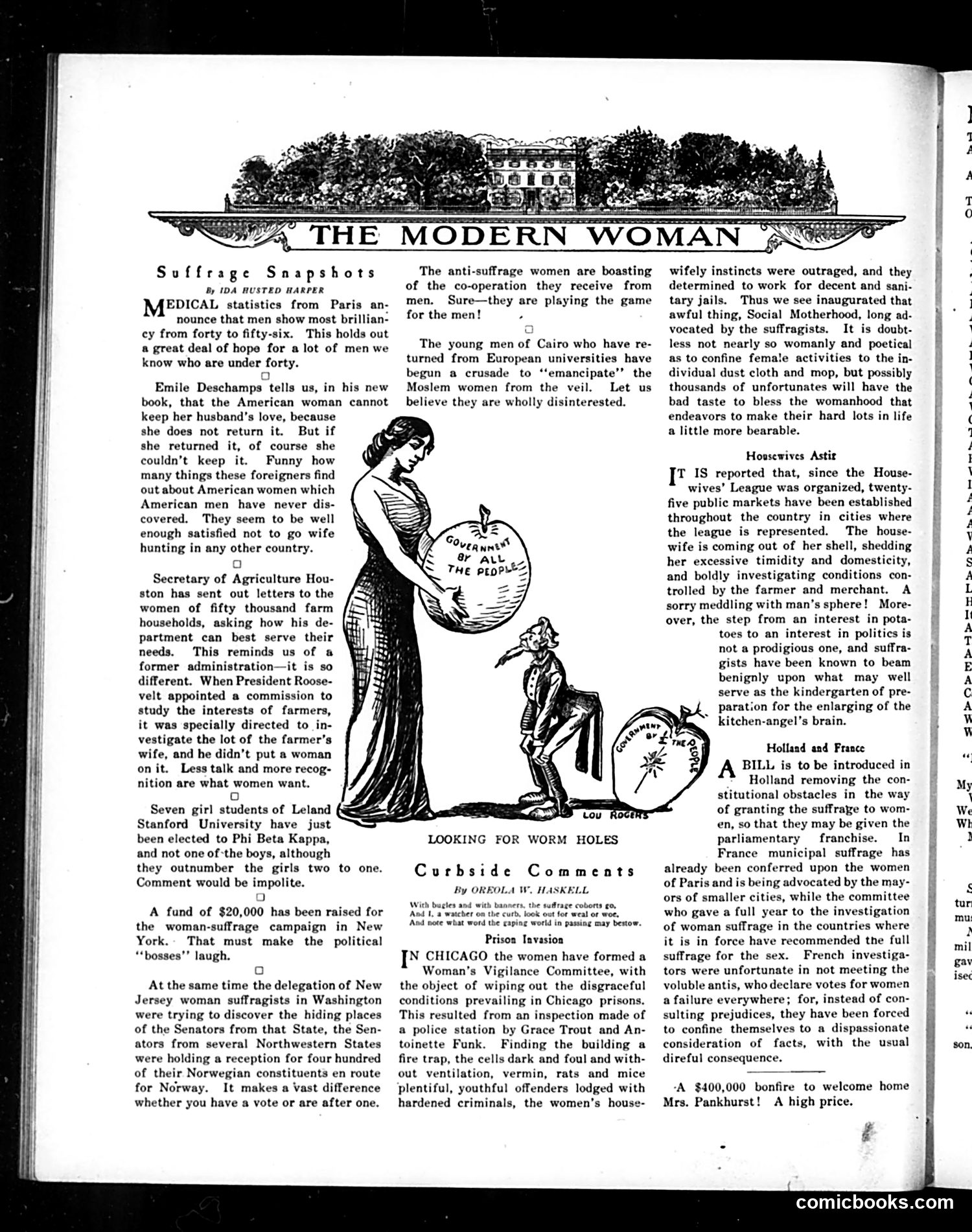
This page satirizes both **suffragists and anti-suffragists** during the women's suffrage debate (early 1900s). ## The Main Cartoon The illustration labeled "Looking for Worm Holes" depicts a woman (representing suffragists) examining a large sphere labeled with suffrage messaging, while a small male figure (likely a politician or "boss") below watches. The satire suggests suffragists are naively searching for fundamental flaws in the political system, unaware they're being manipulated. ## Key Satirical Points: **Against suffragists:** The text mocks their earnest reform efforts—women in Chicago inspecting prisons for "Social Motherhood" work, which the author dismissively calls "awful." The fundraising ($20,000 for New York campaign) is ridiculed as making political bosses laugh. **Against anti-suffragists:** The opening joke exposes how anti-suffrage women receive male "cooperation" only because men want to preserve the status quo ("playing the game for the men"). **General mockery:** Foreign observers' observations about American women are presented as obvious absurdities, undercutting serious arguments on both sides. The satire uses condescension toward women's activism as its primary weapon.
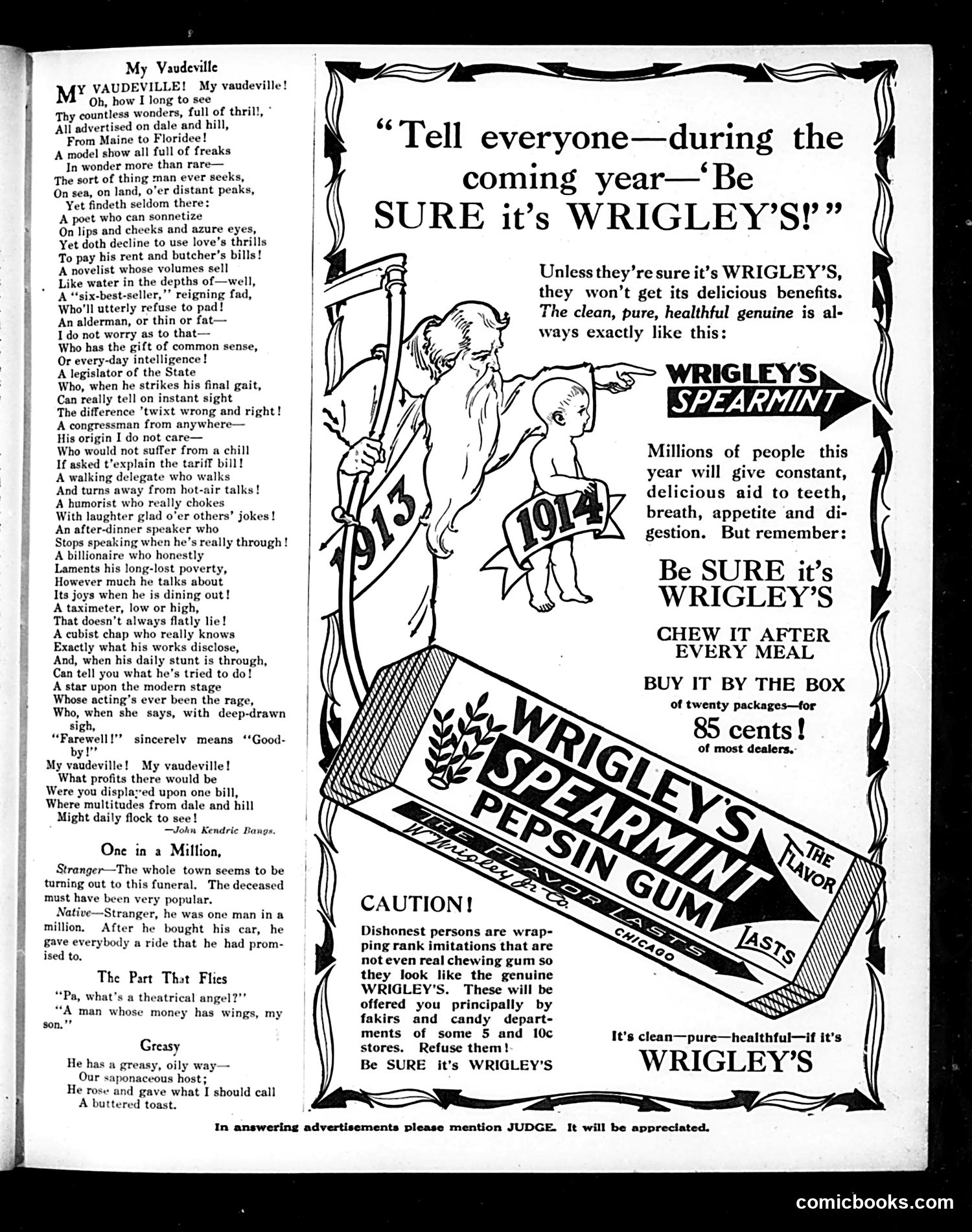
This page combines satirical poetry with period advertising. The left side features "My Vaudeville," a poem by John Kendric Bangs satirizing vaudeville theater's false promises. Bangs lists impossible "attractions"—a poet who won't commercialize his work, a legislator who understands right from wrong, a congressman who grasps tariffs, a billionaire genuinely poor—all presented as fantasies never found in actual vaudeville. The satire mocks both entertainment industry hype and broader public incompetence (corrupt politicians, dishonest businessmen, pretentious artists). The right side contains a Wrigley's Spearmint gum advertisement warning against counterfeit products—a genuine 1910s-era consumer concern when trademark counterfeiting was rampant. The ad emphasizes authenticity and purity, selling at 85 cents per box of twenty packages. The humor depends on recognizing vaudeville's reputation for exaggerated advertising and dubious acts—fitting company for an advertisement about avoiding fakes.
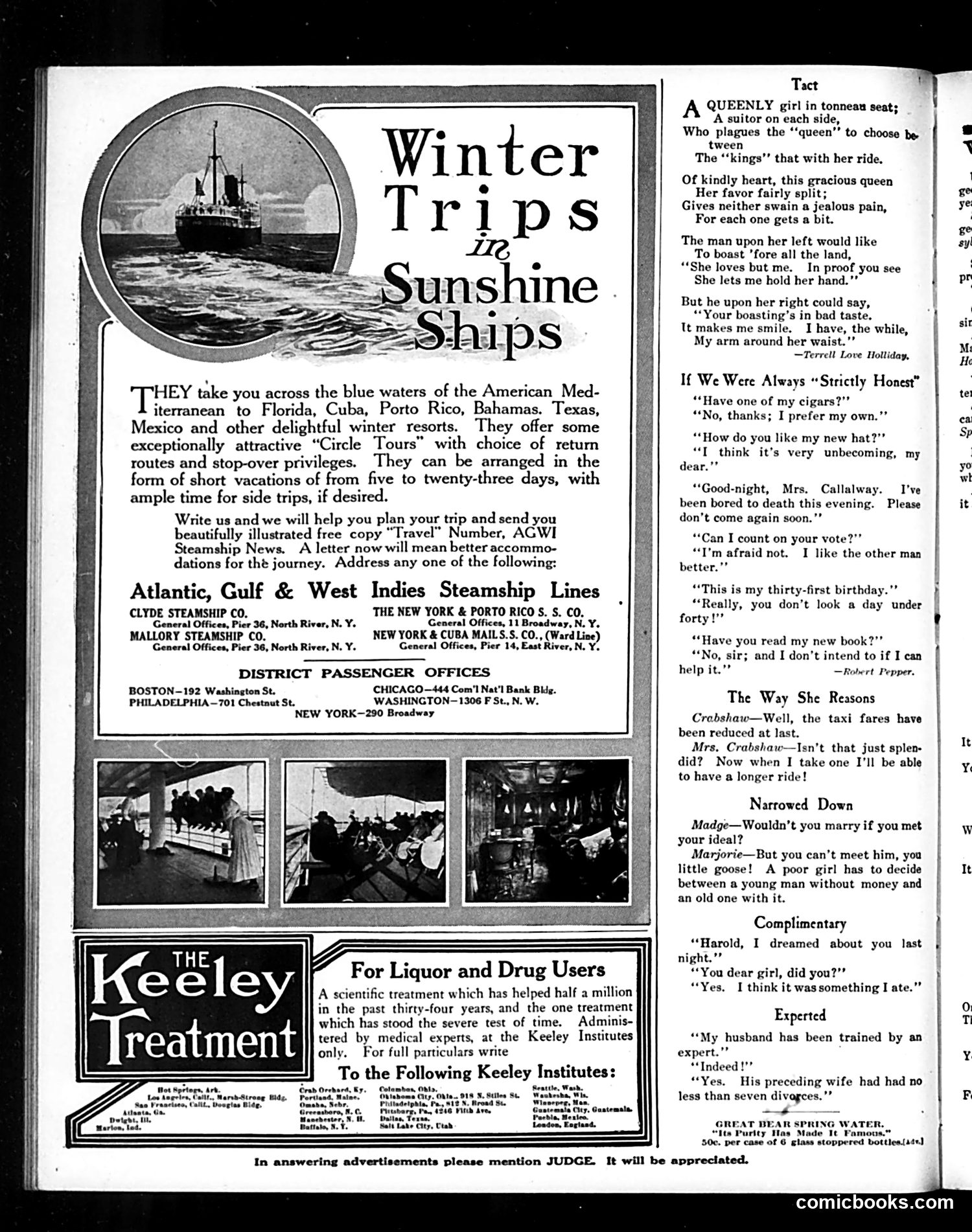
This page from the satirical magazine *Judge* contains mostly **light social humor and advertising** rather than political satire. The main content is a series of short comic vignettes mocking everyday social situations: - **"Tact"**: A joke about a woman in a car with two suitors, each claiming her affection while she manipulates both—poking fun at romantic games and male vanity. - **"If We Were Always 'Strictly Honest'"**: A series of brief, cynical quips about people's real (unfiltered) thoughts versus polite conversation—satirizing social hypocrisy. - **Other segments** ("The Way She Reasons," "Narrowed Down," etc.): Quick jokes about marriage, women's logic, and gender relations, reflecting early 20th-century attitudes toward courtship. The page is dominated by **ship line advertisements** and a **Keeley Institute ad** (a real treatment facility for addiction). The humor throughout targets middle-class social conventions rather than politics, reflecting *Judge*'s focus on domestic and romantic comedy over serious satire.
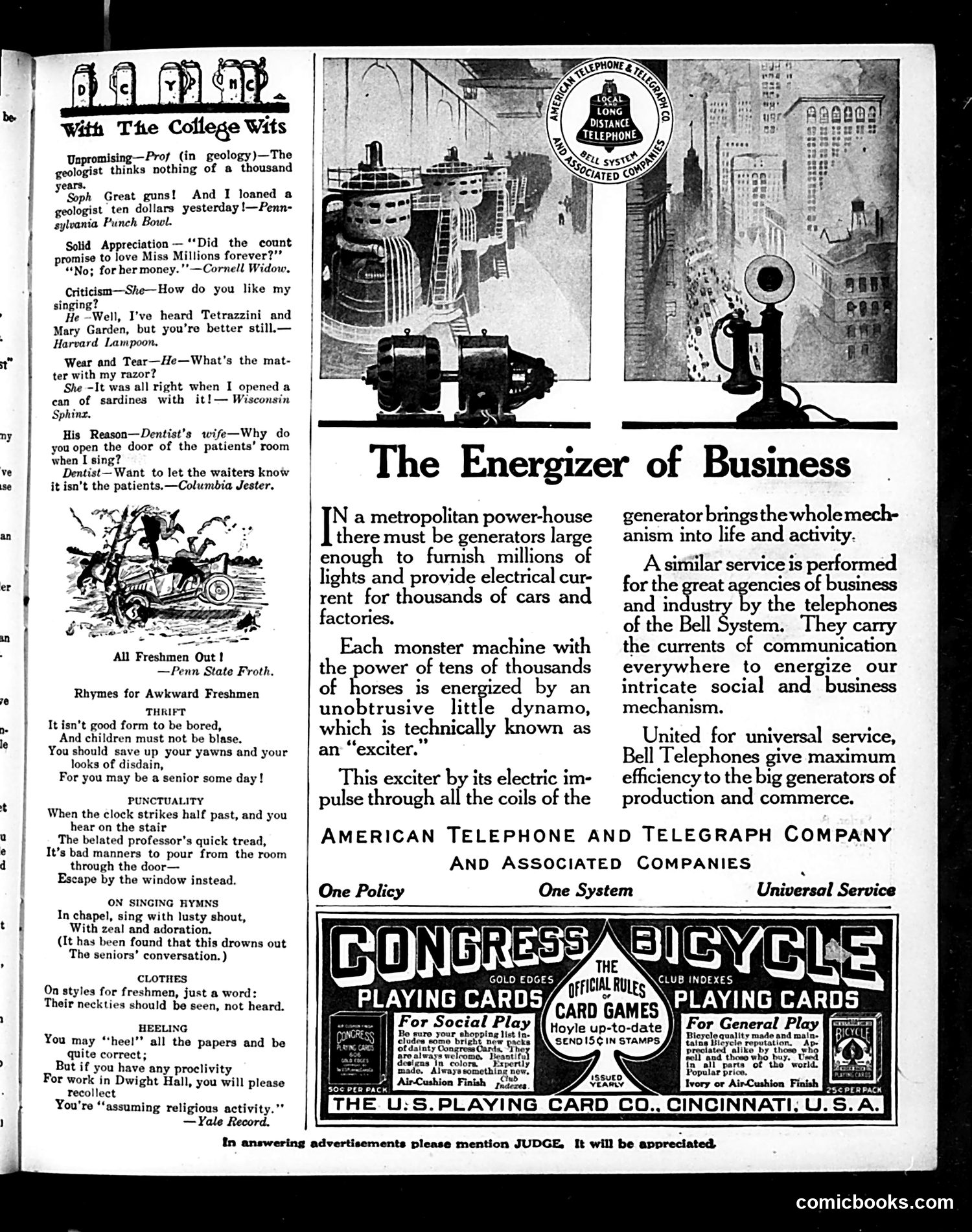
This Judge page combines college humor with corporate advertising. The left side features brief satirical jokes from various college publications—poking fun at freshman behavior, romantic mercenary motives, and academic absurdities. These are gentle jabs at college life conventions (singing hymns to drown out seniors, using razors on sardine cans). The right side is an AT&T advertisement comparing telephone systems to electrical generators. It uses engineering metaphors to suggest Bell Telephones are the "exciter" or vital energizing force for modern business and commerce—portraying the company as essential infrastructure rather than mere utility. The bottom advertises playing cards from Cincinnati, marketed for "social play" and "general play." The page reflects early 20th-century attitudes: optimism about technology and business, college life as privileged and somewhat frivolous, and corporate self-promotion disguised as public service messaging.
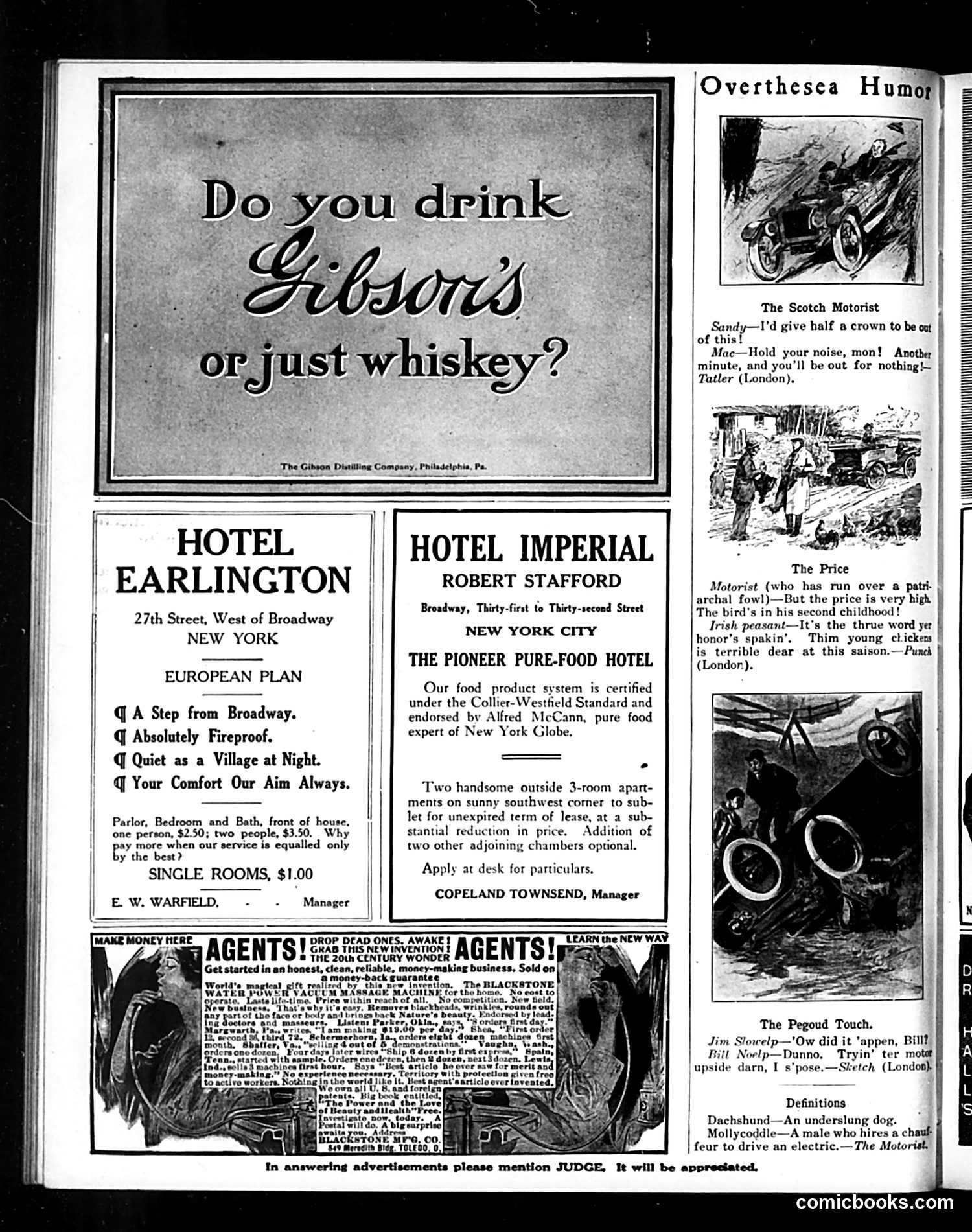
This page is primarily **advertising with sidebar humor content**. The main advertisement is Gibson's whiskey (Philadelphia), using the marketing question "Do you drink Gibson's or just whiskey?" to promote their brand. The right column contains **"Overthesea Humor"**—reprinted jokes from British publications (Tatler, Punch, Sketch, The Motorist). These are brief, genteel comedies of manners: - "The Scotch Motorist": A Scottish driver threatens violence over noise - "The Price": Dark humor about hitting a bird; Irish peasant quips about the cost - "The Pegoud Touch": Working-class Londoners discuss an accident (unclear reference) - "Definitions": Wordplay—a dachshund is literally "underslung," a mollycoddle "hires a chauffeur" The hotel advertisements (Earlington, Hotel Imperial) and agents' recruitment ad round out the commercial content. The page reflects early 20th-century American magazine layout: advertisements subsidized satirical content, with reprinted British humor adding cosmopolitan appeal to Judge's American readership.
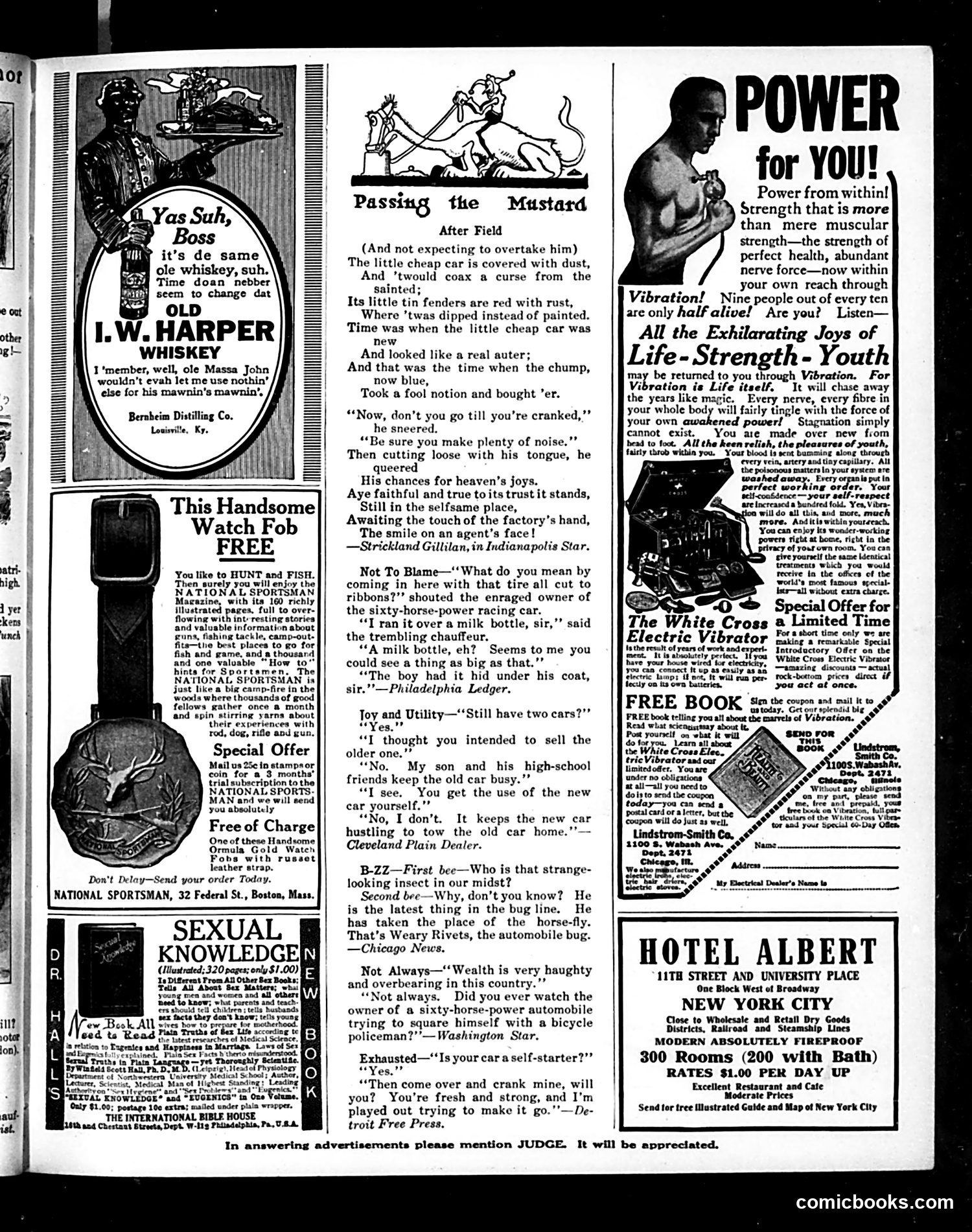
This page mixes advertising with period humor reflecting early 1900s attitudes. **"Yas Suh, Boss"** ad depicts a Black servant endorsing whiskey using exaggerated dialect and subservient imagery—typical of the era's racist advertising that perpetuated minstrel stereotypes and plantation nostalgia. **"Passing the Mustard"** and related automobile jokes satirize the unreliability of cheap early cars. The poem mocks buyers who purchase faulty vehicles, while anecdotes mock drivers' impatience and poor auto maintenance—reflecting the era's transition from horses to automobiles and associated frustrations. **"Vibration" power device** advertises pseudoscientific health equipment claiming electrical vibration cures ailments—a common early 20th-century medical quackery marketed to the credulous. The page also advertises **National Sportsman magazine** and sexual instruction books, both common in this period's periodicals. Overall, the content reflects dated racial attitudes, automobile-age humor, and snake-oil marketing practices.
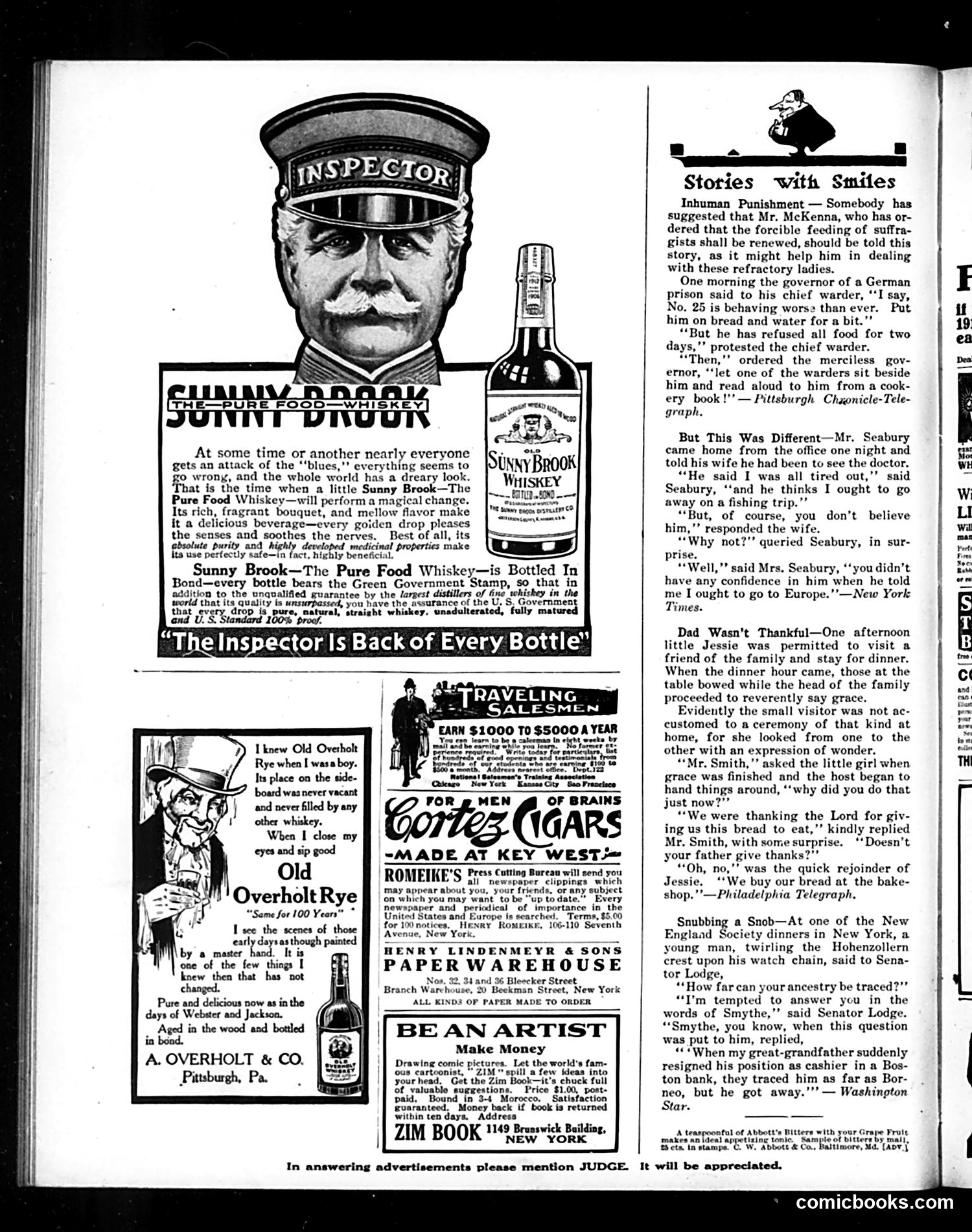
This page is primarily **advertising**, not political satire. It features whiskey and cigar advertisements alongside three brief humorous anecdotes in the "Stories with Smiles" column. The main satirical content is one story referencing **Mr. McKenna** (likely British Home Secretary Reginald McKenna), who ordered forced feeding of **suffragists** (women's voting rights activists). The joke suggests using torture—reading cookery books aloud to starving prisoners—as punishment, sarcastically implying McKenna's forcible feeding policy is equally cruel and absurd. The other two stories are domestic humor about husbands and children, unrelated to politics. The advertisements emphasize "Pure Food" whiskey (invoking Progressive Era food safety regulations) and promote sales jobs and artistic instruction. The "Inspector" imagery references government quality control stamps, which were contemporary marketing appeals.
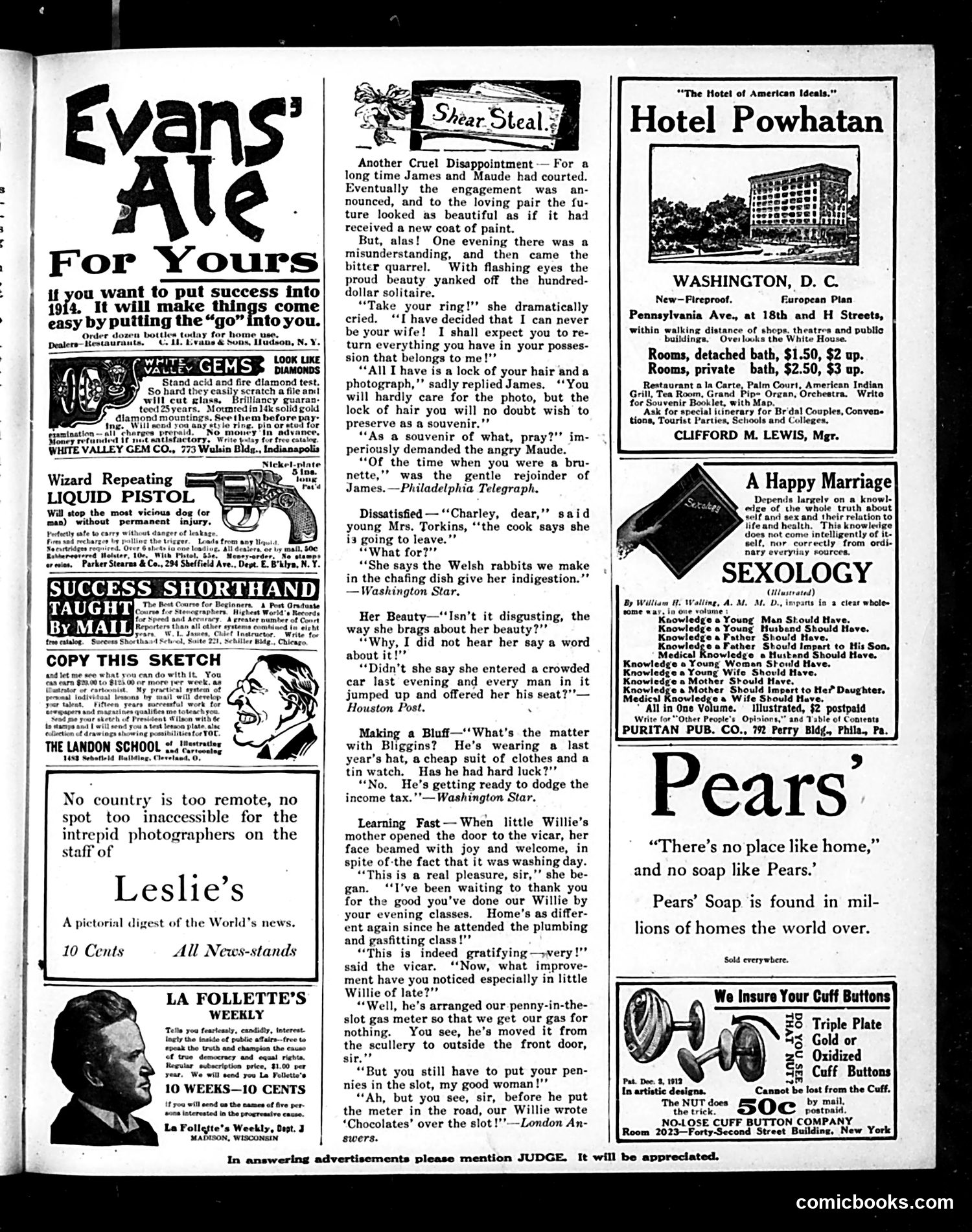
This page is primarily **advertisements and humorous anecdotes** rather than political cartoons. The main content includes short comedic stories satirizing early 20th-century social behaviors: - **"Another Cruel Disappointment"** mocks romantic drama: a woman demands her fiancé return everything after breaking their engagement; he notes he only has her hair and a photo, then quips the hair was when she was a brunette (implying she dyed it). - **"Learning Fast"** satirizes working-class ambition: a boy attends evening classes and impresses his mother, but his "improvement" is learning to tamper with the gas meter to steal service—the vicar's education inadvertently enabled petty crime. - Other brief jokes target vanity, marital discord, and financial dodging (tax evasion). The advertisements (Evans' Ale, White Valley Gems, Leslie's magazine) occupy substantial space. Overall, this represents **typical Judge content: light satirical humor about domestic life and social pretension**, with no identifiable political figures or major contemporary events referenced.
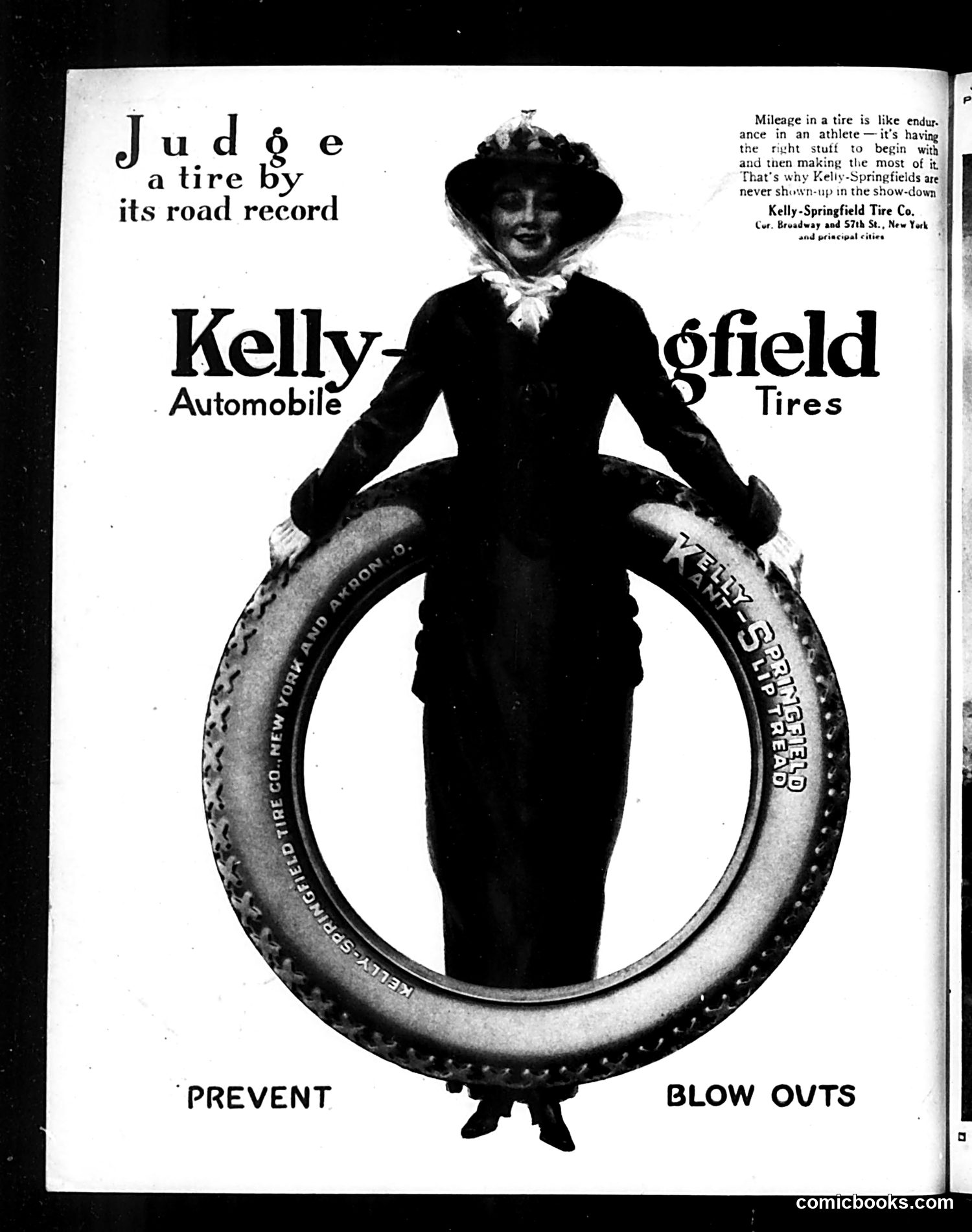
This is primarily a **tire advertisement**, not political satire. The page promotes Kelly-Springfield automobile tires using a stylized illustration of a fashionably dressed woman posed inside a large tire. The ad's messaging compares tire durability to athletic endurance—both require "the right stuff to begin with" and proper maintenance. The central claim is that Kelly-Springfield tires "prevent blow outs," a significant practical concern for early automobiles with unreliable tires. The elegant woman in period dress (appears to be 1910s-1920s fashion) serves as an aspirational figure suggesting that quality tires are associated with refinement and reliability. The company's location—"Broadway and 57th St., New York and principal cities"—emphasizes urban, metropolitan credibility. This reflects early automotive advertising's emphasis on tire safety and durability as primary selling points to consumers still skeptical about automobile reliability.