
Judge, 1914-01-03 · page 4 of 24
Judge — January 3, 1914 — page 4: what you’re looking at
What you’re looking at
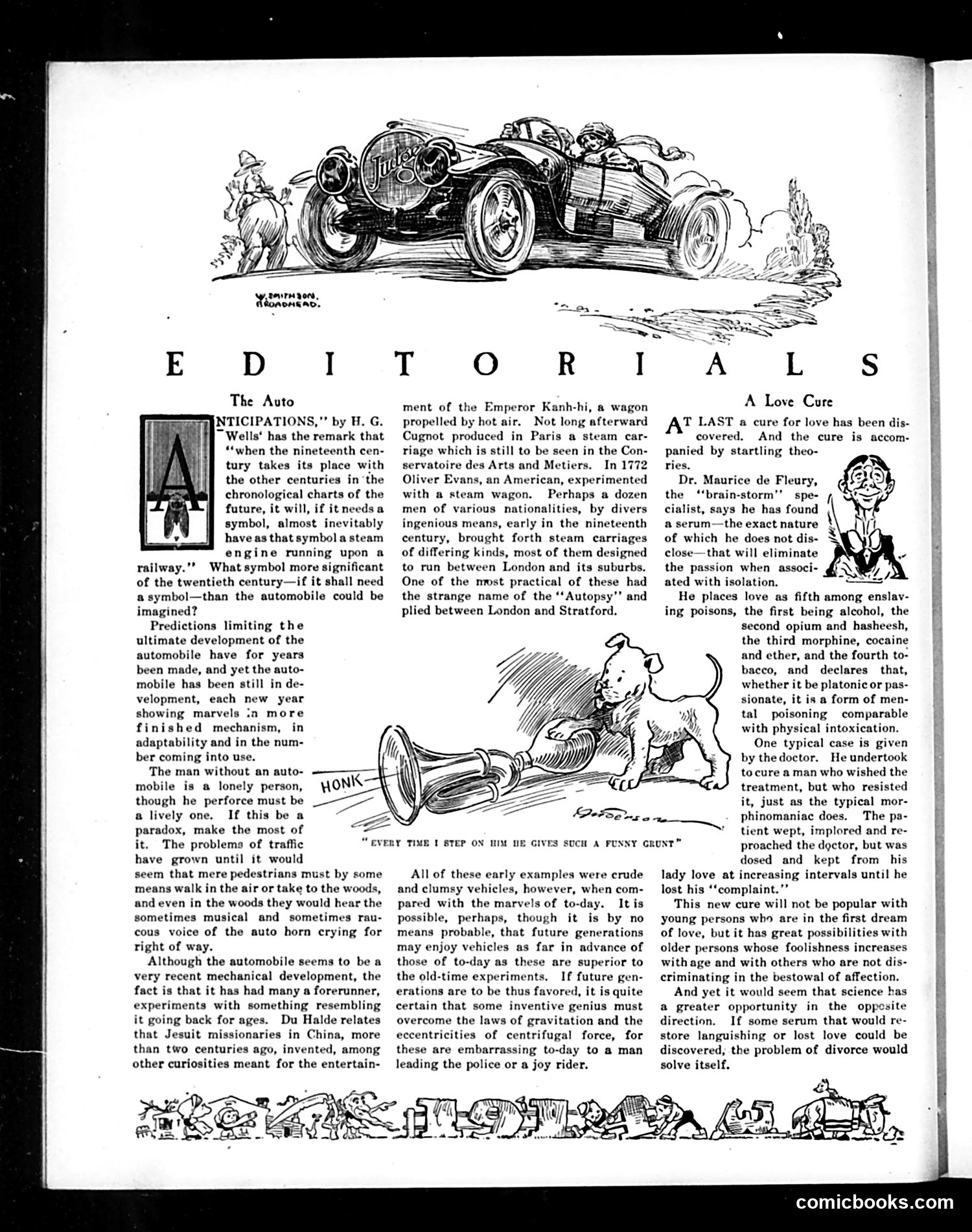
This page contains two distinct pieces: **"The Auto"** (left): H.G. Wells's essay reflects on the automobile as the twentieth century's defining symbol—comparing it to the steam engine's role in the nineteenth. Wells discusses the auto's evolution from crude early vehicles to modern marvels, noting its transformative impact on society. He addresses traffic problems and pedestrian safety concerns while celebrating mechanical progress. **"A Love Cure"** (right): A satirical medical piece by Dr. Maurice de Fleury claims to have discovered a love cure through enslaving poisons (opium, hashish, cocaine, tobacco, alcohol). The absurdist humor mocks pseudoscientific medical fads and questionable treatments of the era. The cartoon of a horn-honking dog illustrates automotive culture's intrusive novelty in urban life.
📄 Transcribed text from this page (OCR, searchable)
Machine-transcribed from the original scan — historical spelling and the odd misread are preserved.
Colttad HEAD. D sid The Auto INTICIPATIONS,”"’ by H. G. ~ Wells‘ has the remark that “when the nineteenth cen- tury takes its place with the other centuries inthe chronological charts of the future, it will, if itneedsa symbol, almost inevitably have as that symbol a steam engine running upon a railway.’? What symbol more significant of the twentieth century—if it shall need asymbol—than the automobile could be imagined? Predictions limiting the ultimate development of the automobile have for years been made, and yet the auto- mobile has been still in de- velopment, each new year showing marvels :n more finished mechanism, in adaptability and in the num- ber coming into use. The man without an auto- mobile is a lonely person, though he perforce must be a lively one. If this be a paradox, make the most of it. The problems of traffic have grown until it would seem that mere pedestrians must by some means walk in the air or take to the woods, and even in the woods they would hear the sometimes musical and sometimes rau- cous voice of the auto horn crying for right of way. Although the automobile seems to be a very recent mechanical development, the fact is that it has had many a forerunner, experiments with something resembling it going back for ages. Du Halde relates that Jesuit missionaries in China, more than two centuries ago, invented, among other curiosities meant for the entertain- T O R ment of the Emperor Kanh-hi, a wagon propelled by hot air. Not long afterward Cugnot produced in Paris a steam car- riage which is still to be seen in the Con- servatoire des Arts and Metiers. In 1772 Oliver Evans, an American, experimented with a steam wagon. Perhaps a dozen men of various nationalities, by divers ingenious means, early in the nineteenth century, brought forth steam carriages of differing kinds, most of them designed to run between London and its suburbs. One of the mmst practical of these had the strange name of the ‘‘Autopsy”’ and plied between London and Stratford. “EVERY TIME I STEP ON HIM HE GIVES SUCH A PUNNY GRUNT” All of these early examples were crude and clumsy vehicles, however, when com- pared with the marvels of to-day. Itis possible, perhaps, though it is by no means probable, that future generations may enjoy vehicles as far in advance of those of to-day as these are superior to the old-time experiments. If future gen- erations are to be thus favored, it is quite certain that some inventive genius must overcome the laws of gravitation and the eccentricities of centrifugal force, for these are embarrassing to-day to a man leading the police or a joy rider. S A Love Cure T LAST a cure for love has been dis- covered. And the cure is accom- panied by startling theo- AS d28 7 the “‘brain-storm'’ spe- , c t, says he has found a serum—the exact nature of which he does not dis- close—that will eliminate the passion when associ- ated with isolation, He places love as fifth among enslav- ing poisons, the first being alcohol, the second opium and hasheesh, the third morphine, cocaine and ether, and the fourth to- bacco, and declares that, whether it be platonic or pas- sionate, it is a form of men- tal poisoning comparable with physical intoxication. One typical case is given by thedoctor. He undertook tocure a man who wished the treatment, but who resisted it, just as the typical mor- phinomaniac does. The pa- tient wept, implored and re- proached the doctor, but was dosed and kept from his lady love at increasing intervals until he lost his ‘‘complaint.”” This new cure will not be popular with young persons who are in the first dream of love, but it has great possibilities with older persons whose foolishness increases with age and with others who are not dis- criminating in the bestowal of affection. And yet it would seem that science has a greater opportunity in the oppesite direction. If some serum that would re- store languishing or lost love could be discovered, the problem of divorce would solve itself. ries. Ns Dr. Maurice de Fleury, We ——, comicbooks.com