
Judge, 1914-01-03 · page 12 of 24
Judge — January 3, 1914 — page 12: what you’re looking at
What you’re looking at
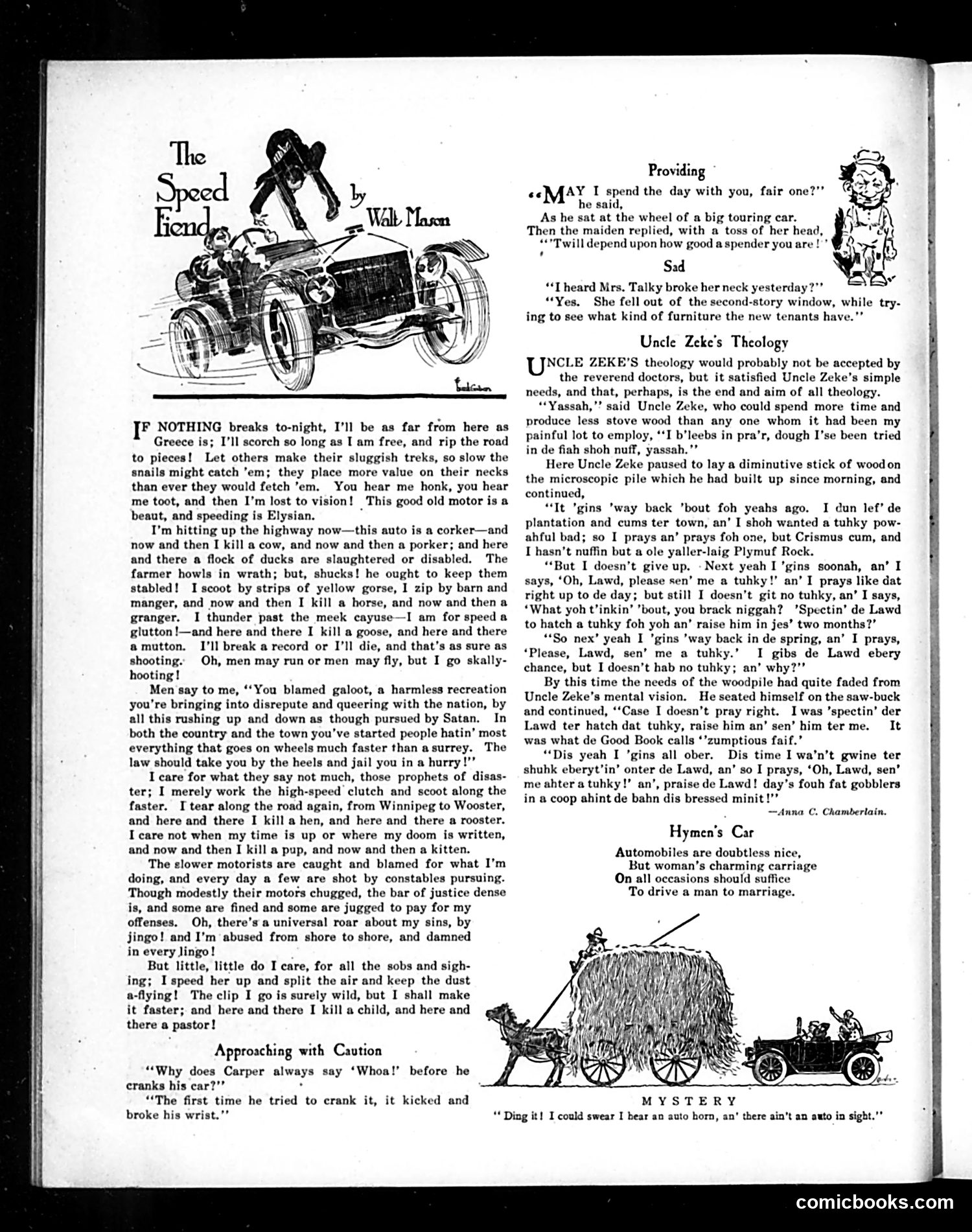
This page satirizes the emerging danger of reckless automobile drivers in early 20th-century America. The main story, "The Speed Fiend" by Walt Mason, mocks a driver who boasts of dangerously speeding, killing livestock and pedestrians (including a child and pastor) while dismissing all criticism and legal consequences. The satire targets both the driver's arrogance and society's struggle with automobiles—a new technology causing deaths and social disruption. The smaller anecdotes reinforce the theme: drivers causing accidents, women interested only in wealthy suitors with cars, and jokes about automobile dangers. The humor is dark by modern standards, treating deaths casually to emphasize how recklessly some early motorists drove and how unprepared society was for automotive fatalities. This was topical satire responding to real contemporary concerns about unregulated speeding and inadequate traffic laws.
📄 Transcribed text from this page (OCR, searchable)
Machine-transcribed from the original scan — historical spelling and the odd misread are preserved.
F NOTHING breaks to-night, I'll be as far from here as Greece is; I'll scorch so long as I am free, and rip the road to pieces! Let others make their sluggish treks, so slow the snails might catch ’em; they place more value on their necks than ever they would fetch ’em. You hear me honk, you hear me toot, and then I’m lost to vision! This good old motor is a beaut, and speeding is Elysian. . I'm hitting up the highway now—this auto is a corker—and now and then I kill a cow, and now and then a porker; and here and there a flock of ducks are slaughtered or disabled. The farmer howls in wrath; but, shucks! he ought to keep them stabled! I scoot by strips of yellow gorse, I zip by barn and manger, and now and then I kill a horse, and now and then a granger. I thunder past the meek cayuse—I am for speed a glutton !—and here and there I kill a goose, and here and there amutton. I'll break a record or I'll die, and that’s as sure as shooting. Oh, men may run or men may fly, but I go skally- hooting! Men say to me, ‘‘You blamed galoot, a harmless recreation you're bringing into disrepute and queering with the nation, by all this rushing up and down as though pursued by Satan. In both the country and the town you've started people hatin’ most everything that goes on wheels much faster than a surrey. The law should take you by the heels and jail you in a hurry !"’ I care for what they say not much, those prophets of disas- ter; I merely work the high-speed clutch and scoot along the faster. I tear along the road again, from Winnipeg to Wooster, and here and there I kill a hen, and here and there a rooster. I care not when my time is up or where my doom is written, and now and then I kill a pup, and now and then a kitten. The slower motorists are caught and blamed for what I'm doing, and every day a few are shot by constables pursuing. Though modestly their motors chugged, the bar of justice dense is, and some are fined and some are jugged to pay for my offenses. Oh, there’s a universal roar about my sins, by jingo! and I’m abused from shore to shore, and damned in every lingo! But little, little do I care, for all the sobs and sigh- ing; I speed her up and split the air and keep the dust a-flying! The clip I go is surely wild, but I shall make it faster; and here and there I kill a child, and here and there a pastor! Approaching with Caution “Why does Carper always say ‘Whoa!’ before he cranks his car?’’ “The first time he tried to crank it, it kicked and broke his wrist." Providing Y I spend the day with you, fair one?’ he said, «MA As he sat at the wheel of a big touring car. Then the maiden replied, with a toss of her head, “-Twill depend upon how good a spender you are ! rig Sad “T heard Mrs. Talky broke her neck yesterday?” “Yes. She fell out of the second-story window, while try- ing to see what kind of furniture the new tenants have." Uncle Zeke's Theology NCLE ZEKE’S theology would probably not be accepted by the reverend doctors, but it satisfied Uncle Zeke’s simple needs, and that, perhaps, is the end and aim of all theology. “Yassah,’’ said Uncle Zeke, who could spend more time and produce less stove wood than any one whom it had been my painful lot to employ, “I b’leebs in pra’r, dough I’se been tried in de fiah shoh nuff, yassah.’’ Here Uncle Zeke paused to lay a diminutive stick of woodon the microscopic pile which he had built up since morning, and continued, “It "gins "way back ‘bout foh yeahs ago. I dun lef’ de plantation and cums ter town, an’ I shoh wanted a tuhky pow- ahful bad; so I prays an’ prays foh one, but Crismus cum, and I hasn’t nuffin but a ole yaller-laig Plymuf Rock. “But I doesn’t give up. -Next yeah I 'gins soonah, an’ I says, ‘Oh, Lawd, please sen’ me a tuhky!’ an’ I prays like dat right up to de day; but still I doesn’t git no tuhky, an’ I says, ‘What yoh t’inkin’ ’bout, you brack niggah? 'Spectin’ de Lawd to hatch a tuhky foh yoh an’ raise him in jes’ two months?’ “So nex’ yeah I ’gins ’way back in de spring, an’ I prays, ‘Please, Lawd, sen’ me a tuhky I gibs de Lawd ebery chance, but I doesn’t hab no tuhky; an’ why?’’ By this time the needs of the woodpile had quite faded from Uncle Zeke’s mental vision. He seated himself on the saw-buck and continued, ‘‘Case I doesn’t pray right. I was ’spectin’ der Lawd ter hatch dat tuhky, raise him an’ sen’ him terme. It was what de Good Book calls ‘’zumptious faif.’ “Dis yeah I ‘gins all ober. Dis time I wa’n’t gwine ter shuhk eberyt’in’ onter de Lawd, an’ so I prays, ‘Oh, Lawd, sen’ me ahter a tuhky!’ an’, praise de Lawd! day’s fouh fat gobblers in a coop ahint de bahn dis bressed minit!’’ Anna C. Chamberlain. Hymen’s Car Automobiles are doubtless nice, But woman’s charming carriage On all occasions should suffice To drive a man to marriage. MYSTERY “* Ding it! I could swear I bear an auto horn, an’ there ain't an auto in sight.’" comicbooks.com