
Judge, 1914-01-03 · page 8 of 24
Judge — January 3, 1914 — page 8: what you’re looking at
What you’re looking at
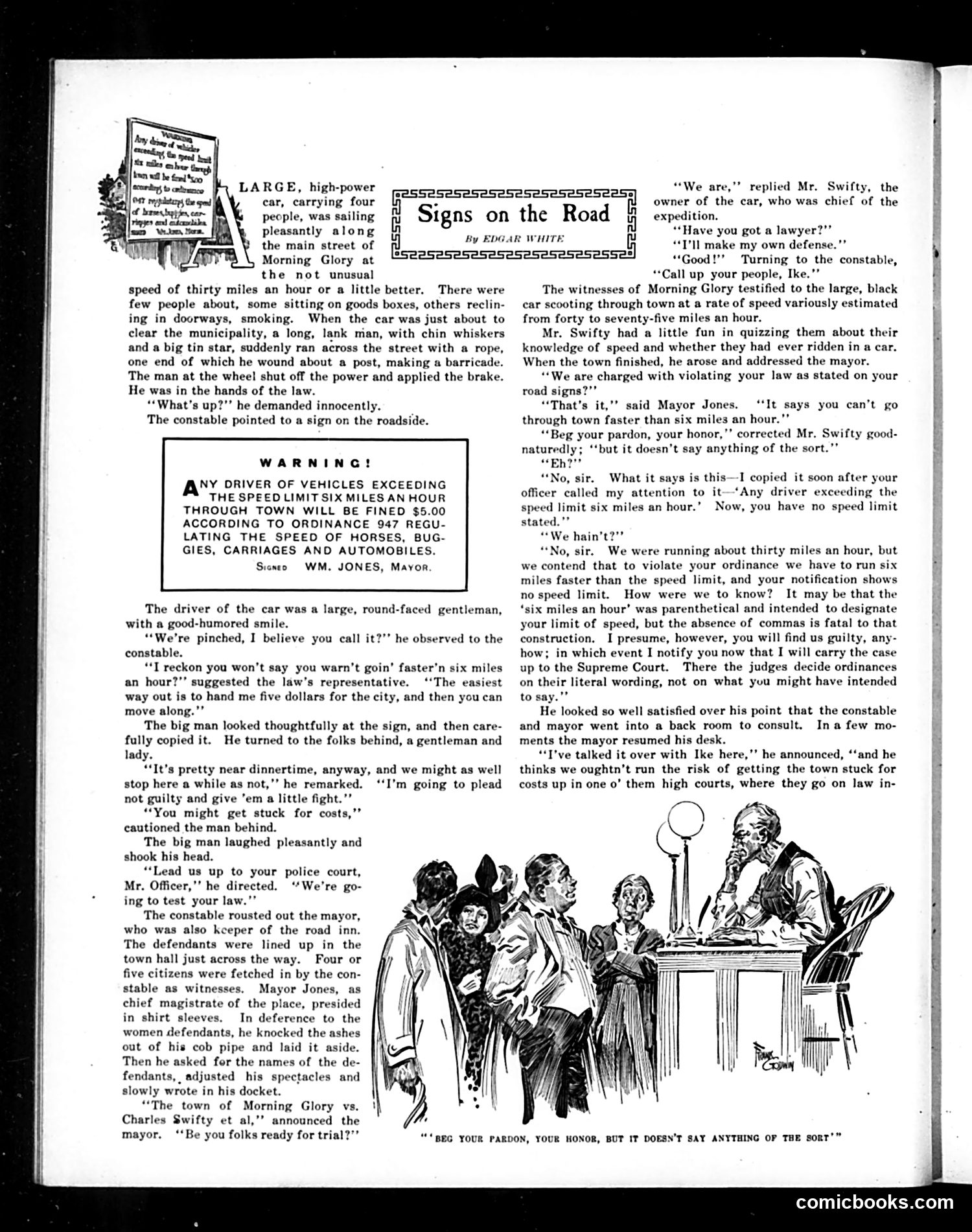
This story satirizes small-town America's ad-hoc speed enforcement during the early automobile era. A wealthy motorist ("Mr. Swifty") is stopped by a constable in the fictional town of Morning Glory for exceeding a six-mile-per-hour speed limit. The satire targets corrupt local governance: the mayor doubles as innkeeper and judge, witnesses give wildly inconsistent accounts (40-75 mph), and the constable tries extracting a $5 bribe. Swifty outsmarts them by literally reading the town ordinance, which regulates "horses, buggies, carriages and automobiles" but fails to specify that automobiles must obey the limit—an oversight reflecting how hastily rural towns adapted old horse-and-buggy laws to the new technology. The humor mocks small-town officials' incompetence and greed, while celebrating the clever motorist's legal victory. It reflects contemporary anxieties about automobiles disrupting rural communities and the law's struggle to address them.
📄 Transcribed text from this page (OCR, searchable)
Machine-transcribed from the original scan — historical spelling and the odd misread are preserved.
LARGE, high-power ear, carrying four people, was sailing pleasantly along the main street of Bee Morning Glory at the not unusual speed of thirty miles an hour or a little better. There were few people about, some sitting on goods boxes, others reclin- ing in doorways, smoking. When the car was just about to clear the municipality, a long, lank man, with chin whiskers and a big tin star, suddenly ran across the street with a rope, one end of which he wound about a post, making a barricade. The man at the wheel shut off the power and applied the brake. He was in the hands of the law. “*What’s up?’’ he demanded innocently. The constable pointed to a sign on the roadside. WARNING! ANY DRIVER OF VEHICLES EXCEEDING THE SPEED LIMIT SIX MILES AN HOUR THROUGH TOWN WILL BE FINED $5.00 ACCORDING TO ORDINANCE 947 REGU- LATING THE SPEED OF HORSES, BUG- GIES, CARRIAGES AND AUTOMOBILES. Siontco WM. JONES, Mayor. The driver of the car was a large, round-faced gentleman, with a good-humored smile. “We're pinched, I belie constable. “T reckon you won't say you warn’t goin’ faster’n six miles an hour?’’ suggested the law's representative. ‘‘The easiest way out is to hand me five dollars for the city, and then you can move along.’” The big man looked thoughtfully at the sign, and then care- fully copied it. He turned to the folks behind, a gentleman and lady. “It’s pretty near dinnertime, anyway, and we might as well stop here a while as not,’’ he remarked. ‘‘I’m going to plead not guilty and give 'em a little fight.’’ “You might get stuck for costs,” cautioned the man behind. The big man laughed pleasantly and shook his head. “Lead us up to your police court, Mr. Officer,"’ he directed. ‘*We’re go- ing to test your law." The constable rousted out the mayor, who was also kceper of the road inn. The defendants were lined up in the town hall just across the way. Four or five citizens were fetched in by the con- stable as witnesses, Mayor Jones, as chief magistrate of the place, presided in shirt sleeves. In deference to the women defendants, he knocked the ashes out of his cob pipe and laid it aside. Then he asked for the names of the de- fendants, adjusted his spectacles and slowly wrote in his docket. “The town of Morning Glory vs. Charles Swifty et al,’’ announced the mayor. ‘Be you folks ready for trial?” you call it?’’ he observed to the F Signs on the Road By EDGAR WHITE “* BEG YOUR PARDON, YOUR HONOR, BUT IT DOESN'T SAY ANYTHING OP THE soRT’” “We are,’’ replied Mr. Swifty, the owner of the car, who was chief of the expedition, “Have you got a lawyer?” gol] {I'll make my own defense." “Good!’’ Turning to the constable, “Call up your people, Ike.’’ The witnesses of Morning Glory testified to the large, black car scooting through town at a rate of speed variously estimated from forty to seventy-five miles an hour. Mr. Swifty had a little fun in quizzing them about their knowledge of speed and whether they had ever ridden in a car. When the town finished, he arose and addressed the mayor. “We are charged with violating your law as stated on your road signs?”’ “That's it,’’ said Mayor Jones. ‘‘It says you can’t go through town faster than six miles an hour.’* “Beg your pardon, your honor,”’ corrected Mr. Swifty good- naturedly; ‘‘but it doesn’t say anything of the sort. Eh?" “No, sir. What it says is this—I copied it soon after your officer called my attention to it—‘Any driver exceeding the speed limit six miles an hour.’ Now, you have no speed limit stated.’” “We hain’t?”’ “No, sir. We were running about thirty miles an hour, but we contend that to violate your ordinance we have to run six miles faster than the speed limit, and your notification shows no speed limit. How were we to know? It may be that the ‘six miles an hour’ was parenthetical and intended to designate your limit of speed, but the absence of commas is fatal to that construction. I presume, however, you will find us guilty, any- how; in which event I notify you now that I will carry the case up to the Supreme Court. There the judges decide ordinances on their literal wording, not on what you might have intended to say." He looked so well satisfied over his point that the constable and mayor went into a back room to consult, Ina few mo- ments the mayor resumed his desk. “T've talked it over with Ike here,’’ he announced, ‘‘and he thinks we oughtn’t run the risk of getting the town stuck for costs up in one o’ them high courts, where they go on law in- f i comicbooks.com