
A complete issue · 24 pages · 1913
Judge — September 13, 1913
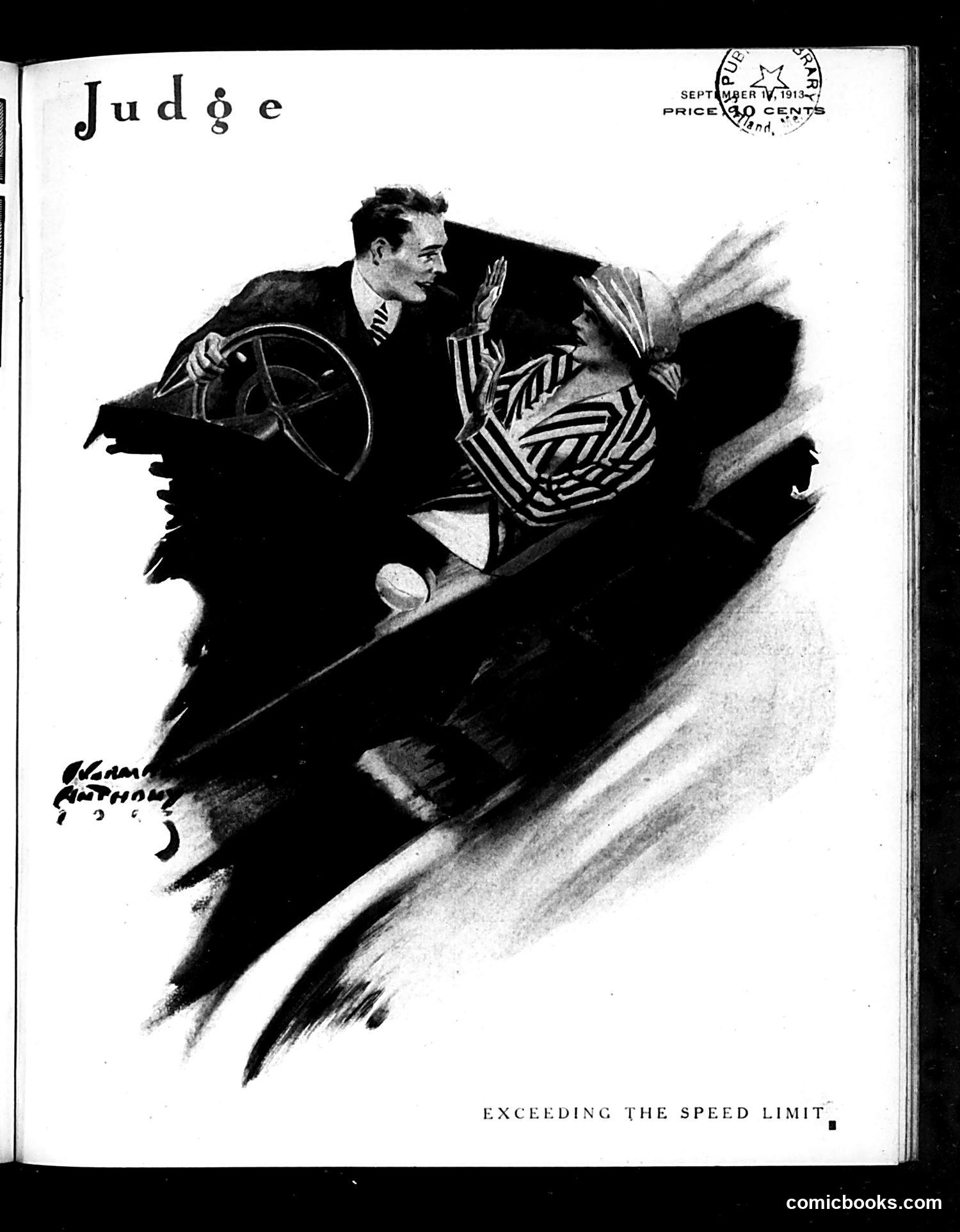
This Judge magazine cover (September 1914) satirizes reckless driving through a striking silhouette composition. A well-dressed man in a suit drives an automobile at dangerous speed while a fashionably-dressed woman passenger appears alarmed, her hat and scarf flying dramatically in the wind. The large profile silhouette of what appears to be an angry or stern face looms behind them—likely representing the law or authority figure they're violating. The satire targets the emerging problem of automobile speeding in early 20th-century America, when speed limits were new and motorists frequently ignored them. The cartoon suggests that wealthy, fashionable people treated traffic laws cavalierly, endangering themselves and others. The exaggerated silhouette technique emphasizes both the velocity and the moral judgment inherent in lawbreaking.
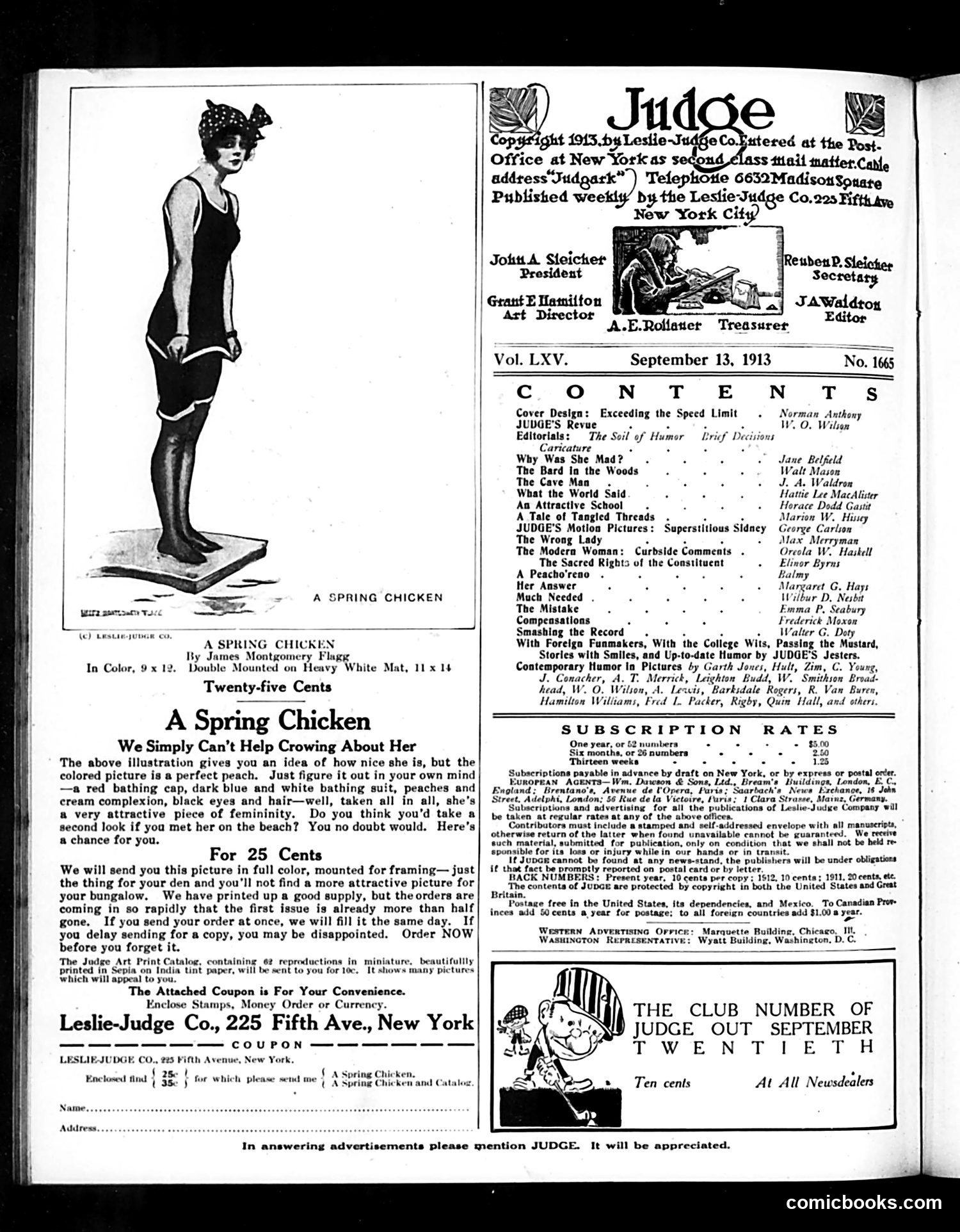
This page is primarily **advertising and editorial content** rather than political satire. The main illustration shows a young woman in a bathing suit standing on a pedestal, titled "A Spring Chicken." The accompanying text is a sales pitch: Leslie-Judge Co. offers a colored reproduction of this illustration for 25 cents, marketed to readers as decoration for homes or bungalows. The phrase "spring chicken" (meaning a young, attractive woman) was contemporary slang. The page includes the magazine's masthead, subscription rates, and contributor credits. The bottom features an advertisement for "The Club Number of Judge" (September 20th issue) at ten cents. This represents typical early 20th-century magazine content—mixing humor, pin-up style imagery, and commercial appeals to readers.
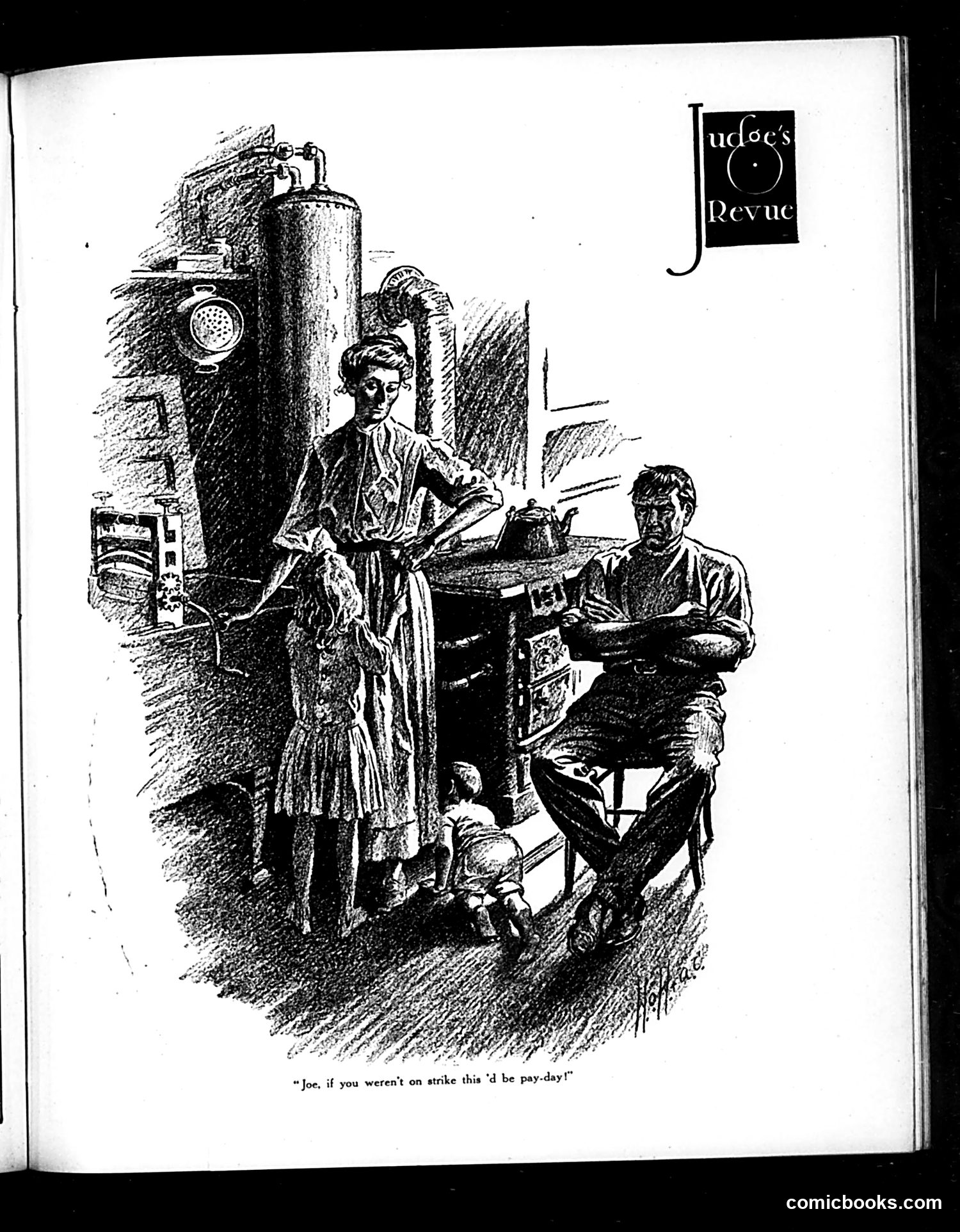
This cartoon from **Judge's Revue** section satirizes labor strike negotiations. The caption reads: "Joe, if you weren't on strike this 'd be pay-day!" The scene depicts an industrial setting with a large cylindrical tank (possibly a boiler or factory equipment) in the background. A woman stands centrally—apparently "Joe's" wife or partner—speaking to a man seated on the right, likely representing a worker or union member. A small child is also present. The satire targets **striking workers**, suggesting that labor strikes result in lost wages and hardship for workers' families. The implication is that strikers sacrifice their immediate paychecks, making the strike economically painful for households. This reflects Judge's typically **pro-business, anti-labor stance** during the early-to-mid 20th century labor movement.
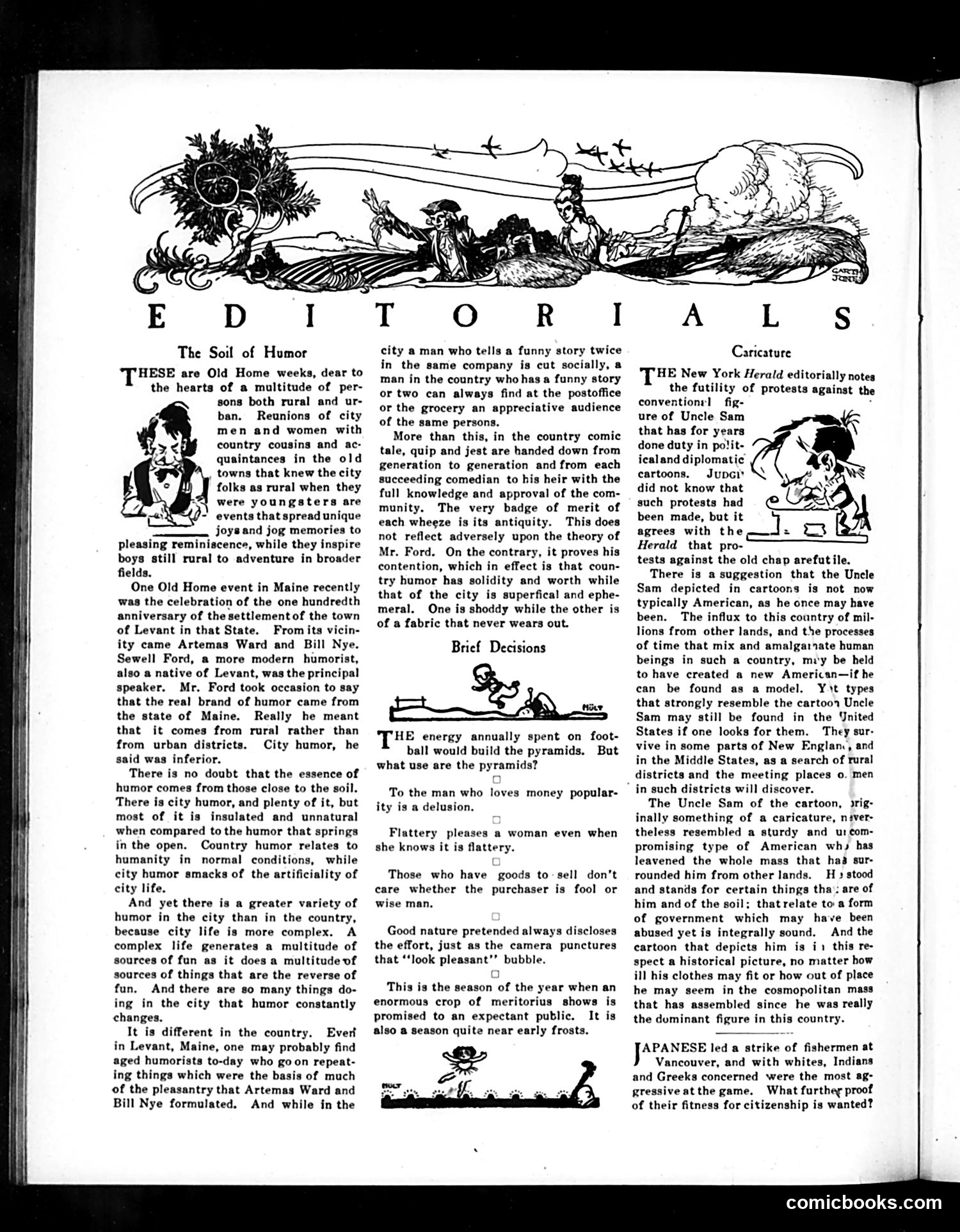
This page from *Judge* magazine features editorial commentary and brief satirical observations. The main content includes: **"The Soil of Humor"** - A essay arguing that rural/country humor is superior to urban humor because it's rooted in genuine human experience rather than artificiality. The author claims country humor has "greater variety" and relates to real life, while city humor relies on superficial wit. **"Brief Decisions"** - Short satirical quips about contemporary social issues, including observations on money-loving men, flattery, and seasonal topics. **"Caricature"** - A note defending *Judge's* Uncle Sam cartoon character as representing authentic Americana, arguing the figure has legitimately evolved over time. The illustrations appear to be decorative vignettes supporting these humor-focused pieces, typical of *Judge's* satirical style from this era (appears early 20th century based on typography and aesthetic).
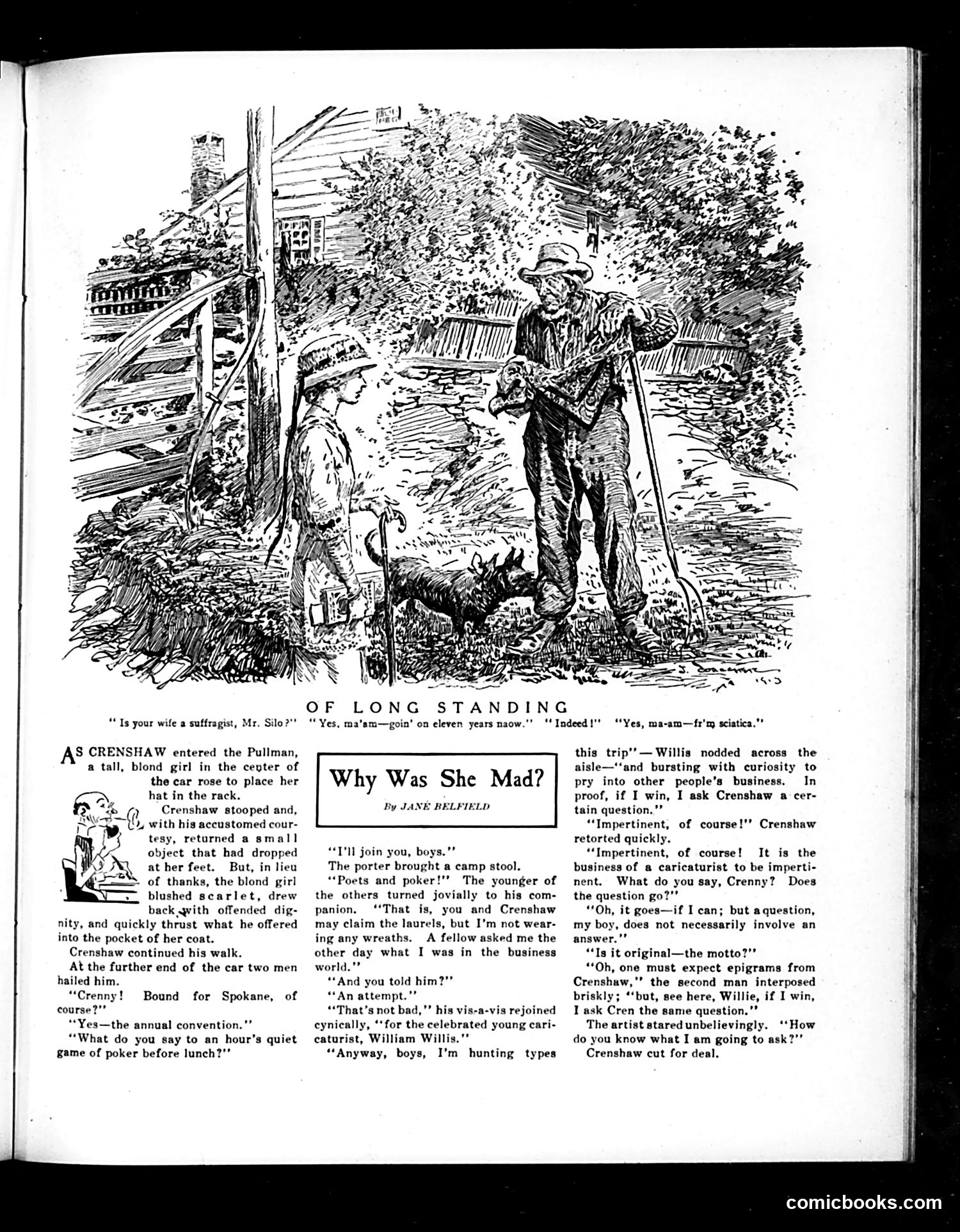
This page contains two separate stories. The top illustration depicts a rural scene with a man and woman discussing a long-standing disagreement—likely about the man's wife being "a suffragis." The main story, "Why Was She Mad?" by Jane Belfield, concerns a character named Crenshaw on a train to Spokane. At the annual convention, Crenshaw encounters a blonde woman and other men discussing "the celebrated young caricaturist, William Willis." The humor hinges on someone asking an impertinent question. Crenshaw, described as a caricaturist himself, decides to "cut for deal"—suggesting a card game or competition will determine the outcome. The story mocks social awkwardness and professional rivalry among artists, with the woman's anger presumably stemming from an insulting question or perceived slight.
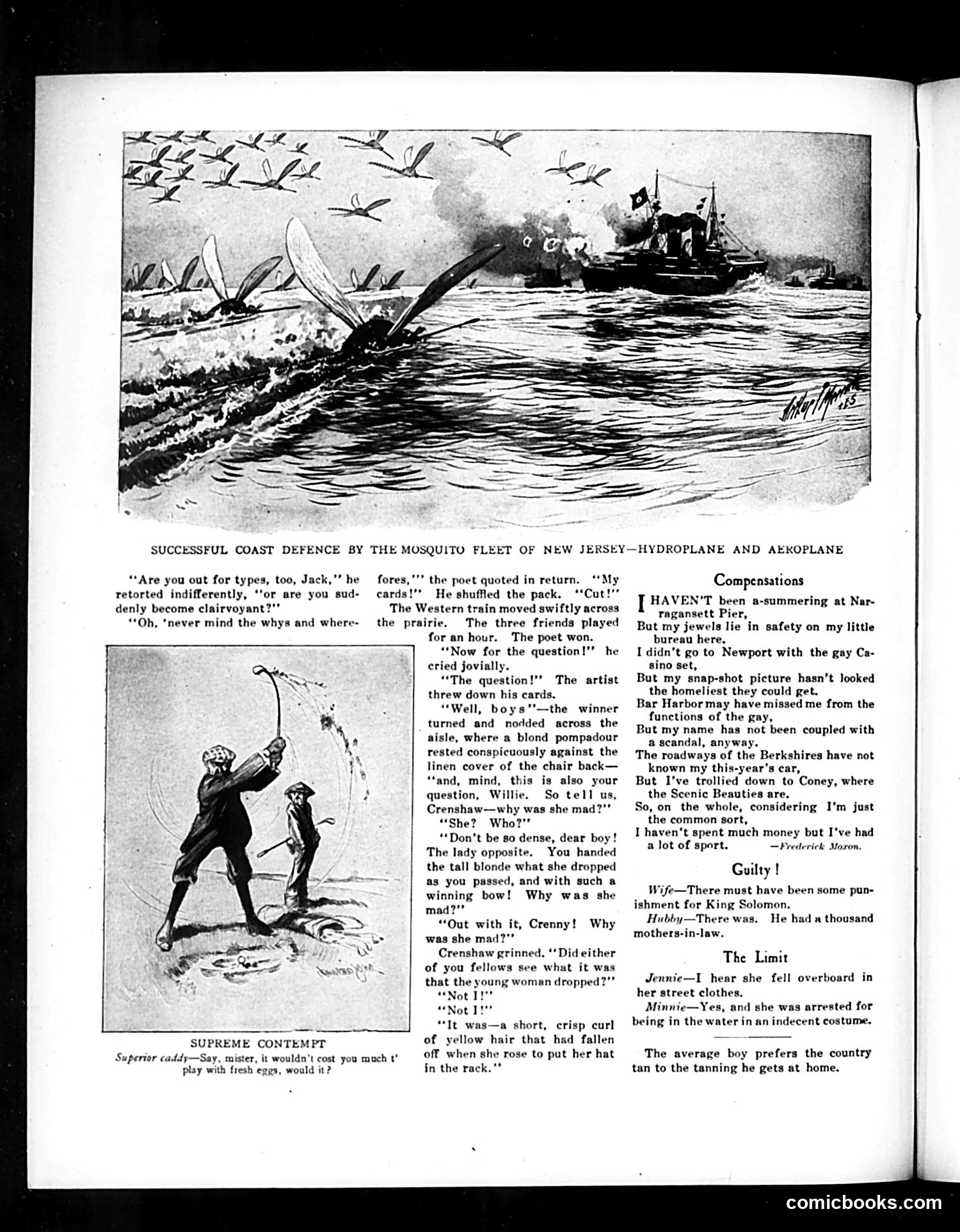
This Judge magazine page contains multiple unrelated pieces of humor typical of early 20th-century satire. **Top cartoon**: "Successful Coast Defence by the Mosquito Fleet of New Jersey" is political satire about coastal defense, likely referencing contemporary naval anxieties or military preparedness debates. The title ironically juxtaposes "mosquito fleet" (small, seemingly insignificant vessels) with actual warships shown in the illustration. **"Supreme Contempt"**: A golf caddy's quip about paying with fresh eggs—mocking either a wealthy golfer's stinginess or class pretension. **Main story**: Three train travelers play cards; the winner poses a riddle about why a blonde woman was offended when a man returned something she'd dropped. The punchline reveals it was a loose curl of hair—implying she was vain about her appearance or that her pompadour hairstyle was artificial. **Sidebar humor pieces**: Brief jokes about avoiding scandal by staying home, King Solomon's punishment being his many mothers-in-law, a woman arrested for swimming in street clothes, and boys preferring honest suntan to parental discipline. These reflect period concerns: fashion vanity, class distinctions, marital humor, and domestic discipline as comedy.
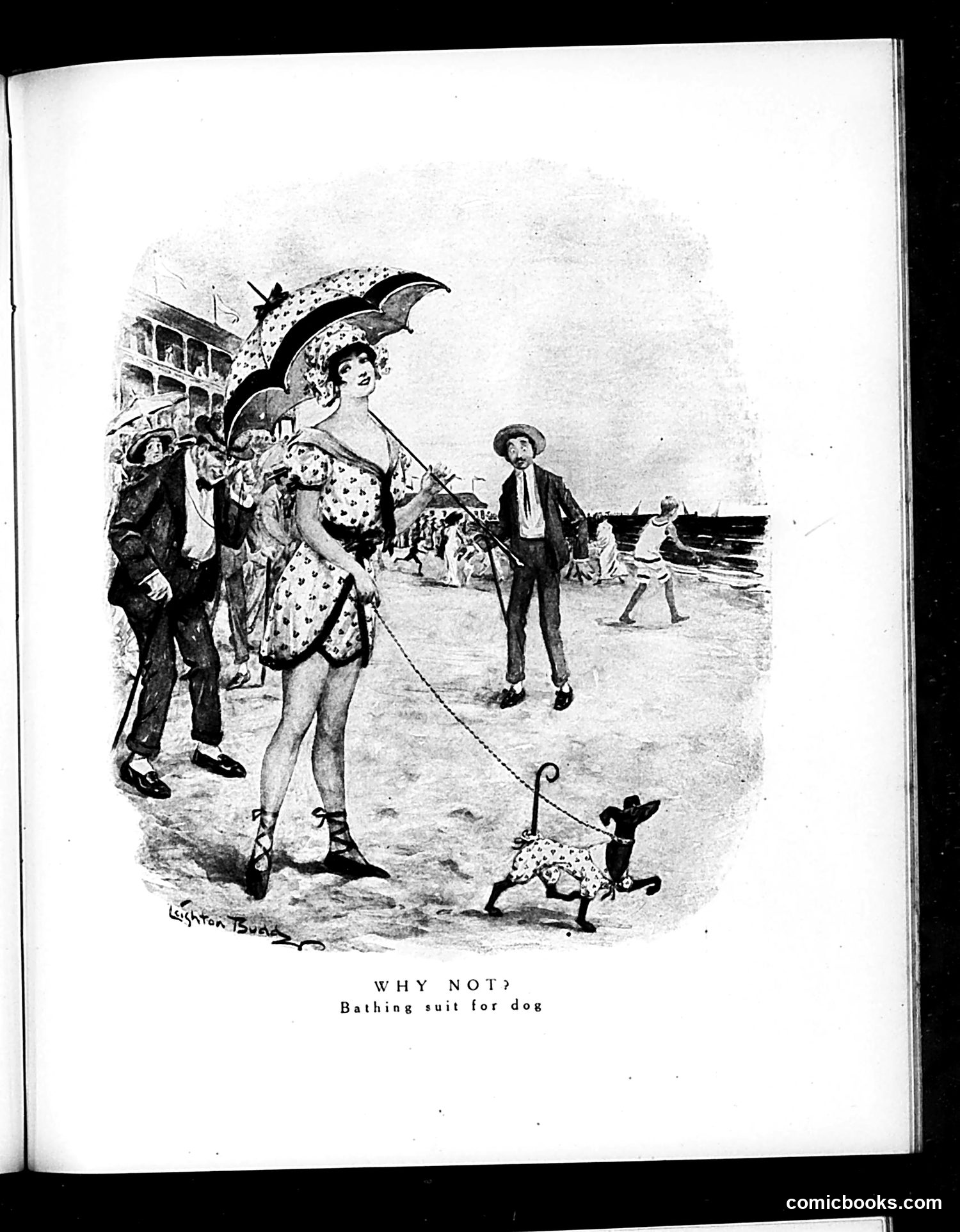
This is a straightforward fashion satire with no political content. The cartoon depicts a fashionable woman at the beach wearing a polka-dotted bathing suit and hat, walking a small dog that is also dressed in a matching polka-dotted bathing suit. The humor lies in the absurd proposition of the caption "WHY NOT? Bathing suit for dog"—mocking the tendency of wealthy or fashion-conscious owners to dress their pets in human clothing, mirroring their own outfits. This satirizes both excess consumerism and the affectation of treating dogs as fashion accessories rather than animals. The comic gently ridicules Edwardian-era vanity and the sometimes ridiculous extremes of haute couture culture.
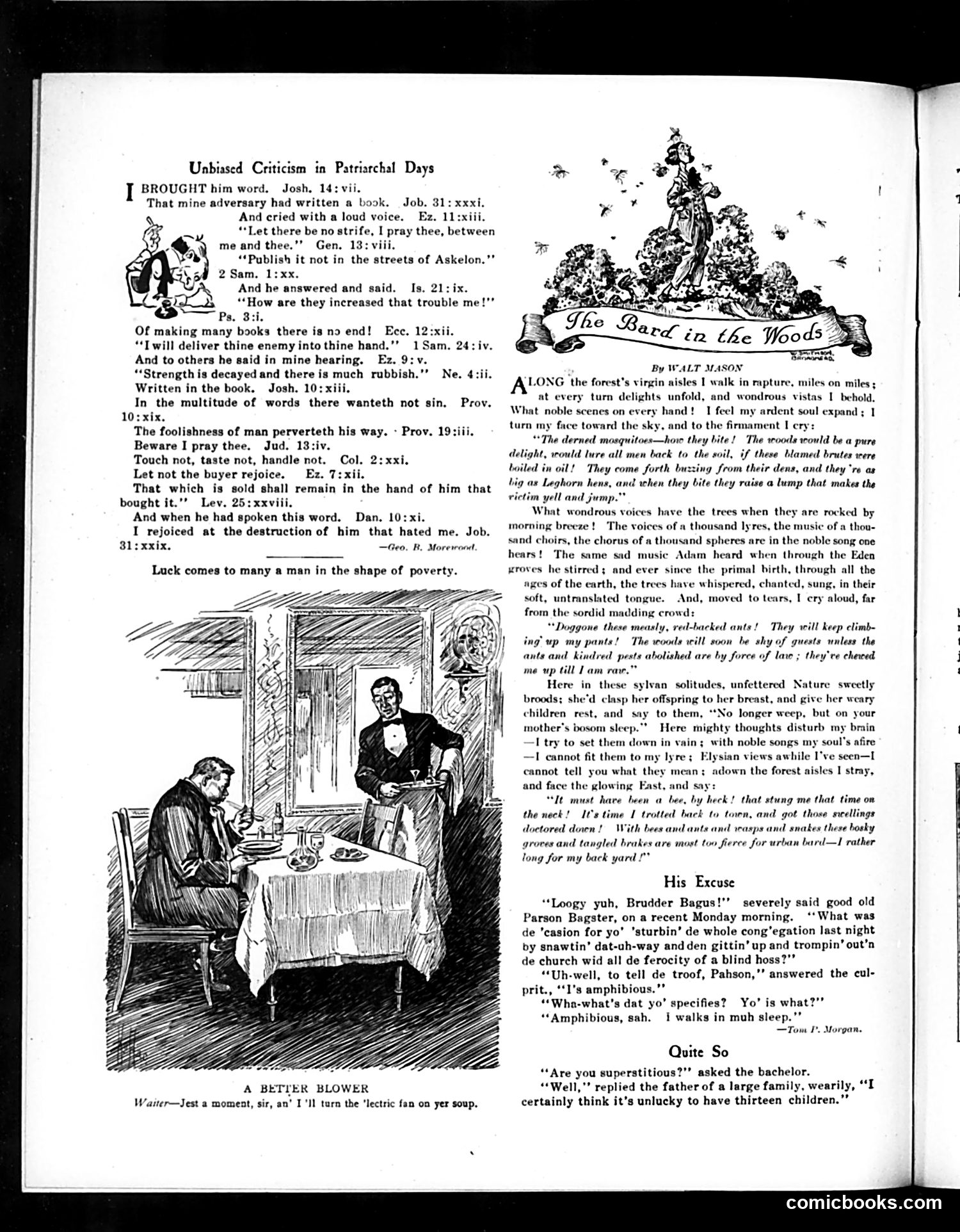
**Top Section - "Unbiased Criticism in Patriarchal Days":** This is satirical commentary on literary criticism, using biblical quotations (many misattributed or fabricated) to mock pedantic book reviewers. The piece ridicules critics who attack authors' works with excessive harshness, presenting their behavior as hypocritical and biblically unjustified. The closing line, "Luck comes to many a man in the shape of poverty," sarcastically suggests that being poor (and thus unable to publish) protects one from critical attack. **Illustration - "A Better Blower":** A waiter offers to operate an electric fan over a diner's soup. The joke plays on "blower" (fan) and suggests the absurd lengths service staff go to satisfy pretentious customers. **Right Column - Walt Mason's Poem:** Mason humorously describes nature's beauty while repeatedly interrupted by annoyances—mosquitoes, ants, and bees—that force him back to urban life. The satire targets romantic idealization of wilderness versus practical reality. **Bottom - "His Excuse" and "Quite So":** Brief comedic dialogues about disruptive church behavior and superstitions, respectively.
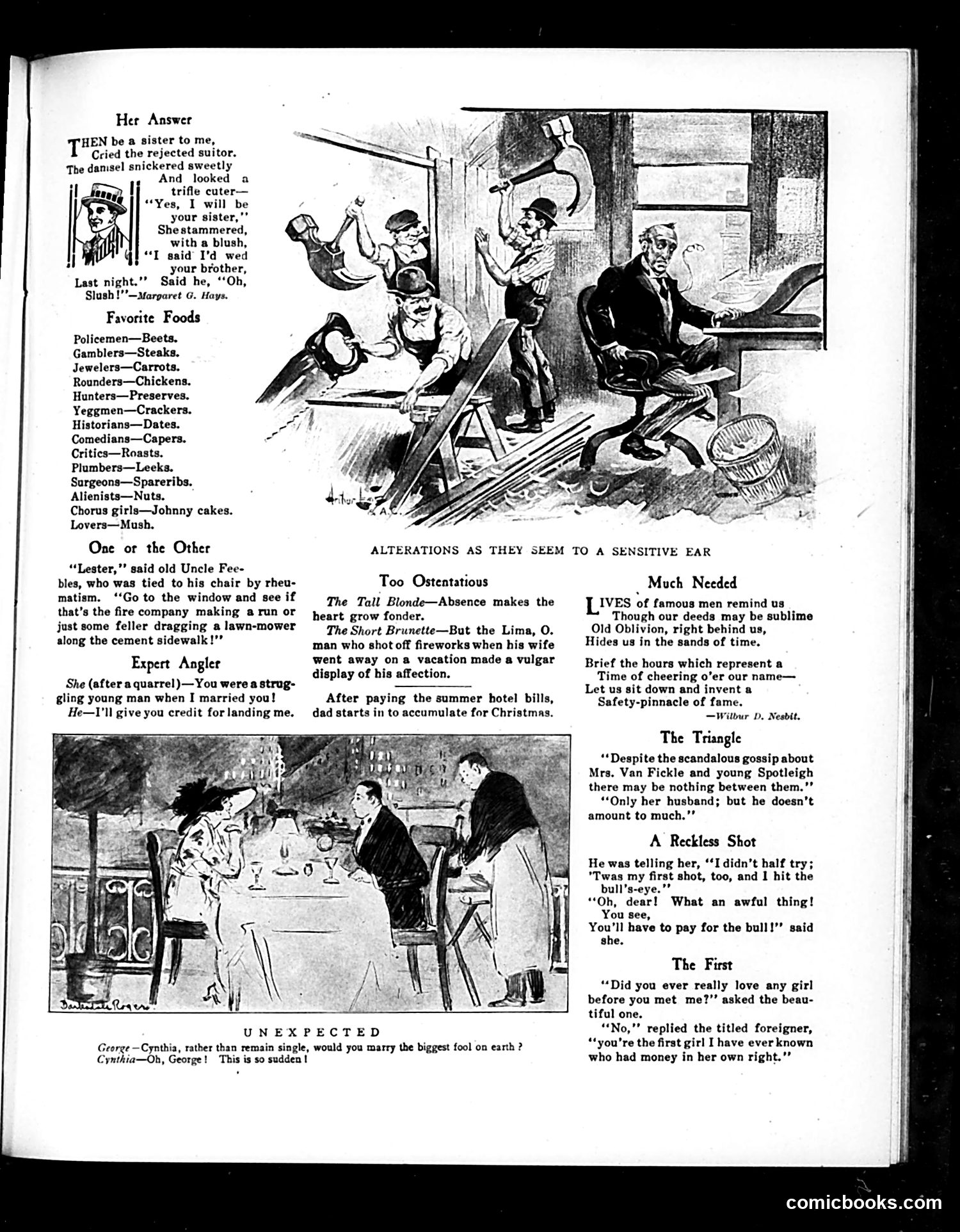
This page from the satirical magazine *Judge* contains multiple humor pieces typical of early-20th-century American comedy: **Top cartoon** depicts men in an office or workshop causing chaos—swinging from ropes and fixtures while a stern authority figure (likely a boss or supervisor) watches disapprovingly. The satire appears to mock workplace disorder or insubordination. **"Favorite Foods"** is a pun list associating professions with foods: "Policemen—Beets," "Gamblers—Steaks," etc. The humor relies on phonetic wordplay ("Historians—Dates," "Plumbers—Leeks"). **Multiple short jokes** mock romantic relationships and class dynamics: a rejected suitor's awkward pivot to "sister"; a woman crediting herself for "landing" her struggling husband; a foreign aristocrat admitting he only loves his girlfriend for her inherited wealth—satirizing mercenary marriages and social climbing. **Bottom cartoon** shows a formal dinner scene, likely illustrating one of these romantic/social scenarios, though details are unclear. The overall tone reflects period attitudes toward courtship, wealth, and workplace hierarchy with gentle, pun-based humor rather than sharp social critique.
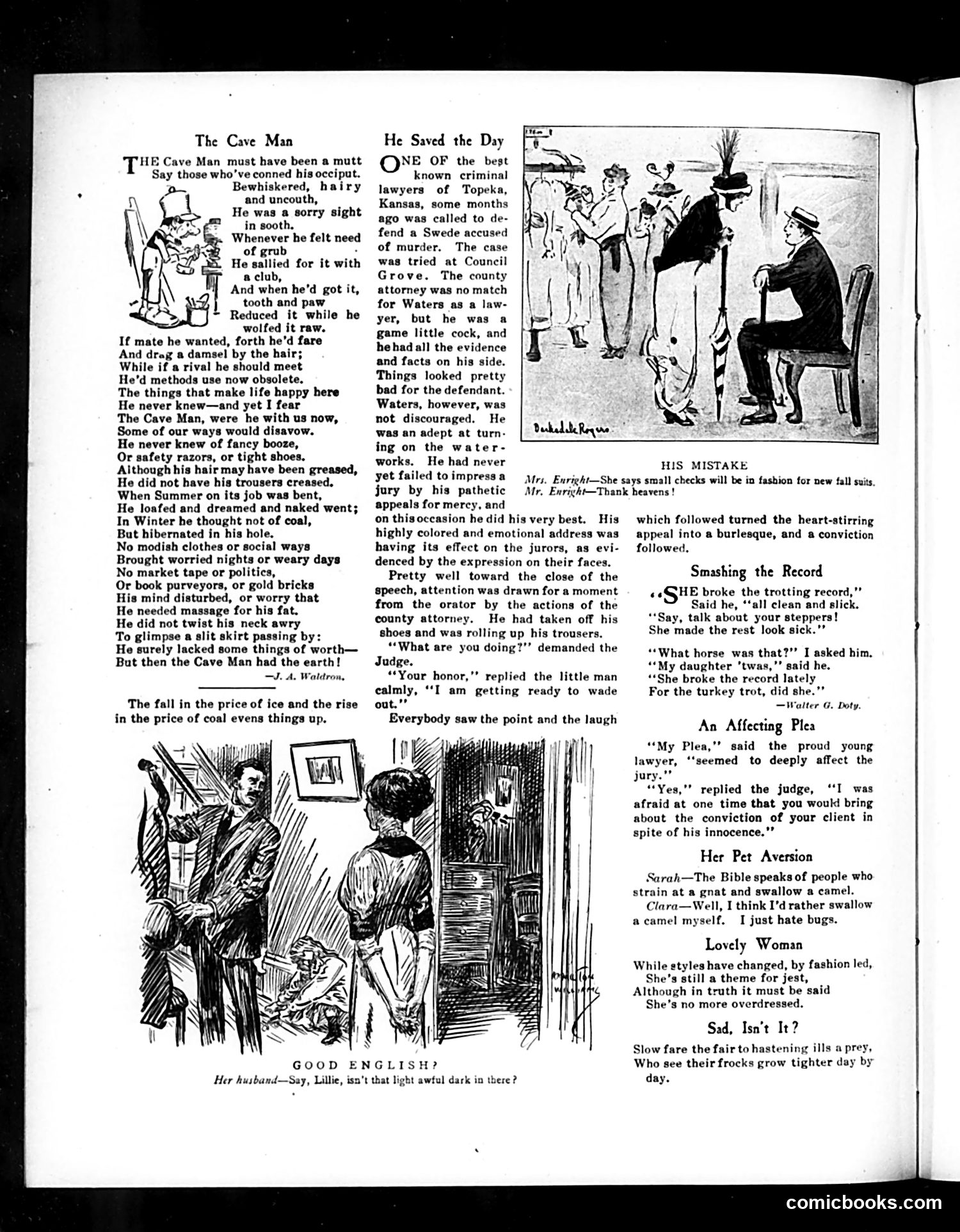
This page contains multiple brief satirical pieces typical of early 20th-century American humor journalism. **"The Cave Man"** is a poem contrasting primitive simplicity with modern anxieties—no fashion concerns, no stock market worries, no social climbing. The implicit critique: modern civilization, for all its progress, has burdened us with unnecessary stresses. **"He Saved the Day"** mocks a courtroom drama where a famous defense lawyer (Waters) relies on emotional manipulation ("turning on the water-works") to sway juries. The county attorney's joke—removing his shoes to "wade out" of the lawyer's overwrought sentimentality—deflates the appeal and costs the defendant a conviction through ridicule. **"Good English?"** features a domestic joke about ambiguous grammar regarding darkness. The remaining sections are brief satirical quips on fashion, a horse-racing anecdote, Biblical humor, and social commentary. The overall tone reflects Judge's formula: gentle mockery of modern manners, legal pretension, and fashion trends, aimed at educated, middle-class readers.
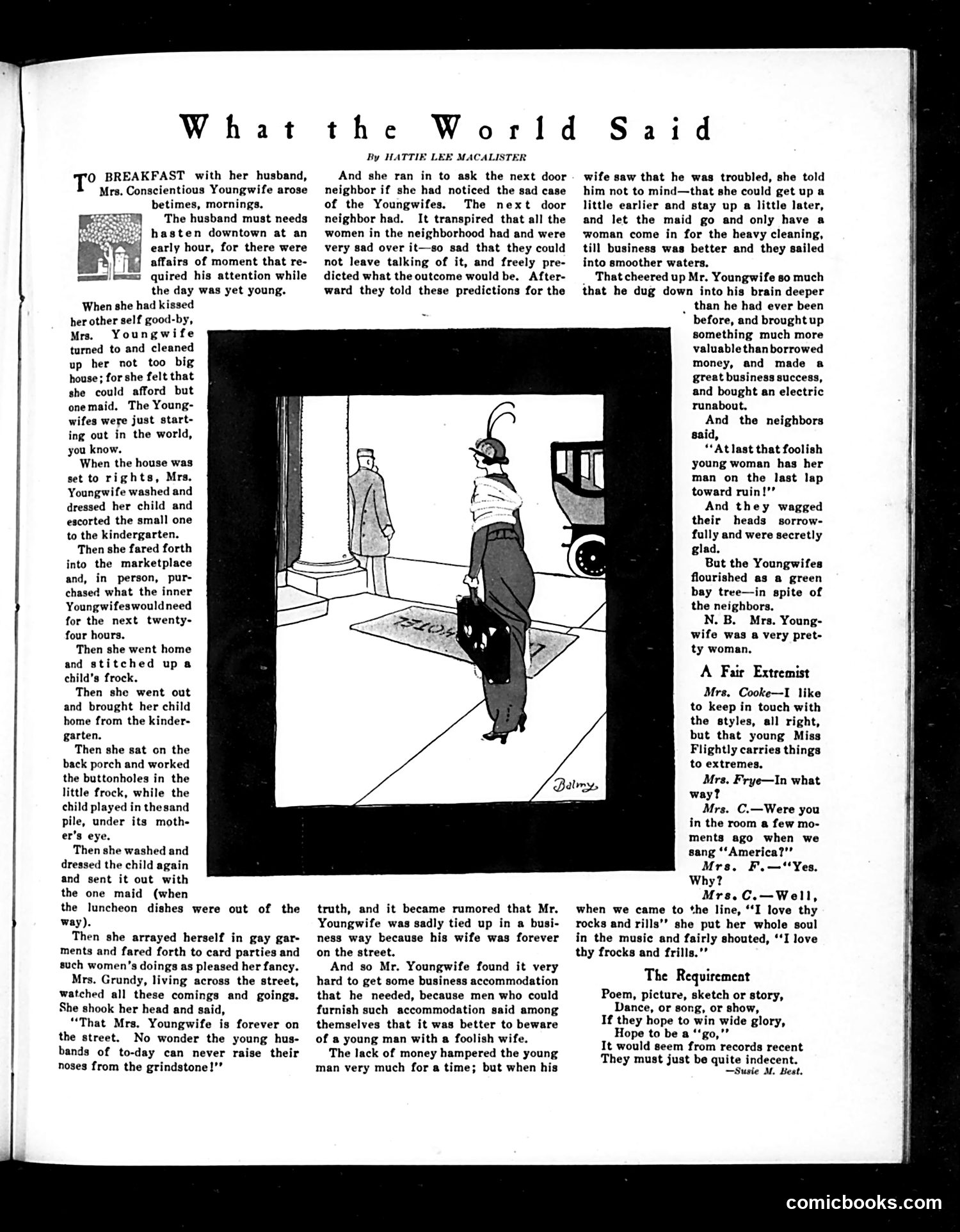
This satirical story by Hattie Lee Macalister critiques small-town gossip and social hypocrisy. Mrs. Youngwife works industriously—managing her household, child-rearing, shopping, and sewing—yet engages in modest social activities (card parties). Mrs. Grundy and other neighbors obsessively watch and condemn her, spreading rumors that Mr. Youngwife is irresponsible and his wife foolish, damaging his business prospects. The irony: Mrs. Youngwife's supportive sacrifice (working harder) actually inspires her husband's entrepreneurial success. He becomes prosperous, buys an electric runabout (a status symbol), yet the neighbors—"secretly glad" at their misfortune—now claim his success proves his wife is leading him to ruin. The cartoon illustrates the neighbors' malicious gossip. The satire targets how community judgment, based on appearance and rumor rather than facts, can actively harm people while the gossipers remain self-righteously convinced of their moral correctness.
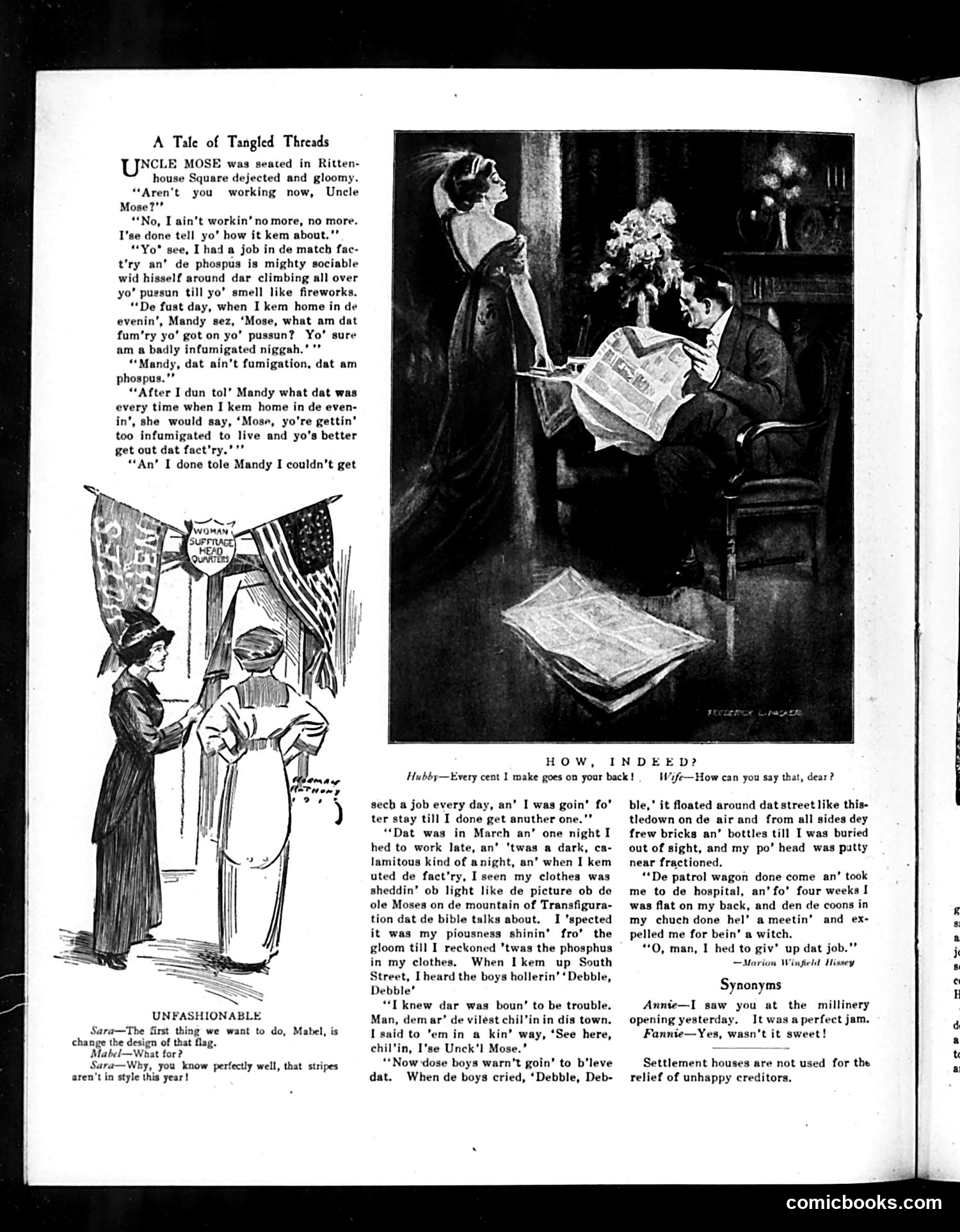
This page contains two satirical pieces from *Judge* magazine: **"A Tale of Tangled Threads"** features Uncle Mose, a Black worker in a match factory whose phosphorus-covered clothes glow at night. His wife Mandy demands he quit, fearing the chemical exposure. When he leaves work one evening, neighborhood children mistake his glowing appearance for a supernatural being ("Debble"—the Devil) and attack him with bricks. He's hospitalized, then expelled from his church as a "witch." The satire targets both superstition and the cruel conditions of industrial labor—though the humor relies heavily on racial dialect caricature typical of the era. **"Unfashionable"** (left side) mocks women's fashion obsession: Sara suggests redesigning the American flag because its stripes aren't "in style this year." The page also includes minor jokes about husbands' complaints and settlement house charity. The content reflects early 20th-century *Judge* editorial positions: criticism of industrial hazards, skepticism toward working-class superstition, and mockery of upper-class women's vanity—all filtered through deeply offensive racial stereotyping.
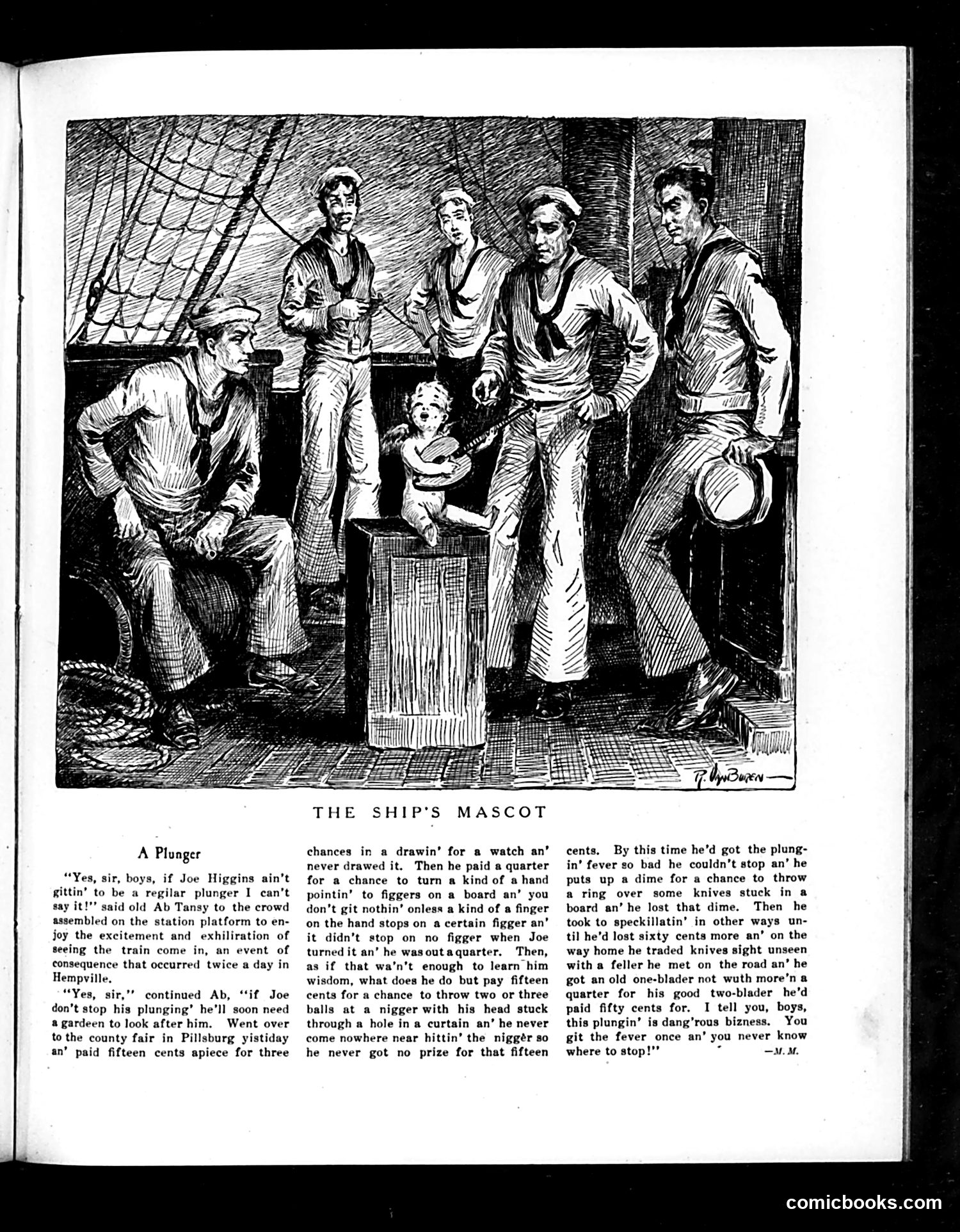
This appears to be a humorous rural American anecdote rather than a political cartoon. The illustration shows sailors aboard a ship with a child (the "mascot"), though the text focuses on a different story. The accompanying narrative, told in dialect by "old Ab Tansy," satirizes compulsive gambling among working-class men. "Joe Higgins" exemplifies a "plunger"—someone unable to resist betting at a county fair, wasting money repeatedly on games of chance (drawings, spinning wheels, ball throws, ring tosses, and knife trades). The satire critiques not politicians but human weakness: once the "fever" of gambling takes hold, the victim cannot stop, spiraling through increasingly poor decisions. The rural setting and vernacular suggest this was meant to amuse middle-class Judge readers with a cautionary tale about lower-class susceptibility to vice and poor judgment.
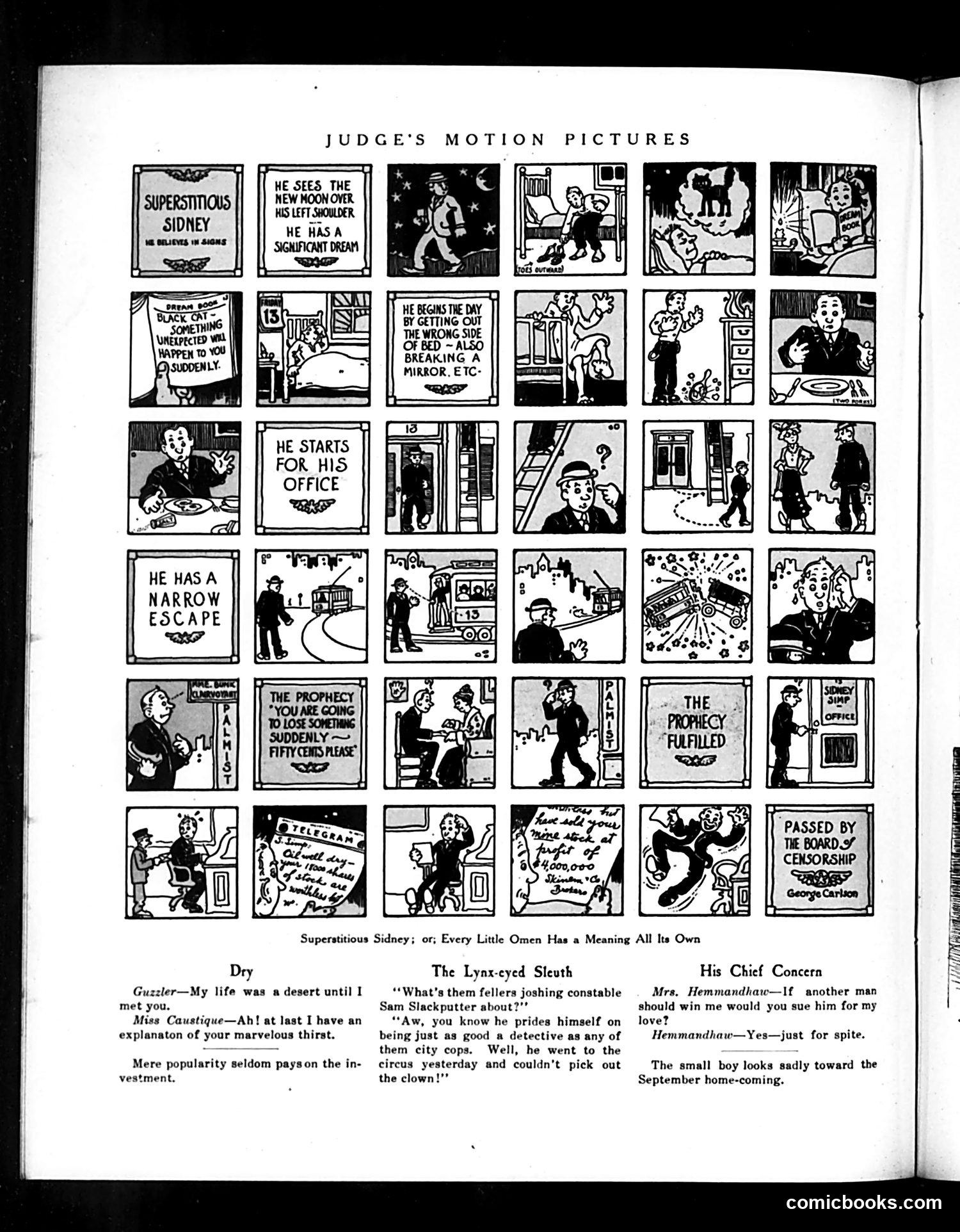
This page presents three separate comic strips satirizing early 20th-century American life. **"Superstitious Sidney"** mocks superstitious beliefs through sequential panels showing a man experiencing increasingly exaggerated "bad omens"—a black cat, broken mirror, spilled salt—that escalate into absurd consequences. The satire targets people who blame minor coincidences for misfortune. **"The Lynx-eyed Sleuth"** jokes about a rural constable's incompetence: he prides himself on detective skills but couldn't identify a circus clown, suggesting small-town law enforcement was seen as inferior to city police. **"His Chief Concern"** offers dark humor about marriage: when asked if he'd sue a rival who won his wife, the husband says yes "just for spite"—satirizing loveless marriages and litigious attitudes rather than genuine emotional attachment. The page uses period vernacular and stock character types typical of Judge's satirical approach to everyday American social pretensions and failures.
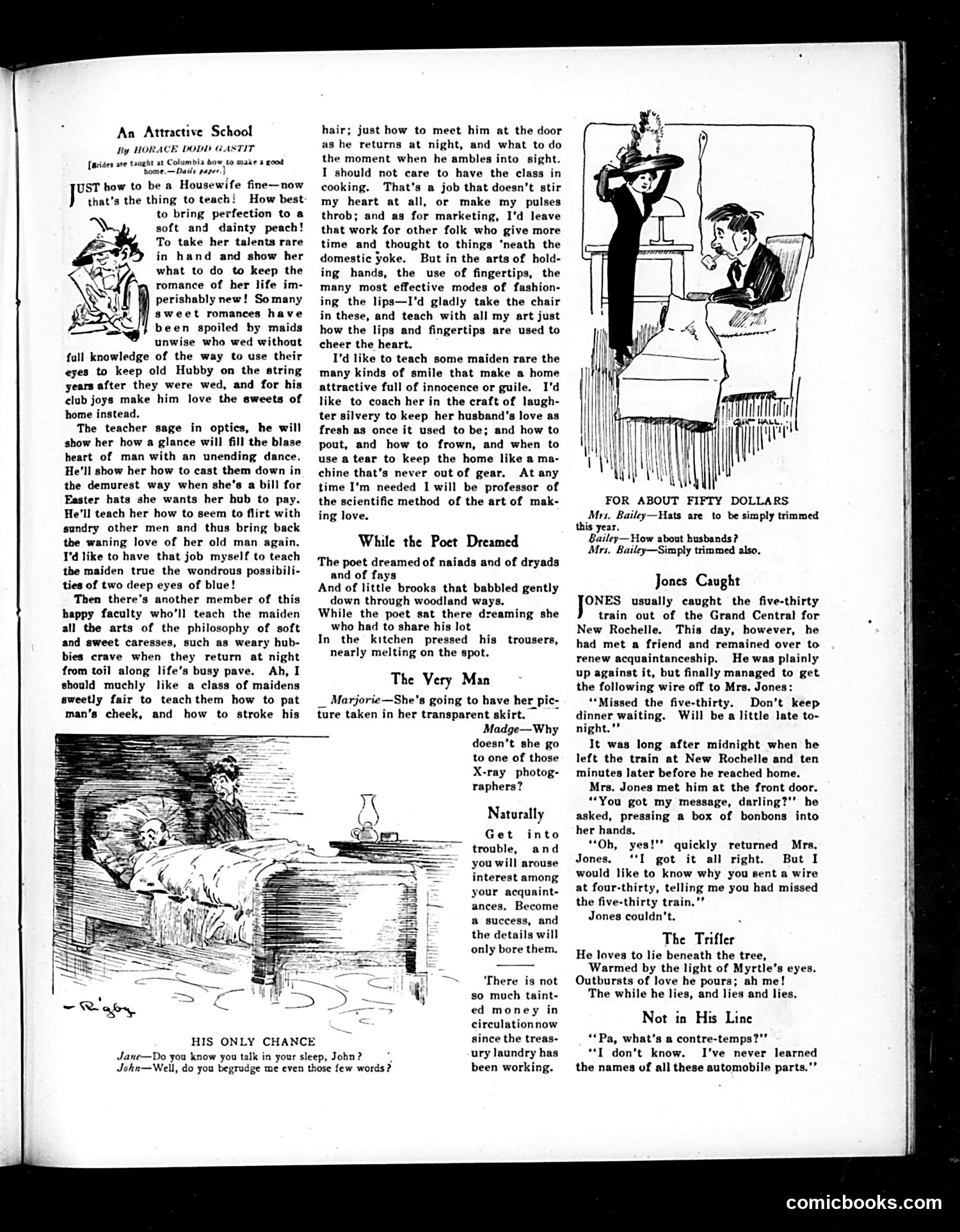
This page contains multiple short satirical pieces typical of early-20th-century Judge magazine, mocking gender relations and domestic life. **"An Attractive School"** proposes teaching young women to manipulate husbands through flirtation, tears, and physical affection rather than practical skills like cooking. The satire criticizes both the author's shallow priorities and the era's expectation that wives use emotional/physical manipulation to maintain marriages. **"His Only Chance"** shows a husband who can only speak freely while asleep—satirizing wives' dominance in marriage and men's lack of autonomy. **"The Very Man"** mocks a woman planning transparent clothing photography, suggesting she'd need X-rays for modesty—satire on 1920s fashion trends and women's changing appearance standards. **"Jones Caught"** describes a man missing his train due to socializing, with his wife's reaction implied. The cartoons throughout use domestic scenarios to satirize marriage power dynamics, gender expectations, and social pretension—characteristic Judge humor targeting middle-class American life.
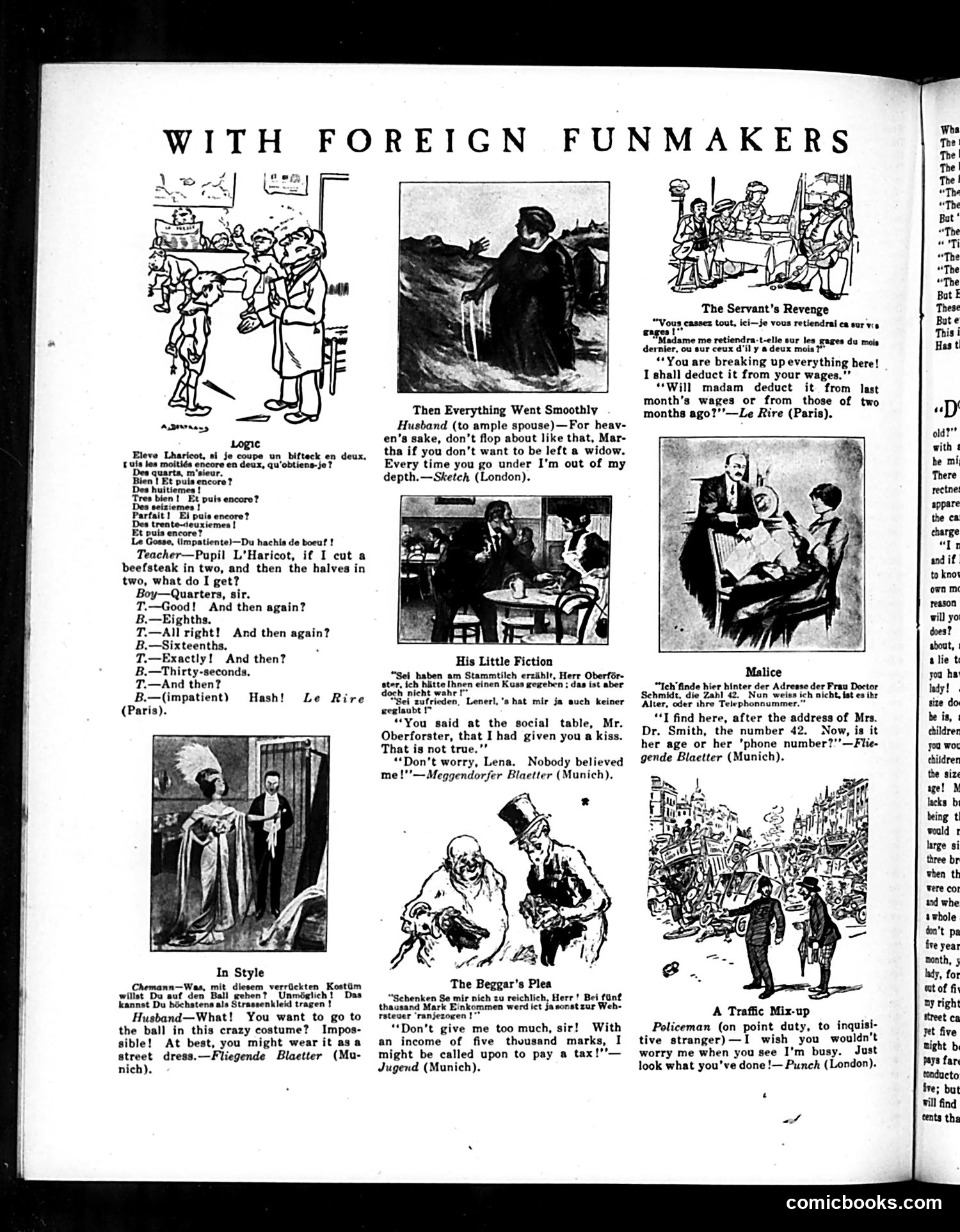
This page collects humorous sketches from European satirical magazines (French *Le Rire*, German *Jugend* and *Fliegende Blätter*, British *Punch* and *Sketch*), translated for American readers. The jokes are gentle domestic and social humor: a student's geometric progression reducing a beefsteak to "hash"; a wife's elaborate ball costume unsuitable for public; a swimmer husband afraid his wife will sink him; servants and employers negotiating wage deductions for broken items; confusion over whether "42" is a woman's age or phone number. **Key context:** The page demonstrates early 20th-century *transatlantic humor exchange*—Judge reprinted witty sketches from European publications to show American readers that similar middle-class anxieties (marital tension, class relations, domestic mishaps) were universal. The format suggests these were considered sophisticated, cosmopolitan entertainment for educated audiences.
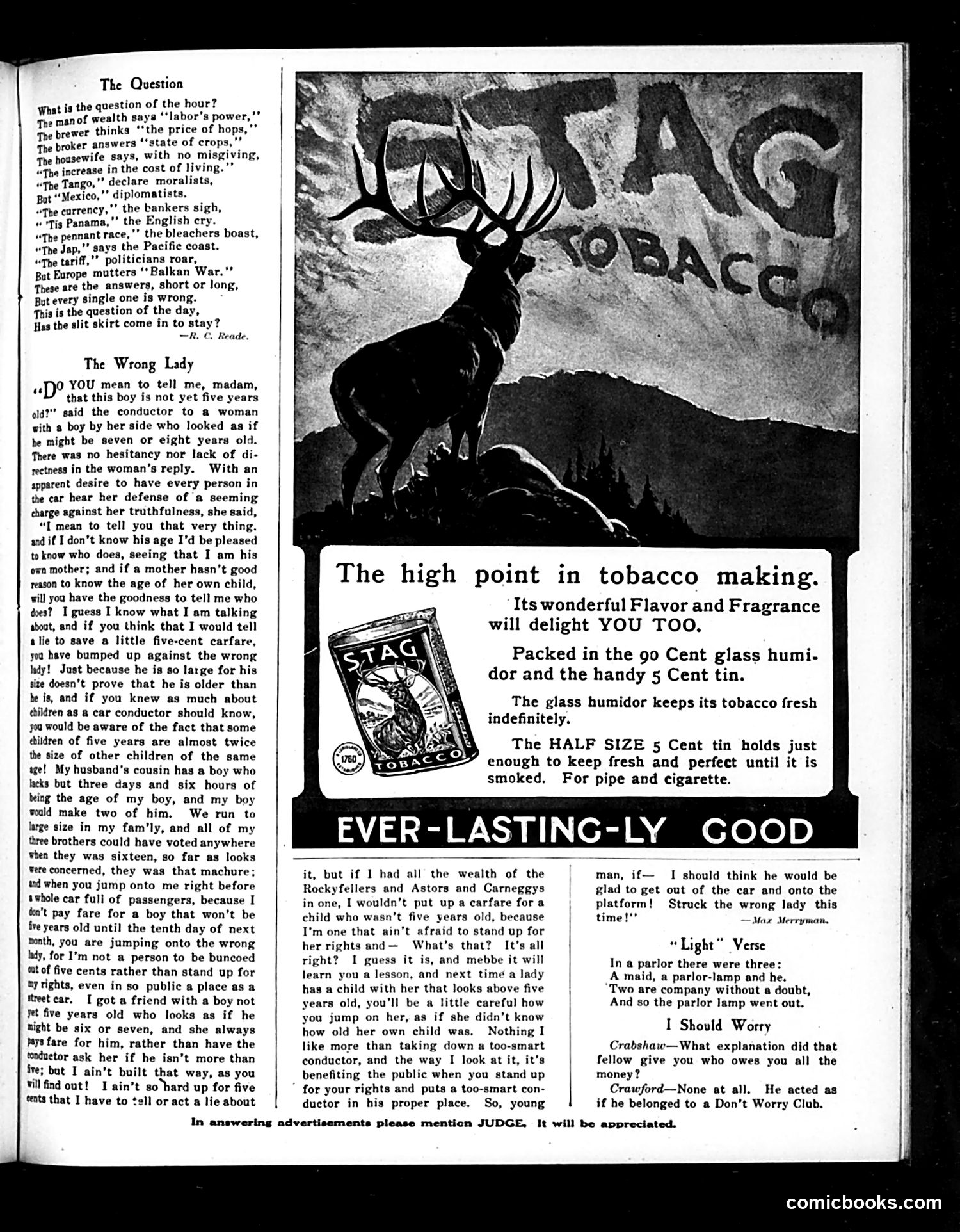
This page contains two distinct pieces of social satire: **"The Question"** is a short poem mocking public discourse of the era. It lists various concerns people cite as "the question of the hour"—labor, economics, politics, sports, international affairs—only to punch line that everyone's truly obsessed with whether women's "slit skirts" (a scandalous new fashion) will become permanent. The satire targets both the public's shallow priorities and the moral panic over changing women's fashion. **"The Wrong Lady"** is a humorous anecdote about a woman defending herself against a streetcar conductor's accusation that her young son is older than she claims (to avoid paying full fare). Her lengthy, defiant monologue—delivered loudly to the entire car—asserts her integrity and knowledge of her own child, and criticizes the conductor's assumptions. The humor derives from her fierce, working-class indignation at the implication she's dishonest. The page also contains a **Stag tobacco advertisement** featuring a stag illustration.
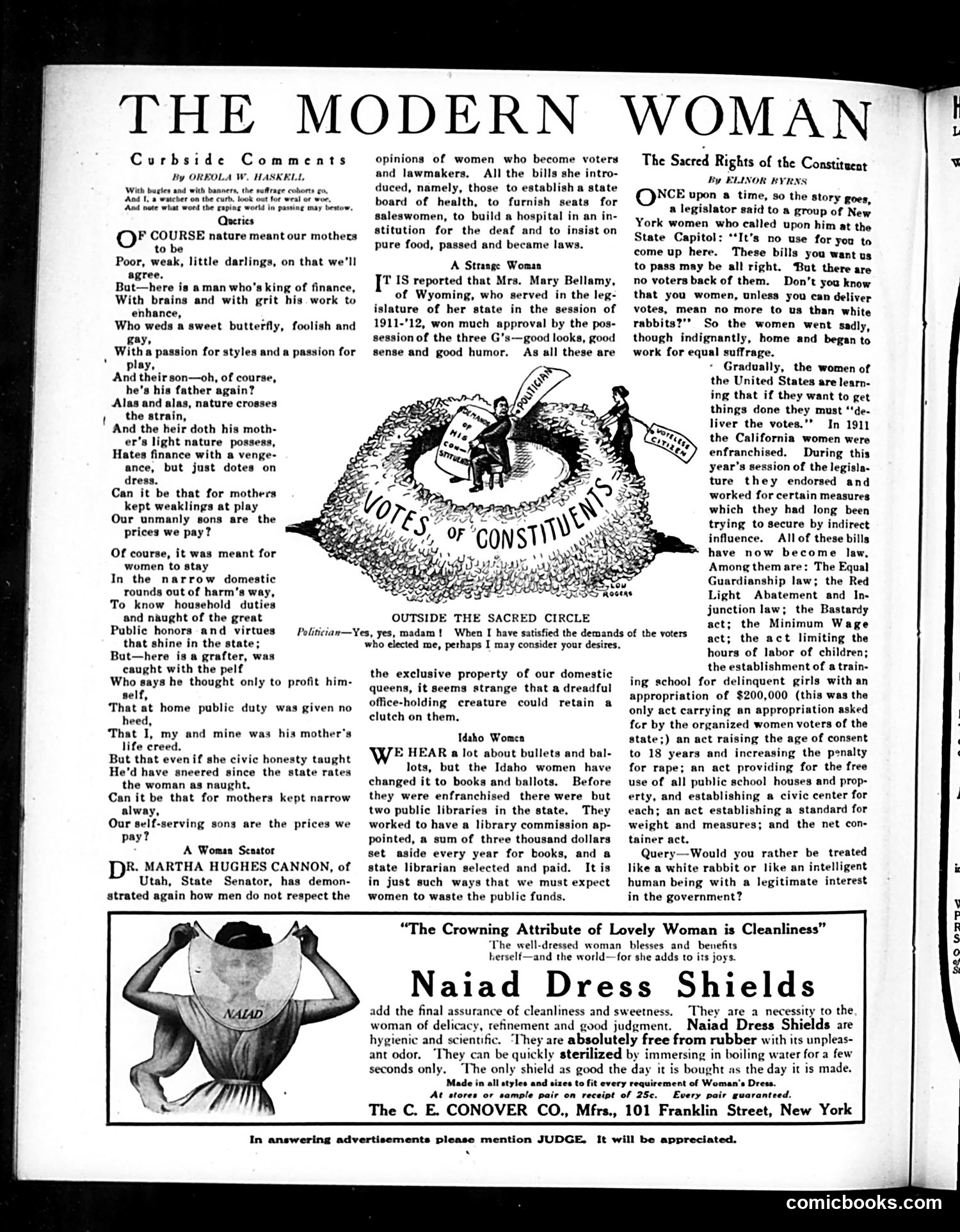
This satirical page addresses the emerging political power of women voters and female legislators in early 1910s America, a time when women's suffrage was expanding state-by-state. **Main Cartoons/Articles:** 1. **"Curbside Comments"** (left): Argues that keeping women intellectually weak produces weak, emasculated sons and corrupt male politicians who lack civic duty—inverting the era's claim that women's "natural" domestic role served society. 2. **Central illustration** ("Outside the Sacred Circle"): Depicts women excluded from the circle of voter influence, satirizing their historical powerlessness. 3. **Right column articles**: Celebrate actual female legislators (Dr. Martha Hughes Cannon of Utah, Mrs. Mary Bellamy of Wyoming, Idaho women) who passed substantive reforms (health boards, labor protections, libraries) once given political voice—proving women's effectiveness when enfranchised. **The Point:** Judge mocks anti-suffrage arguments by demonstrating that denying women political power harms society, while women legislators actively improve it through practical legislation.
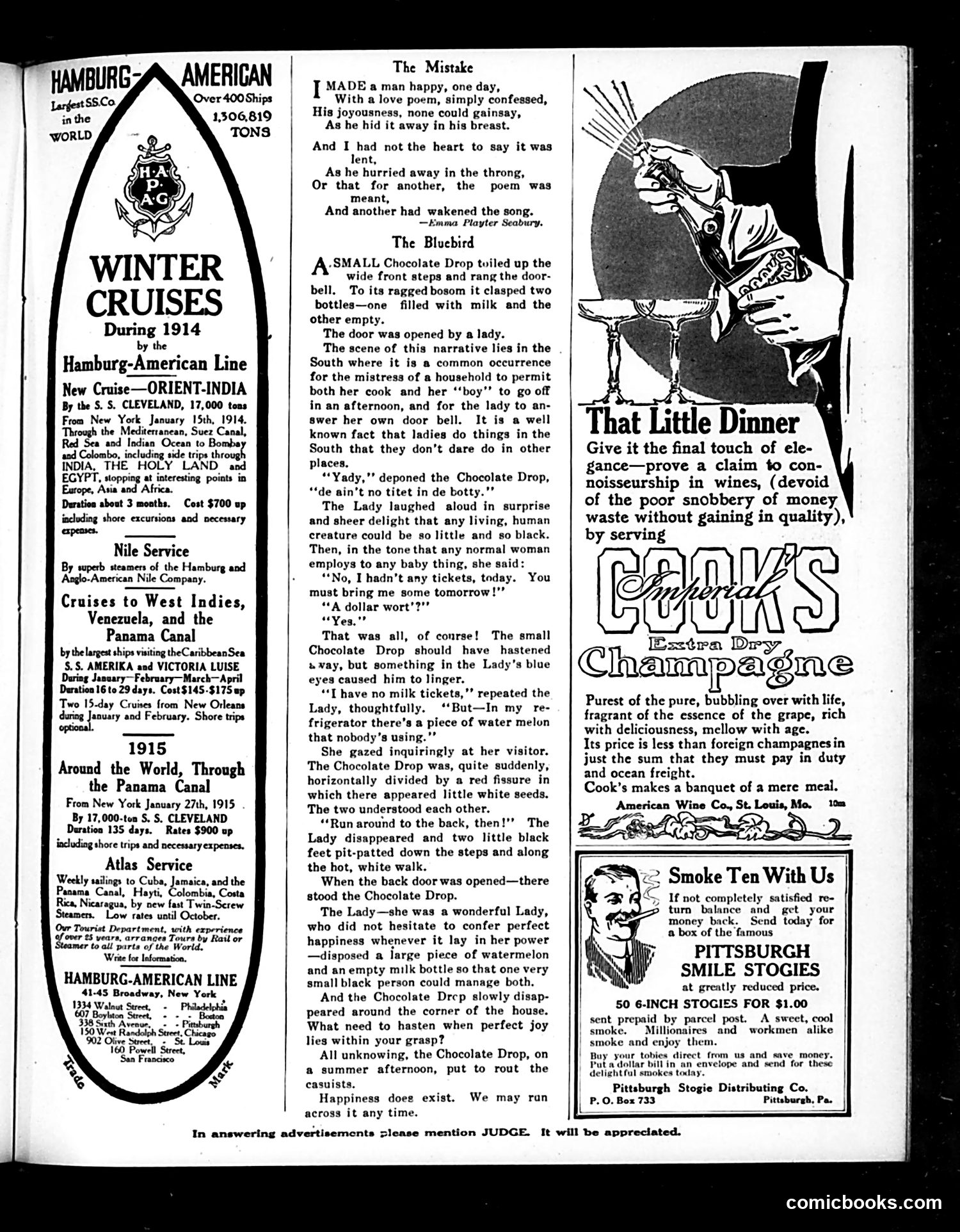
This page is primarily **advertising**, dominated by Hamburg-American Line cruise promotions for 1914-1915 (notable timing—just as World War I began, affecting transatlantic travel). The literary and illustrated content consists of three separate pieces: 1. **"The Mistake"** - A short poem about inadvertently giving a love poem meant for someone else to the wrong person. 2. **"The Bluebird"** - A sentimental short story depicting a white Southern lady's kind interaction with a Black child ("Chocolate Drop") she allows to take watermelon from her refrigerator when he lacks money for milk. The story portrays this as touching benevolence. 3. **Right column advertisements** for Cook's Champagne, Pittsburgh Stogies cigars, and other products. **Context for modern readers**: "The Bluebird" reflects early 20th-century racial attitudes—the story presents a patronizing, stereotypical portrayal of a Black child as worthy of sympathy and gentle treatment, positioning the white woman's small kindness as noteworthy virtue. The language ("Yady," "de ain't") uses dialect stereotyping. This exemplifies how mainstream publications normalized racial hierarchies through sentimental narratives.
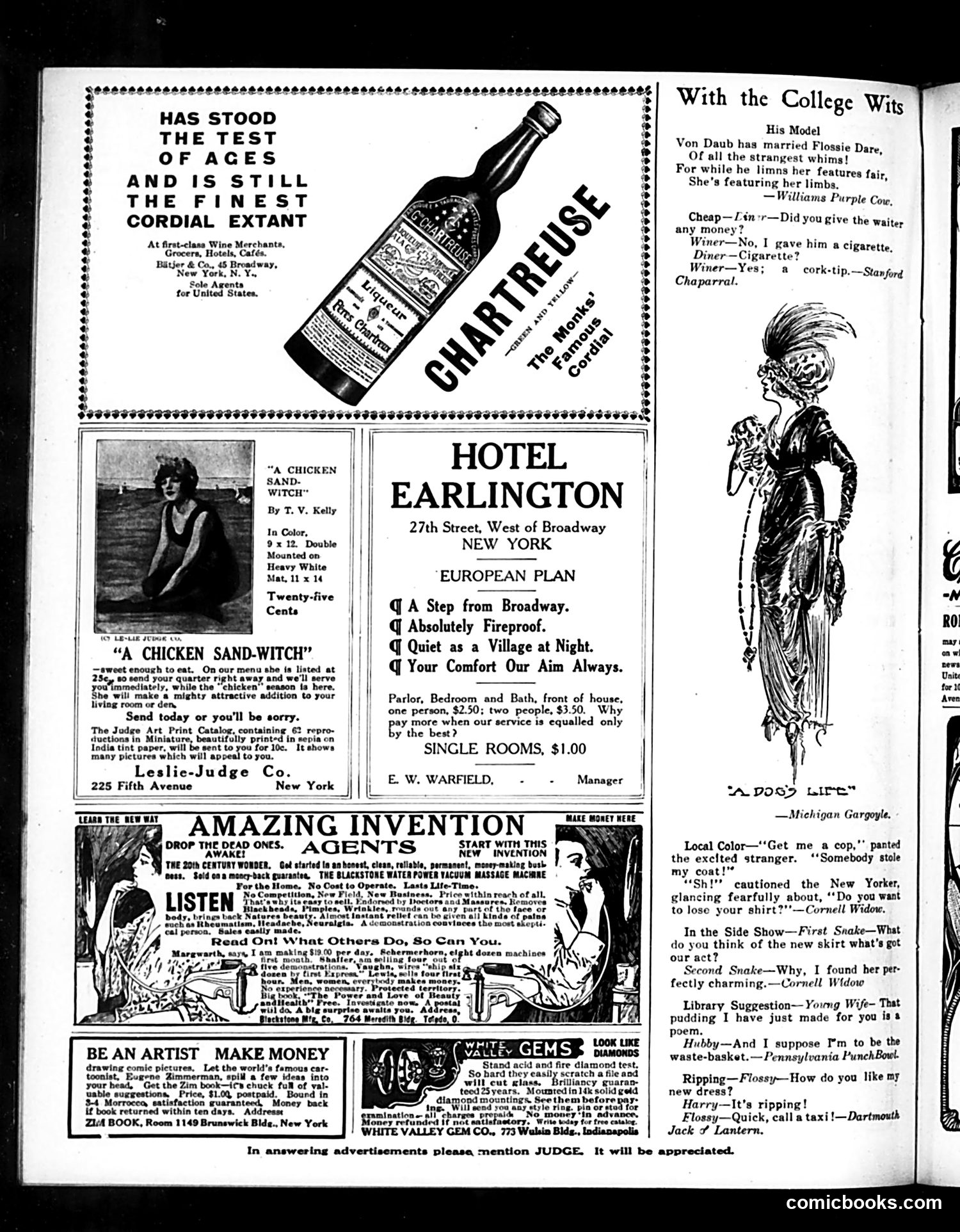
This page consists primarily of **advertisements and light humor columns** rather than political satire. The main content includes: **Advertisements:** Chartreuese cordial, Hotel Earlington, a "Chicken Sandwich" art print, an "amazing invention" (likely a dubious medical device), artist instruction, and gem sales—typical commercial pitches for the era. **"College Wits" Section:** Brief, mild jokes about dating and dining etiquette, including a joke about a painter (Von Daub) marrying a woman notable for her legs rather than her face—risqué for the period but not deeply satirical. **Social Commentary:** The cartoons and quips gently mock contemporary behavior: cheapskate diners, nervous newlyweds, flirtation, and marital dynamics. The humor targets everyday social awkwardness rather than political issues. This appears to be a typical Judge magazine page from roughly the 1910s-1920s, mixing consumer advertising with lighthearted social humor aimed at college-educated, urban readers.
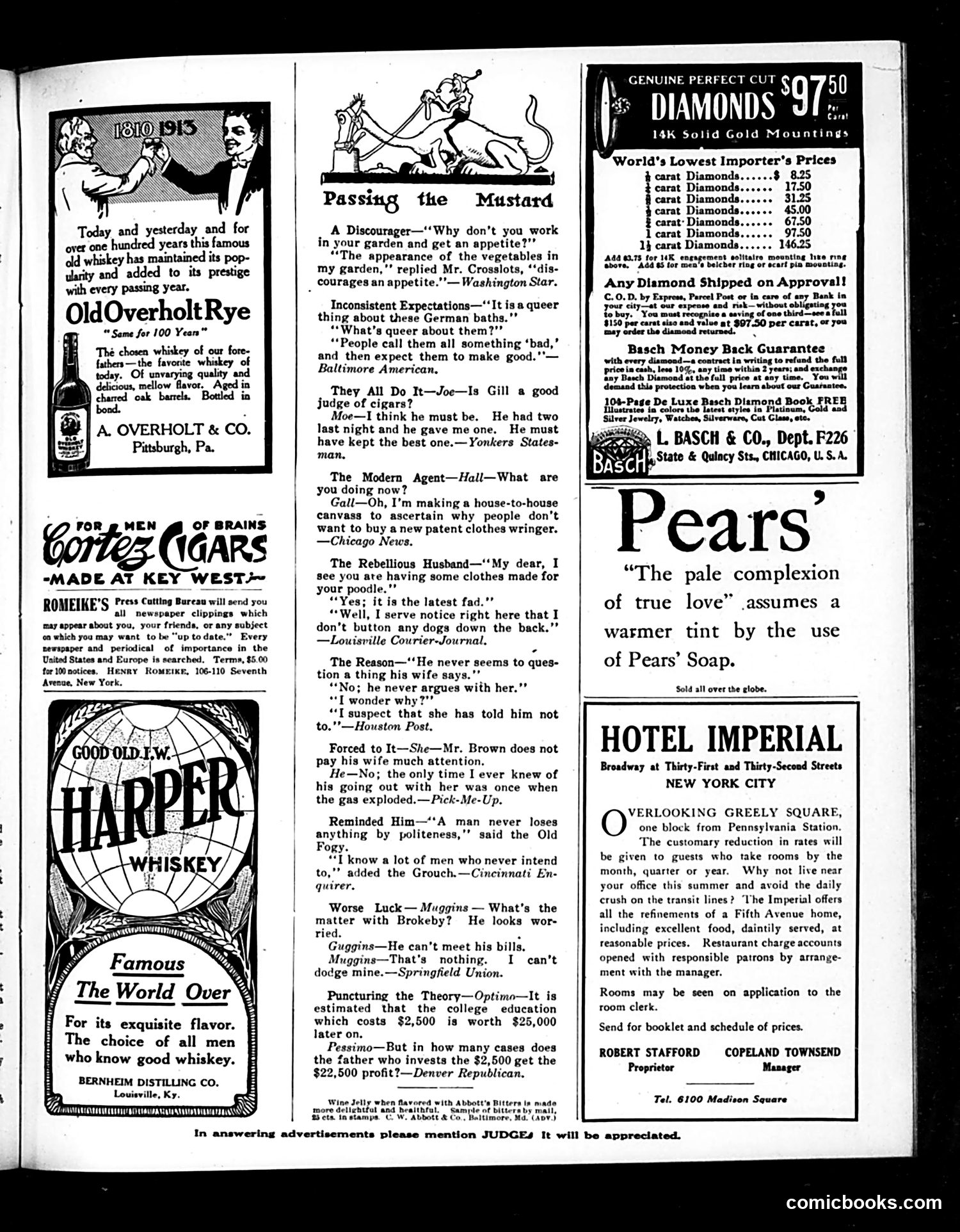
This page is primarily **advertising**, with humor content secondary. The main illustrations are: 1. **"Passing the Mustard"** cartoon: A simple domestic joke about a husband's vegetable garden being so unappealing it discourages appetite rather than stimulates it—a commentary on failed home gardening. 2. **Multiple short humorous anecdotes** (jokes with titles like "They All Do It," "The Rebellious Husband," "Forced to It"): These satirize middle-class domestic life—marital dynamics, poor judges of cigars, wives buying clothes for pets, husbands' inattentiveness, and financial struggles. The humor relies on mild domestic discord and observation of everyday absurdities. 3. **Advertisements dominate**: Old Overholt Rye whiskey, Cortez cigars, J.W. Harper whiskey, Pears soap, diamonds, and Hotel Imperial—typical luxury goods marketed to Judge's affluent readership. The page reflects **1910s attitudes toward marriage, consumption, and class**—mostly lighthearted jabs at bourgeois life for an educated audience.
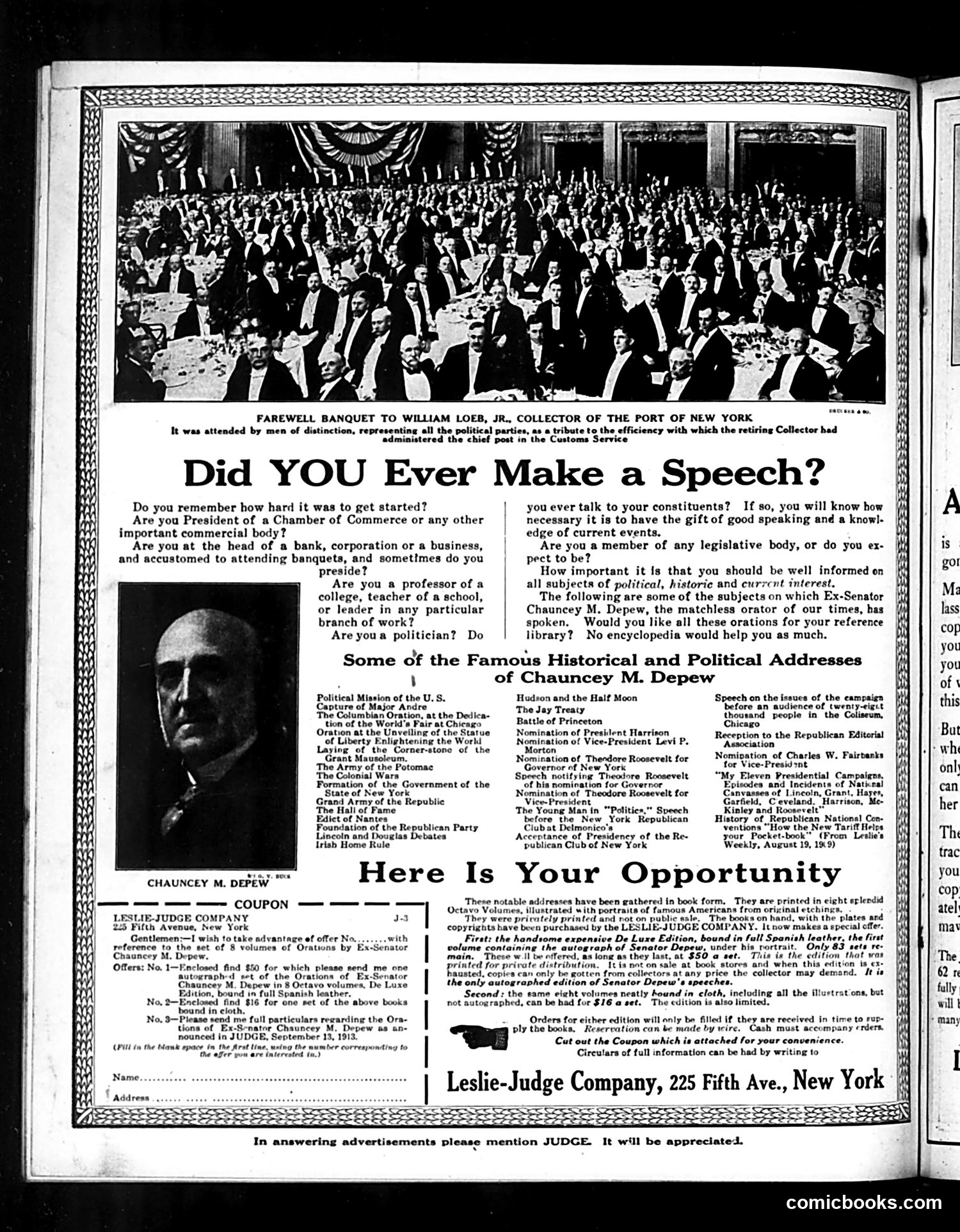
This is primarily an **advertisement**, not a political cartoon. It promotes a book collection of speeches by **Chauncey M. Depew**, a prominent Republican politician and orator of the Gilded Age era. **The Context:** The top photograph shows a farewell banquet for **William Loeb Jr.**, Collector of the Port of New York—a significant federal patronage position. The ad leverages Depew's prestige as a celebrated public speaker to sell his published orations. **The Sales Pitch:** The ad targets business leaders, politicians, and professionals who might need to give speeches, positioning Depew's addresses as models for emulation. It lists famous occasions he spoke at (Lincoln-Douglas debates, Grant's tomb dedication, World's Fair, etc.). **The Offer:** Two editions are available—an expensive De Luxe Spanish leather bound set ($50) and a cloth-bound version ($16)—with limited, numbered printings to create collector's appeal. This reflects early 20th-century enthusiasm for *oratorical culture* and famous speakers' published works as educational/inspirational references.
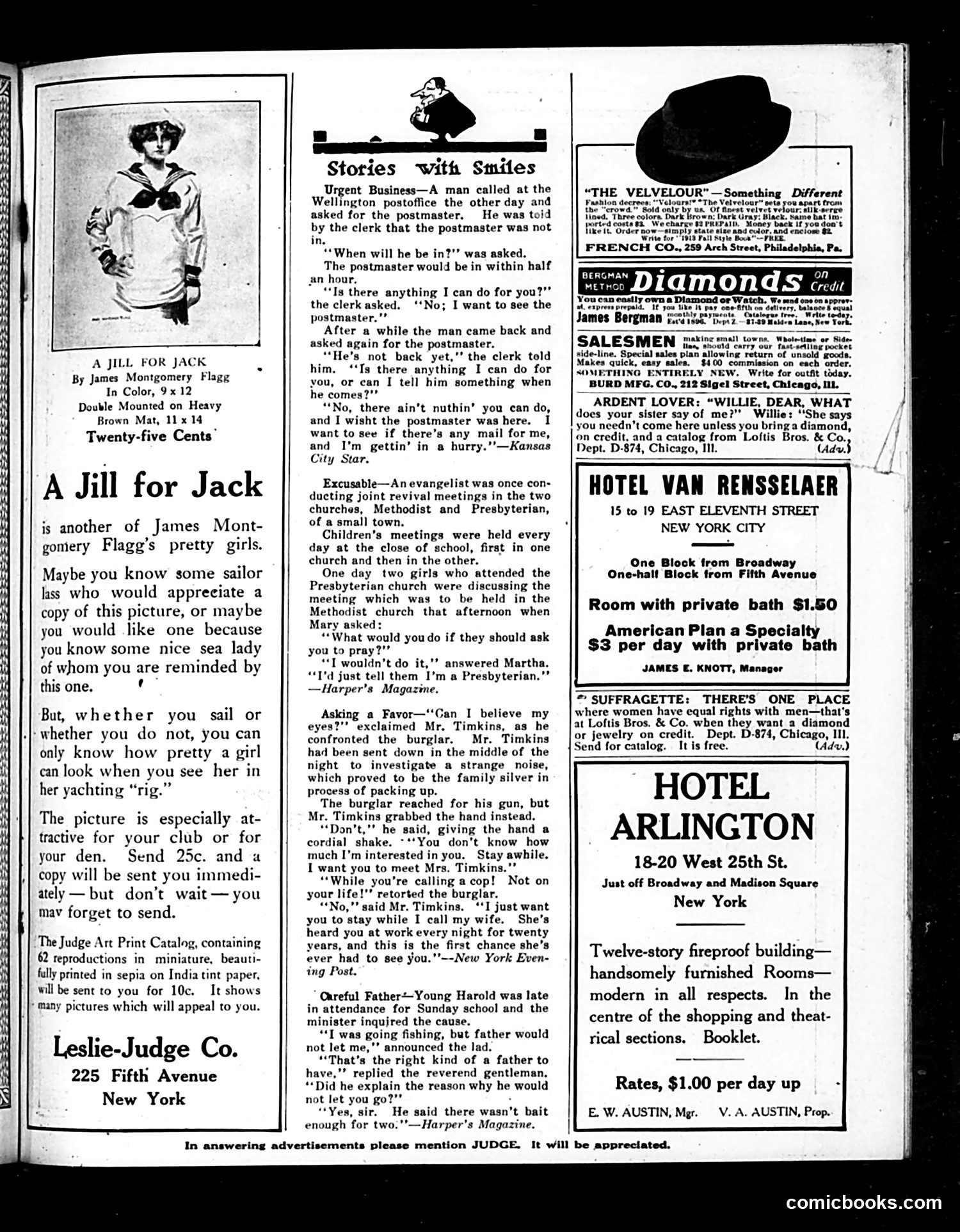
This page is primarily **advertising and promotional content** rather than political satire or editorial cartooning. The main feature is "A Jill for Jack," a James Montgomery Flagg illustration (a famous commercial artist of the era) depicting an attractive woman in nautical attire. The accompanying text markets this image as a print for sale—aimed at sailors or gift-givers—emphasizing her beauty and "yachting rig." The bulk of the page contains four brief humorous anecdotes under "Stories with Smiles," typical of Judge's light humor: a postal clerk's frustration, a girl's Presbyterian excuse, a householder's ironic hospitality to a burglar, and a father's fishing excuse. These are gentle, family-friendly jokes reflecting early 20th-century social attitudes. The remaining space is filled with hotel and product advertisements typical of the magazine's era. There is **no significant political content** or satirical commentary on this particular page.
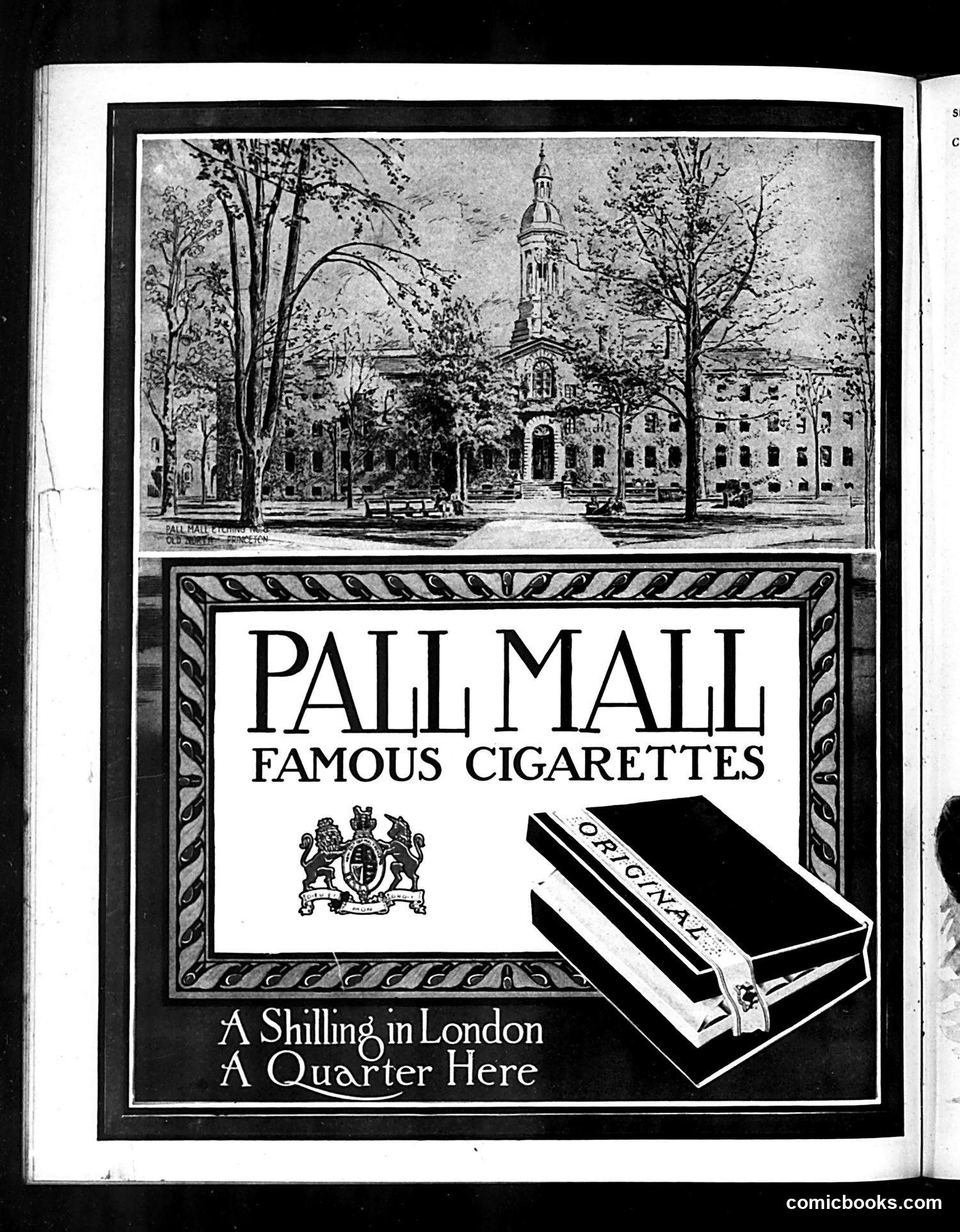
This is primarily an **advertisement**, not a satirical cartoon. It promotes Pall Mall cigarettes, a British brand, with the tagline "A Shilling in London / A Quarter Here," emphasizing affordability in the American market. The image shows an idealized university or civic building with a domed tower, framed by trees—suggesting prestige and respectability. A coat of arms appears below the building name. Two cigarette packs labeled "ORIGINAL" are displayed prominently on the right. The ad leverages British imagery and heritage to market cigarettes as sophisticated and desirable to American consumers, playing on anglophile preferences common in early 20th-century advertising. The pricing comparison highlights the value proposition for American buyers compared to London prices.