
Judge, 1913-09-13 · page 8 of 24
Judge — September 13, 1913 — page 8: what you’re looking at
What you’re looking at
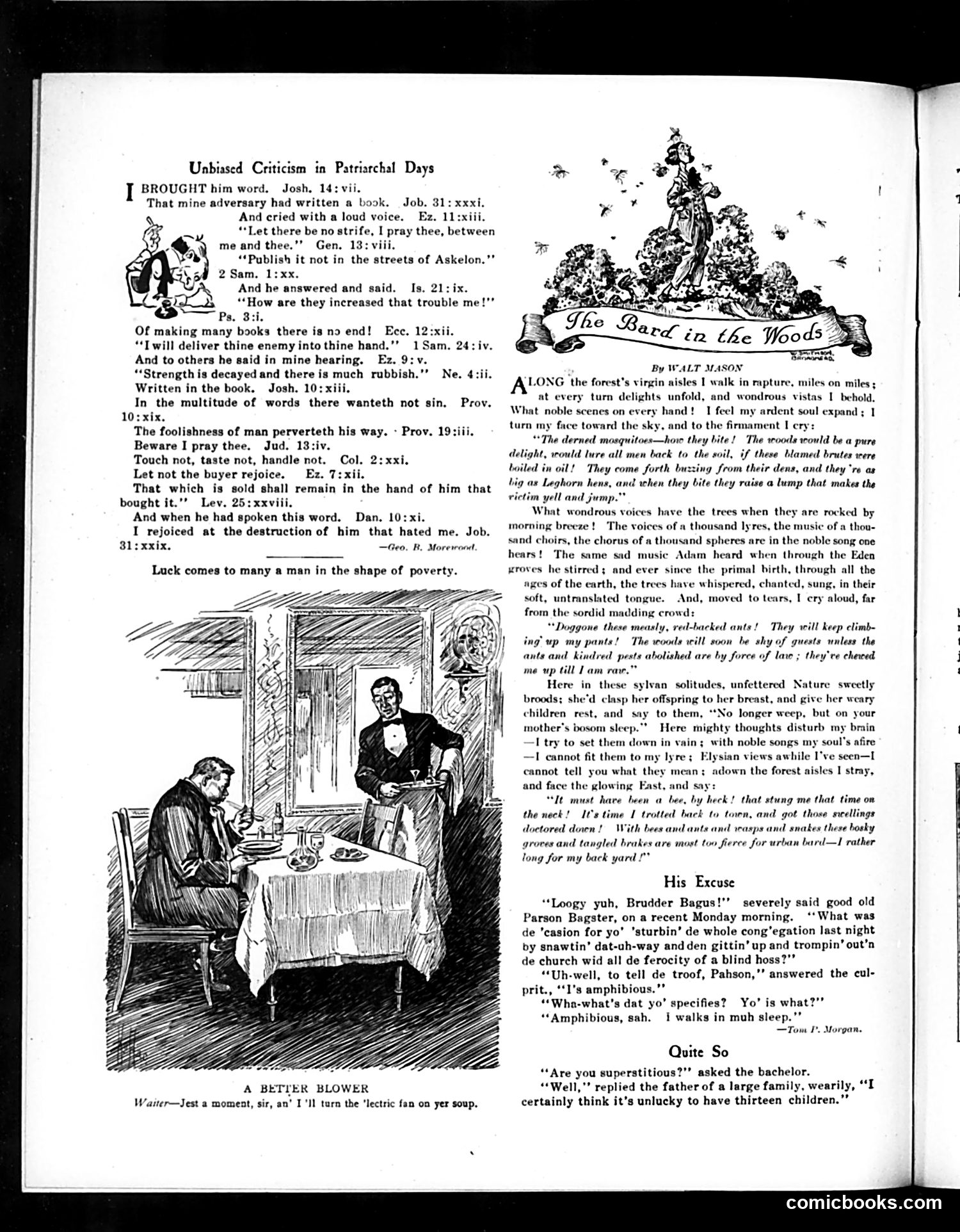
**Top Section - "Unbiased Criticism in Patriarchal Days":** This is satirical commentary on literary criticism, using biblical quotations (many misattributed or fabricated) to mock pedantic book reviewers. The piece ridicules critics who attack authors' works with excessive harshness, presenting their behavior as hypocritical and biblically unjustified. The closing line, "Luck comes to many a man in the shape of poverty," sarcastically suggests that being poor (and thus unable to publish) protects one from critical attack. **Illustration - "A Better Blower":** A waiter offers to operate an electric fan over a diner's soup. The joke plays on "blower" (fan) and suggests the absurd lengths service staff go to satisfy pretentious customers. **Right Column - Walt Mason's Poem:** Mason humorously describes nature's beauty while repeatedly interrupted by annoyances—mosquitoes, ants, and bees—that force him back to urban life. The satire targets romantic idealization of wilderness versus practical reality. **Bottom - "His Excuse" and "Quite So":** Brief comedic dialogues about disruptive church behavior and superstitions, respectively.
📄 Transcribed text from this page (OCR, searchable)
Machine-transcribed from the original scan — historical spelling and the odd misread are preserved.
Unbiased Criticism in Patriarchal Days BROUGHT him word. Josh, 14: vii. That mine adversary had written a book. Job. 31: xx And cried with a loud voice. Ez. 11:xiii. “Let there be no strife, I pray thee, between ot me and thee.” Gen, 13: viii, a «Publish it not in the streets of Askelon.” ‘BA 2 Sam. 1:xx. And he answered and said. Is, 21: ix. S&S “How are they increased that trouble me!"" —" Ps. 8:1. Of making many books there is no end! Ecc. 12:xii. “Twill deliver thine enemy into thine hand.’’ 1Sam. 24: iv. And to others he said in mine hearing. Ez. 9:v. “Strength is decayed and there is much rubbish."” Ne. 4:ii. Written in the book. Josh. 10: xiii. In the multitude of words there wanteth not sin, Prov. i xix. The foolishness of man perverteth his way. - Prov. 19:iii. Beware I pray thee. Jud. 13:iv. Touch not, taste not, handle not. Col. 2: xxi. Let not the buyer rejoice. Ez. 7: xii. That which is sold shall remain in the hand of him that bought it.’" Lev. 25: xxviii. And when he had spoken this word. Dan. 10:xi. I rejoiced at the destruction of him that hated me. Job. 81: xxix. —Geo. RB. Morewood, Luck comes to many a man in the shape of poverty. A BETIER BLOWER Waiter—Jest a moment, sir, an’ I'Il turn the ‘lectric fan on yer soup, By WALT MASON ALONG the forest's virgin aisles I walk in rapture, miles on miles ; at every turn delights unfold, and wondrous vistas I behold. What noble scenes on every hand! 1 feel my ardent soul expand ; 1 turn my face toward the sky, and to the firmament I cry: “The derned mosquitoes—how they bite! The woods would be a pure delight, would lure all men back to the soil, if these blamed brutes were boiled in oil! They come forth buzzing from their dens, and they "re as big as Leghorn hens, and when they bite they raise a lump that makes the victim yell and jump.” t wondrous voices have the trees when they are rocked by morning breeze! The voices of a thousand lyres, the music of a thou- sand choirs, the chorus of a thousand spheres are in the noble song one hears! The same sad music Adam heard when through the Eden urd he stirred ; and ever since the primal birth, through all the ages of the earth, the trees have whispered, chanted, sung, in their soft, untranslated tongue. And, moved to tears, I cry aloud, far from the sordid madding crowd: “Doggone these measly, red-backed ants! They will keep climb- ing’ up my pants! The woos will soon be shy of guests unless the ants and kindred pests abolished are by force of law ; they've chewed me up till Lam raw.” Here in these sylvan solitudes, unfettered Nature sweetly broods; she'd clasp her offspring to her breast, and give her weary children rest, and say to them, “No longer weep, but on your mother's bosom sleep."? Here mighty thoughts disturb my brain I try to set them down in vain; with noble songs my soul's afire —I cannot fit them to my lyre sian views awhile I've seen—I cannot tell you what they mean; adown the forest aisles I stray, and face the glowing East, and say: “It must have heen a bee, by heck! that stung me that time on the neck! It's time I trotted back to town, and got those swellings doctored dowen ! With bees and ants and wasps and snakes these bosky groves and tangled brakes are most too fierce for urban bard—I rather long for my back yard His Excuse ‘*Loogy yuh, Brudder Bagus!’’ severely said good old Parson Bagster, on a recent Monday morning. ‘*What was de 'casion for yo’ ‘sturbin’ de whole cong'egation last night by snawtin’ dat-uh-way andden gittin’ up and trompin’ out’n de church wid all de ferocity of a blind hoss?’’ “‘Uh-well, to tell de troof, Pahson,’’ answered the cul- I's amphibious.’” “‘Wha-what’s dat yo’ specifies? Yo’ is what?’’ ‘*Amphibious, sah. 1 walks in muh sleep."" —Tom P. Morgan. Quite So ‘*Are you superstitious?” asked the bachelor. ““Well,”’ replied the father of a large family, wearily, “I certainly think it’s unlucky to have thirteen children.”” comicbooks.com