
Judge, 1913-09-13 · page 11 of 24
Judge — September 13, 1913 — page 11: what you’re looking at
What you’re looking at
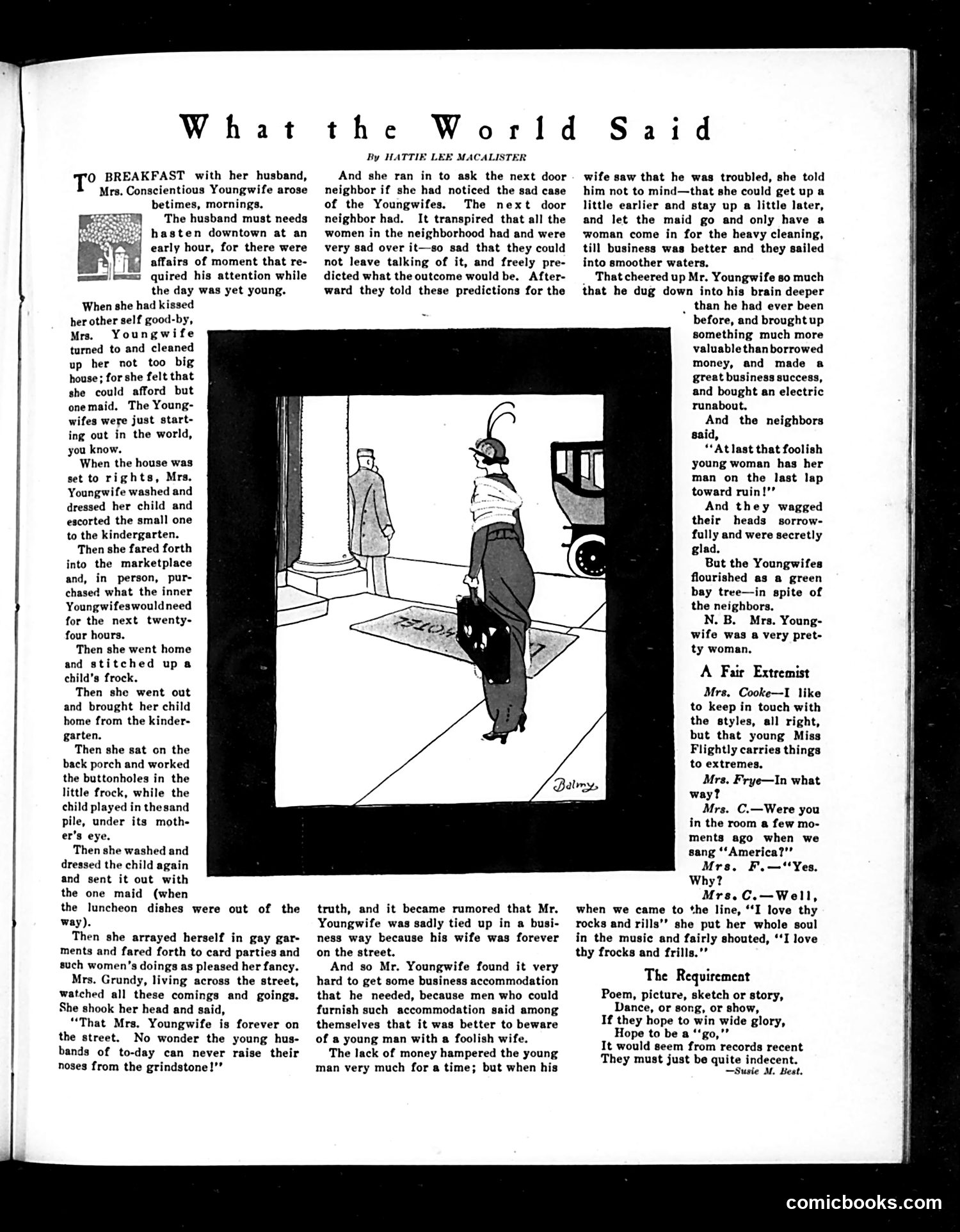
This satirical story by Hattie Lee Macalister critiques small-town gossip and social hypocrisy. Mrs. Youngwife works industriously—managing her household, child-rearing, shopping, and sewing—yet engages in modest social activities (card parties). Mrs. Grundy and other neighbors obsessively watch and condemn her, spreading rumors that Mr. Youngwife is irresponsible and his wife foolish, damaging his business prospects. The irony: Mrs. Youngwife's supportive sacrifice (working harder) actually inspires her husband's entrepreneurial success. He becomes prosperous, buys an electric runabout (a status symbol), yet the neighbors—"secretly glad" at their misfortune—now claim his success proves his wife is leading him to ruin. The cartoon illustrates the neighbors' malicious gossip. The satire targets how community judgment, based on appearance and rumor rather than facts, can actively harm people while the gossipers remain self-righteously convinced of their moral correctness.
📄 Transcribed text from this page (OCR, searchable)
Machine-transcribed from the original scan — historical spelling and the odd misread are preserved.
What T° BREAKFAST with her husband, Mrs. Conscientious Youngwife arose betimes, mornings. The husband must needs is hasten downtown at an Ve, early hour, for there were [I affairs of moment that re- sa! ixas quired his attention while the day was yet young. When she had kissed her other self good-by, Mrs. Youngwife turned to and cleaned up her not too big house; for she felt that she could afford but onemaid. The Young- wifes were just start- ing out in the world, you know. When the house was set to rights, Mrs, Youngwife washed and dressed her child and escorted the small one to the kindergarten. Then she fared forth into the marketplace and, in person, pur- chased what the inner Youngwifeswouldneed for the next twenty- four hours. Then she went home and stitched up a child's frock. Then she went out and brought her child home from the kinder- garten. Then she sat on the back porch and worked the buttonholes in the little frock, while the child played in thesand pile, under its moth- er’s eye. Then she washed and dressed the child again and sent it out with the one maid (when the luncheon dishes were out of the way). Then she arrayed herself in gay gar- ments and fared forth to card parties and such women’s doings as pleased her fancy. Mrs. Grundy, living across the street, watched all these comings and goings. She shook her head and said, “That Mrs. Youngwife is forever on the street. No wonder the young hus- bands of to-day can never raise their noses from the grindstone!’’ the By HATTIE LEE MACALISTER And she ran in to ask the next door neighbor if she had noticed the sad case of the Youngwifes. The next door neighbor had. It transpired that all the women in the neighborhood had and were very sad over it—so sad that they could not leave talking of it, and freely pre- dicted what the outcome would be. After- ward they told these predictions for the truth, and it became rumored that Mr. Youngwife was sadly tied up in a busi- ness way because his wife was forever on the street. And so Mr. Youngwife found it very hard to get some business accommodation that he needed, because men who could furnish such accommodation said among themselves that it was better to beware of a young man with a foolish wife. The lack of money hampered the young man very much for a time; but when his World Said wife saw that he was troubled, she told him not to mind—that she could get up a little earlier and stay up a little later, and let the maid go and only have a woman come in for the heavy cleaning, till business was better and they sailed into smoother waters. _ That cheered up Mr. Youngwife so much that he dug down into his brain deeper , than he had ever been before, and broughtup something much more valuable than borrowed money, and made a great business success, and bought an electric runabout. And the neighbors said, “At last that foolish young woman has her man on the last lap toward ruin!”” And they wagged their heads sorrow- fully and were secretly glad. But the Youngwifes flourished as a green bay tree—in spite of the neighbors, N. B. Mrs. Young- wife was a very pret- ty woman. A Fair Extremist Mrs. Cooke—I like to keep in touch with the styles, all right, but that young Miss Flightly carries things to extremes. Mrs. Frye—In what way? Mrs. C.—Were you in the room a few mo- ments ago when we sang ‘‘America?”” Mrs, F.—“Yes. Why? Mrs.C.—Well, when we came to the line, ‘I love thy rocks and rills’’ she put her whole soul in the music and fairly shouted, ‘I love thy frocks and frills.” The Requirement Poem, picture, sketch or story, Dance, or song, or show, If they hope to win wide glory, Hope to be a ‘‘go,”” It would seem from records recent They must just be quite indecent. —Susie M. Best. comicbooks.com