
Judge, 1913-09-13 · page 4 of 24
Judge — September 13, 1913 — page 4: what you’re looking at
What you’re looking at
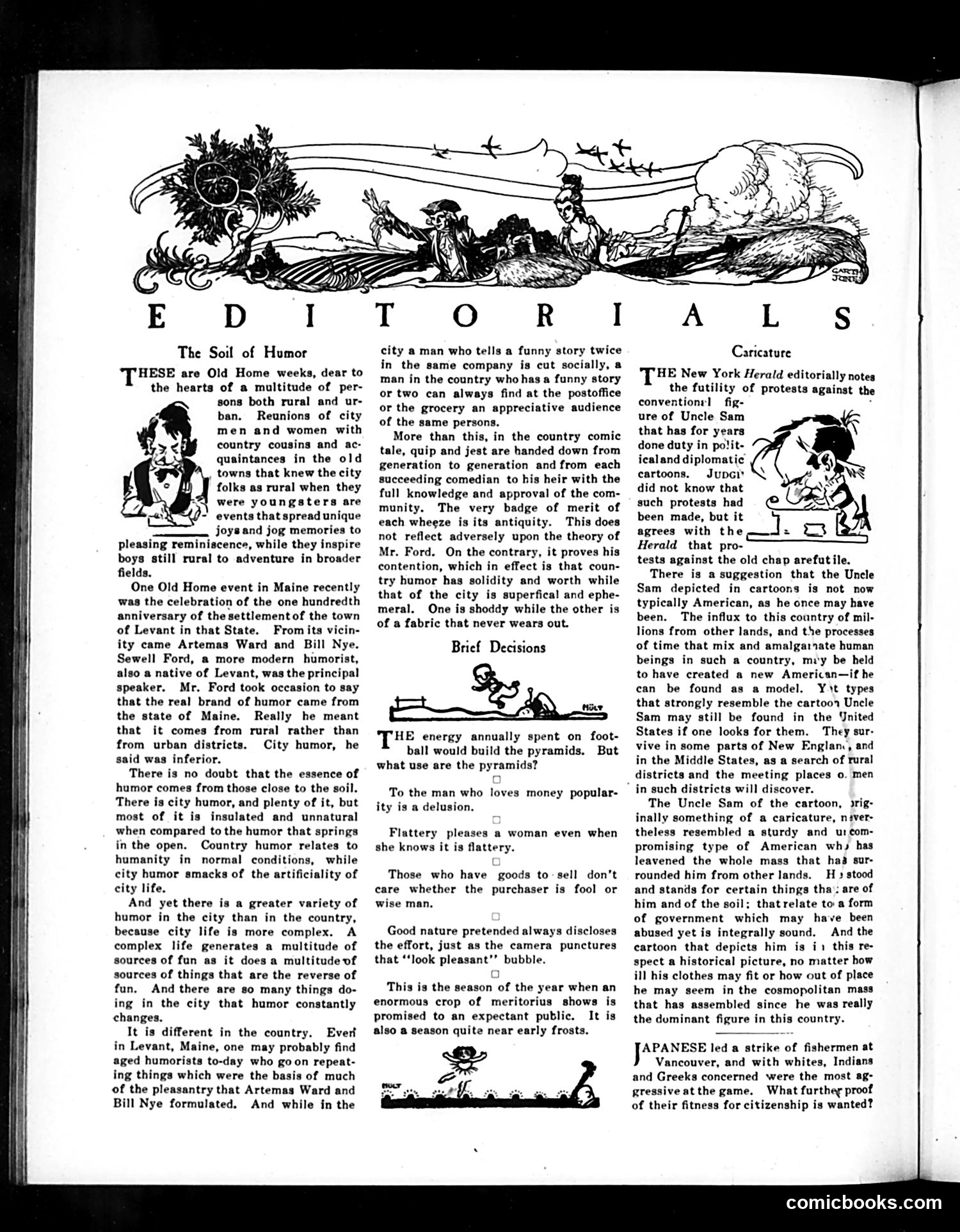
This page from *Judge* magazine features editorial commentary and brief satirical observations. The main content includes: **"The Soil of Humor"** - A essay arguing that rural/country humor is superior to urban humor because it's rooted in genuine human experience rather than artificiality. The author claims country humor has "greater variety" and relates to real life, while city humor relies on superficial wit. **"Brief Decisions"** - Short satirical quips about contemporary social issues, including observations on money-loving men, flattery, and seasonal topics. **"Caricature"** - A note defending *Judge's* Uncle Sam cartoon character as representing authentic Americana, arguing the figure has legitimately evolved over time. The illustrations appear to be decorative vignettes supporting these humor-focused pieces, typical of *Judge's* satirical style from this era (appears early 20th century based on typography and aesthetic).
📄 Transcribed text from this page (OCR, searchable)
Machine-transcribed from the original scan — historical spelling and the odd misread are preserved.
The Soil of Humor HESE are Old Home weeks, dear to the hearts of a multitude of per- sons both rural and ur- ban. Reunions of city men and women with country cousins and ac- quaintances in the old , towns that knew the city folks as rural when they were youngsters are - events that spread unique joys and jog memories to pleasing reminiscence, while they inspire boys still rural to adventure in broader fields. One Old Home event in Maine recently was the celebration of the one hundredth anniversary of the settlementof the town of Levant in that State. From its vicin- ity came Artemas Ward and Bill Nye. Sewell Ford, a more modern humorist, also a native of Levant, was the principal speaker. Mr. Ford took occasion to say that the real brand of humor came from the state of Maine. Really he meant that it comes from rural rather than from urban districts. City humor, he said was inferior. There is no doubt that the essence of humor comes from those close to the soil. There is city humor, and plenty of it, but most of it is insulated and unnatural when compared to the humor that springs in the open. Country humor relates to humanity in normal conditions, while city humor smacks of the artificiality of city life. And yet there is a greater variety of humor in the city than in the country, because city life is more complex. A complex life generates a multitude of sources of fun as it does a multitude vf sources of things that are the reverse of fun. And there are so many things do- ing in the city that humor constantly changes. It is different in the country. Evert in Levant, Maine, one may probably find aged humorists to-day who goon repeat- ing things which were the basis of much of the pleasantry that Artemas Ward and Bill Nye formulated. And while in the city a man who tells a funny story twice in the same company is cut socially, a man in the country who has a funny story or two can always find at the postoffice or the grocery an appreciative audience of the same persons. More than this, in the country comic tale, quip and jest are handed down from generation to generation and from each succeeding comedian to his heir with the full knowledge and approval of the com- munity. The very badge of merit of each wheeze is its antiquity. This does not reflect adversely upon the theory of Mr. Ford. On the contrary, it proves his contention, which in effect is that coun- try humor has solidity and worth while that of the city is superfical and ephe- mer: One is shoddy while the other is of a fabric that never wears out. Brief Decisions fn, NOE THE energy annually spent on foot- ball would build the pyramids. But what use are the pyramids? To the man who loves money popular- ity is a delusion. Flattery pleases a woman even when she knows it is flattery. Those who have goods to:sell don’t care whether the purchaser is fool or wise man. Good nature pretended always discloses the effort, just as the camera punctures that ‘‘look pleasant’’ bubble. This is the season of the year when an enormous crop of meritorius shows is promised to an expectant public. It is also a season quite near early frosts. Caricature THE New York Herald editorially notes the futility of protests against the conventionrl fig- : ure of Uncle Sam that has for years done duty in polit- icaland diplomatic cartoons. Jupci" did not know that such protests had been made, but it agrees with the Herald that pro- tests against the old chap arefutile. There is a suggestion that the Uncle Sam depicted in cartoons is not now typically American, as he once may have been. The influx to this country of mil- lions from other lands, and the processes of time that mix and amalgamate human beings in such a country, mvy be held to have created a new American—if he can be found as a model. Yt types that strongly resemble the cartoon Uncle Sam may still be found in the Jnited States if one looks for them. They sur- vive in some parts of New Englan, and in the Middle States, as a search of rural districts and the meeting places o. men in such districts will discover. The Uncle Sam of the cartoon, drig- inally something of a caricature, naver- theless resembled a sturdy and u:com- promising type of American wh» has leavened the whole mass that haa sur- rounded him from other lands. _H 3 stood and stands for certain things tha: are of him and of the soil; that relate to a form of government which may have been abused yet is integrally sound. And the cartoon that depicts him is i1 this re- spect a historical picture, no matter how ill his clothes may fit or how out of place he may seem in the cosmopolitan mass that has assembled since he was really the dominant figure in this country. APANESE led a strike of fishermen at Vancouver, and with whites, Indians and Greeks concerned were the most ag- gressive atthe game. What furtheg proof of their fitness for citizenship is wanted? comicbooks.com