
A complete issue · 24 pages · 1913
Judge — July 12, 1913
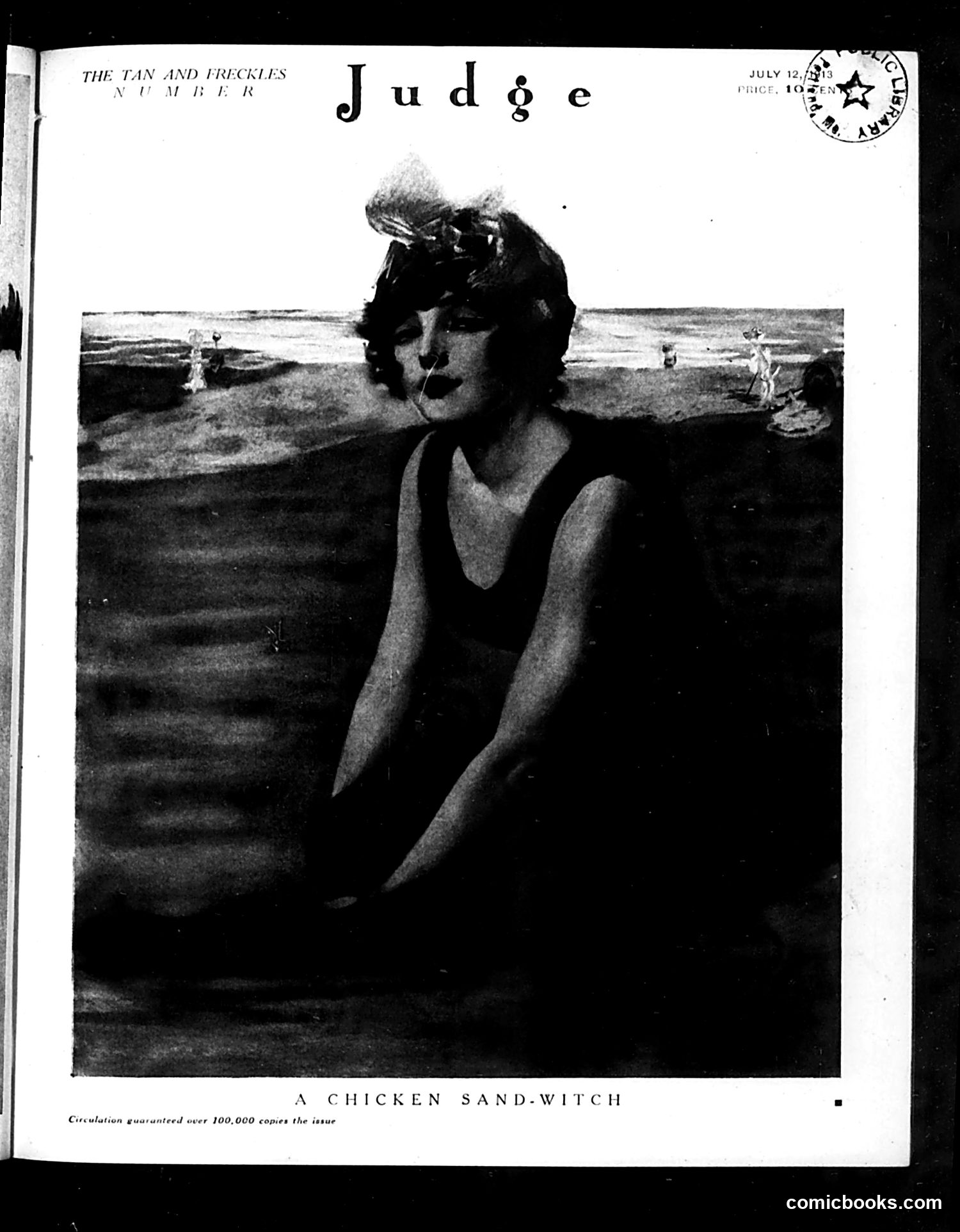
This page from Judge magazine (July 12, 1913) appears to be primarily a **beach/seaside photograph** rather than a political cartoon. The image shows a woman in a dark bathing suit at what looks like a beach, with the caption "A CHICKEN SAND-WITCH." The humor seems to derive from a **visual pun**: the woman is positioned between two other figures visible in the background, creating the appearance of being a "sandwich" between two other people (likely other beachgoers). The title plays on "sandwich" imagery. This represents **lighthearted social humor** typical of Judge's period content—mildly risqué beach humor that reflected early 20th-century attitudes toward bathing attire and seaside leisure activities. The reference to "Tan and Freckles" in the header suggests the page may have been part of a summer-themed issue.
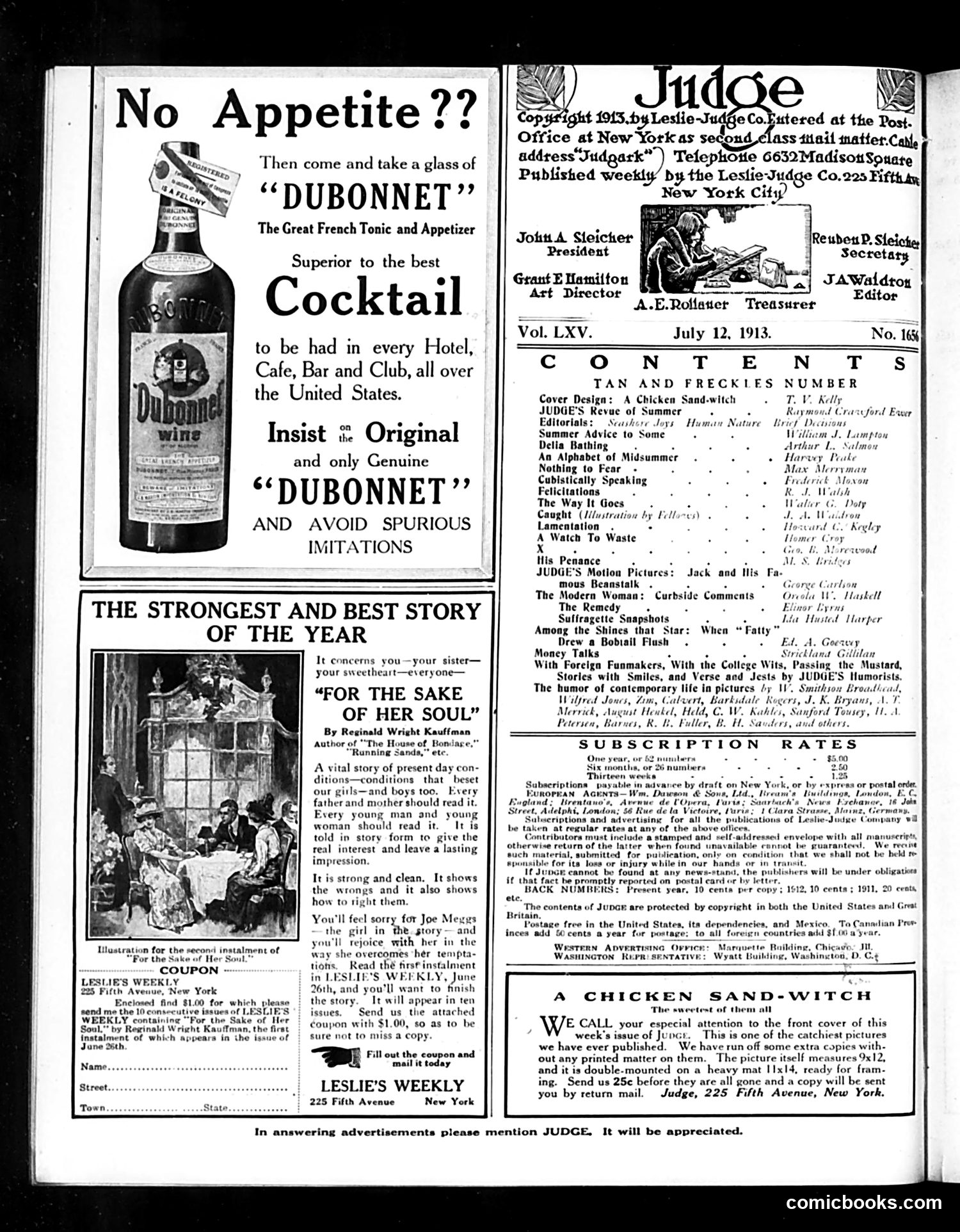
This page is primarily **advertising and table of contents**, not political satire. The left side features a Dubonnet liqueur advertisement emphasizing the product's authenticity and availability in American establishments. The main illustrated story, "For the Sake of Her Soul," appears to be serialized domestic fiction rather than political commentary—it concerns family drama ("your sister—your sweetheart—everyone"). The right side contains the magazine's masthead, contents listing, and subscription rates. A "Chicken Sand-Witch" cover image is promoted at bottom. **Overall assessment:** This is a standard magazine issue page mixing commercial advertising with entertainment content rather than containing editorial satire or political cartoons requiring historical interpretation.
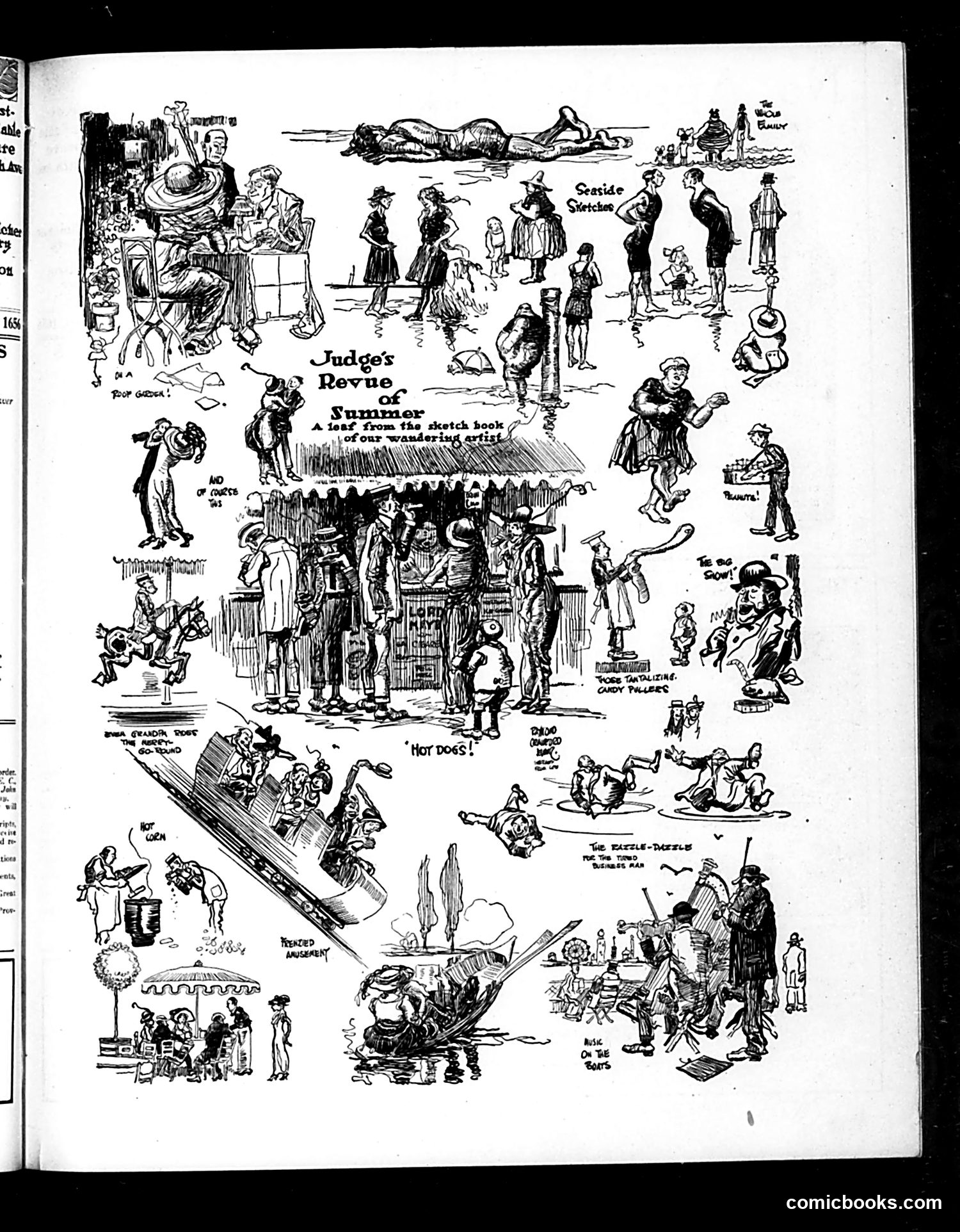
This page presents a collage of beach and seaside vacation scenes titled "Judge's Revue of Summer." The sketches satirize typical summer leisure activities and tourist behavior: "Seaside Sketches" shows beachgoers in various poses; "Hot Dogs" depicts a vendor; "The Puzzle-Dazzle" appears to mock a children's game or amusement; "Shell-shocked" references shell-collecting; and other scenes include swimming, boating mishaps, and family recreation. The humor targets middle-class vacation culture and the somewhat absurd or undignified positions people assume while trying to enjoy leisure time. This reflects Judge magazine's tradition of gently mocking contemporary American social habits and the growing tourist industry of the early 20th century.
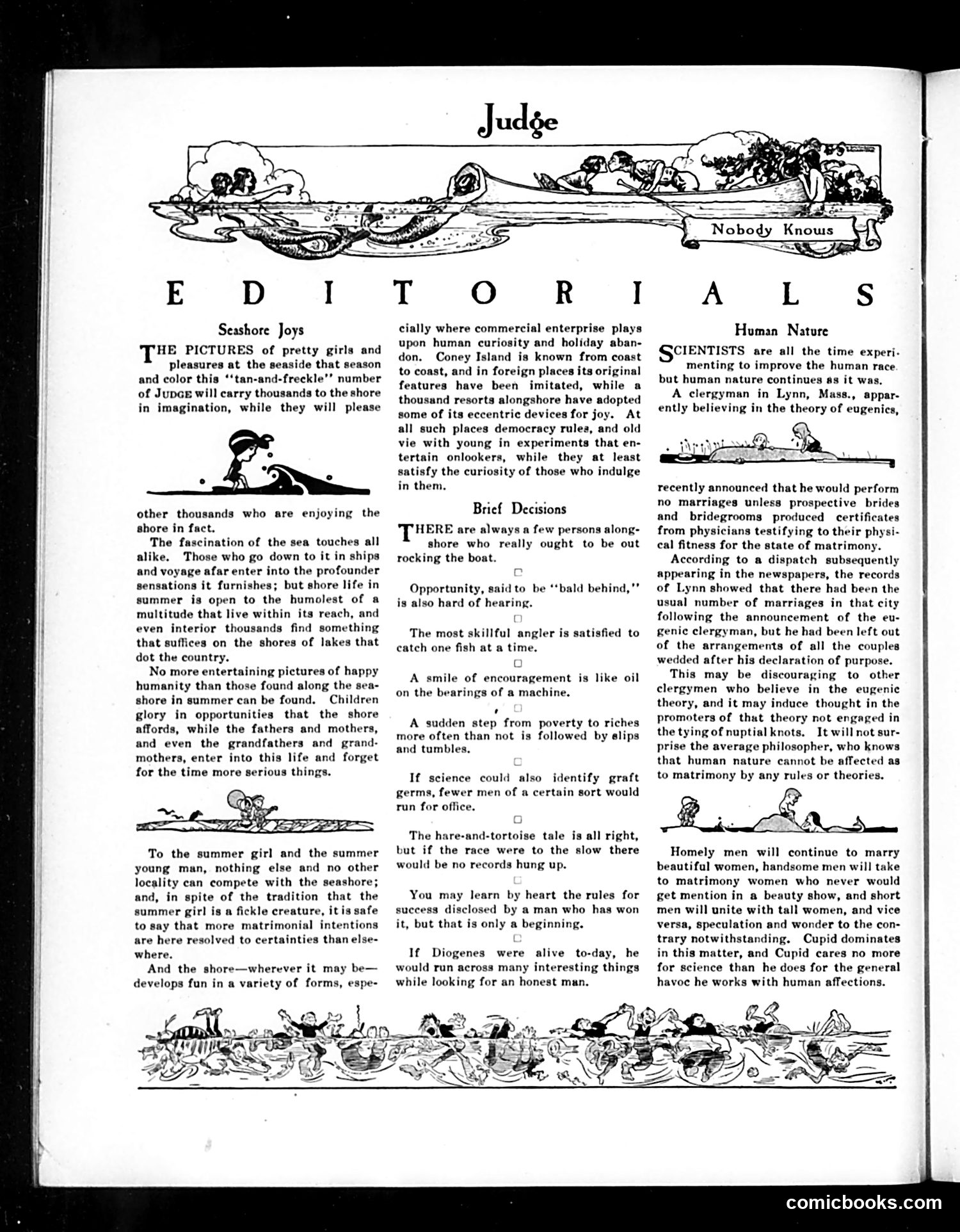
This editorial page mixes social commentary with humor. The left column discusses seaside tourism and summer romance—how beaches attract crowds seeking entertainment and matrimonial prospects. The middle section, "Brief Decisions," offers sardonic aphorisms about life (opportunity, fishing, poverty, success, and science). The right column, "Human Nature," critiques eugenics through a story about a clergyman in Lynn, Massachusetts who refused to perform marriages unless couples produced certificates from physicians verifying their physical fitness. Judge satirizes this pseudo-scientific approach to controlling reproduction, arguing human nature cannot be controlled by rules or theories. The piece mocks both eugenics theory and Cupid's indifference to such schemes.
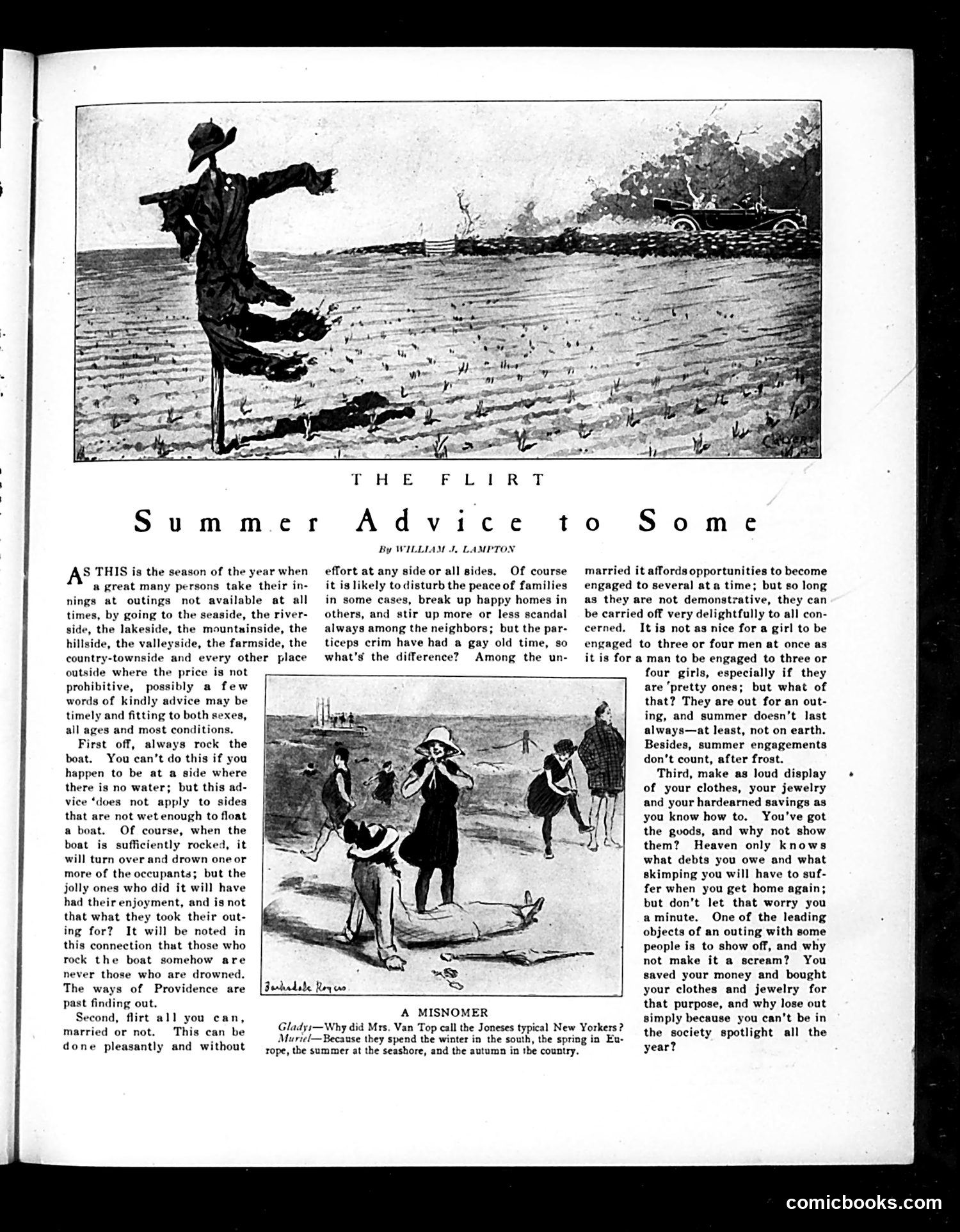
This page satirizes upper-class summer social behavior and romantic courtship rituals of the early 20th century. The main article by William J. Lampton advises readers (primarily women) on proper summer conduct at fashionable seaside resorts. The top illustration shows a scarecrow in a field—a visual metaphor for how flirtation appears ridiculous or pathetic. The lower cartoon "A Misnomer" depicts wealthy New Yorkers vacationing at coastal resorts. The caption suggests the "Joneses" (representing typical wealthy families) spend their year circulating between winter retreats in the south and summer seashore stays—mocking their restless social climbing and conspicuous consumption patterns that defined Gilded Age leisure culture.
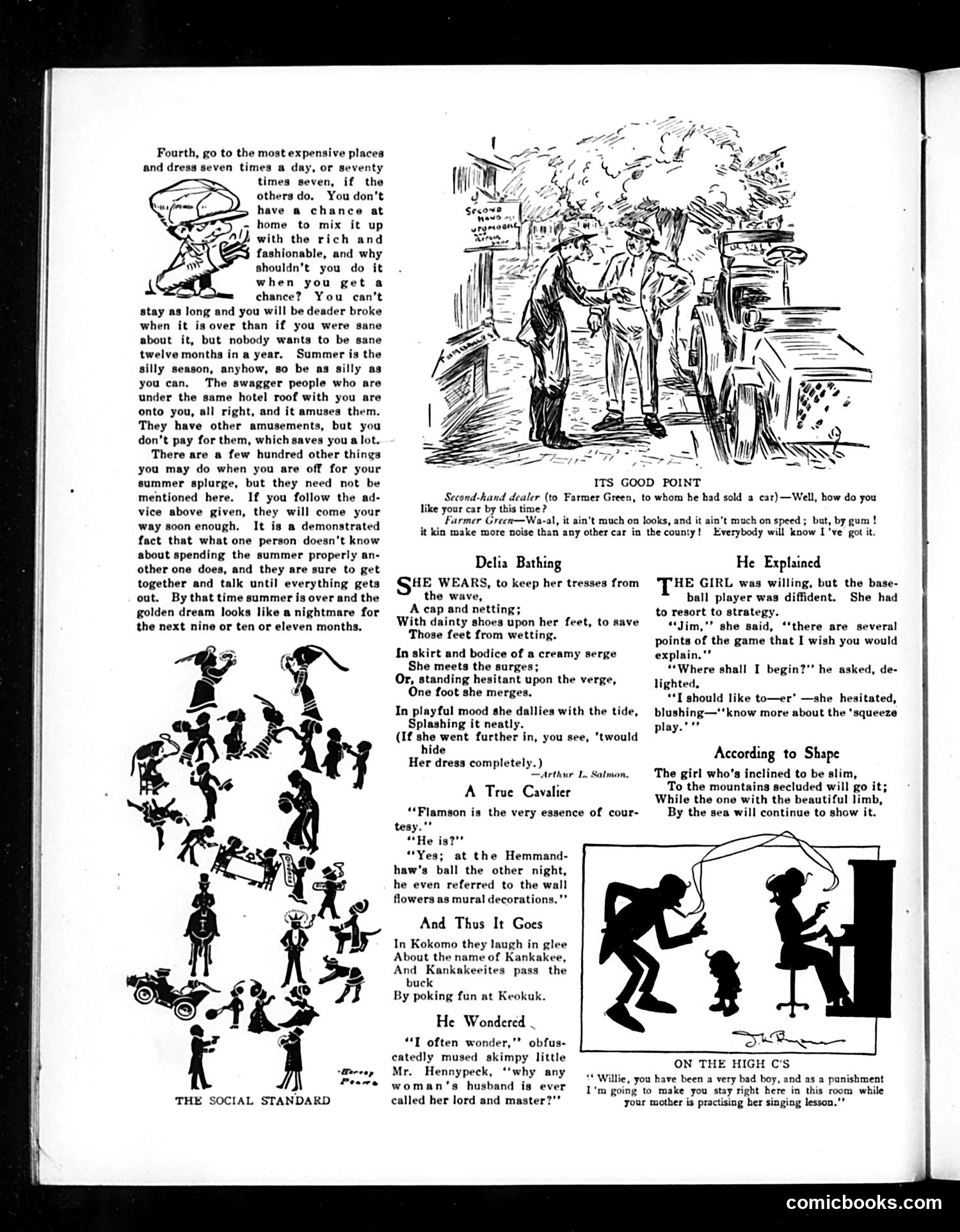
This page satirizes early 20th-century American leisure and social pretense through multiple cartoons and verses. **"The Social Standard"** mocks wealthy summer tourists who wastefully compete through constant costume changes and expensive hotel stays, knowing they appear ridiculous to actual high society but continuing anyway—a commentary on aspirational overspending. **"Its Good Point"** uses a farmer's pride in his used car's noise (not quality) to satirize how people rationalize poor purchases by focusing on trivial attributes. **"Delia Bathing"** humorously critiques women's impractical Victorian bathing costumes—elaborate serge dresses and shoes designed to prevent wetting while supposedly swimming, reducing bathing to mere appearance maintenance. Minor pieces mock social pretension ("A True Cavalier"), small-town rivalry ("And Thus It Goes"), and gender dynamics ("He Wondered," "On the High C's"). The overall theme: American society's obsession with superficial status markers over genuine value or practicality.
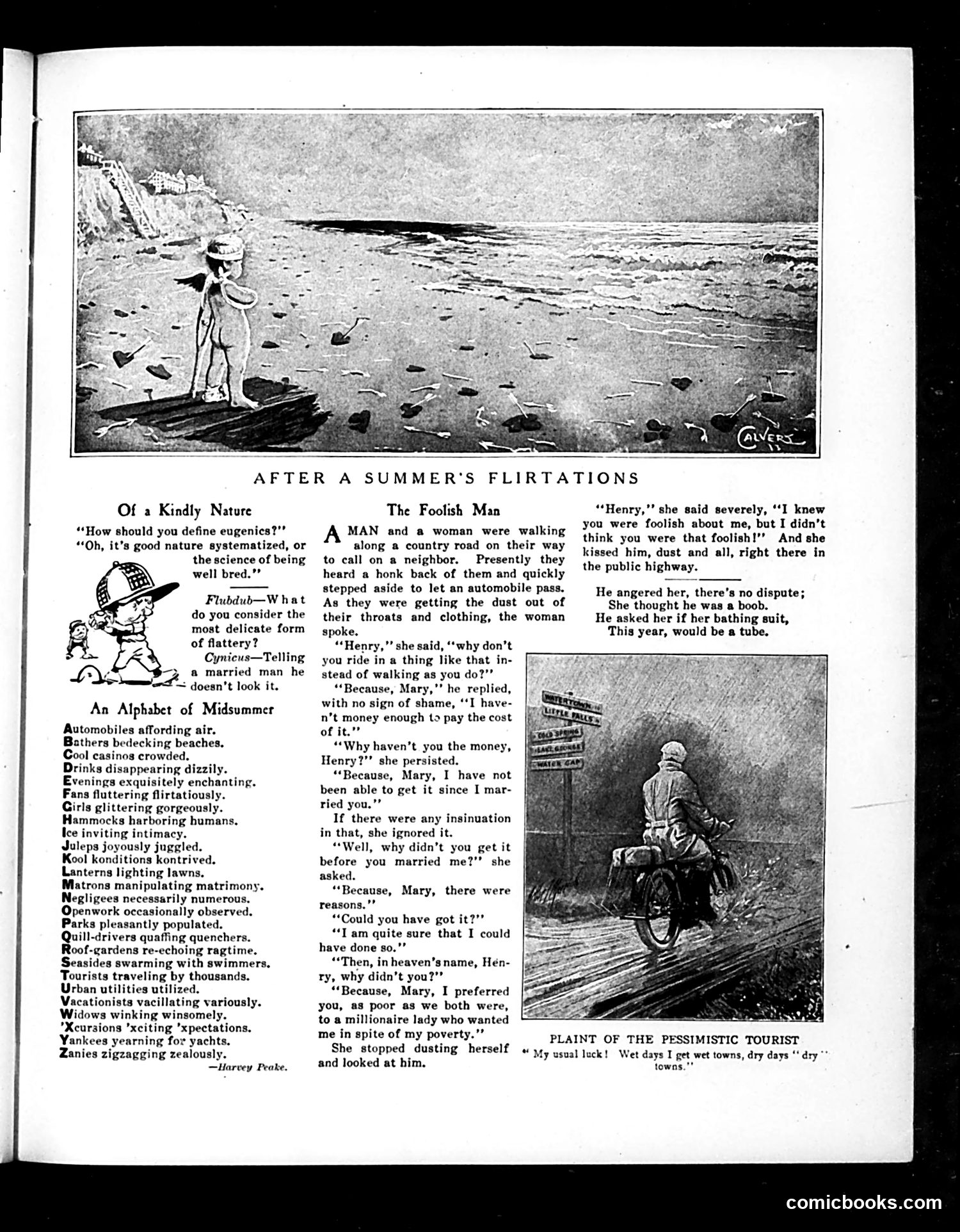
This page contains three separate humorous pieces satirizing summer social life circa early 1900s: **"After a Summer's Flirtations"** (top): A cartoon showing a woman and man on a dusty road encountering automobiles—then the new technology disrupting countryside life. The joke: he won't ride in cars, claiming poverty, yet she suspects he prioritized marrying her over pursuing a wealthier woman. The satire targets both male financial irresponsibility and the transactional nature of marriage. **"An Alphabet of Midsummer"**: An alliterative list mocking summer leisure activities—beaches, hammocks, automobiles, romance—as frivolous pursuits of the leisured classes. Items like "Negligees necessarily numerous" and "Matrons manipulating matrimony" satirize Victorian courtship rituals. **"Plaint of the Pessimistic Tourist"** (bottom right): A pessimist complaining that regardless of weather conditions, he encounters disappointment—attacking the character type of chronic complainers. The overall page ridicules upper-class summer behavior, romantic conventions, and personality types through gentle, domestic humor typical of Judge's satirical approach to American social life.
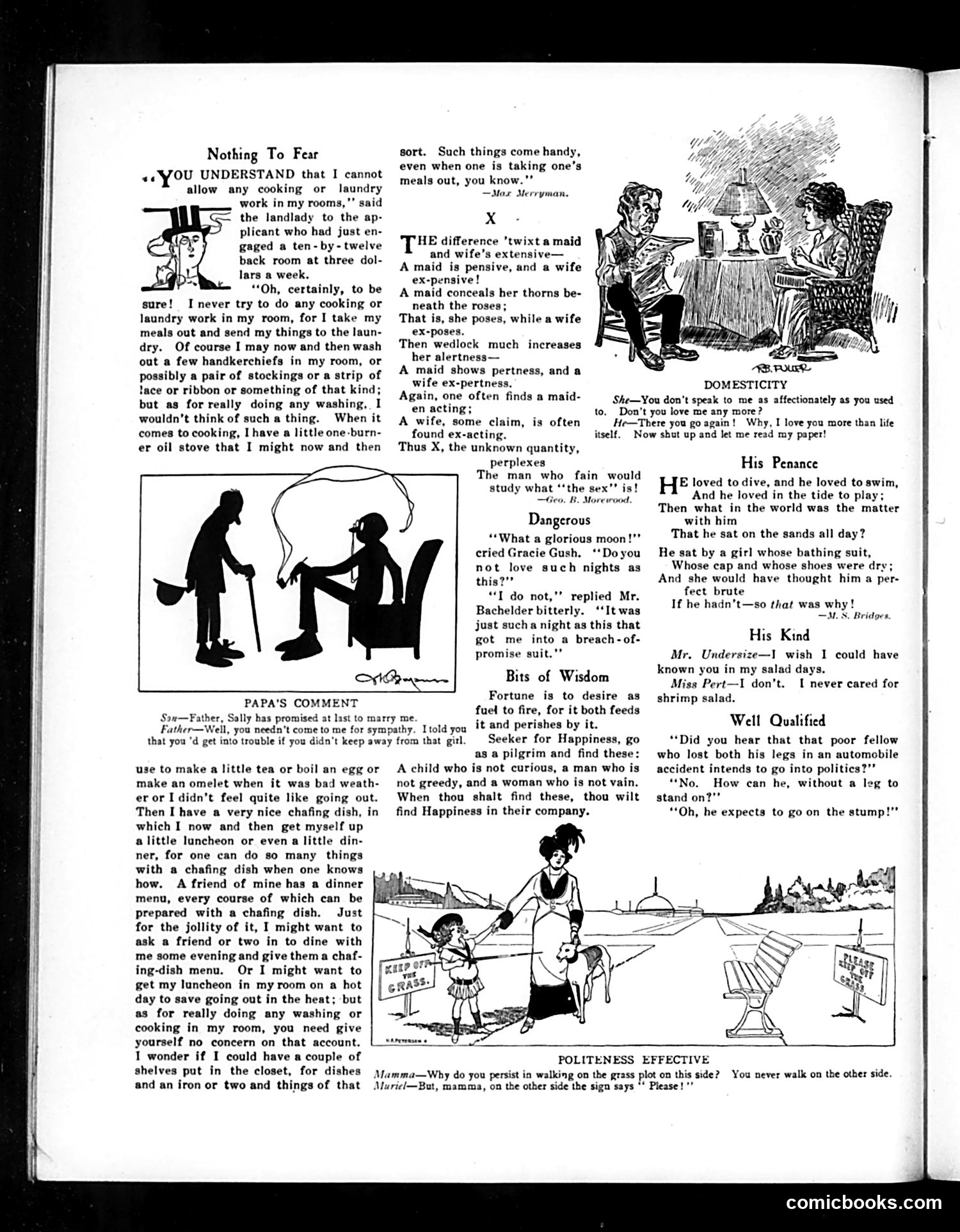
This page from *Judge* magazine contains several satirical pieces mocking domestic life and gender relations circa early 1900s. **"Nothing to Fear"** depicts a landlady and tenant in a hypocritical dance: the tenant claims not to cook or do laundry in her rented room, then immediately describes all the cooking she'll actually do (tea, eggs, chafing dishes, dinner parties). The joke is that she's blatantly lying while maintaining plausible deniability—a commentary on how renters and landlords negotiated lease violations. **"Papa's Comment"** shows a father rejecting his son's engagement announcement, callously refusing sympathy because he'd warned the boy away from "that girl"—satirizing paternal coldness and the "I told you so" attitude. Other pieces mock marriage (maid vs. wife), breach-of-promise suits (legal actions for broken engagements), and gender stereotypes. The humor assumes readers understood Victorian-era concerns: respectable housing standards, marriage as economic transaction, and men's anxieties about women's independence and litigation.
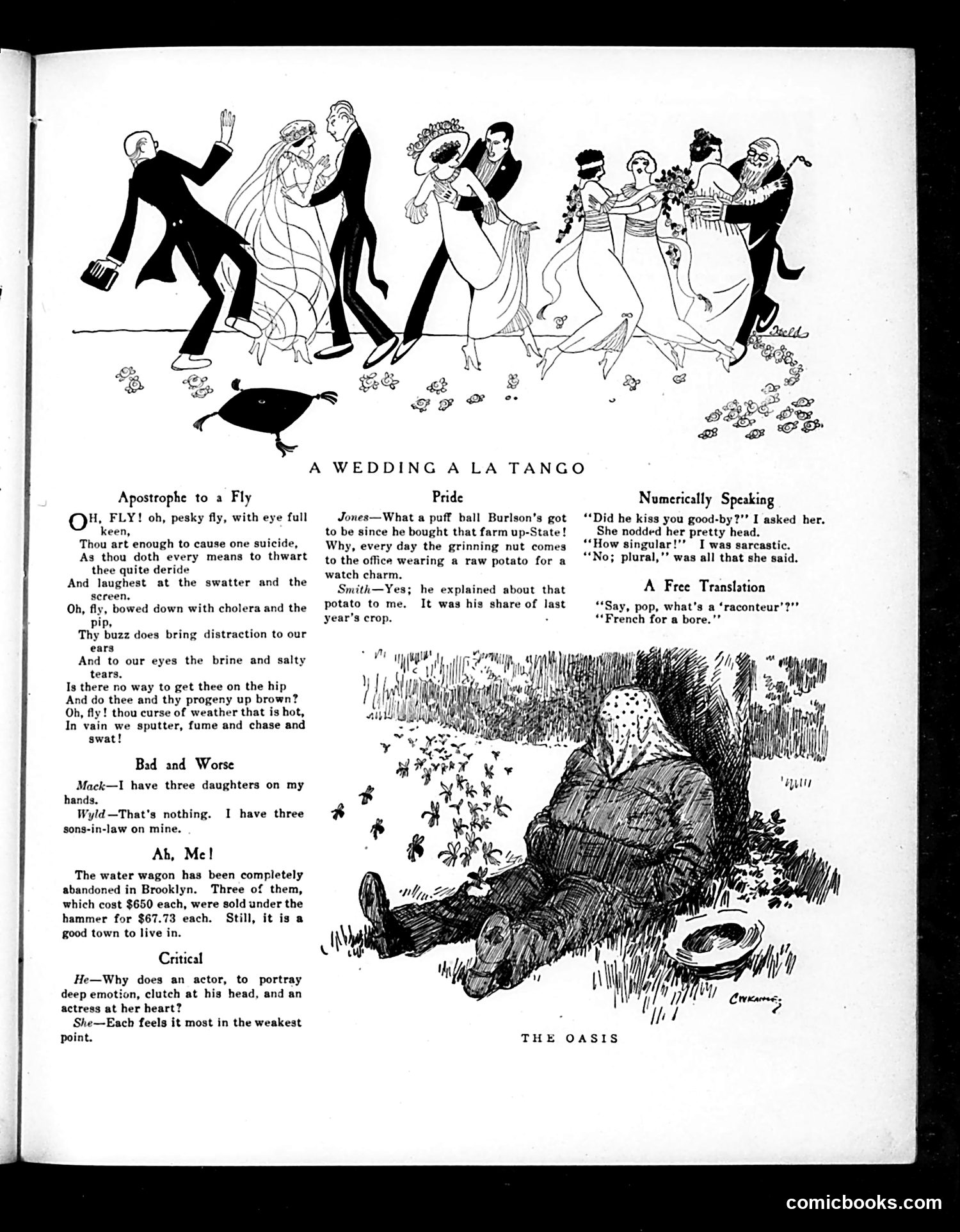
This page satirizes the tango craze that swept America in the early 1910s. The top illustration shows wedding guests dancing wildly in tango style, with money scattered on the floor—mocking how the fashionable dance consumed wealth and attention. The accompanying jokes mock various social absurdities of the era: a man wearing a raw potato as a watch charm (suggesting farm failure disguised as pretension), complaints about daughters and sons-in-law as marital burdens, and Brooklyn's abandonment of water wagons (likely referencing Prohibition debates or municipal inefficiency). "The Oasis" illustration depicts a homeless or vagrant figure—suggesting the contrast between wealthy tango-dancers and the urban poor. The smaller jokes about flies, emotions, and French words ("raconteur") represent typical period humor: mild social observation and wordplay. Overall, the page lampoons both the frivolous excess of tango-dancing society and everyday domestic frustrations, typical of Judge's satirical approach to American life.
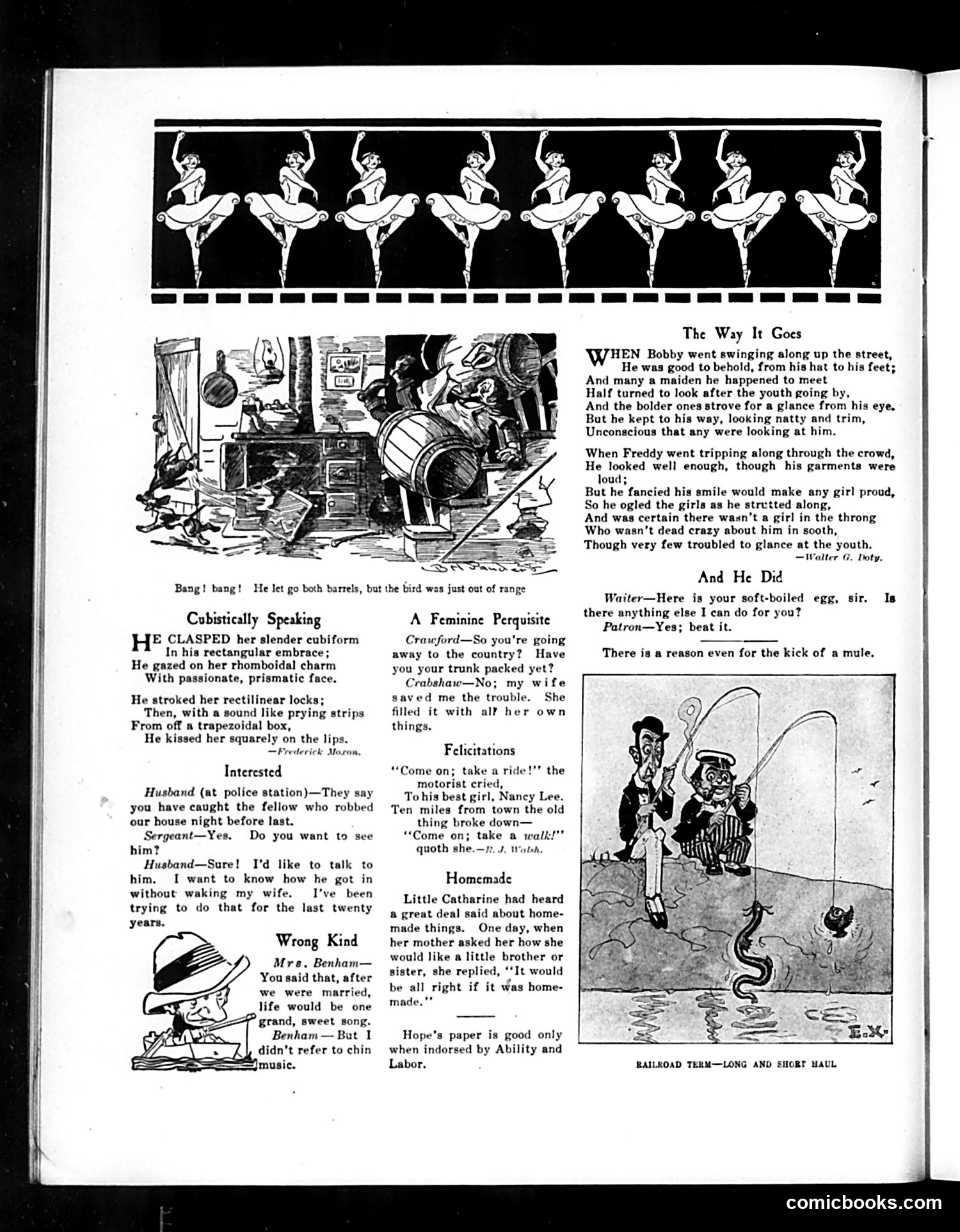
This page contains multiple humor pieces satirizing early 20th-century social dynamics and gender relations. **"Cubistically Speaking"** mocks the then-fashionable Cubist art movement by describing romance entirely in geometric terms—a parody of how pretentious artistic language obscures simple subjects. **"Interested"** and **"Wrong Kind"** present marital complaints as jokes: a husband wants to know how a burglar entered undetected (implying his wife is a light sleeper he resents), and another regrets that married life isn't the romantic "song" promised. **"The Way It Goes"** contrasts two young men: Bobby, naturally attractive and modest, unwittingly attracts female attention; Freddy, vain and attention-seeking, receives none—mocking male vanity and suggesting that genuine appeal lies in indifference rather than self-promotion. Scattered throughout are one-liners about women's materialism (wife packing her own items, not husband's) and domestic frustration. The overall tone reflects period attitudes toward gender, marriage, and social pretension.
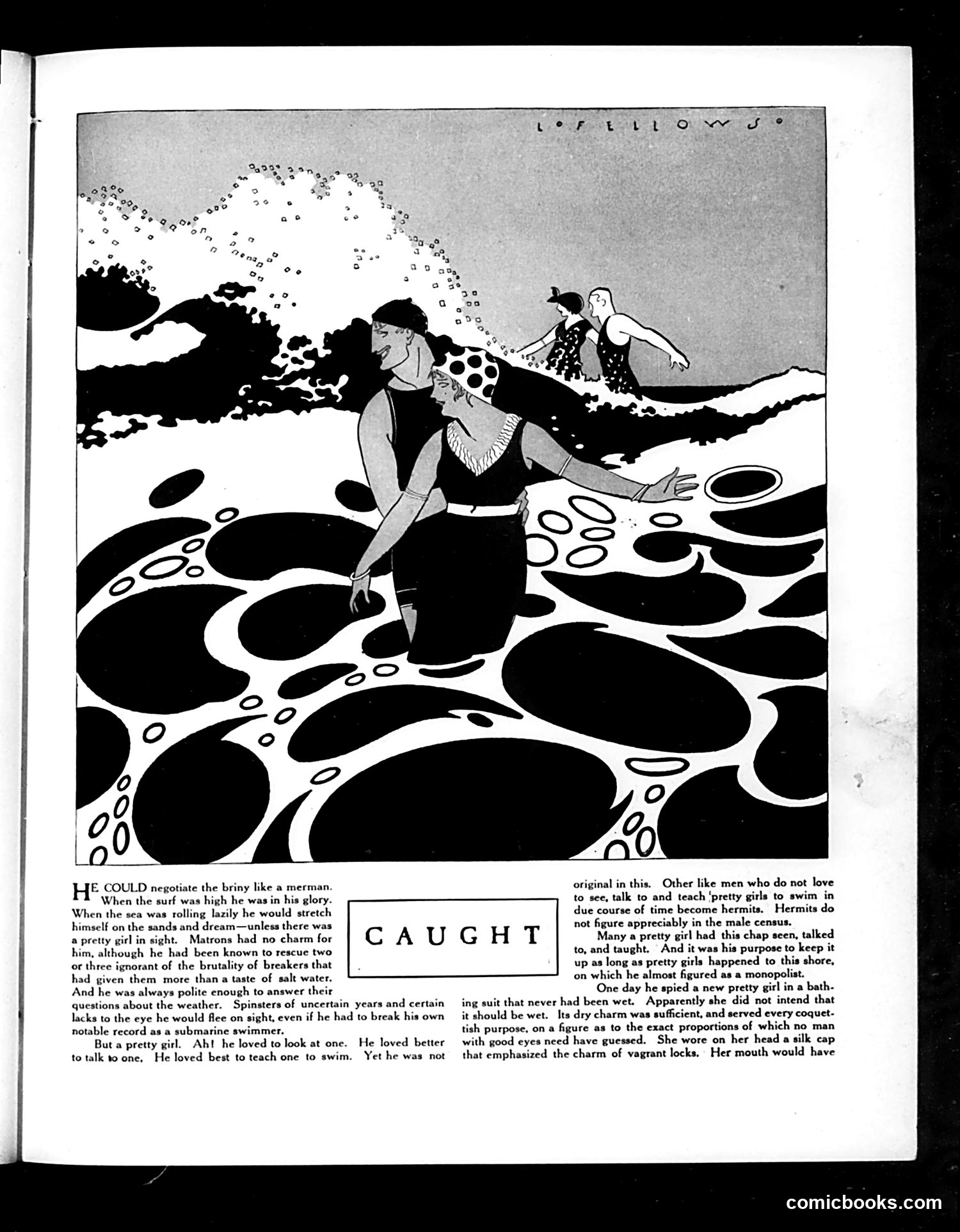
This is a humorous short story illustration about a male swimmer who frequents the beach to teach pretty girls to swim—his actual hobby, though he claims to merely rescue drowning women. The satire targets male vanity and predatory flirtation disguised as heroism. The protagonist is portrayed as a serial seducer who uses swimming lessons as a pretext for attention from women. The joke intensifies when he encounters a new girl in an unwet bathing suit, suggesting she's deliberately avoiding the water to maintain her appearance—subverting his usual conquest strategy. The titled caption "CAUGHT" implies he's finally met his match: a girl more interested in being admired than actually swimming. The illustration shows him gesturing toward the water while figures (possibly already-taught girls) appear in the background. This reflects early 20th-century beach culture anxieties about courtship rituals and gender dynamics, satirizing both male presumption and female coquetry.
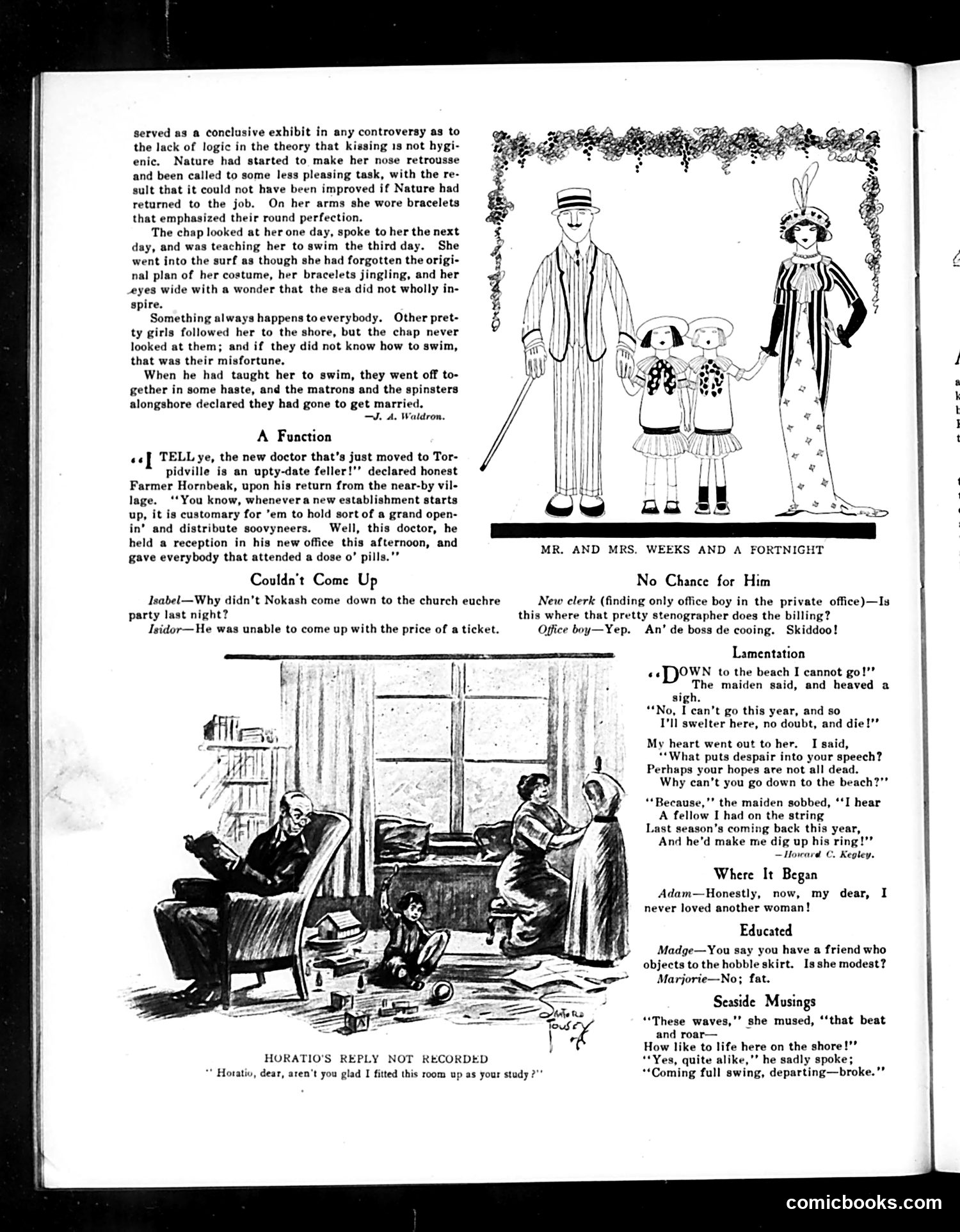
This page contains multiple brief satirical pieces typical of early 20th-century American humor magazines: **Main cartoon** ("Horatio's Reply Not Recorded"): A domestic scene where a wife shows her husband his new study, asking if he's pleased. The joke's point is unstated—likely mocking either the wife's presumption or the husband's trapped domestic situation. **"A Function"**: Satirizes a new doctor's unconventional "grand opening" reception where, instead of distributing customary souvenirs, he gives attendees pills—a joke about aggressive medical marketing or dubious medical practices. **"No Chance for Him"**: Office humor about a stenographer's billing department visit; the "cooing" boss reference suggests workplace flirtation or romance. **Other pieces** are brief comic verses and one-liners about dating, beach visits, and marriage—standard light humor of the era with no specific political references. The overall tone reflects Judge's focus on genteel, domestic American life rather than hard satire.
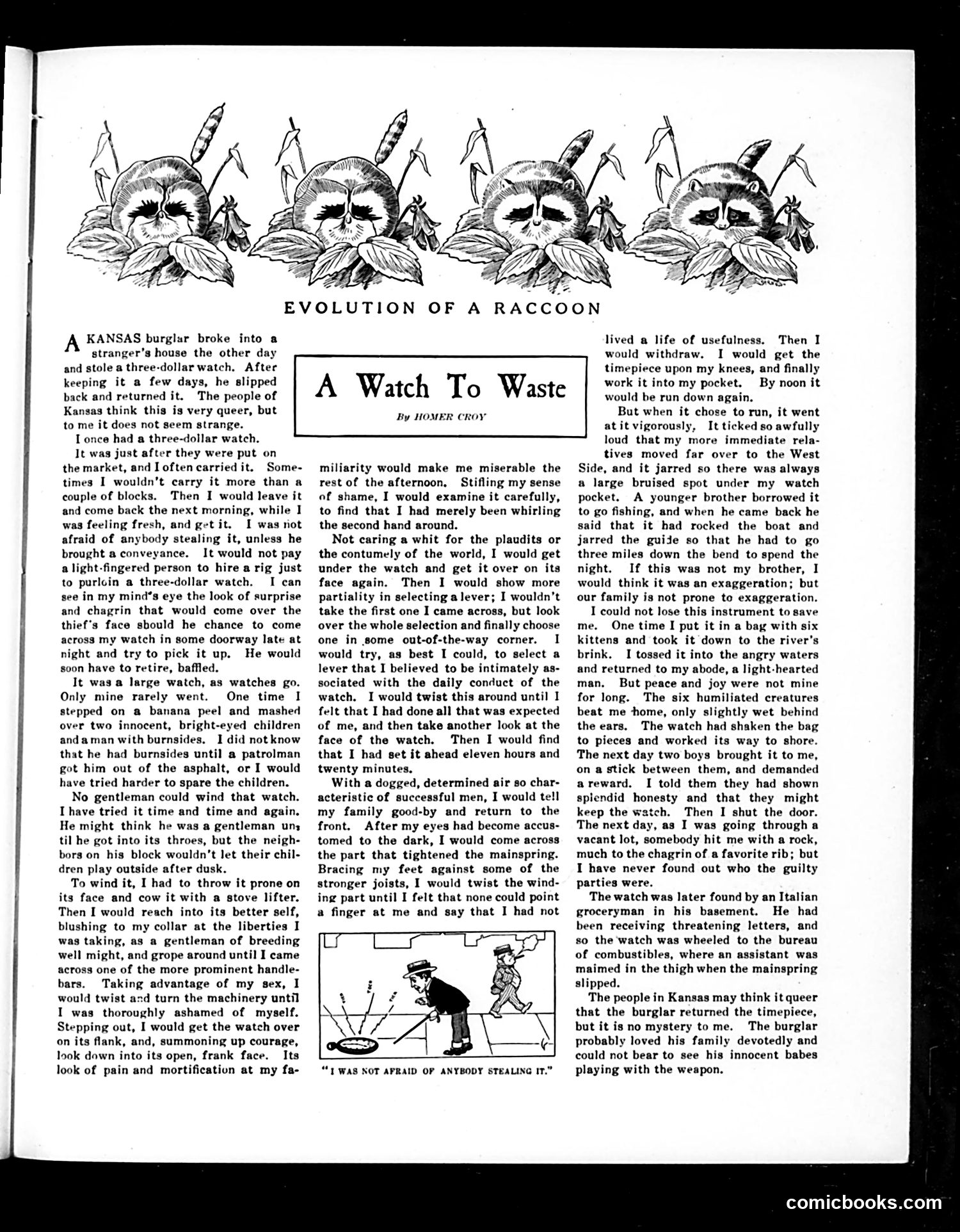
This is a humorous essay by Homer Croy about the absurdity of cheap, poorly-made watches—specifically three-dollar models newly available on the market. The piece is framed around a Kansas burglar who stole such a watch and returned it, which the author uses as a springboard for satirizing the watch's worthlessness. The joke targets the inferior quality of mass-produced timepieces: the watch barely functions, requires violent manipulation to wind (using a stove lifter), frequently stops or runs incorrectly, and is so unreliable that stealing it would yield no benefit. The author's elaborate, self-deprecating account of attempting to maintain the device mocks both the watch's design and consumer culture's embrace of cheap, disposable goods. The cartoon at top shows the "evolution" of a raccoon—likely a visual pun on the watch's mechanical dysfunction and unpredictability.
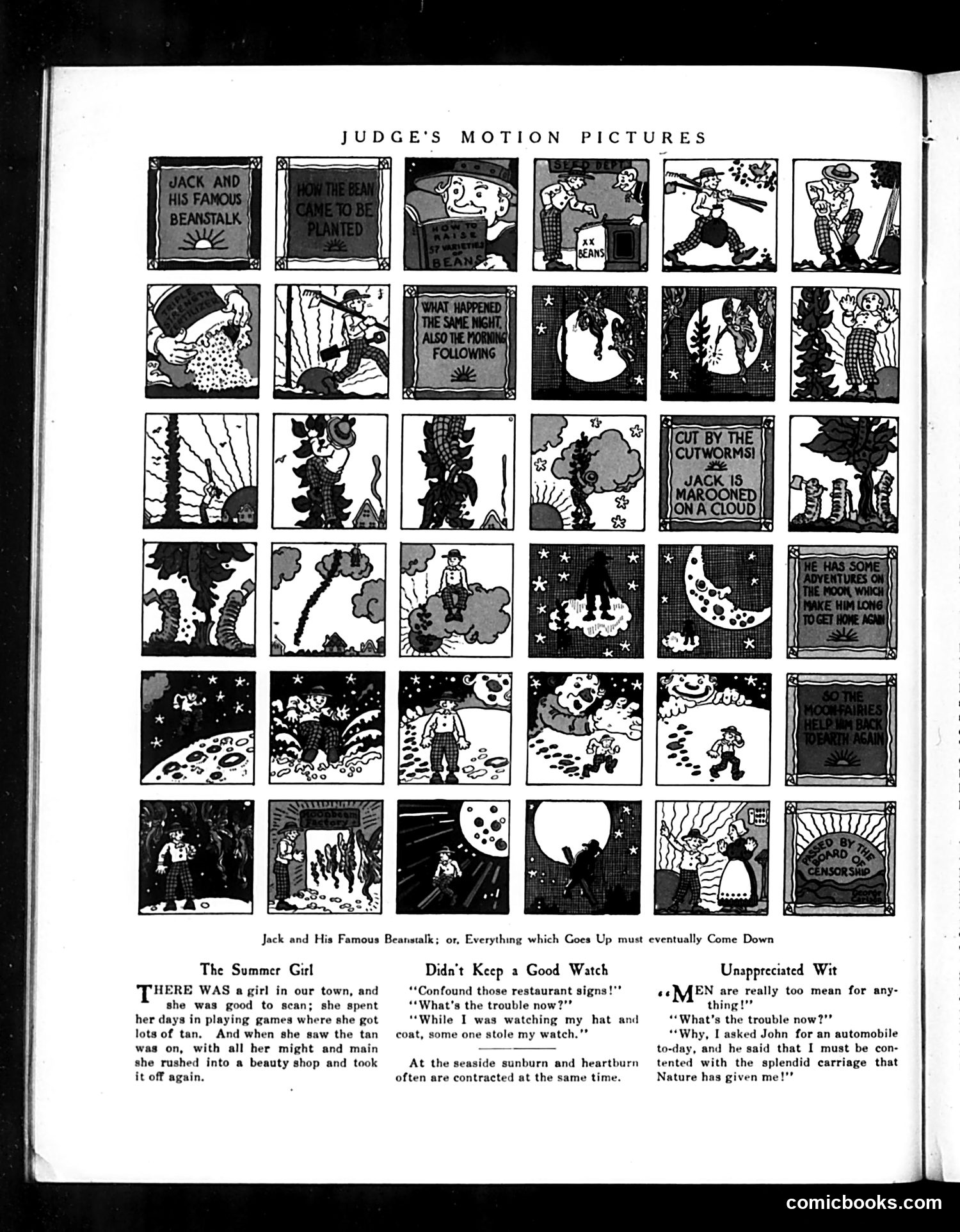
This page contains three separate joke comics typical of Judge magazine's early 20th-century humor: **"Jack and His Famous Beanstalk"** is a visual comic strip adapting the fairy tale, with the subtitle "Everything which Goes Up must eventually Come Down"—likely satirizing financial speculation or social climbers. The three written jokes below use common period humor formulas: 1. **"The Summer Girl"** mocks women's vanity: a girl spends summer tanning, then immediately pays to have it removed at a beauty shop—satire on contradictory female beauty standards and consumer behavior. 2. **"Didn't Keep a Good Watch"** is a simple pun: a man watches his hat and coat at a restaurant but someone steals his watch instead—playing on the double meaning of "watch." 3. **"Unappreciated Wit"** presents a woman's complaint that her boyfriend dismissively compared her to "nature's carriage"—mocking both male insensitivity and women's materialism. These represent mainstream, genteel American humor from Judge's target audience.
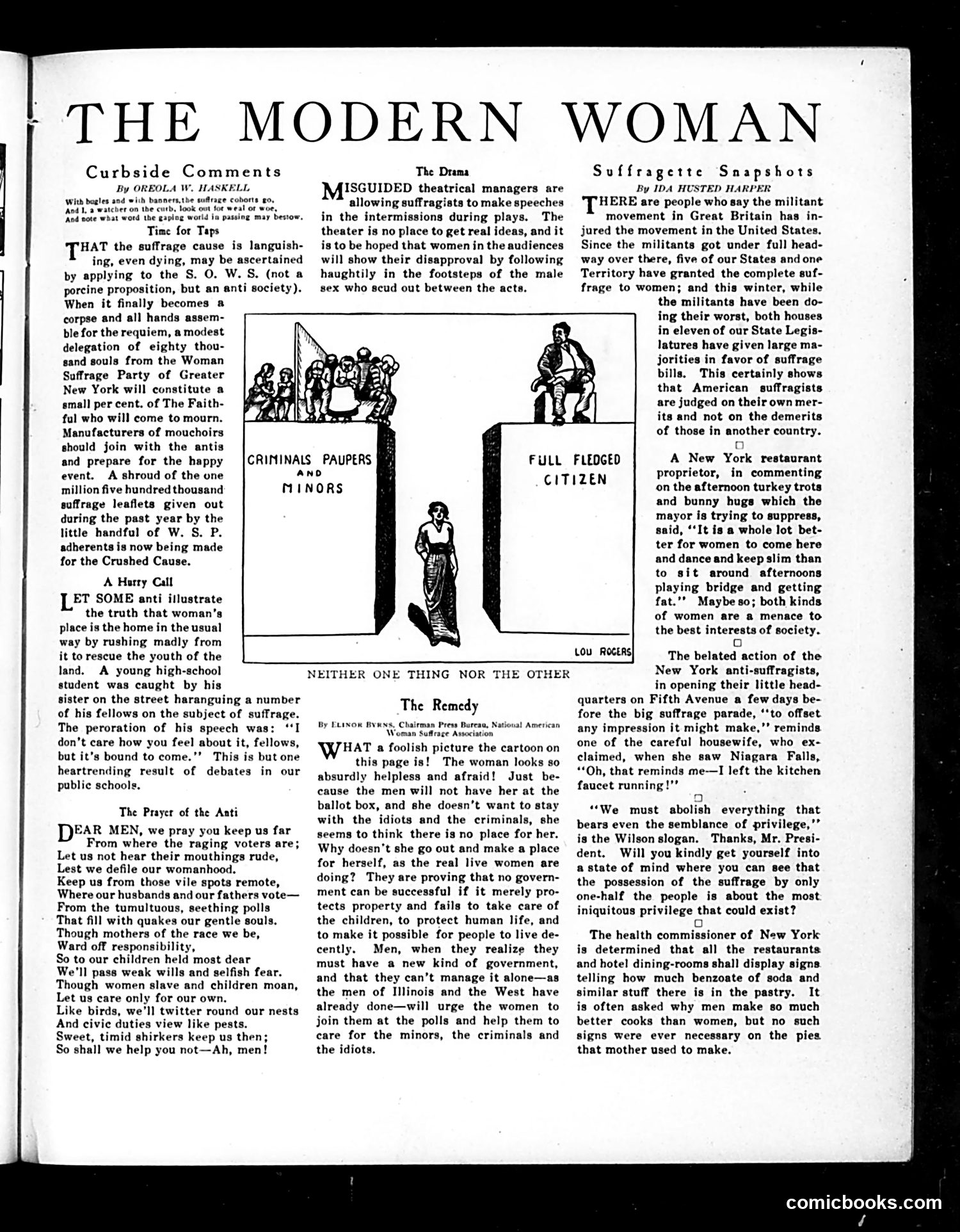
This anti-suffrage page presents opposing views on women's voting rights circa 1910s. The central cartoon depicts a woman standing between two doors labeled "Criminals, Paupers and Minors" and "Full Fledged Citizen," illustrating the anti-suffrage argument that women shouldn't vote because they'd be grouped with society's undesirables. The left columns mock suffragists: "Time for Taps" predicts the movement's death; "The Drama" ridicules women disrupting theater intermissions with speeches; "A Harry Call" criticizes children absorbing pro-suffrage arguments in schools. The right column features Eleanor Byrns (identified in text), a National American Woman Suffrage Association leader, who rebuts these arguments. She calls the cartoon "foolish," arguing women should create their own place in society and that governments fail without women's participation in protecting children and human life. The page presents classic suffrage-era debate: anti-suffragists claiming women's "proper sphere" was home; suffragists demanding political participation to address social problems.
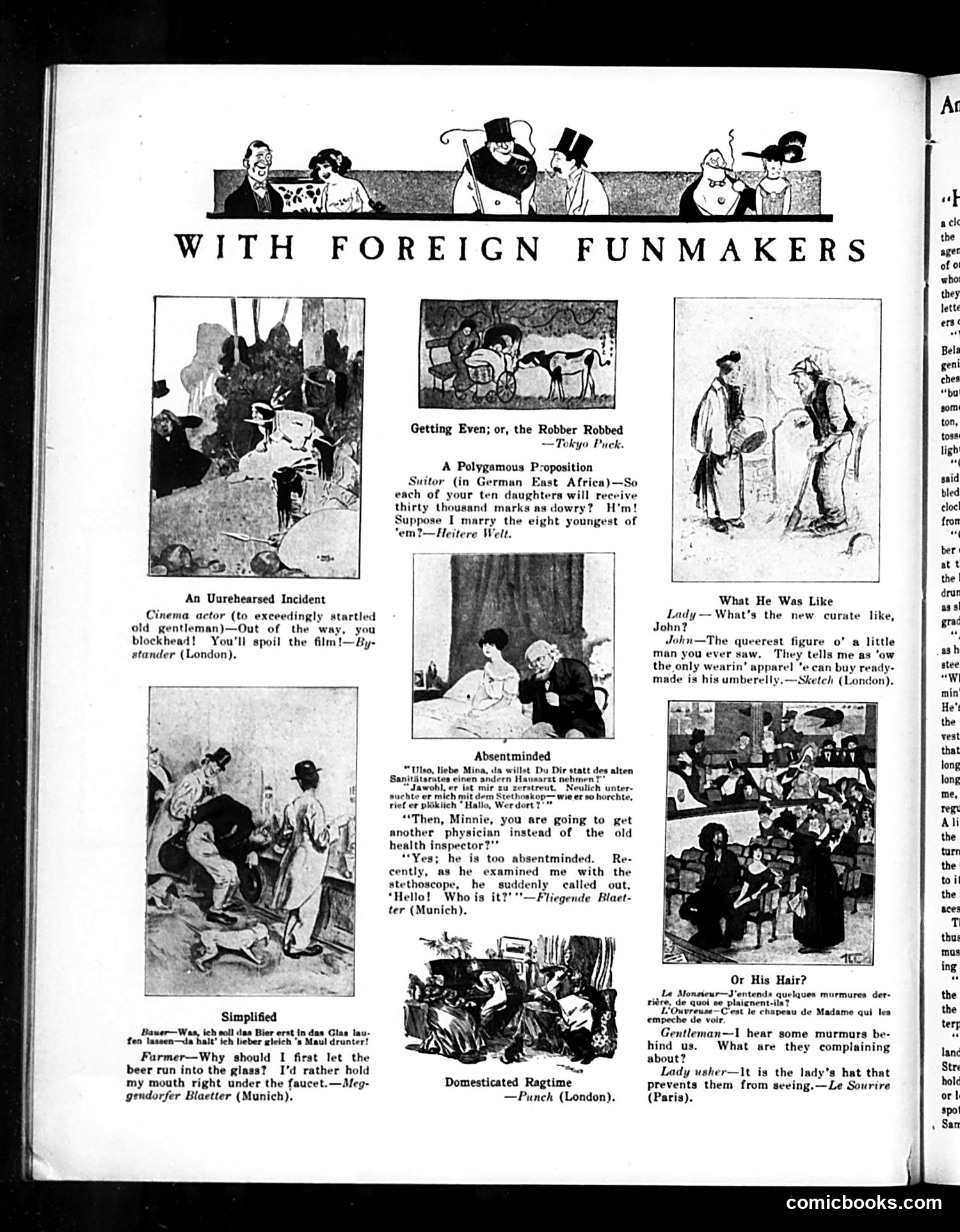
This page collects humor reprinted from international satirical magazines (German, Japanese, French, British). The cartoons mock everyday absurdities: **Key jokes:** - A suitor in German East Africa haggling over bride-price, proposing to marry fewer daughters for less dowry - A film actor shouting at a bystander, revealing cinema's self-importance - A distracted doctor examining a patient while apparently hallucinating ("Hello! Who is it?") - A farmer preferring to drink beer directly from a tap rather than use a glass - A curate so small he can only buy ready-made umbrellas - A woman's oversized hat blocking theatergoers' views **The satire targets:** pompous professionals, modern technology's disruptions, physical peculiarities, and social pretension. The page's framing as "foreign" humor suggests American editors presenting European wit as sophisticated entertainment for readers. These are gentle, observational jokes—not overtly political, but reflecting early 20th-century class consciousness and urban anxieties.
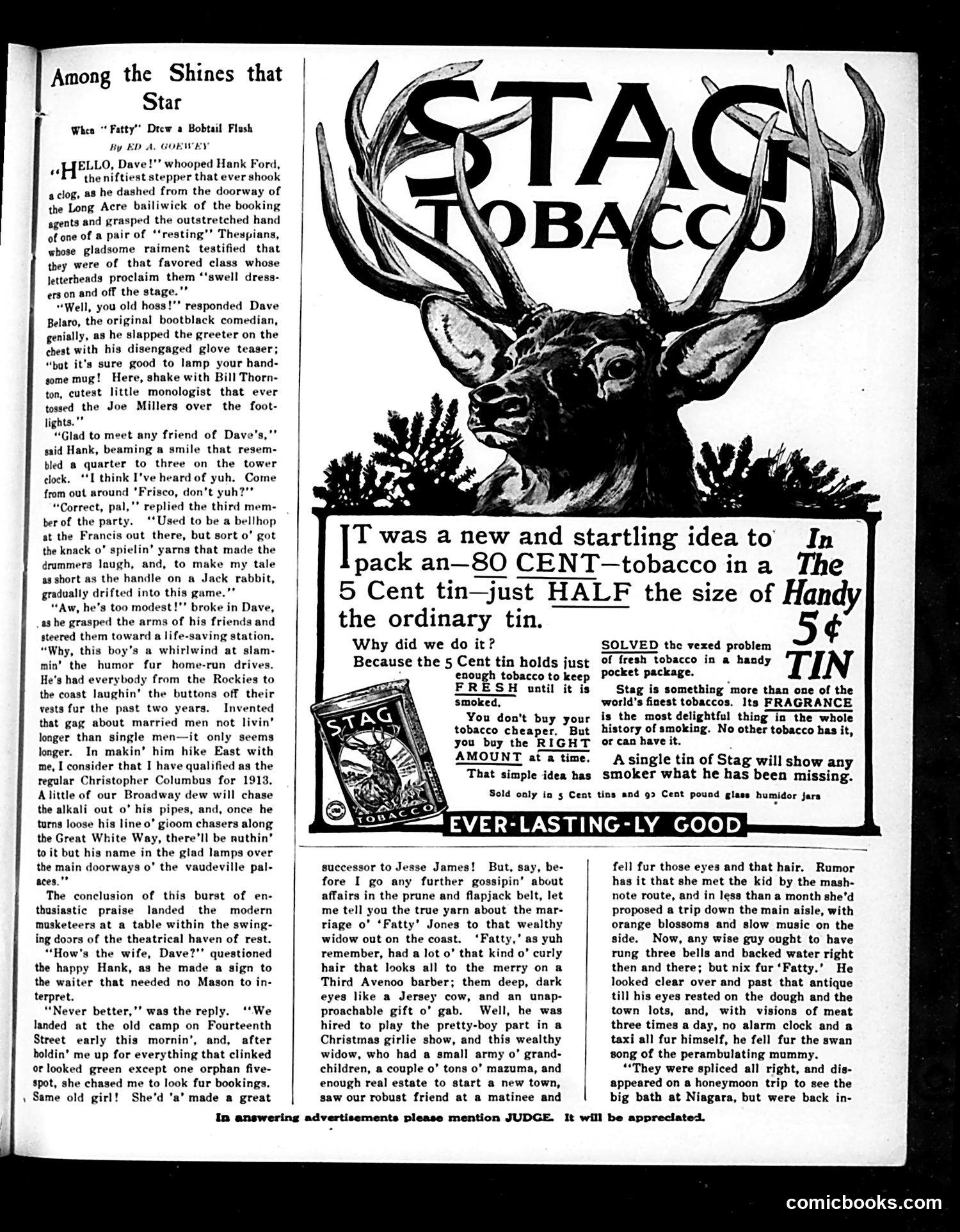
This page contains a short story "Among the Shines that Star" by Ed A. Goewey about theatrical characters in early 1900s New York, followed by a **Stag Tobacco advertisement**. The story depicts vaudeville performers—Dave Belaro (a "bootblack comedian"), Hank Ford, and Bill Thornton—meeting at a theater district hangout. Their dialogue uses period theatrical slang ("resting" actors, vaudeville terminology) to establish camaraderie among stage workers. Dave boasts that bringing Thornton east will make him a star, then launches into gossip about "Fatty" Jones's marriage to a wealthy widow. The **advertisement** (the page's main content) promotes Stag tobacco's innovation: selling 80-cent tobacco in a 5-cent tin—"half the size of ordinary tin." The copy emphasizes freshness, convenience, and that Stag is "something more than one of the world's finest tobaccos," claiming superior fragrance and no substitute tobacco exists. The illustration shows a stag's head with antlers framing the product. This is primarily advertising disguised as editorial content, common in Judge magazine's revenue model.
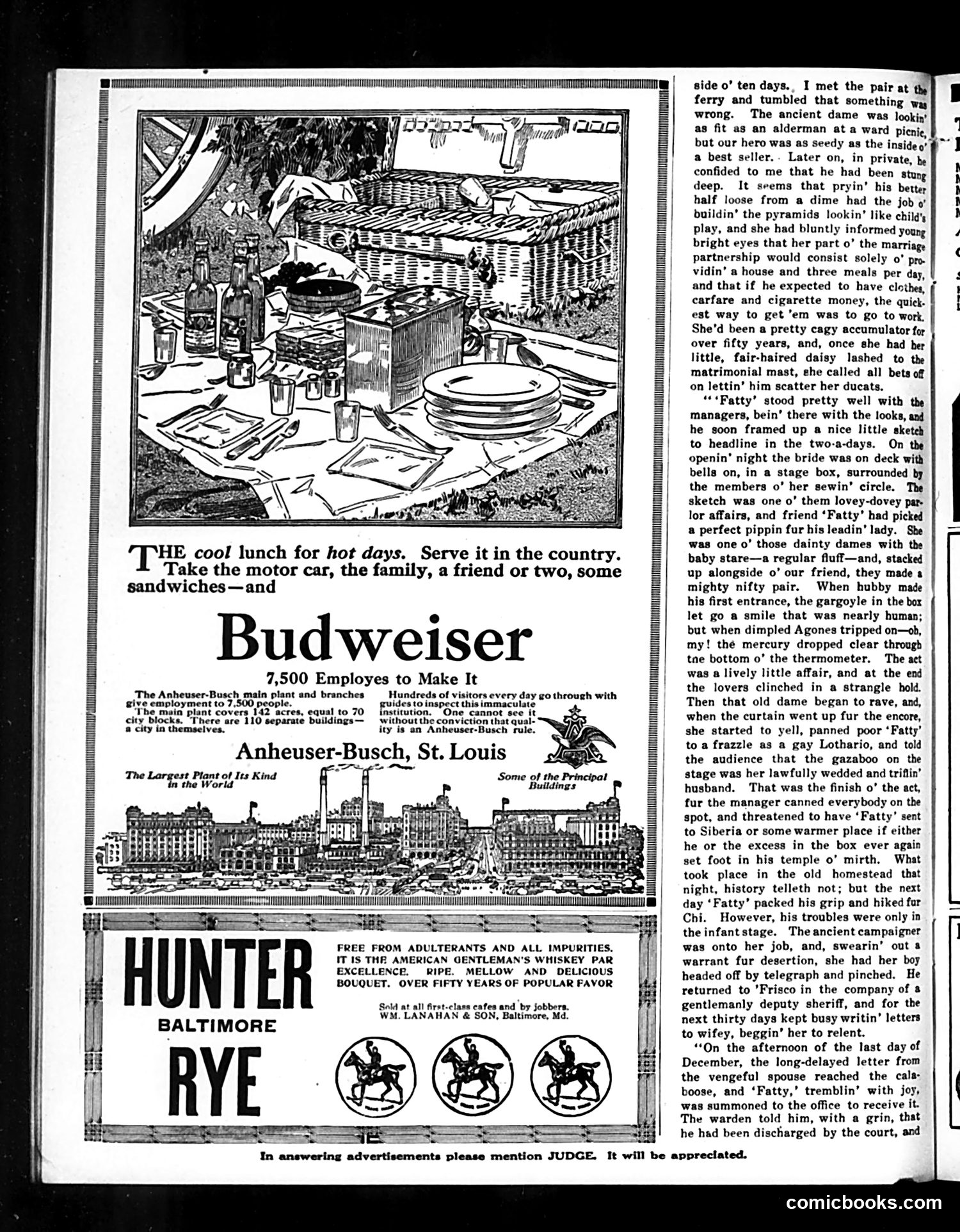
This page consists primarily of **advertisements** for Budweiser beer and Hunter Rye whiskey, with no political satire. The illustrated top section advertises Budweiser, emphasizing the brewery's massive St. Louis operation (7,500 employees, 142 acres) as a marker of quality and American industrial prowess—typical early-20th-century advertising linking size to legitimacy. The text column on the right contains a serialized **humorous story** (not political commentary) about "Fatty," a vaudeville performer whose wealthy, miserly wife attends his theatrical debut with a leading lady. The wife's jealous outburst during the performance ruins his career—a melodramatic tale of domestic conflict played for laughs. The Hunter Rye advertisement emphasizes purity and fifty years of popularity. **Bottom line:** This is an advertising-heavy magazine page with entertainment fiction, not political or social satire requiring historical context for modern readers.
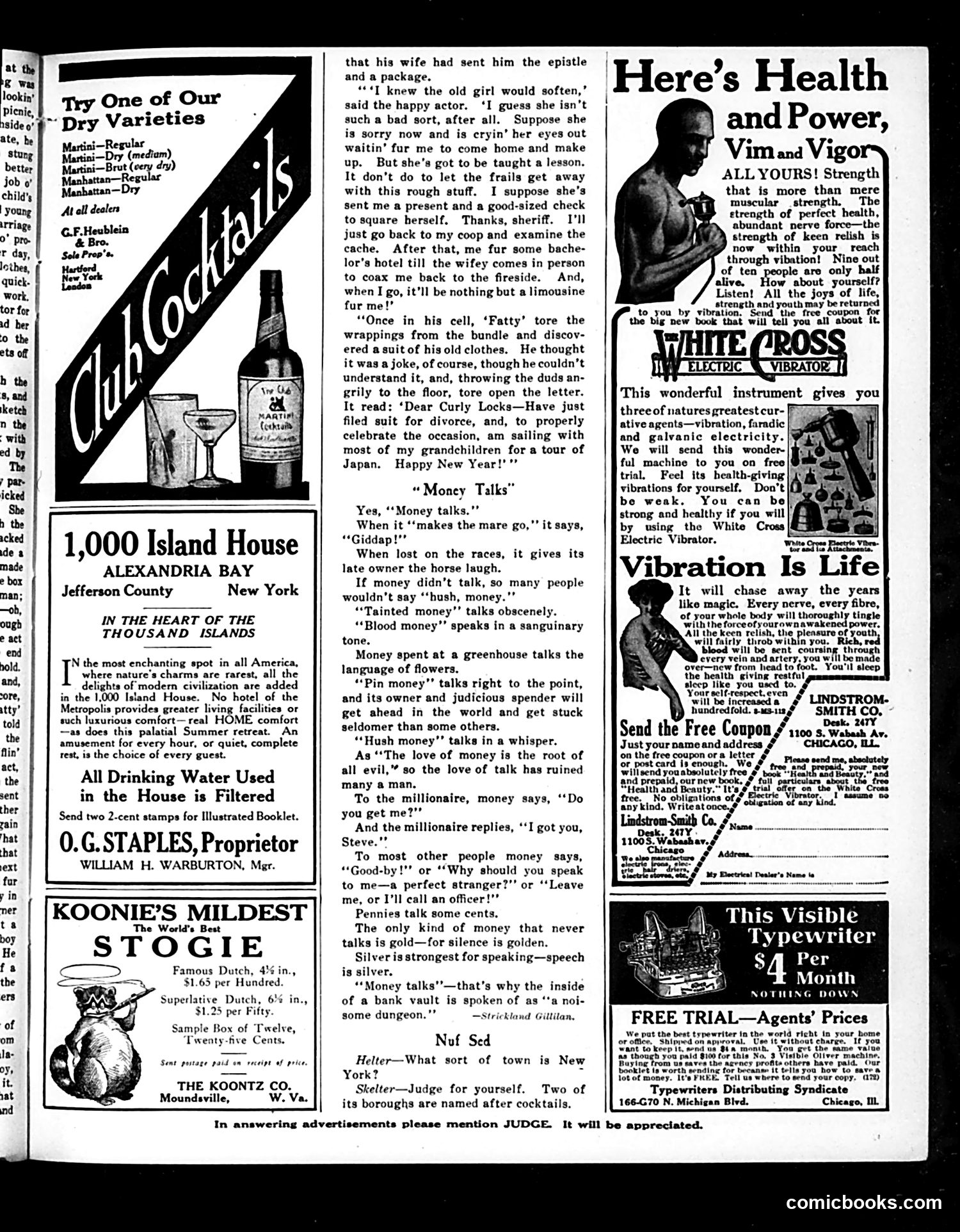
This page contains primarily **advertisements** rather than editorial cartoons, reflecting early 20th-century magazine economics. The notable content is a **short story titled "Money Talks,"** a satirical piece playing on the idiom. It depicts a jailed man ("Fatty") receiving divorce papers and old clothes from his estranged wife—a comedic reversal where material objects "speak" volumes about their relationship. The story uses wordplay, punning on how money literally and figuratively communicates in various contexts (horse racing, flowers, romance). The **advertisements** hawking dubious products are themselves satirical artifacts of the era: a "White Cross Electric Vibrator" promising health and vigor through vibration (typical of pseudoscientific wellness devices popular then), and a typewriter for $4/month. These reflect contemporary snake-oil marketing that Judge's sophisticated readership would recognize as absurd. The page's humor operates at multiple levels—the story's domestic satire and the implicit mockery of gullible consumers targeted by exaggerated advertising claims. This juxtaposition was Judge's editorial strategy: satirizing both society and consumer culture simultaneously.
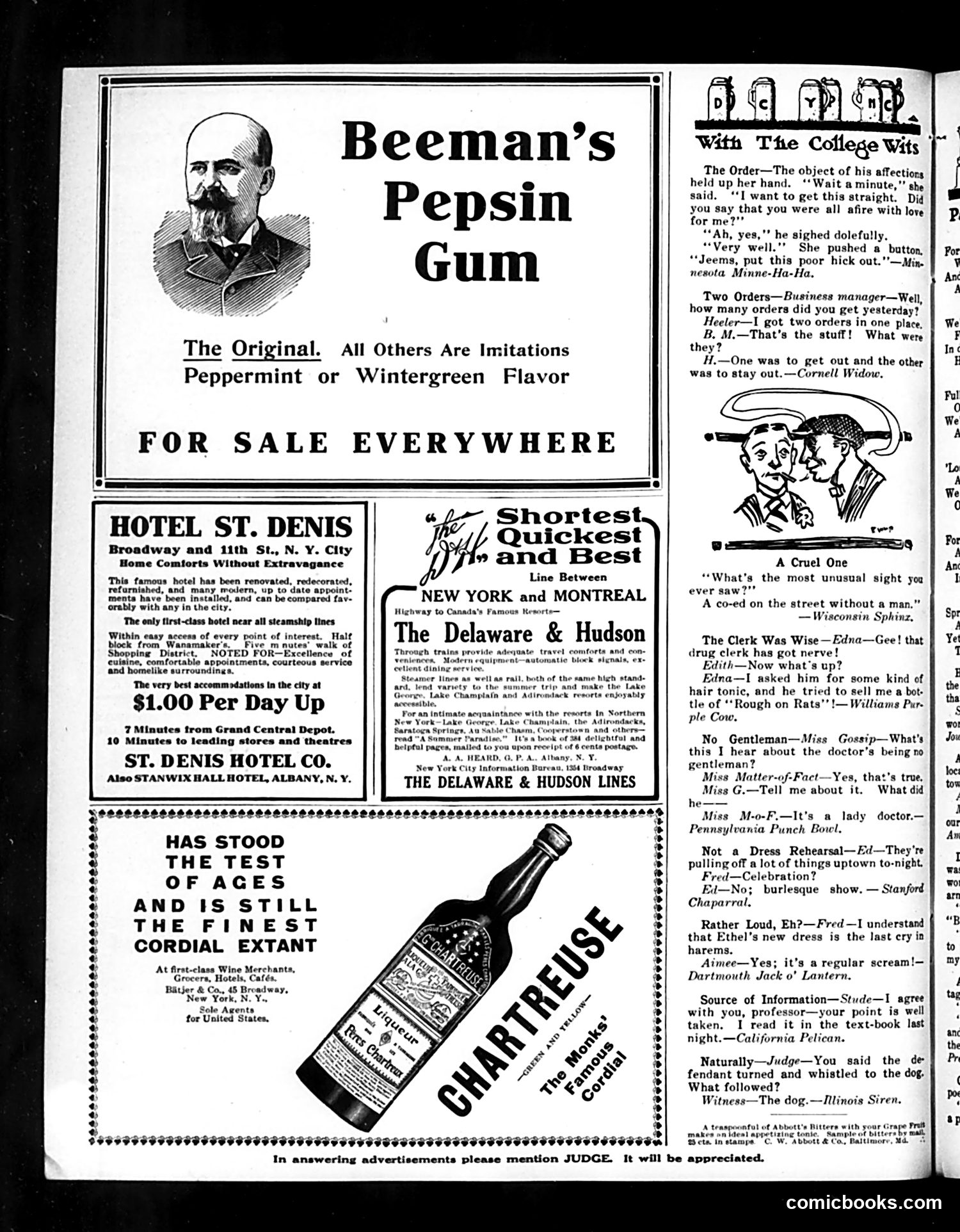
This page is primarily **advertisements and humor columns**, not political satire. The ads promote Beeman's chewing gum, a hotel, wine, and train service—typical early 20th-century Judge magazine content. The humor section ("With The College Wits") contains brief jokes from college newspapers, most relying on dated tropes: a woman rejecting a suitor, a drug clerk's crude sales pitch, observations about co-eds and their appearance, and a woman's loud dress. These reflect period attitudes toward gender roles and courtship. One recurring theme is **workplace hierarchy**—a business manager questioning an employee, a judge questioning a witness—suggesting contemporary anxieties about authority and class. The jokes are largely **situational and conversational** rather than politically pointed. They target no specific figures or events, focusing instead on universal social awkwardness and romantic misunderstandings common to college humor of the era. The humor would feel dated to modern readers primarily due to outdated assumptions about gender behavior and propriety.
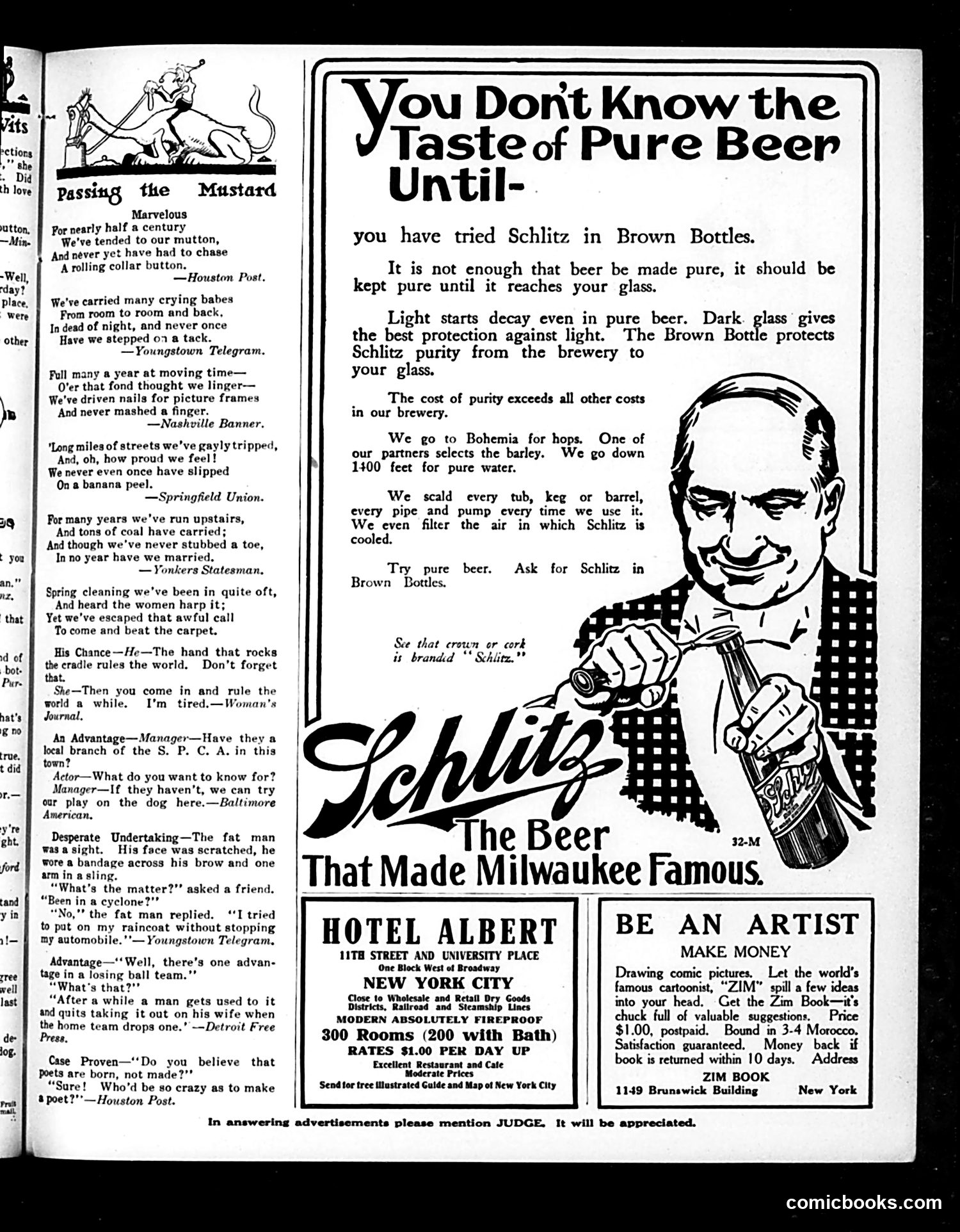
This page is primarily a **Schlitz beer advertisement** from Judge magazine, combined with humorous short jokes. The main ad features a smiling man in a checkered shirt holding a Schlitz bottle, promoting "The Beer That Made Milwaukee Famous." The advertisement's core message emphasizes product purity: beer must remain pure not just during brewing but until it reaches the consumer's glass. Dark brown bottles are highlighted as protective against light decay. The ad details Schlitz's manufacturing claims—sourcing barley from Bohemia, water from 1,400 feet underground, and sterilizing every equipment component. The tagline promises purity "from the brewery to your glass." The left column contains unrelated humorous anecdotes from various newspapers (Houston Post, Youngstown Telegram, Nashville Banner, etc.), using repetitive structure to deliver comedic punchlines about domestic mishaps—never breaking collar buttons, stepping on tacks, or slipping on banana peels despite decades of activity. Below are hotel and "Be an Artist" advertisements offering drawing instruction and accommodation services in New York City.
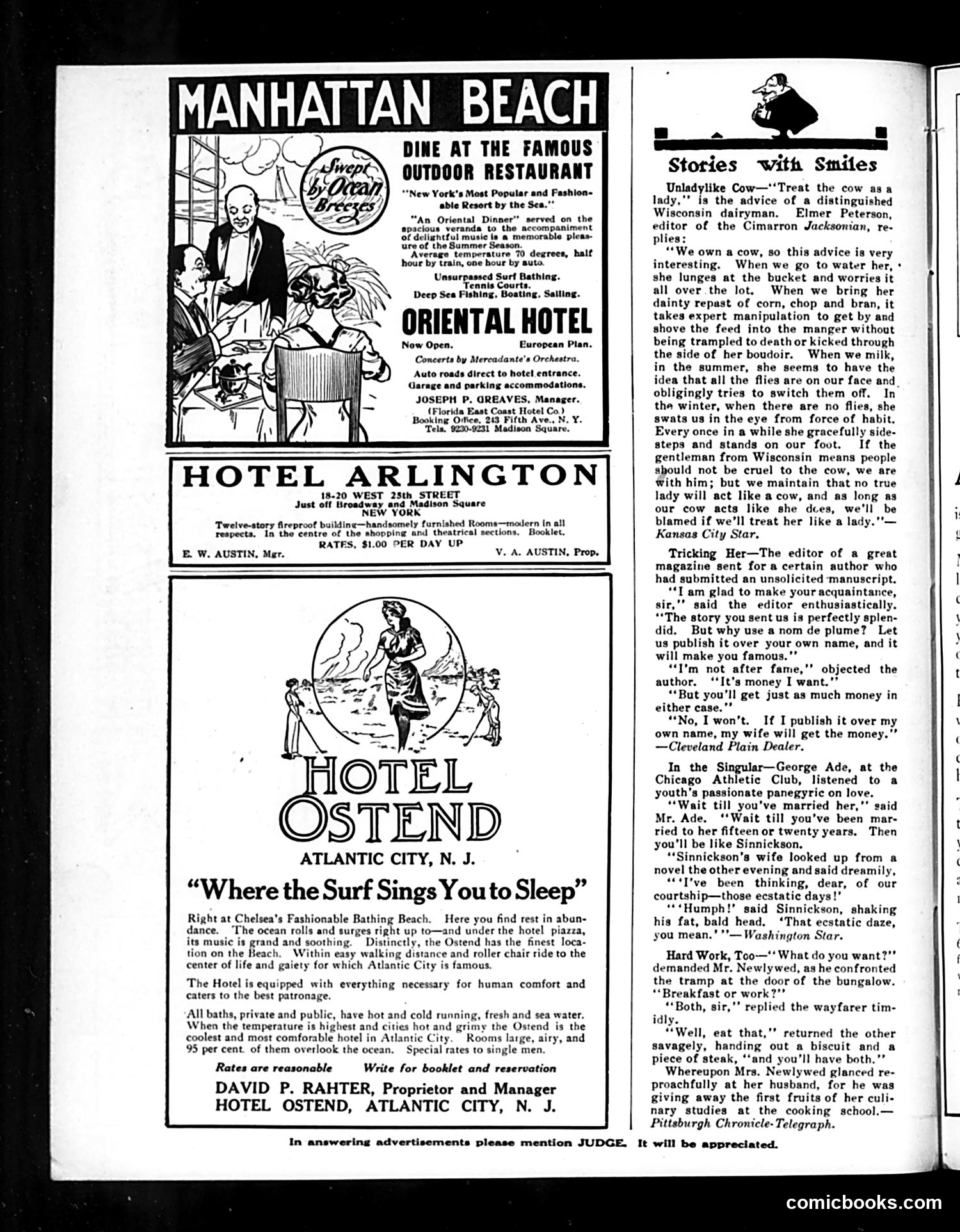
This page is primarily **hotel and resort advertisements** rather than political satire. The content includes promotional materials for three hotels: Manhattan Beach's Oriental Hotel, Hotel Arlington in New York City, and Hotel Ostend in Atlantic City—all offering leisure accommodations and dining. The right column features "Stories with Smiles," humorous anecdotes rather than political cartoons. One story mocks advice to "treat the cow as a lady," with a dairyman describing the animal's unladylike behavior. Another depicts an author refusing magazine publication under his own name because "my wife will get the money"—a joke about marital property rights or spousal financial control. **For modern readers:** These brief comedic pieces reflect early 20th-century attitudes toward gender relations and domestic economics, presented as lighthearted humor. The page demonstrates how Judge balanced satirical content with commercial advertising.
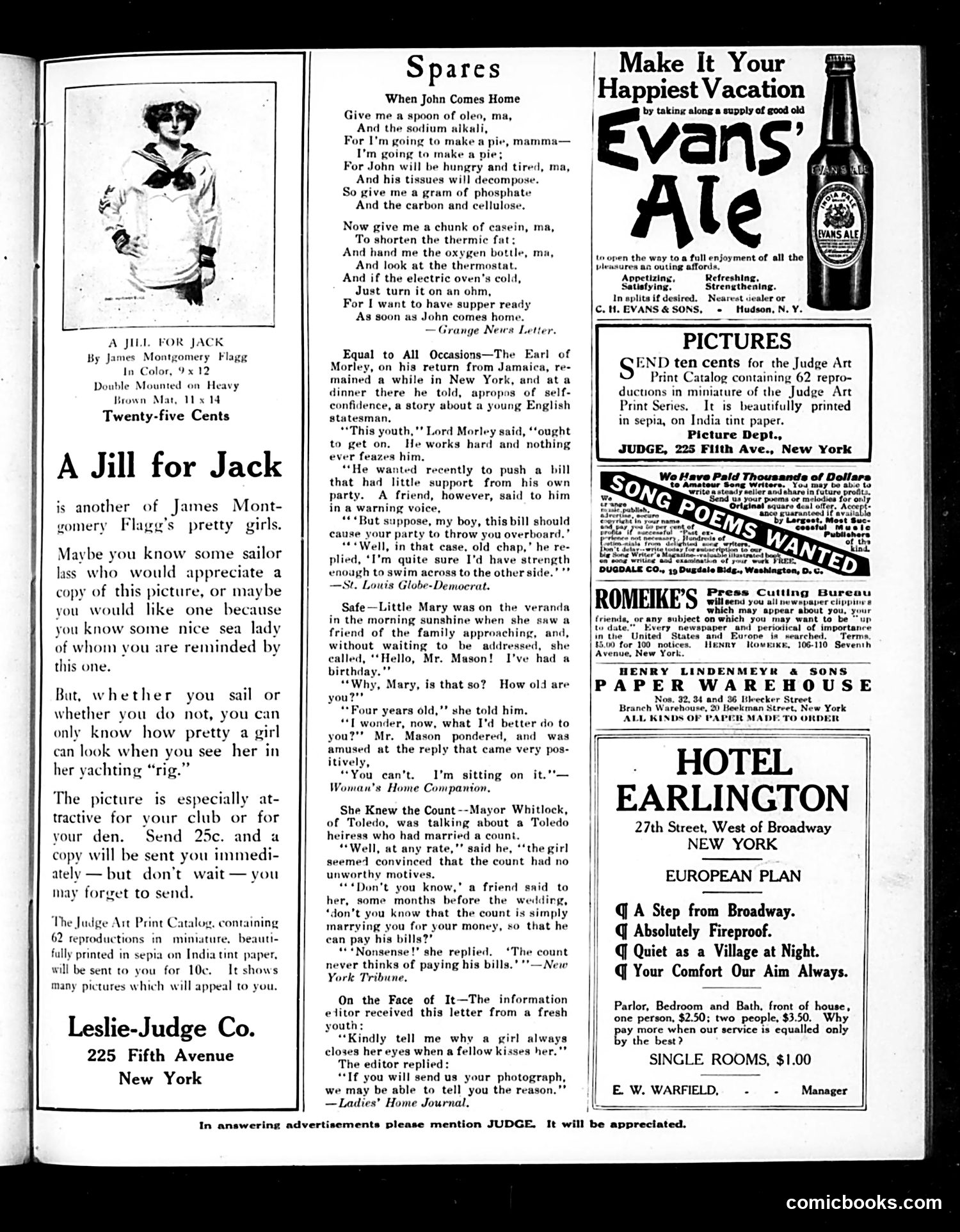
This page consists primarily of **advertising and humor pieces** rather than political cartoons. **Main Content:** The featured item is "A Jill for Jack," a James Montgomery Flagg illustration of an attractive woman in nautical/yachting attire—marketed as a 25-cent print for sailors or those who appreciate pretty women. This reflects early 20th-century pin-up style entertainment. **Humor Pieces:** "Spares: When John Comes Home" uses mock-scientific language (sodium alkali, phosphate, casein, thermic fat, ohms) to describe ordinary cooking—satirizing the era's fascination with chemistry and "scientific" domesticity. Other brief anecdotes mock pretension: a British statesman's false confidence, a Toledo heiress naive about marrying a count for money, and a young man's naive question about why girls close their eyes during kissing. **Advertisements:** Evans' Ale, Judge Art Prints, Hotel Arlington, and publishing services fill the remaining space. The page reflects early 20th-century American humor: genteel, mildly risqué, and preoccupied with social pretension and scientific modernity.
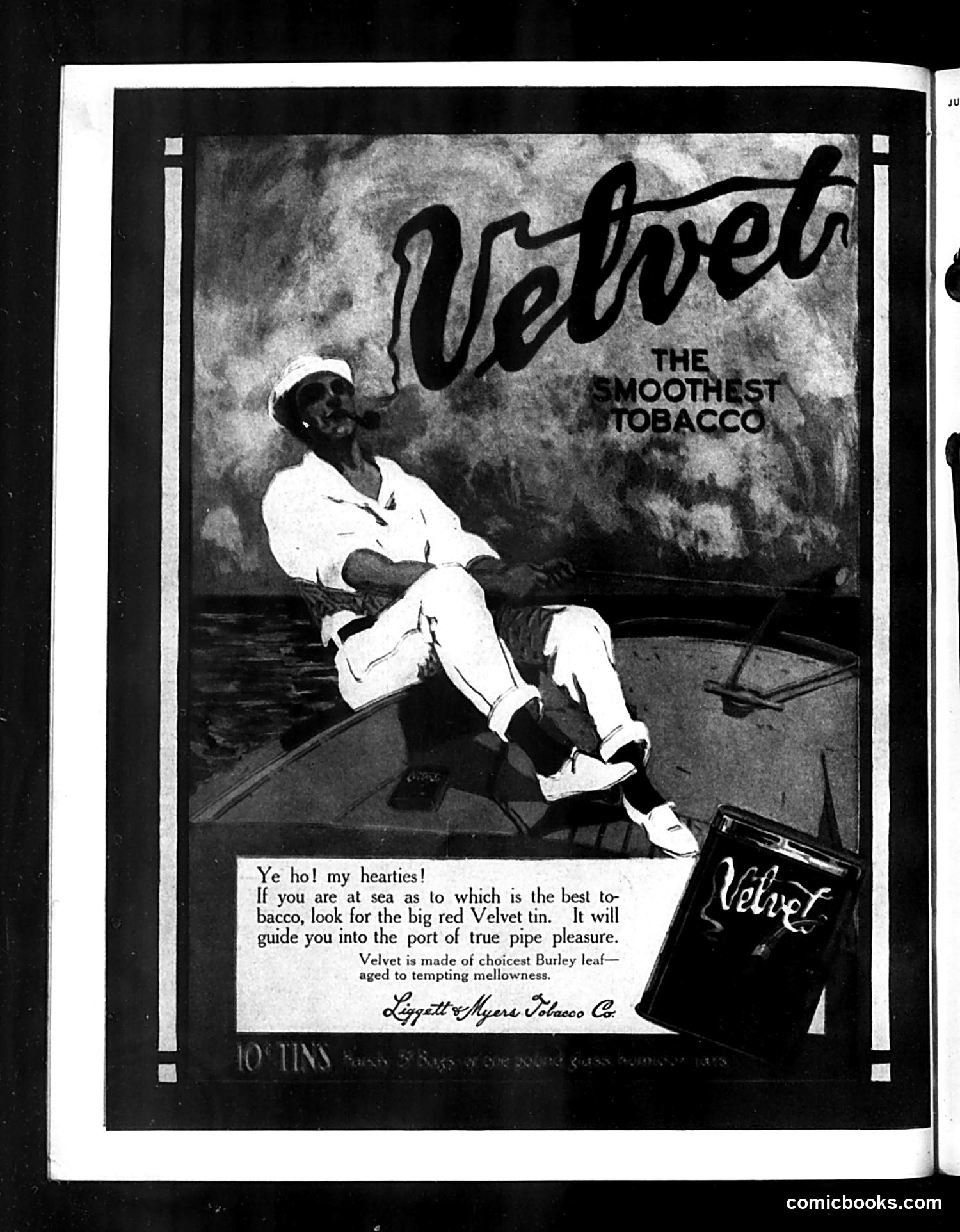
This is a tobacco advertisement, not political satire. It depicts a sailor in white clothing sitting relaxed in a boat, promoting Velvet brand tobacco ("the smoothest tobacco"). The ad uses nautical imagery and dialect ("Ye ho! my hearties!") to appeal to working-class men. The marketing emphasizes the product's quality—Burley leaf aged for smoothness—and uses the sailor figure as an aspirational lifestyle image suggesting leisure and contentment. This represents early 20th-century advertising conventions normalizing tobacco consumption without health warnings. The "big red Velvet tin" serves as the visual anchor, making the product instantly recognizable to potential buyers.