
A complete issue · 25 pages · 1913
Judge — June 28, 1913
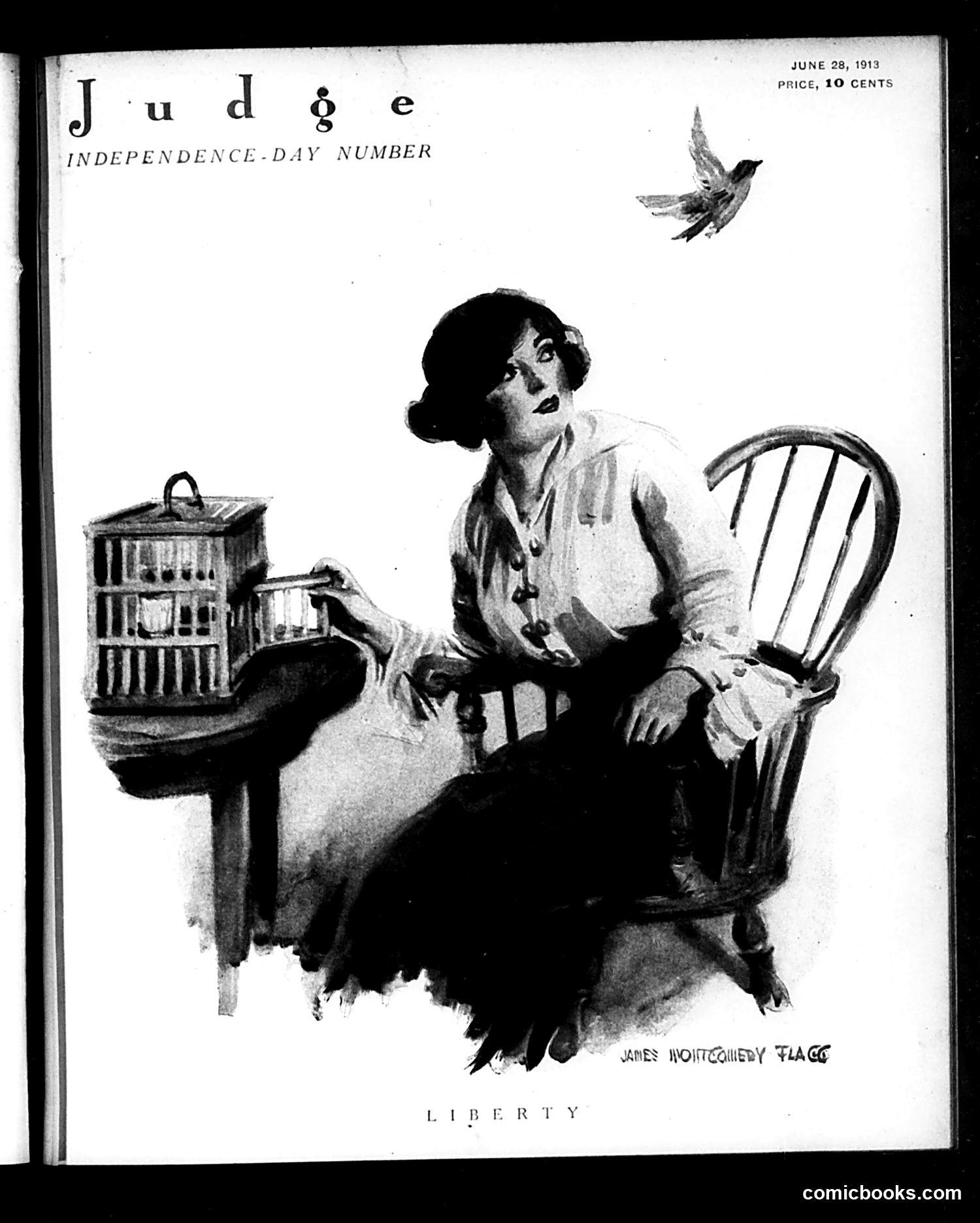
This is the **Independence Day Number** (June 28, 1913) cover titled "Liberty," illustrated by James Montgomery Flagg, a prominent American illustrator. The image depicts a woman—personifying Lady Liberty—sitting in a chair, gazing upward at a flying dove (symbolizing peace). She holds an empty birdcage, suggesting freedom or release. The composition appears to be satirical commentary on American liberty around the 1913 period. Without additional context text from the magazine's interior, the precise political message is unclear. However, the imagery suggests commentary on themes of freedom, captivity, or perhaps the state of American democracy during the progressive era. The dove's escape or flight may reference hopes for peace or liberation during a period of significant social change.
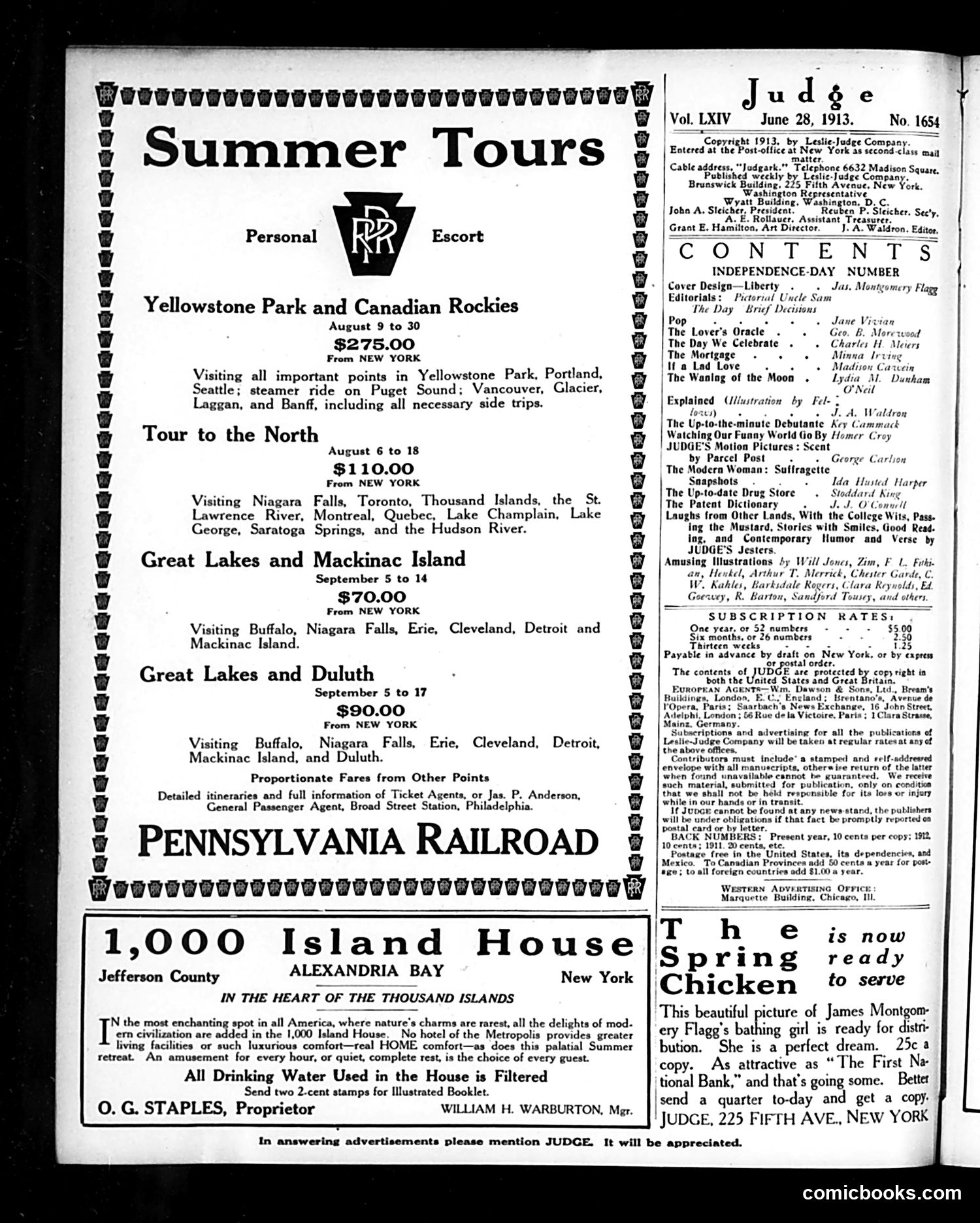
This page is **primarily advertising** for summer travel tours offered by the Pennsylvania Railroad, featuring trips to Yellowstone Park, the Great Lakes, and Canadian destinations. The ads highlight vacation packages ranging from $70 to $275. Below the travel ads appears a separate advertisement for the **"1,000 Island House"** in Alexandria Bay, New York, marketing it as a luxurious summer retreat with filtered drinking water. At bottom right is an advertisement for **"The Spring Chicken,"** featuring an illustration of actress James Montgomery Flagg's bathing-suited model, promoting the image for sale at 25 cents as "a perfect dream." The page contains **no political cartoons or satirical content**—it is a commercial advertising section typical of early 20th-century magazine layouts.
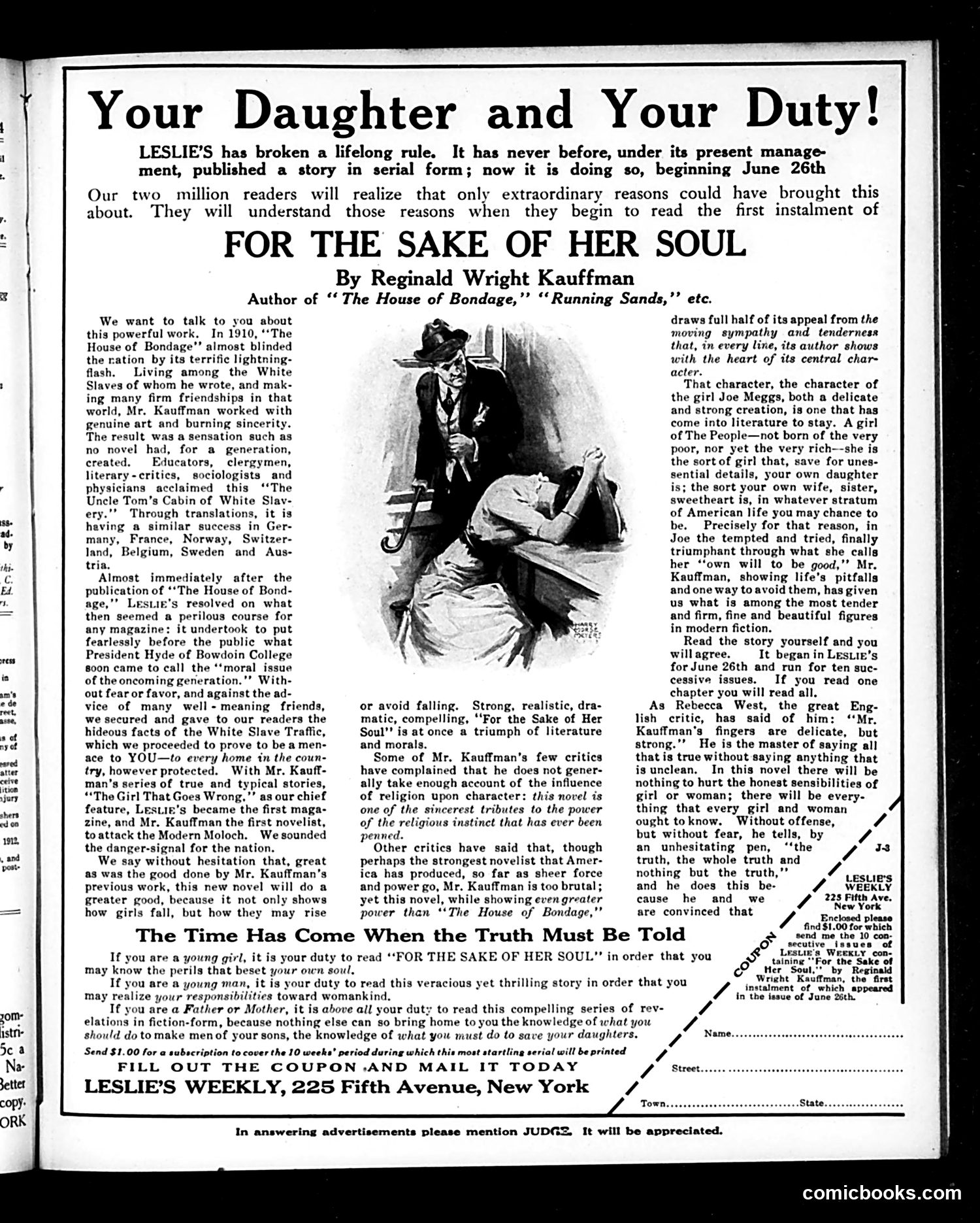
This page is primarily an **advertisement for a serialized story**, not political satire. It promotes "For the Sake of Her Soul" by Reginald Wright Kauffman, beginning June 26th in Leslie's Weekly. The ad appeals to readers' sense of moral duty, urging parents, young people, and fathers to read the story about a working-class girl named Joe Meggin who faces temptation and moral peril. The language emphasizes protecting daughters' virtue and understanding "what you must do to save your daughters." The illustration shows a dramatic scene of what appears to be a man and woman in distress or conflict, reinforcing the moralistic tone. This reflects early 20th-century magazine advertising that weaponized parental anxiety about urban corruption and female virtue—framing serial fiction as educational moral instruction rather than entertainment.
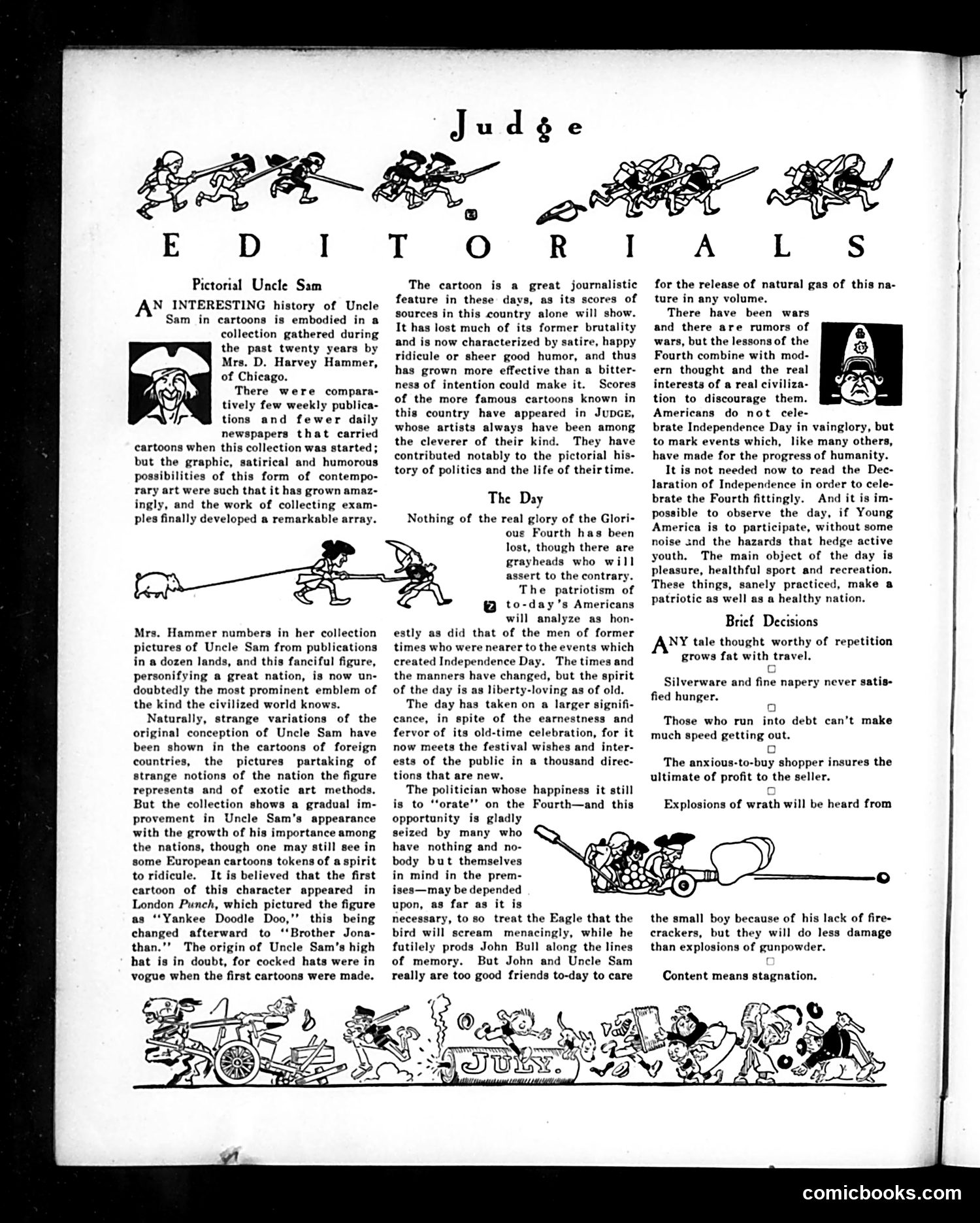
This page celebrates Uncle Sam cartoons from Mrs. D. Harvey Hammer's Chicago collection. The text praises cartooning as effective political satire, noting that Judge magazine's cartoons have historically influenced public opinion more successfully than bitter criticism alone. The editorial discusses Fourth of July celebrations, arguing that patriotic recreation—healthy sport and amusement—strengthens the nation better than formal Independence Day declarations. It references "John Bull" (Britain personified) as Uncle Sam's friend, suggesting Anglo-American alliance. The "Brief Decisions" section offers satirical one-liners mocking contemporary consumer behavior and politics, though specific targets are unclear without additional context. The illustrated header showing Uncle Sam figures emphasizes the character's central role in American political cartooning of this era.
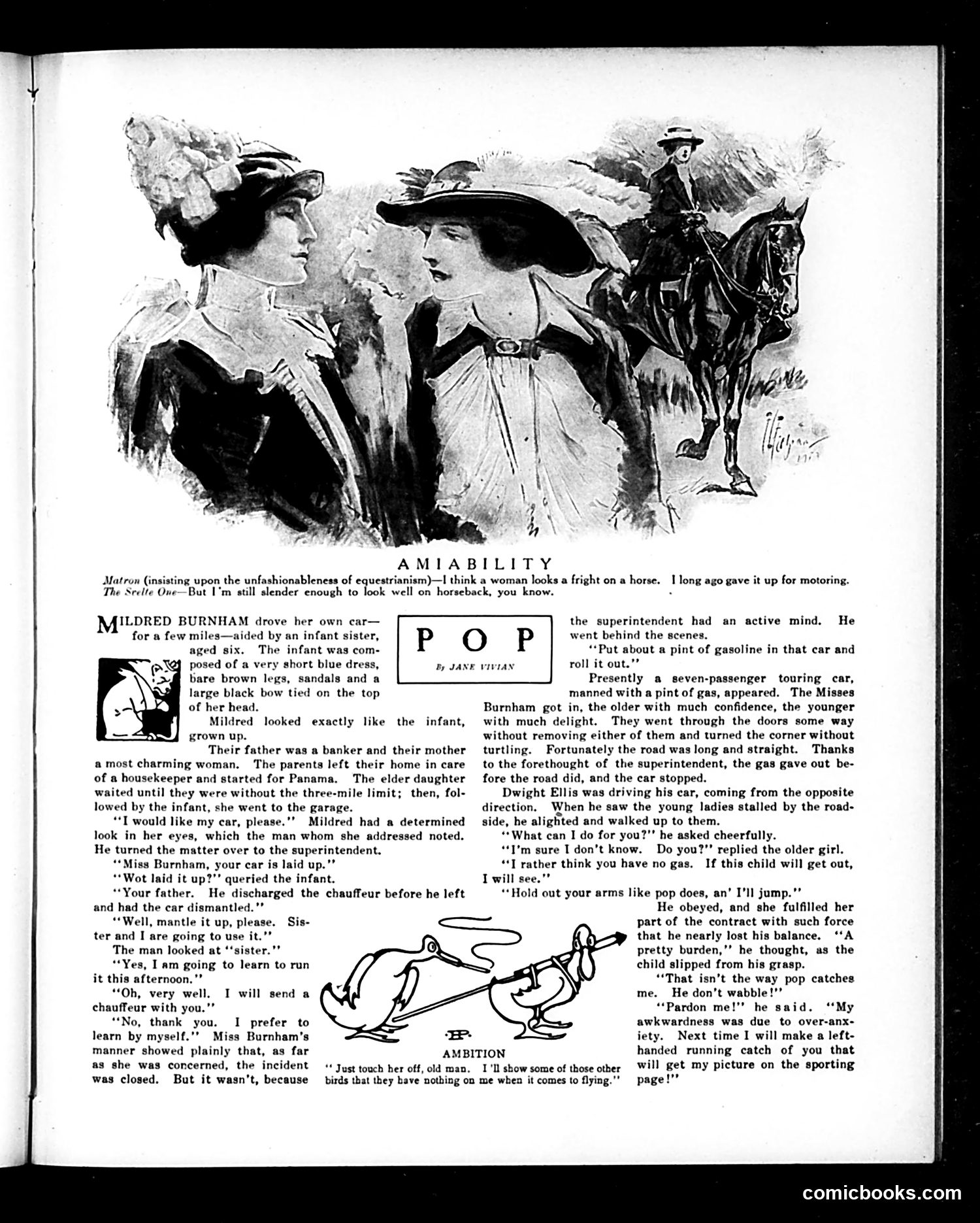
**Top Cartoon ("Amiability"):** The illustration satirizes women's fashion and behavior around horseback riding. The caption mocks a woman's claim that she looks "a fright on a horse" despite being "slender enough to look well on horseback." The joke targets the contradictory vanity of fashionable women—they worry obsessively about appearance while engaging in activities that undermine it. **"Pop" Story:** This is a humorous short fiction piece by Jane Ovian depicting Mildred Burnham, a determined young woman who insists on driving a car herself rather than relying on a male chauffeur. The narrative satirizes early 20th-century gender roles: men assume women cannot handle automobiles, while Mildred proves capable and independent. Her successful driving—and the near-accident she causes—gently mocks both rigid gender assumptions and women's emerging autonomy during the automobile age.
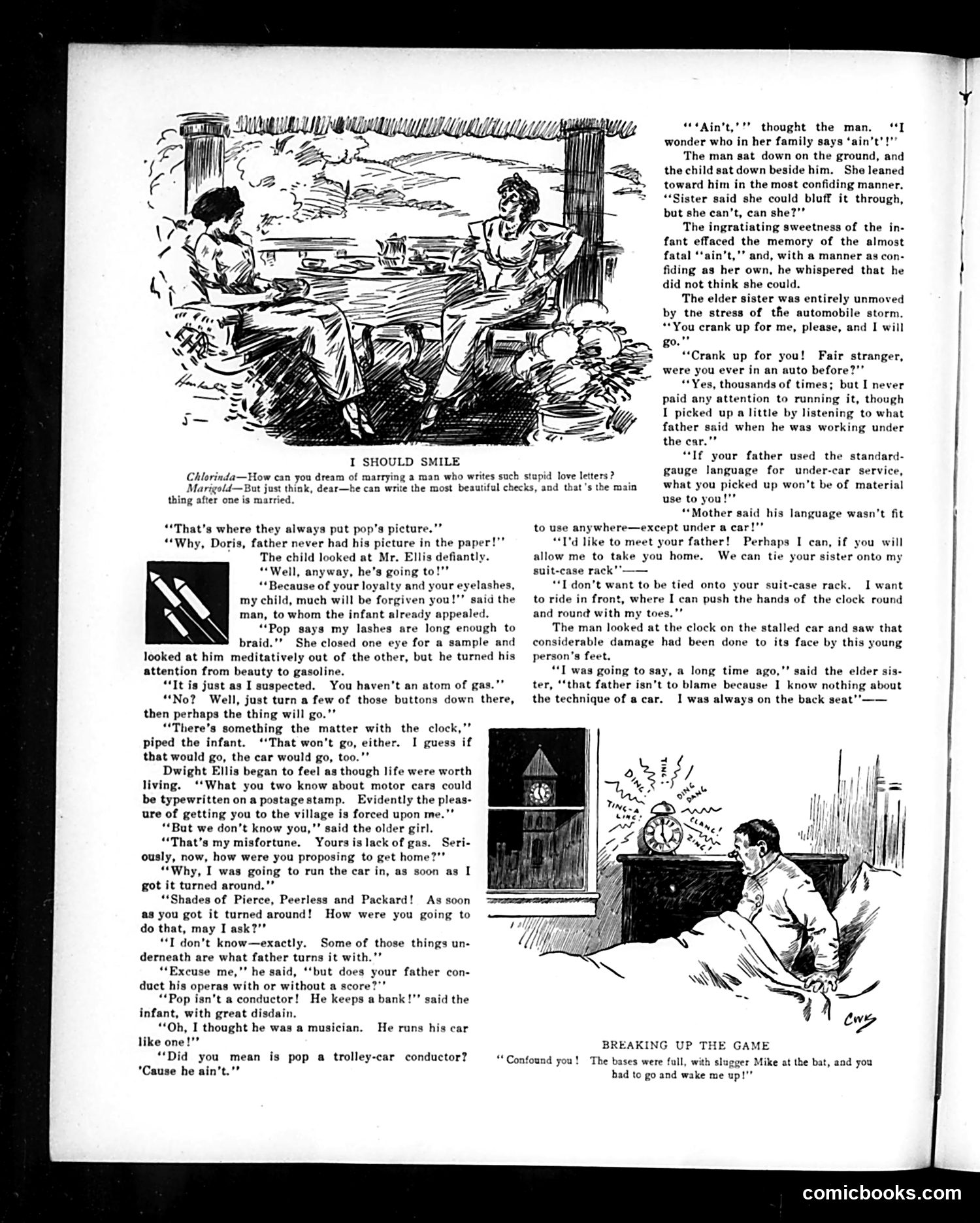
This page contains humor about early automobile culture and gender roles circa 1910s-1920s. The main comic narrative follows a man stranded with two young girls whose car has broken down. The satire targets: **The girls' incompetence**: They cannot operate the automobile despite attempting to drive it themselves, not knowing basic mechanics or how to crank the engine. Their ignorance is played for laughs. **Class and propriety**: References to "Pierce, Peerless and Packard" (luxury car brands) suggest aspirational middle-class owners. The man is scandalized they'd invite a stranger to their home. **Language and refinement**: The recurring "ain't" joke suggests class anxiety—the man is initially offended by this grammatical error but is charmed by the child despite it. **Parental authority**: The girls' father is mocked as incompetent with machinery (conducting an opera like driving a car), yet he's a banker—suggesting the newly wealthy lacked practical knowledge. The secondary cartoon "I Should Smile" appears to be about romantic/financial pragmatism in marriage. The humor relies on period assumptions about women, machinery, and social hierarchy.
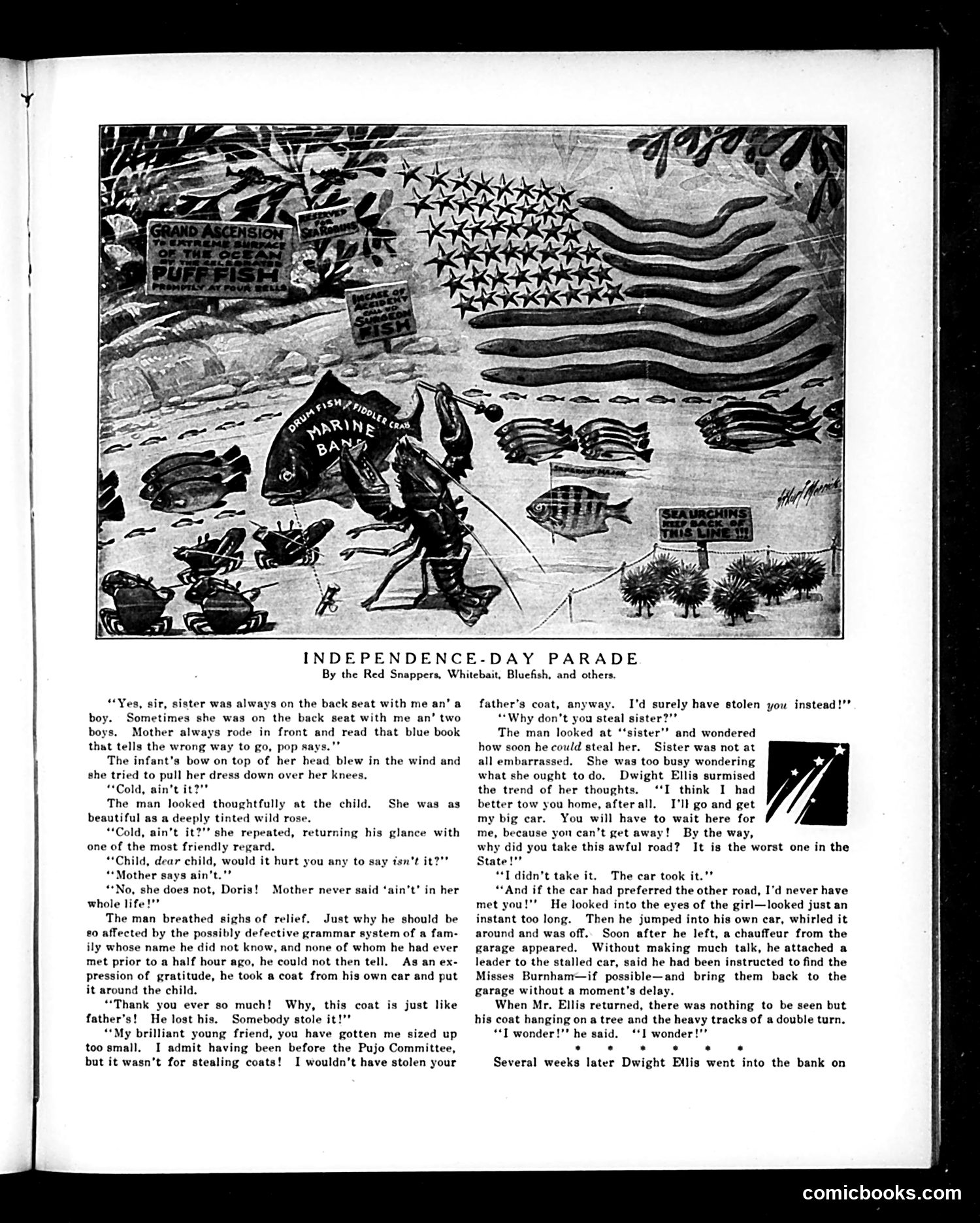
This is a satirical story rather than a political cartoon. The narrative mocks both poor grammar and wealthy industrialists' moral hypocrisy. A well-dressed man (Dwight Ellis, apparently a prominent businessman) encounters a poorly-spoken girl and her sister on a broken-down car. He condescendingly corrects the child's grammar while simultaneously making a veiled confession: he's been "before the Pujo Committee" (a real 1912 congressional investigation into banking monopolies) but claims he wasn't investigated for theft—implying he engaged in far worse financial crimes. The joke satirizes how wealthy men like Ellis concern themselves with working-class propriety while their own unethical dealings escape real consequence. His immediate romantic interest in the older sister, followed by her mysterious disappearance, leaves the ending ambiguously ominous or comedic—suggesting the wealthy man's comeuppance or continued moral blindness.
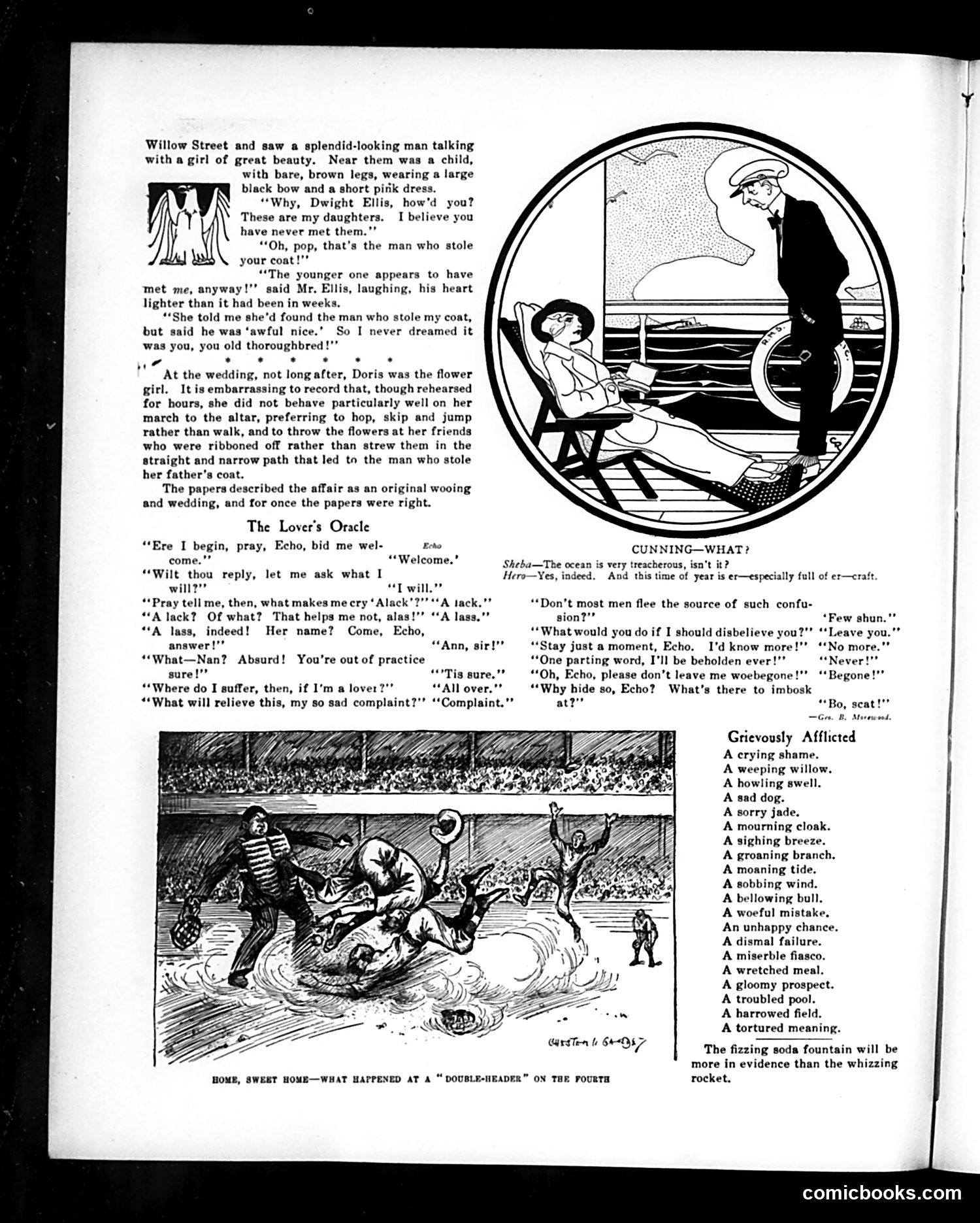
This page from *Judge* contains several satirical pieces exploiting wordplay and social commentary. **"The Lover's Oracle"** is a romantic dialogue playing on the mythological Echo—a figure cursed to repeat only others' words. The humor derives from a lover's questions receiving answers that sound like Echo's repetitions but create unintended, often deflating meanings ("Where do I suffer?" / "Allover"). **The narrative pieces** ("Willow Street," "At the wedding") satirize courtship and marriage customs of the era, depicting a girl's misbehavior at her own wedding (hopping and skipping rather than walking solemnly) as comic evidence of youth's irreverence toward formality. **"Grievously Afflicted"** is a list joke playing on personification—pairing emotional states with objects that literally embody them ("A weeping willow," "A bellowing bull"), followed by a contemporary jab that fizzy drinks will be more popular than fireworks that Fourth of July. The page reflects early 20th-century middle-class anxieties about propriety, courtship rituals, and generational behavior changes.
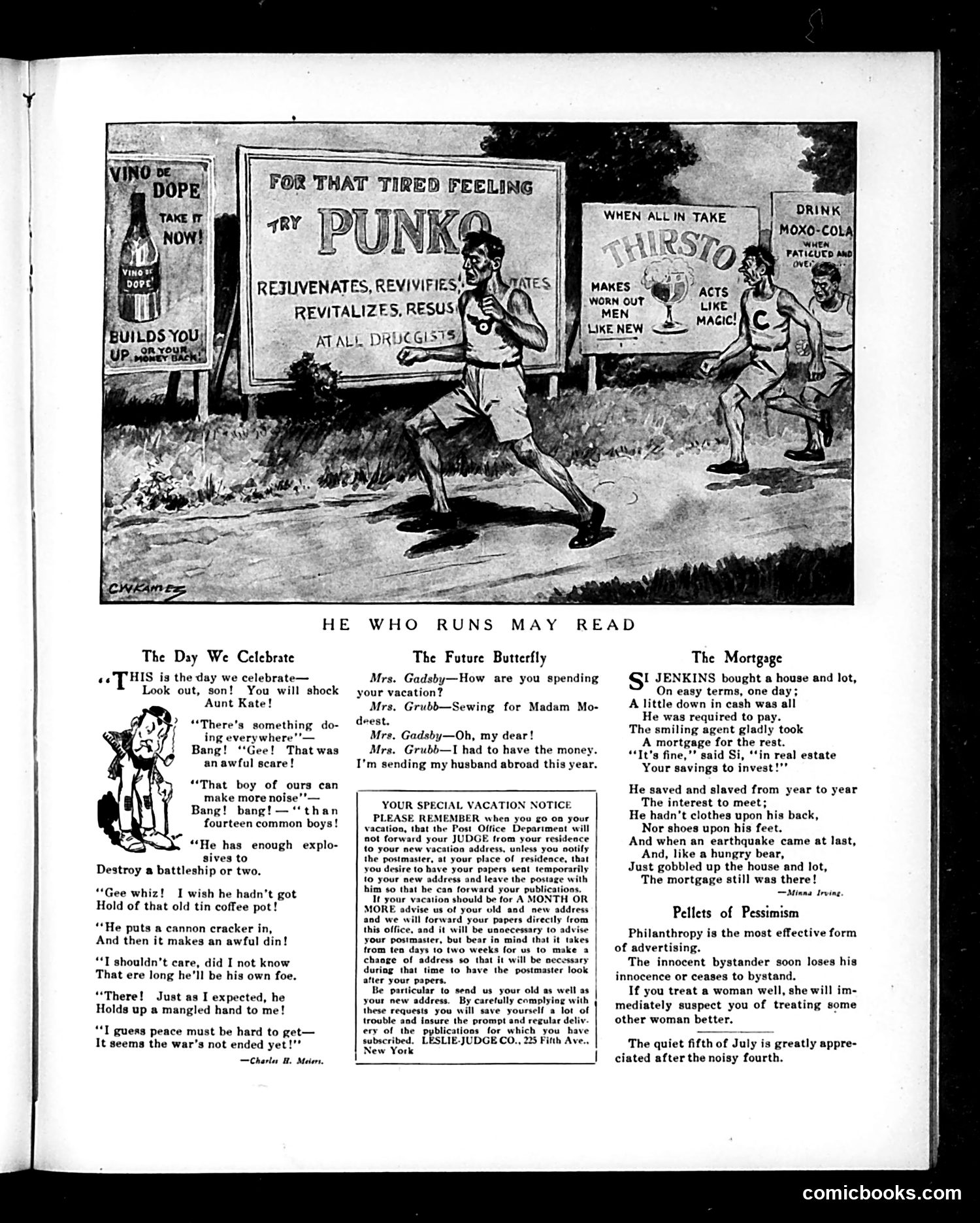
This Judge magazine page contains three distinct satirical pieces reflecting post-WWI American anxieties: **"The Day We Celebrate"** mocks Independence Day festivities, using a child's fireworks accidents as dark humor about warfare's lingering trauma. The repeated "Bang! bang!" and references to "explosives" and "battleship" suggest citizens still processing recent war violence—the joke being that peacetime celebrations mirror combat. **"The Future Butterfly"** satirizes economic hardship: a woman must sew for others and send her husband abroad for work just to afford a vacation, revealing the false promise of prosperity. **"The Mortgage"** is a cautionary tale about homeownership: a man sacrifices everything to pay mortgage interest, only to lose everything to an earthquake while remaining liable for the debt—a dark commentary on financial vulnerability. The vintage advertisements (Punko drink, Thirst-O, Moxo-Cola) promising energy and vitality ironically surround these pessimistic narratives, creating tension between commercial optimism and actual lived hardship during the economically unstable 1920s.
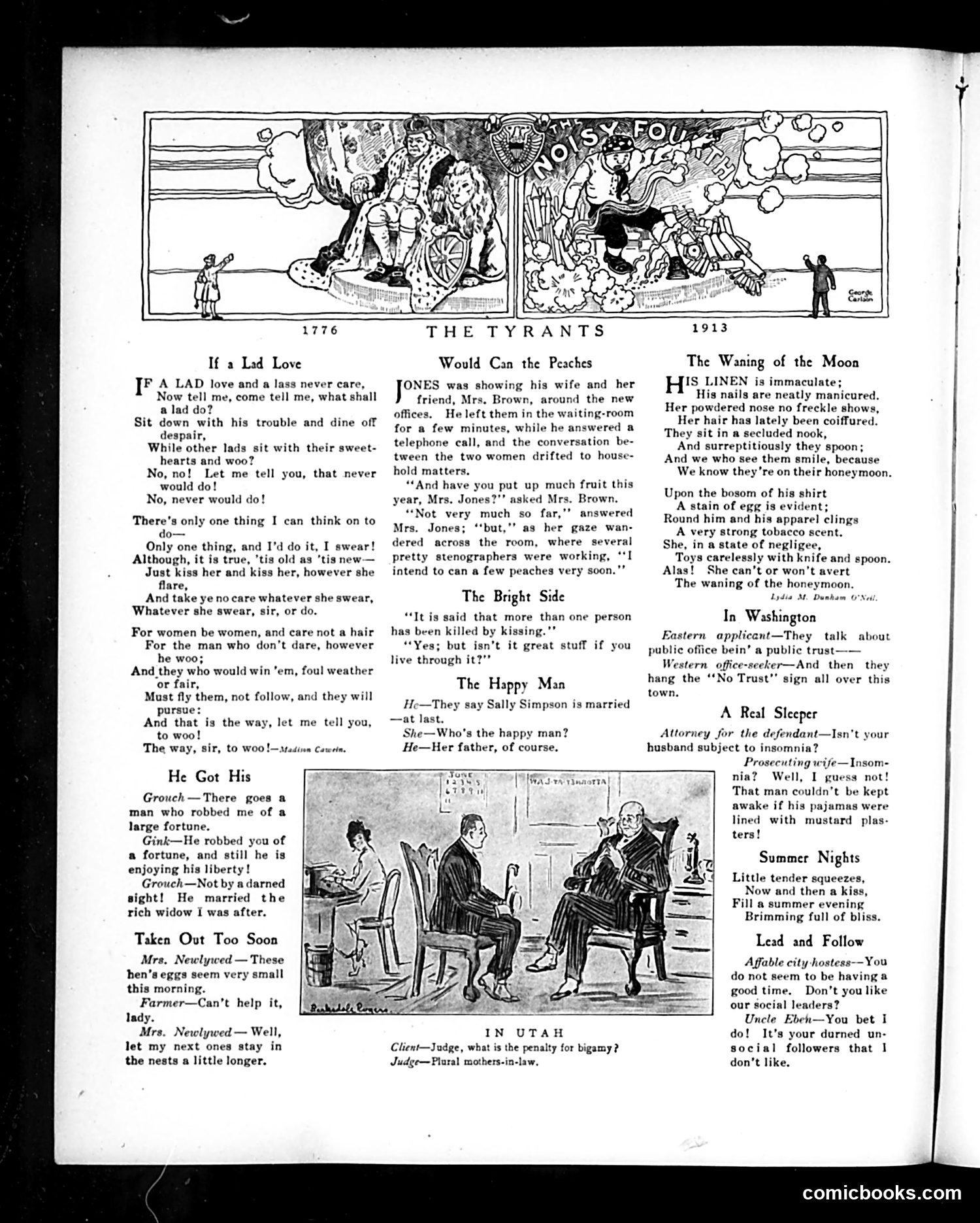
This page collects short humorous pieces and satirical jokes typical of Judge's style. Key items include: **"The Tyrants" section** features domestic humor—a wife threatens to "can" (preserve) her husband's stenographer colleagues like peaches, a dark joke about workplace jealousy. **"In Washington"** satirizes political corruption: Eastern applicants naively speak of "public office bein' a public trust," while Western office-seekers pragmatically display "No Trust" signs everywhere—mocking the gap between democratic ideals and cynical political reality. **"In Utah"** makes a polygamy joke: when asked the penalty for bigamy in Utah (then recently admitted to the Union after abandoning the practice), the judge replies "plural mothers-in-law"—treating marital complication as worse than legal consequence. The page also includes period romantic poetry and light domestic humor ("The Waning of the Moon" contrasts honeymoon perfection with reality). Overall, this reflects Judge's satirical focus on politics, gender relations, and social hypocrisy circa 1913.
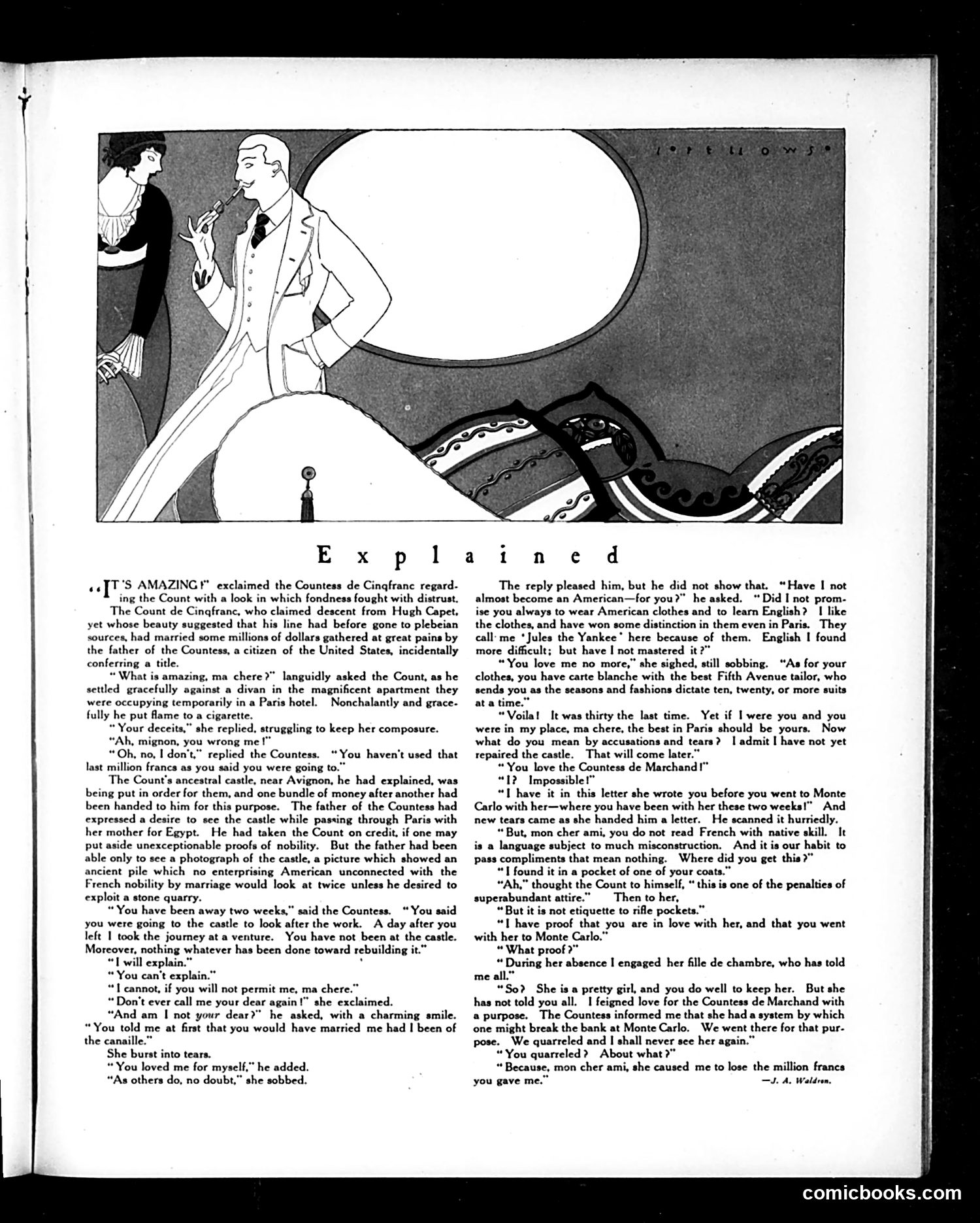
This story satirizes the American heiress marrying European nobility—a common theme in Gilded Age satire. A wealthy American's daughter has married the Count de Cingfranc, a French nobleman of questionable lineage who married her for her father's millions. The cartoon depicts their confrontation: the Countess discovers the Count has lied about renovating his ancestral castle near Avignon and suspects him of an affair with the Countess de Marchand. The Count deflects with charm and flattery, claiming he's "almost become an American" for her, adopting American clothes and even learning English. The satire targets both figures: the Count's transparent deceptions and his casual infidelities, and the Countess's willingness to be seduced by compliments despite obvious evidence of his dishonesty. It mocks the social climbing of European aristocrats and the gullibility of wealthy Americans purchasing titles.
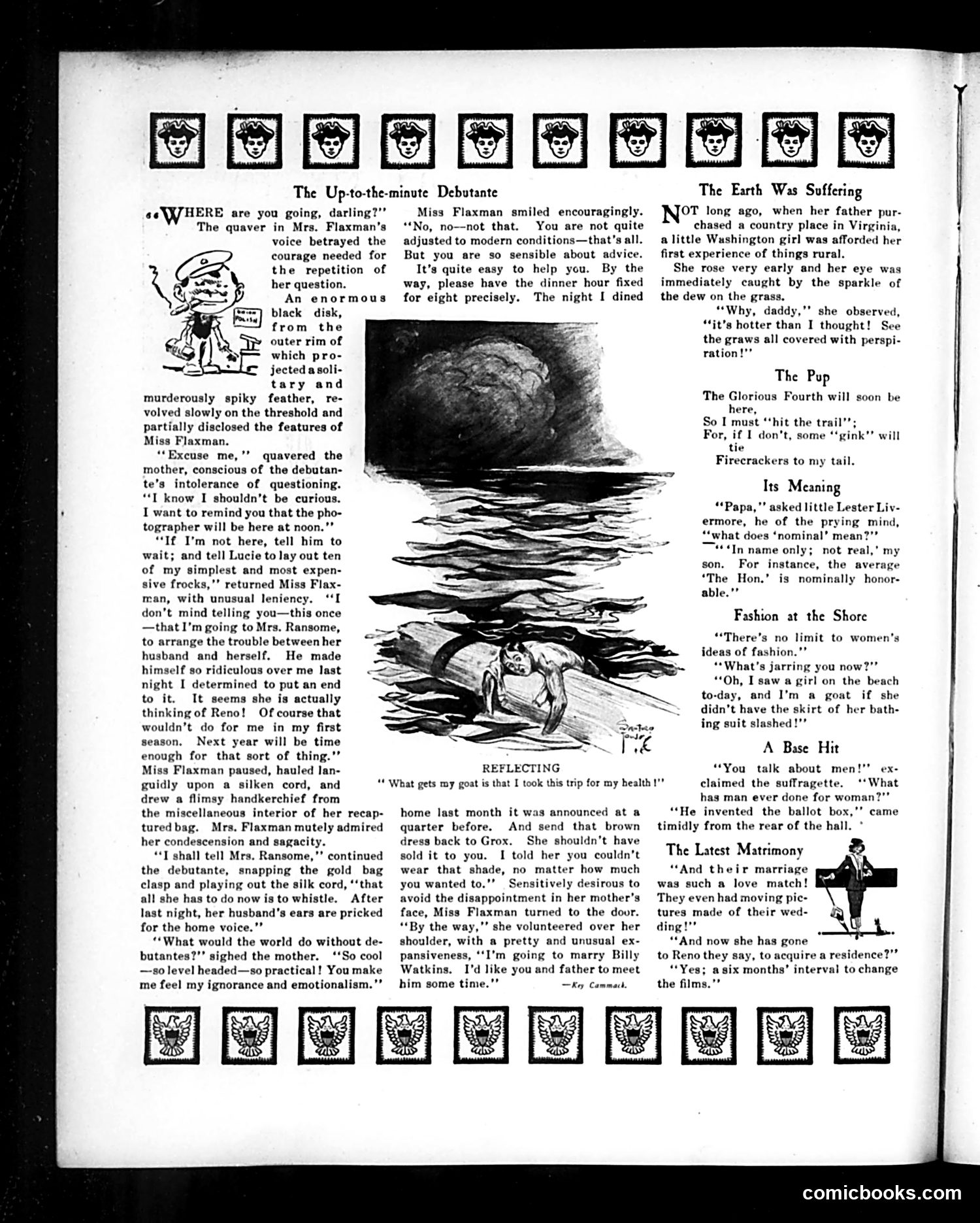
This page contains several brief satirical pieces mocking early 20th-century American society: **"The Up-to-the-minute Debutante"** (main story): A young debutante arrogantly lectures her bewildered mother on modern etiquette and social management. The satire targets the pretentiousness of wealthy young women who, despite their youth and inexperience, condescend to their elders while casually announcing engagements. The absurd hat with a "murderously spiky feather" visualizes her affected vanity. **Shorter pieces** mock: - Urban women's bewilderment at rural phenomena (confusing dew perspiration) - The hollow titles of men ("The Hon." are only nominally honorable) - Women's ever-changing fashion obsessions at seaside resorts - Dogs' anxiety about Fourth of July fireworks The recurring theme: modern society's superficiality, particularly among privileged women who mistake fashionable detachment for sophistication. The humor depends on recognizing the gap between their self-regard and their actual foolishness.
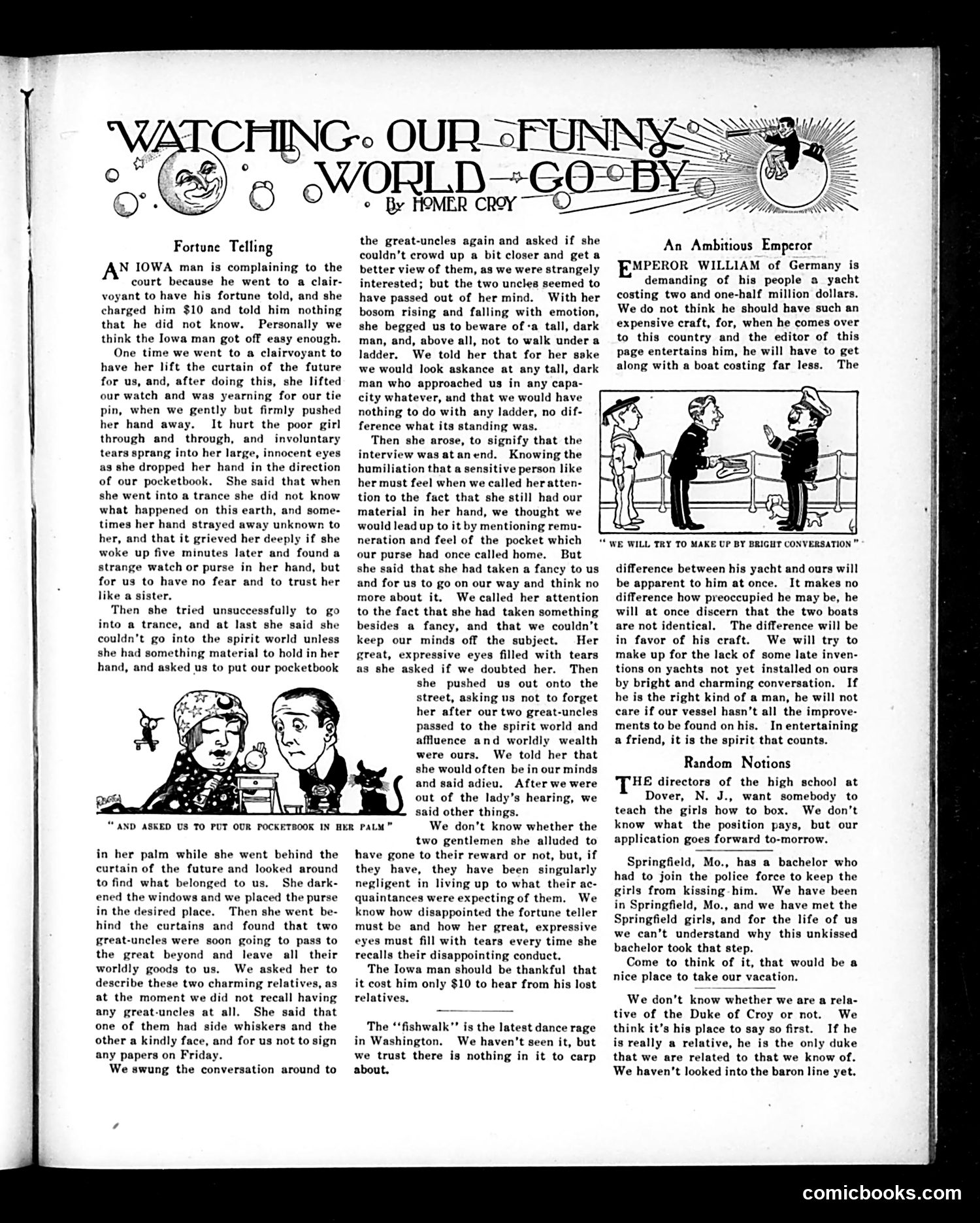
This page from Judge magazine presents a satirical essay about fortune tellers and their cons, illustrated with a cartoon showing a clairvoyant attempting to steal from a client. The author describes visiting a fraudulent fortune teller who charged $10 for vague predictions. The joke centers on her obvious pickpocketing scheme: she claims she needs "something material" to hold while entering a trance, persuades the narrator to place his pocketbook in her palm, then retreats behind a curtain. She emerges with fabricated predictions about deceased great-uncles who will leave inheritances—a classic con to distract from the theft. The satire targets both the charlatan's transparent methods (fake emotional displays, generic warnings about "tall, dark men" and ladders) and the narrator's willingness to be duped. The cartoon illustration shows the moment she requests his pocketbook, capturing the predatory nature of her con. This reflects early 20th-century skepticism toward spiritualism and fortune-telling scams that preyed on credulous Americans.
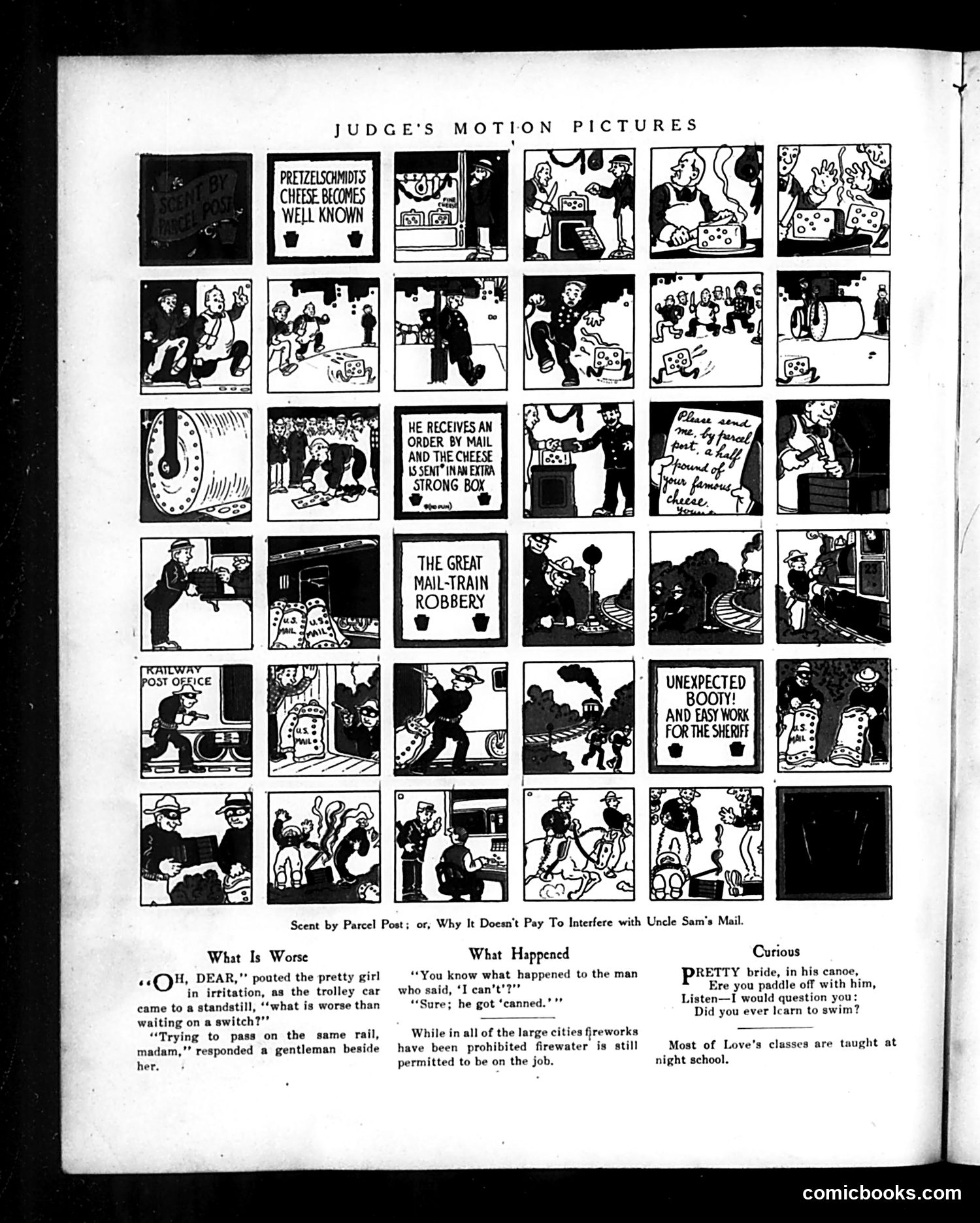
This page presents a comic strip titled "Scent by Parcel Post; or, Why It Doesn't Pay To Interfere with Uncle Sam's Mail," satirizing the US Postal Service's reliability and the dangers of shipping perishable goods. The narrative follows "Pretzelschmidt's Cheese" being sent via mail in an "extra strong box." The story culminates in "The Great Mail-Train Robbery," where the package apparently gets stolen or lost during transit—a humorous exaggeration of postal mishaps. The satire's point: mailing valuable items is risky; the postal system, despite its official authority, cannot guarantee safe delivery. The title's reference to "Uncle Sam's Mail" invokes government legitimacy while the comedic plot undermines it. Below are unrelated joke snippets about waiting on trolley switches, fireworks prohibition versus alcohol legality, and swimming ability for newlyweds—typical period humor emphasizing social inconveniences and courtship anxieties.
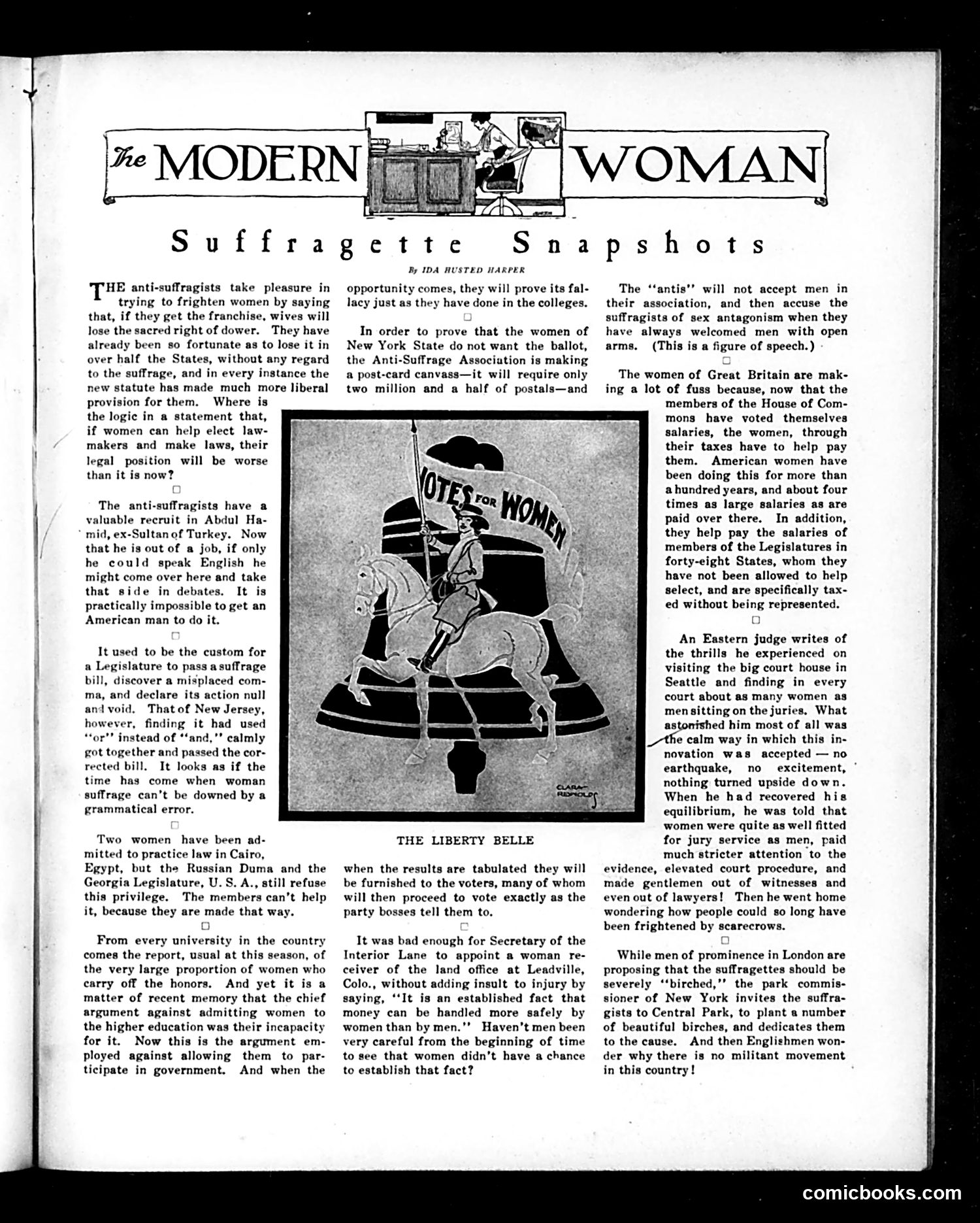
This page from *Judge* magazine presents pro-suffrage arguments by Ida Husted Harper, satirizing anti-suffrage positions. The central cartoon, "The Liberty Belle," depicts a woman on horseback wielding a sword—a classical allegorical figure representing liberty and suffrage rights. The text uses sharp wit to counter anti-suffragists' claims. Key targets include: - **Anti-suffragists' hypocrisy**: They claim women will lose property rights if granted voting rights, yet this has already occurred in many states without suffrage - **International mockery**: Sarcastically suggesting the ex-Sultan of Turkey could effectively argue against women's suffrage - **Women's proven competence**: Citing women's academic success and their management of public funds (women have paid taxes for over a century in America without representation) - **Procedural absurdity**: A New Jersey legislature nearly invalidated suffrage legislation over a grammatical error The overall message: women deserve voting rights based on demonstrated capability and fundamental fairness.
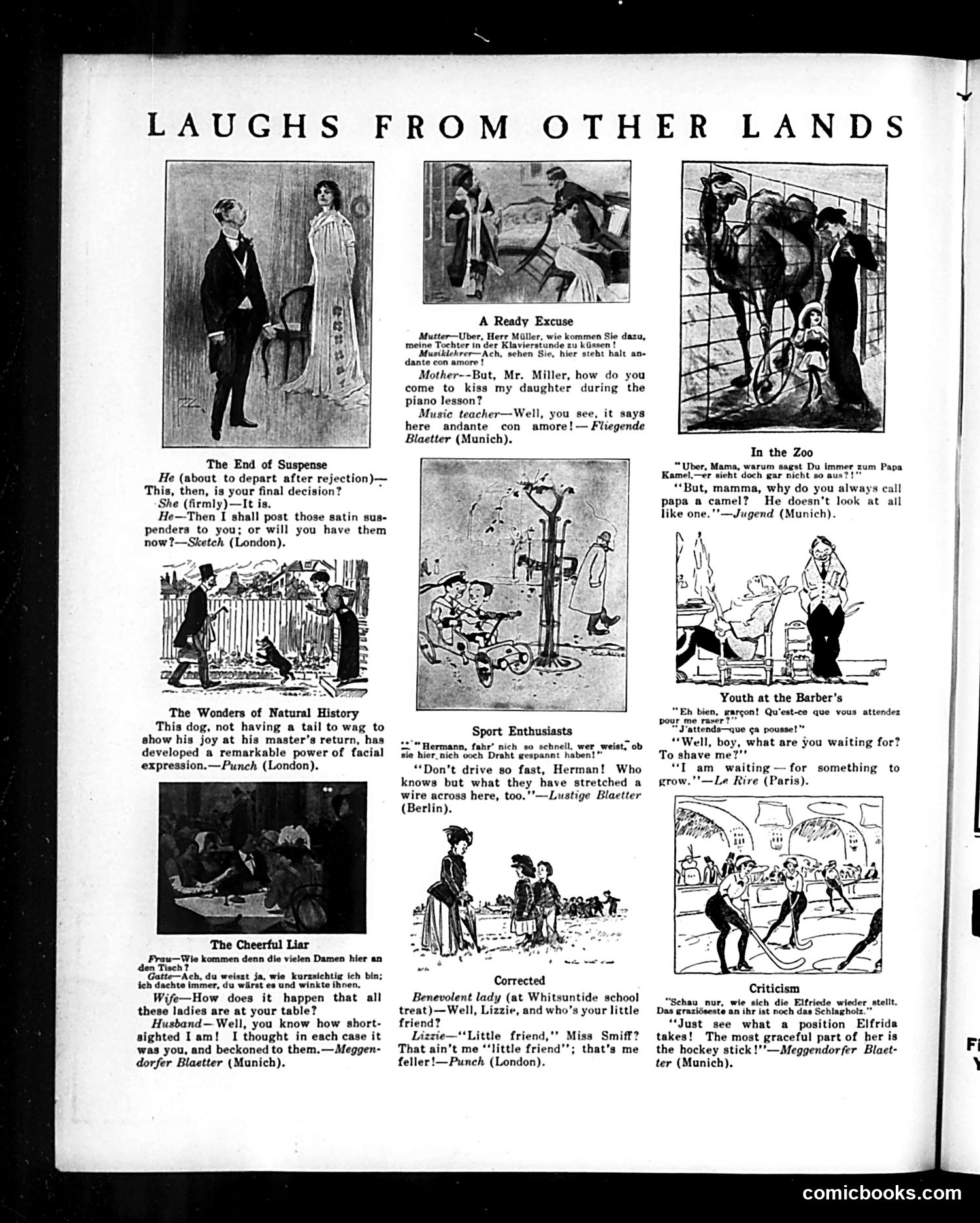
This page collects short humorous anecdotes translated from European satirical magazines (Punch, Fliegende Blaetter, Lustige Blaetter, Jugend). The jokes reflect early 20th-century domestic and social comedy: **Key themes:** - Romantic rejection and awkward courtship - Marital misunderstandings (a husband mistakenly inviting multiple women to dinner, thinking each is his wife) - Professional impropriety (a piano teacher kissing his student while claiming "andante con amore"—a musical instruction—as excuse) - Children's innocent mispronunciations and observations - Physical comedy and social pretension The humor relies on wordplay, double meanings, and relatable domestic situations. These are gentle, family-appropriate jokes showcasing European wit—the magazine's purpose in reprinting them was to present cosmopolitan, sophisticated humor to American readers and demonstrate shared comedic sensibilities across cultures.
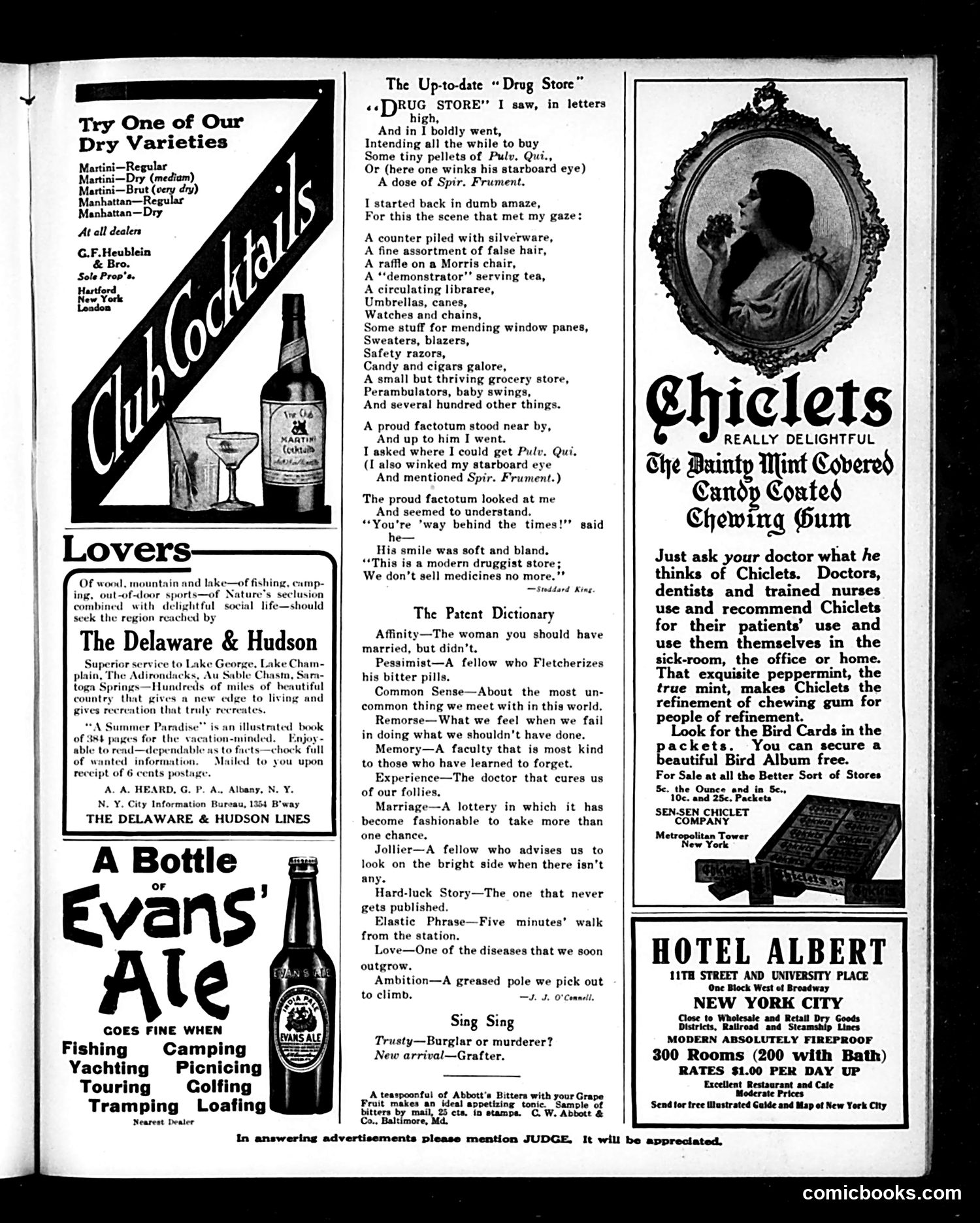
This poem satirizes the transformation of American pharmacies in the early 20th century. The narrator enters a drugstore expecting to purchase medicines (Latin abbreviations for powdered quinine and spirits of fermentation—coded references to legitimate pharmaceuticals), but finds instead a general store selling everything except actual drugs: silverware, false hair, umbrellas, razors, candy, cigars, groceries, baby carriages. The "proud factotum" (staff member) explains: "This is a modern druggist store; We don't sell medicines no more." The satire targets how drugstores had become retail catchalls, abandoning their original pharmaceutical purpose. This reflects real commercial trends of the era, when pharmacies expanded into general merchandise to increase profits—a practice that concerned traditionalists who believed this diluted professional standards and represented misguided modernization.
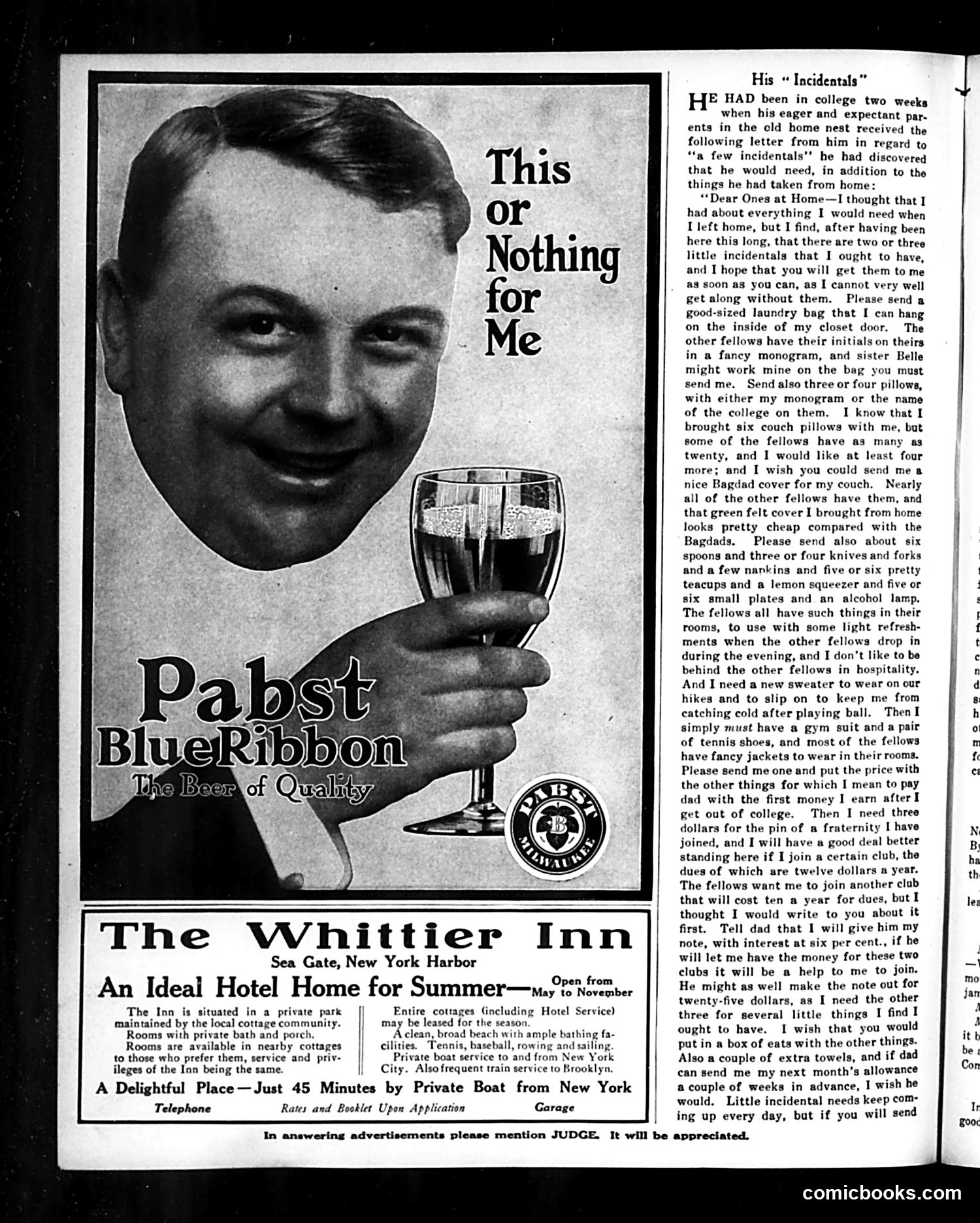
This page satirizes college students' escalating financial demands on their parents. The piece presents a letter from a son who claimed to need nothing before leaving for college but now requests numerous "little incidentals"—laundry bags with monograms, multiple pillows, expensive Bagdad couch covers, fine dishware, alcohol lamps, sweaters, gym suits, tennis shoes, fancy jackets, fraternity pins, and club dues totaling significant sums. The satire targets the pretentious materialism and peer pressure among college students of the era. By framing excessive requests as casual "incidentals," the letter mocks how students justified luxury spending to their parents. The detailed list—each item justified by peer comparison ("the other fellows have...")—exposes vanity masquerading as necessity. The joke is that "incidentals" had become the student's primary financial concern, not education.
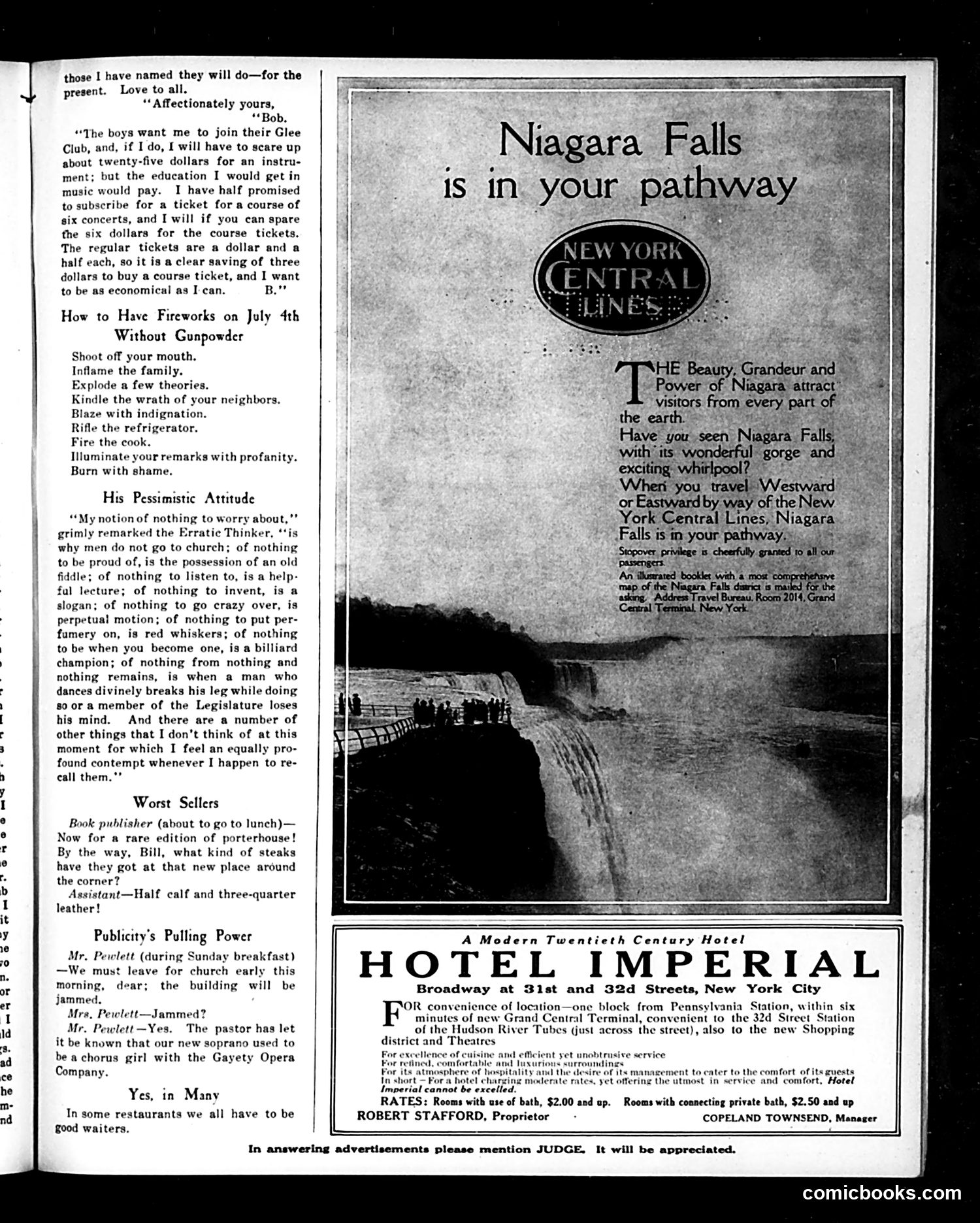
This page contains several humor pieces typical of Judge's satirical style: **"How to Have Fireworks on July 4th Without Gunpowder"** is a tongue-in-cheek list suggesting ways to create domestic chaos and conflict instead of using actual fireworks—shooting off one's mouth, inflaming family disputes, firing the cook. The satire mocks both reckless Independence Day celebrations and family discord. **"His Pessimistic Attitude"** ridicules an overly cynical character who obsessively catalogs things beneath his contempt, with absurdist examples (old fiddles, red whiskers, a legislator losing his mind). **"Worst Sellers"** is a brief joke: a publisher asks about steak at a restaurant; the assistant puns that they serve "half calf and three-quarter leather"—wordplay on book binding materials. **"Publicity's Pulling Power"** satirizes how churches draw crowds not through doctrine but scandal—a pastor's decision to feature a former chorus girl as soprano packs the pews. The right page is primarily advertising for Niagara Falls tourism and Hotel Imperial, typical of Judge's business model.
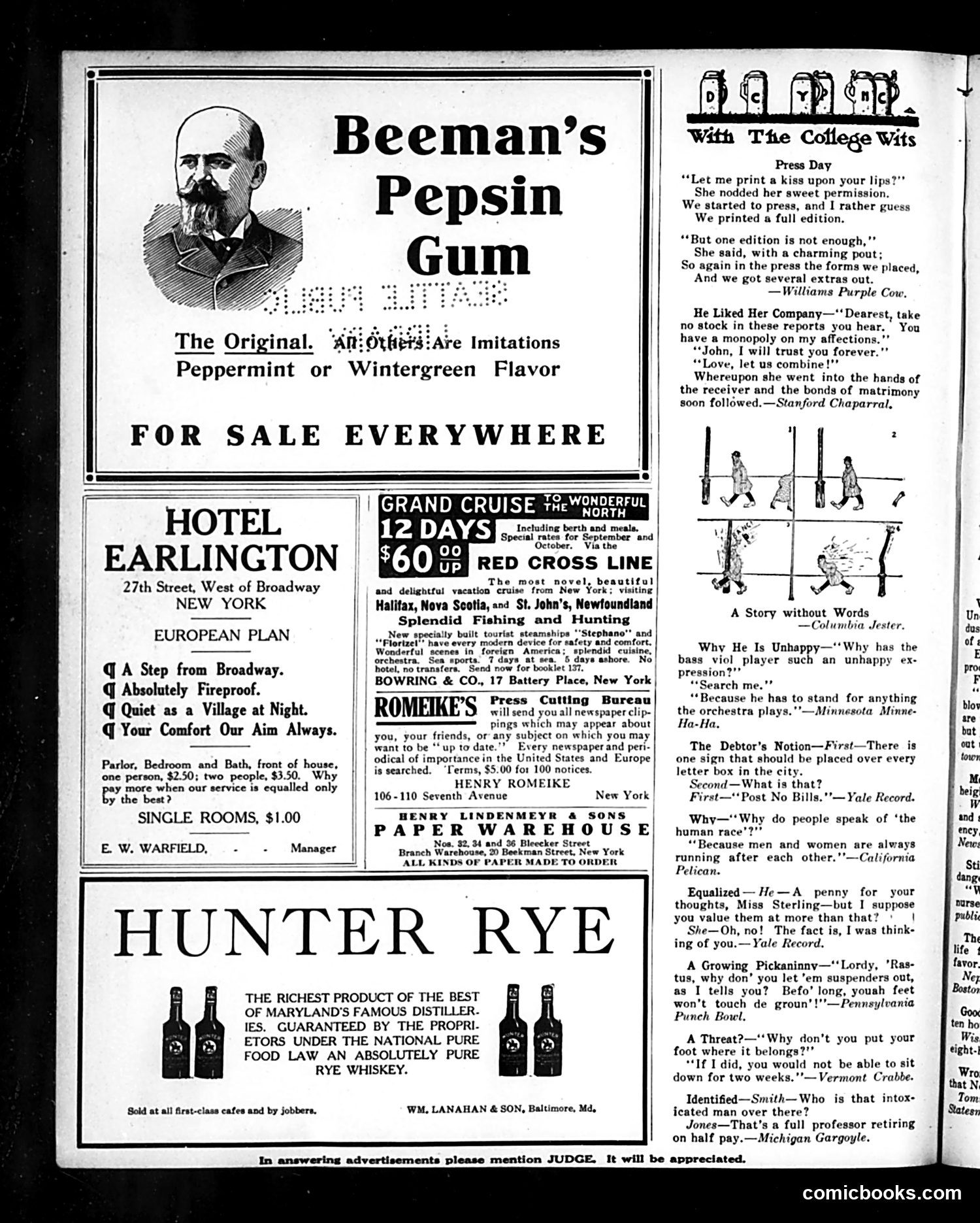
This is primarily an **advertising page** with scattered humorous content. The main elements include: **Advertisements:** - Beeman's Pepsin Gum (top left) - claiming to be "the original" against imitators - Hotel Earlington (budget lodging) - Grand Cruise and Red Cross Line (vacation travel) - Romeike's Press Cutting Bureau (newspaper clipping service) - Hunter Rye Whiskey (bottom) **"With The College Wits" Section** (right side): This is a humor column featuring brief jokes from various college publications (Williams Purple Cow, Stanford Chaparral, Columbia Jester, Yale Record, etc.). The jokes are light romantic and social humor typical of early 1900s college wit—puns about printing kisses, monopolies on affections, orchestras, and absurdist observations. **The Satire:** Minimal. This appears to be a filler/revenue page from Judge magazine, mixing advertisements with light collegiate humor rather than the political or social satire the magazine was known for. The content reflects early 1900s sensibilities but lacks pointed commentary.
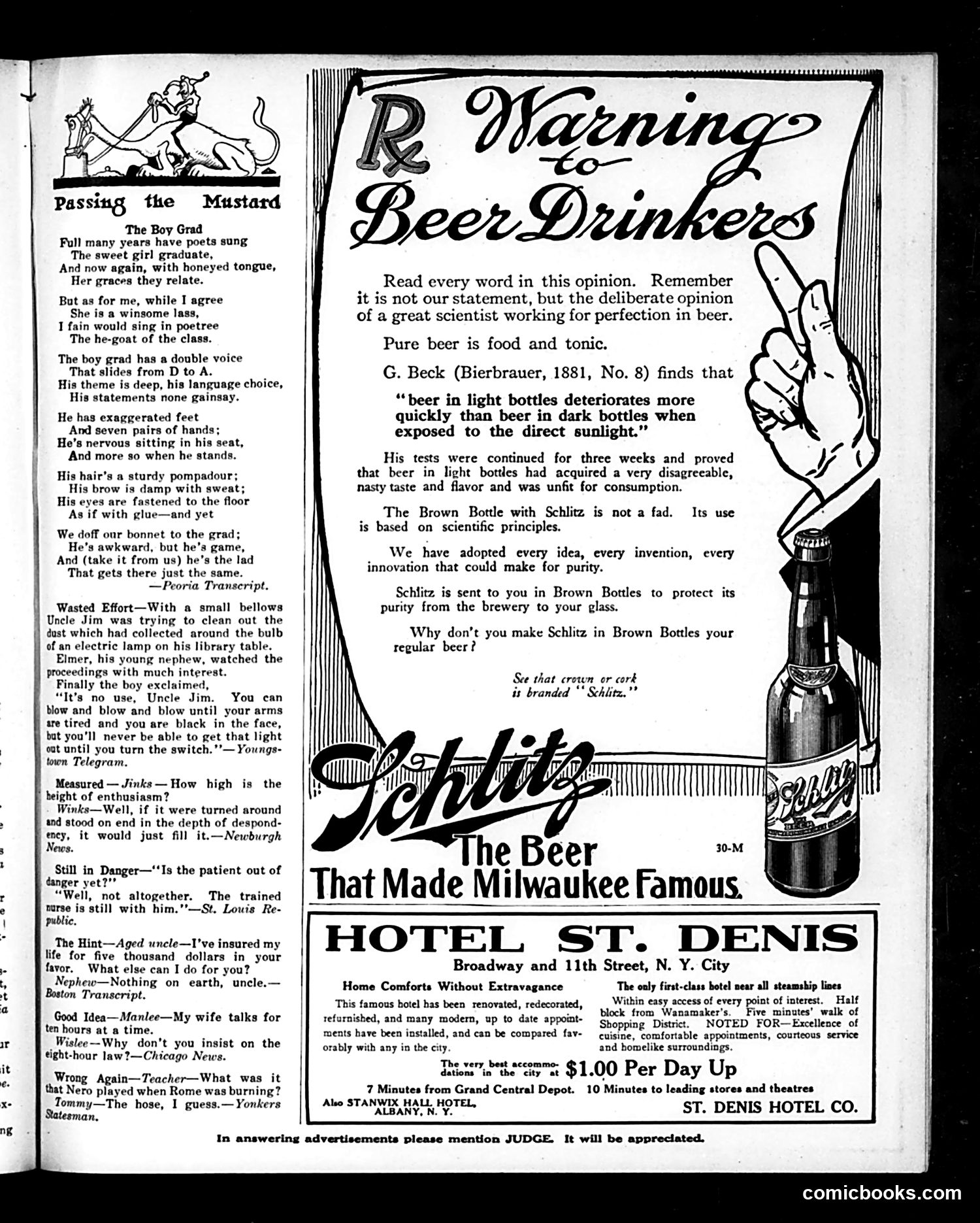
This page contains two main elements: humorous short jokes and a Schlitz beer advertisement. **The Jokes ("Passing the Mustard"):** A collection of brief, lighthearted satirical pieces mocking everyday situations—a nervous boy graduate, an uncle trying to blow dust from a lightbulb without turning it off, a nephew angling for inheritance money. These are gentle social commentary on human folly and miscommunication, typical of Judge's satirical humor. **The Schlitz Advertisement:** The dominant right-hand content is a persuasive ad claiming brown bottles protect beer from sunlight deterioration, citing a scientist named G. Beck. It frames the brown bottle choice as scientific rather than marketing, urging readers to adopt Schlitz as their regular beer. This appears designed to convince consumers that brown bottles represent quality and purity—a sales pitch dressed in scientific authority. The page represents early 20th-century advertising's strategy of using pseudo-scientific claims to differentiate products.
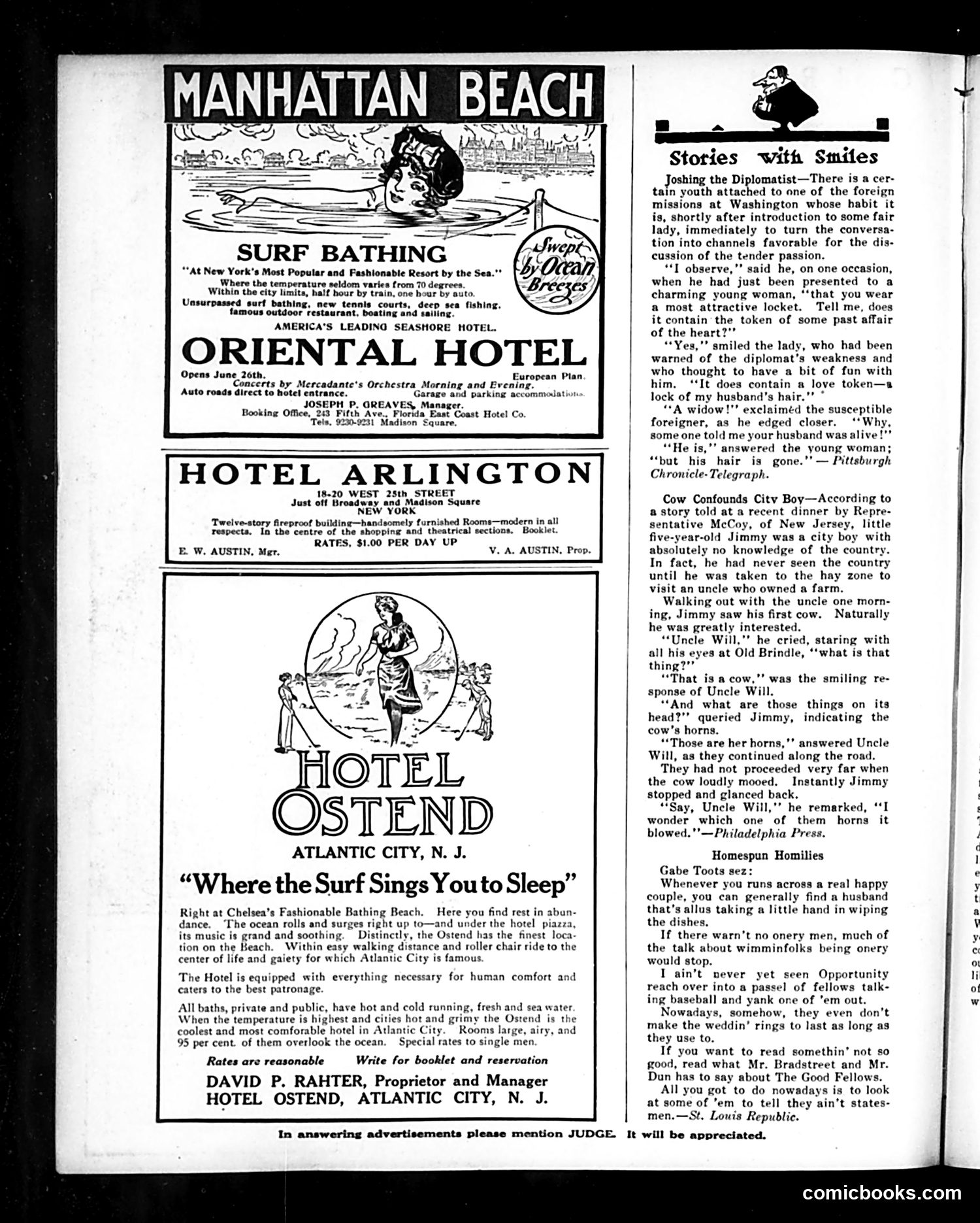
This is primarily a **hotel and resort advertisement page** from Judge magazine, with two brief humorous anecdotes in the right column. The advertisements promote fashionable seaside destinations—Manhattan Beach and Hotel Ostend in Atlantic City—popular leisure spots for affluent Americans of the early 20th century. The two short humor pieces are social commentary: 1. **"Joshing the Diplomatist"** satirizes a foreign diplomat's predictable habit of steering conversations toward romance immediately after meeting women. The joke: a woman tricks him by claiming a locket contains her dead husband's hair, when he's actually still alive—mocking the diplomat's transparent seduction tactics. 2. **"Cow Confounds City Boy"** depicts an urban child's complete ignorance of farm animals, finding a cow bewildering. This reflects the era's urban-rural divide and serves as gentle comedy about city dwellers disconnected from agricultural life. Both anecdotes use familiar social stereotypes (the forward foreigner, the sheltered city child) for light satire.
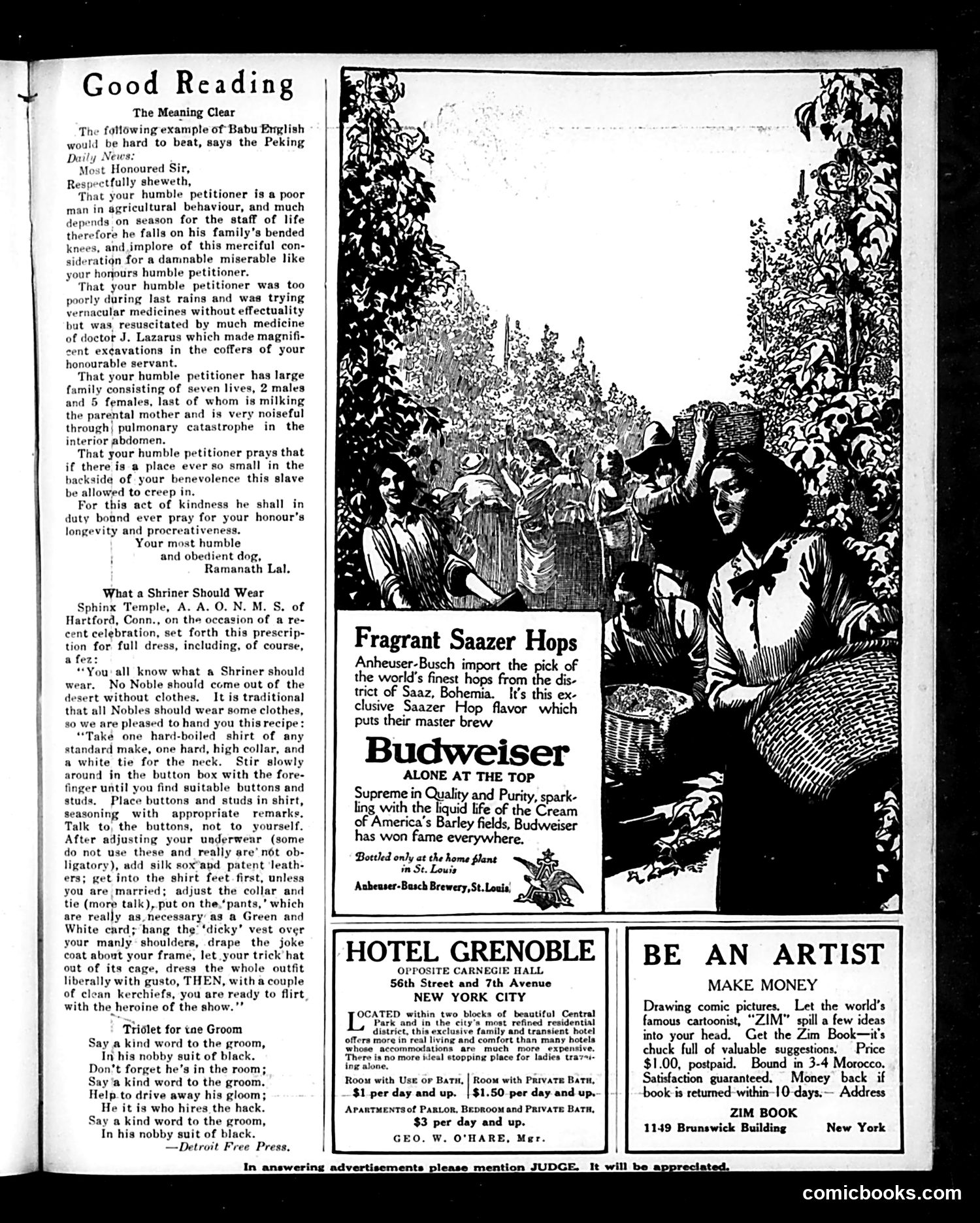
This page contains satirical humor and period advertisements typical of Judge magazine. **"The Meaning Clear"** mocks "Babu English"—English written by Indian clerks under British colonial rule. The humor relies on absurdly formal, verbose phrasing ("pulmonary catastrophe in the interior abdomen" for a cough) and awkward constructions. It's colonial-era satire ridiculing non-native English speakers, reflecting attitudes common in early 20th-century American publications. **"What a Shriner Should Wear"** humorously describes proper formal dress for Shriners (members of the Masonic fraternal organization), styled as a recipe. The joke lies in treating clothing assembly like cooking instructions—deliberately overwrought and absurd. The page is primarily **advertisements** for Budweiser beer and Hotel Grenoble, plus a "Be an Artist" correspondence school ad—typical monetization of magazine pages from this era. The central **illustration** shows what appears to be people in a garden or natural setting, possibly related to one of the articles, though its specific meaning is unclear without additional context.
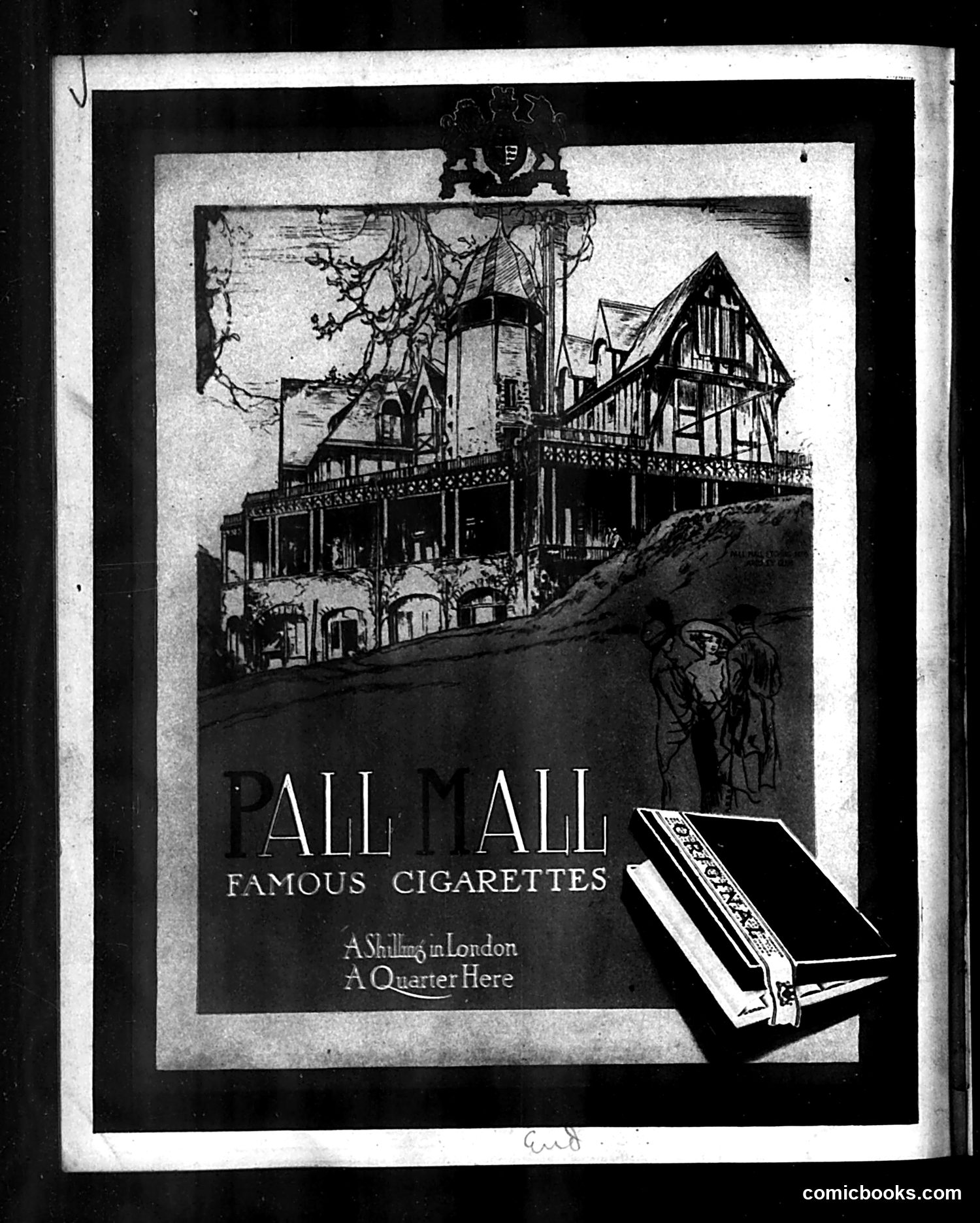
This appears to be a **cigarette advertisement** rather than a political cartoon. The page shows an illustration of a Tudor-style English manor house with distinctive half-timbered architecture, positioned above a Pall Mall cigarette package. The ad's text establishes a price comparison: "A Shilling in London / A Quarter Here," suggesting Pall Mall cigarettes cost one shilling in England but only a quarter (25 cents) in America—positioning them as an affordable luxury good with British prestige. The Tudor imagery appeals to consumers' association of England with sophistication and tradition. This is straightforward commercial advertising from the early 20th century, not satirical commentary. The Judge magazine likely ran such ads alongside humor content.
I can see this is a page from Judge magazine with a watermark crediting comicbooks.com, but the image is almost entirely black with only a faint white mark visible near the center and a light gray border on the left edge. The OCR text provides only the website URL. I cannot reliably identify any cartoon figures, caricatures, political references, or satirical content from this image. The page appears either to be severely damaged, improperly scanned, or intentionally blank. Without visible text or imagery beyond the watermark, I cannot explain what this page's satire or humor meant to contemporary readers.