
Judge, 1913-06-28 · page 4 of 25
Judge — June 28, 1913 — page 4: what you’re looking at
What you’re looking at
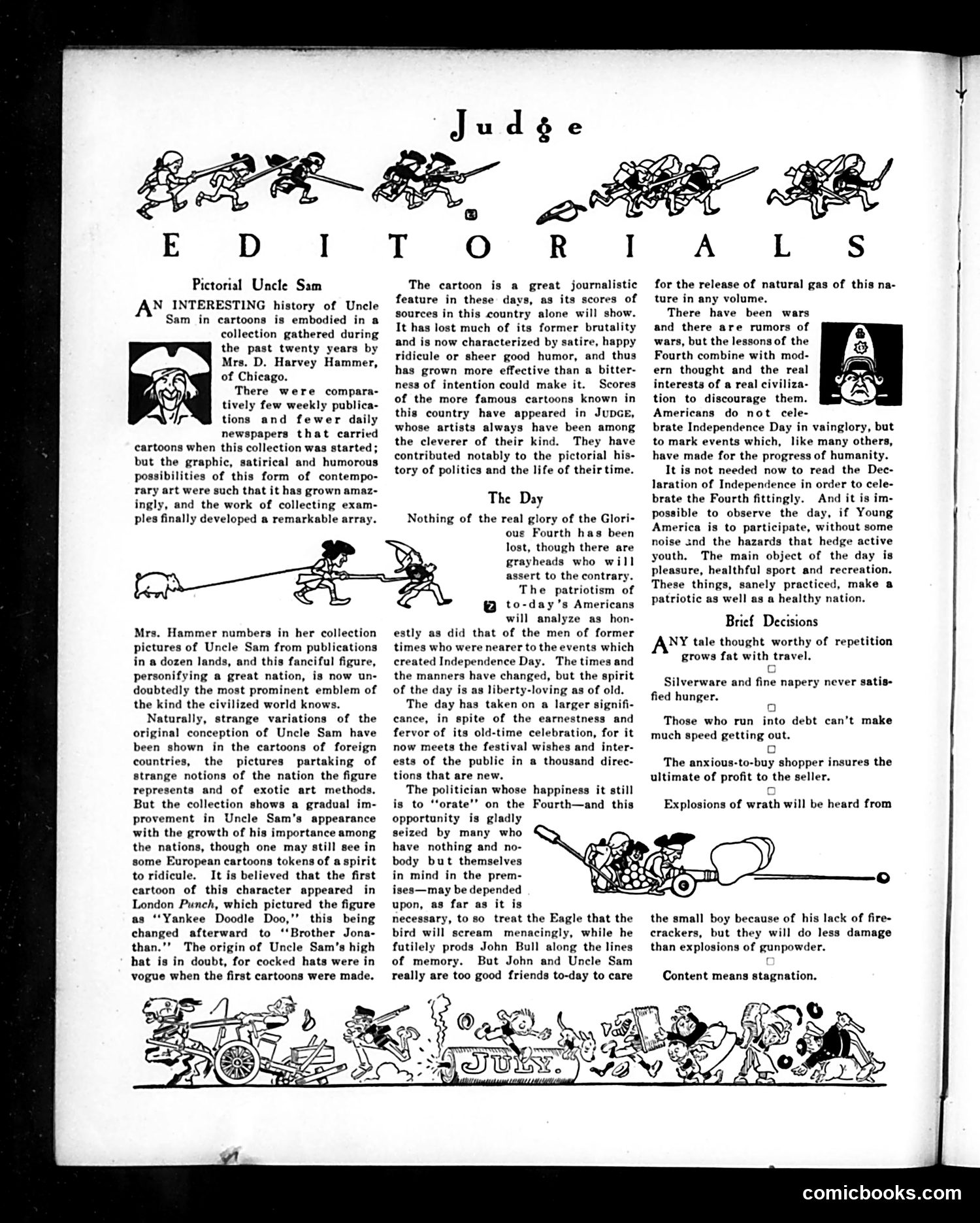
This page celebrates Uncle Sam cartoons from Mrs. D. Harvey Hammer's Chicago collection. The text praises cartooning as effective political satire, noting that Judge magazine's cartoons have historically influenced public opinion more successfully than bitter criticism alone. The editorial discusses Fourth of July celebrations, arguing that patriotic recreation—healthy sport and amusement—strengthens the nation better than formal Independence Day declarations. It references "John Bull" (Britain personified) as Uncle Sam's friend, suggesting Anglo-American alliance. The "Brief Decisions" section offers satirical one-liners mocking contemporary consumer behavior and politics, though specific targets are unclear without additional context. The illustrated header showing Uncle Sam figures emphasizes the character's central role in American political cartooning of this era.
📄 Transcribed text from this page (OCR, searchable)
Machine-transcribed from the original scan — historical spelling and the odd misread are preserved.
Pictorial Uncle Sam AN INTERESTING history of Uncle Sam in cartoons is embodied in a collection gathered during the past twenty years by Mrs. D. Harvey Hammer, of Chicago. There were compara- tively few weekly public tions and fewer daily newspapers that carried cartoons when this collection was started; but the graphic, satirical and humorous possibilities of this form of contempo- rary art were such that it has grown amaz- ingly, and the work of collecting exam- ples finally developed a remarkable array. Mrs. Hammer numbers in her collection pictures of Uncle Sam from publications in a dozen lands, and this fanciful figure, personifying a great nation, is now un- doubtedly the most prominent emblem of the kind the civilized world knows. Naturally, strange variations of the original conception of Uncle Sam have been shown in the cartoons of foreign countries, the pictures partaking of strange notions of the nation the figure represents and of exotic art methods. But the collection shows a gradual im- provement in Uncle Sam's appearance with the growth of his importance among the nations, though one may still see i: some European cartoons tokens of a spirit to ridicule. It is believed that the first cartoon of this character appeared in London Punch, which pictured the figure as ‘‘Yankee Doodle Doo,’’ this being changed afterward to ‘‘Brother Jona- than.’’ The origin of Uncle Sam’s high hat is in doubt, for cocked hats were in vogue when the first cartoons were made. The cartoon is a great journalistic feature in these days, as its scores of sources in this country alone will show. It has lost much of its former brutality and is now characterized by satire, happy ridicule or sheer good humor, and thus has grown more effective than a bitter- ness of intention could make it. Scores of the more famous cartoons known in this country have appeared in JupGE, whose artists always have been among the cleverer of their kind. They have contributed notably to the pictorial his- tory of politics and the life of theirtime. The Day Nothing of the real glory of the Glori- ous Fourth has been lost, though there are grayheads who will assert to the contrary. The patriotism of to-day’s Americans will analyze as hon- estly as did that of the men of former times who were nearer to the events which created Independence Day. The times and the manners have changed, but the spirit of the day is as liberty-loving as of old. The day has taken on a larger signifi- cance, in spite of the earnestness and fervor of its old-time celebration, for it now meets the festival wishes and inter- ests of the public in a thousand direc- tions that are new. The politician whose happiness it still is to ‘‘orate’’ on the Fourth—and this opportunity is gladly seized by many who have nothing and no- body but themselves in mind in the prem- ises—may be depended upon, as far as it is necessary, to so treat the Eagle that the bird will scream menacingly, while he futilely prods John Bull along the lines of memory. But John and Uncle Sam really are too good friends to-day to care for the release of natural gas of this na- ture in any volume. There have been wars and there are rumors of wars, but the lessons of the Fourth combine with mod- ern thought and the real interests of a real civiliza- tion to discourage them. Americans do not cele- brate Independence Day in vainglory, but to mark events which, like many others, have made for the progress of humanity. It is not needed now to read the Dec- laration of Independence in order to cele- brate the Fourth fittingly. And it is im- possible to observe the day, if Young America is to participate, without some noise 2nd the hazards that hedge active youth, The main object of the day is pleasure, healthful sport and recreation. These things, sanely practiced, make a patriotic as well as a healthy nation. Brief Decisions AXY tale thought worthy of repetition grows fat with travel. c Silverware and fine napery never satis- fied hunger. a Those who run into debt can’t make much speed getting out. o The anxious-to-buy shopper insures the ultimate of profit to the seller. Explosions of wrath will be heard from the small boy because of his lack of fire- crackers, but they will do less damage than explosions of gunpowder. Content means stagnation. comicbooks.com