
Judge, 1913-06-28 · page 11 of 25
Judge — June 28, 1913 — page 11: what you’re looking at
What you’re looking at
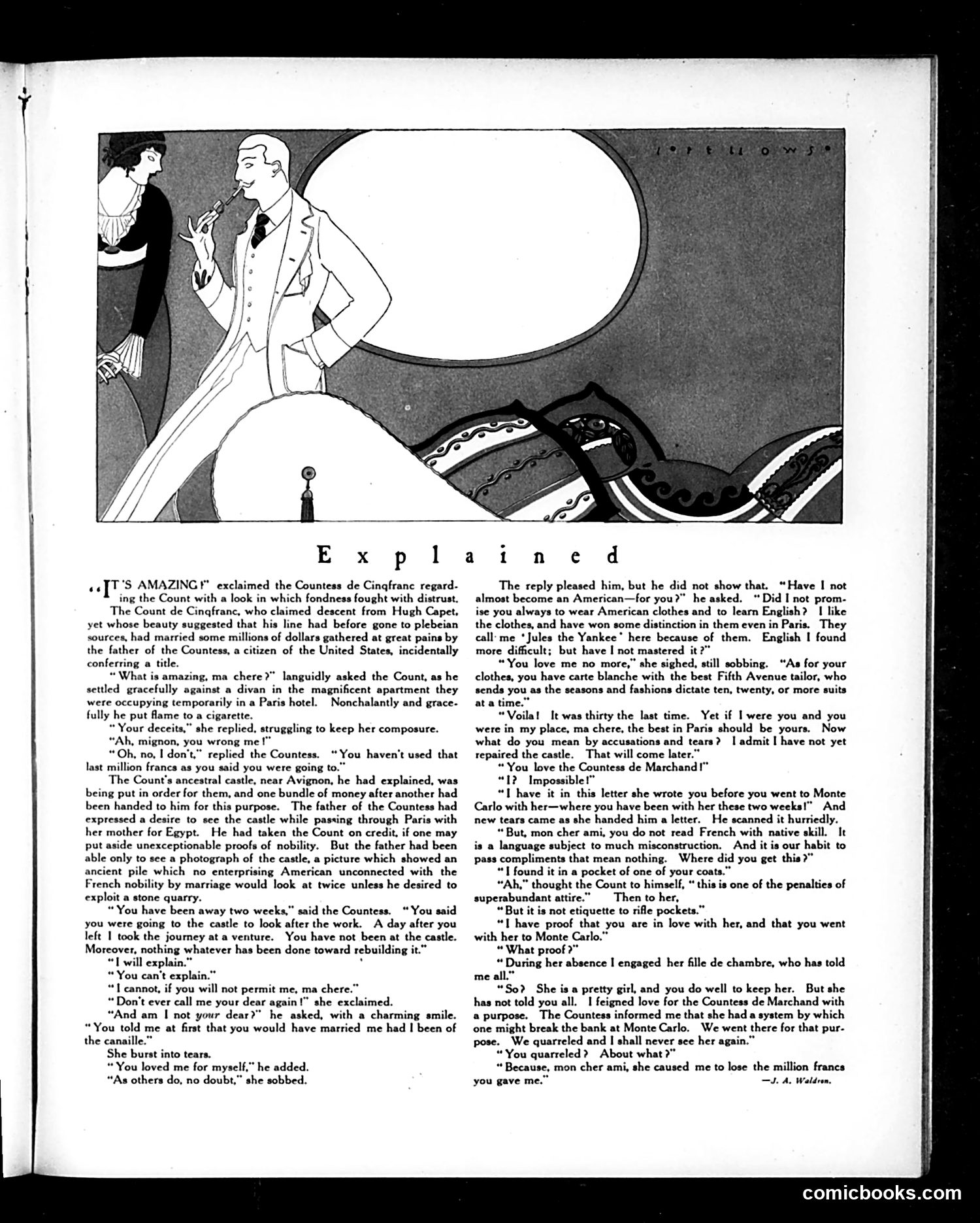
This story satirizes the American heiress marrying European nobility—a common theme in Gilded Age satire. A wealthy American's daughter has married the Count de Cingfranc, a French nobleman of questionable lineage who married her for her father's millions. The cartoon depicts their confrontation: the Countess discovers the Count has lied about renovating his ancestral castle near Avignon and suspects him of an affair with the Countess de Marchand. The Count deflects with charm and flattery, claiming he's "almost become an American" for her, adopting American clothes and even learning English. The satire targets both figures: the Count's transparent deceptions and his casual infidelities, and the Countess's willingness to be seduced by compliments despite obvious evidence of his dishonesty. It mocks the social climbing of European aristocrats and the gullibility of wealthy Americans purchasing titles.
📄 Transcribed text from this page (OCR, searchable)
Machine-transcribed from the original scan — historical spelling and the odd misread are preserved.
i "S AMAZING?" exclaimed the Countess de Cingfranc regard- ing the Count with a look in which fondness fought with distrust, The Count de Cingfranc, who claimed descent from Hugh Capet, yet whose beauty suggested that his line had before gone to plebeian sources, had married some millions of dollars gathered at great pains by the father of the Countess, a citizen of the United States, incidentally conferring a title. “ What is amazing, ma chere?” languidly asked the Count, as he settled gracefully against a divan in the magnificent apartment they were occupying temporarily in a Paris hotel. Nonchalantly and grace- fully he put flame to a cigarette. “ Your deceits,” she replied, struggling to keep her composure. h, mignon, you wrong me!” “Oh, no, I don’t,” replied the Countess. “You haven't used that last million francs as you said you were going to.” The Count's ancestral castle, near Avignon, he had explained, was being put in order for them, and one bundle of money after another had been handed to him for this purpose. The father of the Countess had expressed a desire to see the castle while passing through Paris with her mother for Egypt. He had taken the Count on credit, if one may put aside unexceptionable proofs of nobility. But the father had been able only to see a photograph of the castle, a picture which showed an ancient pile which no enterprising American unconnected with the French nobility by marriage would look at twice unless he desired to exploit a stone quarry. “You have been away two weeks,” said the Countess. “You said you were going to the castle to look after the work. A day after you left 1 took the journey at a venture. You have not been at the castle. Moreover, nothing whatever has been done toward rebuilding it.” “I will explain.” ‘ “You can’t explain.” “| cannot, if you will not permit me, ma chere.” “Don’t ever call me your dear again!" she exclaimed. “And am I not your dear?” he asked, with a charming smile. “You told me at first that you would have married me had I been of the canaille.” She burst into tears. “You loved me for myself,” he added. “As others do, no doubt,” she sobbed. a 1 The reply pleased him, but he did not show that. “Have | not almost become an American—for you?” he asked. “Did I not prom- ise you always to wear American clothes and to learn English? | like the clothes, and have won some distinction in them even in Paris. They call-me ‘Jules the Yankee” here because of them. English I found more difficult; but have I not mastered it ?” “You love me no more,” she sighed, still sobbing. “As for your clothes, you have carte blanche with the best Fifth Avenue tailor, who sends you as the seasons and fashions dictate ten, twenty, or more suits at a time.” “Voila! It was thirty the last time. Yet if I were you and you were in my place, ma chere, the best in Paris should be yours. Now what do you mean by accusations and tears? | admit I have not yet repaired the castle. That will come later.” “You love the Countess de Marchand!” “1? Impossible!” “I have it in this letter she wrote you before you went to Monte Carlo with her—where you have been with her these two weeks!” And new tears came as she handed him a letter. He scanned it hurriedly. “But, mon cher ami, you do not read French with native skill. It is a language subject to much misconstruction. And it is our habit to pass compliments that mean nothing. Where did you get this?” “| found it in a pocket of one of your coats.” “Ah,” thought the Count to himself, “ this is one of the penalties of superabundant attire.” Then to her, “But it is not etiquette to rifle pockets.” “| have proof that you are in love with her, and that you went with her to Monte Carlo.” “ What proof ” “ During her absence I engaged her fille de chambre, who has told me all.” “So? She isa pretty girl, and you do well to keep her. But she has not told you all. I feigned love for the Countess de Marchand with a purpose. The Countess informed me that she had a system by which one might break the bank at Monte Carlo. We went there for that pur- pose. We quarreled and I shall never see her again.” “You quarreled? About what?” “Because, mon cher ami, she caused me to lose the million francs you gave me.” J. A. Waldron, comicbooks.com