
Judge, 1913-06-28 · page 6 of 25
Judge — June 28, 1913 — page 6: what you’re looking at
What you’re looking at
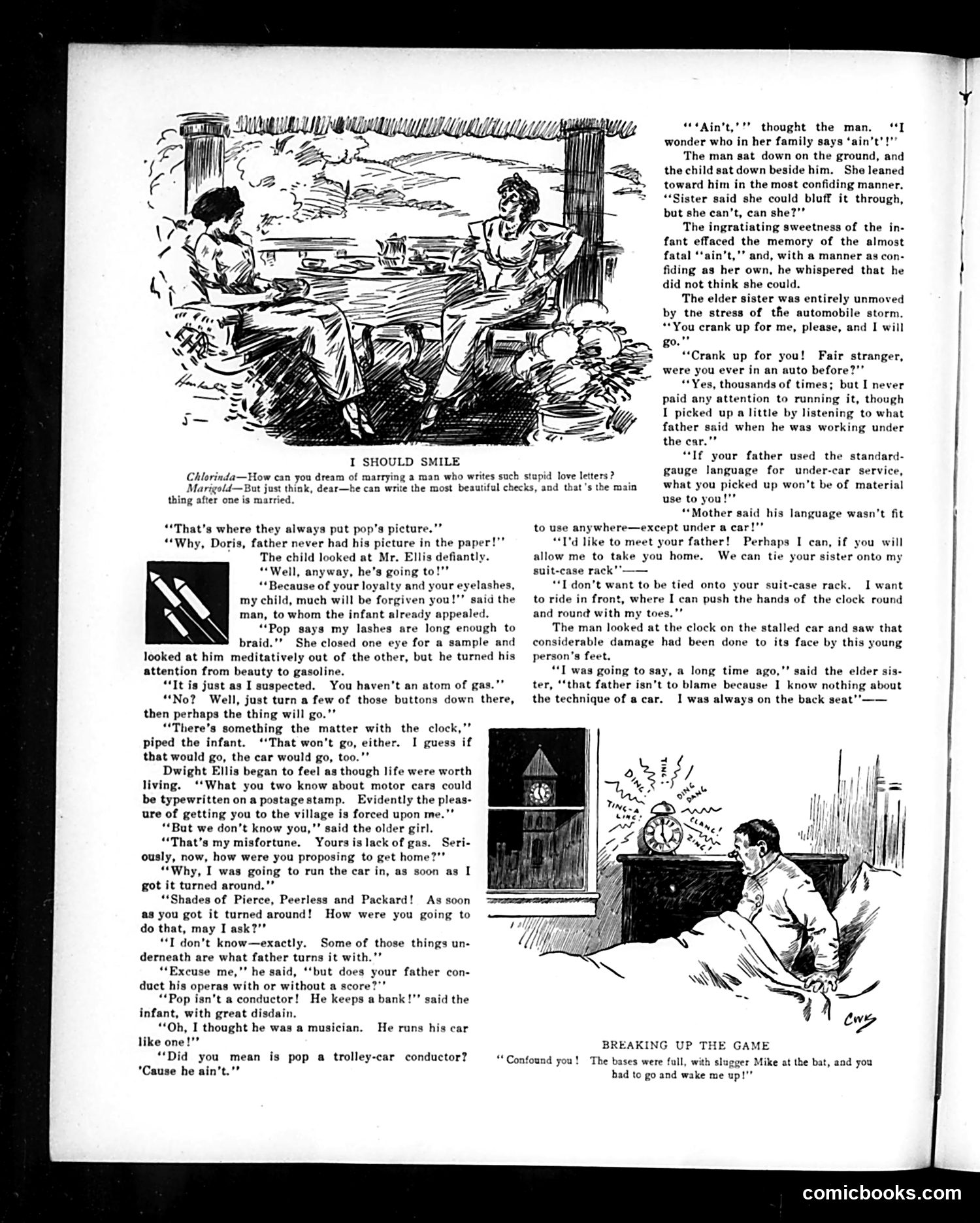
This page contains humor about early automobile culture and gender roles circa 1910s-1920s. The main comic narrative follows a man stranded with two young girls whose car has broken down. The satire targets: **The girls' incompetence**: They cannot operate the automobile despite attempting to drive it themselves, not knowing basic mechanics or how to crank the engine. Their ignorance is played for laughs. **Class and propriety**: References to "Pierce, Peerless and Packard" (luxury car brands) suggest aspirational middle-class owners. The man is scandalized they'd invite a stranger to their home. **Language and refinement**: The recurring "ain't" joke suggests class anxiety—the man is initially offended by this grammatical error but is charmed by the child despite it. **Parental authority**: The girls' father is mocked as incompetent with machinery (conducting an opera like driving a car), yet he's a banker—suggesting the newly wealthy lacked practical knowledge. The secondary cartoon "I Should Smile" appears to be about romantic/financial pragmatism in marriage. The humor relies on period assumptions about women, machinery, and social hierarchy.
📄 Transcribed text from this page (OCR, searchable)
Machine-transcribed from the original scan — historical spelling and the odd misread are preserved.
I SHOULD SMILE thing after one is married. “That's where they always put pop’s picture.” “Why, Doris, father never had his picture in the paper!"" The child looked at Mr. Ellis defiantly. “Well, anyway, he’s going to!"’ “Because of your loyalty and your eyelashes, my child, much will be forgiven you!"’ said the man, to whom the infant already appealed. “Pop says my lashes are long enough to brai She closed one eye for a sample and looked at him meditatively out of the other, but he turned his attention from beauty to gasoline. “It is just as I suspected. You haven't an atom of gas.”’ “No? Well, just turn a few of those buttons down there, then perhaps the thing will go."’ “There's something the matter with the cloc! piped the infant. ‘‘That won't go, either. I guess if that would go, the car would go, too.’” Dwight Ellis began to feel as though life were worth living. ‘*What you two know about motor cars could be typewritten on a postage stamp. Evidently the pleas- ure of getting you to the village is forced upon me."" “But we don’t know you,’’ said the older girl. “That’s my misfortune. Yours islack of gas. Seri- ously, now, how were you proposing to get home?”’ “Why, I was going to run the car in, as soon as I got it turned around."’ “Shades of Pierce, Peerless and Packard! As soon as you got it turned around! How were you going to do that, may I ask?’" “T don’t know—exactly. Some of those things un- derneath are what father turns it with.’” “Excuse me,"’ he said, ‘‘but does your father con- duct his operas with or without a score?”’ “Pop isn’t a conductor! He keeps a bank!"’ said the infant, with great disdain. “Oh, I thought he was a musician. He runs his car like one! "ey, “Did you mean is pop a trolley-car conductor? "Cause he ain’t."" Chlorinda—How can you dream of marrying a man who writes such stupid love letters ? arigold— But just think, dear—he can write the most beautiful checks, and that's the main “*Ain't,’’’ thought the man. “I wonder who in her family says ‘ain't The man sat down on the ground, and the child sat down beside him. She leaned toward him in the most confiding manner. “Sister said she could bluff it through, but she can’t, can she? The ingratiating sweetness of the in- fant effaced the memory of the almost fatal ‘‘ain’t,’’ and, with a manner as con- fiding as her own, he whispered that he did not think she could. The elder sister was entirely unmoved by the stress of the automobile storm. “You crank up for me, please, and I will “Crank up for you! Fair stranger, were you ever in an auto before?” “*Yes, thousands of times; but I never paid any attention to running it, though I picked up a little by listening to what father said when he was working under the car.’" “If your father used the standard- gauge language for under-car service, what you picked up won't be of material use to you!"" “Mother sai to use anywhere—except under a car “I'd like to meet your father! Perhaps I can, if you will allow me to take you home. We can tie your sister onto my his language wasn’t fit suit-case rack’’—— “I don't want to be tied onto your suit-case rack. I want to ride in front, where I can push the hands of the clock round and round with my toes."” The man looked at the clock on the stalled car and saw that considerable damage had been done to its face by this young person’s feet. “I was going to say, a long time ago,"’ said the elder sis- ter, ‘that father isn't to blame because 1 know nothing about the technique of a car. I was always on the back seat’ BREAKING UP THE GAME “‘Confound you! The bases were full, with slugger Mike at the bat, and you had to go and wake me up!” comicbooks.com