
A complete issue · 24 pages · 1913
Judge — June 7, 1913
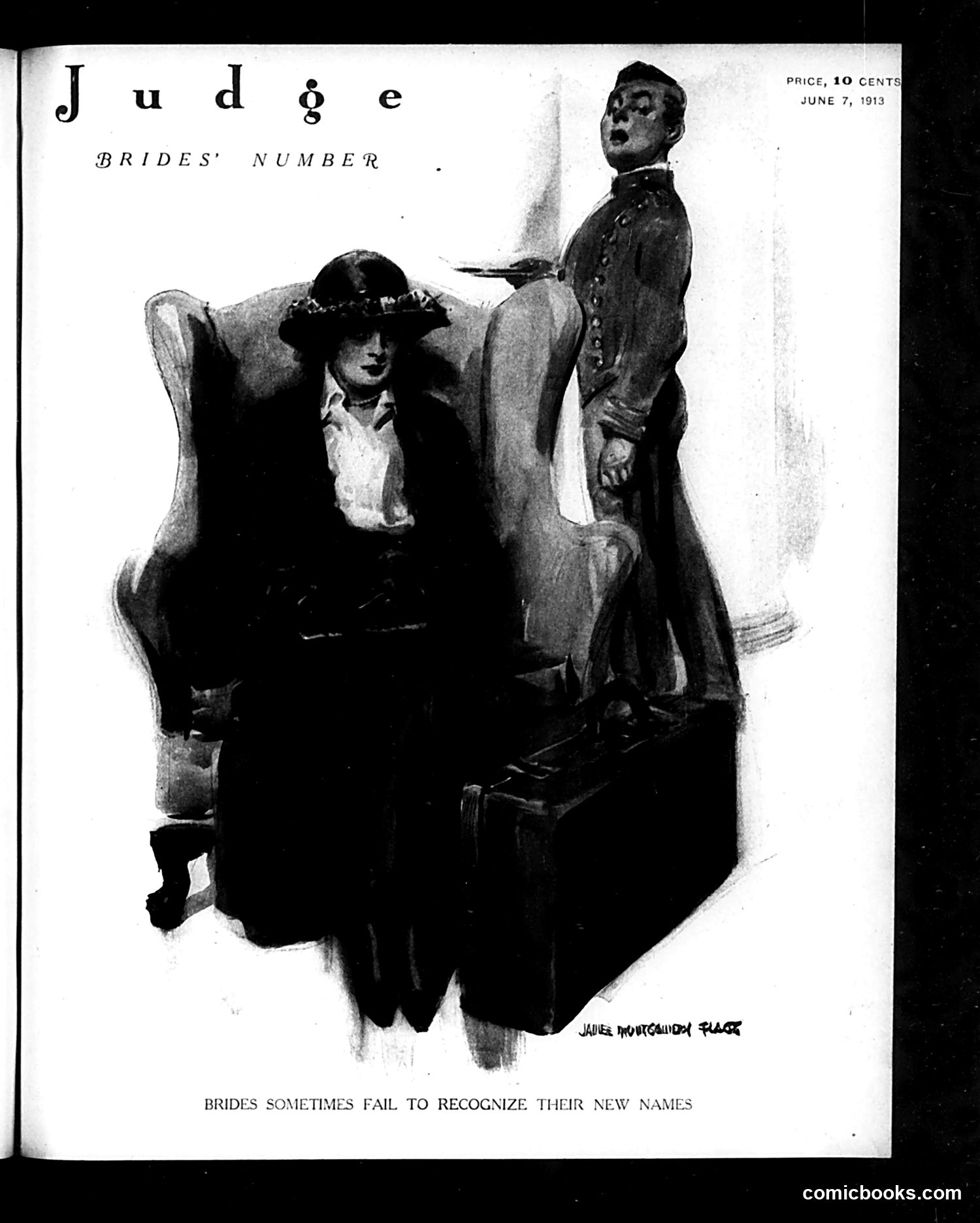
This is the cover of Judge's special "Brides' Number" issue. The cartoon illustrates the caption: "Brides Sometimes Fail to Recognize Their New Names." The image shows a bride seated in a chair, wearing a hat and dark dress, appearing confused or disoriented. A man (presumably her new husband) stands nearby holding what appears to be a calling card or document, looking exasperated as he tries to address her by her married name. The joke satirizes the then-contemporary custom of women taking their husbands' surnames upon marriage. The cartoon humorously suggests that newly married women sometimes couldn't adjust to being called by their new family names, finding the change jarring or disorienting. This reflects early 20th-century social conventions about marriage and female identity.
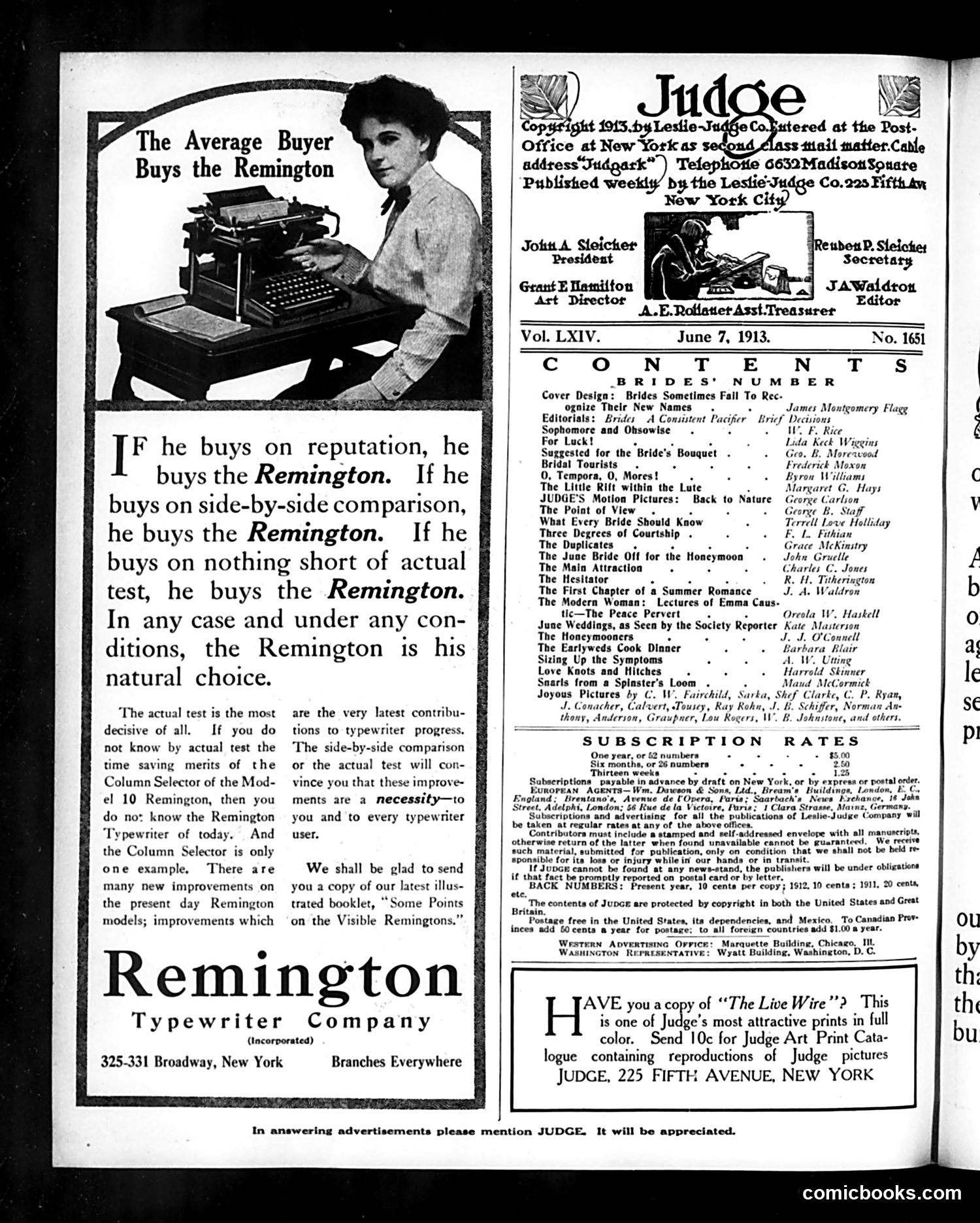
**Main Content:** This page is dominated by a Remington Typewriter advertisement featuring a man at a typewriter with the headline "The Average Buyer Buys the Remington." **The Satire/Message:** The ad's text argues that regardless of purchasing method—reputation, comparison, or rigorous testing—buyers inevitably choose Remington. This is satirical advertising: it humorously suggests the Remington's superiority is so obvious that any rational evaluation leads to the same conclusion. The repetitive "he buys the Remington" becomes comedic through its inevitability. **Context:** In 1913, typewriters were relatively new office technology, and manufacturers competed aggressively. The ad mockingly implies that competing products cannot withstand actual scrutiny. The remainder of the page contains the magazine's table of contents and subscription rates. No political cartoons are visible.
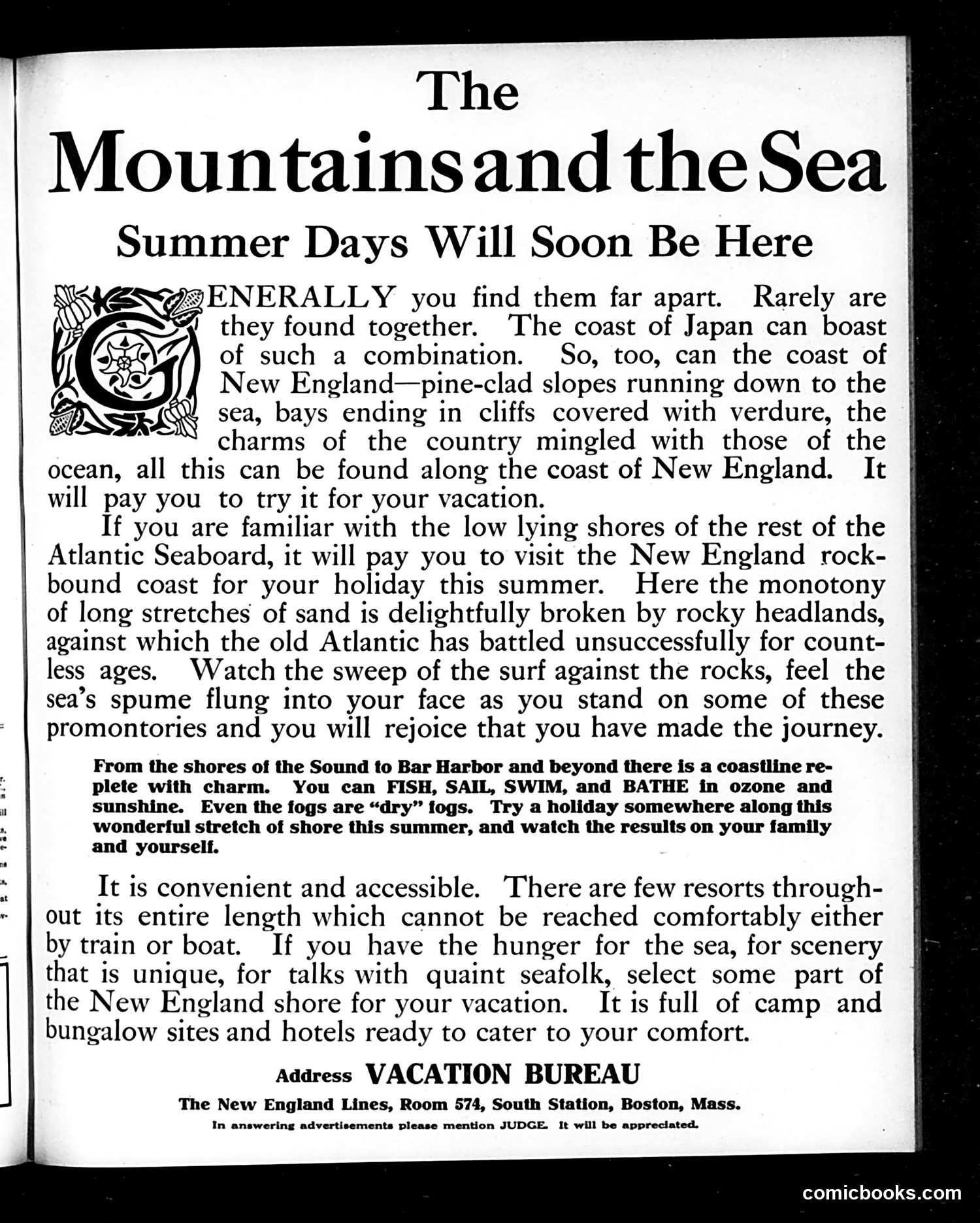
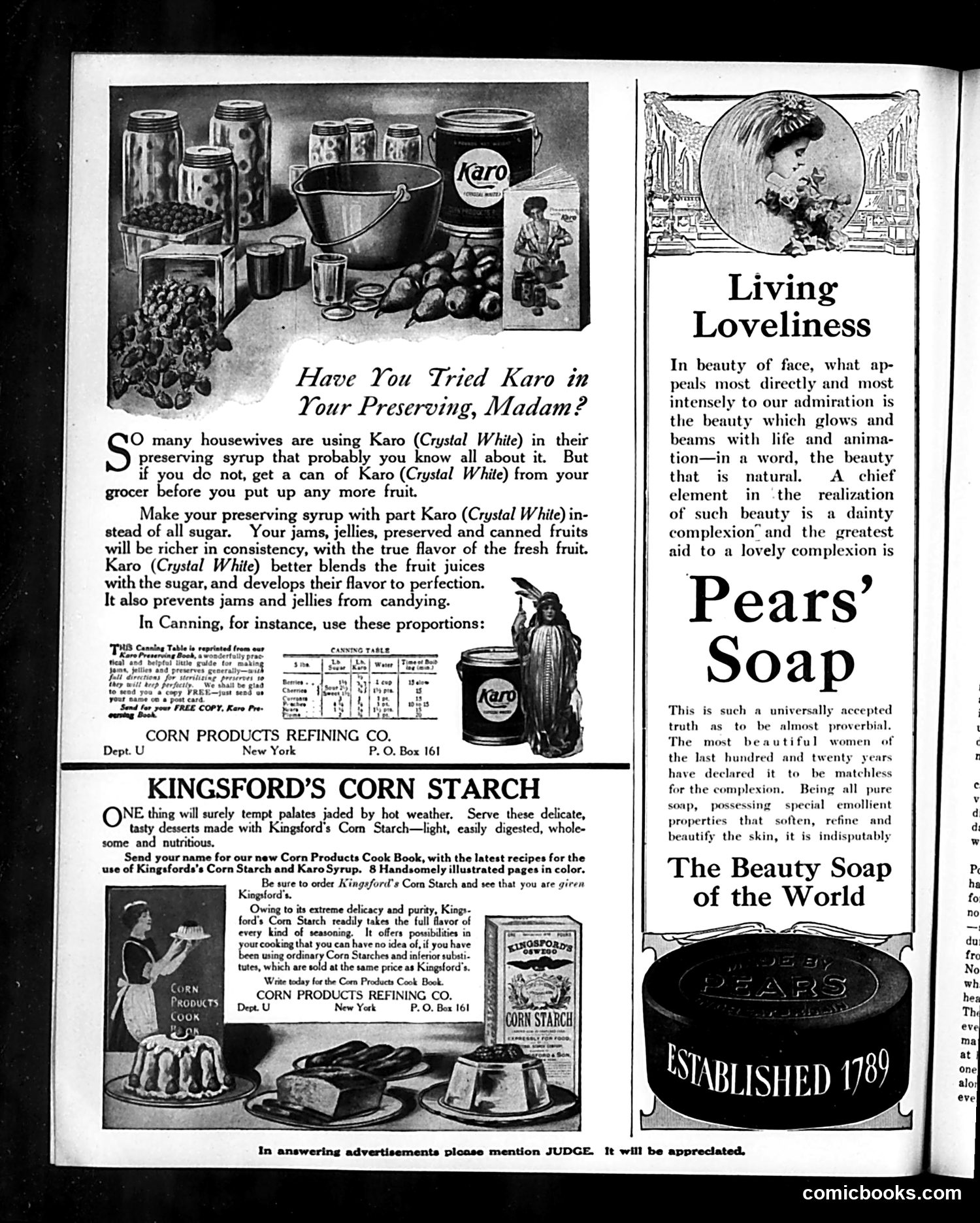
This page contains **three vintage advertisements**, not satirical cartoons. The content includes: 1. **Karo Syrup ad** (top left): Promotes using Karo Crystal White syrup for home preserving and canning, with a canning table guide. 2. **Kingsford's Corn Starch ad** (bottom left): Features a woman serving corn starch-based desserts, advertising the product's versatility in cooking. 3. **Pears' Soap ad** (right side): Emphasizes natural beauty and complexion care, established 1789. Uses the slogan "The Beauty Soap of the World." There are **no political cartoons or satirical content** on this page. It represents typical early 20th-century magazine advertising promoting household products and personal care items to women, emphasizing domesticity and beauty standards of the era.
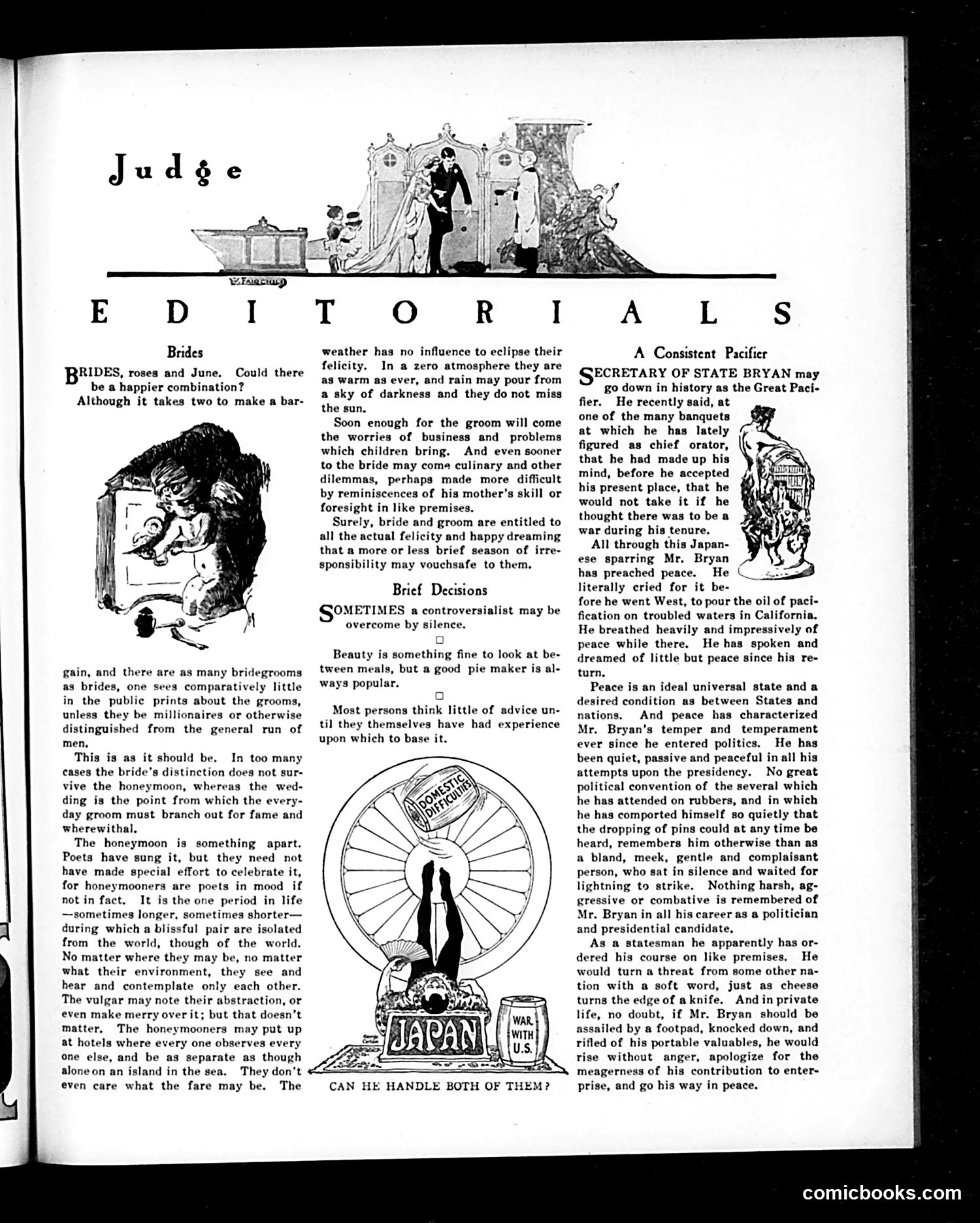
This page contains two satirical pieces from Judge magazine: **"Brides" Editorial**: A humorous essay about newlyweds, discussing how brides and grooms deserve a brief, responsibility-free honeymoon period isolated from worldly concerns. The tone is gentle social commentary on marriage expectations. **"A Consistent Pacifist"**: A critical piece about Secretary of State William Jennings Bryan. The text characterizes him as genuinely peaceful and consistent in his pacifist beliefs, even when facing threats. The accompanying cartoon (showing Bryan and a globe labeled "Japan" with "War with U.S." notation) appears to satirize Bryan's pacifism during a period of U.S.-Japan tensions—likely referencing early 20th-century anxieties about potential conflict with Japan. The satire questions whether Bryan's unwavering pacifism remains practical amid growing international tensions.
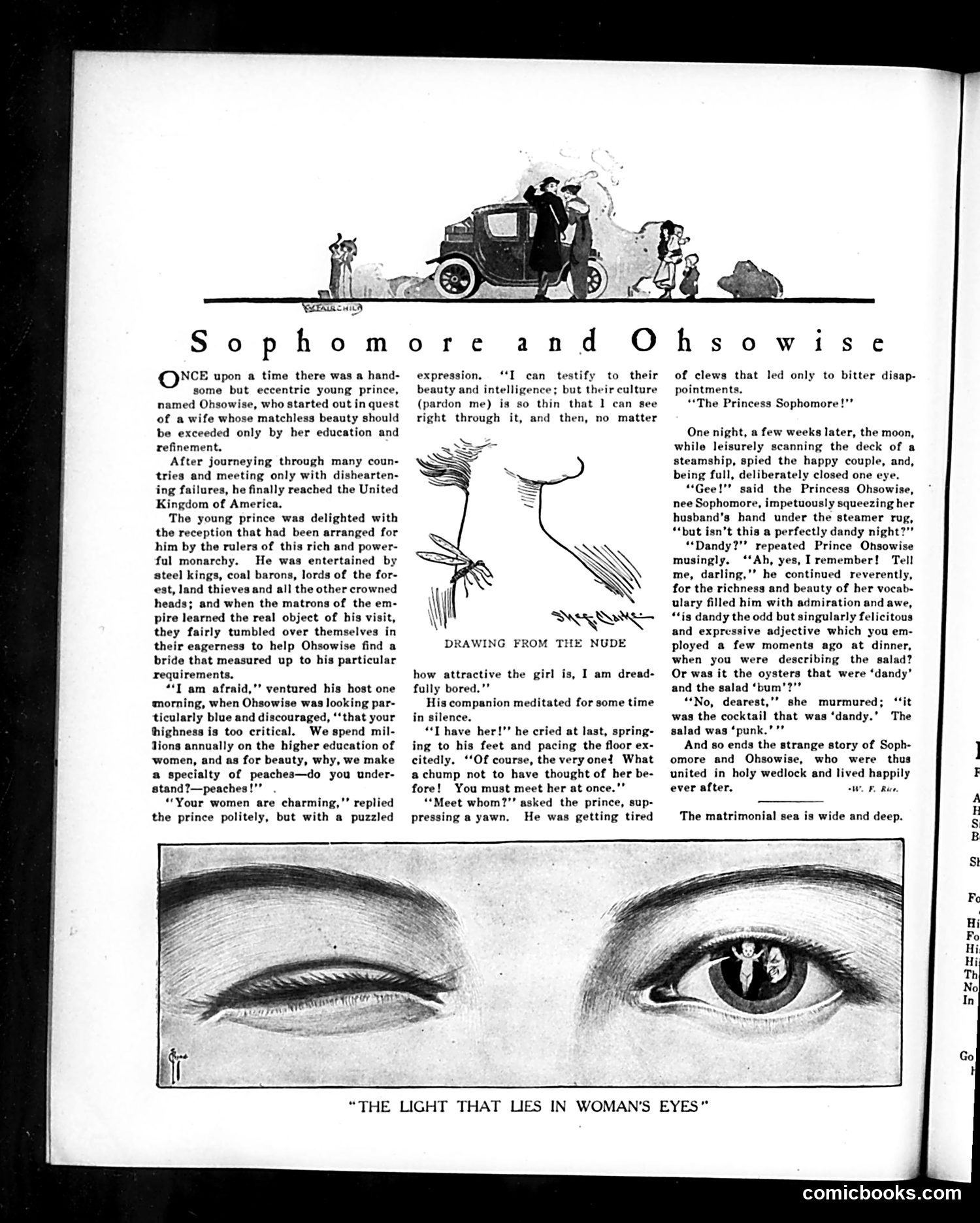
This story mocks the limitations of women's higher education in early 20th-century America. Prince Ohsowise seeks a wife with both beauty and genuine intellectual depth, but American heiresses—despite expensive education—prove superficial. Their "culture" is described as "so thin" he can "see right through it." The satire peaks when he marries "Princess Sophomore," a woman whose vocabulary consists entirely of slang adjectives like "dandy" and "punk." Despite her elite upbringing, she cannot articulate complex thoughts beyond shallow praise. The cruel punchline: they live "happily ever after"—suggesting either that men don't actually want educated women, or that American women's education was so inadequate it produced only ornamental sophistication. The accompanying illustration of a woman's eye reinforces that her appeal remains purely physical, not intellectual. Judge ridicules both the pretense of women's higher education and the mediocre results it produced.
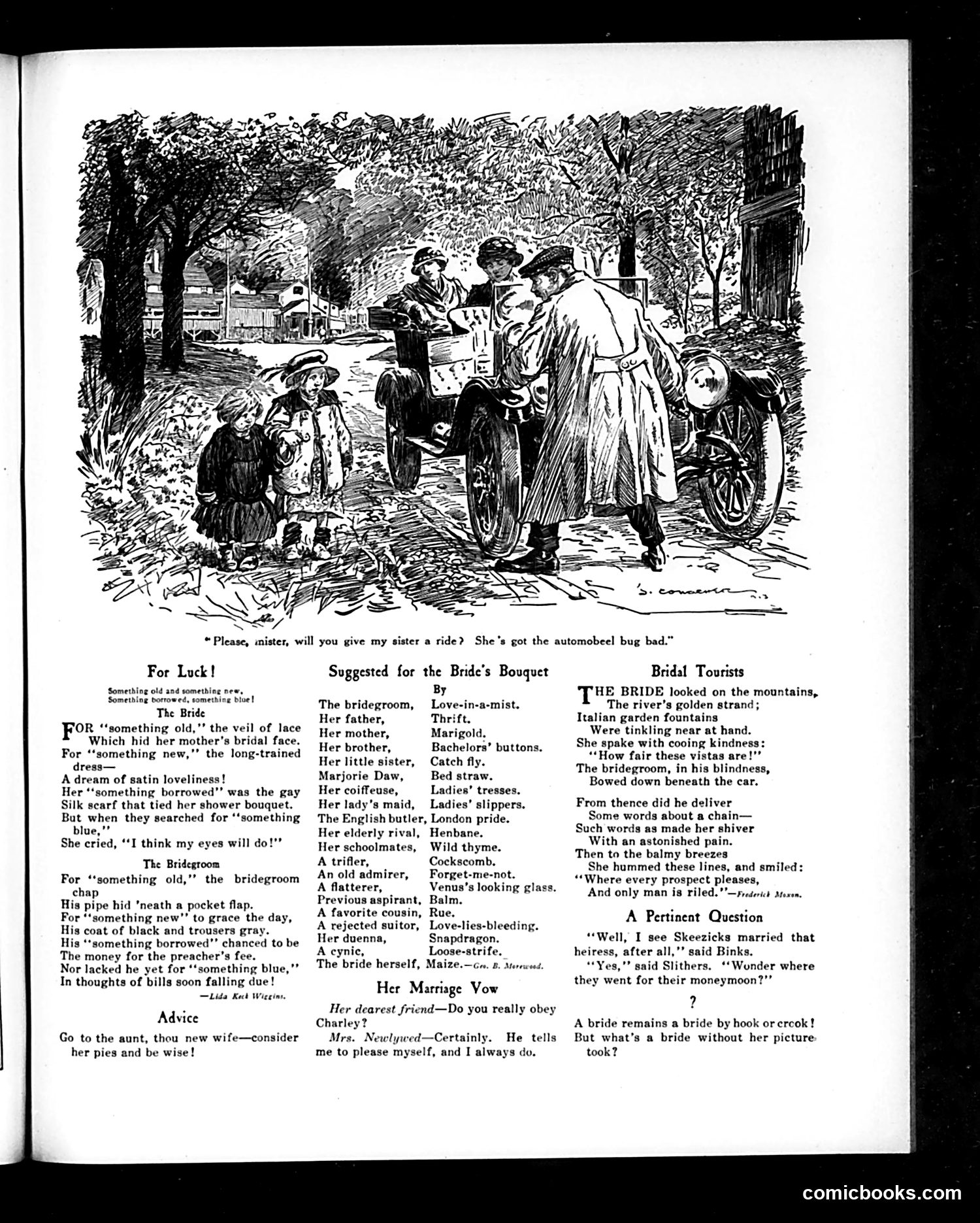
This page from *Judge* magazine contains multiple pieces of **wedding-themed humor** satirizing early 20th-century marriage customs and gender dynamics. The main cartoon depicts a child asking a motorist for a ride, claiming his sister has "the automobeel bug"—a pun on the newfangled automobile craze. The written content mocks bridal traditions: "For Luck!" plays on the "something old, new, borrowed, blue" wedding rhyme, humorously applying it to both bride and groom. The bride's tears serve as "something blue"; the groom worries about bills. Several short pieces satirize marriage itself: "Her Marriage Vow" jokes that the newlywed wife obeys her husband by doing exactly what she wants. "Bridal Tourists" depicts the bride enchanted by Italian scenery while the groom—presumably frustrated about marital expenses—mutters irritably about "chains." "A Pertinent Question" plays on "honeymoon" versus "moneymoon," suggesting the groom married for wealth. Overall, the humor reflects period anxieties about matrimony, female independence, and consumerism.
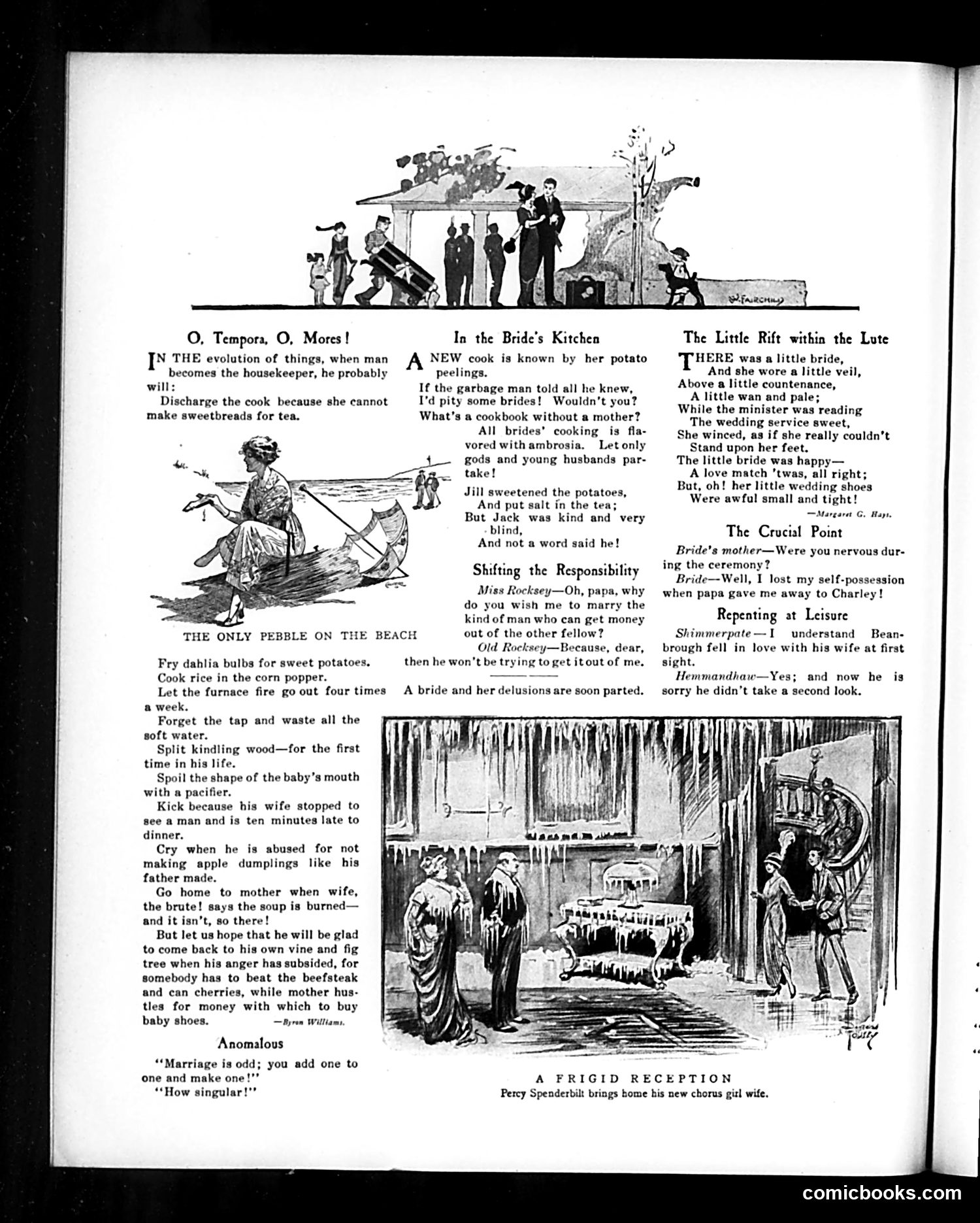
This page lampoons late 19th/early 20th-century anxieties about shifting gender roles. The main theme: what happens when men become housekeepers? **"O, Tempora, O, Mores!"** lists ridiculous domestic incompetence men would exhibit—wasting water, spoiling food, needing mother's help—suggesting men are naturally unsuited to housework, a critique of women's demands for equality. **Marriage satires** mock young brides: their cooking disasters, nervous breakdowns at weddings (caused by tight shoes, not emotion), and delusions about romance. "A bride and her delusions are soon parted" captures the cynical tone. **"A Frigid Reception"** shows Percy Spenderbilt introducing his new wife—a chorus girl—to shocked society, satirizing class anxiety and scandalous marriages. The overall message defends traditional gender hierarchies: women belong in kitchens (badly), men in breadwinning. These pieces dismiss both women's aspirations and unconventional marriages as absurd.
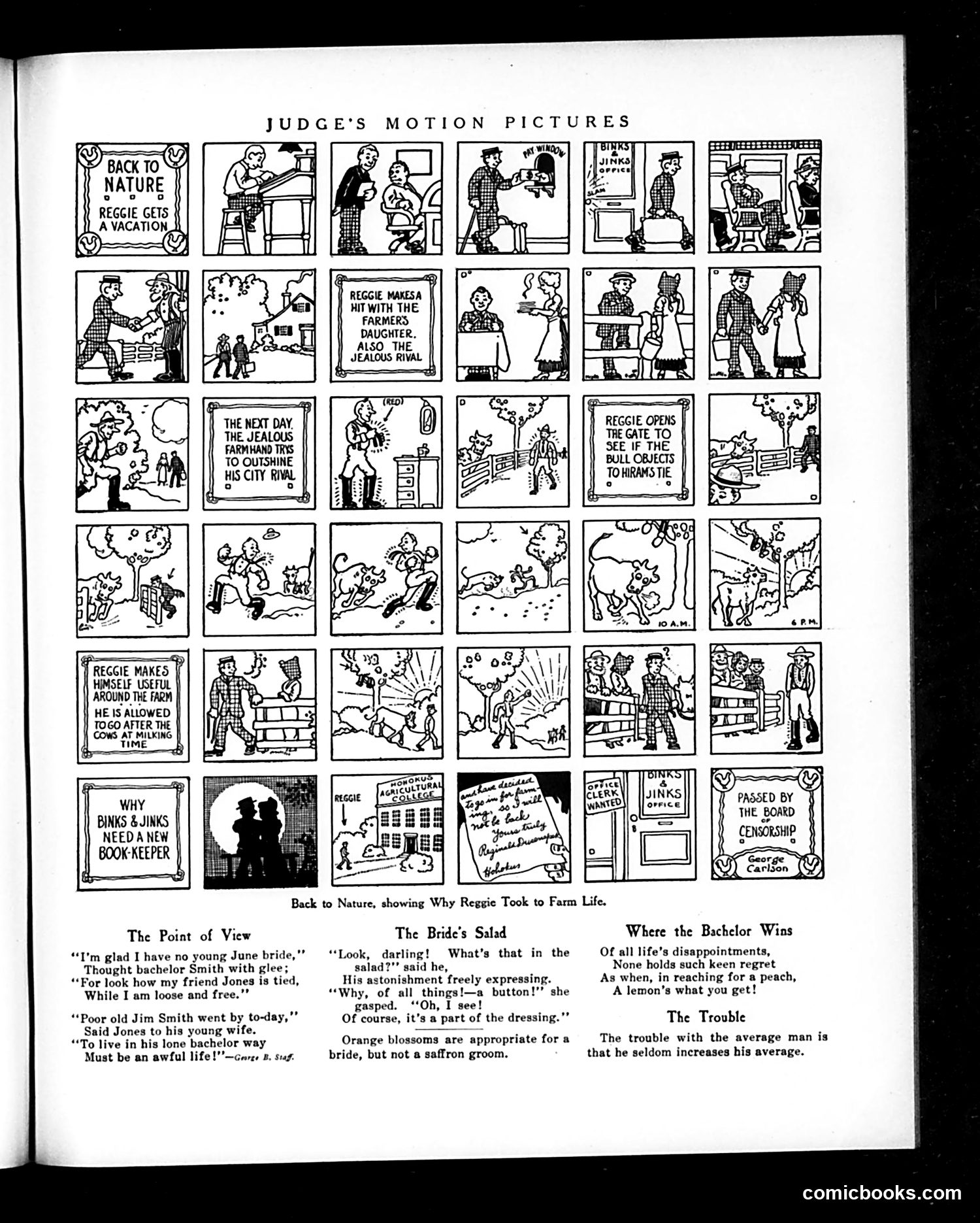
This multi-panel comic strip follows "Reggie," a character who abandons city life for farming. The narrative arc shows: Reggie takes a vacation, meets a farmer's daughter, develops a rivalry with another suitor over her affections, and eventually moves to farm life to be near her. The satire targets **turn-of-the-century "back to nature" romanticism**—a cultural movement where disillusioned urbanites idealized rural living. The joke is that Reggie's motivations are entirely romantic rather than philosophical; he's chasing a woman, not seeking genuine agrarian virtue. The accompanying short jokes use similar themes: bachelors versus married men debating life quality, and expectations versus reality in relationships. The overall message mocks both the "noble farmer" mythology and male sentimentality about love and marriage—suggesting that real life rarely matches romantic ideals, whether in cities or countryside.
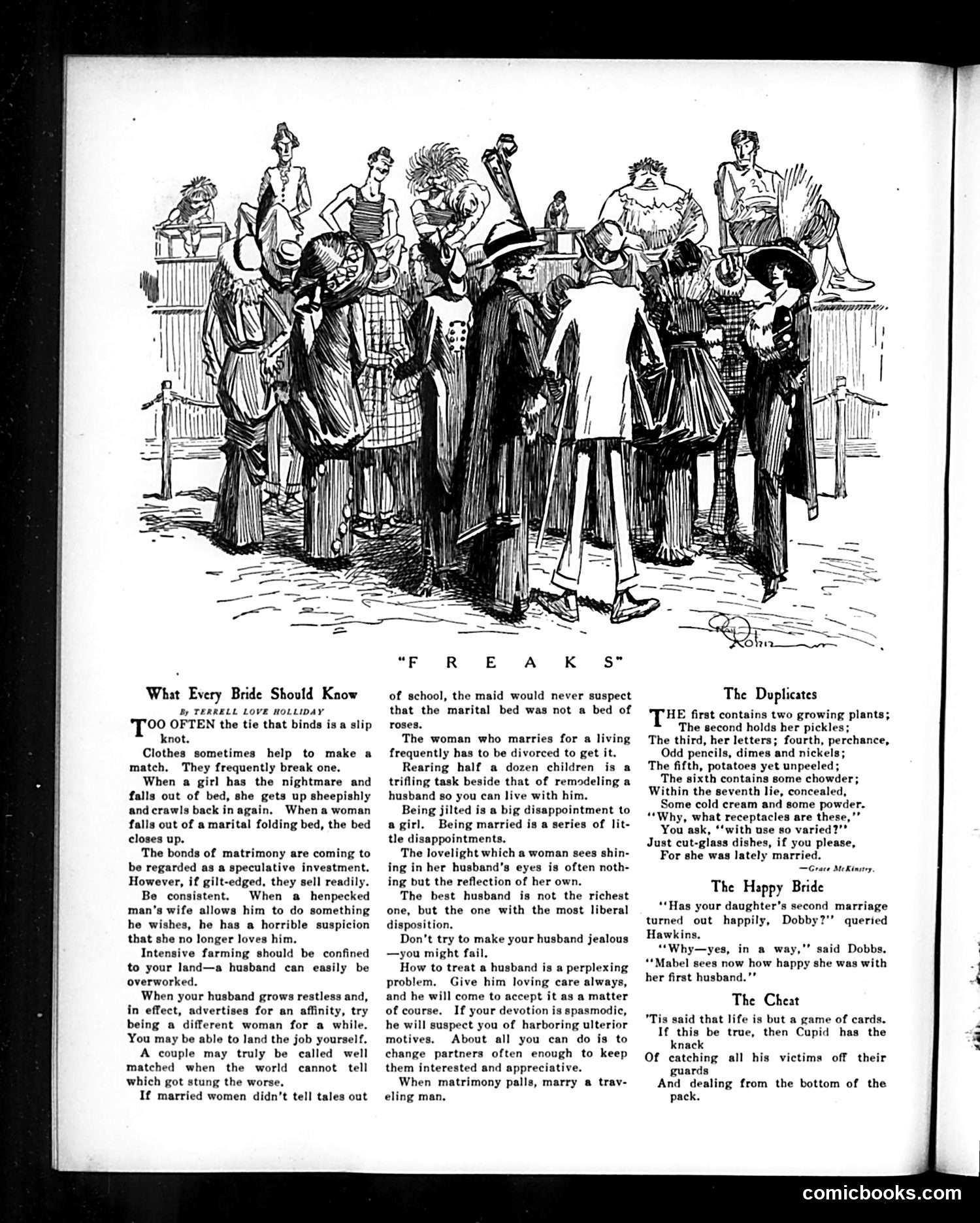
This page from Judge magazine presents satirical commentary on marriage from the early 20th century. The central illustration shows a crowd gathered around what appears to be a wedding or social gathering—the title "FREAKS" suggests these are unusual matrimonial situations. The main article, "What Every Bride Should Know" by Terrell Love Holliday, uses sardonic wit to critique marriage expectations. It mocks romantic ideals ("the tie that binds is a slip knot"), warns that marriages are treated as financial speculation, and satirizes gender dynamics—suggesting husbands grow "restless," wives nag, and divorce is financially motivated for women. The accompanying shorter pieces ("The Duplicates," "The Happy Bride," "The Cheat") continue the cynical theme: newlyweds accumulate household goods; remarried women realize their first marriages were preferable; and romantic love is portrayed as a con game. The satire targets both genders but particularly mocks Victorian marriage mythology, suggesting matrimony is ultimately disappointing, transactional, and based on mutual deception rather than genuine affection.
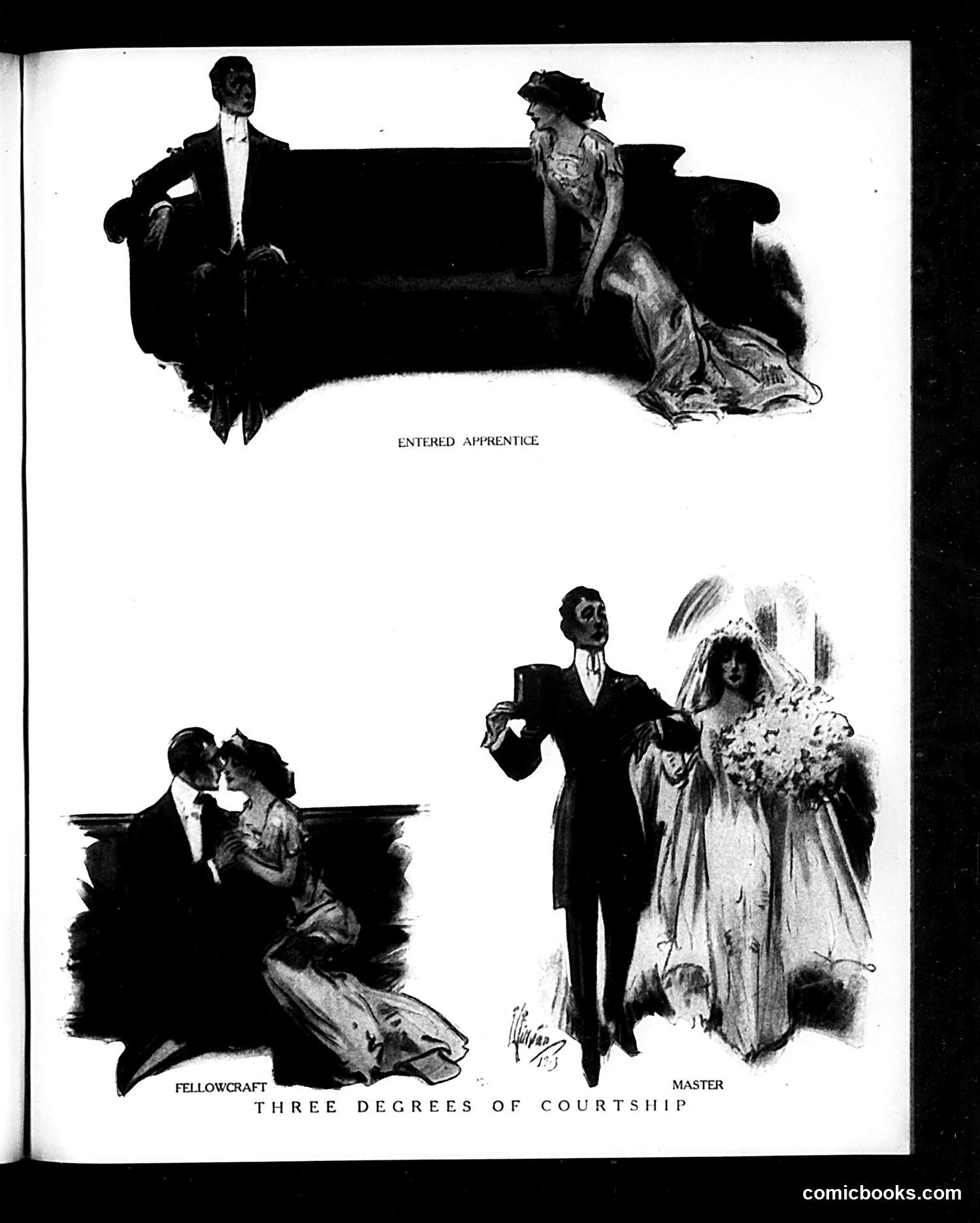
This satirical illustration uses Freemasonry's three ritual degrees (Entered Apprentice, Fellowcraft, Master) as a framework for mocking the progressive stages of courtship in the early 20th century. **The progression shown:** - **Entered Apprentice** (top): A formally dressed man and woman sit distantly on a sofa, maintaining decorum - **Fellowcraft** (bottom left): The couple grows closer, more intimate physical contact - **Master** (bottom right): A bride and groom, suggesting marriage as the "mastery" of courtship The joke satirizes how courting rituals escalate from formal, reserved interactions to marriage. By paralleling this to Freemasonry's secretive advancement through degrees, the cartoon mocks both the formality of courtship customs and fraternal lodge culture. The humor targets the predictable, ritualistic nature of romance among the middle and upper classes.
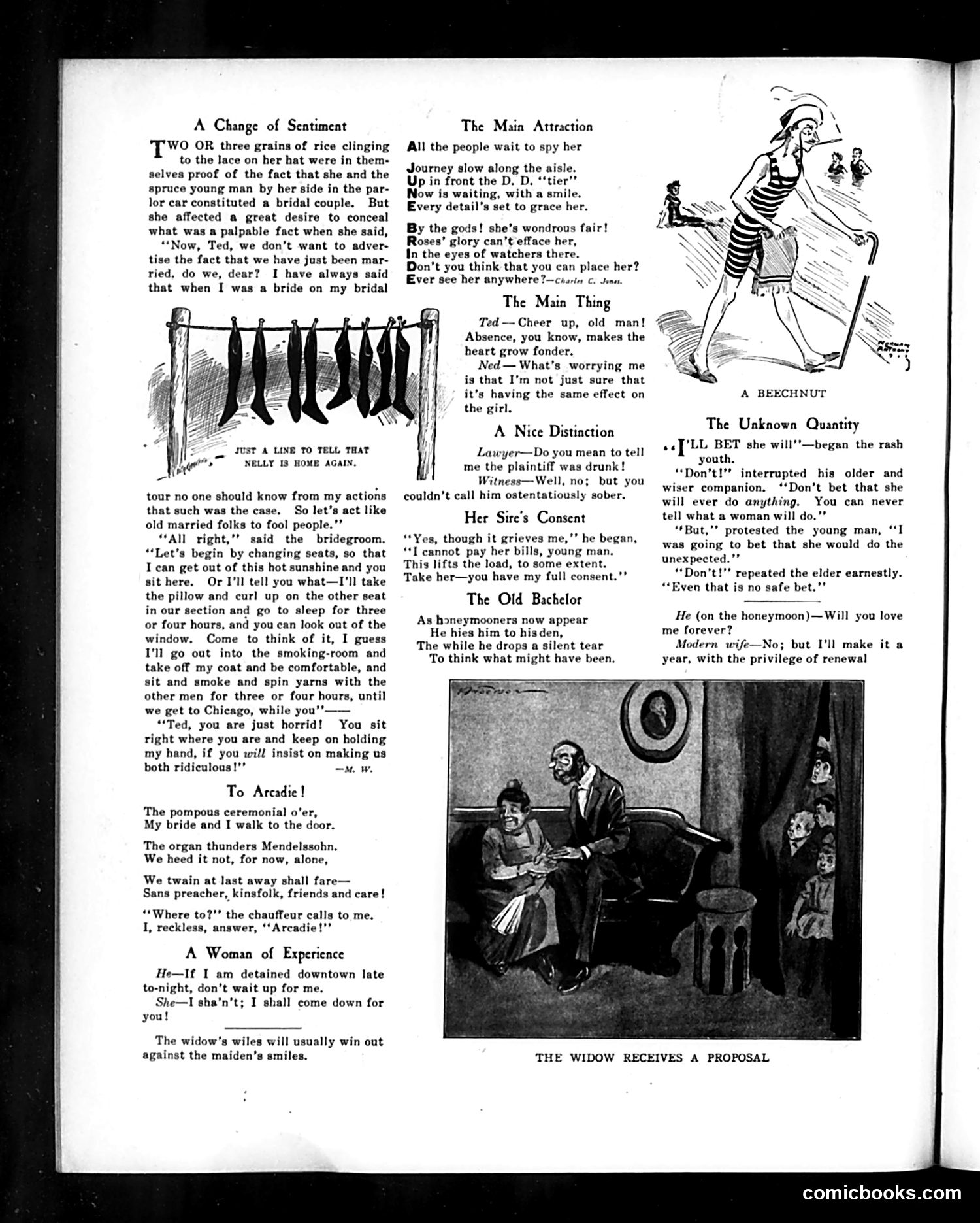
This page contains multiple brief humorous pieces satirizing early 20th-century courtship and marriage conventions: **"A Change of Sentiment"** mocks newlyweds who claim they want to hide their married status, yet the bride immediately demands the groom remain attentive and hold her hand—revealing that her desire for discretion conflicts with her actual need for romantic attention. **"The Old Bachelor"** presents a widower's melancholy perspective: as honeymoon couples pass, he weeps over what marriage "might have been," sardonically suggesting bachelorhood as preferable to matrimony's disappointments. **"The Unknown Quantity"** jokes that predicting women's behavior is impossible—even betting she'll do something unexpected is foolish. **"Her Sire's Consent"** presents dark humor: the bride's father consents to the marriage partly because it relieves him of paying her bills. **"A Woman of Experience"** suggests the widow's strategic romantic tactics outmaneuver a younger maiden's genuine affection. The overall theme: **marriage disillusionment**—the gap between romantic expectations and the mundane, often disappointing reality of married life, particularly the husband's loss of freedom and attention.
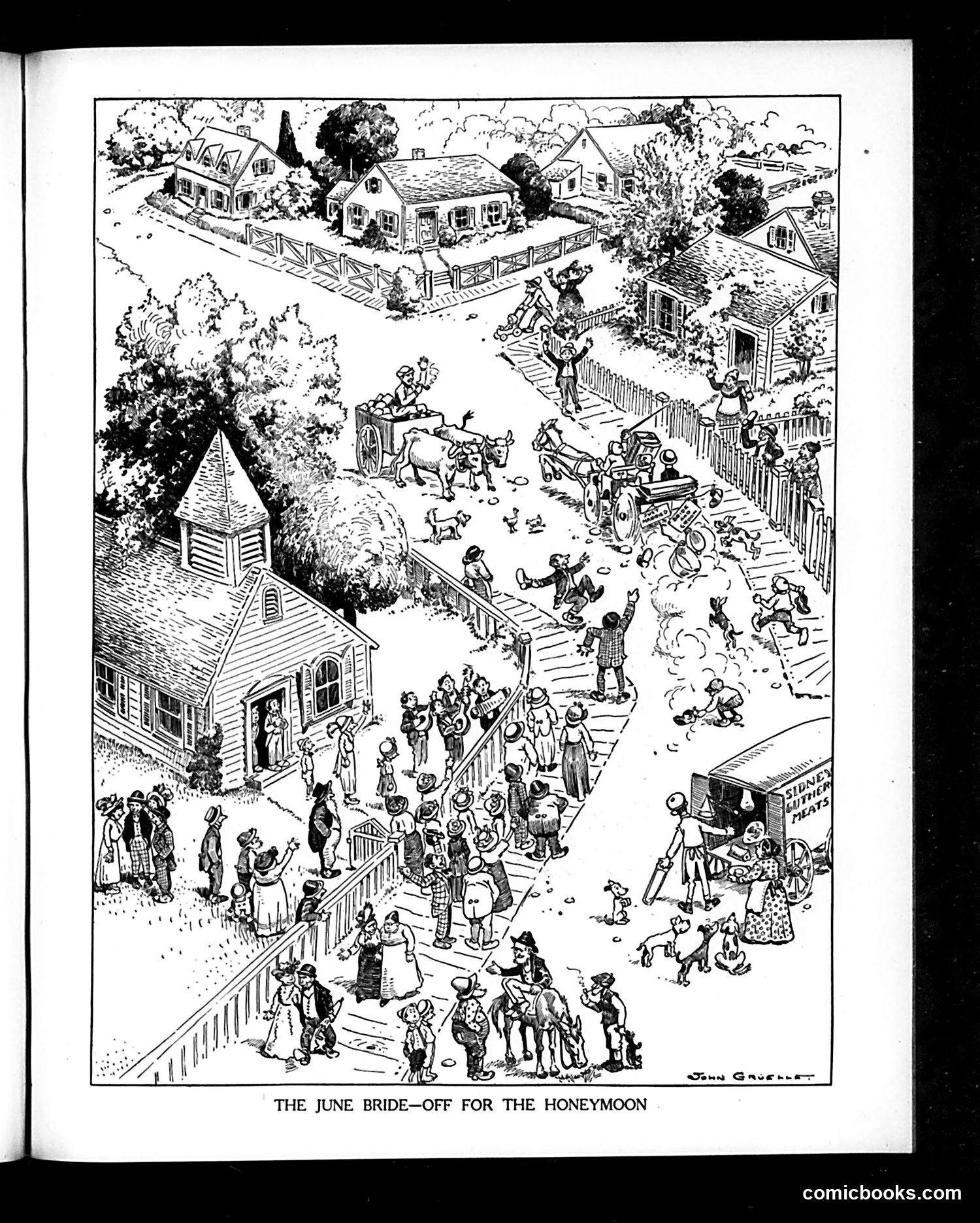
This illustration satirizes the chaos and expense surrounding June weddings and honeymoon departures in early 20th-century America. The cartoon depicts a crowded village scene where a newlywed couple's send-off has descended into mayhem: people wave enthusiastically, children run about, various vehicles (including what appears to be a decorated cart or carriage) compete for space, and domestic animals roam freely. The satire likely mocks the excessive social rituals and community spectacle surrounding weddings—the well-meaning but overwhelming attention from family and neighbors, the financial burden of celebrations, and the general loss of privacy for the couple. The artist (signed "John Gachet" or similar) captures the frenzy as comedic disorder, suggesting that a supposedly romantic occasion becomes an undignified public circus. The title's ironic tone ("off for the honeymoon") emphasizes the couple's apparent desperation to escape the festivities.
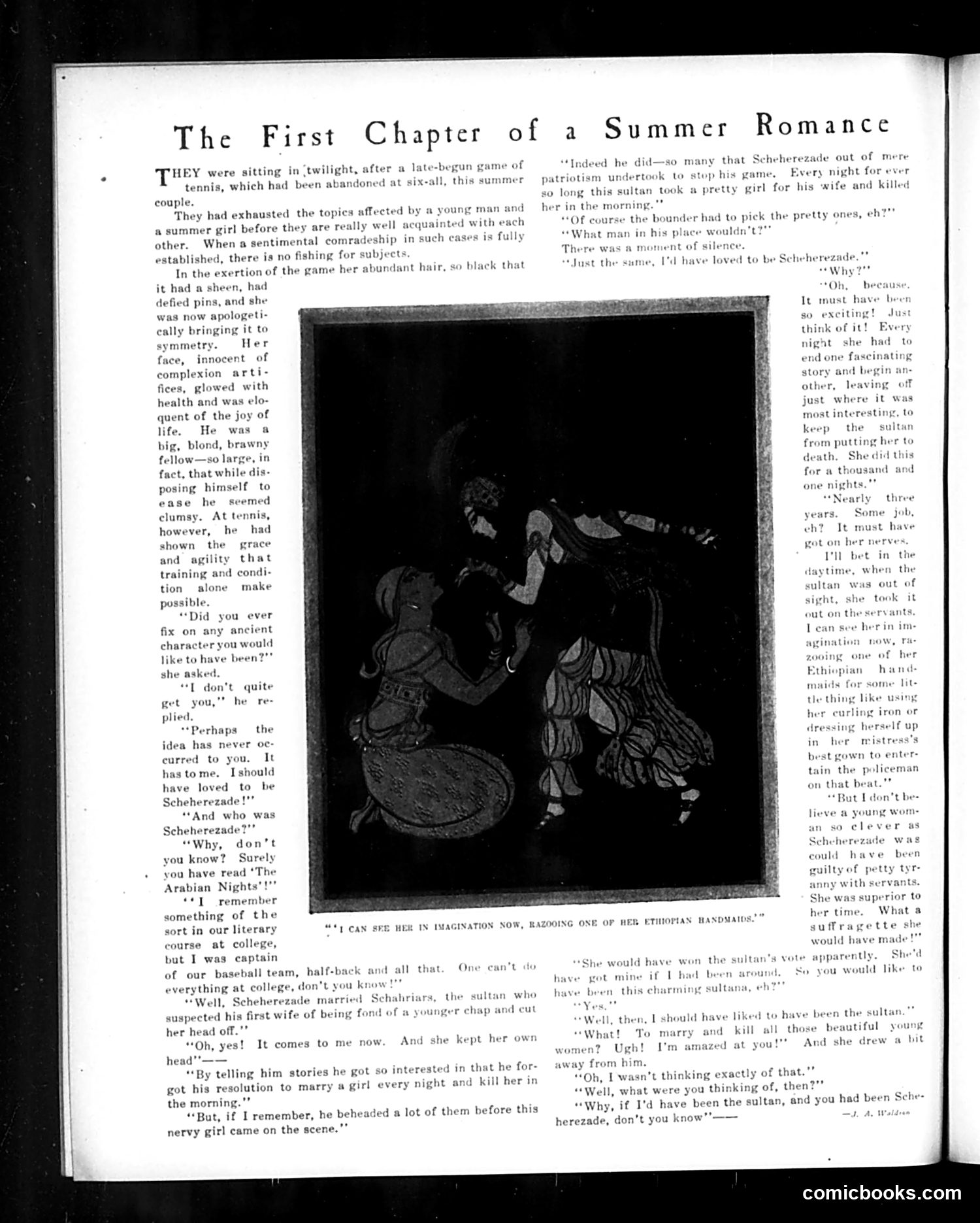
This page contains a serialized short story titled "The First Chapter of a Summer Romance," with an illustration showing figures in what appears to be Oriental dress. The story references **Scheherezade from "The Arabian Nights,"** the legendary queen who kept her husband (the Sultan) from executing her by telling him cliffhanger stories each night for 1,001 nights. The dialogue humorously applies this premise to a modern summer romance: a young man and woman discuss how the sultan was so entertained by Scheherezade's storytelling that he abandoned his habit of marrying and murdering a new wife each day. The joke plays on the contrast between the fantastical Persian tale and contemporary courtship. One speaker calls Scheherezade a "suffragette" (anachronistically)—praising her cleverness in manipulating power through wit rather than direct authority, appealing to Judge magazine's readers familiar with early 20th-century women's rights debates. The illustration depicts the moment referenced in the text: Scheherezade entertaining the Sultan with her stories.
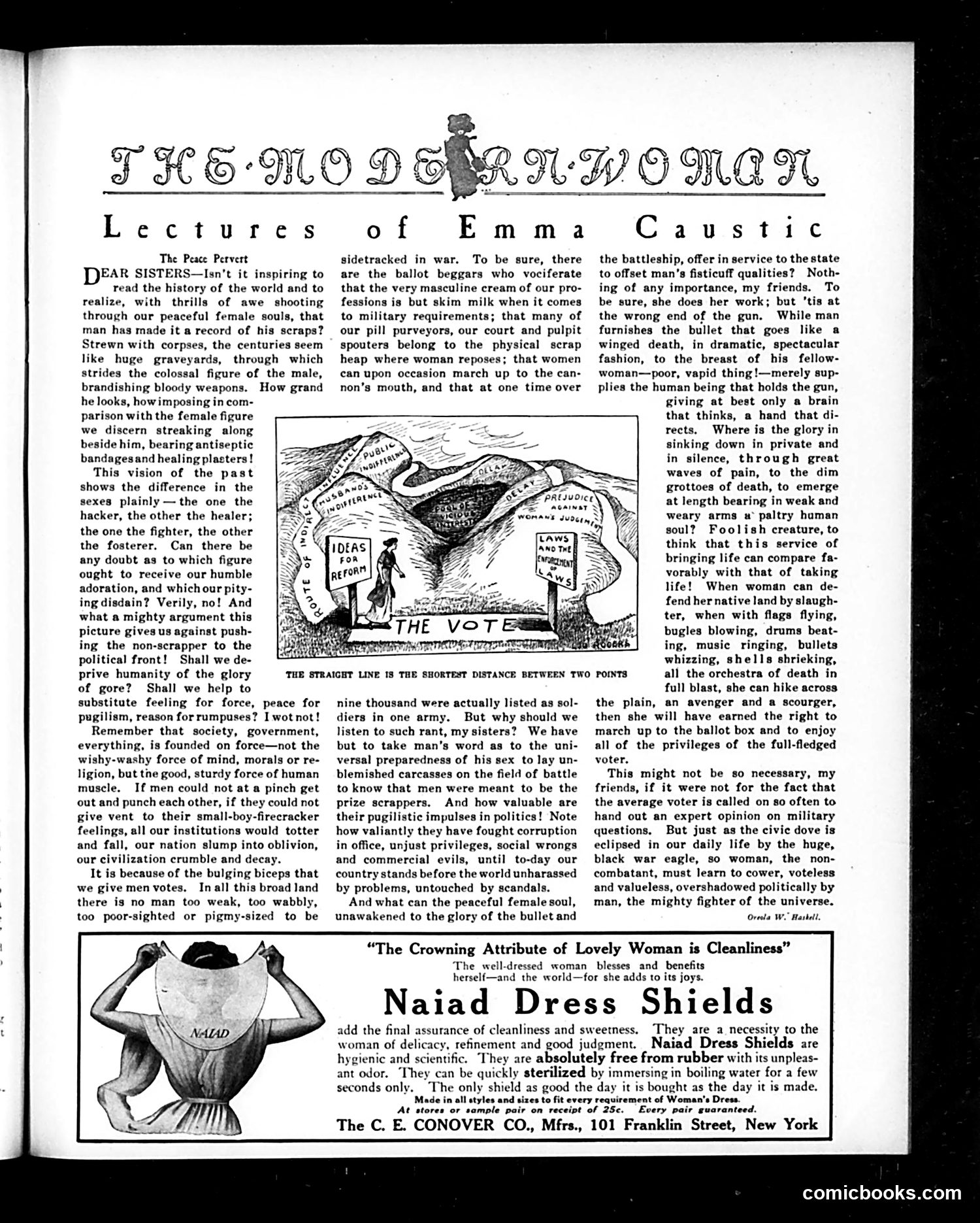
This is a **feminist satire** mocking male arguments against women's suffrage. The fictional lecture by "Emma Caustic" uses **heavy irony** to expose the absurdity of claims that only physical force qualifies one for political power. The cartoon shows a woman at "THE VOTE" standing between two male figures labeled with ideologies (appearing to reference competing political forces), illustrating the suffrage debate. **Key targets:** - Men who justified voting rights based on "muscular strength" and military capability - The notion that women's contributions (healthcare, childbirth—"bearing in weak and weary arms paltry human soul") are inferior to combat - Political hypocrisy: men claim preparedness for battle yet fail to solve corruption and social problems The satire argues: **if force determines citizenship, then women—who literally produce life—deserve rights at least equally.** By praising male "scrapping" while describing childbirth as inglorious, Caustic reveals the logical bankruptcy of excluding women from voting based on physical prowess.
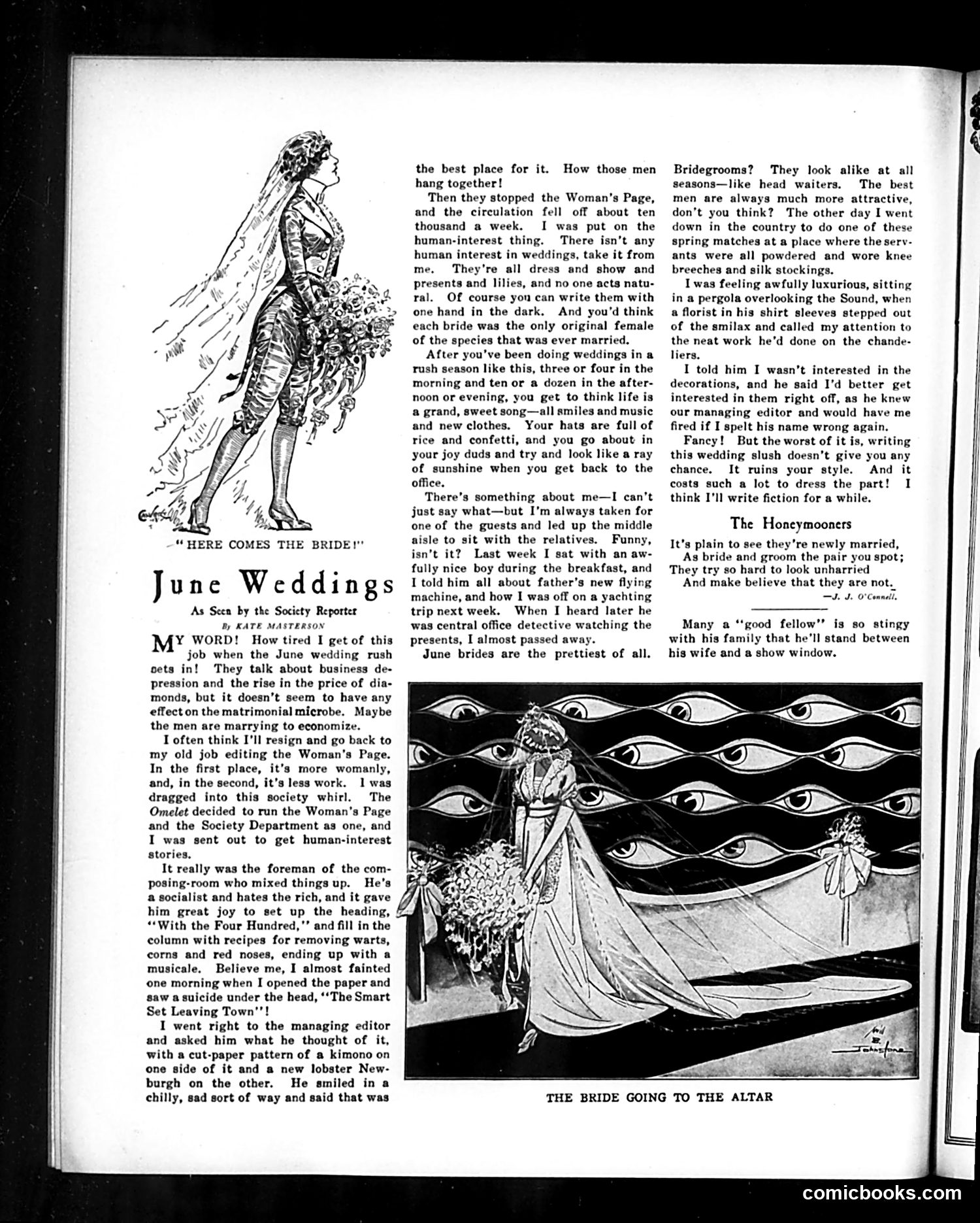
This article by Kate Masterson satirizes the tedious repetitiveness of covering high-society weddings for a magazine's "Woman's Page." The unnamed female narrator—a journalist—complains that June weddings are monotonous, superficial events requiring her to attend multiple ceremonies daily while pretending to enjoy the "dress and show and presents and lilies." The satire targets several elements: the shallow uniformity of wealthy weddings, the absurdity that bridegrooms all resemble "head waiters," and the pretension of high society (servants in knee breeches, pergolas overlooking the Sound). A running joke involves her being mistaken for a guest and seated with relatives. Another mocks how she once invented a fabricated personal life (father's flying machine, yachting trip) to impress a man, only to discover he was a detective monitoring wedding gifts. The piece critiques both the social world being covered and the exhausting, style-deadening work of magazine journalism documenting it.
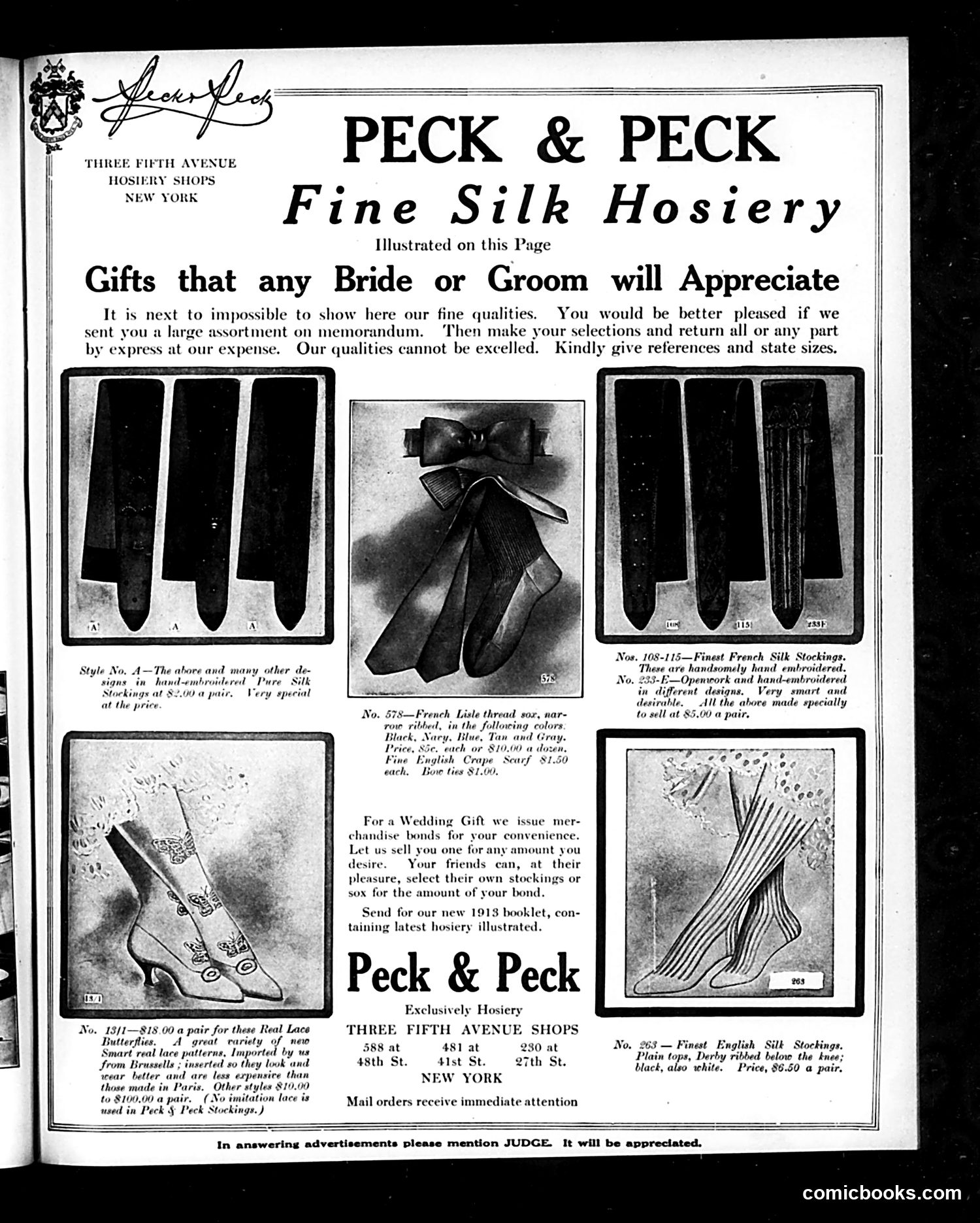
This page is **not a cartoon or satire**—it is a full-page advertisement for Peck & Peck, a high-end hosiery retailer located on Fifth Avenue in New York. The ad promotes fine silk stockings and socks as wedding gifts, featuring photographs of their products (embroidered stockings, lace-detailed hosiery, and formal wear). The text emphasizes quality and exclusivity, noting items range from $2 to $100 per pair. The reference to "1918 booklet" suggests this advertisement dates to around 1918. The ad mentions merchandise bonds as an alternative gifting option, allowing wedding guests to select their preferred hosiery. This appears in *Judge* magazine simply as a paid advertisement targeting the magazine's affluent readership—there is no political or social satire present on this page.
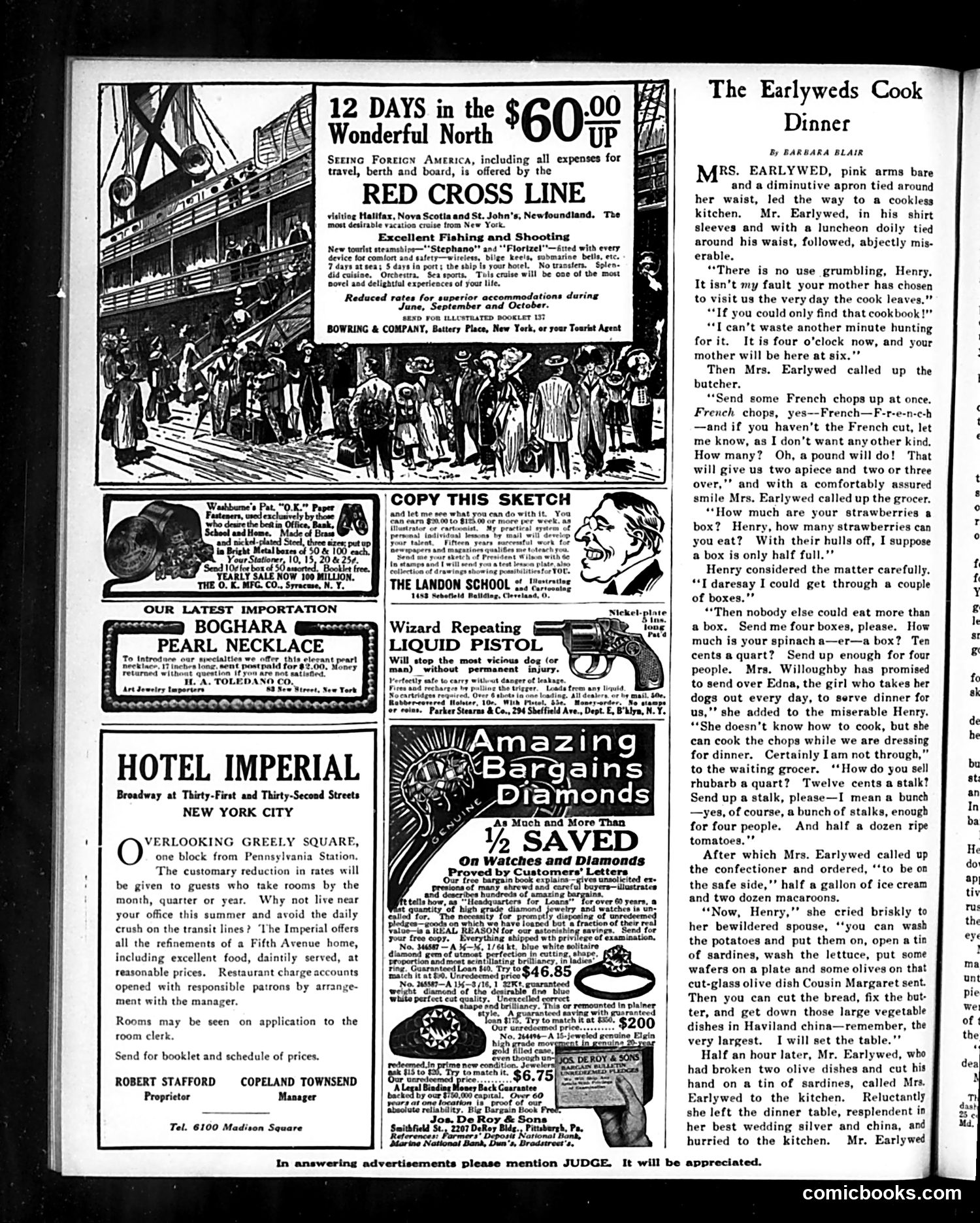
This page is primarily **advertising** with one short comedic story. The main content includes: **"The Earlyweds Cook Dinner"** (right column): A humorous domestic sketch about a young married couple facing a crisis—their cook has quit the day Mrs. Earlywed's mother-in-law visits. The husband is miserable; the wife confidently calls the butcher ordering "French chops" with specific pronunciation, then contacts the grocer. The joke satirizes early-20th-century middle-class domesticity: the couple's pretension to refinement ("French" cuisine), their dependence on servants, and the wife's unflappable competence masking likely improvisation. **Advertisements** dominate: Red Cross Line cruise vacations, Hotel Imperial, Boghara Pearl Necklace, Wizard Repeating Liquid Pistol, and diamond/watch bargains. These reflect 1910s consumer culture targeting affluent readers. The page reflects Judge's audience: prosperous urbanites interested in travel, luxury goods, and domestic comedy.
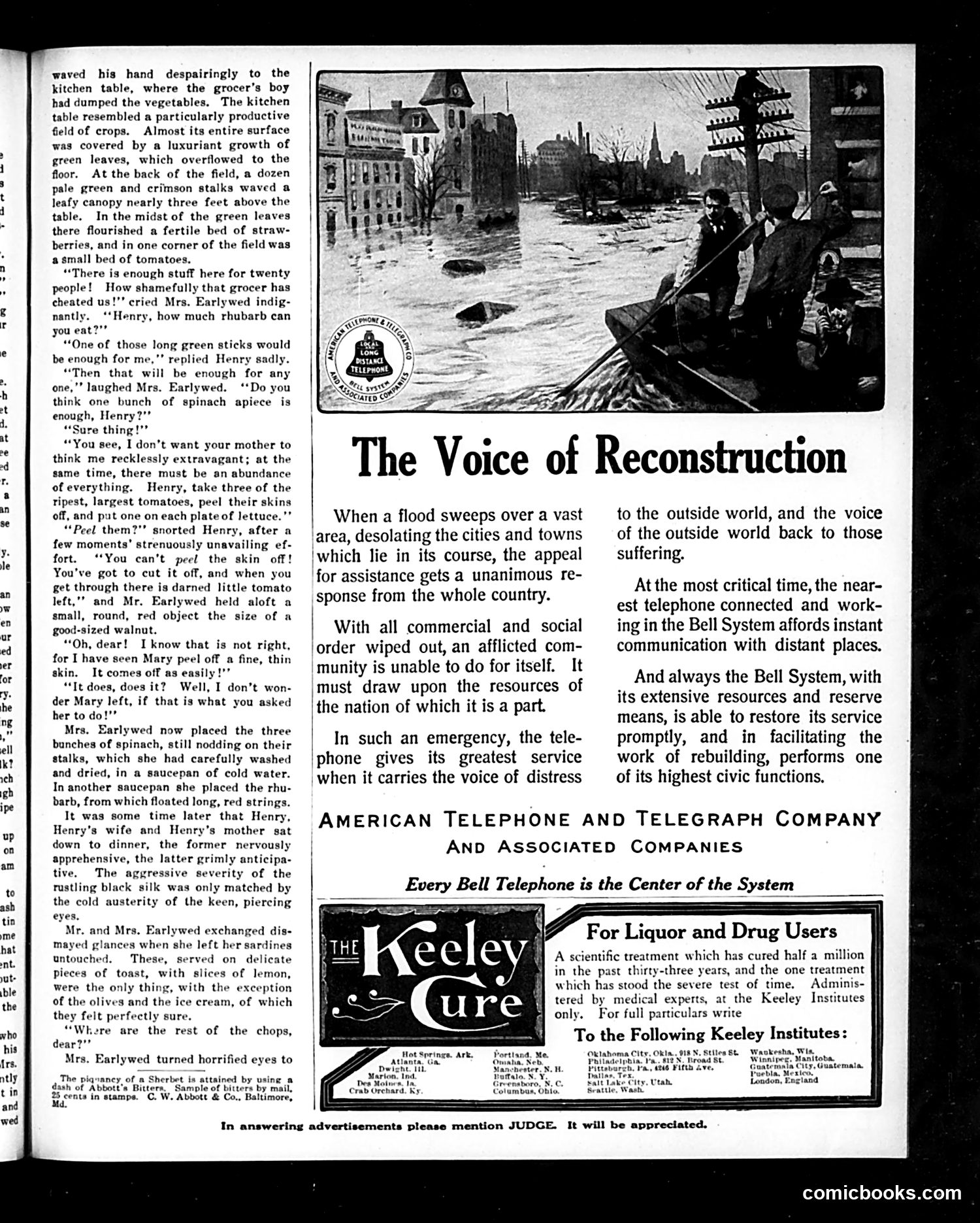
This page contains a domestic humor story about newlyweds Henry and Mrs. Earlywed preparing dinner, likely mocking inexperienced housewives. The narrative satirizes Mrs. Earlywed's confusion about basic cooking—she overbuys vegetables, doesn't know how to properly peel tomatoes, and apparently miscooks spinach and rhubarb. The joke centers on her pretense of domesticity and managing a household while lacking actual competence. Henry's mother appears as the stern, judgmental mother-in-law figure, serving as an audience for the young wife's failures. The page also contains an advertisement for the American Telephone and Telegraph Company framed as "The Voice of Reconstruction," positioning the telephone's utility during disasters. Below that is an ad for the Keeley Institute, a real historical treatment facility for addiction. The domestic humor reflects early 20th-century attitudes about women's "proper" roles in the home, portraying inexperience as comical rather than sympathetic.
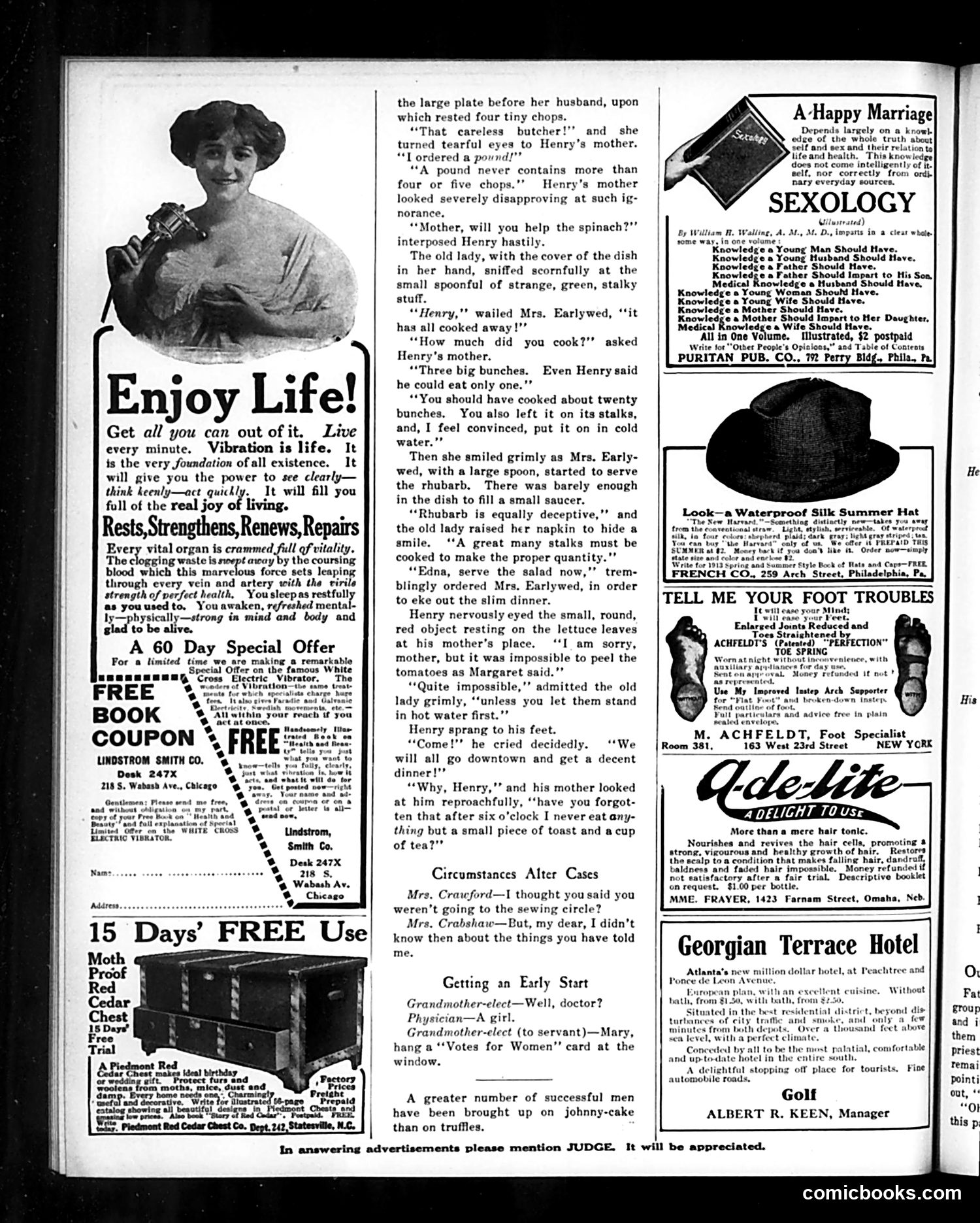
This page primarily contains **domestic humor and period advertisements rather than political satire**. The main illustrated story depicts a common early-20th-century marital scenario: a new bride ("Mrs. Earlywed") fails at cooking because she doesn't understand proper food preparation—her vegetables shrink drastically, her meat portions are inadequate. Her critical mother-in-law corrects her techniques, eventually prompting the husband to take everyone to dinner. **The satire targets**: Female domesticity and the assumption that wives should instinctively know how to cook. The joke mocks both the incompetent new bride and the overbearing mother-in-law who knows "proper" household management. **Period context**: The page includes an advertisement for "Votes for Women" (women's suffrage was a contemporary political issue) and early electric vibrators marketed as health devices—both reflecting early 1900s concerns. The humor reflects anxieties about marriage, gender roles, and women's domestic capabilities typical of this era's popular magazines.
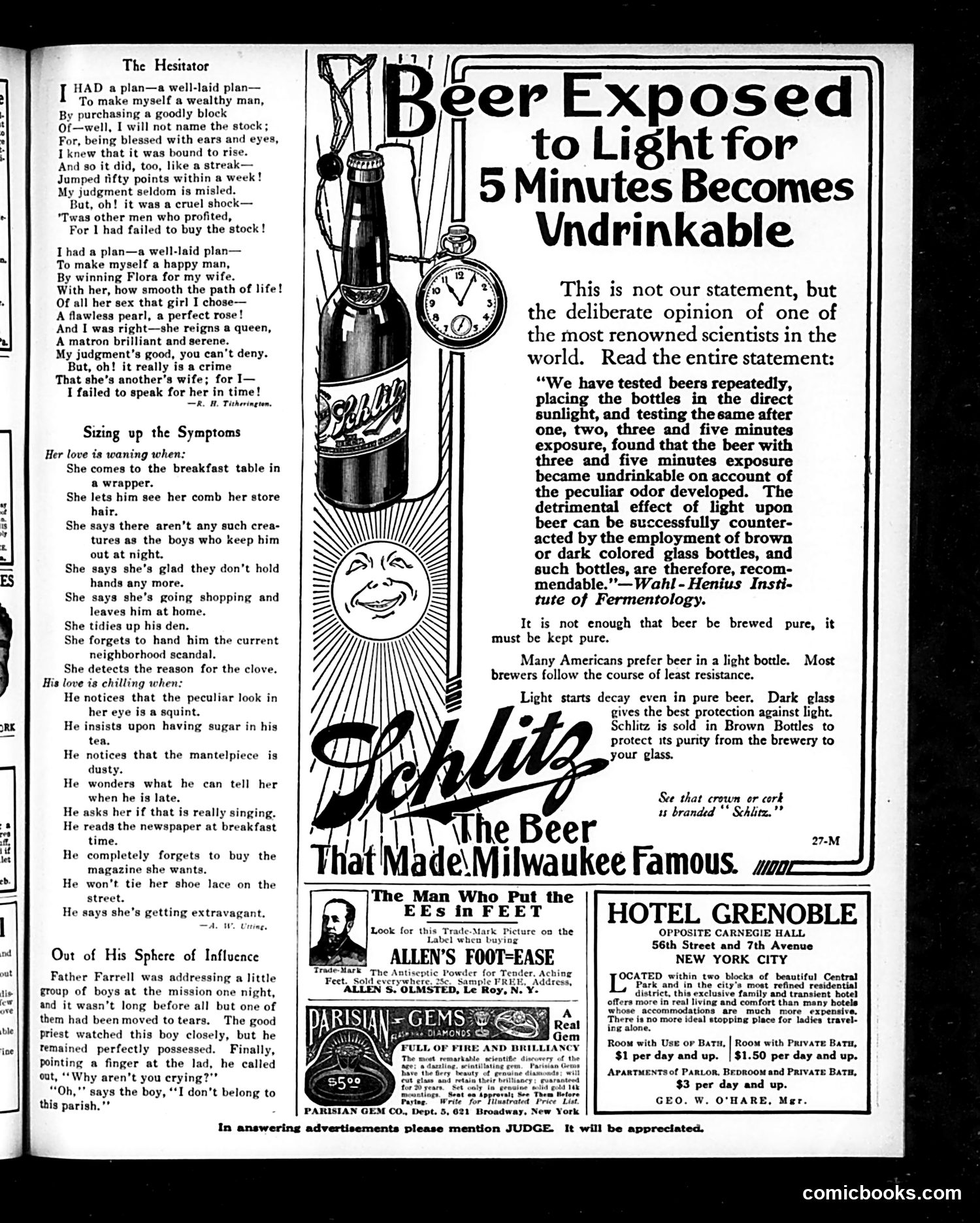
This page contains two separate satirical pieces and advertisements: **"The Hesitator"** (left column): A poem mocking indecisiveness. The narrator describes two missed opportunities—failing to buy profitable stock and failing to propose to a woman named Flora before she married someone else. The satire targets men who hesitate at crucial life moments, then regret it when others benefit. The companion piece "Sizing up the Symptoms" catalogs signs of a woman in love, suggesting the hesitator failed to recognize Flora's interest. **Schlitz Beer Advertisement** (right): Claims that light exposure ruins beer in just five minutes, citing a "renowned scientist." The ad argues brown bottles protect beer's purity—a genuine concern in early 1900s brewing. This isn't satire but period product advertising emphasizing Schlitz's superior packaging. **"Out of His Sphere of Influence"** (bottom left): A brief anecdote about Father Farrell addressing mission boys; the punchline appears cut off. The page also advertises Allen's Foot-Ease powder, Hotel Grenoble, and Parisian Gems jewelry—typical Judge magazine commercial content.
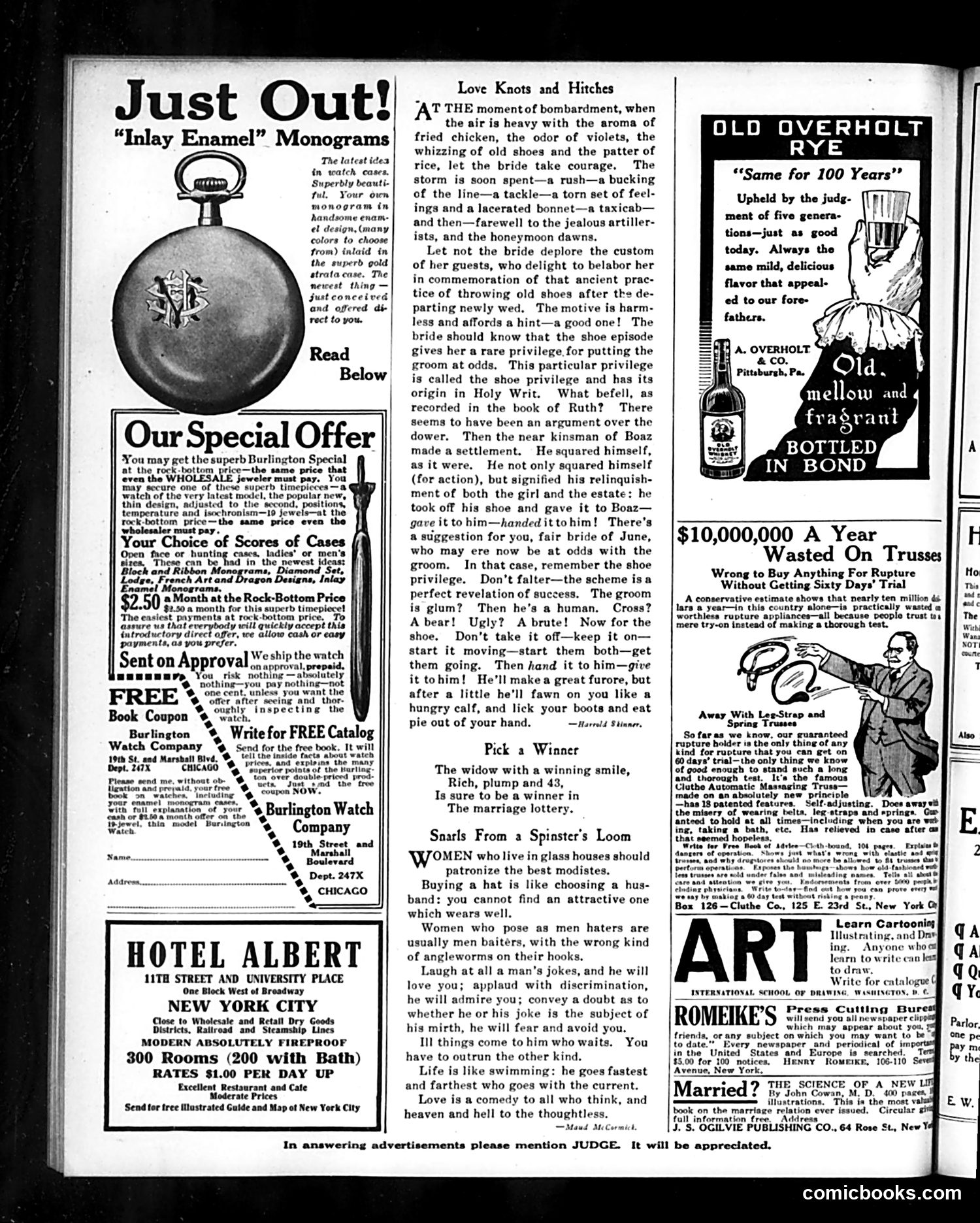
This page is primarily **advertising** with one substantial article about wedding customs. The main editorial content is "Love Knots and Hitches," a humorous piece advising newlyweds (particularly brides) about the tradition of throwing shoes after departing couples. The author, Harold Stinner, argues the custom is harmless and traces its origin to the Book of Ruth, where a kinsman removed his shoe to signify a legal transaction. The satirical advice suggests brides can use the "shoe privilege" to manage difficult grooms—literally throw a shoe at an irritable groom and he'll become docile ("fawn on you like a hungry calf"). The joke relies on early-20th-century gender dynamics and marital expectations, presenting matrimonial conflict with humorous inevitability while offering absurd "biblical" justification for domestic shoe-throwing. The remainder consists of advertisements: Burlington Watch Company (with approval coupon), Hotel Albert in NYC, Old Overholt Rye whiskey, and various other products. No political cartoons appear on this page.
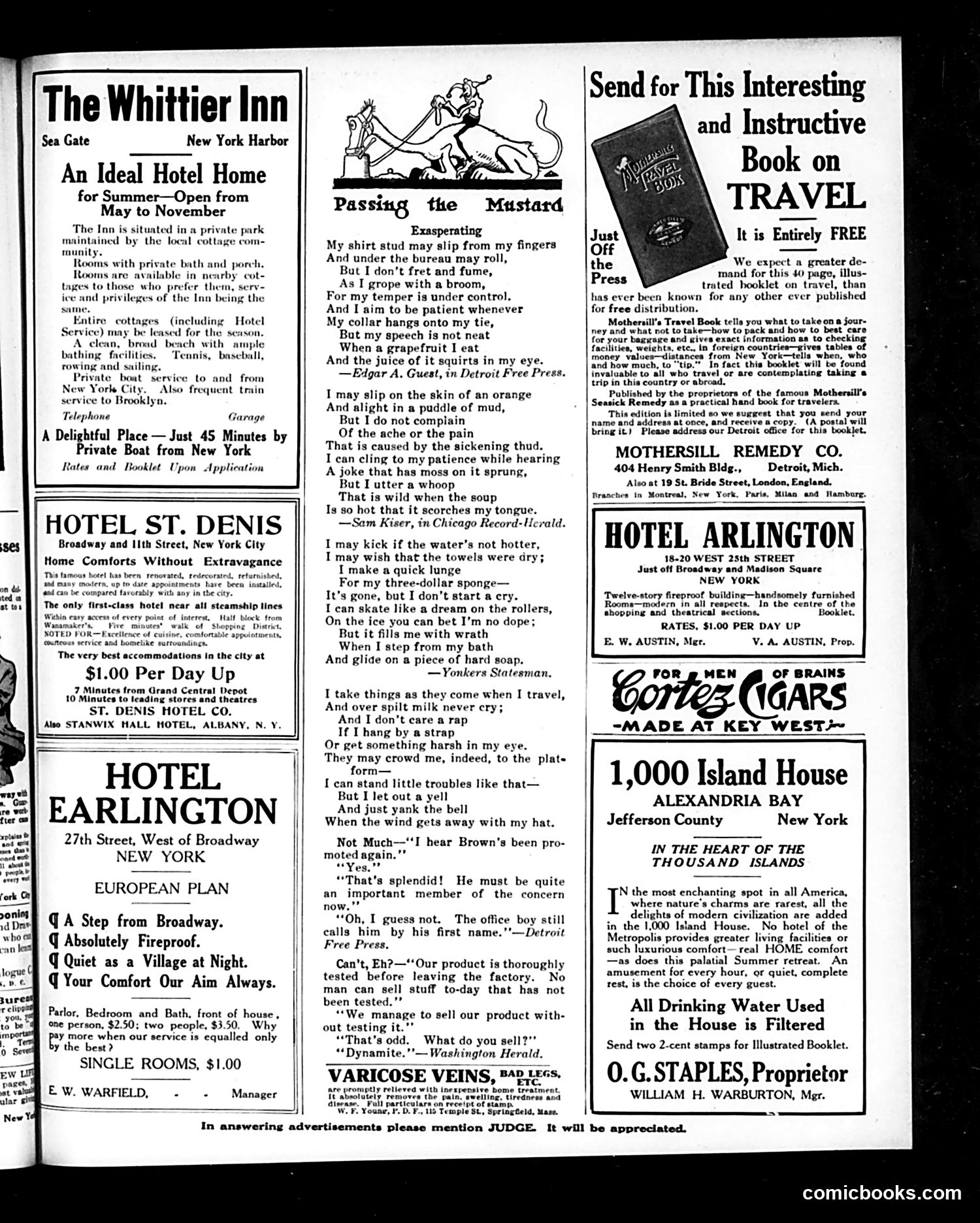
This page is primarily **advertising and light humor**, not political satire. The central cartoon "Passing the Mustard" features a humorous illustration of a figure (appears to be a demon or imp) and relates to the accompanying poetry below it. The poem and those that follow are humorous verses about everyday irritations—spilled condiments, grapefruit juice in the eye, slipping on soap—contrasting with the speaker's claim of patience. The joke is ironic: he claims composure during major troubles but loses his temper over minor annoyances. The remaining content consists entirely of **hotel advertisements** (The Whittier Inn, Hotel St. Denis, Hotel Arlington, Hotel Earlington) and product ads (Cortez Cigars, Mothersill's Travel Book, Varicose Veins remedy, 1,000 Island House resort). There is **no political commentary or social satire** on this page—it represents Judge magazine's reliance on advertising revenue and lighthearted, domestic humor rather than the satirical commentary the publication was known for.
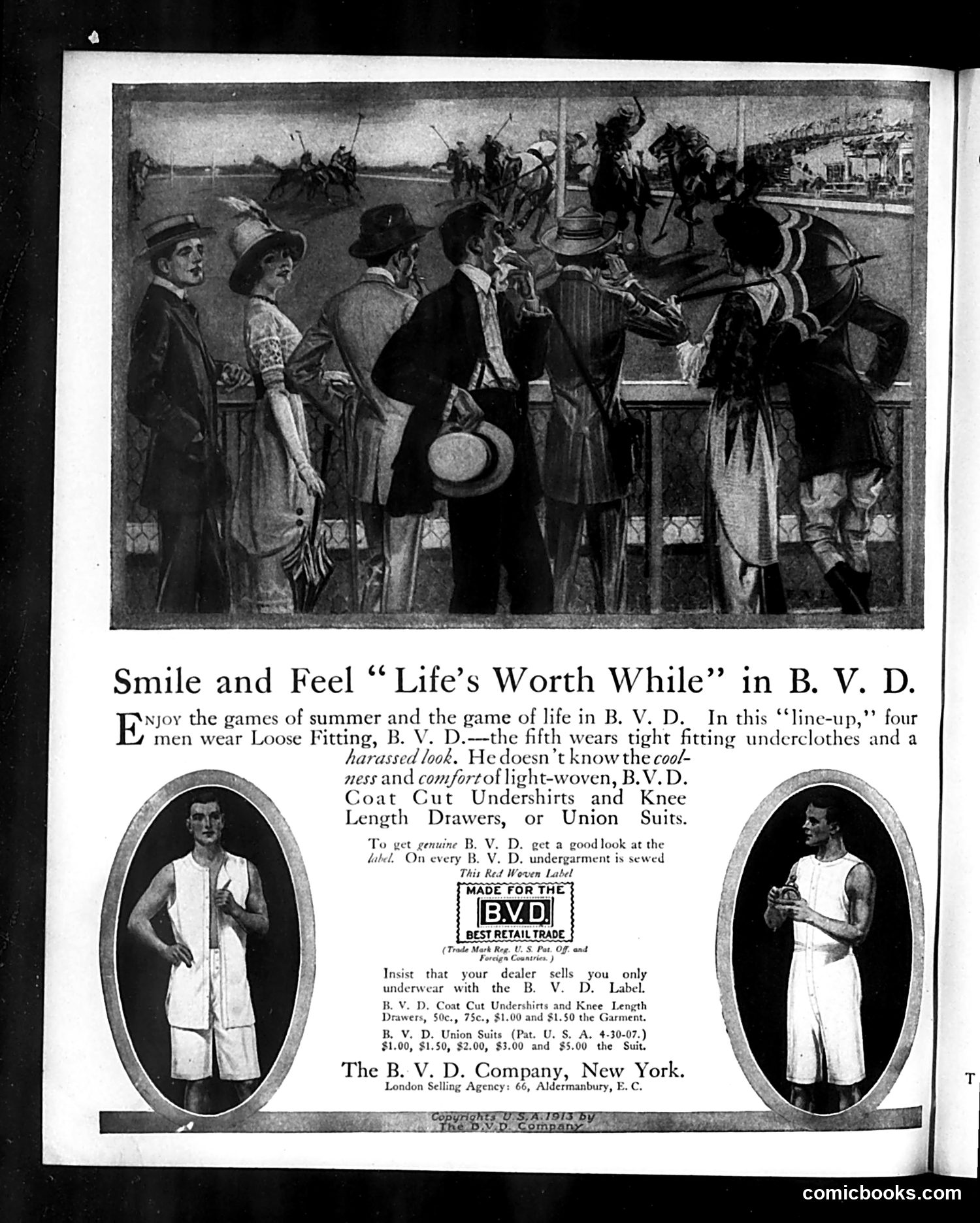
This is primarily a **commercial advertisement**, not political satire. The "cartoon" at the top depicts five men at what appears to be a sporting event or leisure activity. Four wear B.V.D. brand underwear and appear comfortable and happy; the fifth wears a competitor's tight-fitting undergarment and looks visibly distressed ("harassed look"). The joke is straightforward product comparison: loose-fitting B.V.D. underwear makes you comfortable and lets you enjoy life ("Life's Worth While"), while inferior competitors leave you uncomfortable and miserable. The text emphasizes the B.V.D. brand label as a guarantee of quality and urges consumers to specifically request it from retailers. Pricing is listed for various styles. This represents early 20th-century advertising strategy: using humor and social scenarios to promote brand loyalty and differentiate products in an emerging consumer marketplace.