
A complete issue · 24 pages · 1913
Judge — March 15, 1913
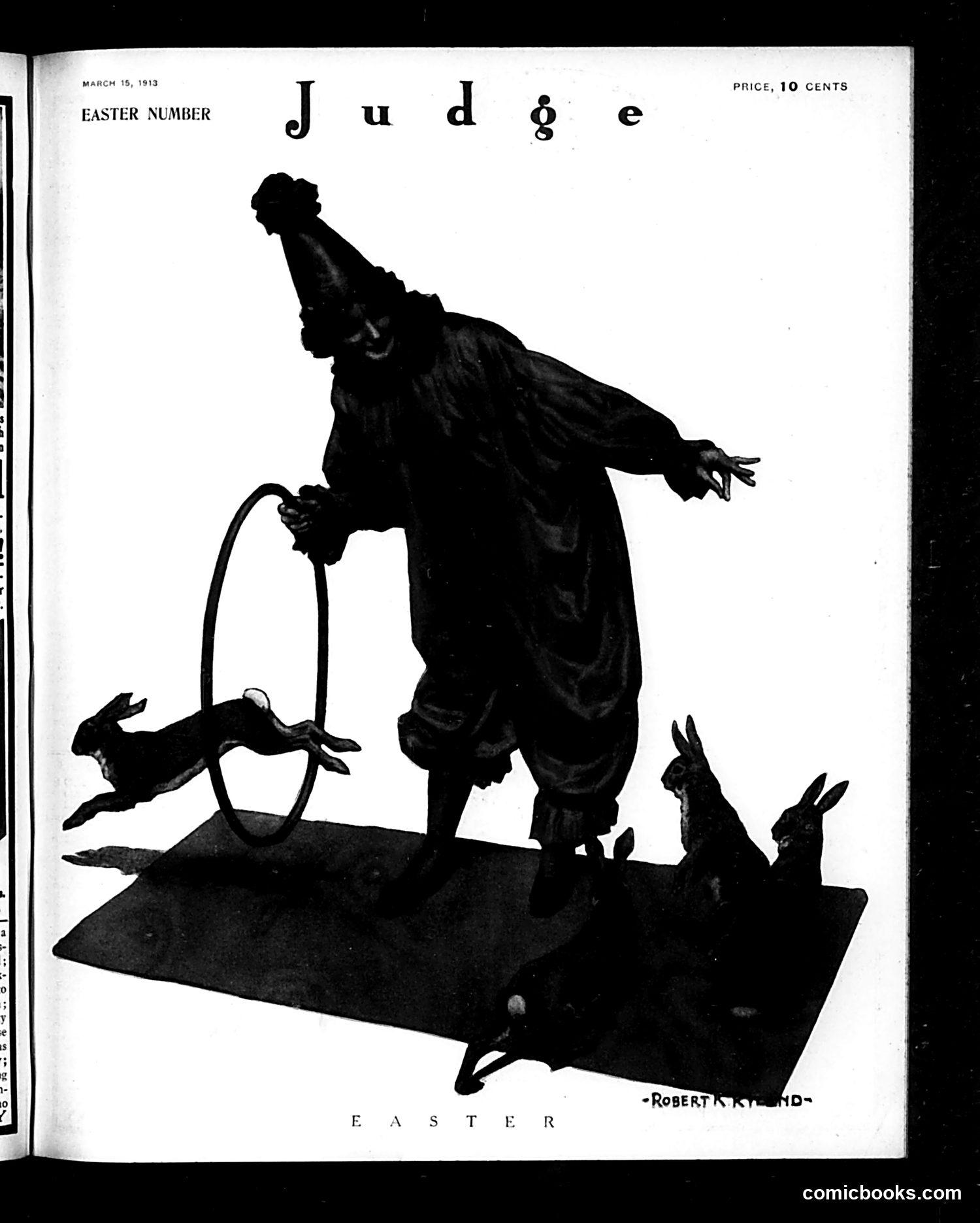
This silhouette illustration by Robert Kiemond depicts an Easter-themed scene with a clown or jester figure juggling a hoop while surrounded by rabbits. The central figure appears to be a performer or entertainer managing multiple rabbits—creatures traditionally associated with Easter. The cartoon likely satirizes themes of chaos, control, or incompetence in managing multiple responsibilities simultaneously. The juggling motion and numerous rabbits suggest difficulty maintaining order. Without additional text context, the specific political target remains unclear, though Judge magazine typically mocked politicians, social figures, and contemporary follies. The silhouette style was popular for Easter covers during this era, combining festive imagery with satirical commentary typical of the publication's approach.
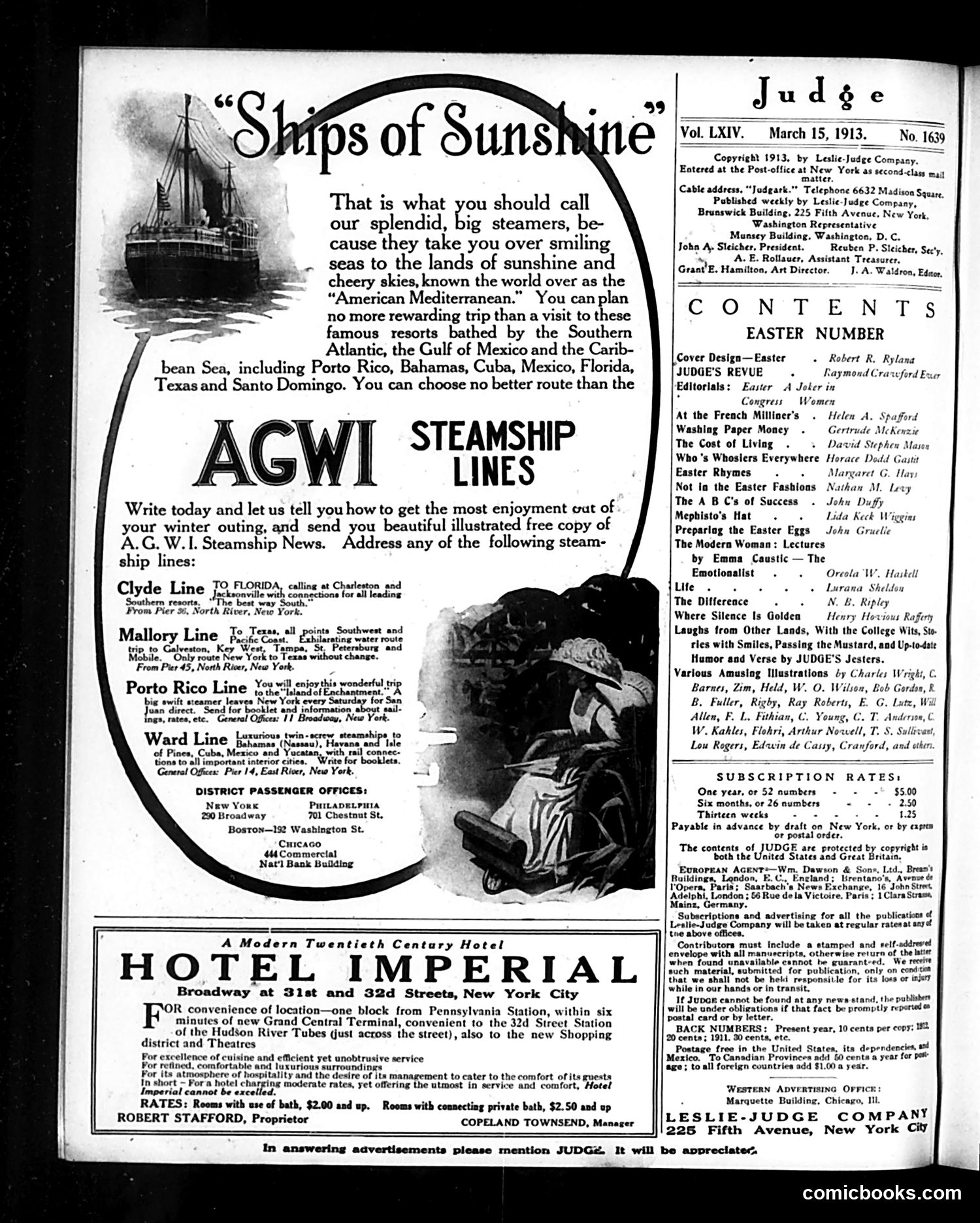
This page is predominantly **advertising** rather than editorial content or political satire. The main visual elements are: - A large advertisement for **AGWI Steamship Lines**, featuring a ship illustration and promoting leisure cruises to Caribbean and Southern U.S. destinations - A secondary advertisement for the **Hotel Imperial** in New York City The right column contains a table of contents for an "Easter Number" issue, listing various article titles and authors, but no visible political cartoons or satirical commentary requiring historical context. The only potentially satirical element is the magazine's masthead design, but the page itself functions primarily as a commercial vehicle for travel and hospitality advertisements typical of early 20th-century publications.
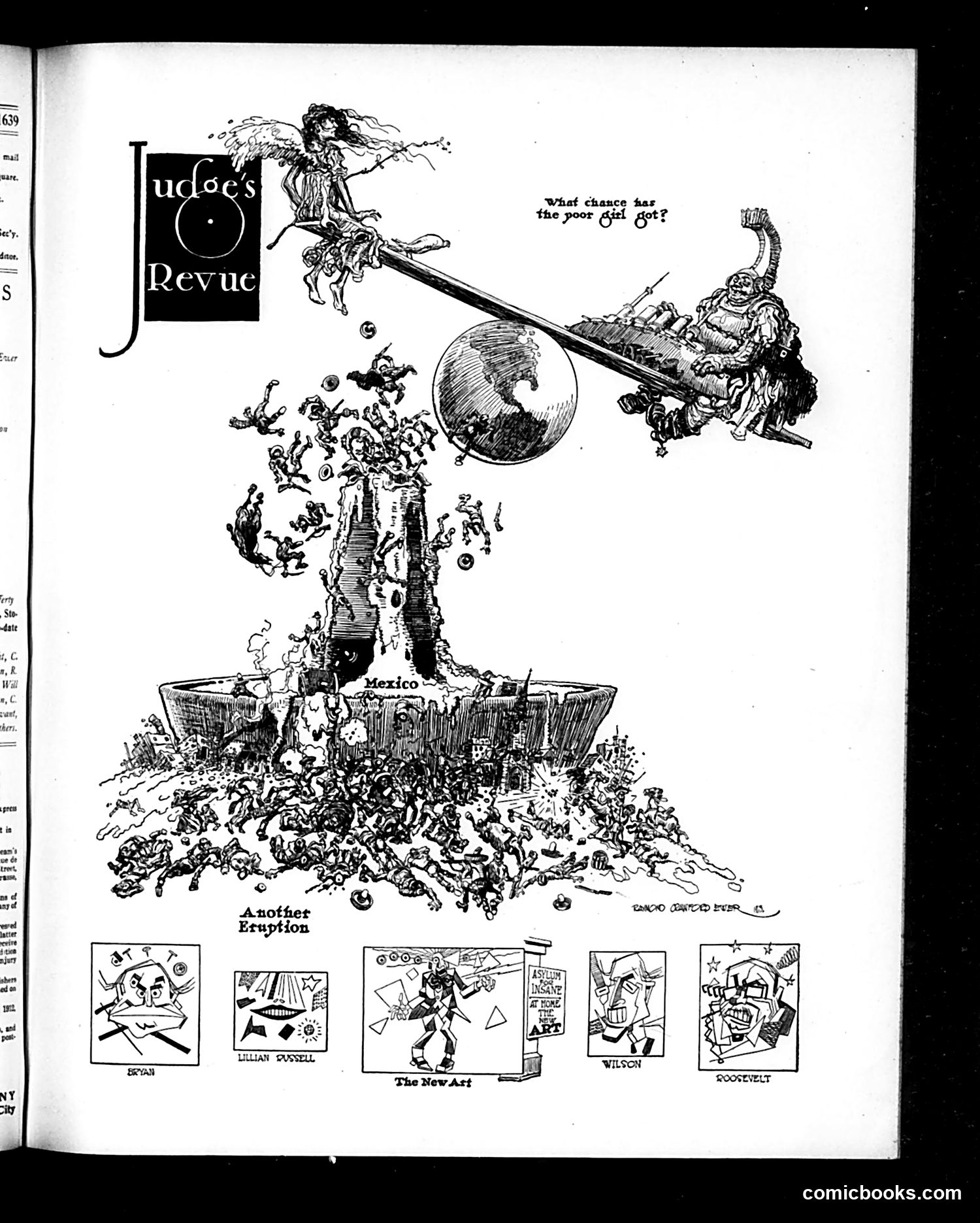
This Judge magazine page satirizes political turmoil in Mexico through volcanic imagery. A tower labeled "Mexico" erupts violently, spewing chaos and political figures skyward. At the top, a devil-like figure operates a seesaw/lever, asking "What chance has the poor girl got?"—personifying Mexico as a victim of political upheaval. The central sphere appears to represent the globe or Mexican stability being destabilized. Below, "Another Eruption" labels the catastrophic scene, with masses of turbulent figures representing Mexican political instability. The smaller cartoons at bottom (credited to various artists including Cesare, Lillian Russell, and Wilson) appear to be separate satirical sketches, likely commenting on contemporary American cultural and political figures. The overall message criticizes Mexico's chronic political instability as destructive chaos.
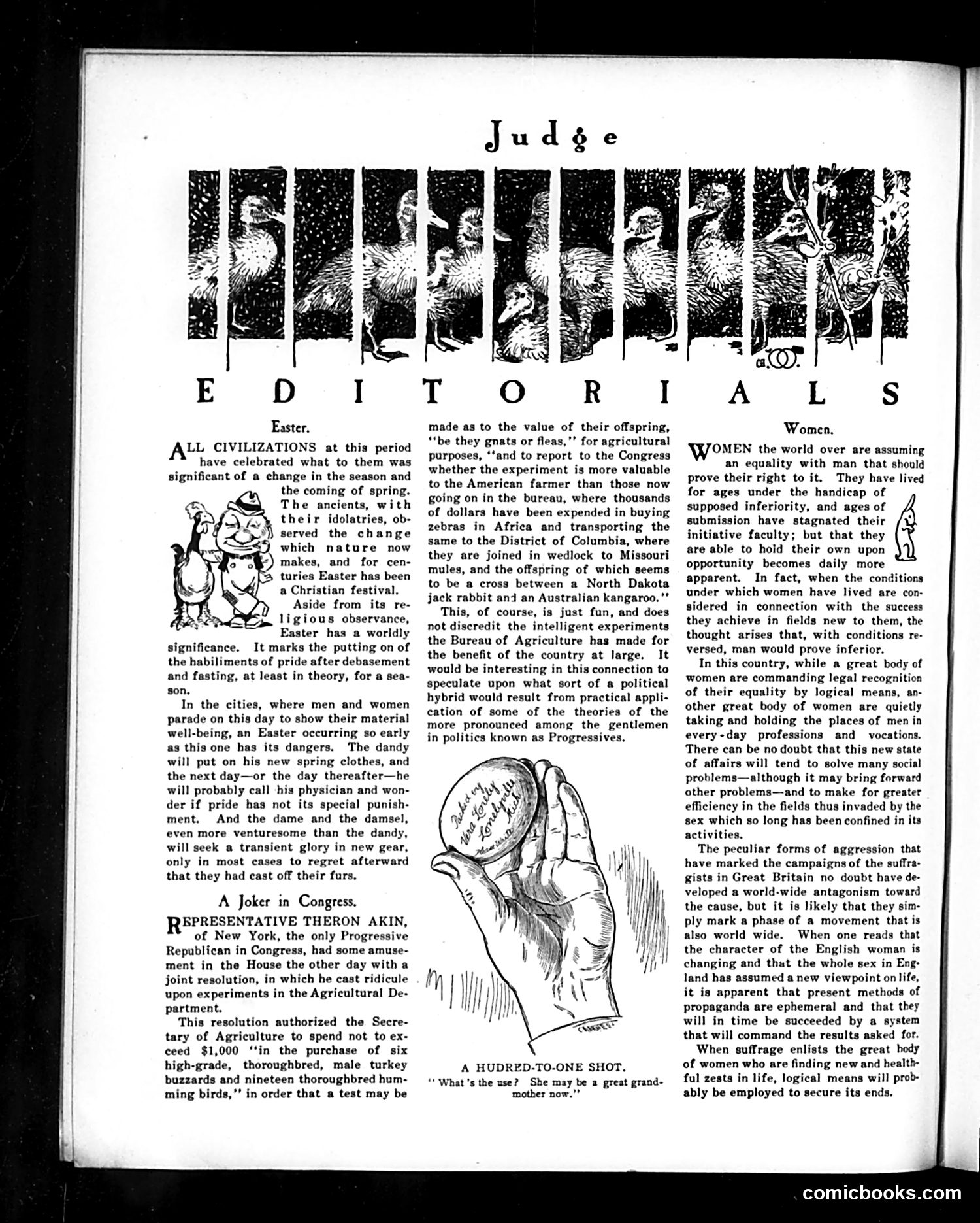
This page contains three editorial sections rather than traditional cartoons. **"Easter"** satirizes wealthy Easter parade culture, mocking how the season's religious significance has been overshadowed by ostentatious fashion displays. The text notes that city dwellers prioritize new clothing over spiritual observance. **"A Joker in Congress"** criticizes Representative Theron Akin (Republican, New York) for proposing an absurd agricultural experiment: spending $1,000 on breeding turkeys and hummingbirds. The satire suggests this represents wasteful government spending and legislative incompetence. **"Women"** discusses women's expanding role in society and professions, advocating for equality while acknowledging resistance. It references the suffrage movement and argues women's participation will solve social problems more effectively than past exclusion. The hand illustration labeled "A Hundred-to-One Shot" appears to accompany a separate joke about pregnancy odds.
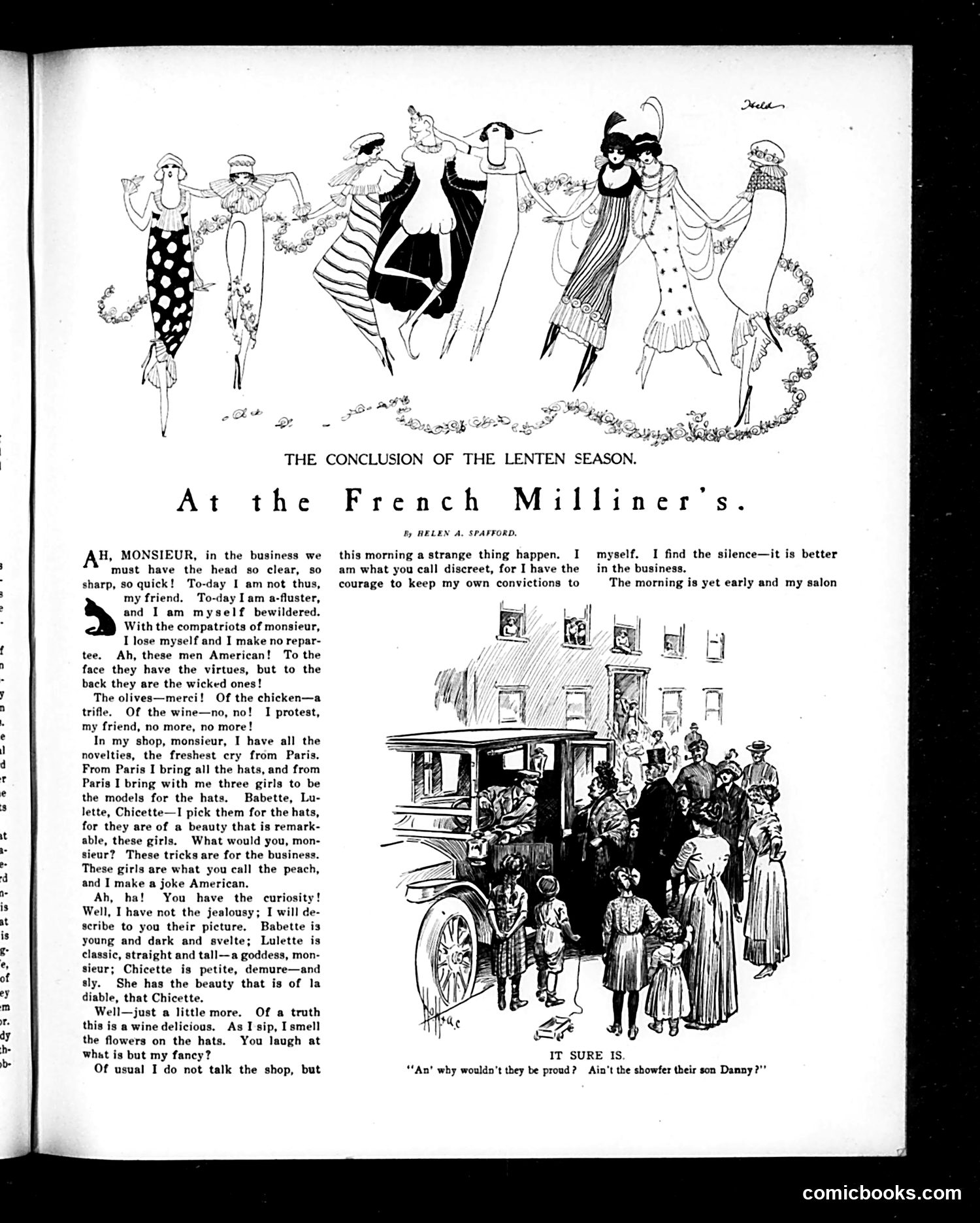
This satirical piece by Helen A. Stafford mocks American attitudes toward French fashion and culture during the post-Lenten season. The top illustration shows fashionably dressed women celebrating the end of Lenten restrictions. The main cartoon depicts a French milliner (hat-maker) boasting to a male customer about his models—young women named Babette, Lucette, and Chicette—who display hats for sale. The satire targets American snobbery: wealthy Americans eagerly purchase French fashions and employ French models, viewing them as inherently superior and exotic, while the milliner cynically exploits this cultural infatuation. The joke's punchline—"Ain't the shower their son Danny?"—suggests the models may not be authentically French, undermining the pretentious assumptions of American customers.
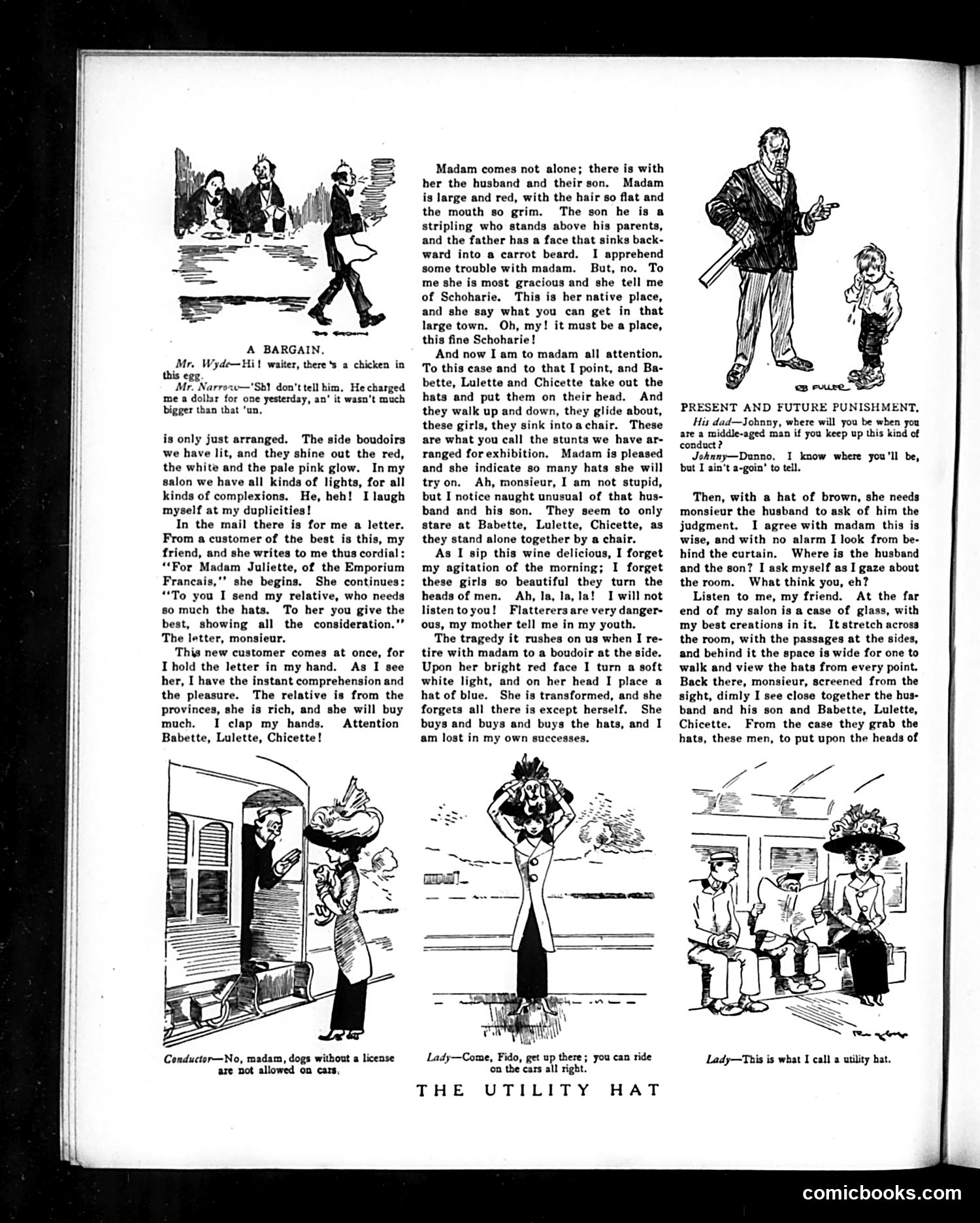
This page satirizes the fashion industry and male behavior through interconnected stories. The main narrative follows a French hat-shop proprietor (Monsieur) who employs attractive salesgirls (Babette, Lulette, Chicette) as exhibition "stunts" to sell hats. When a provincial family visits, the husband and son become distracted by the young women rather than the merchandise—revealing how retailers exploit female attractiveness for sales. The sidebar cartoons mock related absurdities: a restaurant dispute over tiny chicken portions ("A Bargain"), a conductor enforcing dog licensing rules, and a mother questioning her son's future behavior—all capturing early 20th-century social anxieties about commerce, propriety, and propriety. The satire critiques both manipulative retail tactics and male susceptibility to distraction, while the "utility hat" title suggests practical versus ornamental value.
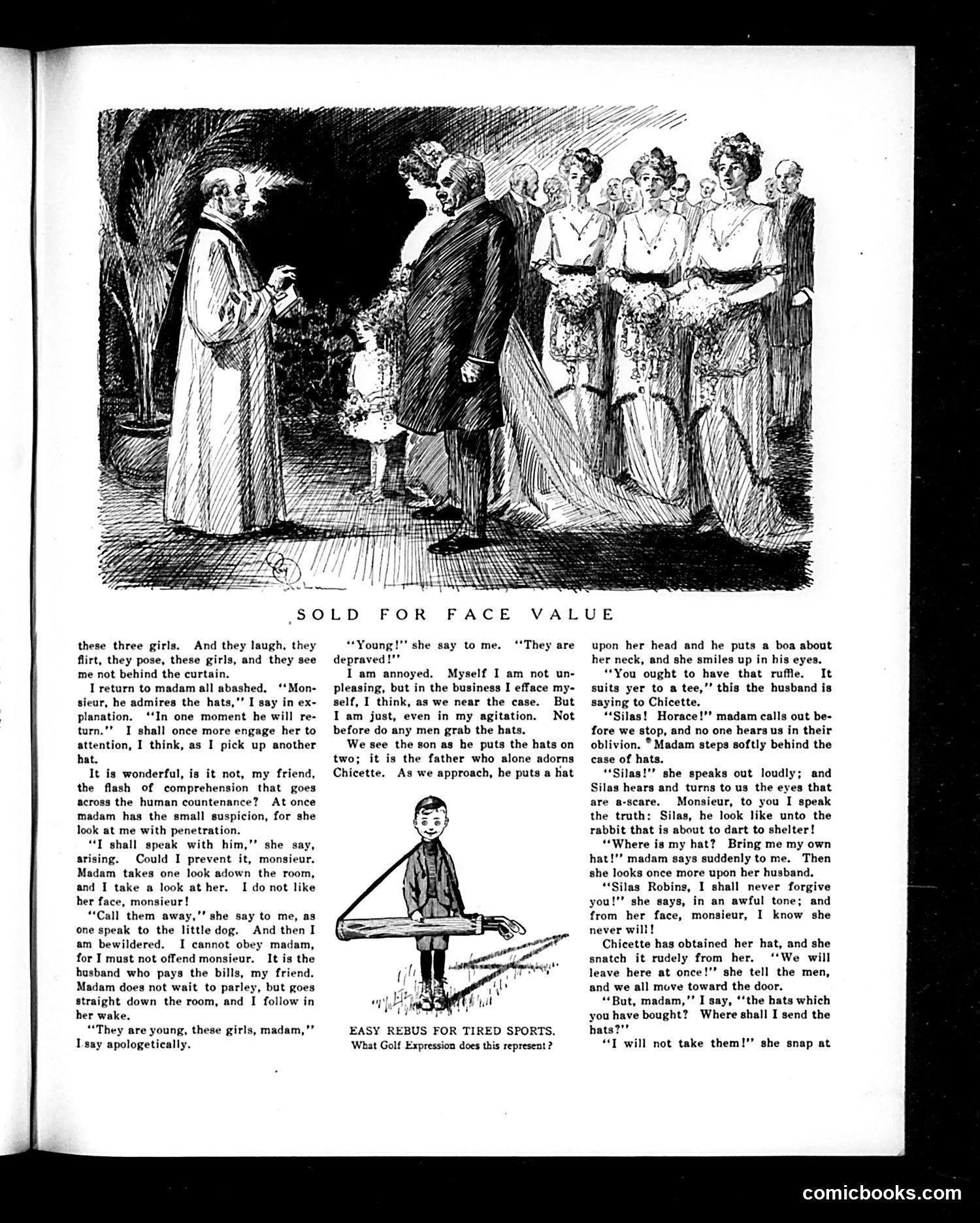
This is a satirical short story (not a political cartoon) about marital infidelity disguised as a hat-shop anecdote. The narrator, a French hat salesman, witnesses a husband (Silas Robins) flirting with a young woman customer (Chicette) while his wife shops. The wife grows suspicious, confronts the pair, and catches her husband complimenting Chicette—"It suits yer to a tee" (a double entendre). Enraged, the wife refuses to purchase the hats and storms out. The satire targets two things: the hypocrisy of respectable society (husbands conducting affairs in public), and the powerlessness of service workers caught between quarreling customers. The title's irony suggests marriages, like hats, are valued by surface appearance rather than genuine worth. The small illustration shows the embarrassed moment of discovery.
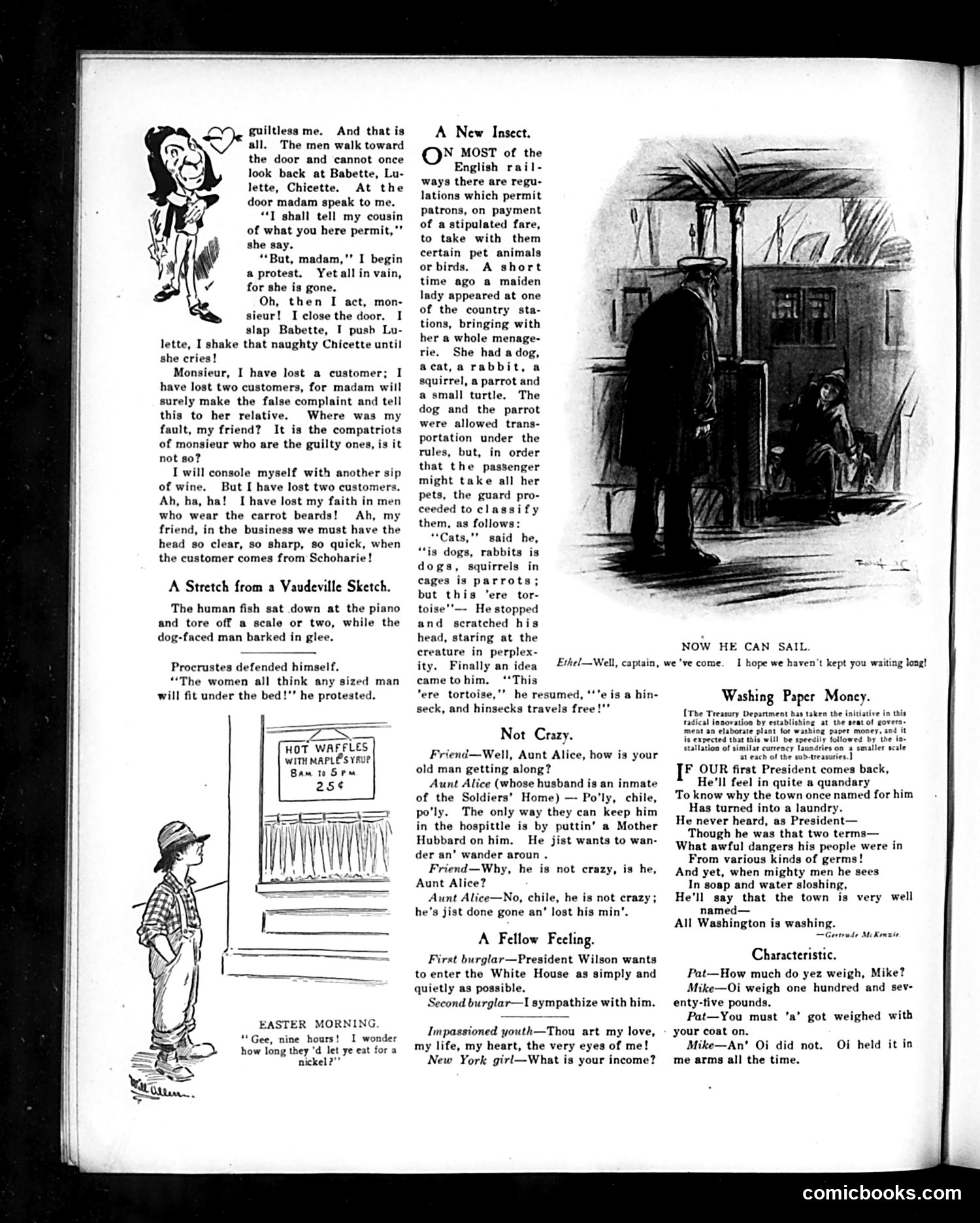
This page from *Judge* magazine contains several satirical pieces reflecting early 20th-century American concerns: **"A New Insect"** mocks British railway regulations. A train guard must classify a woman's menagerie of pets. When encountering a tortoise, he struggles—declaring it an "insect" that travels free. The satire targets bureaucratic absurdity and rigid rule-application. **"Wasting Paper Money"** references President Wilson and a laundry named "Washington." The joke: if Washington returned, he'd be confused that his namesake city now primarily washes clothes (likely alluding to literal laundries or perhaps government inefficiency). It plays on the contrast between the founding president's legacy and modern commercial mundanity. **Minor sketches** include vaudeville humor, jokes about elderly soldiers' homes, and Irish dialect humor ("Pat" and "Mike"), typical period comedy relying on ethnic stereotypes. The overall tone reflects pre-WWI American satirical humor—mocking bureaucracy, poking fun at political figures, and employing now-dated comedic conventions.
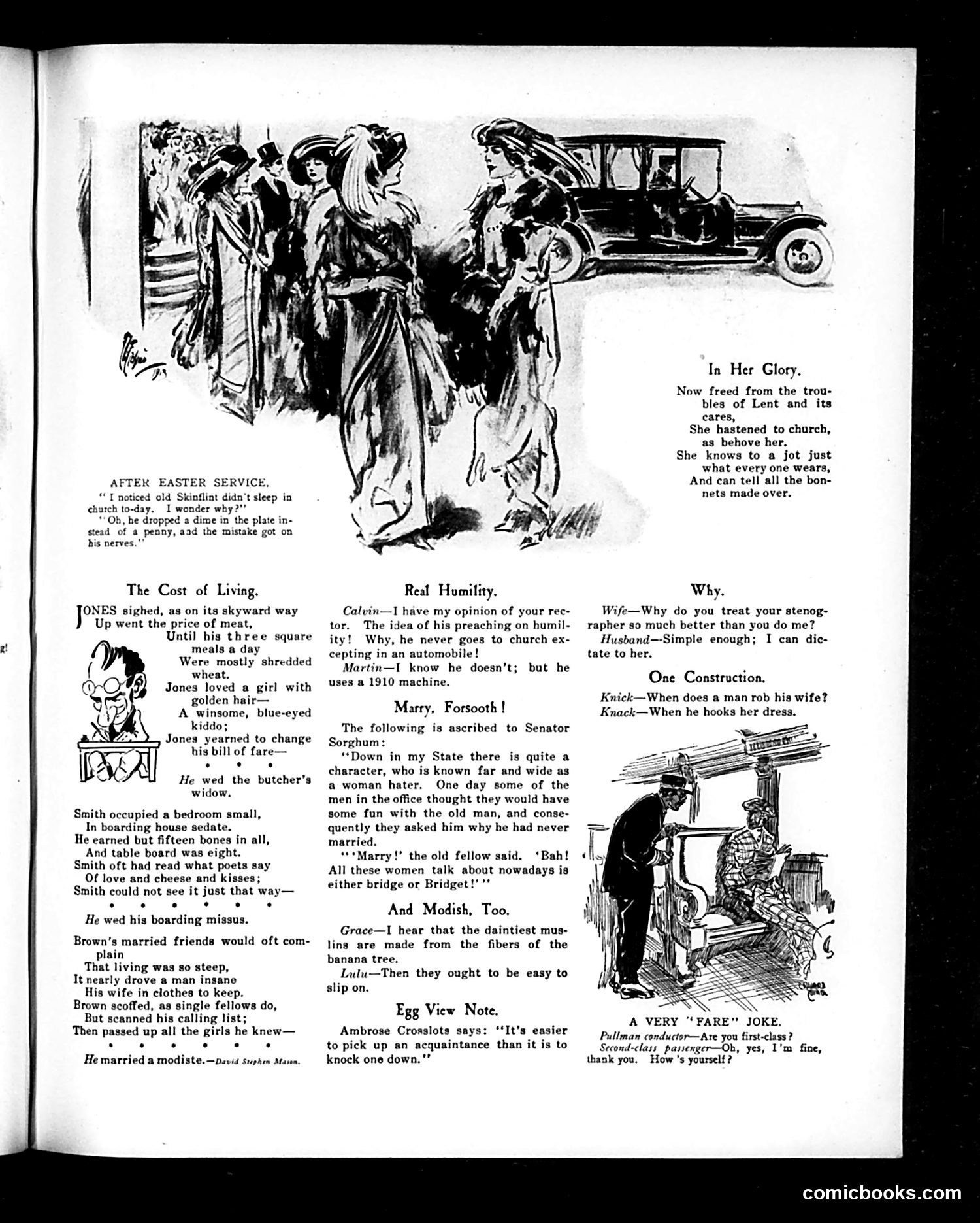
This page from *Judge* contains multiple short humorous pieces satirizing early 20th-century American social anxieties, particularly around **rising costs of living and courtship**. The dominant theme is economic desperation driving unlikely marriages: Jones marries a butcher's widow to afford meat; Smith weds his boarding-house landlady due to poverty; Brown marries a modiste (dressmaker) to manage clothing expenses. These jokes mock how financial pressure forces men into marriages of convenience rather than romance. Other pieces target **hypocrisy and class pretension**: a miserly churchgoer's nerves are rattled by accidentally donating a dime; a rector preaches humility while arriving by automobile (a luxury item in 1910). The "Real Humility" and "Marry, Forsooth!" sections reference Senator Sorghum (likely a fictional character representing rural/conservative politicians) and mock women's interests (bridge, fashion, bonnets). The illustration at top shows fashionable women and an automobile, supporting the theme of modern consumerism and its financial burdens on ordinary men.
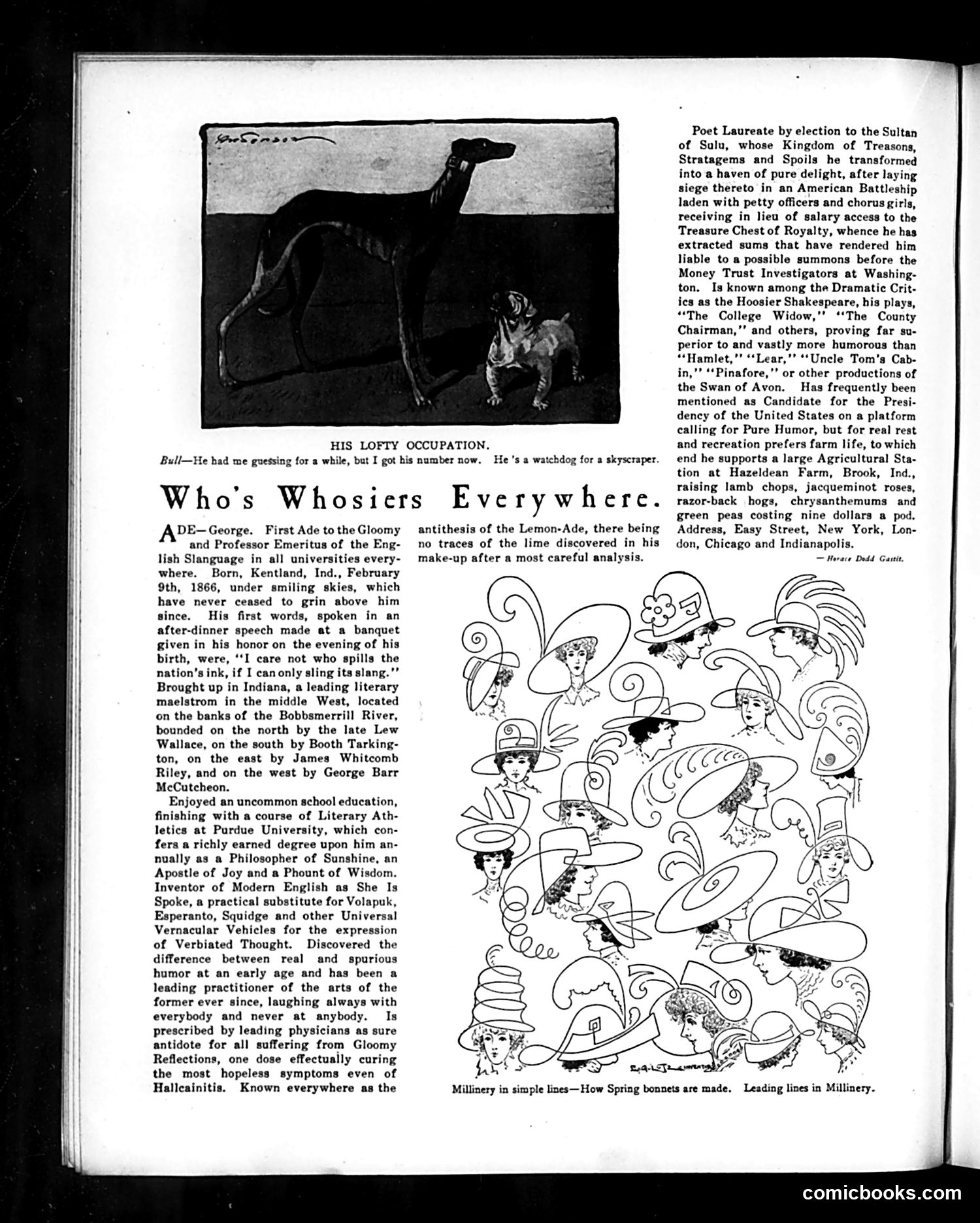
**Top Image: "His Lofty Occupation"** A satirical cartoon showing a tall greyhound-type dog standing on hind legs next to a small bulldog. The caption indicates the tall dog is a "watchdog for a skyscraper" while the smaller dog "guessed for a while, but I got his number now." This is visual humor about size disparity and job fitness—mocking the idea of an absurdly oversized creature performing a task requiring different proportions. **"Who's Whosiers Everywhere"** This section profiles a character named Ade-George, described as an early literary figure who pioneered English slang across universities. It's biographical satire celebrating (possibly mockingly) someone who influenced cultural language and style. **Lower Image: Millinery Illustration** A decorative illustration showing elaborately hatted women in spring fashions, with the caption "Millinery in simple lines—How Spring bonnets are made. Leading lines in Millinery." This is fashion satire about ornately decorated hats marketed as "simple."
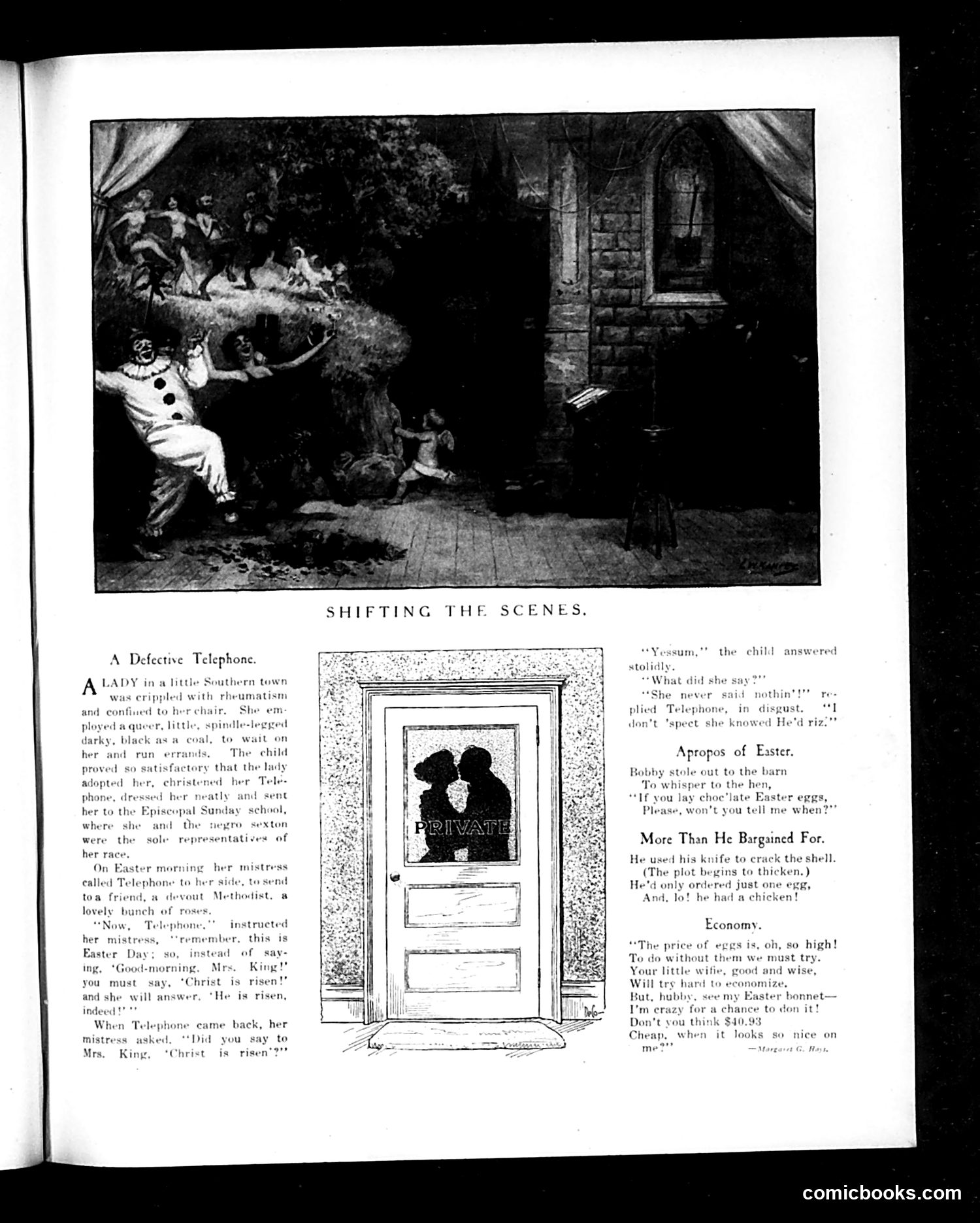
This page contains three separate humorous sketches from the early 20th century, all centered on Easter themes: **"A Defective Telephone"** (top): A Southern white lady with rheumatism employs a Black servant girl named "Telephone." On Easter, the mistress instructs Telephone to greet a friend with the religious phrase "Christ is risen," expecting the response "He is risen indeed." When asked if she delivered the message, Telephone replies she didn't because she "don't 'spect she wed He'd riz"—a phonetic rendering of dialect humor playing on the servant's supposed ignorance of the religious greeting. **"Apropos of Easter"** and **"More Than He Bargained For"**: Brief comic verses about Easter eggs and chickens, using wordplay typical of period humor. **"Economy"**: A domestic dispute about egg prices during Easter, satirizing household budget arguments. The page relies heavily on racial caricature stereotypes common to the era, with the servant character depicted through exaggerated dialect. The humor targets both working-class concerns and social hierarchies of the time.
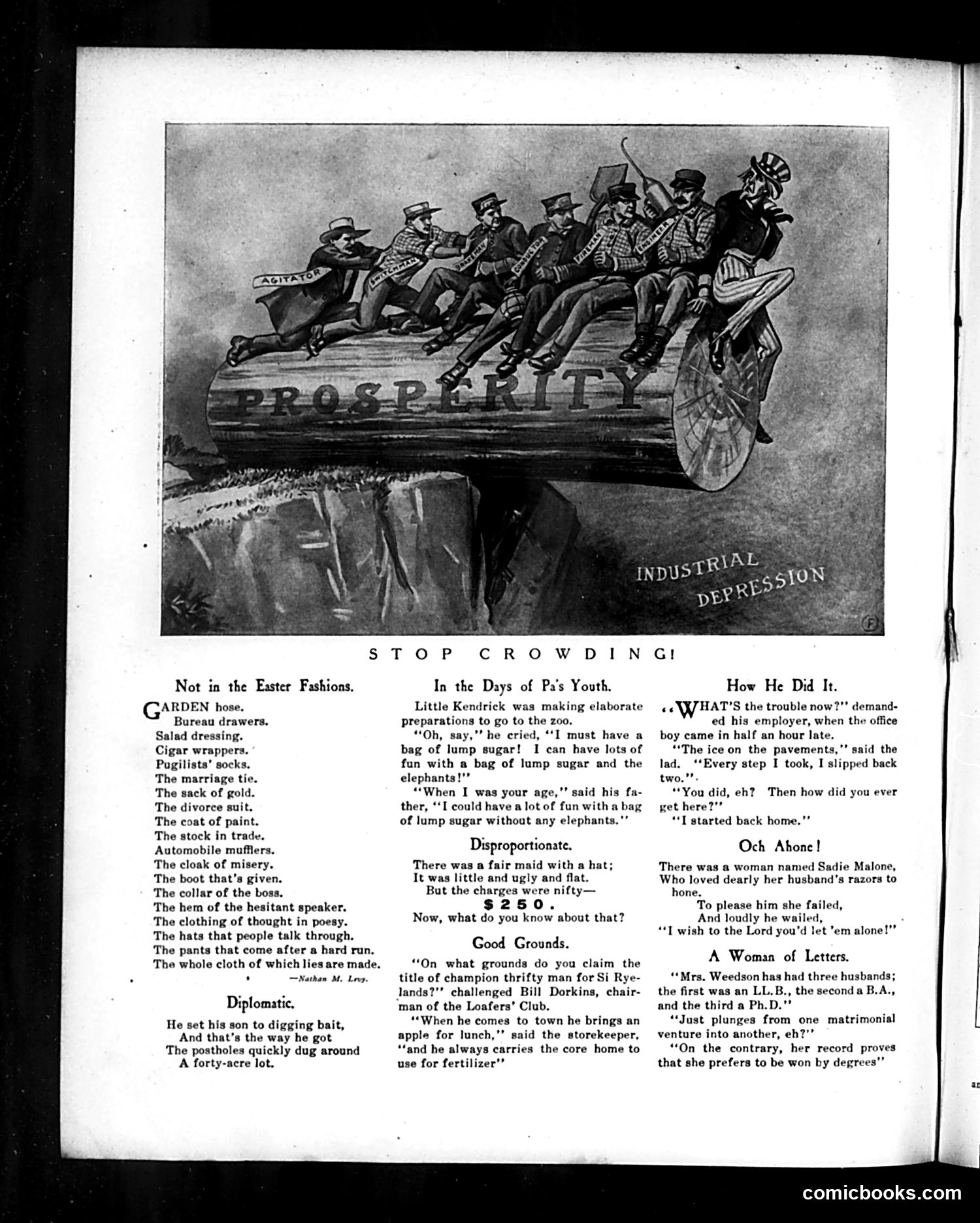
The main illustration depicts the "Industrial Depression" as a log labeled "PROSPERITY" balanced precariously on a cliff edge, with multiple figures (representing various industries or economic sectors) perched atop it, about to tumble. The caption "STOP CROWDING!" warns against overloading the economy. The page contains several satirical jokes and humorous verses mocking contemporary life: - A list of things "NOT in Easter Fashions" offering social commentary - Anecdotes contrasting past and present (fathers recalling simpler pleasures without modern goods) - Jokes about inflation (a tiny, ugly hat costing $250) - Puns on thrift and character The overall theme critiques economic instability during what appears to be a recession period, warning that too many competing interests threaten the fragile "prosperity." The humor targets materialism, changing social values, and economic anxiety—typical Judge magazine fare blending political-economic satire with domestic humor.
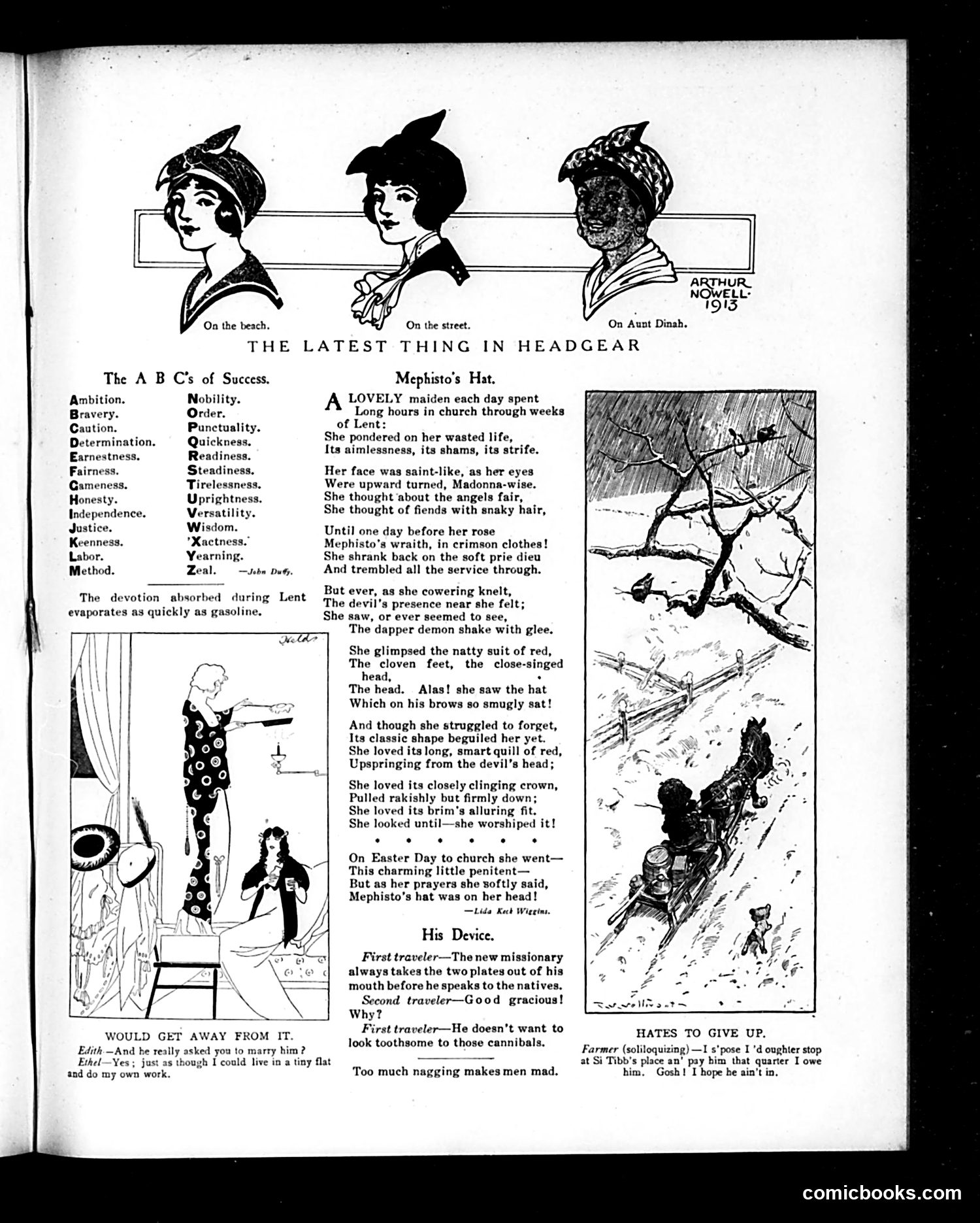
This page contains three satirical pieces typical of early 20th-century humor: **"The Latest Thing in Headgear"** shows three women's hat styles for different occasions (beach, street, "Aunt Dinah"), establishing fashion satire. **"Mephisto's Hat"** is the main narrative cartoon. A devout woman spends Lent in religious contemplation but becomes distracted by the Devil's appearance—specifically his fashionable red hat with an upright feather. Despite her pious intentions, she becomes so obsessed with the hat's style that by Easter, she's wearing it herself. The satire mocks how easily worldly vanity undermines religious devotion, particularly women's susceptibility to fashion trends. The poem's moral: even sincere spiritual effort ("the devotion absorbed during Lent") evaporates quickly, like gasoline. **Lower cartoons** include jokes about missionaries and domestic life—a traveler removes dentures before speaking to natives (racial stereotype humor), and a farmer debates paying debts versus avoiding creditors. The page reflects period attitudes: fashion obsession, religious hypocrisy, and casual ethnic mockery.
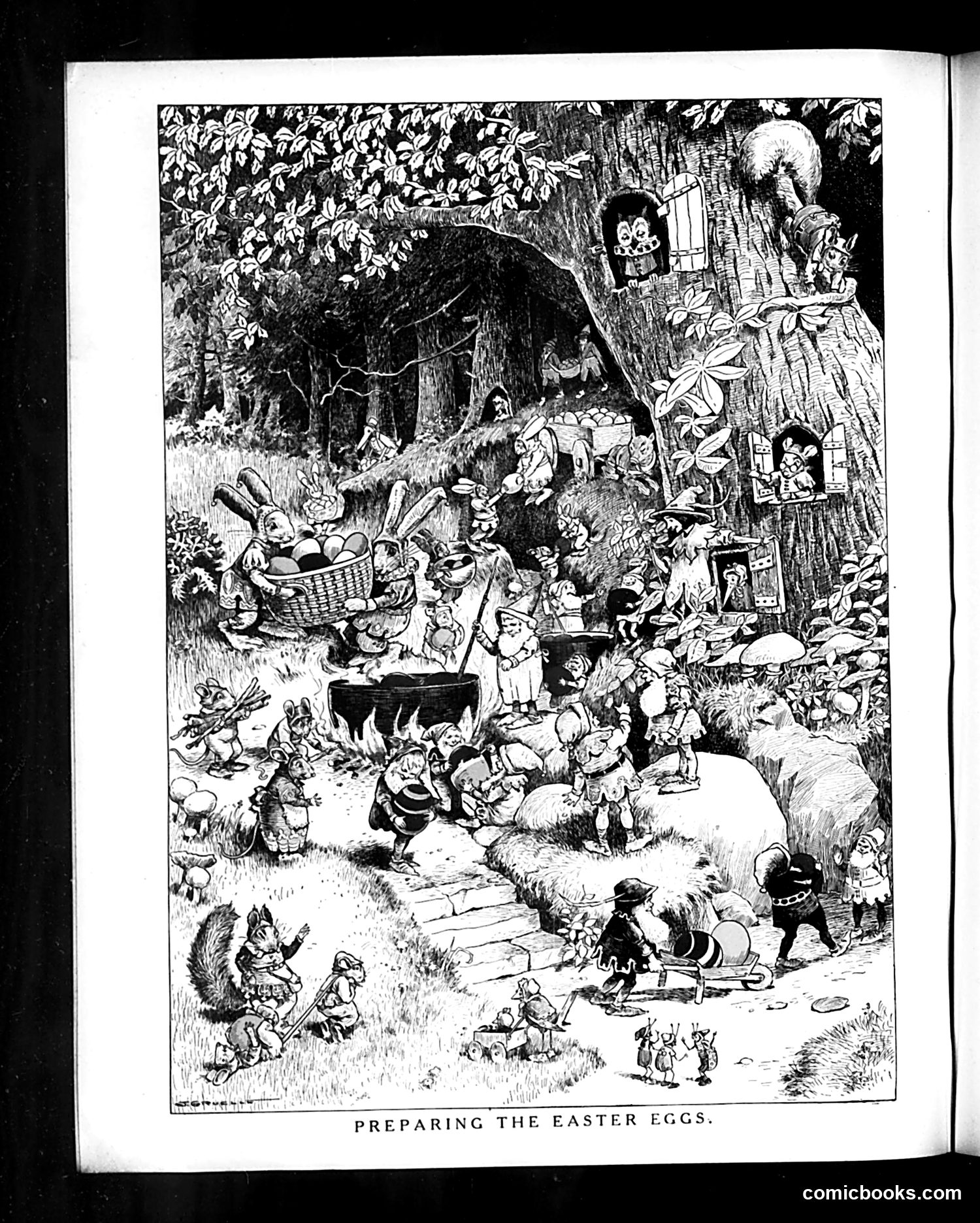
This whimsical illustration depicts anthropomorphic animals and fantastical creatures in a woodland scene, busily preparing Easter eggs. The image shows what appears to be rabbits, gnomes, elves, and other magical beings engaged in egg decoration and organization near a tree dwelling or cottage. Rather than political satire, this appears to be a humorous, fanciful illustration celebrating Easter traditions and the folklore associated with Easter bunnies and egg decoration. The crowded, detailed composition—typical of Judge's style—creates comedy through the chaotic busyness of the scene and the whimsical character designs. The illustration plays on the magical mythology surrounding Easter egg preparation, presenting it as an elaborate behind-the-scenes operation conducted by mythical creatures in nature. Without additional context or byline visible, the specific artist and intended satirical target (if any) remain unclear.
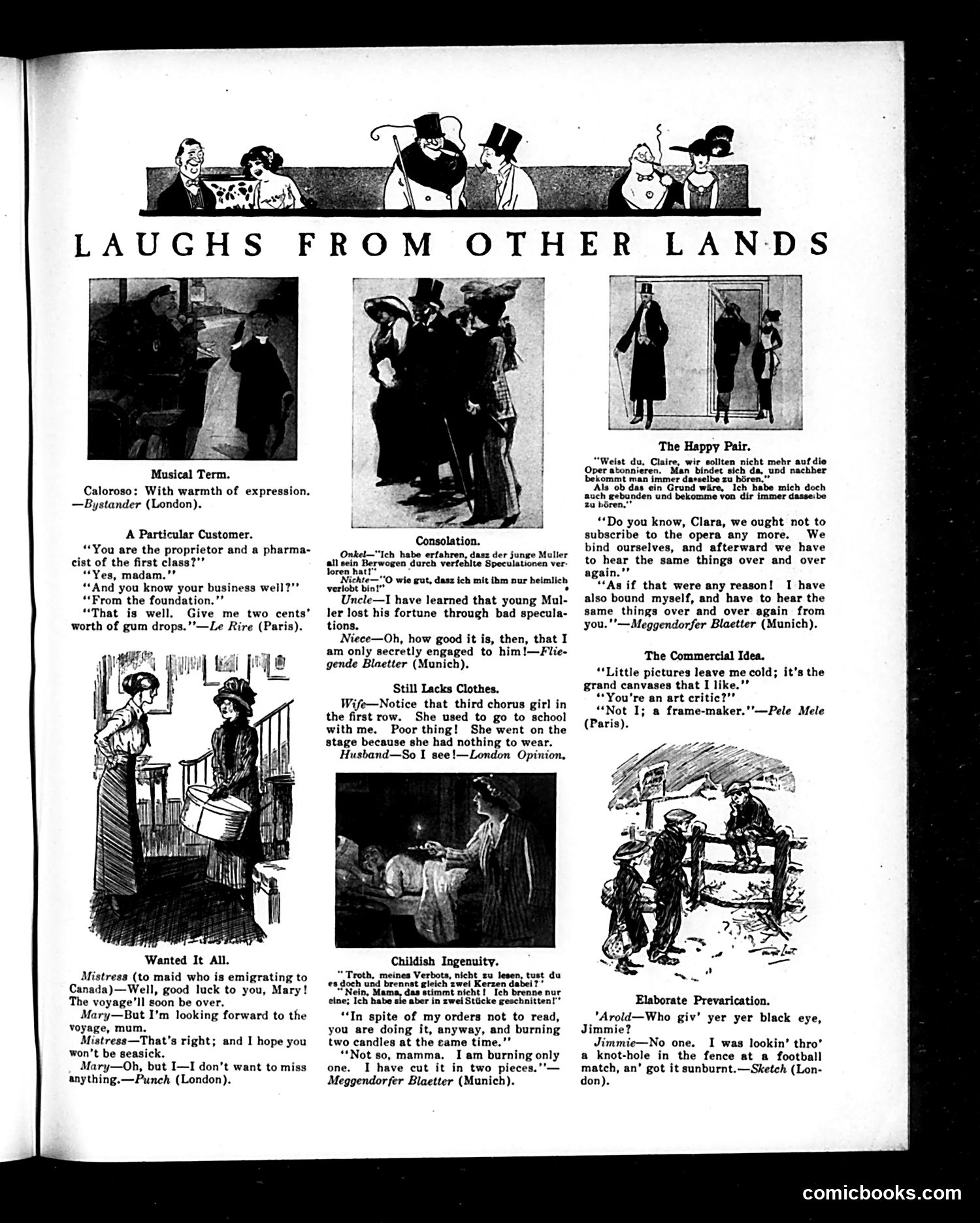
This page collects brief humorous anecdotes translated from European satirical publications (Punch, Le Rire, Fliegende Blätter, etc.). The jokes reflect early 20th-century social observations: **Key themes include:** - **Class and pretension**: A pharmacist's customer dismisses her expensive expertise for cheap candy; a frame-maker poses as art critic to appear cultured. - **Gender dynamics**: A maid eager to emigrate; a chorus girl forced into theater due to poverty; wives negotiating with husbands over opera subscriptions. - **Childhood logic**: A boy cleverly circumvents his mother's rules by cutting one candle in two rather than burning two. - **Immigration anxieties**: A servant's enthusiasm for leaving suggests difficult working conditions. The page demonstrates how Judge magazine positioned itself as cosmopolitan, sharing "sophisticated" European humor with American readers. The satire targets social hypocrisy, economic hardship, and domestic power struggles—concerns transcending national borders in this era.
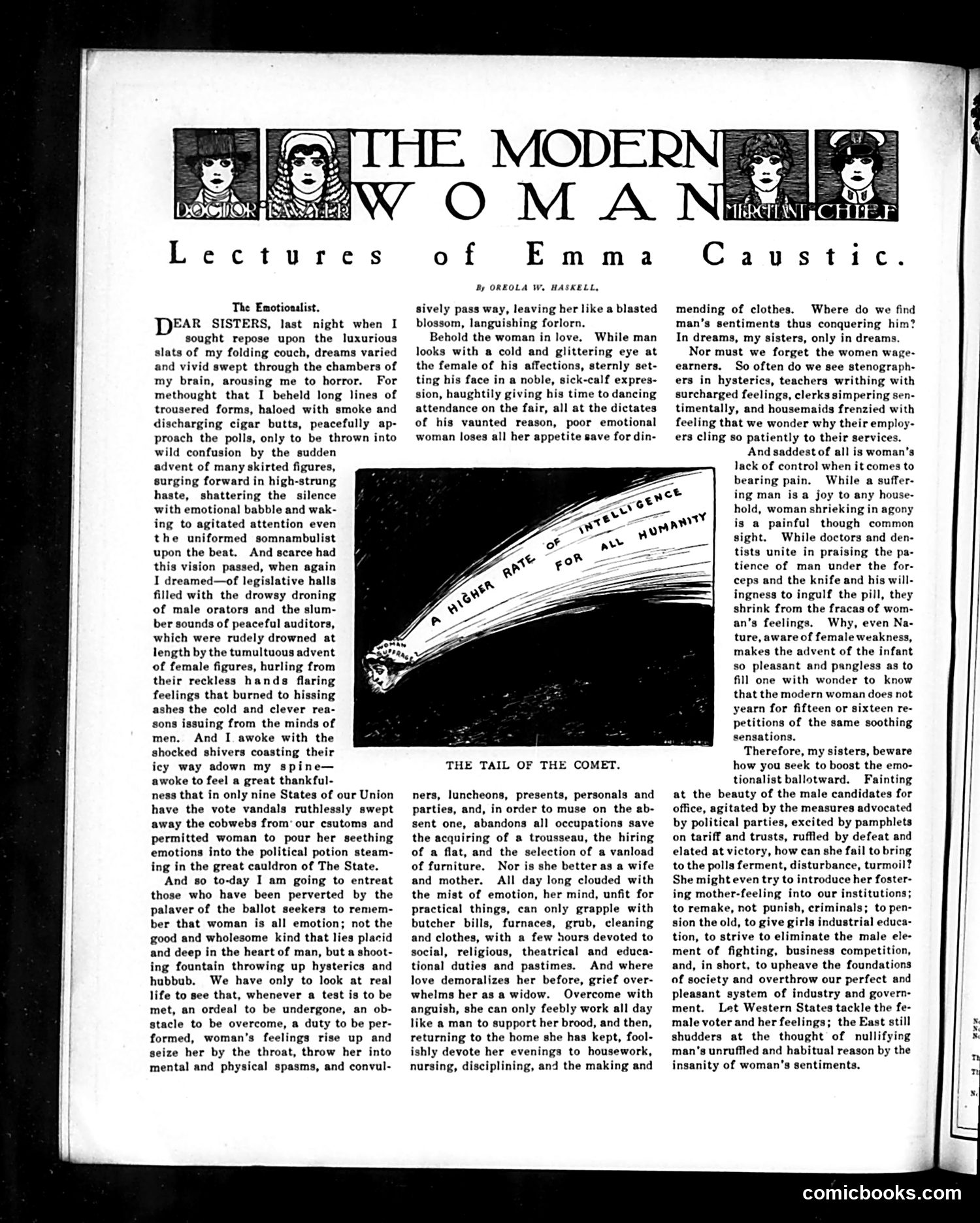
This article by Oreola W. Haskell satirizes anti-women's suffrage rhetoric by adopting the emotionalist opponent's voice. The piece mocks the common argument that women were too emotional and irrational to vote—a major claim used to oppose women's suffrage (which had been granted in only nine U.S. states at this time). The cartoon "The Tail of the Comet" appears to illustrate women's voting power as an unstoppable force. The article's dream sequence ridicules fears that female voters would disrupt orderly male-dominated legislatures with "emotional babble," while the subsequent detailed examples of women's competence (workers, mothers, widows managing households and finances) expose the hypocrisy of the emotionalist position. Haskell uses ironic exaggeration to argue women demonstrably handle practical responsibilities—contradicting claims that emotion incapacitates them.
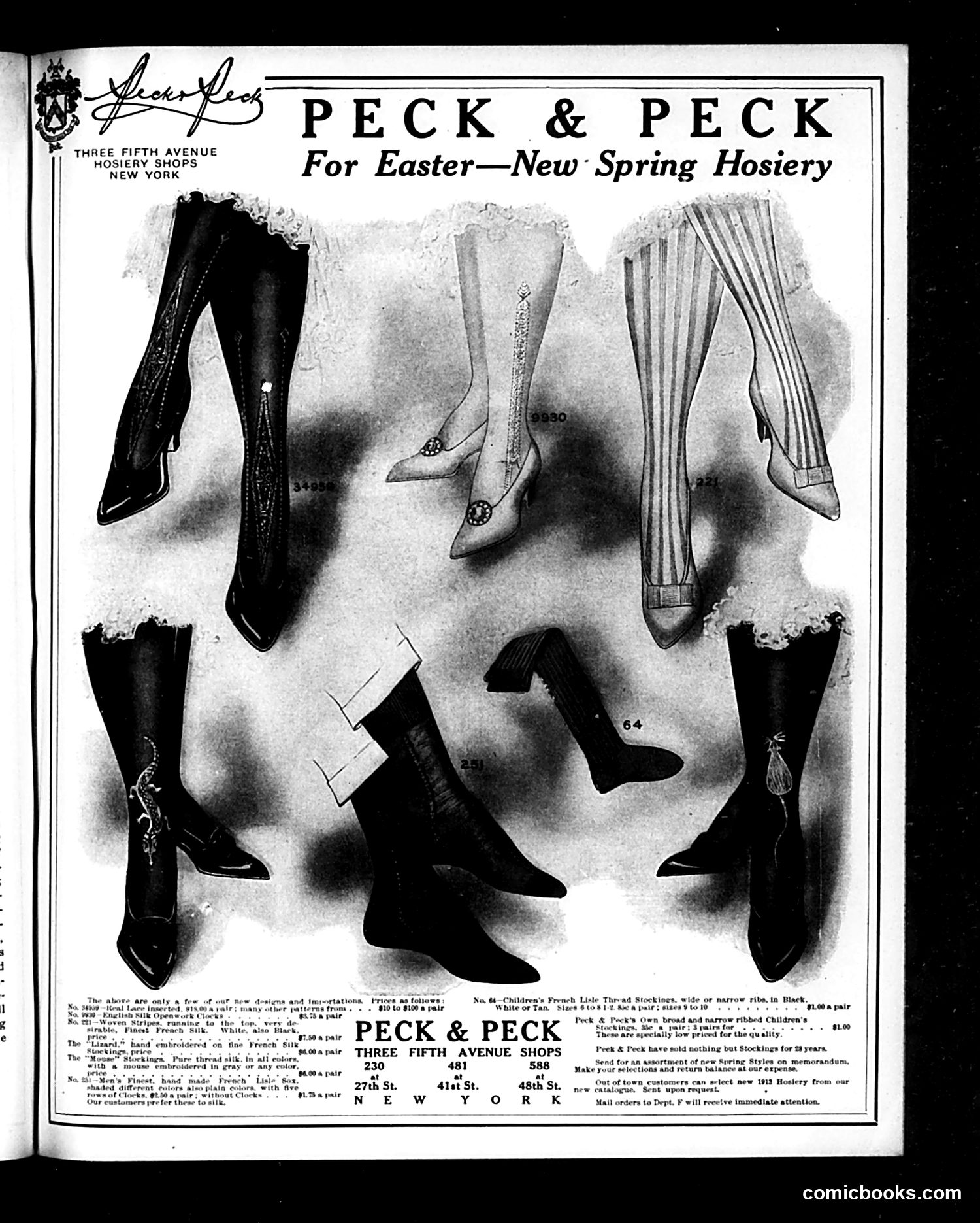
This is not a political cartoon or satire—it's a straightforward **fashion advertisement** for Peck & Peck, a New York department store. The page showcases various women's and children's hosiery styles for Easter/spring shopping, including stockings with different patterns (ribbed, embroidered, and decorative designs) and boots with various heel and toe treatments. The imagery displays merchandise photography typical of early-to-mid 20th century advertising: legs modeled wearing different stocking styles to highlight product details. Text describes specific items, prices (ranging roughly $1-2 per pair), and directs readers to the store's three Fifth Avenue locations or to order by mail. This appears in *Judge* magazine simply as paid advertising content, not editorial satire or commentary.
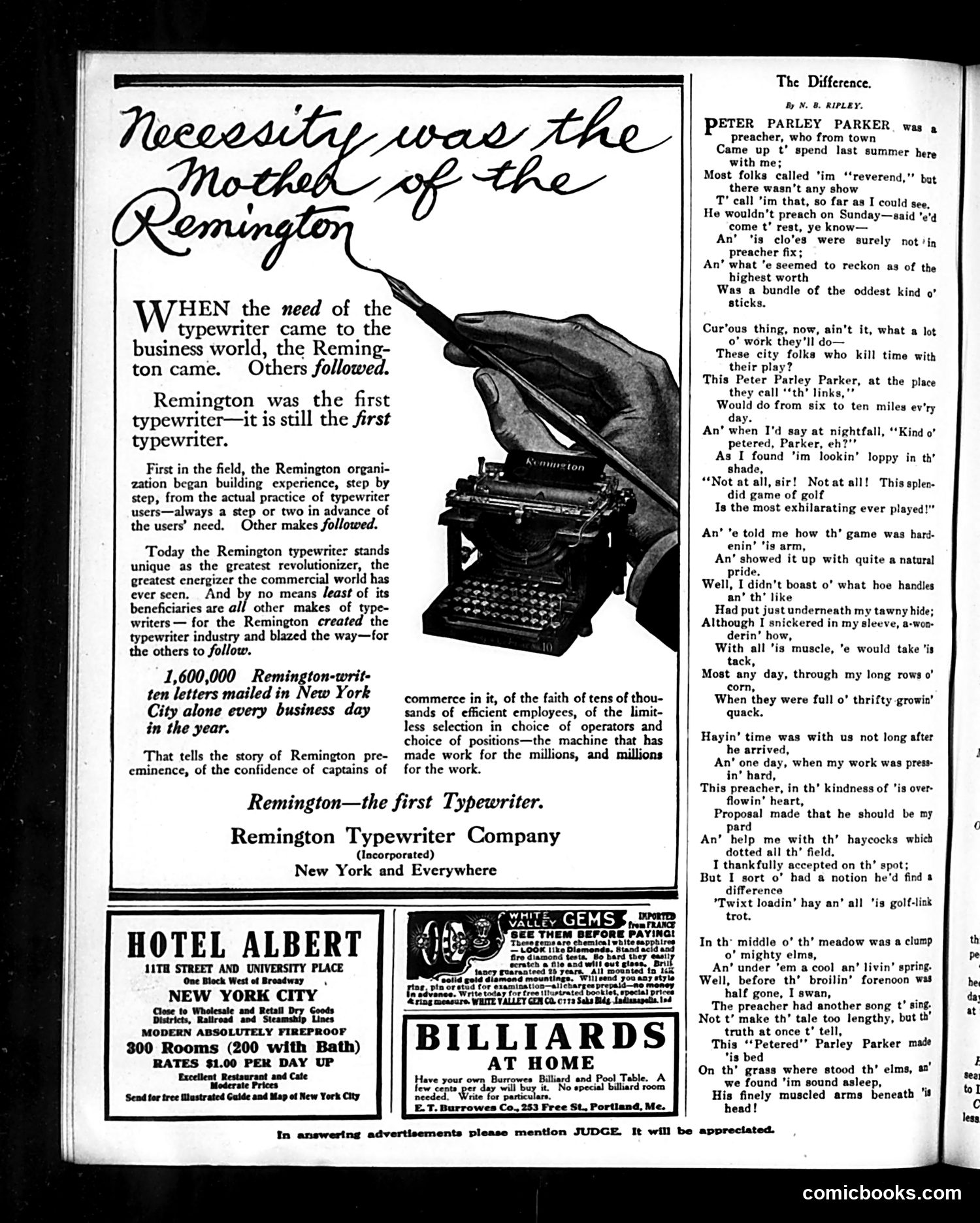
This page is primarily **advertising**, not political satire. The dominant content is a Remington typewriter advertisement claiming it was "the first typewriter" and remains the industry standard, citing 1.6 million letters typed daily in New York City alone. The only satirical content is the poem "The Difference" on the right, by N.B. Ripley. It mocks a visiting preacher named Peter Parley Parker who spends his summer vacation playing golf—then boasts about how the sport is "hardening his arm." The poem's humor lies in the implied comeuppance: when hay-harvesting season arrives and Parker volunteers to help, the narrator expects Parker will discover that real farm labor is far more physically demanding than golf. The satire gently ridicules leisure activities and city folk's romanticization of strenuous exercise.
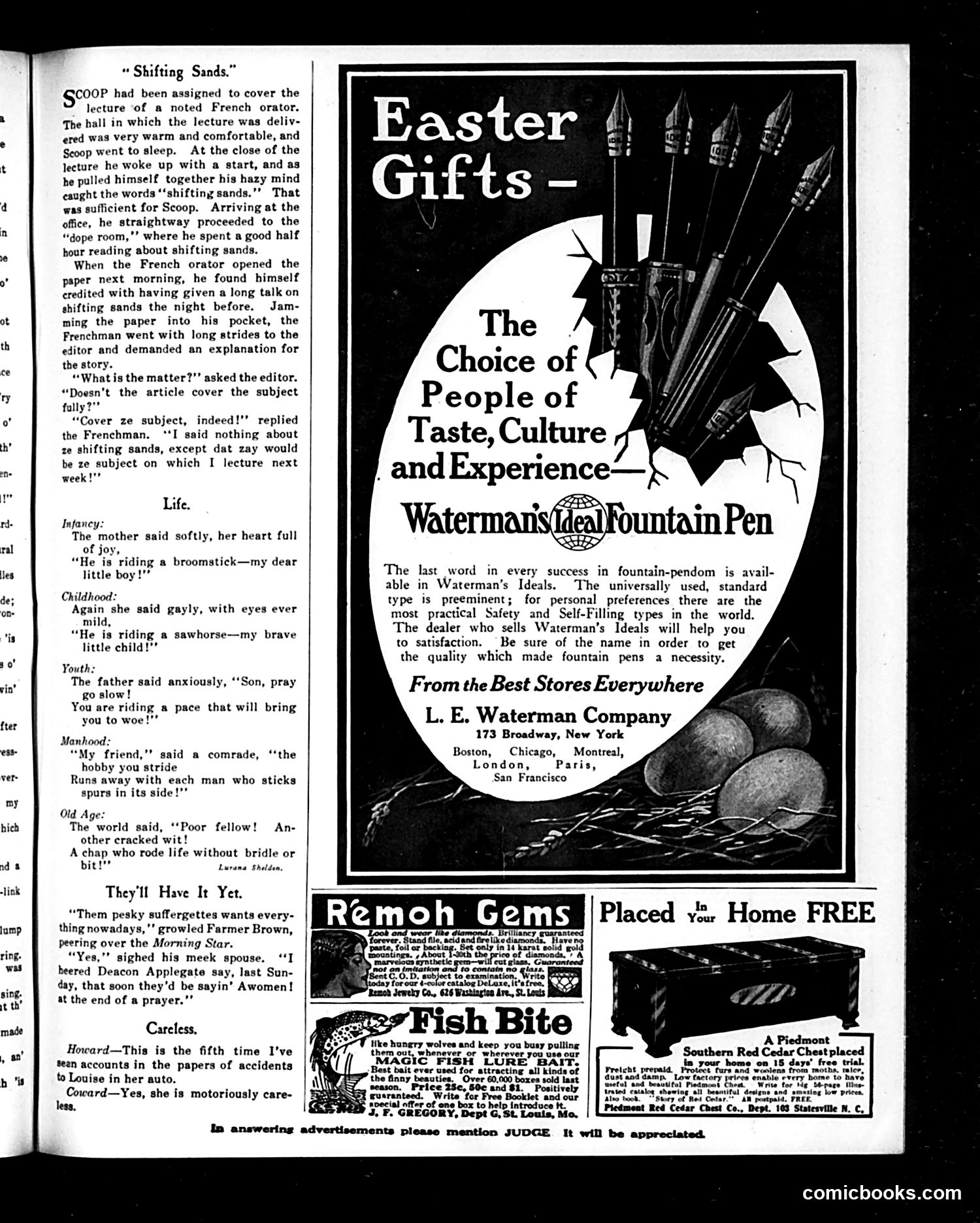
This page consists primarily of **advertisements and brief humorous sketches**, not political cartoons. The main content includes: **"Shifting Sands"** — A joke about a newspaper reporter (Scoop) who fell asleep during a French orator's lecture, caught only the words "shifting sands," and fabricated an entire article about that topic. The French speaker later confronts the editor, outraged that his actual lecture was misrepresented. **"They'll Have It Yet"** — A brief satirical exchange mocking the women's suffrage movement. A farmer complains that "suffragettes want everything nowadays," and his wife jokes they'll soon demand women be included in prayers ("Awomen!"). **"Life" and other sketches** — Sentimental verses about riding through life stages. The **advertisements** dominate: Waterman fountain pens, Remoh gems, Fish Bite lure, and a Piedmont cedar chest occupy significant space. The suffrage reference is the only overtly political content, treating the women's voting rights movement as absurd rather than serious.
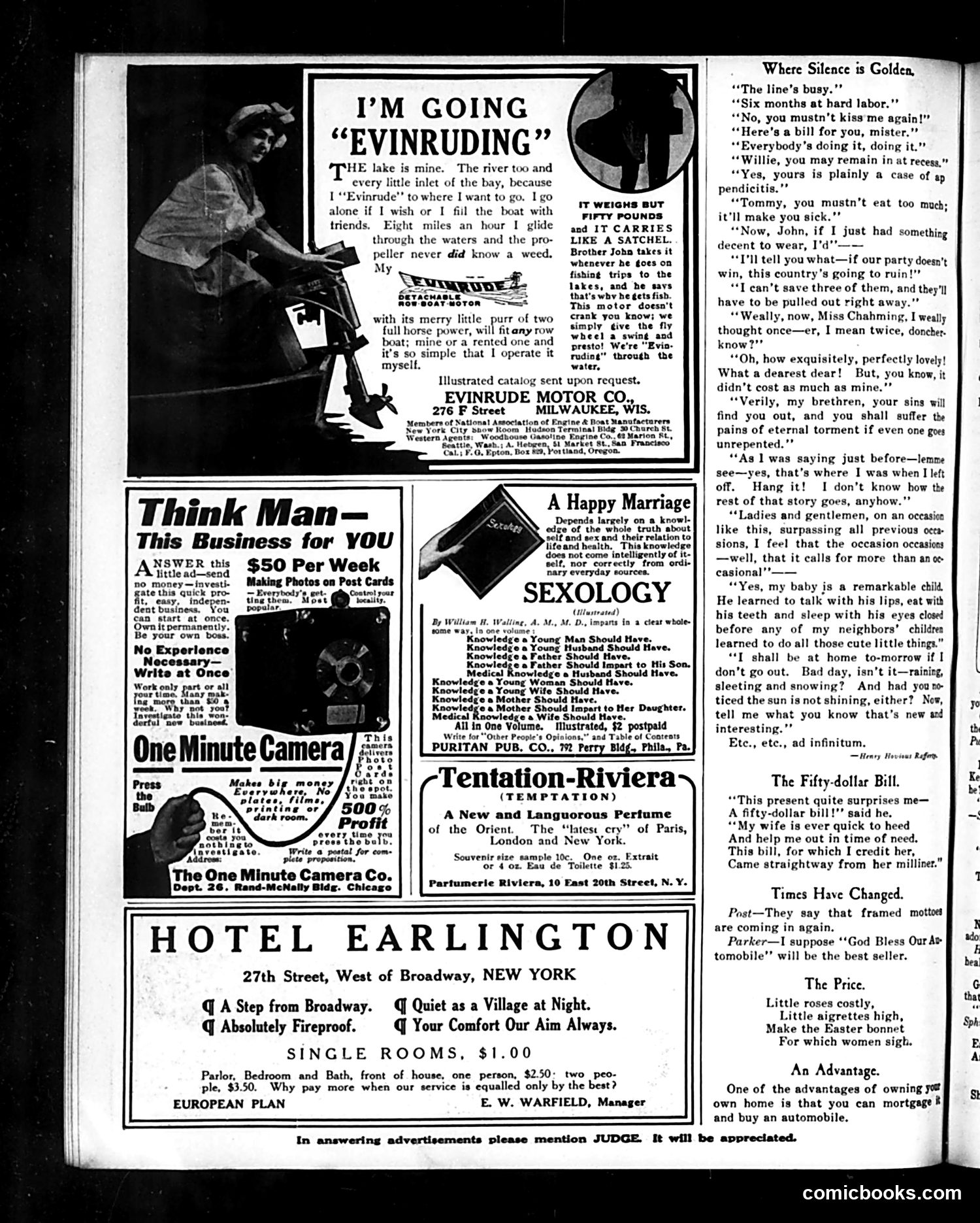
This page contains multiple advertisements and satirical columns typical of Judge magazine's format. The main cartoon, "I'm Going 'Evinruding,'" advertises Evinrude outboard motors by depicting a woman enthusiastically describing the freedom and independence the motorized boat provides—she can fish alone, travel eight miles per hour, and avoid learning about weeds. The satire gently mocks consumer enthusiasm for new technology. The "Where Silence is Golden" column collects overheard conversations satirizing domestic life, medical pretense, and social pretension—common Judge targets. Other advertisements promote a camera, a business opportunity, and a hotel. The "Sexology" book advertisement and perfume ad represent typical early-20th-century mail-order publishing. The tone throughout reflects Judge's middle-class audience: mocking pretense while celebrating consumer goods and modern conveniences. No specific political figures or events appear to be referenced—this is primarily commercial satire of everyday American life.
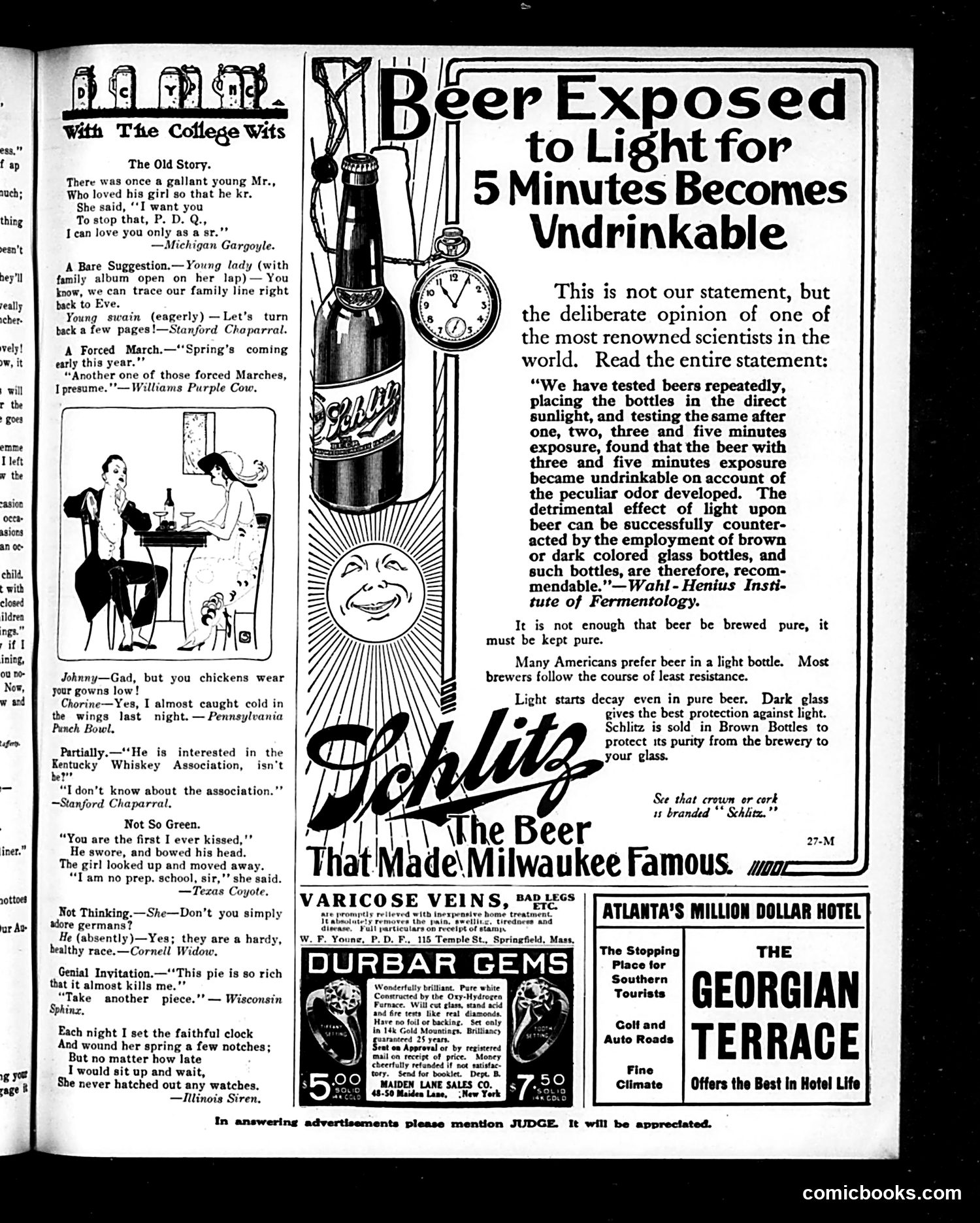
This page is dominated by a **Schlitz beer advertisement** disguised as scientific endorsement. The central claim—that beer exposed to light for five minutes becomes "undrinkable"—is attributed to the "Wahl-Henius Institute of Fermentology," presented as authoritative opinion from "one of the most renowned scientists in the world." The satire targets **brewing industry marketing practices**: Schlitz is essentially admitting that American brewers use clear bottles (which allow light damage) because consumers prefer them, despite the purity problem. Rather than improve their product, Schlitz simply switched to brown bottles and marketed this as a scientific solution. The "joke" is the transparent self-promotion dressed up in pseudo-scientific language—the advertisement announces it's "not our statement" while obviously being Schlitz's statement. For modern readers, this exemplifies **early 20th-century advertising's dubious use of scientific claims** to justify product choices, a practice that remains familiar today. The surrounding humor pieces on the left are unrelated collegiate jokes.
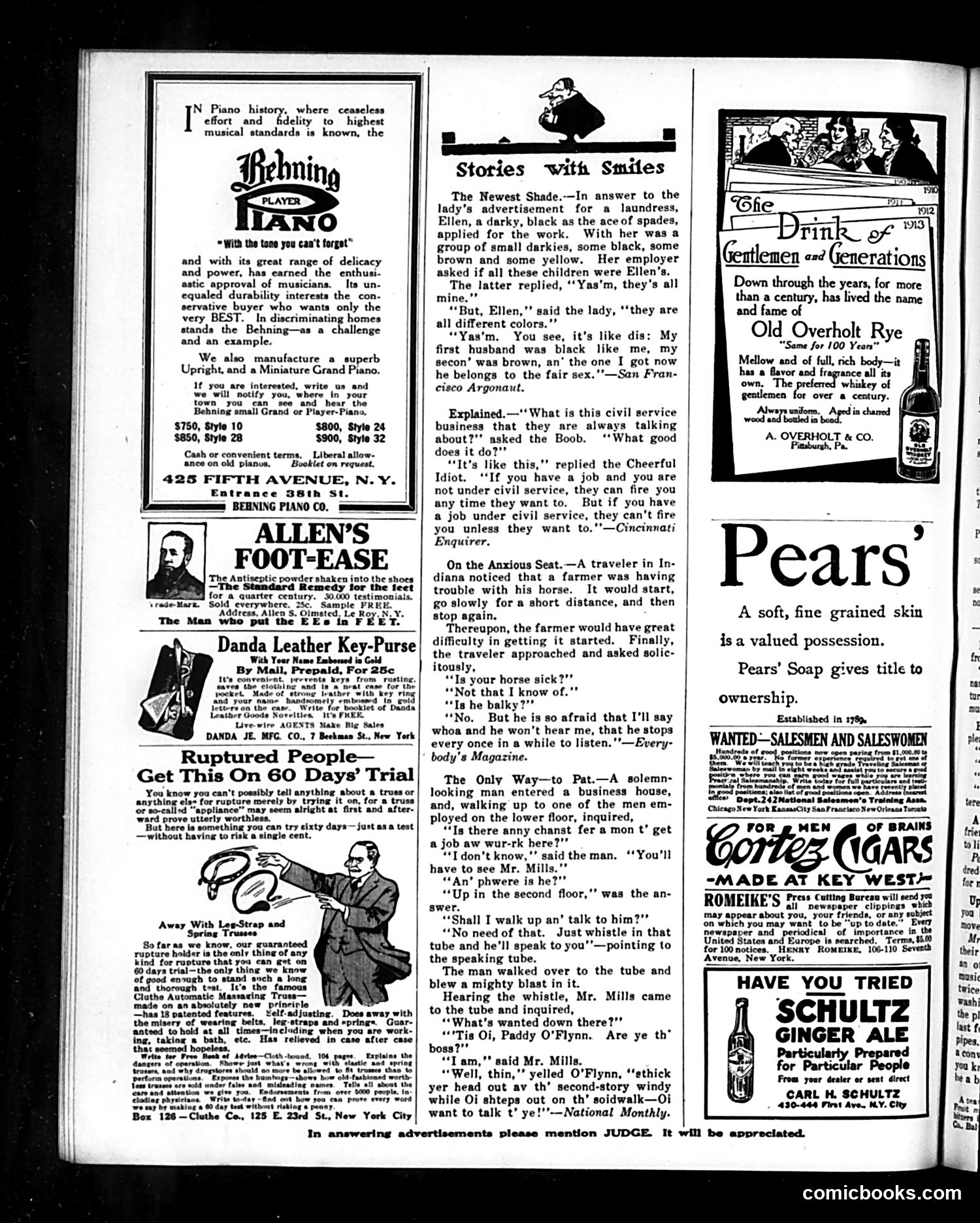
This page is primarily **advertisements and humor filler**, not political satire. The content includes: **Main advertisements**: Behning Player Piano, Allen's Foot-Ease powder, Danda Leather Key-Purse, and a rupture truss (60-day trial offer). **"Stories with Smiles" section**: Three brief jokes: 1. A racist "joke" about a Black laundress named Ellen with multiracial children, playing on stereotypes about Black women and interracial relationships 2. A pun about civil service employment (you can't be fired unless they want to fire you) 3. An incomplete anecdote about a farmer with a stubborn horse **Bottom advertisements**: Old Overholt Rye whiskey, Pears' Soap, Corlez Cigars, Schultz Ginger Ale, and a help-wanted notice. There is **no political cartoon visible**. The page reflects early 20th-century advertising and humor conventions, including period racial stereotyping considered acceptable in mainstream publications at that time.
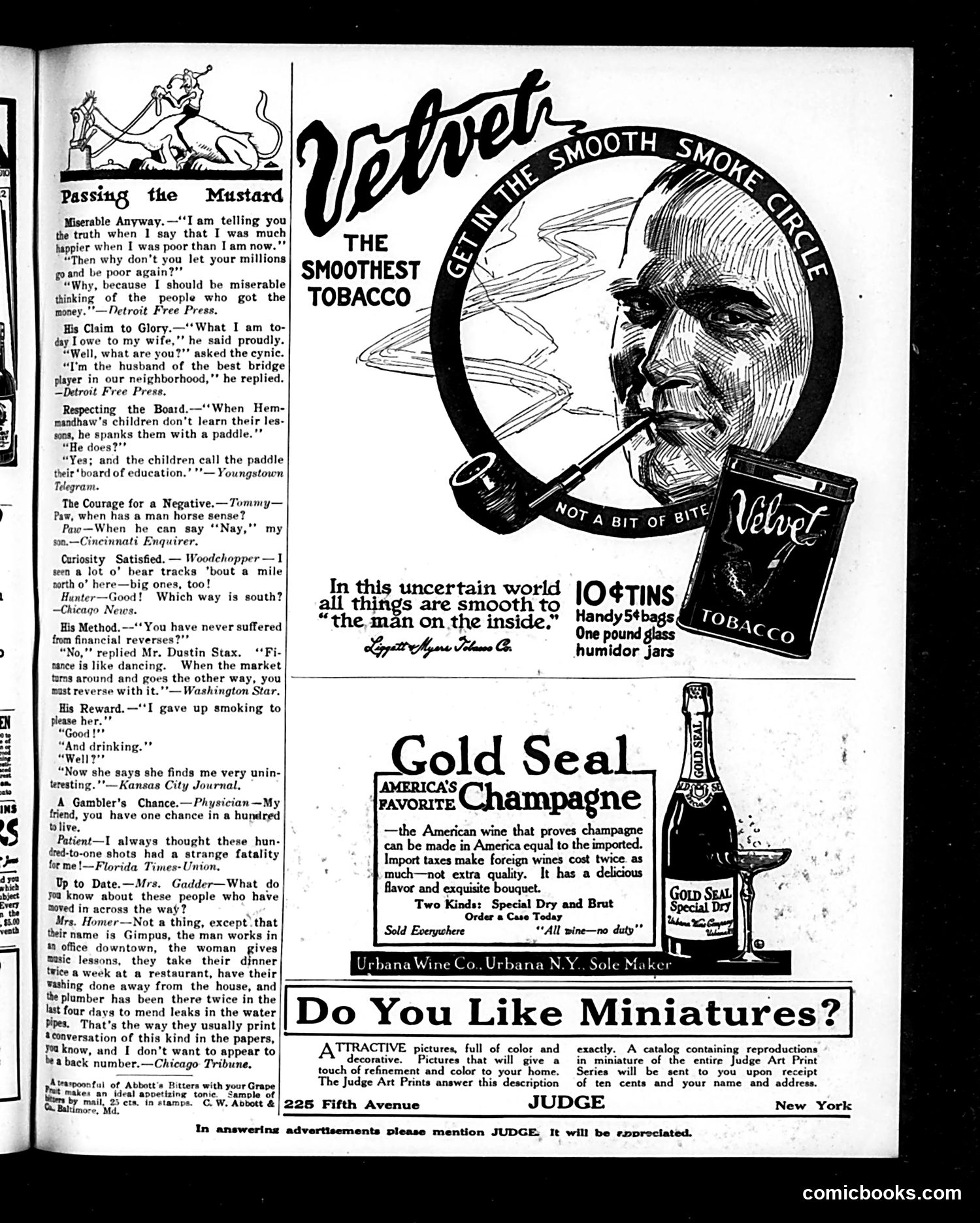
This page from *Judge* contains primarily **short humorous anecdotes** in the left column, plus three advertisements. The jokes mock various social types: the wealthy man miserable despite riches, the bridge player's husband, children punished with a "board of education," and people obsessed with appearing up-to-date. The main visual content is advertising. The **Velvet tobacco ad** features a grotesque face with exaggerated features in a smoke ring, promoting tobacco as "smooth" with the tagline "not a bit of bite"—typical early 20th-century cigarette marketing that emphasized smoothness. Below are ads for **Gold Seal Champagne** (positioning American wine as equal to imported) and a **Judge Art Prints catalog** offer. No political cartoons or caricatures of specific figures appear on this page. It's primarily a humor-and-advertising page typical of *Judge*'s satirical magazine format, mocking everyday social pretensions rather than addressing major political events.
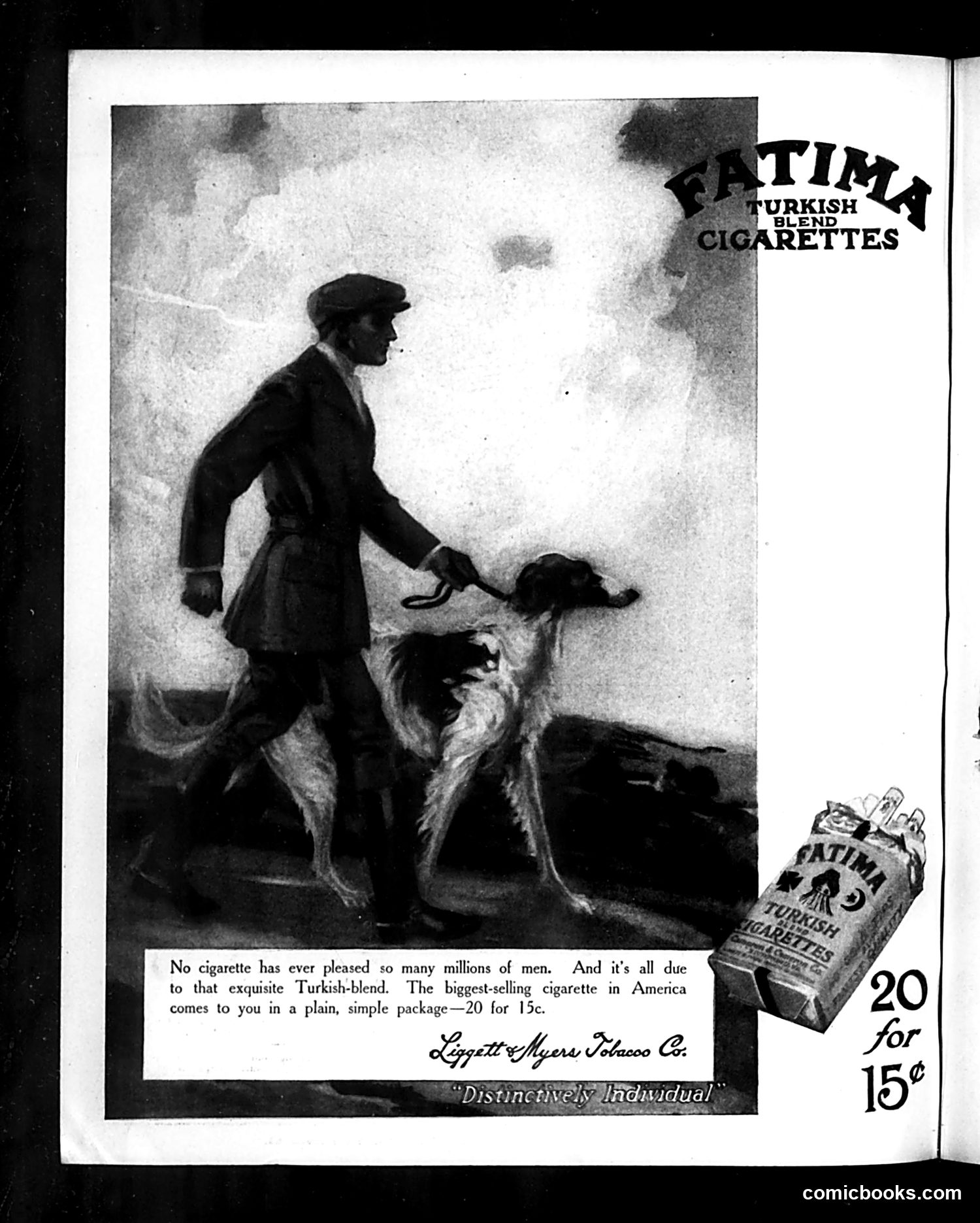
This is primarily a **cigarette advertisement** rather than political satire. It depicts a well-dressed man walking a dog against a cloudy background. The ad promotes Fatima Turkish cigarettes, claiming they're "the biggest-selling cigarette in America" and highlighting their "exquisite Turkish-blend" as the reason for their popularity among "millions of men." The price point—20 cigarettes for 15 cents—suggests this is from the early 20th century when such pricing was standard. The tagline "Distinctively Individual" emphasizes the product's unique appeal. The imagery of a gentleman with his dog conveys respectability and sophistication, a common advertising strategy to associate the product with refined taste and social status.