
Judge, 1913-03-15 · page 15 of 24
Judge — March 15, 1913 — page 15: what you’re looking at
What you’re looking at
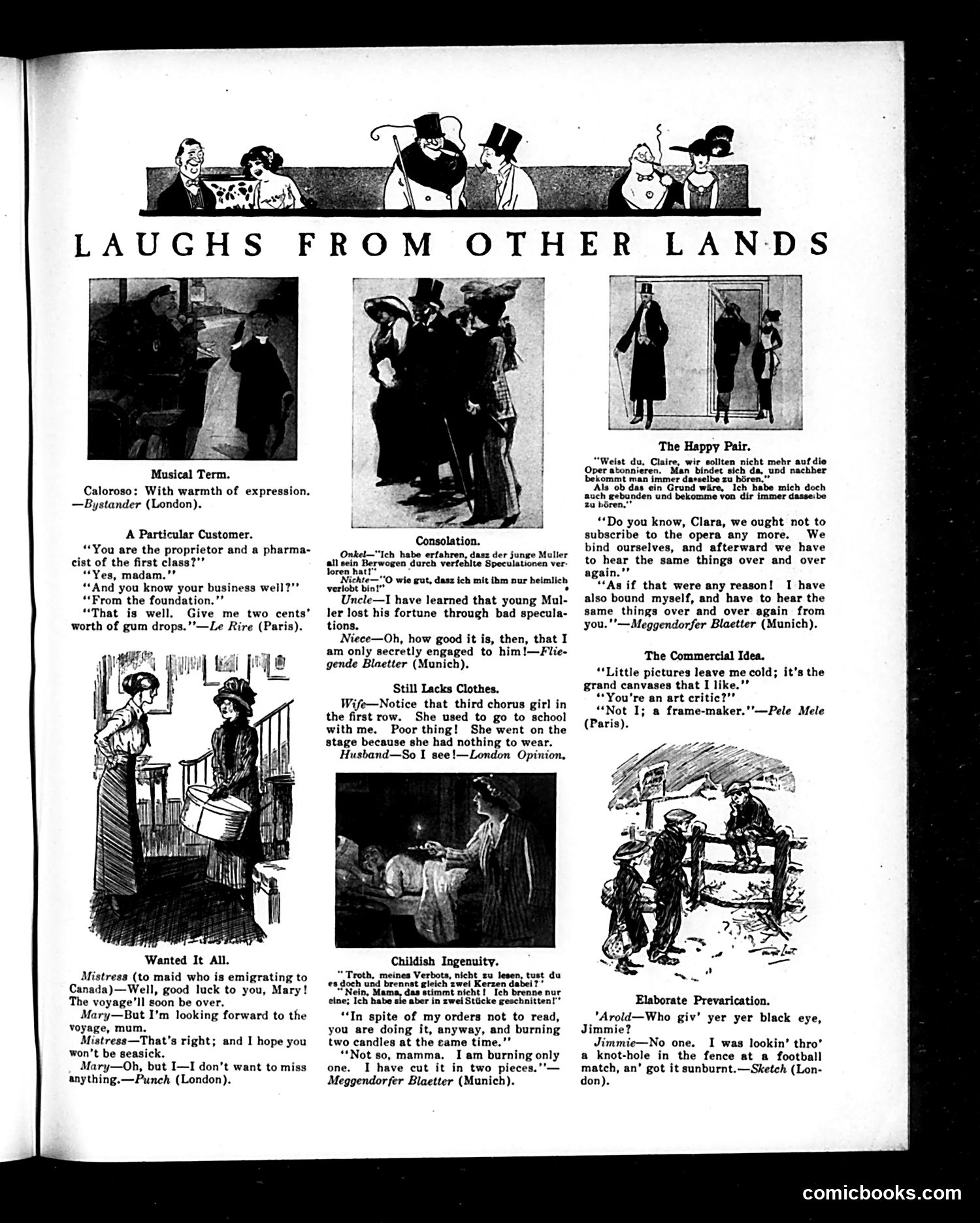
This page collects brief humorous anecdotes translated from European satirical publications (Punch, Le Rire, Fliegende Blätter, etc.). The jokes reflect early 20th-century social observations: **Key themes include:** - **Class and pretension**: A pharmacist's customer dismisses her expensive expertise for cheap candy; a frame-maker poses as art critic to appear cultured. - **Gender dynamics**: A maid eager to emigrate; a chorus girl forced into theater due to poverty; wives negotiating with husbands over opera subscriptions. - **Childhood logic**: A boy cleverly circumvents his mother's rules by cutting one candle in two rather than burning two. - **Immigration anxieties**: A servant's enthusiasm for leaving suggests difficult working conditions. The page demonstrates how Judge magazine positioned itself as cosmopolitan, sharing "sophisticated" European humor with American readers. The satire targets social hypocrisy, economic hardship, and domestic power struggles—concerns transcending national borders in this era.
📄 Transcribed text from this page (OCR, searchable)
Machine-transcribed from the original scan — historical spelling and the odd misread are preserved.
Musical Term. Caloroso: With warmth of expression. —Bystander (London). A Particular Customer. “You are the proprietor and a pharma- cist of the first class?”’ “Yes, madam.”” “And you know your business well?’ “From the foundation.”’ “That is well. Give me two cents’ worth of gum drops.’’—Le Rire (Paris). Wanted It All. Mistress (to maid who is emigrating to Canada)—Well, good luck to you, Mary! The voyage'll soon be over. Mary—But I'm looking forward to the voyage, mum. Mistress—That’s right; and I hope you won't be seasick. Mary—Oh, but I—I don’t want to miss anything.—Punch (London). Onkel—"Ich habe erfahren, dasz der junge Muller gilscin Berwogen dureh verfeblte Speculationen ver- "Nichte—"O wie gut, dasz ich mit thm nur helmticn verlobt bin!” Uncle—I have learned that young Mul. ler lost his fortune through bad specula- tions. Niece—Oh, how good it is, then, that I am only secretly engaged to him!—Flie- gende Blaetter (Munich). Still Lacks Clothes. Wife—Notice that third chorus girl in the first row. She used to go to school with me. Poor thing! She went on the stage because she had nothing to wear. Husband—So I see!—London Opinion. Childish Ingenuity. “Troth, meines Verbots, nicht 2u lesen, tust du ¢s,doch und brennst gleich zwei Kerzen dabei?’ “Nein, Mama, das stimmt nicht! Ich brenne nur eine; Ich habe sie aber in zwei Stdcke geschnitten!” “In spite of my orders not to read, you are doing it, anyway, and burning two candles at the came time.” “Not so, mamma. I am burning only one. I have cut it in two pieces.’’— Meggendor fer Blaetter (Munich). “Weist du, Claire, wir sollten viet mehr auf die Oper abonnieren. Man bindet sich da, und nachher bekommt man immer davealbe su een nd wire, Ich Tube mich doch dir immer dasse:be “Do you know, Clara, we ought not to subscribe to the opera any more. We bind ourselves, and afterward we have to hear the same things over and over again.’” “‘As if that were any reason! I have also bound myself, and have to hear the same things over and over again from you."’—Meggendorfer Blaetter (Munich). The Commercial Idea. “Little pictures leave me cold; it’s the grand canvases that I like.”” “You're an art criti “Not I; a frame-maker.’’—Pele Mele (Paris). Elaborate Prevarication. "Arold—Who giv’ yer yer black eye, Jimmie? Jimmie—No one. I was lookin’ thro’ a knot-hole in the fence at a football _ an’ got it sunburnt.—Sketch (Lon- jon). comicbooks.com