
Judge, 1913-03-15 · page 9 of 24
Judge — March 15, 1913 — page 9: what you’re looking at
What you’re looking at
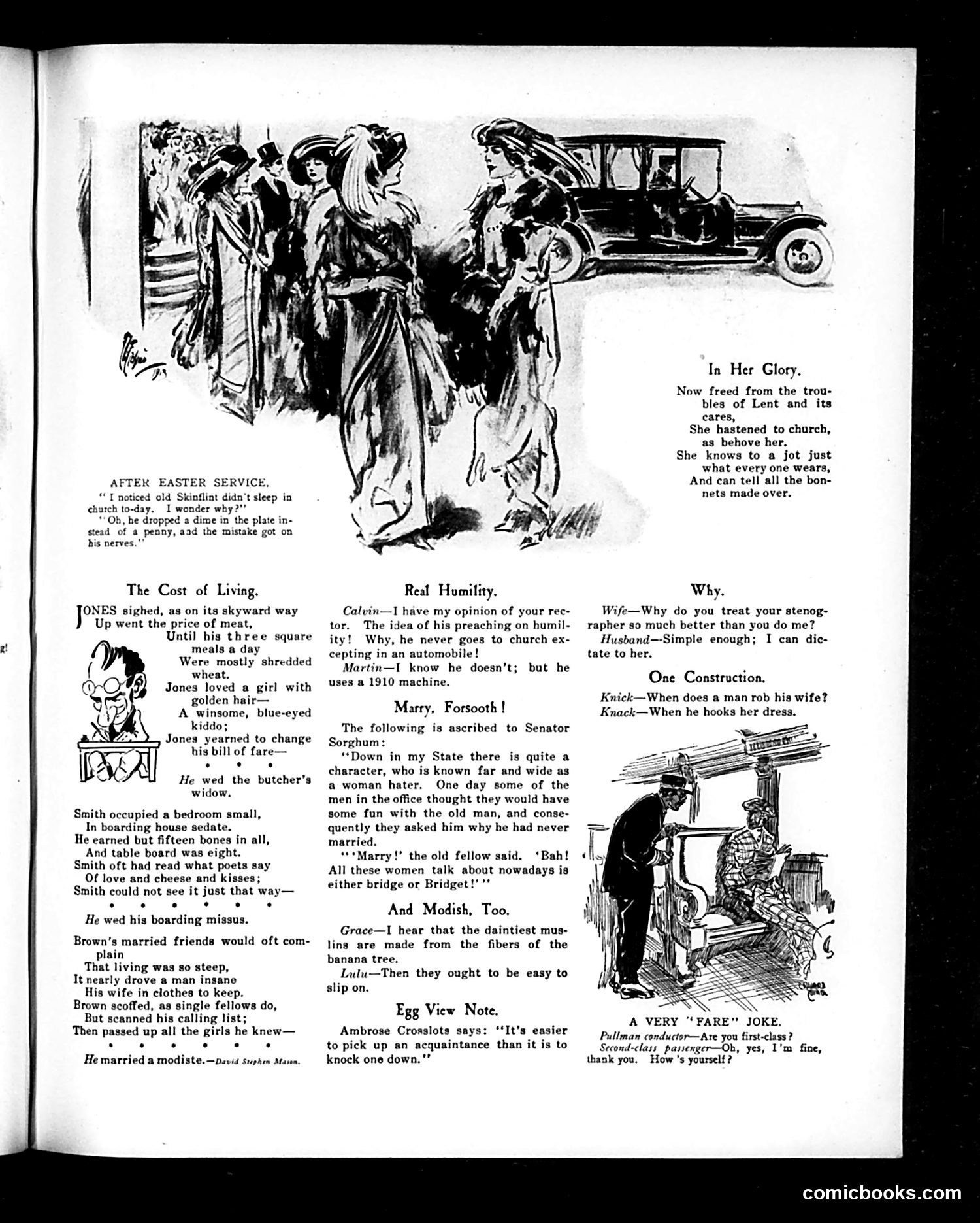
This page from *Judge* contains multiple short humorous pieces satirizing early 20th-century American social anxieties, particularly around **rising costs of living and courtship**. The dominant theme is economic desperation driving unlikely marriages: Jones marries a butcher's widow to afford meat; Smith weds his boarding-house landlady due to poverty; Brown marries a modiste (dressmaker) to manage clothing expenses. These jokes mock how financial pressure forces men into marriages of convenience rather than romance. Other pieces target **hypocrisy and class pretension**: a miserly churchgoer's nerves are rattled by accidentally donating a dime; a rector preaches humility while arriving by automobile (a luxury item in 1910). The "Real Humility" and "Marry, Forsooth!" sections reference Senator Sorghum (likely a fictional character representing rural/conservative politicians) and mock women's interests (bridge, fashion, bonnets). The illustration at top shows fashionable women and an automobile, supporting the theme of modern consumerism and its financial burdens on ordinary men.
📄 Transcribed text from this page (OCR, searchable)
Machine-transcribed from the original scan — historical spelling and the odd misread are preserved.
AFTEK EASTER SERVICE, “ T noticed old Skinflint didn’t sleep in church to-day, I wonder why?” “Ob, he dropped a dime in the plate in- stead of a penny, aad the mistake got on his nerves.” The Cost of Living, ‘ONES sighed, as on its skyward way Up went the price of meat, Until his three square meals a day Were mostly shredded wheat. Jones loved a girl with golden hair— A winsome, blue-eyed kiddo; Jones yearned to change his bill of fare— o 8 He wed the butcher's widow. Smith occupied a bedroom small, In boarding house sedate. He earned but fifteen bones in all, And table board was eight. Smith oft had read what poets say Of love and cheese and kisses; Smith could not see it just that way— o 8 © © © 6 He wed his boarding missus. Brown’s married friends would oft com- pla That living was so steep, It nearly drove a man insane His wife in clothes to keep. Brown scoffed, as single fellows do, But scanned his calling list; Then passed up all the girls he knew— He married a modiste.—David suphen Mason. Real Humility. Calvin—I have my opinion of your rec- tor. The idea of his preaching on humil- ity! Why, he never goes to church ex- cepting in an automobile! Martin—I know he doesn’t; uses a 1910 machine. but he Marry, Forsooth ! The following is ascribed to Senator Sorghum: ‘Down in my State there is quite a character, who is known far and wide as a woman hater. One day some of the men in the office thought they would have some fun with the old man, and conse- quently they asked him why he had never married. “**Marry!’ the old fellow said. ‘Bah! All these women talk about nowadays is either bridge or Bridget!’ ’’ And Modish, Too. Grace—I hear that the daintiest mus- ling are made from the fibers of the banana tree. Lulu—Then they ought to be easy to slip on. Egg View Note. Ambrose Crosslots says: ‘It's easier to pick up an acquaintance than it is to knock one down."” In Her Glory. Now freed from the trou- bles of Lent and its cares, She hastened to church, as behove her. She knows to a jot just what every one wears, And can tell all the bon- nets made over. Why. Wife—Why do you treat your stenog- rapher so much better than you do me? Husband—Simple enough; I can dic- tate to her. One Construction. Knick—When does a man rob his wife? -—When he hooks her dress, aS A VERY “FARE" JOKE. Pullman conductor—Are you first-class ? Second-class passenger—Ob, yes, I'm fine, thank you. How's yourself? comicbooks.com