
A complete issue · 24 pages · 1913
Judge — February 22, 1913
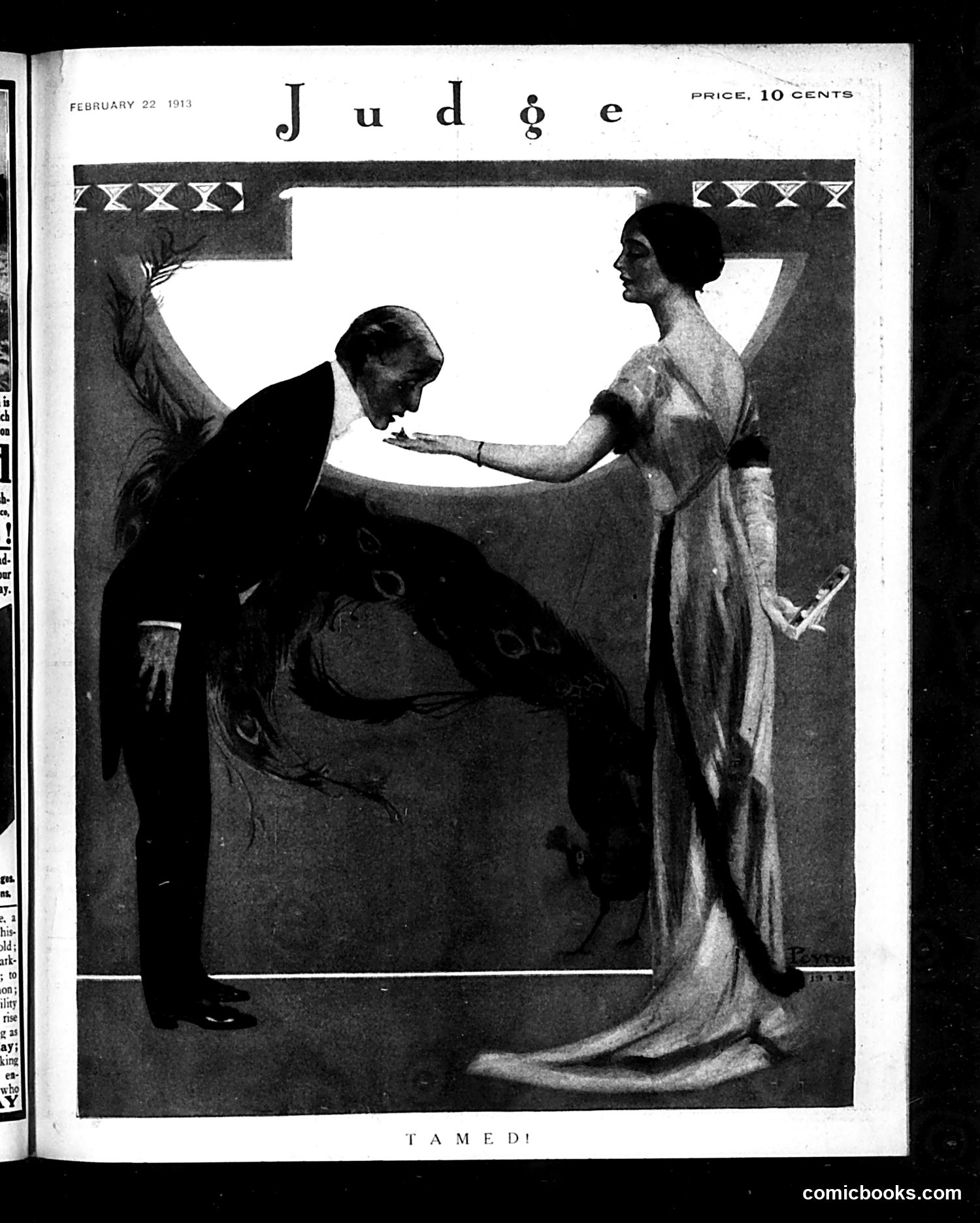
This cover depicts a domestic scene titled "TAMED!" A man in formal attire appears submissive or defeated, bowing slightly toward a woman in an elegant gown who gestures commandingly. The woman's pose and expression suggest dominance over the man. The satire likely comments on marriage dynamics and changing gender relations in early 20th-century America. The "taming" reference suggests the woman has brought the man under control, inverting traditional power structures. Published in 1913, during the height of the suffrage movement, this probably mocks fears among some that women's increasing independence and rights would undermine male authority in domestic life. The cartoon reflects anxieties about shifting gender roles of the era.
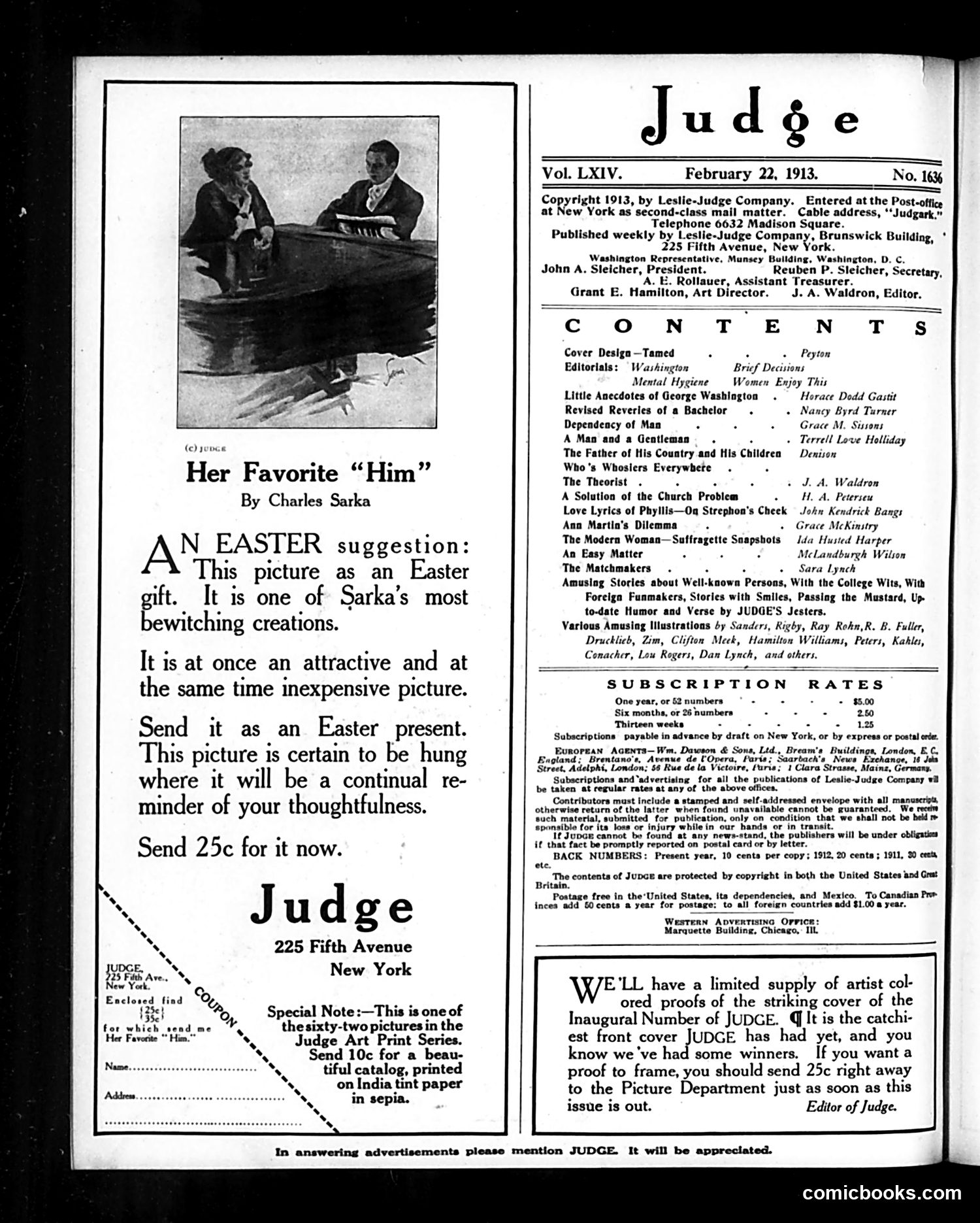
This page is primarily **advertising** for Judge magazine's art prints, not political satire. The main feature is "Her Favorite 'Him'" by Charles Sarka—a romantic illustration showing a couple in an intimate moment. The advertisement promotes this as an Easter gift, emphasizing it's "attractive and inexpensive" at 25 cents. The right page contains the magazine's table of contents and subscription rates. While Judge was known for satirical content, this particular spread focuses on marketing their art print series rather than delivering editorial commentary. The only substantive content is the contents listing, which shows the magazine covered contemporary topics like women's suffrage, church problems, and social matters typical of 1913.
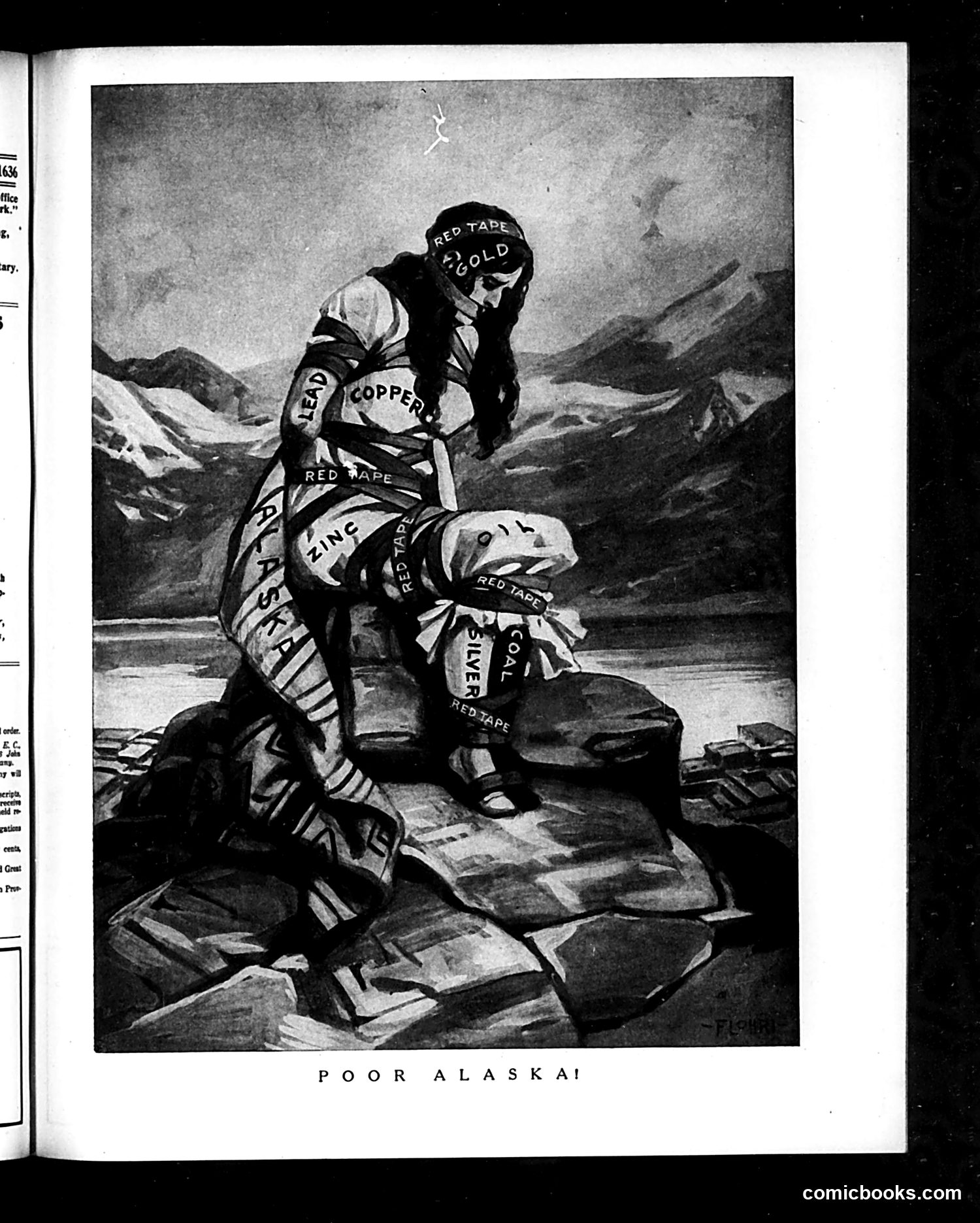
This cartoon depicts Alaska as a wounded figure wrapped in bandages labeled with various economic problems: "Red Tape," "Gold," "Copper," and "Mining." The figure sits dejected in a harsh, mountainous landscape, suggesting Alaska's geographic isolation and economic struggles. The satire criticizes how bureaucratic red tape and regulatory obstacles are preventing Alaska from developing its natural resources (gold, copper, mining). Rather than thriving from its mineral wealth, Alaska remains bound up and immobilized by government obstruction. The "Poor Alaska" caption emphasizes sympathy for the territory's frustrated potential. This likely references early 20th-century debates over Alaska's development and statehood, when territorial resources remained largely untapped due to federal oversight and administrative barriers.
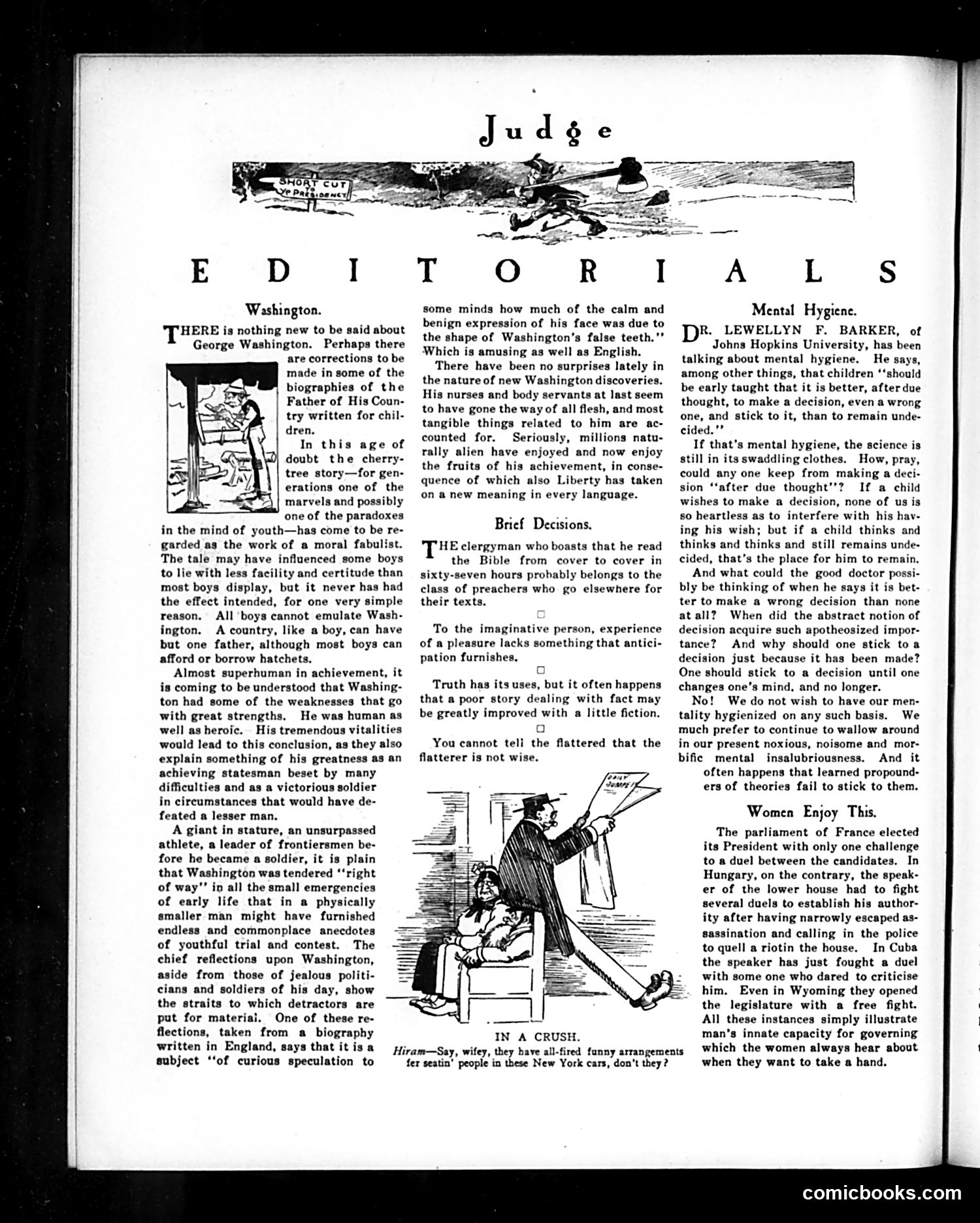
This page presents editorial commentary rather than political cartoons. The main piece discusses George Washington, debunking myths about him (like the cherry tree story) while praising his actual character and achievements. The text argues Washington's true greatness lay in overcoming genuine difficulties, not fabricated anecdotes. The secondary editorial, "Mental Hygiene," critiques indecisive people who won't commit to decisions. It argues that remaining wishy-washy is worse than making wrong choices, advocating for decisiveness. A brief note titled "Women Enjoy This" mocks a French parliament member who fought duels to establish authority, and references similar incidents in Hungary, Cuba, and Wyoming—suggesting men's violent posturing contrasts poorly with women's actual capability to govern. The small cartoon "In a Crush" appears to be a humorous social observation about New York cab arrangements.
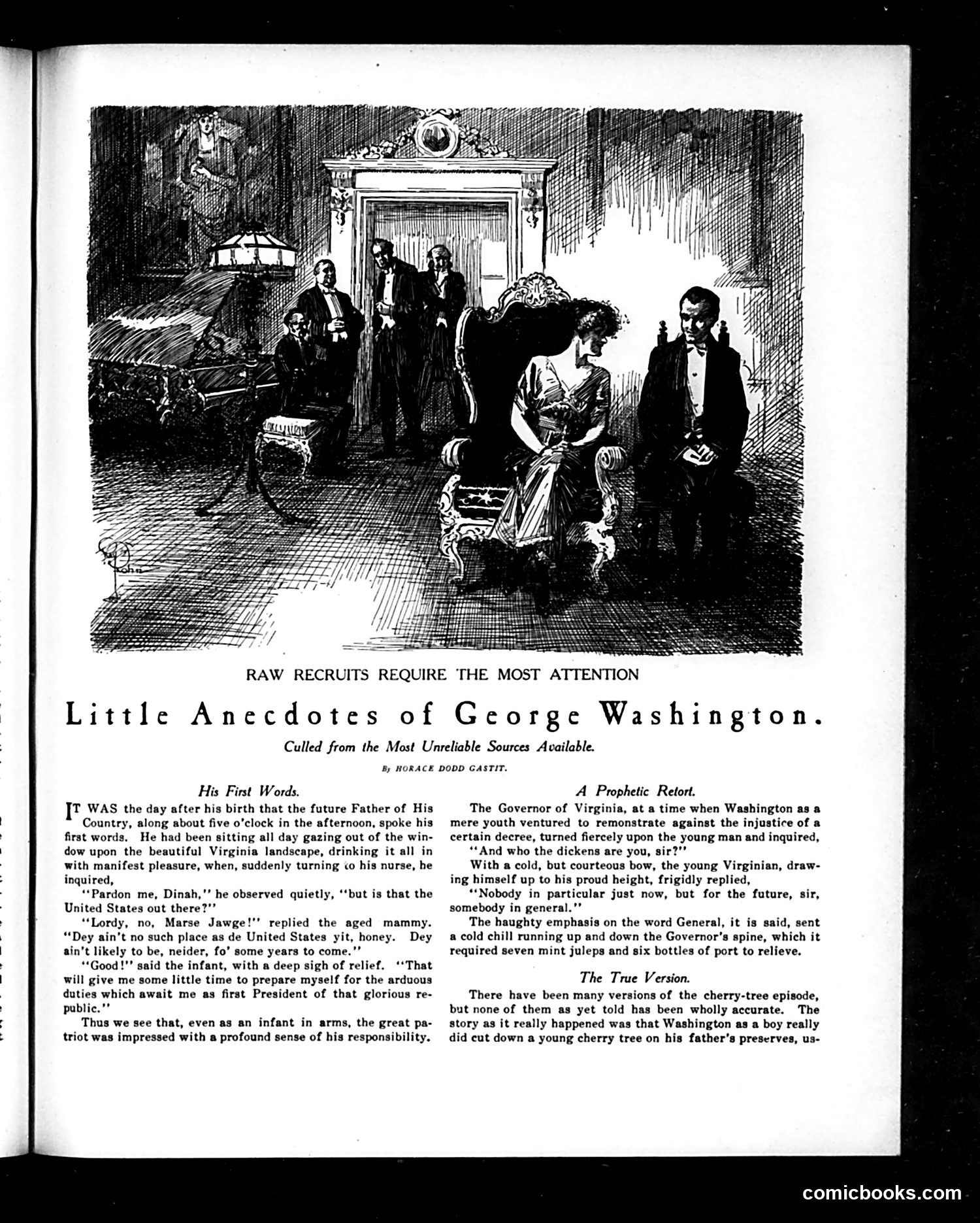
This page from *Judge* magazine presents "Little Anecdotes of George Washington," attributed to humorist Horace Dodd Gattey. The illustration depicts an elegant interior scene with formally dressed figures, likely representing Washington's era. The text includes three anecdotes about young Washington: "His First Words" (speaking to his nurse about Virginia's beauty), "A Prophetic Retort" (responding to Virginia's governor about future leadership), and "The True Version" (addressing the famous cherry-tree legend). The satirical intent appears to be mocking the *mythologization* of Washington through unreliable historical sources. By labeling sources as "Most Unreliable" and progressively debunking famous Washington legends, *Judge* critiques how American folklore sanitizes and romanticizes founding figures. The page parodies hagiographic treatments of Washington common in the era.
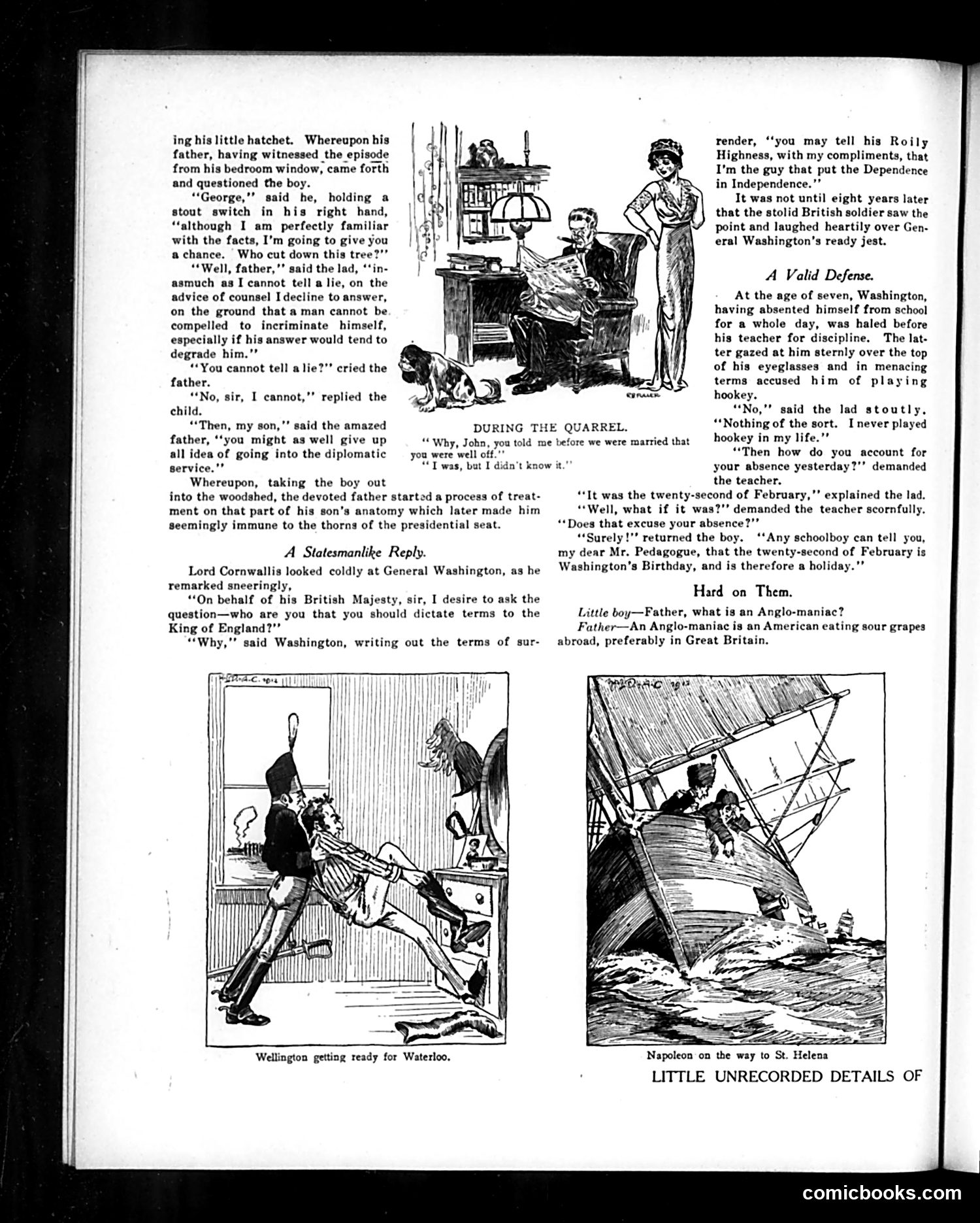
This page contains satirical anecdotes about George Washington and British figures, mocking American deference to British culture. The main jokes exploit the famous (apocryphal) cherry-tree story: young Washington refuses to lie about cutting it down, then uses legalistic evasion instead—satirizing how Americans adopt British legal pretension while claiming independence. A second anecdote shows Washington's witty retort to Lord Cornwallis during surrender negotiations: "I'm the guy that put the Dependence in Independence"—a pun mocking the verbose diplomacy of both nations. The "Valid Defense" section jokes that Washington's Birthday (February 22) excuses any American schoolboy's misbehavior, satirizing American hero-worship. The final "Anglo-maniac" definition mocks Americans abroad in Britain who complain about everything (eating "sour grapes")—criticizing cultural snobbery in both directions. Overall, the page satirizes American-British relations through Washington anecdotes, likely from the early 20th century when Anglo-American tensions were common topics in Judge's humor.
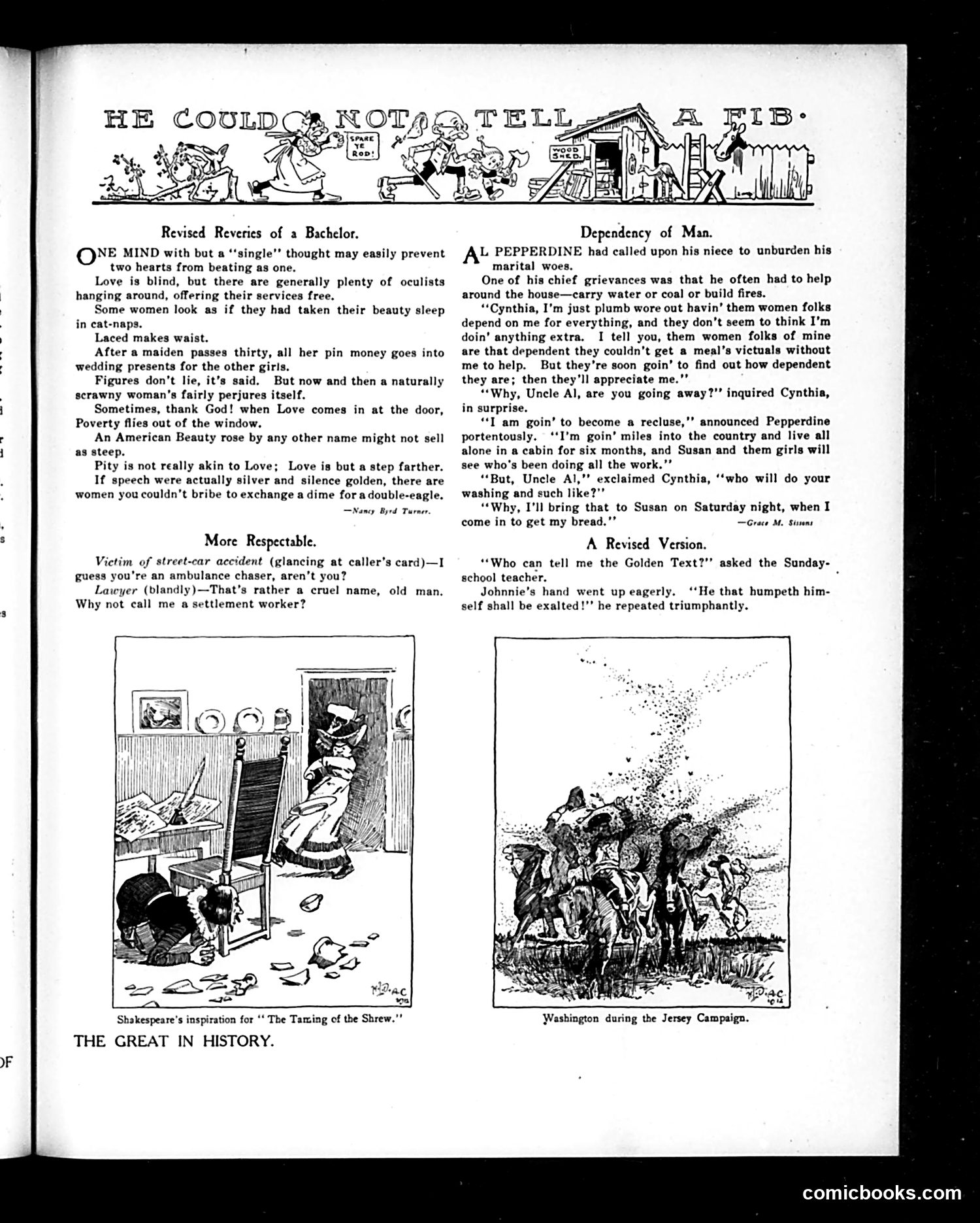
This page contains satirical commentary on gender relations and social pretense circa early 1900s. **"Revised Reveries of a Bachelor"** presents cynical observations about unmarried women—mocking their beauty routines, financial dependence on marriage, and chattiness. The Nancy Byrd Turner verses suggest women's limited options and men's skepticism about romance. **"More Respectable"** jokes about a lawyer euphemistically calling himself a "settlement worker" instead of the pejorative "ambulance chaser" (someone who solicits accident victims). The Shakespeare illustration satirizes women's shrewishness by showing a domestic dispute. **"Dependency of Man"** inverts expectations: Uncle Al complains women depend on him, then announces becoming a recluse for six months—yet admits he'll still bring laundry to Susan for her to wash. The satire exposes male hypocrisy: men claim to support themselves but actually depend entirely on women's unpaid domestic labor, unable to recognize their own dependence. The Sunday school joke offers gentle humor about a child's unintentional double meaning.
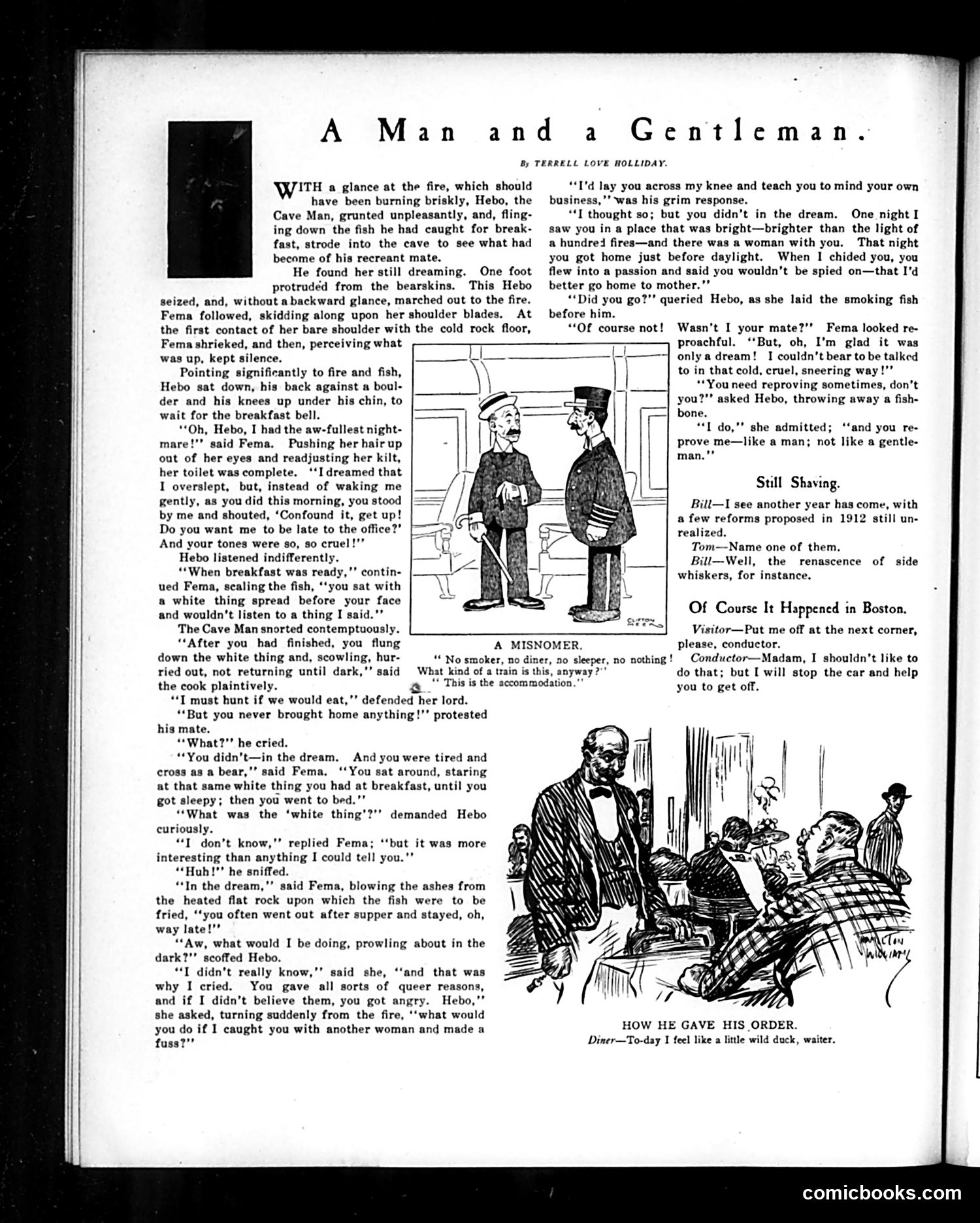
This page contains a short story titled "A Man and a Gentleman" by Terrell Love Holliday, which uses prehistoric "cave man" characters to satirize modern gender relations and marriage dynamics of the early 1900s. The story presents a wife (Fema) describing a nightmare about her husband (Hebo) treating her poorly in modern life—being harsh, ignoring her, staying out late, staring at a "white thing" (likely a newspaper), and potentially meeting other women. When she protests his dream behavior, he threatens physical punishment but claims it was only a dream. The satire's point: it contrasts "a man" (who uses dominance and force) with "a gentleman" (who would treat his wife with respect). By setting this in primitive times, the story suggests that men of the author's era who mistreat their wives are behaving like cavemen rather than civilized gentlemen—a common early-20th-century critique of male behavior and a commentary on changing expectations about marriage and male conduct.
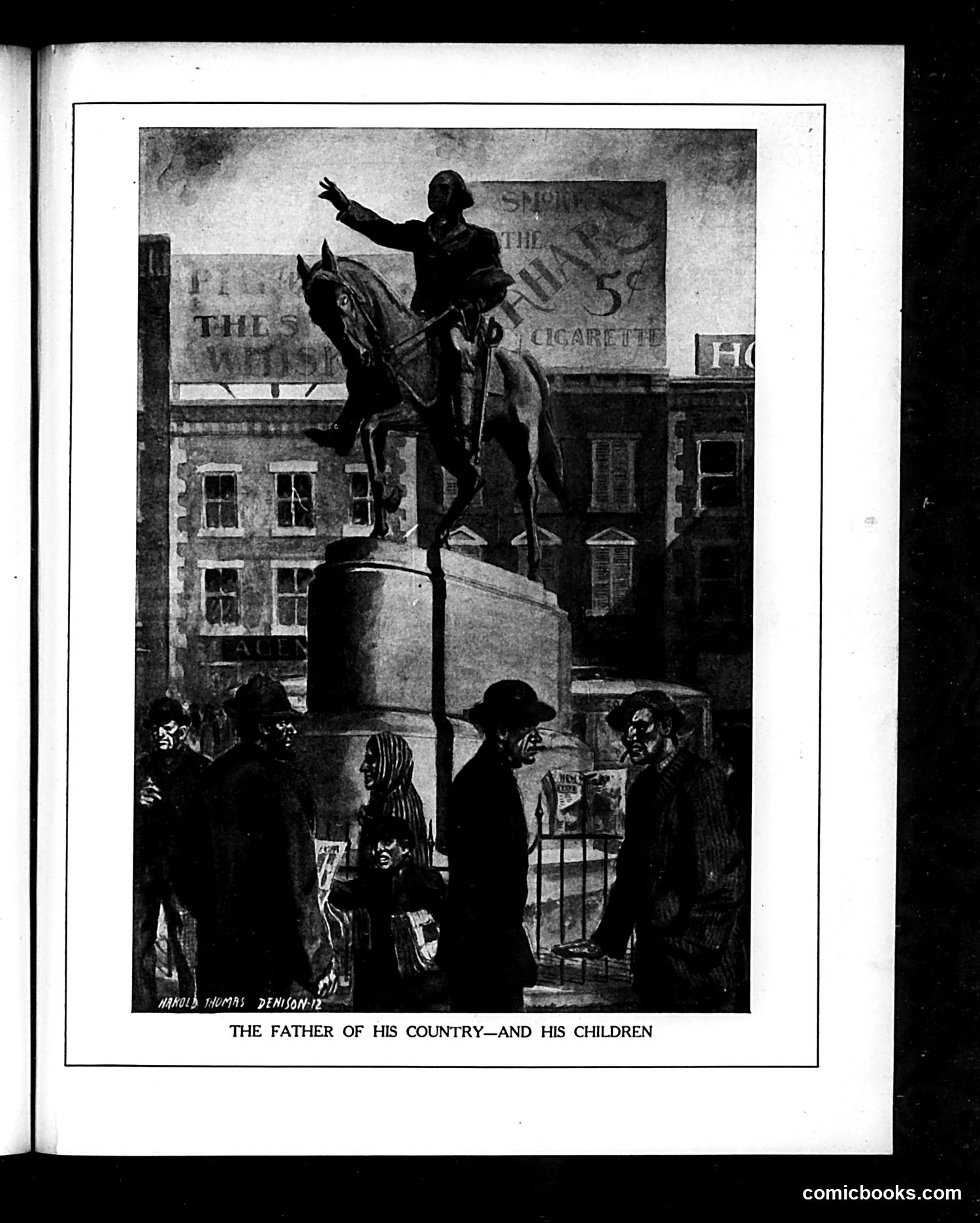
This appears to be a satirical image from *Judge* magazine showing an equestrian statue of what the caption identifies as "The Father of His Country"—likely George Washington. The statue depicts a mounted figure on a pedestal, with several civilians gathered below, including children and adults in period clothing. The satire likely criticizes the gap between idealized patriotic monuments and contemporary social reality. By captioning the image "and his children," the artist suggests irony: these ordinary citizens (the "children" of the nation) stand below the revered statue, perhaps indicating they are disconnected from, or not benefiting from, the nation's founding ideals. The crowded urban setting with visible commercial signage (cigarette advertisements visible in background) underscores the mundane present contrasted against the noble past. Without the specific publication date, the exact political critique remains unclear.
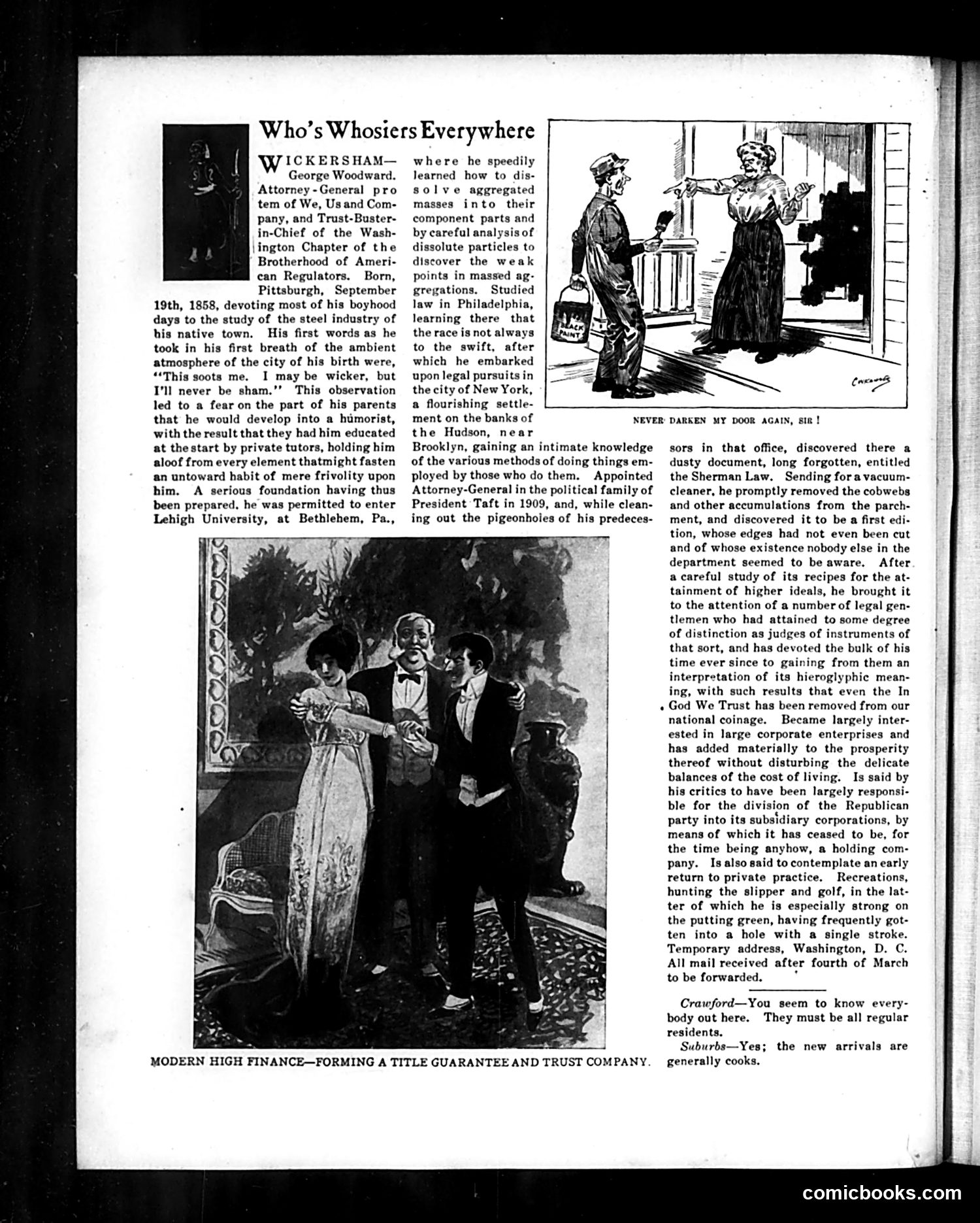
This satirical biography parodies **George Wickersham**, Attorney General under President Taft (1909-1913). The text mockingly credits him with "discovering" the Sherman Antitrust Act—a decades-old law—gathering dust in his office, then aggressively pursuing trust-busting that divided the Republican Party into "subsidiary corporations." The satire mocks Wickersham's zealous, legalistic approach to antitrust enforcement. Phrases like removing "God We Trust" from coinage and getting "into a hole with a single stroke" suggest his actions had unintended consequences, destabilizing Republican unity. The cartoon below (captioned "Modern High Finance") depicts wealthy figures forming corporate structures—satirizing how the wealthy circumvent regulations through complex financial instruments, precisely what Wickersham claimed to combat. The joke: despite aggressive legal action, corporate interests still prospered while the political establishment fractured.
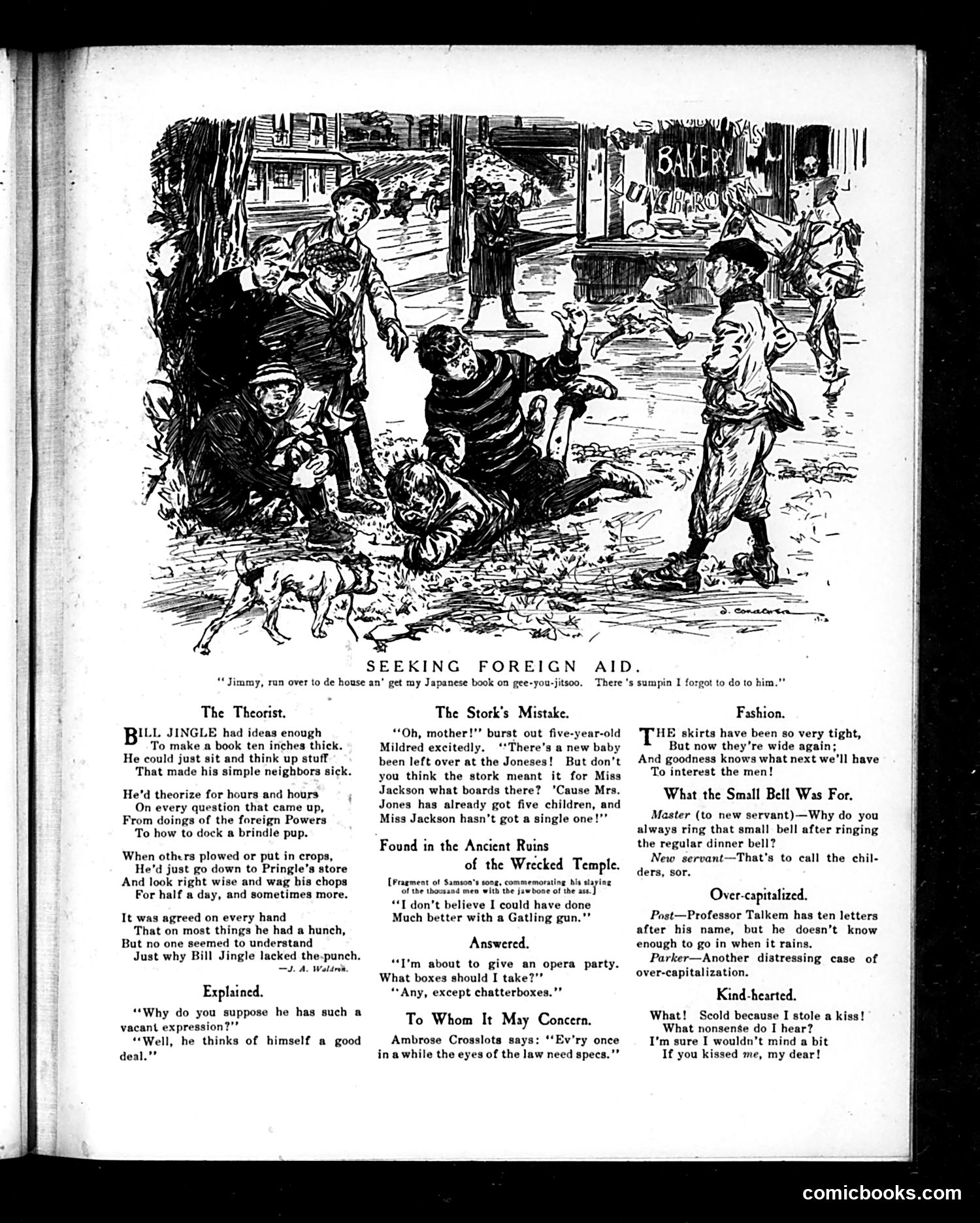
This page collects brief humorous pieces and satirical vignettes typical of Judge magazine's format. **"Seeking Foreign Aid"** (top cartoon): A street scene showing someone instructing "Jimmy" to fetch a "Japanese book on gee-you-jitsoo" (jiu-jitsu) to use on another person. The satire mocks Americans' fascination with Japanese martial arts as a novelty—treating fighting techniques as exotic foreign imports rather than serious discipline. **"The Theorist"**: A poem mocking Bill Jingle, an intellectual who theorizes endlessly about everything from foreign policy to dog-docking but accomplishes nothing. The satire targets armchair philosophers who talk without taking practical action. **Other pieces**: "The Stork's Mistake" jokes about baby delivery mishaps; "Found in Ancient Ruins" humorously compares biblical weaponry (Samson's jawbone) to modern guns; various quips satirize fashion trends, over-credentialed professors, and romantic behavior. The overall tone reflects early 20th-century American humor: gentle mockery of pretension, social awkwardness, and contemporary fads.
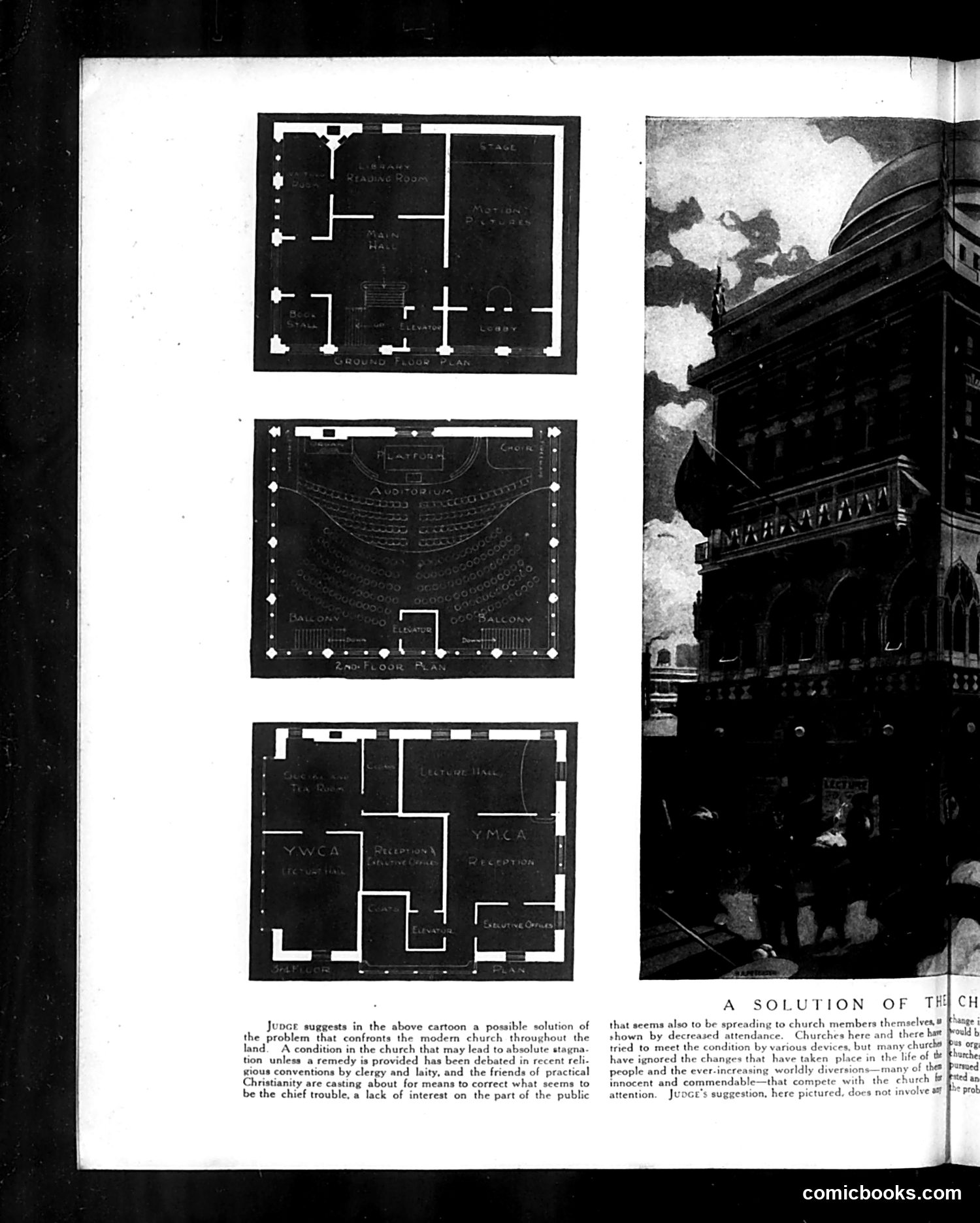
This page addresses the early 20th-century "church problem"—declining public interest in organized religion. The three floor plans show architectural solutions: reconfiguring church spaces to include modern amenities like a YWCA, lecture halls, and social gathering areas alongside traditional worship space. The accompanying photograph (right) shows an ornate church building, likely contrasting old architectural grandeur with modern needs. The satire critiques that churches faced a crisis of relevance. Rather than addressing spiritual or theological issues, Judge suggests the solution involves modernizing facilities and adding secular recreational activities. The cartoon implies churches were responding to declining attendance by becoming social centers rather than addressing deeper religious disengagement. This reflects tensions between traditional religion and modernization in the Progressive Era, when churches competed with secular entertainment and social institutions for public attention.
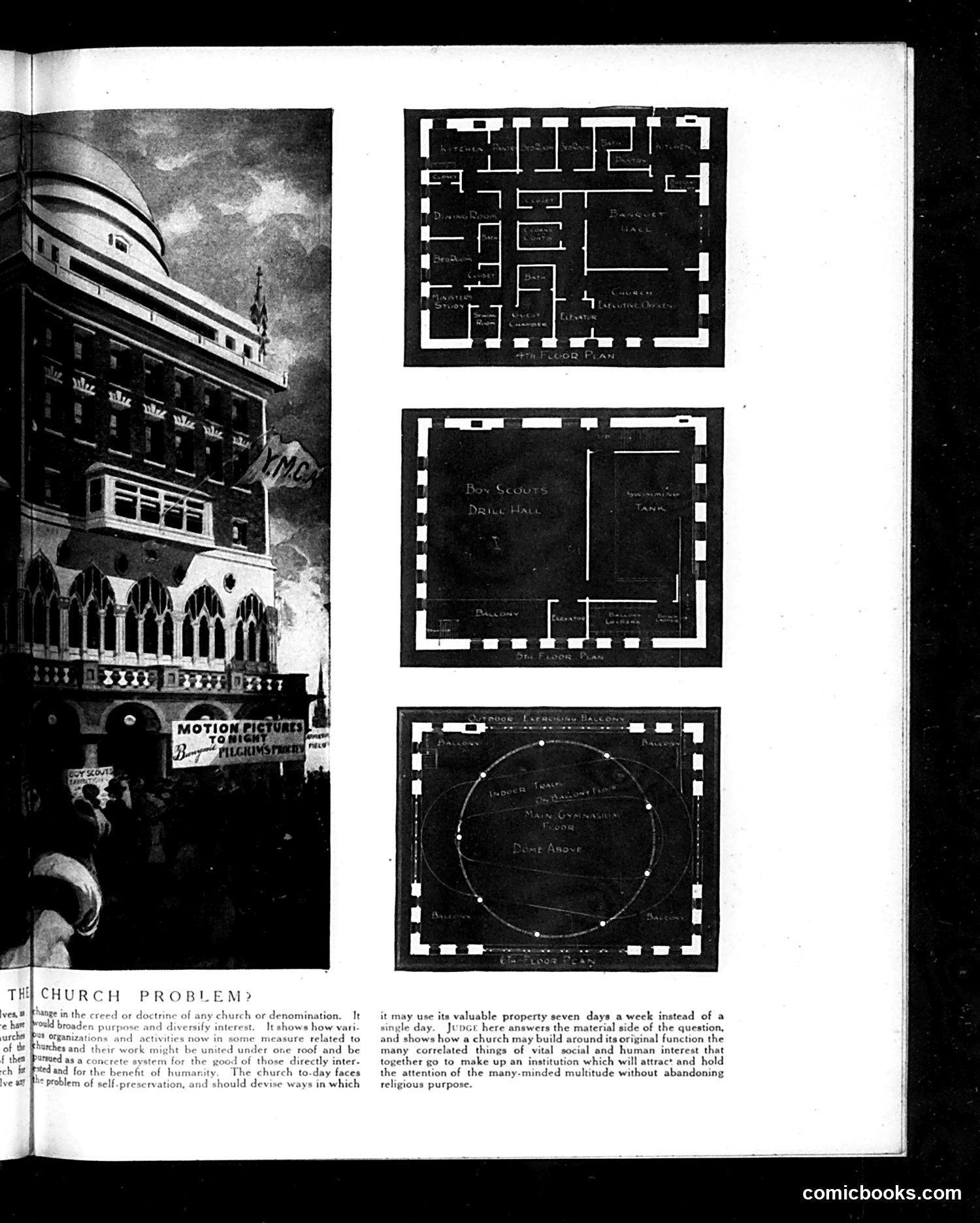
This page addresses "The Church Problem"—a early-20th-century concern about declining church attendance and relevance. The left side shows a photograph of what appears to be a grand urban church building (with "Motion Pictures" signage visible nearby), suggesting competition from secular entertainment venues. The three architectural floor plans on the right propose a solution: redesigning churches to include multipurpose spaces—a "Boy Scouts Drill Hall" and various community facilities alongside traditional worship areas. The circular diagram at bottom shows a domed auditorium layout. The satire's point: churches must compete with modern attractions (motion pictures, social organizations) by offering more than Sunday services. The text explicitly argues churches should use their property "seven days a week" and incorporate "correlated things of vital social and human interest" to "attract and hold the attention of the many-minded multitude without abandoning religious purpose." This reflects Progressive Era debates about institutional relevance and the tension between traditional religion and modern secular culture.
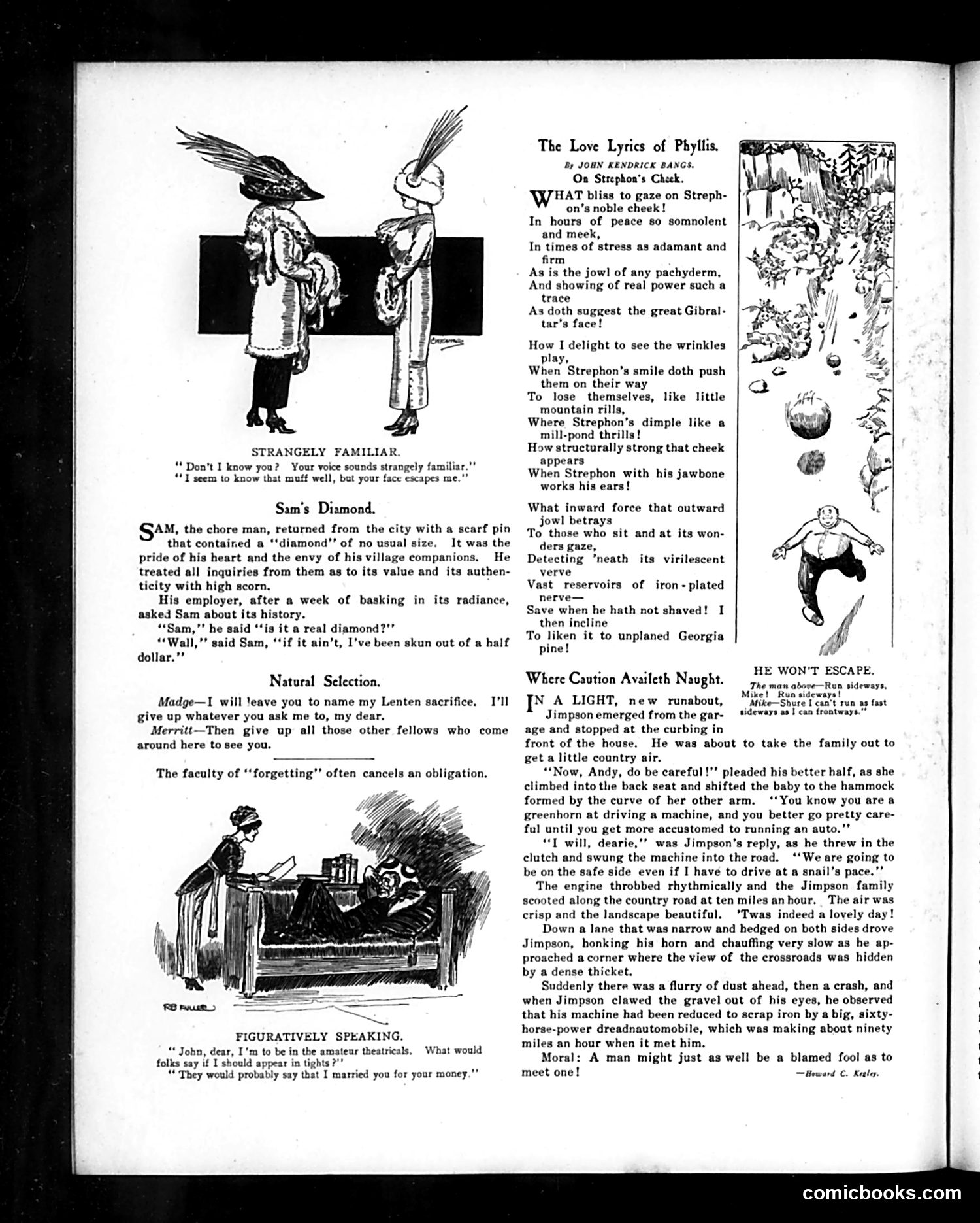
This page contains several satirical pieces typical of early 20th-century Judge magazine: **"Strangely Familiar"** — A brief visual joke about two figures who recognize each other's voices but not faces, likely poking fun at superficial social recognition. **"Sam's Diamond"** — Rural humor about a country man (Sam) who buys what he claims is a diamond pin for half a dollar. The satire mocks both his credulity as a consumer and his defensive pride about the purchase. **"Natural Selection"** and **"Figuratively Speaking"** — Short domestic humor pieces where wives outwit or embarrass their husbands, reflecting common gender-based comedic tropes of the era. **"Love Lyrics of Phyllis"** — Poetic satire mocking Romantic poetry's overwrought descriptions by applying flowery language to an ordinary man's unremarkable facial features, particularly his jowls and jaw. **"Where Caution Availeth Naught"** — A cautionary tale about an inexperienced motorist who drives carefully but is struck by a speeding automobile anyway—satirizing both new automotive dangers and the futility of caution against recklessness.
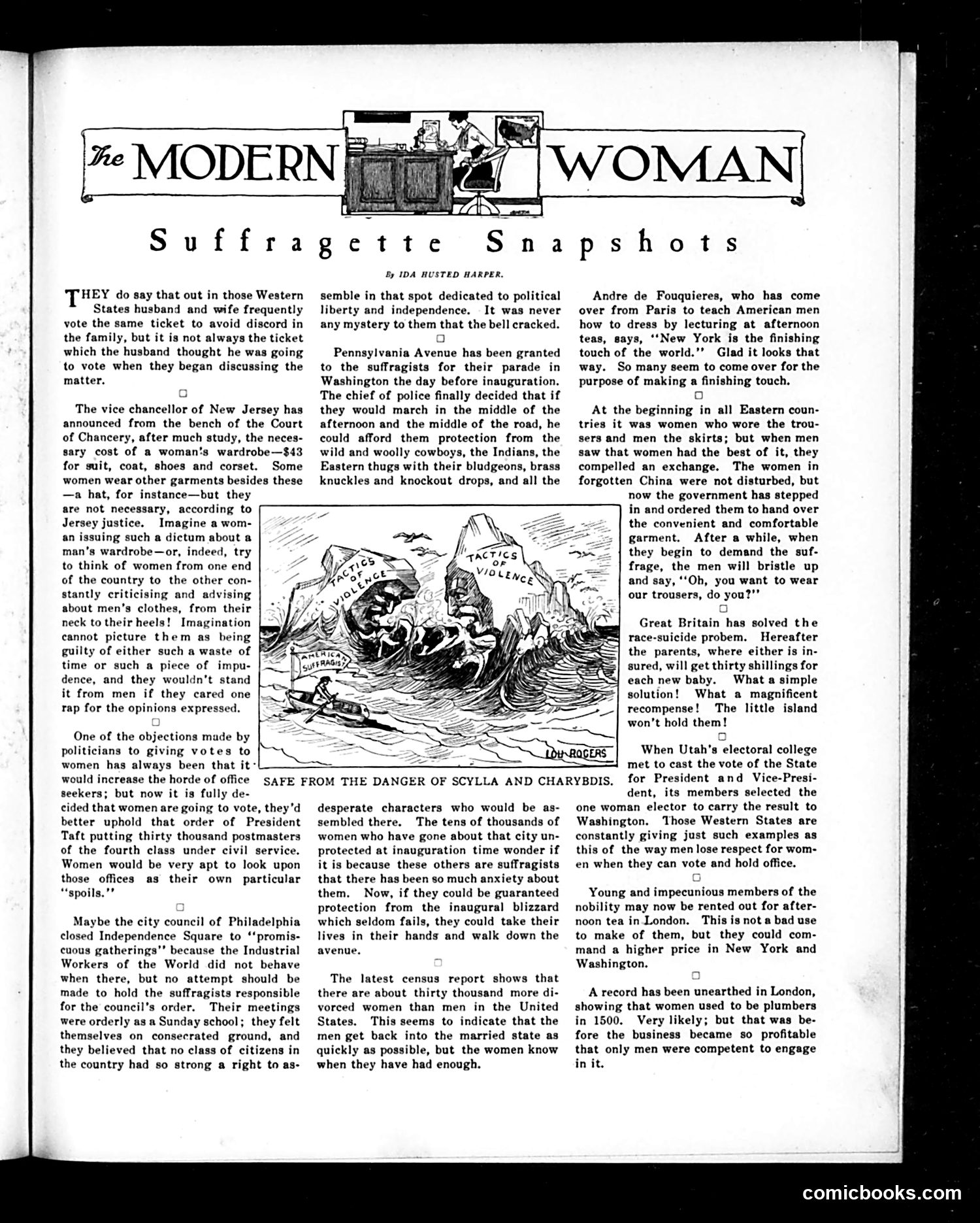
This column by Ida Husted Harper comprises satirical commentary on women's suffrage and gender politics, with one accompanying cartoon. **The cartoon** depicts the goddess of Liberty (labeled "Tactics" and "Vigilance") navigating between Scylla and Charybdis—classical mythological dangers—representing female suffragists' precarious position. The reference likely alludes to planned suffragist parades (the text mentions Pennsylvania Avenue being granted for a suffrage parade before presidential inauguration) facing potential hostile crowds. **The text's satire** employs ironic reversal: it mocks male politicians' opposition to women voting by highlighting the hypocrisy of men controlling women's fashion choices (via a New Jersey judge's ruling on necessary wardrobe costs) while claiming women voters would corrupt politics through "office-seeking." The column also sardonically notes census data showing more divorced women than men remarrying—implying women wisely avoid remarriage while men rush back into it. Overall, Harper's piece defends women's political participation by exposing the contradictions and double standards in anti-suffrage arguments.
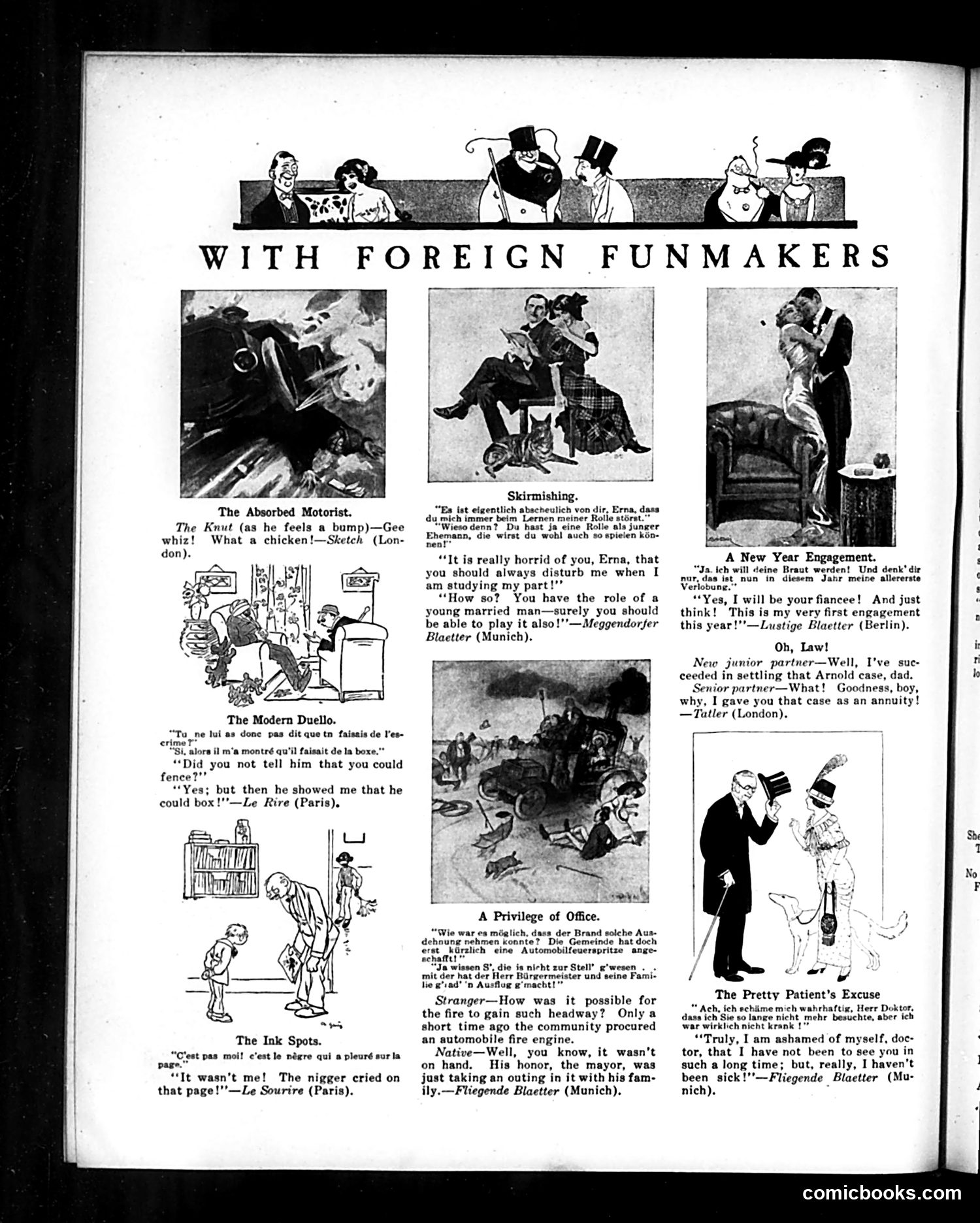
This page collects humorous anecdotes translated from European satirical publications (Sketch, Le Rire, Meggendorfer Blaetter, etc.), presenting jokes that rely on cultural misunderstandings and social commentary familiar to international readers. The cartoons mock everyday absurdities: a distracted motorist, a fencing dispute resolved through boxing instead, bureaucratic incompetence (a mayor using the town's new fire engine for personal outings while buildings burn), marital role-playing confusion, and a doctor's patient who avoided visits because she wasn't actually sick—implying she enjoyed being ill for the attention. The "Ink Spots" joke employs offensive period language reflecting casual racism in early 20th-century humor. Overall, the page demonstrates how Judge republished foreign humor to entertain American audiences with relatable comedic scenarios while showcasing European wit.
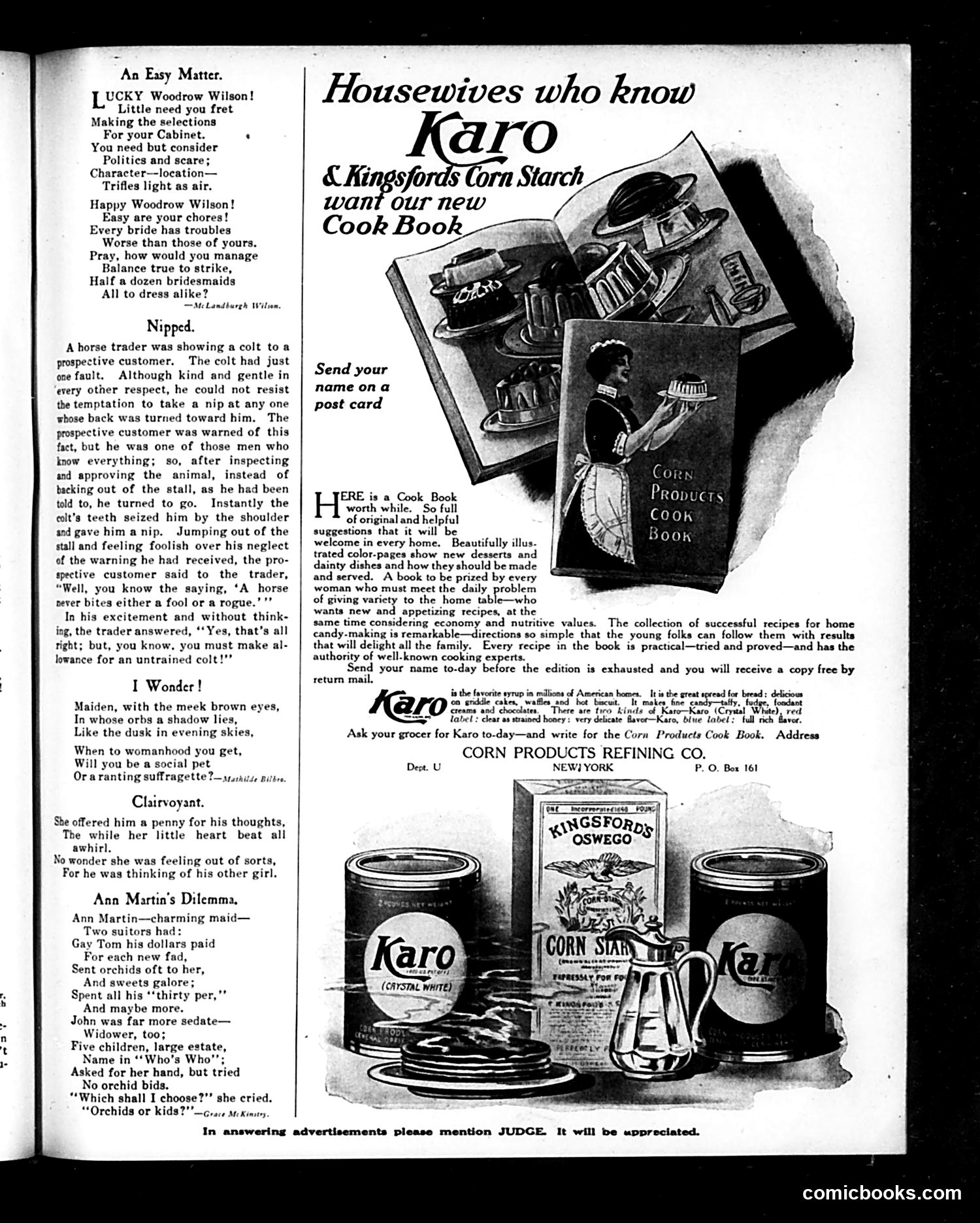
This page contains primarily **advertising and light verse**, not political satire. The political content is minimal: ## Political Reference The poem "An Easy Matter" addresses **Woodrow Wilson**, newly elected president (1912), gently mocking his cabinet-selection task as trivially easy compared to a bride organizing bridesmaids. This is mild ribbing of Wilson's political appointment process, comparing serious governance to domestic trivia—typical of the era's humor about newly-elected presidents. ## Remaining Content The page is dominated by: - **Karo Corn Starch advertisements** promoting a free cookbook - **Humorous short stories and verses** (the colt anecdote, romantic dilemmas) unrelated to politics The anecdotes use wordplay and ironic twists typical of Judge's light humor, but contain no political meaning. The "suffragette" reference in "I Wonder!" is merely a contemporary social type for comic contrast, not political commentary. **Bottom line:** This is primarily a commercial/entertainment page with minimal satire.
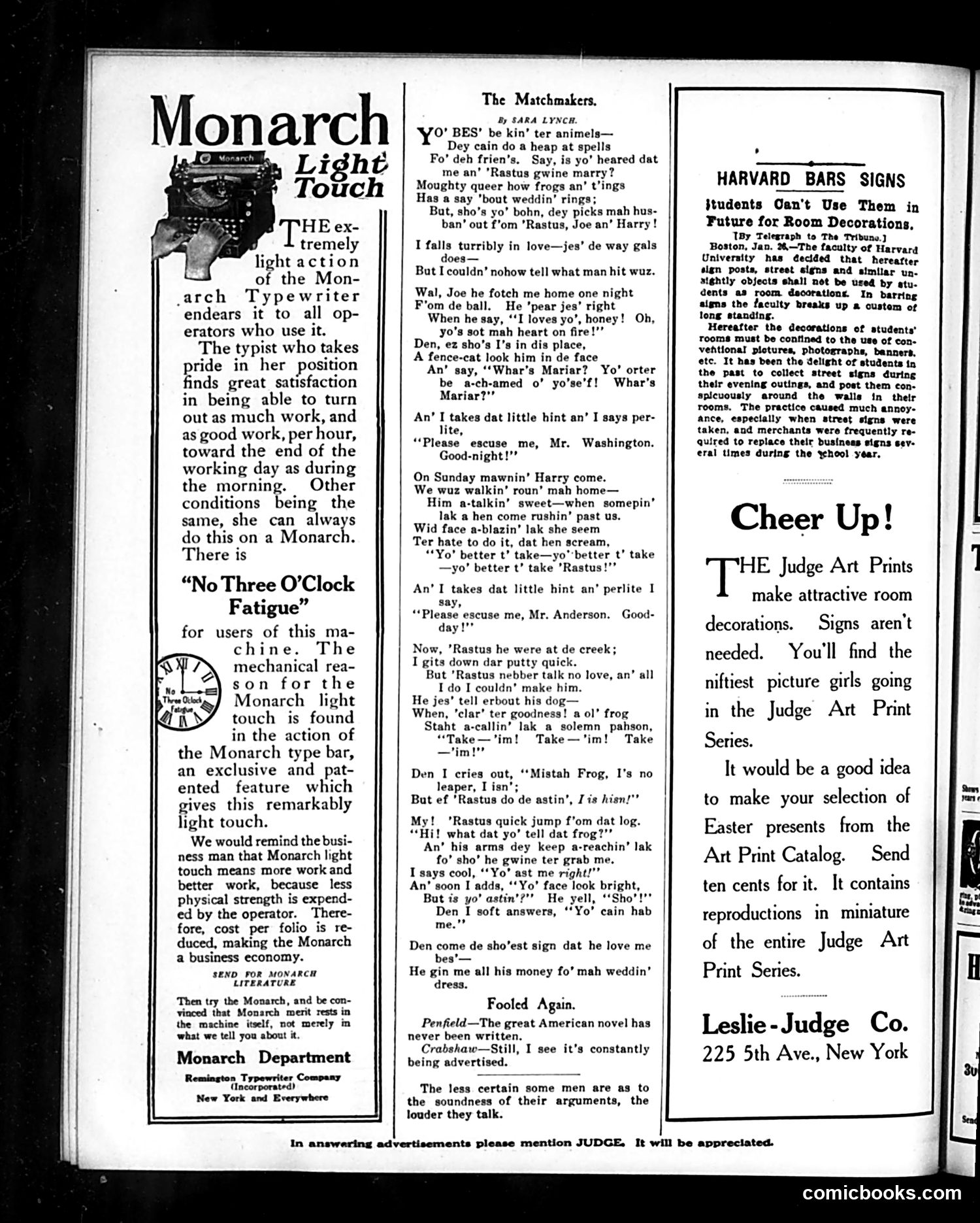
This is a dialectal comic poem using African American Vernacular English (AAVE) of the early 20th century. The narrator, a Black woman, describes how various animals intervene in her romantic choices—a fence-cat, hen, and frog each "reject" suitors (Joe, Harry, Anderson) until the animals point her toward 'Rastus, whom she marries. The humor relies on the conceit that animals possess matchmaking wisdom. The dialect-heavy writing was typical of Judge's era, though by modern standards the heavy phonetic spelling and stereotypical portrayal reflect period prejudices. The page also includes a Monarch typewriter advertisement emphasizing reduced "fatigue" for typists, and a brief note about Harvard banning street signs from student rooms—practical administrative concerns of the time.
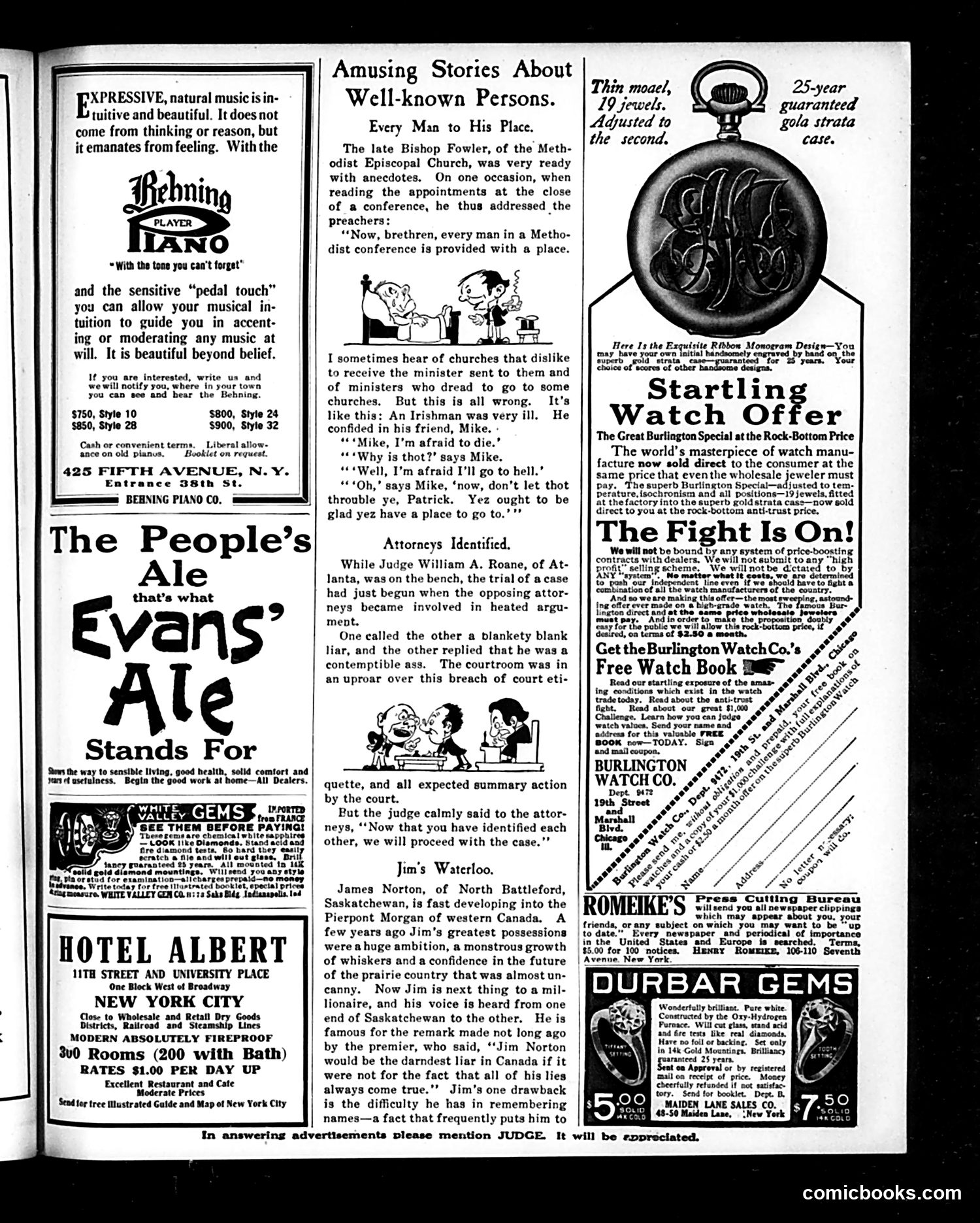
This page is primarily advertisements with some humorous anecdotes rather than political satire. The "Amusing Stories" section contains three jokes featuring named figures: 1. **Bishop Fowler** of the Methodist Episcopal Church tells an Irish dialect joke about accepting one's assigned place (a minister to his parish), comparing it to an Irishman accepting he'll go to hell if he must. 2. **Judge William A. Roane** of Atlanta makes a dry wit quip when two arguing attorneys call each other "liar" and "ass"—he says now that they've identified each other, they can proceed with the case. 3. **James Norton** of North Battleford, Saskatchewan is described as a prairie millionaire whose only flaw is forgetting names; the Saskatchewan premier remarked Norton would be Canada's biggest liar except "all of his lies always come true." These are anecdotes about relatively minor figures (a bishop, judge, and businessman), presented as human-interest humor rather than political commentary. The page primarily serves to fill space between watch, piano, hotel, and gem advertisements.
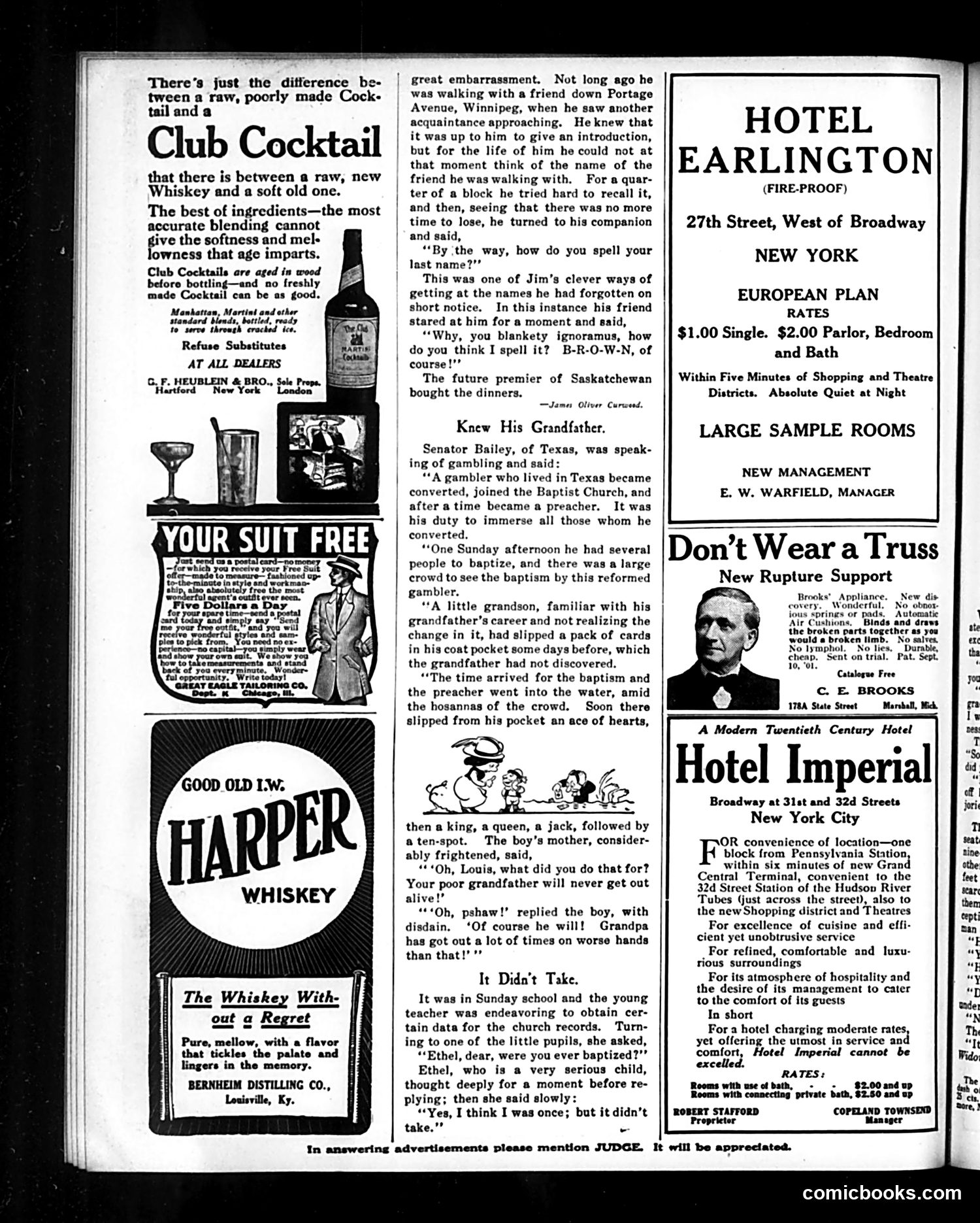
This page is primarily **advertising with interspersed short humorous stories** rather than political satire. The main content includes: **Advertisements:** Hotel Arlington, Hotel Imperial, Harper Whiskey, Brooks' Rupture Support, and a men's clothing offer dominate the layout. **Humorous Anecdotes:** Three brief stories appear in the text: 1. A tale about a man in Winnipeg who forgets an acquaintance's name and cleverly asks how to spell it (punchline: "Brown") 2. Senator Bailey of Texas recounting a converted gambler-turned-preacher whose baptism is disrupted when playing cards spill from his pocket during the ceremony—the grandson explains his grandfather "has got out a lot of times on worse hands" 3. An incomplete Sunday school story about a teacher asking a child if she was baptized **The satire is gentle and moralistic** rather than political—poking fun at memory lapses, hypocrisy, and childhood innocence. The page reflects early 20th-century American attitudes toward propriety and religious practice.
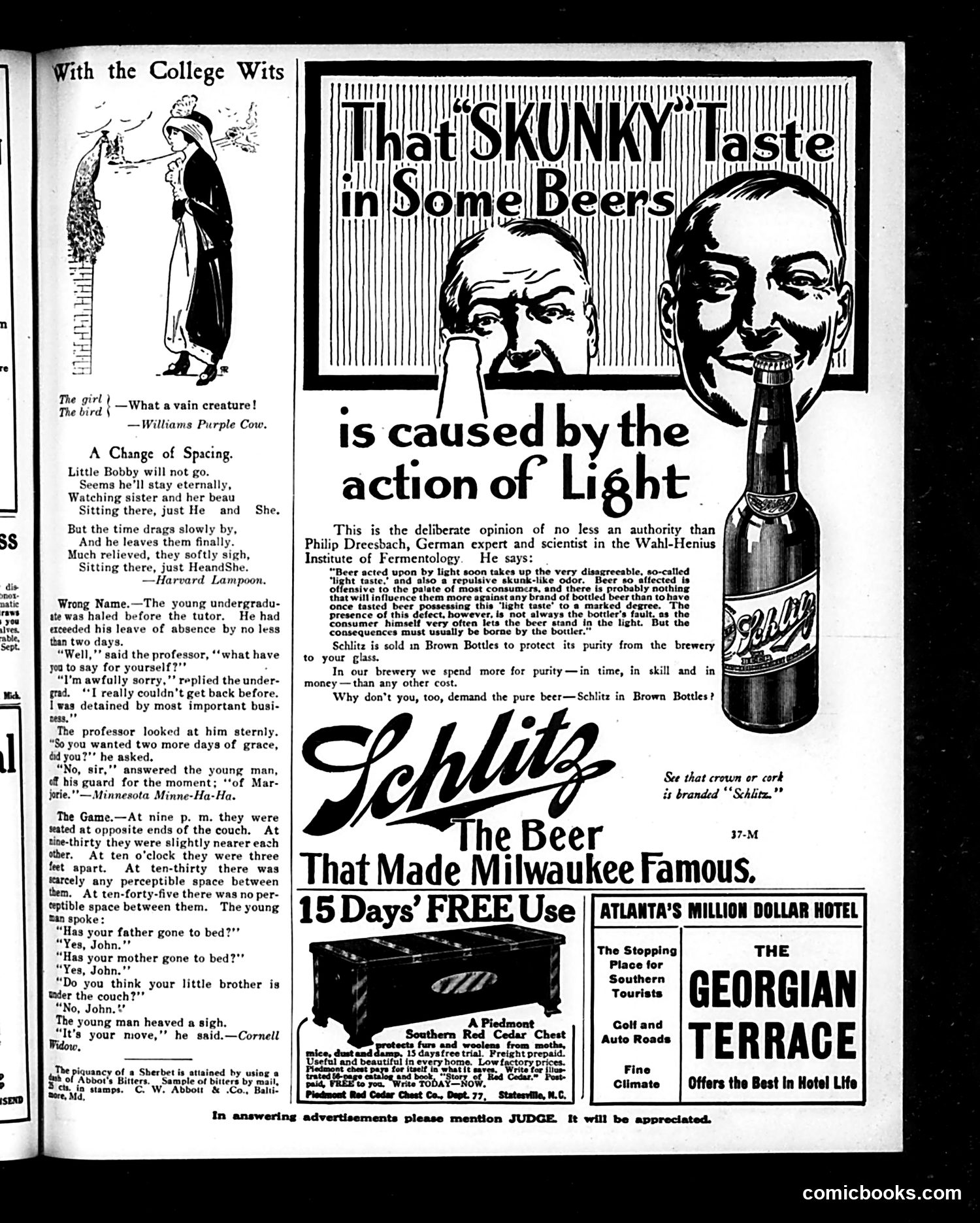
This page consists primarily of **humorous college anecdotes** and **advertisements** typical of early 20th-century satirical magazines. The "College Wits" section features brief, joke-heavy stories mocking undergraduate life: a tutor confronting a tardy student, couples sitting on couches with increasingly minimal spacing (implying courtship/intimacy), and absurdist Q&A about family members. These are gentle social satire about youth behavior and romantic convention. The **major advertisement** is for **Schlitz beer**, which claims (citing a German fermentation expert) that light exposure causes "skunky" off-flavors. Schlitz's selling point: brown bottles protect beer from light damage. This reflects early 20th-century beer marketing before modern refrigeration, when light-struck beer was genuinely problematic. Secondary ads include a Piedmont cedar chest and Atlanta's Georgian Terrace Hotel. No political figures or events are referenced. The humor relies on recognizable social situations rather than topical satire.
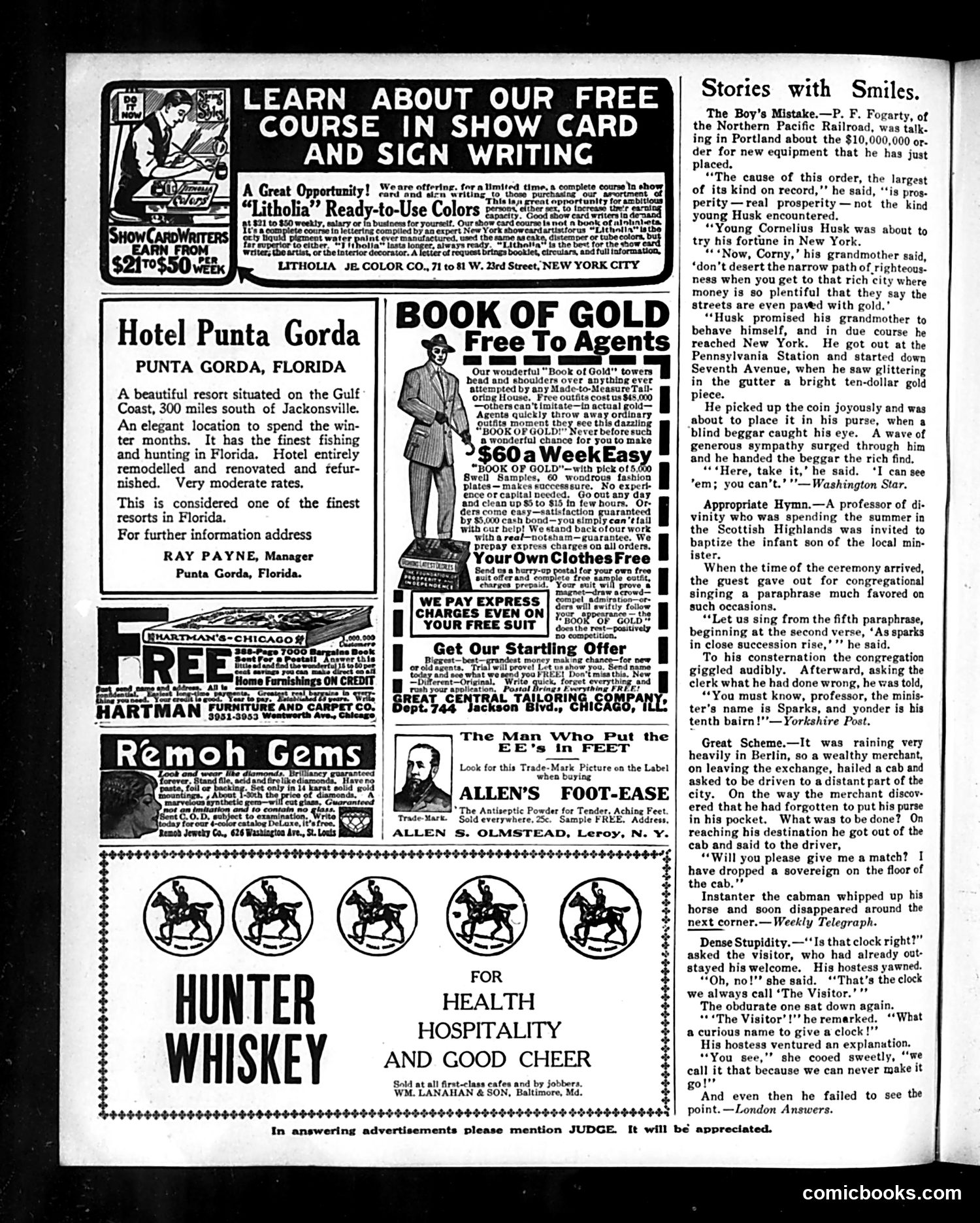
This page is primarily **advertising** with a short humor section ("Stories with Smiles"). The advertisements promote various products and services typical of the era: a show card/sign-writing correspondence course, a Florida resort hotel, furniture on credit, a "Book of Gold" scheme promising easy money to agents, Allen's Foot-Ease powder, and Hunter Whiskey. These ads reflect early 20th-century consumer culture and marketing tactics. The humor section contains two brief anecdotes: 1. **"The Boy's Mistake"** mocks a young man's misguided charity—he gives his found gold coin to a blind beggar, reasoning "I can see 'em; you can't." The joke is on his flawed logic. 2. **"Appropriate Hymn"** (incomplete) appears to set up a humorous situation involving a professor and a baptism ceremony. Neither story contains obvious political satire. The page reflects general period attitudes about morality, class, and urban/rural contrasts rather than specific political commentary.
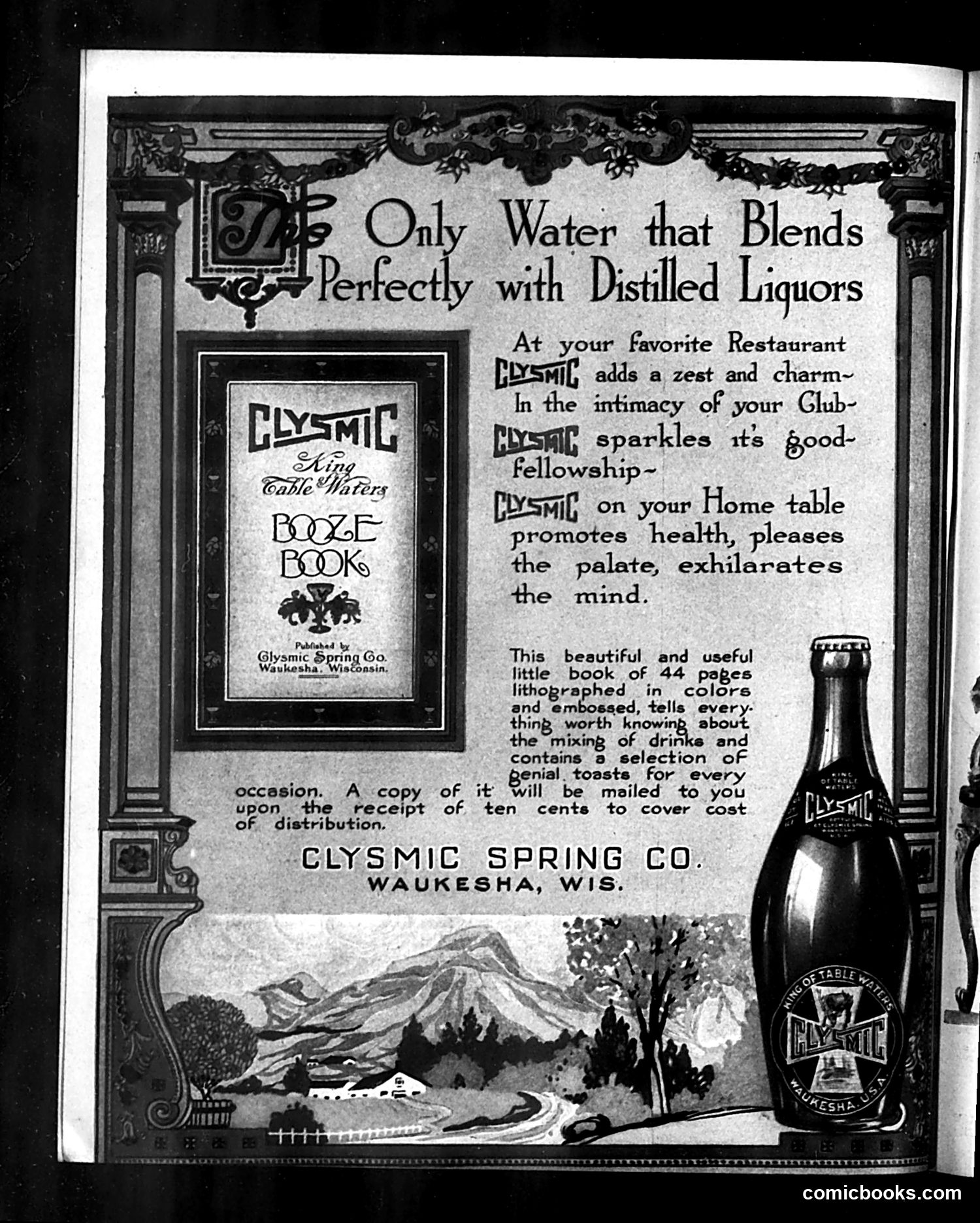
This page is primarily a **product advertisement** for Clysmic Spring water from Waukesha, Wisconsin—not political satire or a cartoon requiring historical decoding. The ad promotes water as the ideal mixer for distilled liquors (spirits), claiming it enhances drinks at restaurants, clubs, and home tables while promoting health. The company offers a free 44-page illustrated book on mixing drinks and toasts for ten cents. The decorative border, bottle imagery, and period typography are typical early-20th-century advertising design. While published in *Judge* magazine (known for satire), this appears to be straightforward commercial promotion rather than commentary on politics or society. The only implicit message is consumerist: quality water enhances social drinking occasions and demonstrates refinement.