
Judge, 1913-02-22 · page 4 of 24
Judge — February 22, 1913 — page 4: what you’re looking at
What you’re looking at
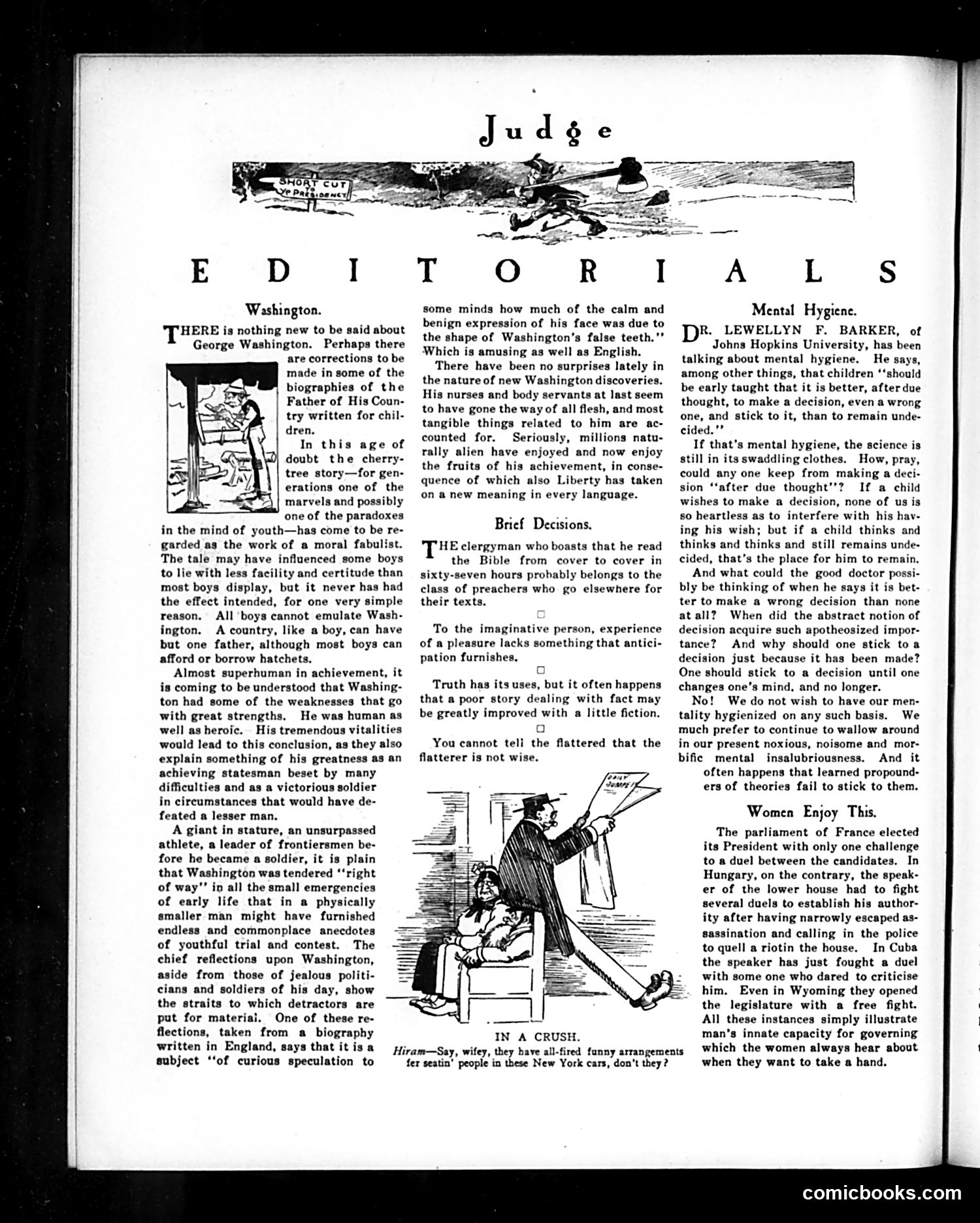
This page presents editorial commentary rather than political cartoons. The main piece discusses George Washington, debunking myths about him (like the cherry tree story) while praising his actual character and achievements. The text argues Washington's true greatness lay in overcoming genuine difficulties, not fabricated anecdotes. The secondary editorial, "Mental Hygiene," critiques indecisive people who won't commit to decisions. It argues that remaining wishy-washy is worse than making wrong choices, advocating for decisiveness. A brief note titled "Women Enjoy This" mocks a French parliament member who fought duels to establish authority, and references similar incidents in Hungary, Cuba, and Wyoming—suggesting men's violent posturing contrasts poorly with women's actual capability to govern. The small cartoon "In a Crush" appears to be a humorous social observation about New York cab arrangements.
📄 Transcribed text from this page (OCR, searchable)
Machine-transcribed from the original scan — historical spelling and the odd misread are preserved.
Washington. HERE is nothing new to be said about George Washington. Perhaps there are corrections to be made in some of the biographies of the Father of His Coun- try written for chil- dren. In this age of doubt the cherry- tree story—for gen- erations one of the marvels and possibly one of the paradoxes in the mind of youth—has come to be re- garded as the work of a moral fabulist. The tale may have influenced some boys to lie with less facility and certitude than most boys display, but it never has had the effect intended, for one very simple reason. All boys cannot emulate Wash- ington. A country, like a boy, can have but one father, although most boys can afford or borrow hatchets, Almost superhuman in achievement, it is coming to be understood that Washing- ton had some of the weaknesses that go with great strengths. He was human as well as heroic. His tremendous vitalities would lead to this conclusion, as they also explain something of his greatness as an achieving statesman beset by many difficulties and as a victorious soldier in circumstances that would have de- feated a lesser man. A giant in stature, an unsurpassed athlete, a leader of frontiersmen be- fore he became a soldier, it is plain that Washington was tendered ‘right of way”’ in all the small emergencies of early life that in a physically smaller man might have furnished endless and commonplace anecdotes of youthful trial and contest. The chief reflections upon Washington, aside from those of jealous politi- cians and soldiers of his day, show the straits to which detractors are put for material. One of these re- flections, taken from a biography written in England, says that it is a subject ‘‘of curious speculation to some minds how much of the calm and benign expression of his face was due to the shape of Washington's false teeth.’’ Which is amusing as well as English. There have been no surprises lately in the nature of new Washington discoveries. His nurses and body servants at last seem to have gone the way of all flesh, and most tangible things related to him are ac- counted for. Seriously, millions natu- rally alien have enjoyed and now enjoy the fruits of his achievement, in conse- quence of which also Liberty has taken on a new meaning in every language. Brief Decisions. "THE clergyman who boasts that he read the Bible from cover to cover in sixty-seven hours probably belongs to the class of preachers who go elsewhere for their texts. To the imaginative person, experience of a pleasure lacks something that antici- pation furnishes. [a] Truth has its uses, but it often happens that a poor story dealing with fact may be greatly improved with a little fiction. o You cannot tell the flattered that the flatterer is not wise. Hiram—Say, wifey, they have all-fired funny arrangements fer seatin’ people in these New York cars, don't they? Mental Hygiene. D®. LEWELLYN F. BARKER, of Johns Hopkins University, has been talking about mental hygiene. He says, among other things, that children ‘‘should be early taught that it is better, after due thought, to make a decision, even a wrong one, and stick to it, than to remain unde- cided."” If that’s mental hygiene, the science is still in its swaddling clothes. How, pray, could any one keep from making a deci- sion ‘‘after due thought’’? If a child wishes to make a decision, none of us is so heartless as to interfere with his hav- ing his wish; but if a child thinks and thinks and thinks and still remains unde- cided, that’s the place for him to remain. And what could the good doctor possi- bly be thinking of when he says it is bet- ter to make a wrong decision than none atall? When did the abstract notion of decision acquire such apotheosized impor- tance? And why should one stick toa decision just because it has been made? One should stick to a decision until one changes one’s mind, and no longer. No! We do not wish to have our men- tality hygienized on any such basis. We much prefer to continue to wallow around in our present noxious, noisome and mor- bific mental insalubriousness. And it often happens that learned propound- ers of theories fail to stick to them. Women Enjoy This. The parliament of France elected its President with only one challenge to a duel between the candidates. In Hungary, on the contrary, the speak- er of the lower house had to fight several duels to establish his author- ity after having narrowly escaped as- sassination and calling in the police to quell a riotin the house. In Cuba the speaker has just fought a duel with some one who dared to criticise him. Even in Wyoming they opened the legislature with a free fight. All these instances simply illustrate man’s innate capacity for governing which the women always hear about when they want to take a hand. comicbooks.com