
Judge, 1913-02-22 · page 8 of 24
Judge — February 22, 1913 — page 8: what you’re looking at
What you’re looking at
This page contains a short story titled "A Man and a Gentleman" by Terrell Love Holliday, which uses prehistoric "cave man" characters to satirize modern gender relations and marriage dynamics of the early 1900s. The story presents a wife (Fema) describing a nightmare about her husband (Hebo) treating her poorly in modern life—being harsh, ignoring her, staying out late, staring at a "white thing" (likely a newspaper), and potentially meeting other women. When she protests his dream behavior, he threatens physical punishment but claims it was only a dream. The satire's point: it contrasts "a man" (who uses dominance and force) with "a gentleman" (who would treat his wife with respect). By setting this in primitive times, the story suggests that men of the author's era who mistreat their wives are behaving like cavemen rather than civilized gentlemen—a common early-20th-century critique of male behavior and a commentary on changing expectations about marriage and male conduct.
📄 Transcribed text from this page (OCR, searchable)
Machine-transcribed from the original scan — historical spelling and the odd misread are preserved.
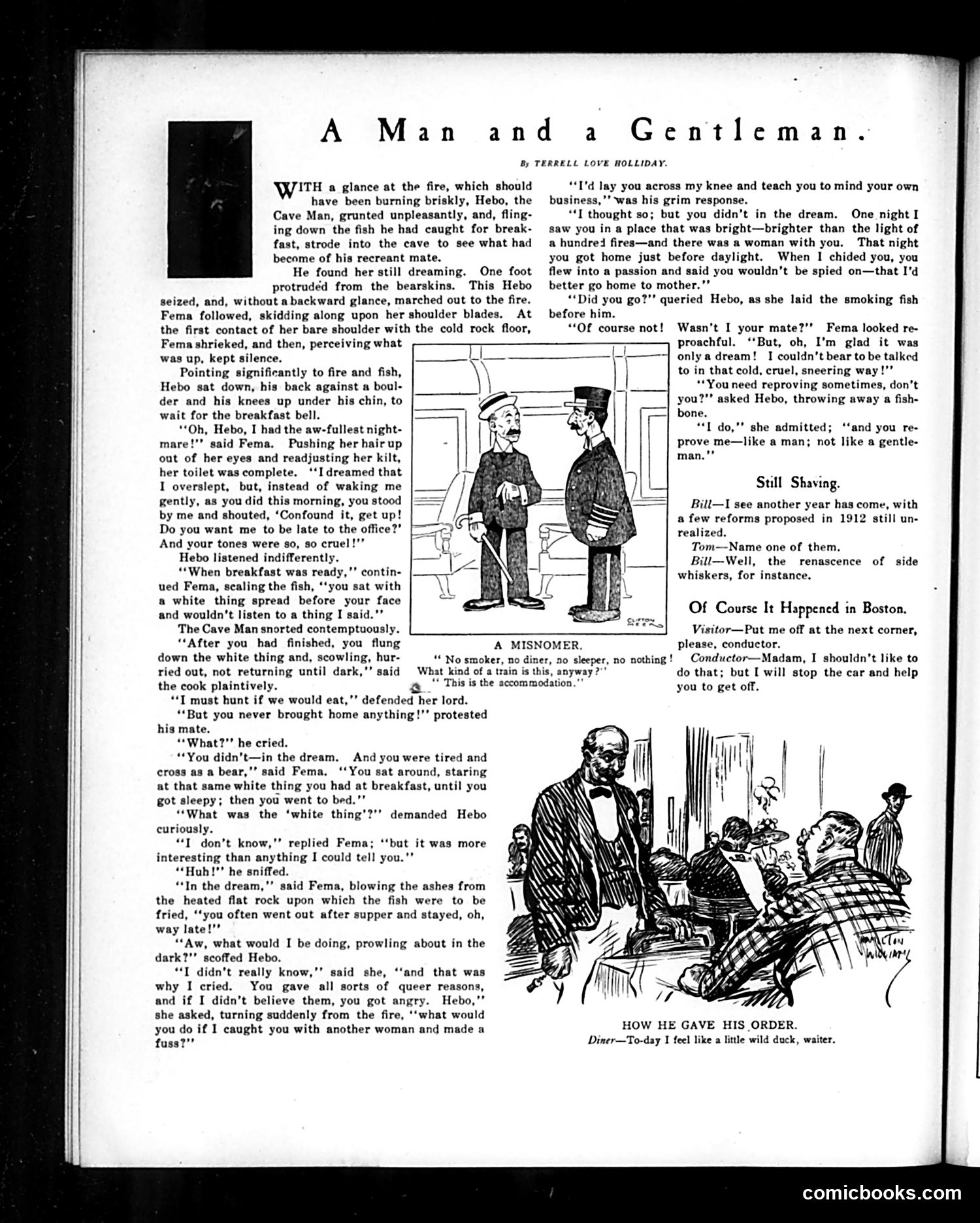
A Man and a Gentleman. By TERRELL LOVE HOLLIDAY. W'tH a glance at the fire, which should have been burning briskly, Hebo, the Cave Man, grunted unpleasantly, and, fling- ing down the fish he had caught for break- fast, strode into the cave to see what had become of his recreant mate. He found her still dreaming. One foot protruded from the bearskins. This Hebo seized, and, without a backward glance, marched out to the fire. Fema followed, skidding along upon her shoulder blades. At the first contact of her bare shoulder with the cold rock floor, “‘I'd lay you across my knee and teach you to mind your own business,’ ‘was his grim response. “I thought so; but you didn’t in the dream. One night I saw you in a place that was bright—brighter than the light of a hundred fires—and there was a woman with you. That night you got home just before daylight. When 1 chided you, you flew into a passion and said you wouldn't be spied on—that I'd better go home to mother.’’ “Did you go?” queried Hebo, as she laid the smoking fish before him. “Of course not! Wasn't I your mate?’’ Fema looked re- Fema shrieked, and then, perceiving what proachful. ‘But, oh, I'm glad it was -| onlya dream! I couldn't bear to be talked was up, kept silence. Pointing significantly to fire and fish, Hebo sat down, his back against a boul- to in that cold, cruel, sneering way!" “You need reproving sometimes, don't der and his knees up under his chin, to you?”’ asked Hebo, throwing away a fish- bone. wait for the breakfast bell. “Oh, Hebo, I had the aw-fullest night- mare!"’ said Fema. Pushing her hair up out of her eyes and readjusting her kilt, her toilet was complete. ‘‘I dreamed that I overslept, but, instead of waking me gently, as you did this morning, you stood by me and shouted, ‘Confound it, get up! Do you want me to be late to the office?’ [= And your tones were so, so cruel !’’ Hebo listened indifferently. “When breakfast was ready,’’ contin- ued Fema, sealing the fish, ‘‘you sat with a white thing spread before your face and wouldn't listen to a thing I said.” The Cave Man snorted contemptuously. “After you had finished, you flung down the white thing and, scowling, hur- ried out, not returning until dark,’ said the cook plaintively. a “‘I must hunt if we would eat,’’ defended her lord. “But you never brought home anything!’’ protested his mate. “What he cried. “You didn’t—in the dream, And you were tired and cross as a bear," said Fema. ‘‘You sat around, staring at that same white thing you had at breakfast, until you got sleepy; then you went to bed." “What was the ‘white thing’?’’ demanded Hebo curiously. “I don't know,’’ replied Fema; ‘‘but it was more interesting than anything I could tell you."’ “Huh!"’ he sniffed. “In the dream,”’ said Fema, blowing the ashes from the heated flat rock upon which the fish were to be fried, ‘‘you often went out after supper and stayed, oh, way late!’’ “Aw, what would I be doing, prowling about in the dark?” scoffed Hebo. “I didn't really know,’’ said she, ‘‘and that was why I cried. You gave all sorts of queer reasons, and if I didn’t believe them, you got angry. Hebo,’’ she asked, turning suddenly from the fire, ‘‘what would you do if 1 caught you with another woman and made a fuss?" A MISNOMER. “* No smoker, no diner, no sleeper, no nothing ! What kind of a train is this, anyway ?"” “This is the accommodation."’ “I do,'’ she admitted; ‘‘and you re- prove me—like a man; not like a gentle- man.” Still Shaving. Bill—I see another year has come, with a few reforms proposed in 1912 still un- realized. Tom—Name one of them. Bill—Well, the renascence of side whiskers, for instance. Of Course It Happened in Boston. Visitor—Put me off at the next corner, please, conductor. Conductor—Madam, I shouldn't like to do that; but I will stop the car and help you to get off. HOW HE GAVE HIS ORDER. Diner—To-day I feel like a little wild duck, waiter. comicbooks.com