
A complete issue · 24 pages · 1912
Judge — December 21, 1912
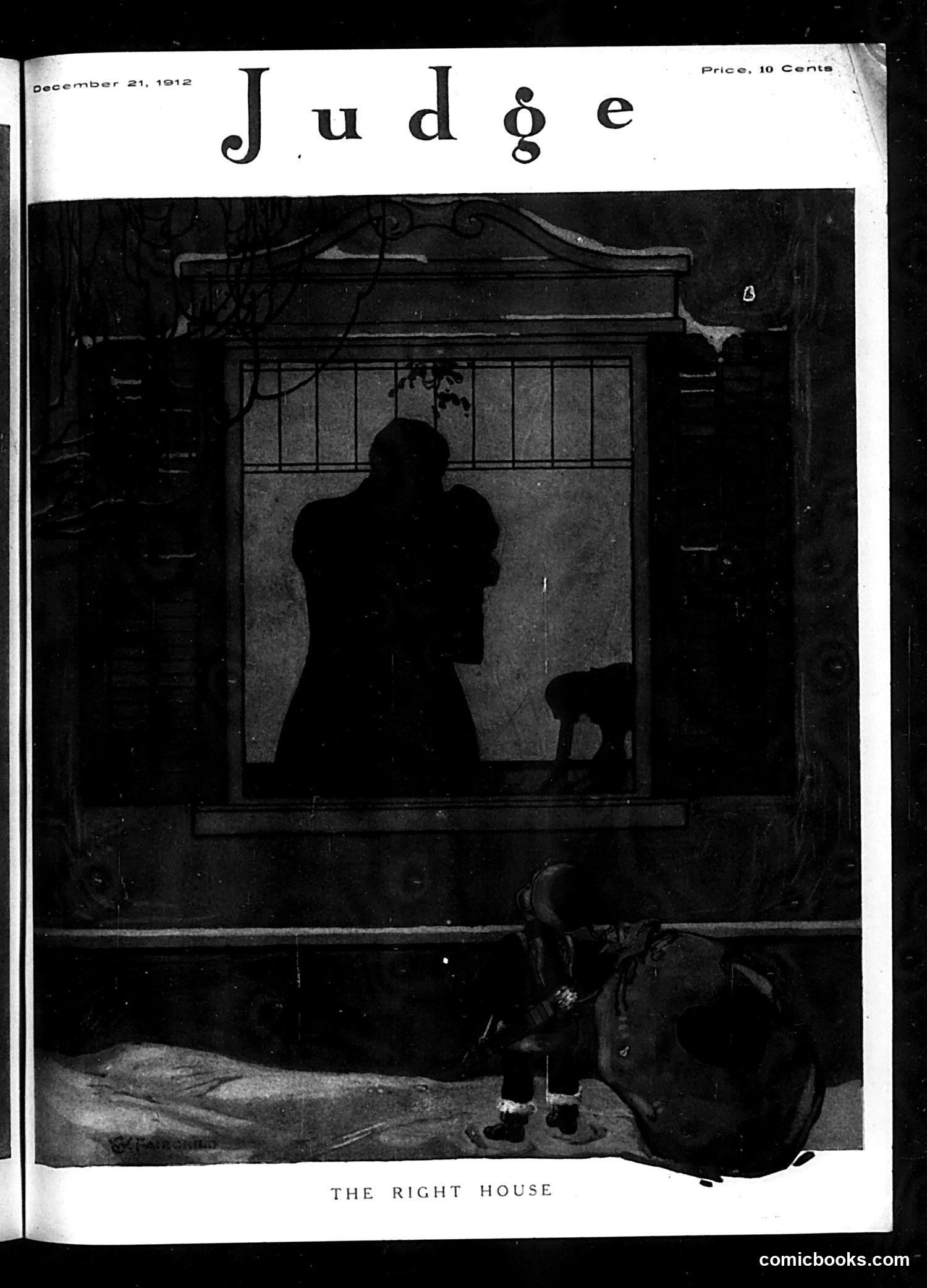
This silhouette cartoon depicts a figure peering through a window at what appears to be a judge's chamber or courtroom. The caption "The Right House" suggests a play on words—likely referencing both an actual building and the concept of finding the "correct" judicial venue or authority. The 1912 date places this during Theodore Roosevelt's presidency and the contentious 1912 election when Roosevelt split the Republican Party. Without clearer identification of the specific figure or legal case referenced, the exact satirical target remains unclear, though it appears to mock either judicial proceedings, political maneuvering through the courts, or someone seeking to influence legal outcomes through dubious means.
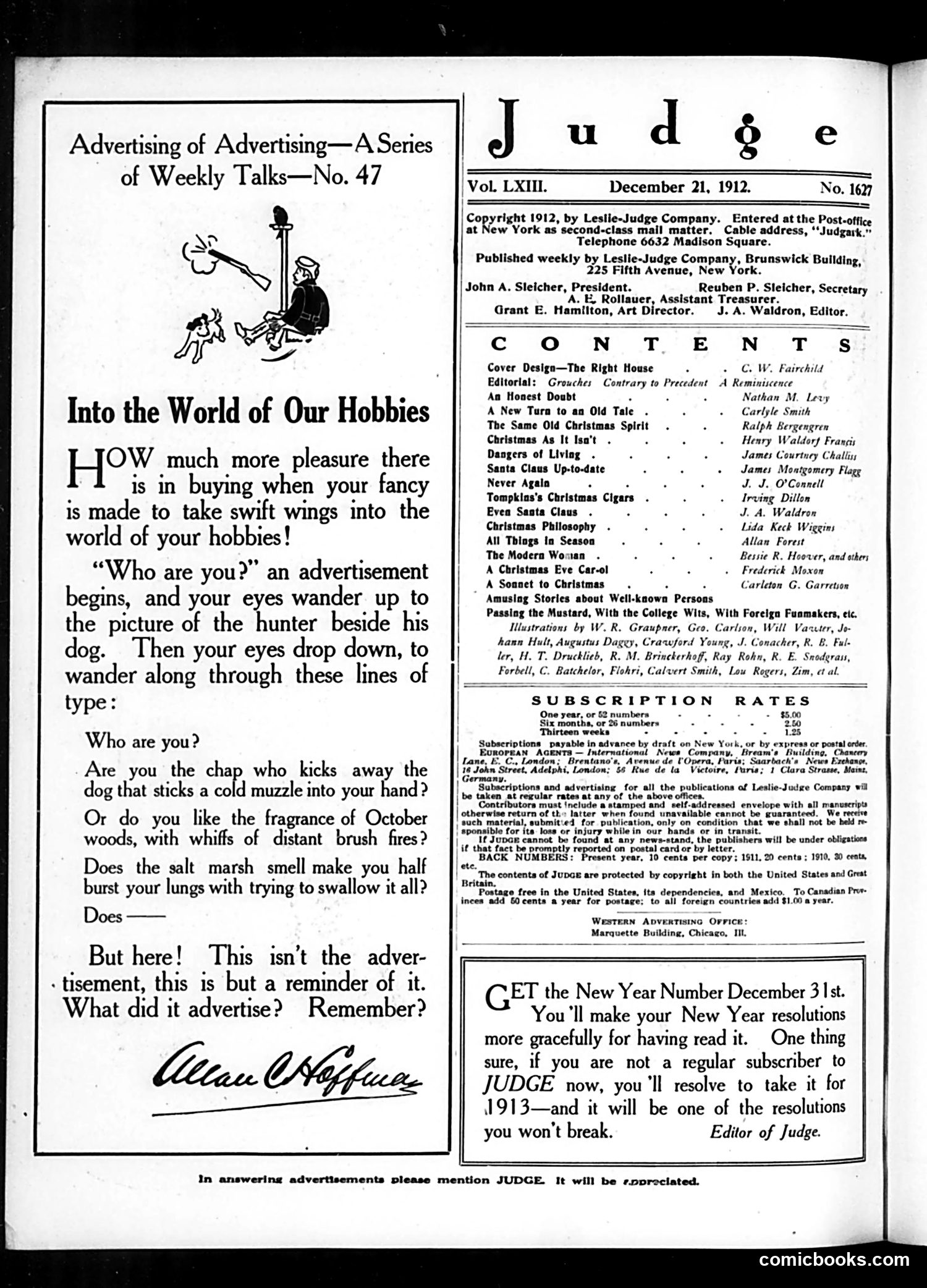
This page is primarily **advertising content**, not political satire. The left side features "Advertising of Advertising—A Series of Weekly Talks No. 47," written by Adolph Hoffmann. It's a meta-advertisement encouraging readers to notice Judge's own advertisements, using evocative imagery of a hunter with a dog to illustrate how advertising catches attention. The piece poses philosophical questions ("Who are you?") to engage readers' imaginations—asking if they identify with outdoor pursuits and sensory experiences—before revealing this was itself an advertisement demonstrating advertising's power. The right side shows the magazine's masthead and contents listing. A note at bottom encourages New Year subscriptions, positioning Judge as a worthwhile 1913 resolution.
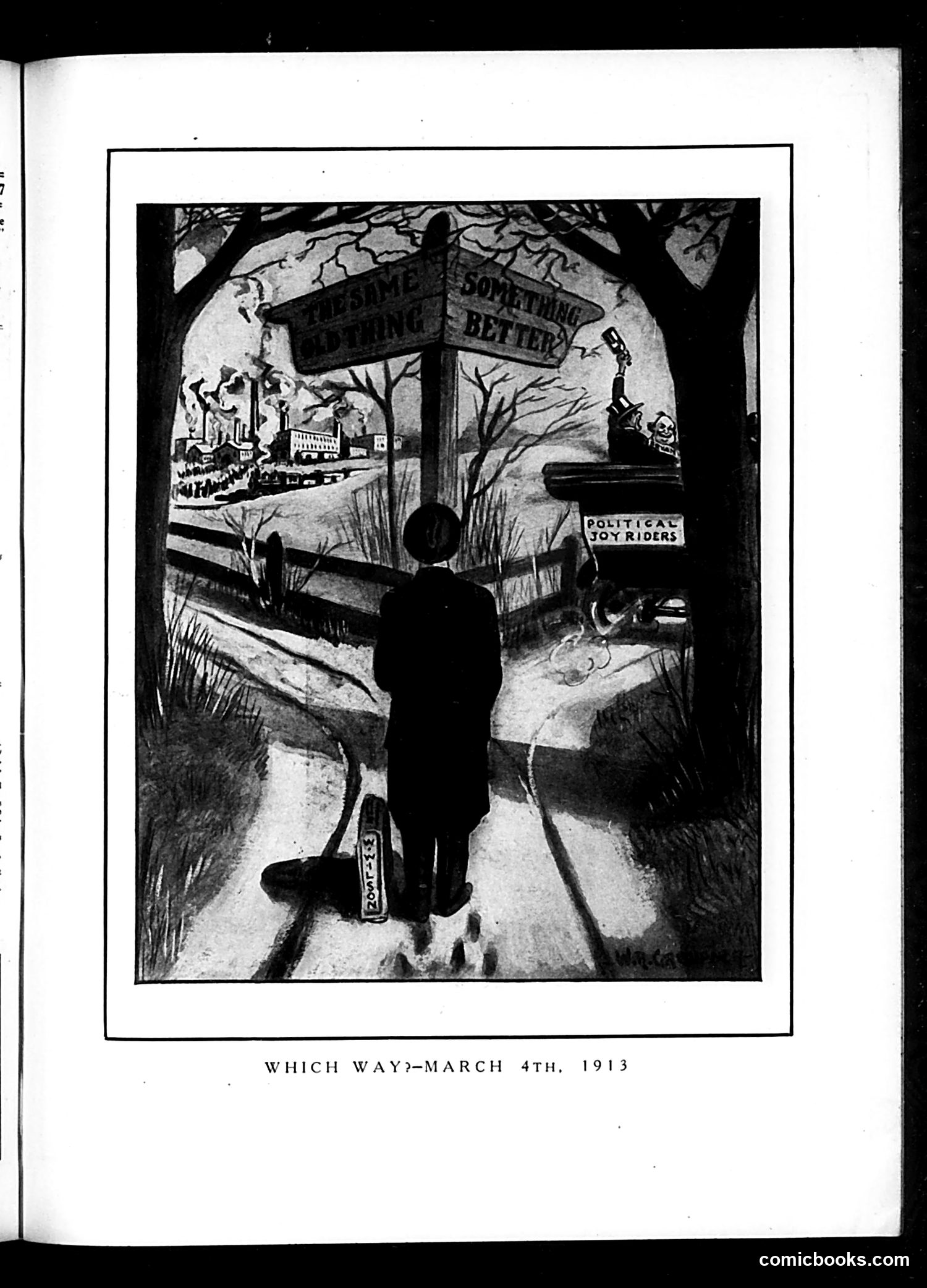
This political cartoon depicts a figure at a crossroads signpost labeled "SOMETHING BETTER," facing two divergent paths. The left path shows industrial progress (factory, train), while the right features "POLITICAL JOY RIDERS"—apparently depicting reckless political activity. The March 4th, 1913 date marks Woodrow Wilson's presidential inauguration. The cartoon satirizes the choice between pursuing practical economic/industrial progress versus engaging in frivolous partisan politics. The silhouetted figure must decide which direction the nation should take under the new administration. "Joy riders" was period slang for reckless thrill-seekers, here applied to politicians who prioritize political maneuvering over substantive governance.
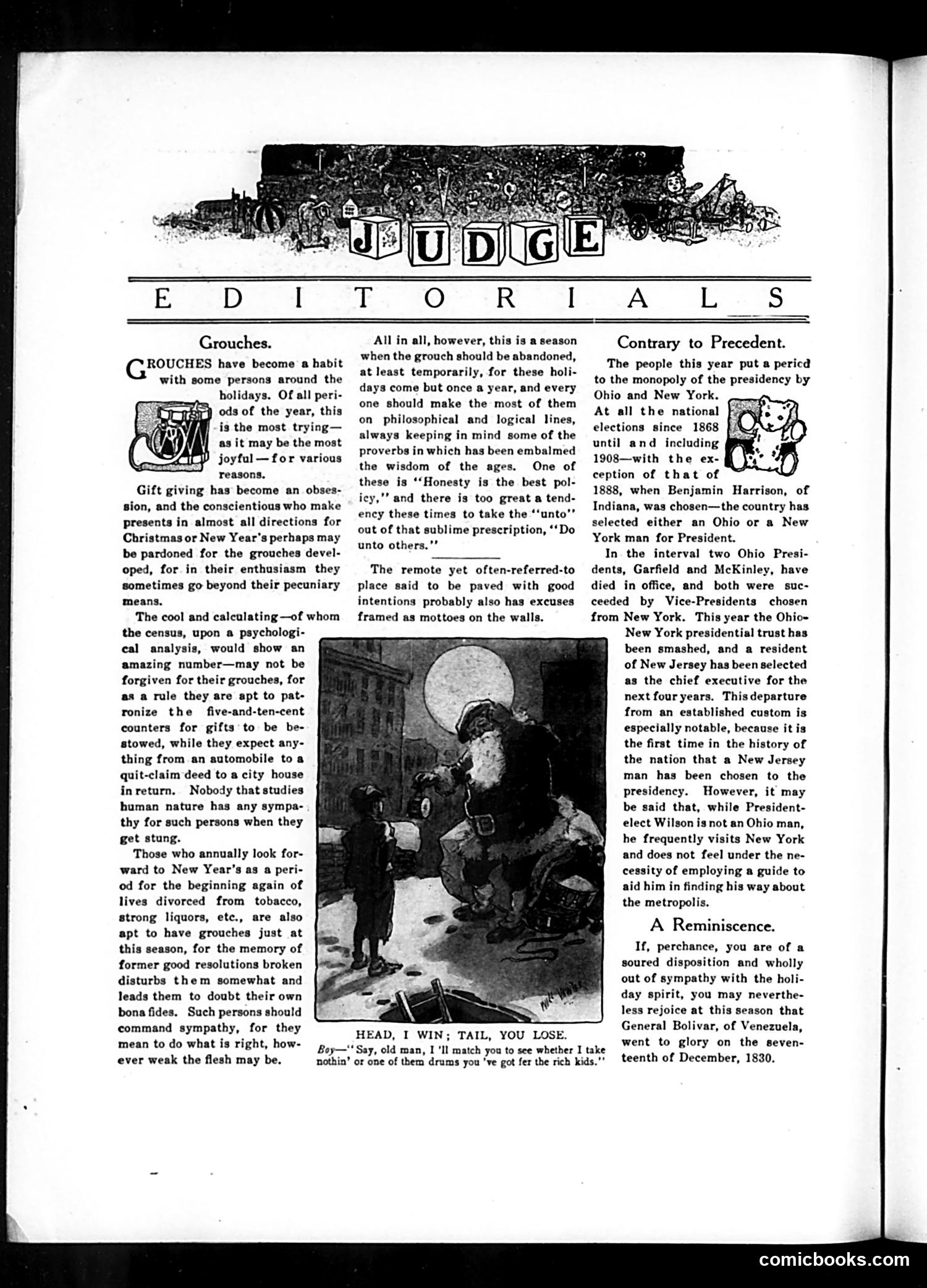
This page contains two distinct sections. The left column discusses "Grouches"—a seasonal editorial about people who complain during holidays. The right column, "Contrary to Precedent," addresses the 1908 U.S. presidential election, noting that for the first time since 1868, neither major party nominated an Ohio or New York candidate. It specifically references the deaths of Ohio Presidents Garfield and McKinley, and notes that the selected candidates broke the established geographical pattern. The central illustration, captioned "HEAD, I WIN; TAIL, YOU LOSE," depicts two figures in what appears to be a gambling scenario, with one proposing to match the other in seeing "whether I take nothin', or one of them dreams you've got for the rich kids." This likely satirizes political maneuvering or backroom dealing related to the presidential contest.
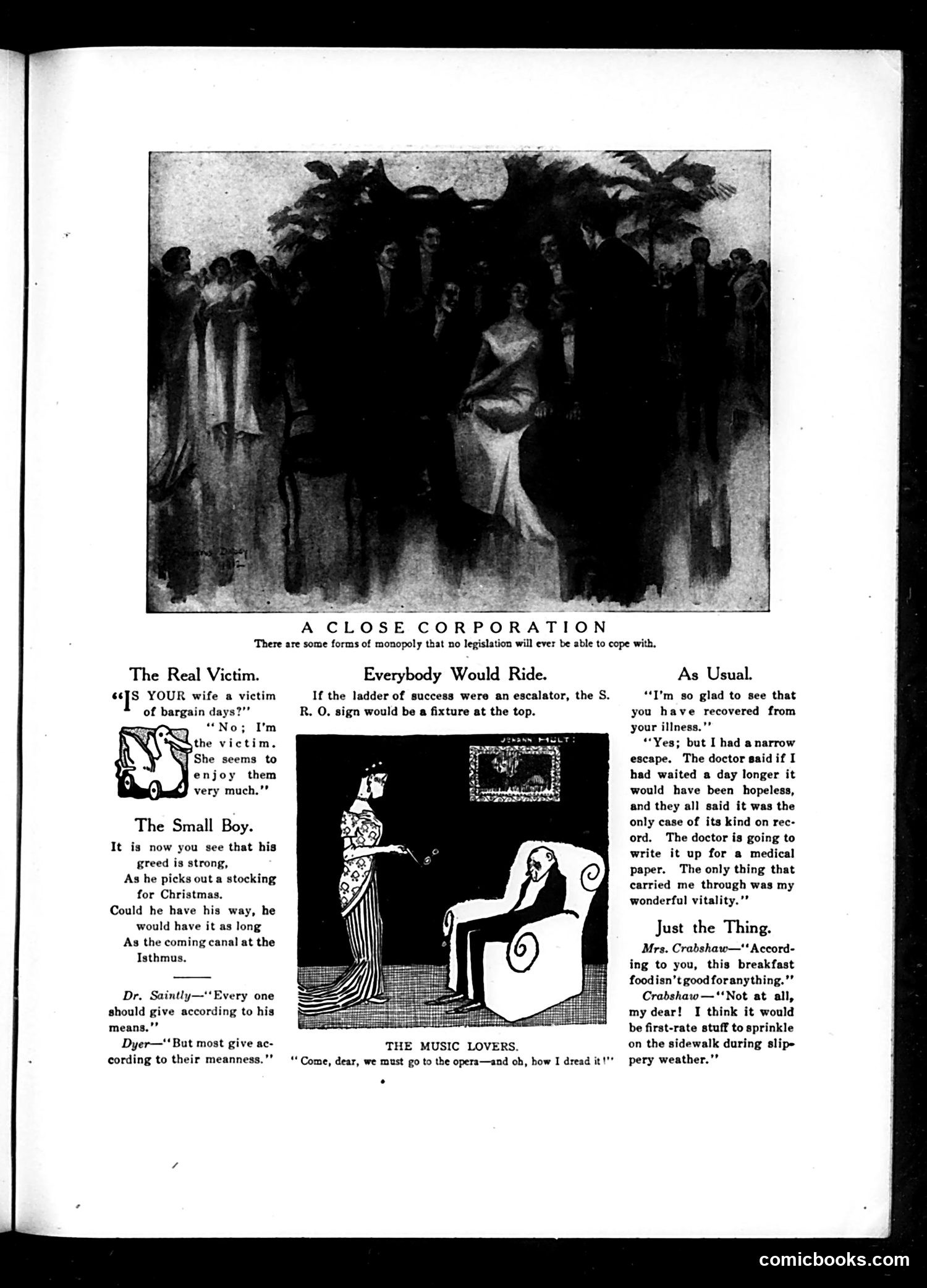
This page satirizes monopolies and wealth inequality through multiple vignettes. The title references "forms of monopoly that no legislation will ever able to cope with." **"The Real Victim"** mocks a wealthy wife complaining about missing bargain sales—the actual victims are ordinary people excluded from prosperity. **"The Small Boy"** uses a child's greed (wanting stockings as long as the coming canal) to lampoon how monopolies create endless, unsatisfiable desires. **"The Music Lovers"** cartoon shows a couple reluctant to attend the opera, satirizing how the wealthy treat expensive culture as obligatory social performance rather than genuine enjoyment. The overall message critiques how concentrated wealth creates artificial social hierarchies and moral decay among the privileged class.
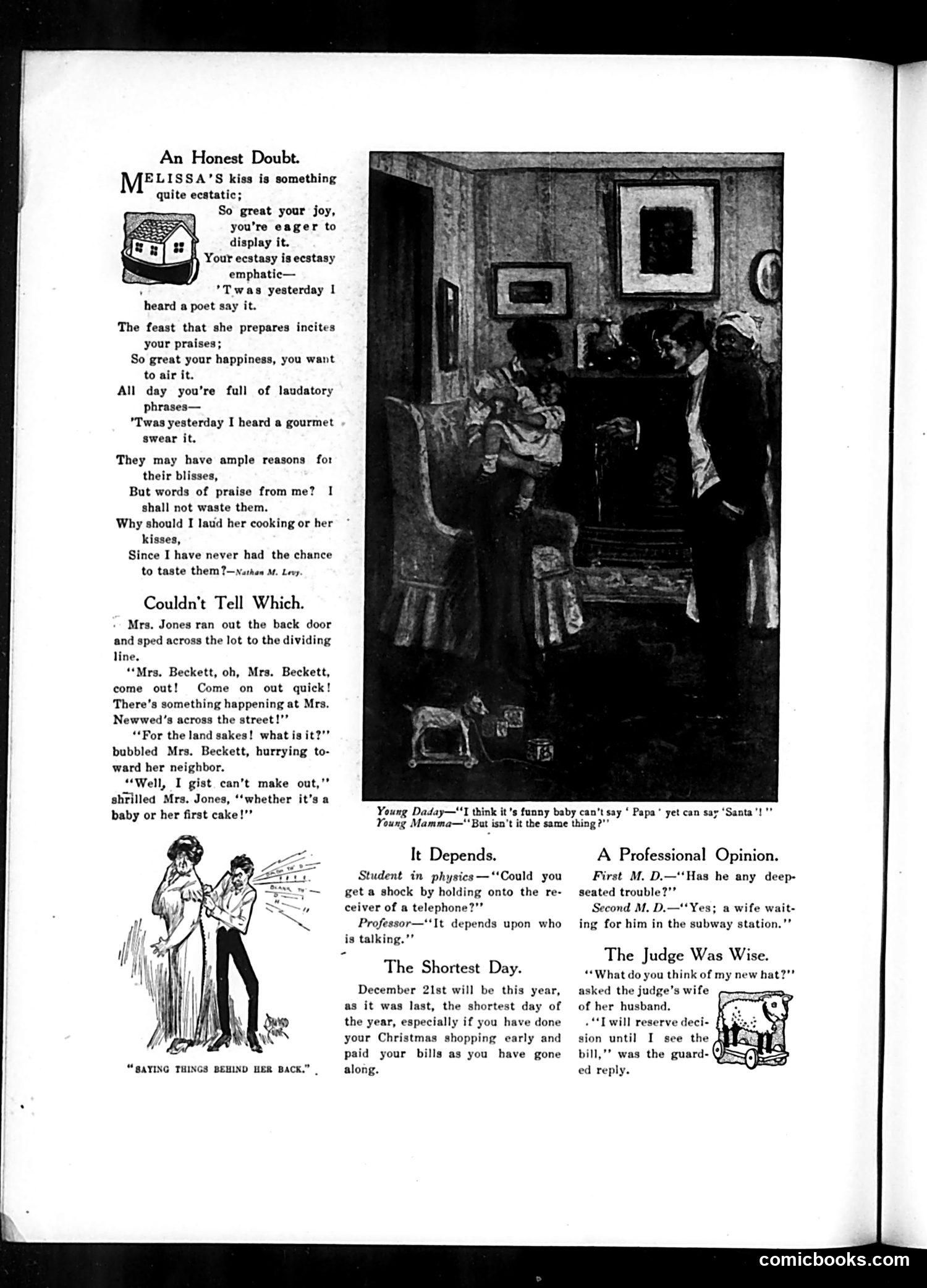
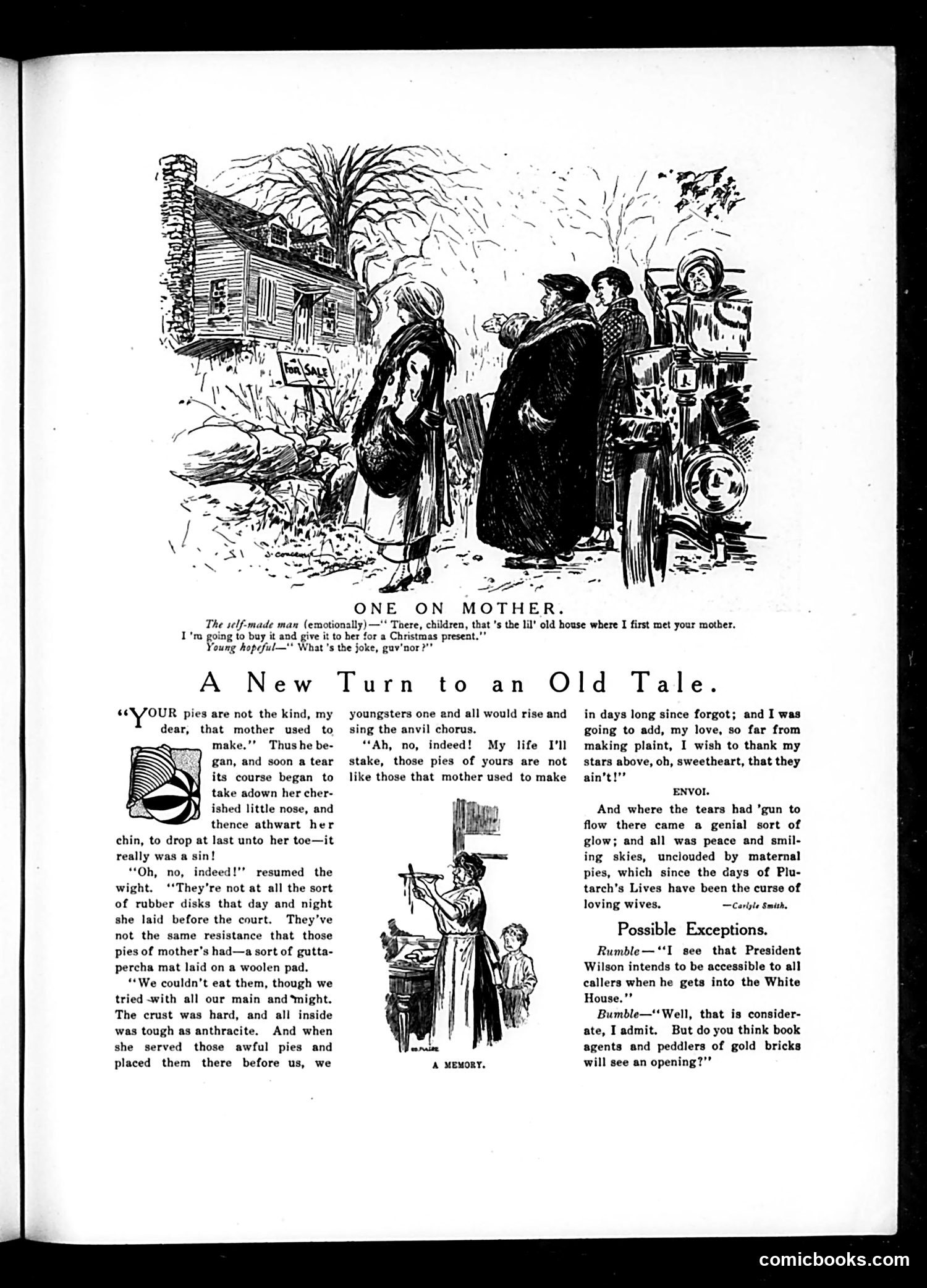
This Judge page contains nostalgic humor and light political commentary. **Top cartoon ("One on Mother"):** A self-made man emotionally recounts buying his childhood home as a Christmas gift for his wife. A young bystander asks what the joke is—the humor lies in the sentimentality and the gap between the man's emotional display and the practical reality of his gift. **Main story ("A New Turn to an Old Tale"):** A sentimental tale about inferior modern pies compared to mother's legendary cooking. The narrator's nostalgic complaint triggers emotional tears, which transform into contentment when he realizes his wife's pies, however bad, represent her love—inverting the complaint into gratitude. This plays on early-20th-century nostalgia for "the old days." **"Possible Exceptions":** Two characters discuss President Wilson's accessibility to White House visitors. The joke suggests that while Wilson claims openness, book agents and con artists peddling schemes ("gold bricks") might find opportunities in his accessibility—a mildly cynical jab at political naiveté.
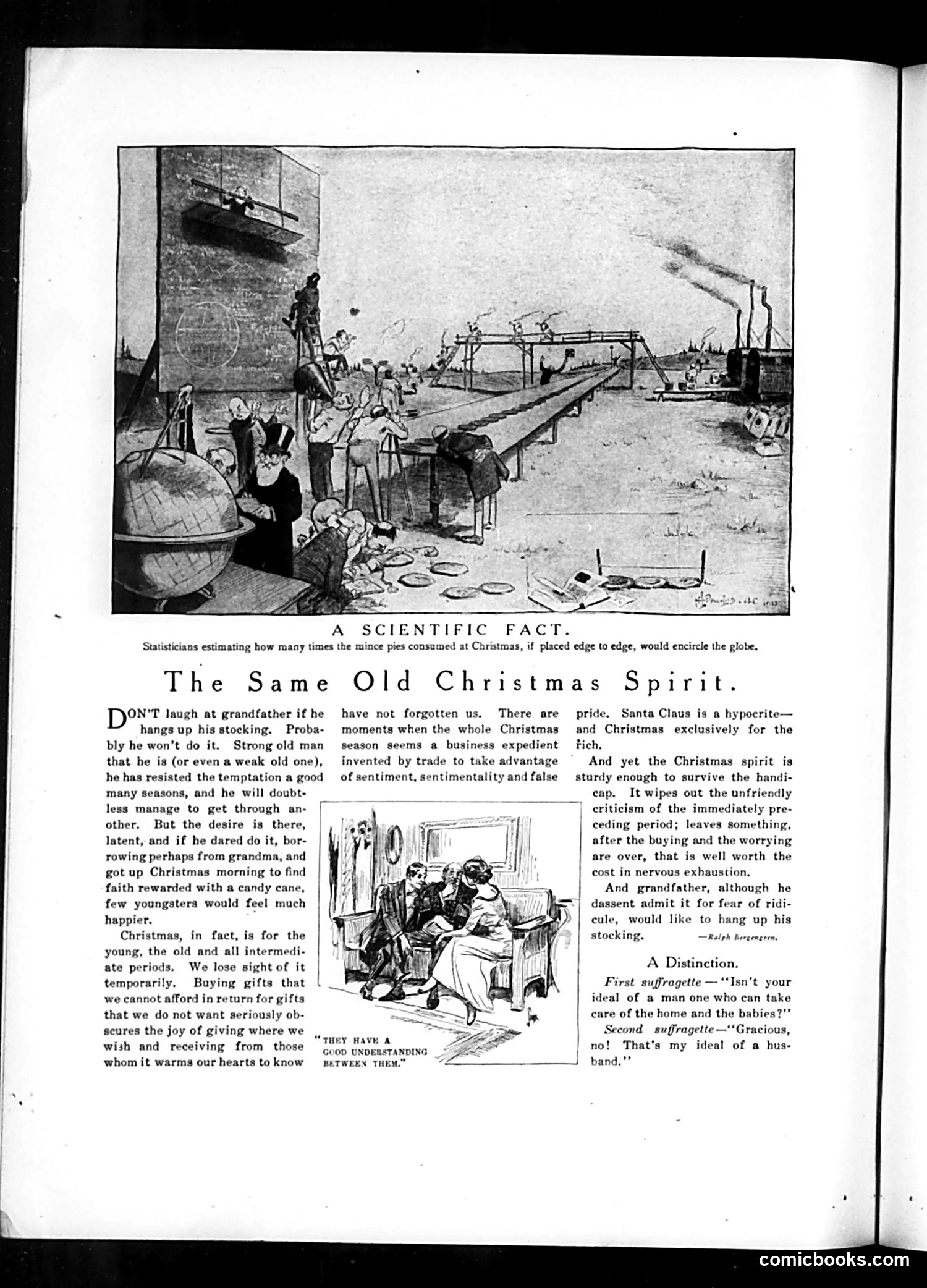
**Top cartoon ("A Scientific Fact"):** A satirical jab at statisticians and their absurd calculations. The image shows researchers measuring mince pies—a Christmas delicacy—presumably to calculate how many consumed pies, laid edge-to-edge, would circle the globe. The satire mocks the era's obsession with quantifying trivial matters through pseudo-scientific methods. **Main article ("The Same Old Christmas Spirit"):** A nostalgic defense of traditional Christmas against growing commercialism. The piece argues that while Christmas has become a "business expedient" exploited by merchants and trade, the genuine spirit of giving and familial joy persists despite commercialization's corrupting influence. It defends elderly people's childlike desire to participate in Christmas traditions. **Bottom cartoon ("A Distinction"):** Early 20th-century suffragette humor. The joke contrasts two women's ideals of men: the first suggests a man should handle domestic duties and childcare; the second clarifies *that's* her ideal of a *husband*—implying she wants independence from such responsibilities, not a man to fulfill them. It satirizes evolving feminist views on gender roles.
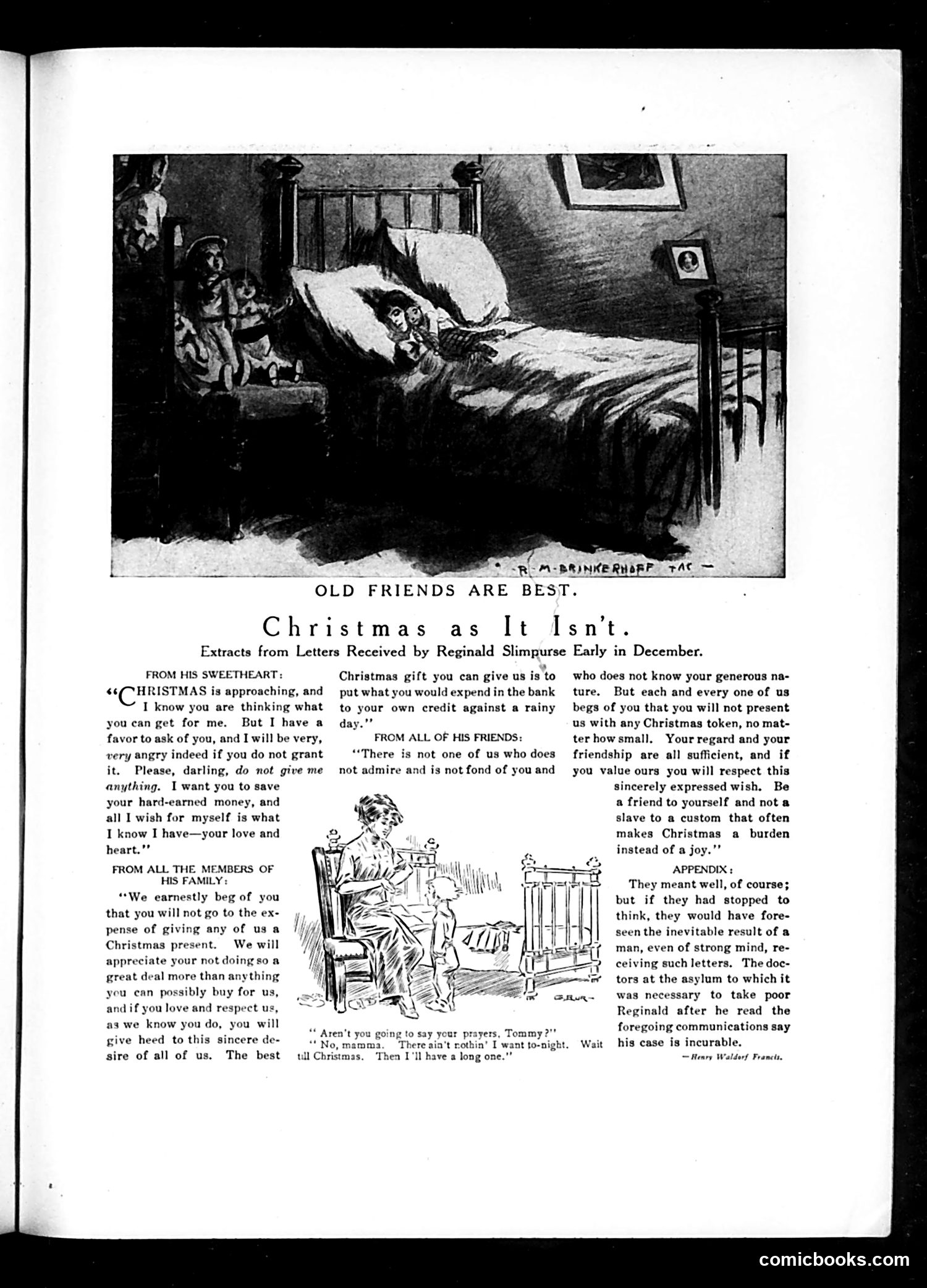
This page satirizes the contradiction between sincere Christmas sentiment and practical selflessness. A man named Reginald Slimpurse receives letters from his sweetheart, family, and friends—all earnestly begging him NOT to buy them gifts. Each group insists his love and regard are sufficient; they'd prefer he save money or donate it. The joke's dark punchline: this barrage of well-meaning refusals drives Reginald insane. The illustration shows him in an asylum bed, having suffered a mental breakdown from the psychological whiplash of being told repeatedly not to give presents during a gift-giving holiday. The satire critiques the era's tendency toward performative unselfishness and the awkward social pressure this created. The title "Christmas as It Isn't" mocks the gap between idealized Christmas virtue (not wanting material goods) and human nature (people actually do want gifts). The appendix confirms Reginald's case is "incurable"—suggesting the contradiction itself is fundamentally unresolvable.
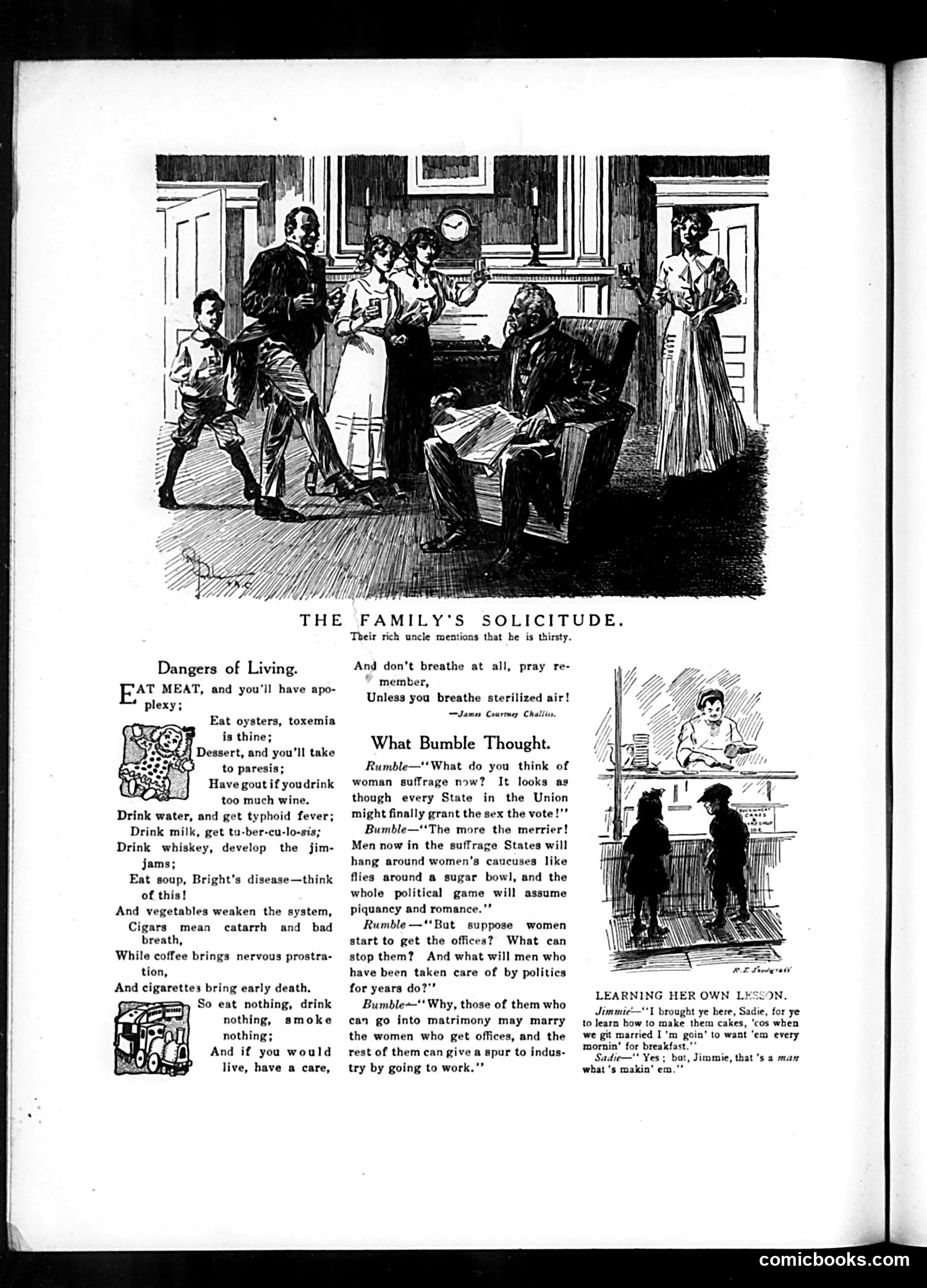
**Main Cartoon (top):** Shows a family gathered around a wealthy uncle, who announces he's thirsty. The satire mocks health-anxiety hysteria: the accompanying text lists contradictory warnings about nearly every food and beverage (meat causes apoplexy, oysters cause toxemia, water causes typhoid, milk causes tuberculosis, etc.). The punchline: to stay alive, one must eat nothing, drink nothing, smoke nothing—and breathe only sterilized air. This ridicules contemporary health-scare culture and medical alarmism. **"What Bumble Thought":** Satirizes male attitudes toward women's suffrage. "Bumble" cynically predicts that if women gain voting power and offices, men will simply marry the successful ones or be forced into actual work. The joke exposes male selfishness and resistance to women's independence. **"Learning Her Own Lesson":** A young woman (Sadie) discovers her fiancé (Jimmie) expects her to cook exactly like a professional male baker every morning. Her deadpan response—"that's a man what's makin' 'em"—mocks male expectations that women naturally possess domestic skills. All three mock early 20th-century social anxieties and gender attitudes.
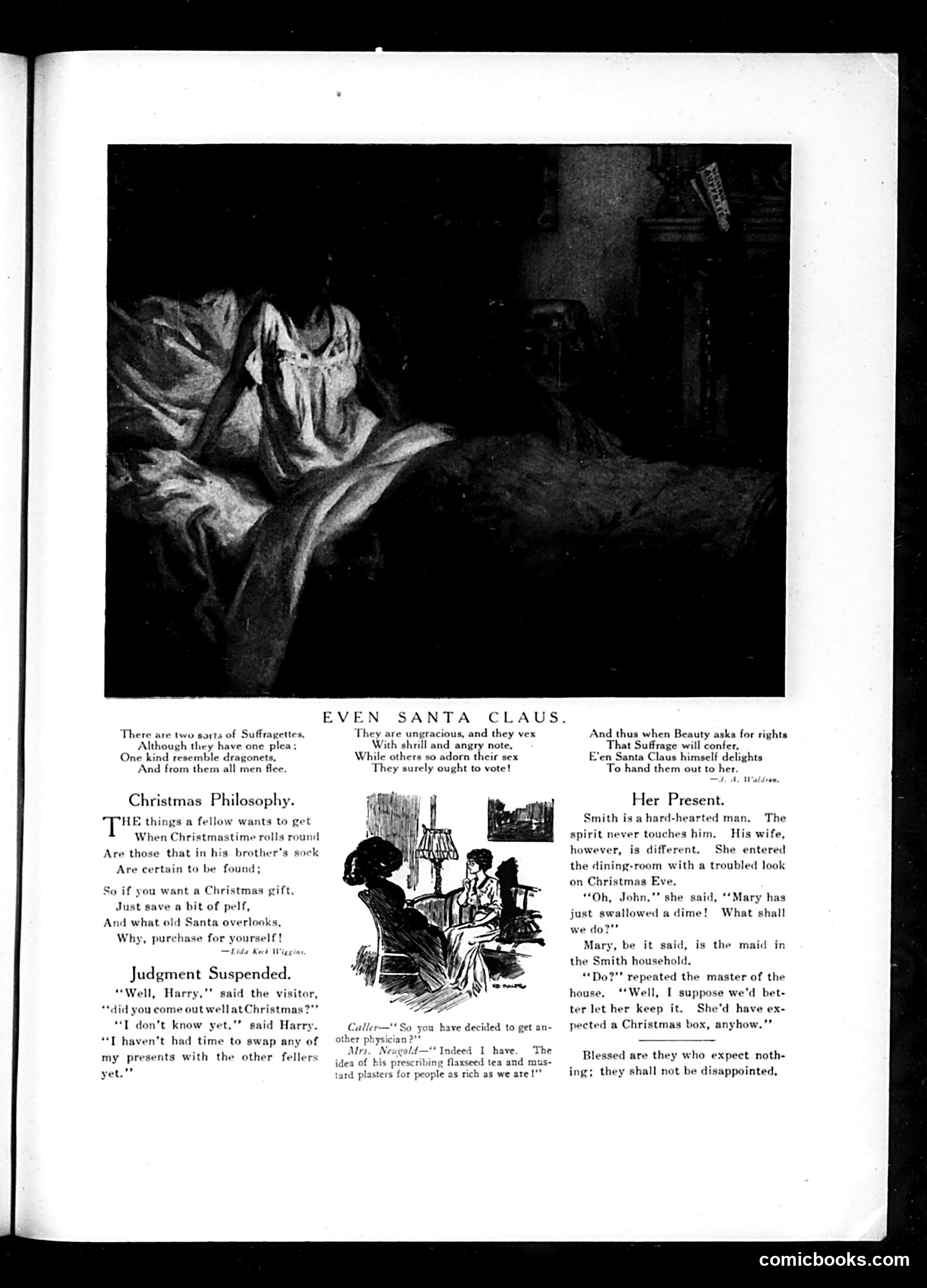
This page satirizes early 20th-century debates around women's suffrage and class attitudes. **"Even Santa Claus"** (top) mocks female suffragettes by dividing them into two types: unattractive "dragonets" whom men avoid, and conventionally beautiful women who "ought to vote." The joke suggests suffragettes are either physically repellent or should rely on beauty rather than political argument—a common anti-suffrage taunt. **"Christmas Philosophy"** and **"Judgment Suspended"** are gentler holiday humor about gift-giving customs. **"Her Present"** satirizes wealthy hypocrisy: Mr. Smith, described as "hard-hearted," refuses to give his maid Mary a Christmas box (traditional servant gift), but when she swallows a dime, he coldly lets her keep it as her "present"—satisfying the obligation while avoiding genuine generosity. The final quote mocks this stinginess by suggesting the poor should expect nothing. Together, these pieces reflect Judge's conservative stance on women's rights and class relations during the Progressive Era.
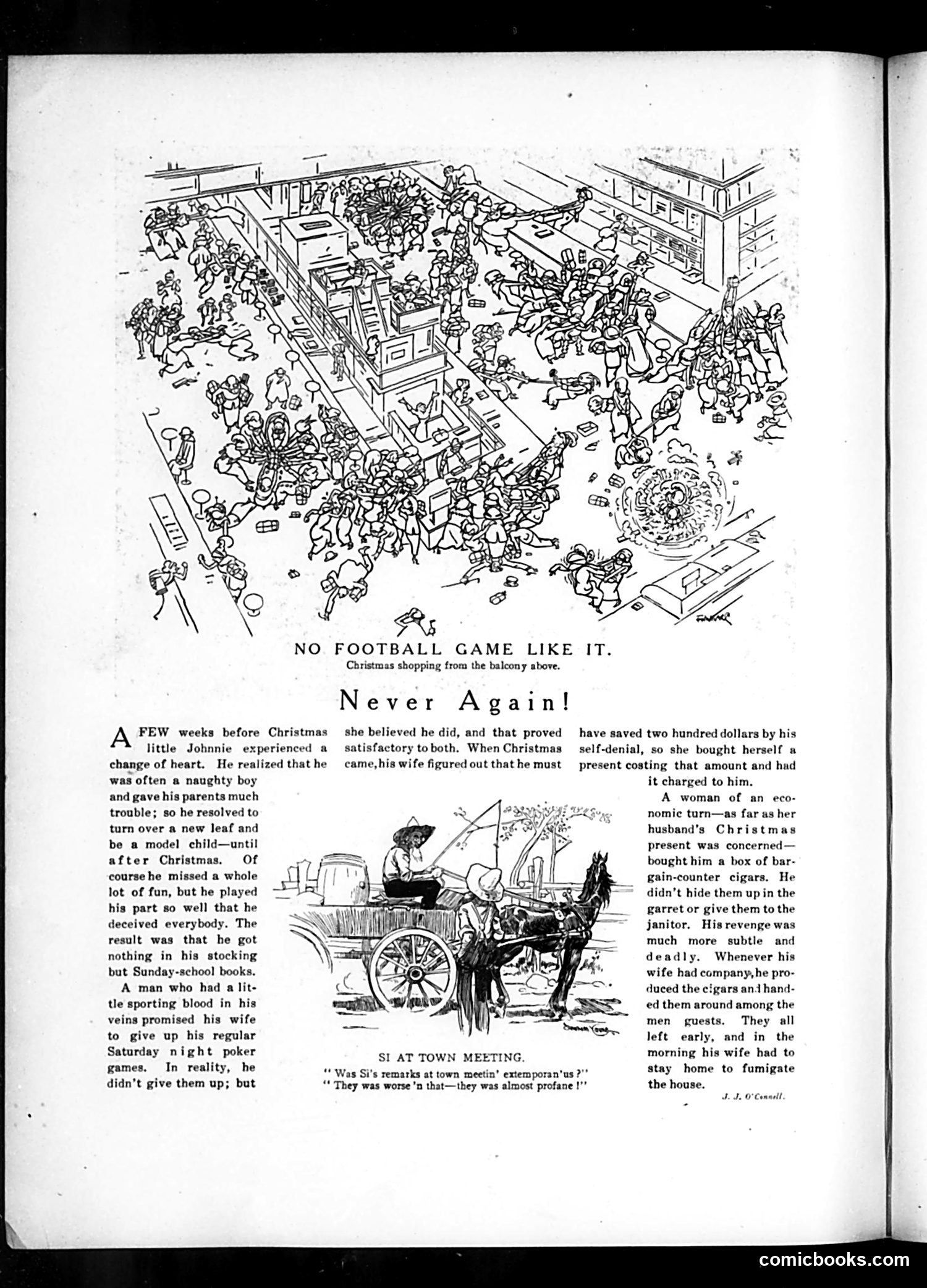
This page from *Judge* magazine contains three satirical vignettes about Christmas deception and marital revenge: 1. **Top cartoon**: A chaotic Christmas shopping scene viewed from above, illustrating the madness of holiday consumerism. 2. **"Never Again!"**: Three short humorous stories exposing hypocrisy: - A boy pretends to reform before Christmas to receive gifts, then returns to misbehavior - A man promises his wife he'll quit poker but secretly continues, deceiving her - A woman buys her husband cheap cigars as a gift; he retaliates by smoking them around her dinner guests, driving them away with the smell and forcing her to spend the next day cleaning 3. **"Si at Town Meeting"**: A brief rural joke about a man's church remarks being shockingly profane rather than spontaneous. The satire targets 1920s domestic dishonesty—showing spouses deceiving each other through false promises and calculated revenge. The humor relies on readers recognizing the petty but relatable marital conflicts of the era.
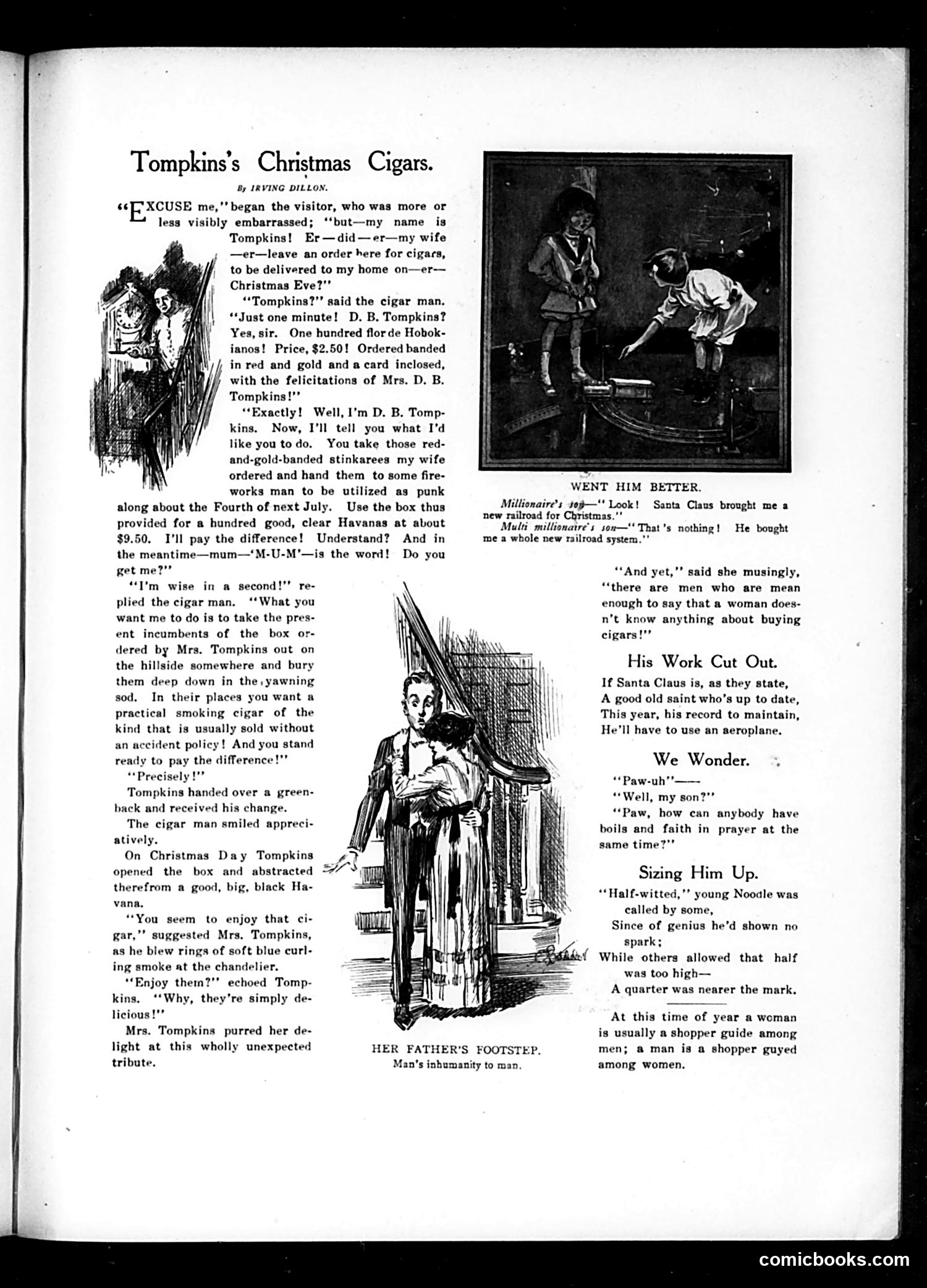
This story satirizes marital dynamics and consumer culture in the early 1900s. Mr. Tompkins discovers his wife ordered him expensive, poor-quality cigars ("stinkarees") as a Christmas gift. He cunningly instructs the cigar seller to substitute cheap Havana cigars instead, paying the difference himself while keeping it secret from Mrs. Tompkins. On Christmas, he openly praises the cigars, and Mrs. Tompkins takes credit for the thoughtful gift. The joke's payoff occurs when she smugly declares that men who claim women don't understand cigars are wrong—unaware her husband has deceived her. The accompanying verses mock gift-giving excess (wealthy children receiving entire railroad systems) and satirize gender roles: women as holiday shoppers who guide male purchases, while men are "guyed" (ridiculed) by female shopping decisions. The humor relies on the assumption that wives lack judgment about male pleasures like cigars, though ironically she chose well—just unknowingly.
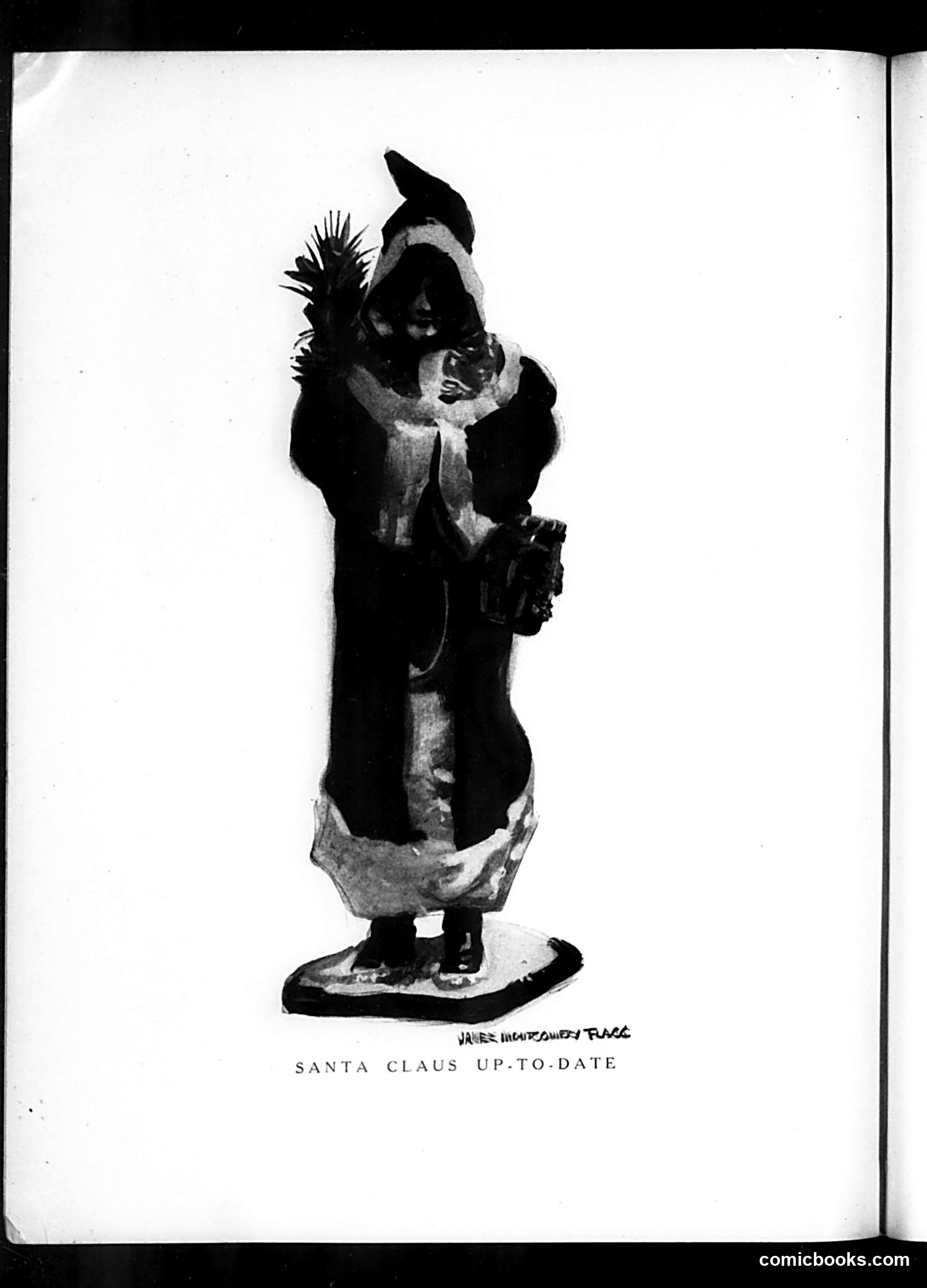
This illustration presents a modernized Santa Claus figure for satirical effect. The "up-to-date" Santa depicted here appears to be a caricature showing Santa Claus equipped with contemporary (to Judge magazine's era) technology or accessories—notably what appears to be a camera or similar device at his side. The satire likely comments on commercialization or mechanization of Christmas traditions, or how Santa has been adapted to modern times through photography, advertising, or mass production. The exaggerated, somewhat grotesque rendering emphasizes the transformation of the beloved holiday figure into something more industrial or commodified. Without clearer dating information, the specific historical moment this references remains somewhat unclear, though the style suggests early-to-mid 20th century.
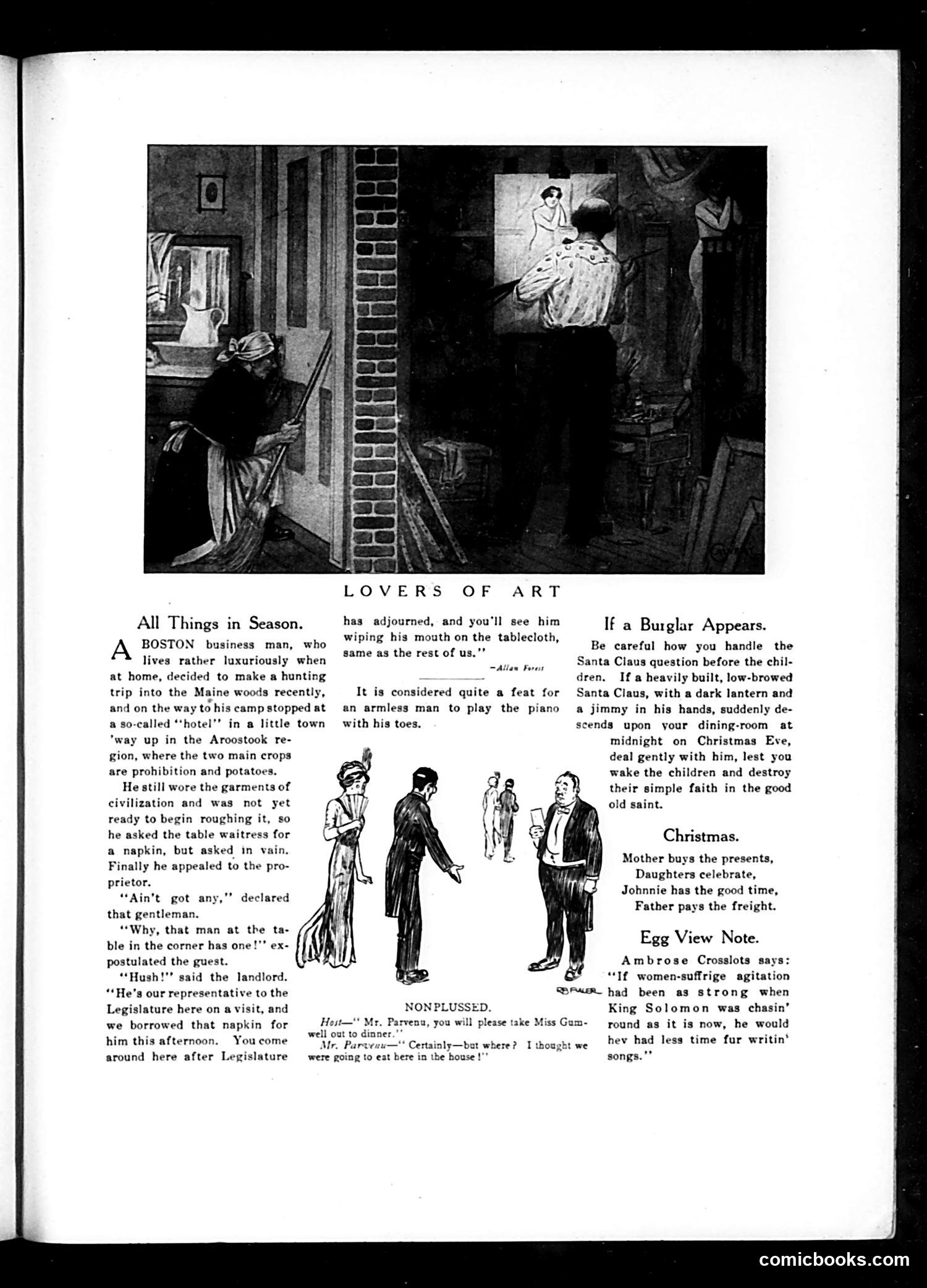
This *Judge* page contains three satirical pieces mocking rural Maine life and social pretension: 1. **"All Things in Season"**: A Boston businessman visits a remote Aroostook region hotel and requests a napkin. The proprietor claims they have none—except the one borrowed for their state Legislature representative, whom they'll reclaim after his visit. The joke satirizes rural poverty and the absurdity of treating a politician as special while lacking basic hospitality amenities. It mocks both rural Maine's sparse conditions and the inflated status given to politicians. 2. **"Nonplussed"**: A host asks Mr. Parvenu to take Miss Gamwell to dinner, but Parvenu questions where they'll eat, expecting to dine at the house. The humor targets social-climbing nouveaux riches uncertain about proper etiquette and venues. 3. **"Christmas" and "Egg View Note"**: Brief humorous observations about holiday spending disparities and women's suffrage. The overarching theme mocks rural backwardness, social pretension, and political pomposity through gentle ridicule.
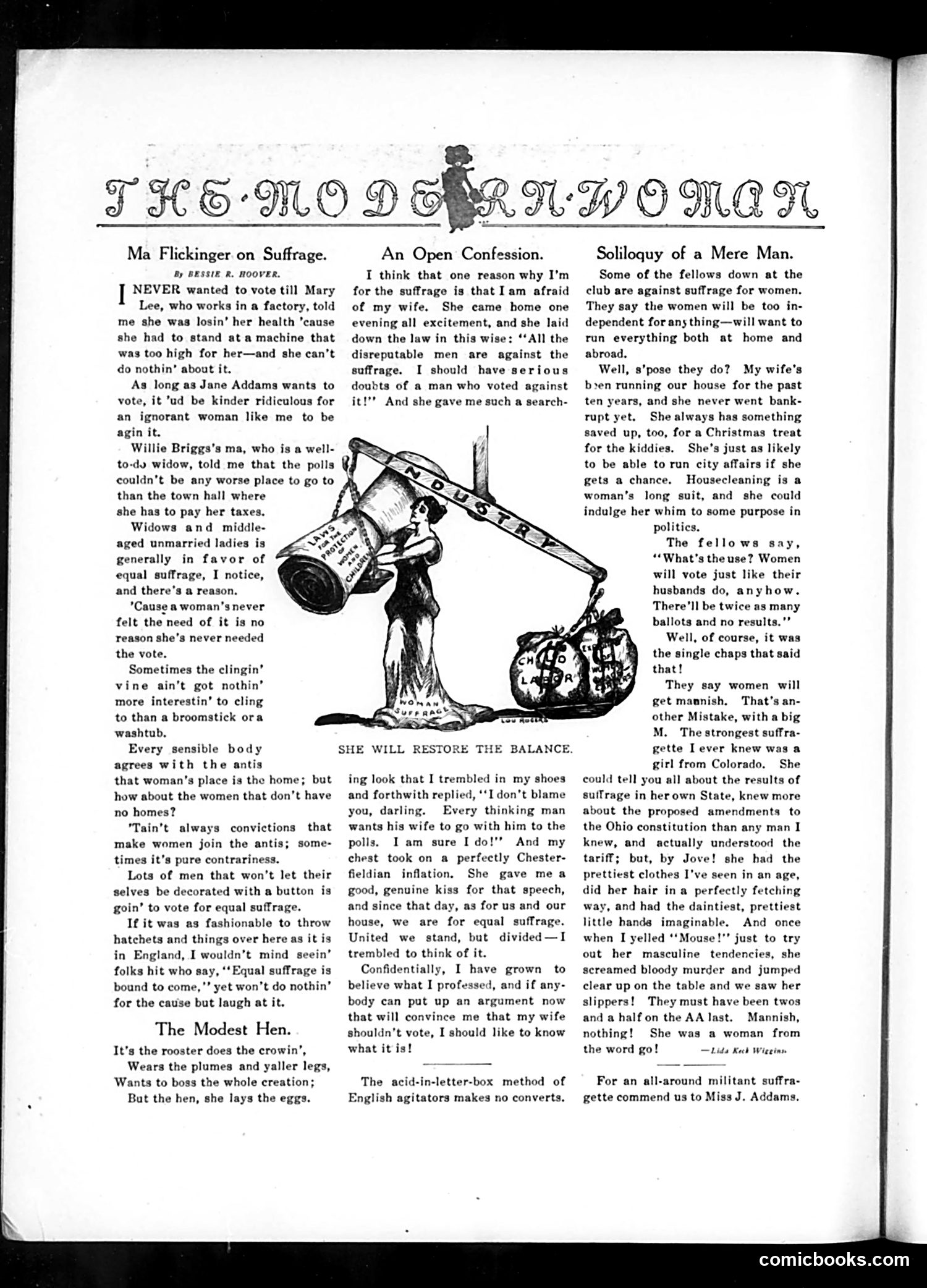
This page from *Judge* magazine presents three pro-suffrage arguments dressed as everyday voices, countering anti-suffrage claims common in early 20th-century America. **"Ma Flickinger on Suffrage"** features a working-class woman arguing that factory workers like Mary Lee need voting power to improve dangerous conditions. The piece mocks anti-suffragettes' claim that women belong only at home—"how about the women that don't have no homes?" **"An Open Confession"** humorously depicts a man converted to suffrage by his wife's ultimatum: respectable men support women's voting rights. His chest swells with "Chesterfieldian inflation" at her approval. **"Soliloquy of a Mere Man"** and **"The Modest Hen"** (the cartoon showing a woman balancing a heavy ballot box on a rooster's back) use domestic management as proof women can handle politics. The hen laying eggs while the rooster crows suggests women do practical work while men take credit. The satire targets anti-suffrage arguments as hypocritical and irrational, using working-class and middle-class perspectives to argue women's competence and rights.
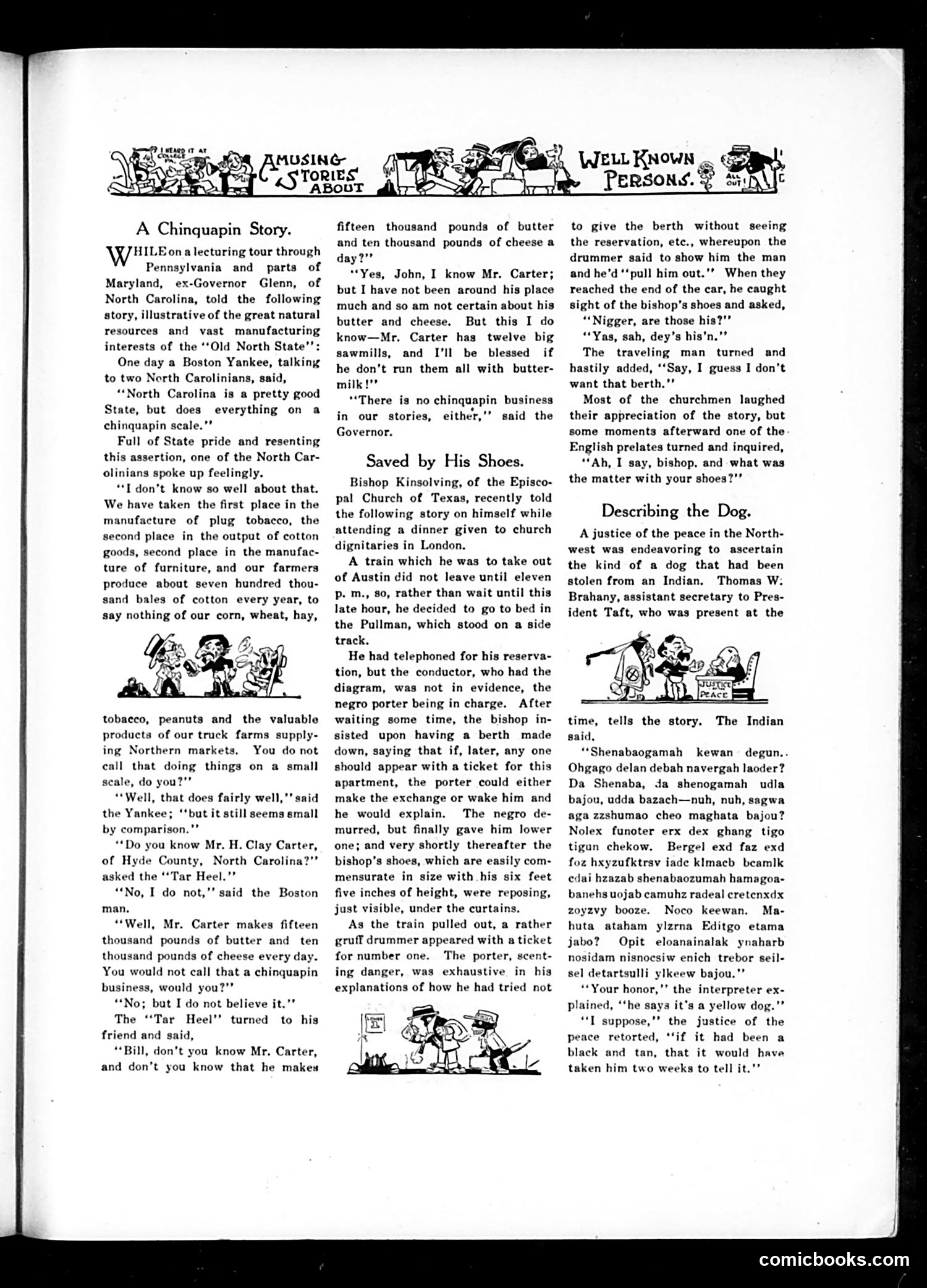
This page from *Judge* magazine contains two humorous anecdotes about regional American character types. **"A Chinquapin Story"** satirizes North Carolina's defensive boasting about its industrial output. A Boston Yankee dismisses the state's accomplishments as small-scale ("chinquapin scale"). A North Carolinian responds with inflated claims about Mr. H. Clay Carter's dairy production—fifteen thousand pounds of butter and cheese daily. The punchline: Carter actually runs the operation on *buttermilk*, undercutting the entire boast. The joke mocks Southern regional pride and tall-tale exaggeration. **"Saved by His Shoes"** features Bishop Kinsolving of Texas, a real religious figure. A railroad porter gives him a berth despite a ticket conflict. When an aggressive drummer demands the berth and threatens to "pull him out," he glimpses the bishop's enormous shoes protruding from under the curtain and immediately backs down, intimidated by their size. The humor relies on physical comedy and the assumption that large shoes signal a formidable person not worth confronting. Both stories trade in period stereotypes about regional and class types.
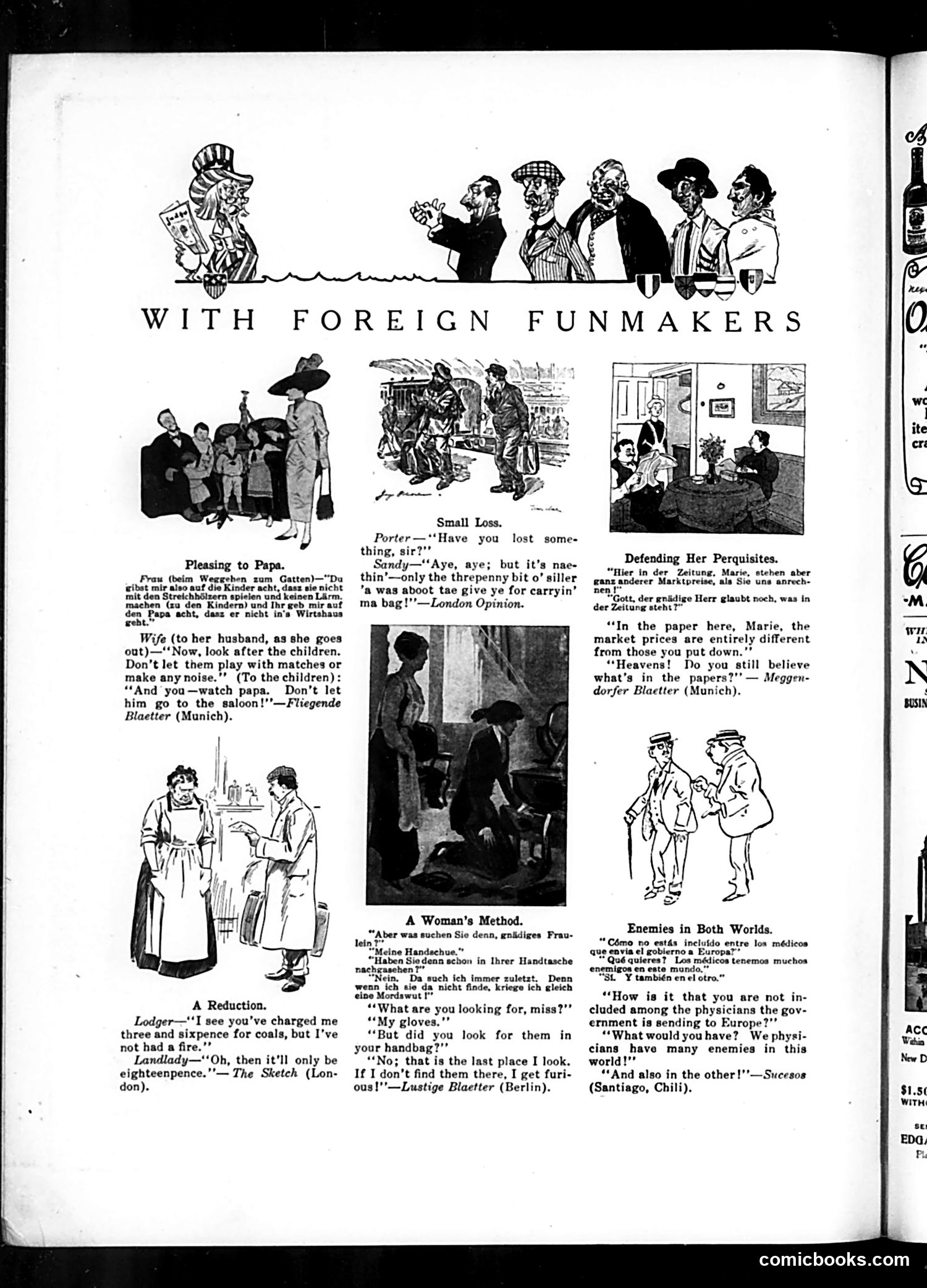
This page collects humorous anecdotes from European publications, satirizing international differences in culture and sensibility. The sketches mock various national stereotypes: Germans are portrayed as rigid and authoritarian ("Papa"), the French as refined ("A Reduction"), the British as emotionally reserved ("Lodger"), and Spanish/Chilean physicians as ineffectual ("Enemies in Both Worlds"). The humor relies on exaggerated accents, misunderstandings, and contrasting attitudes toward money, propriety, and practicality. For example, one joke plays on a porter's confusion about "losing something" versus financial loss. The overall satire suggests Americans viewing European customs as quaint, illogical, or absurdly formal—a common Judge magazine theme emphasizing American pragmatism against perceived Old World eccentricity. The international sourcing itself advertises Judge's cosmopolitan reach.
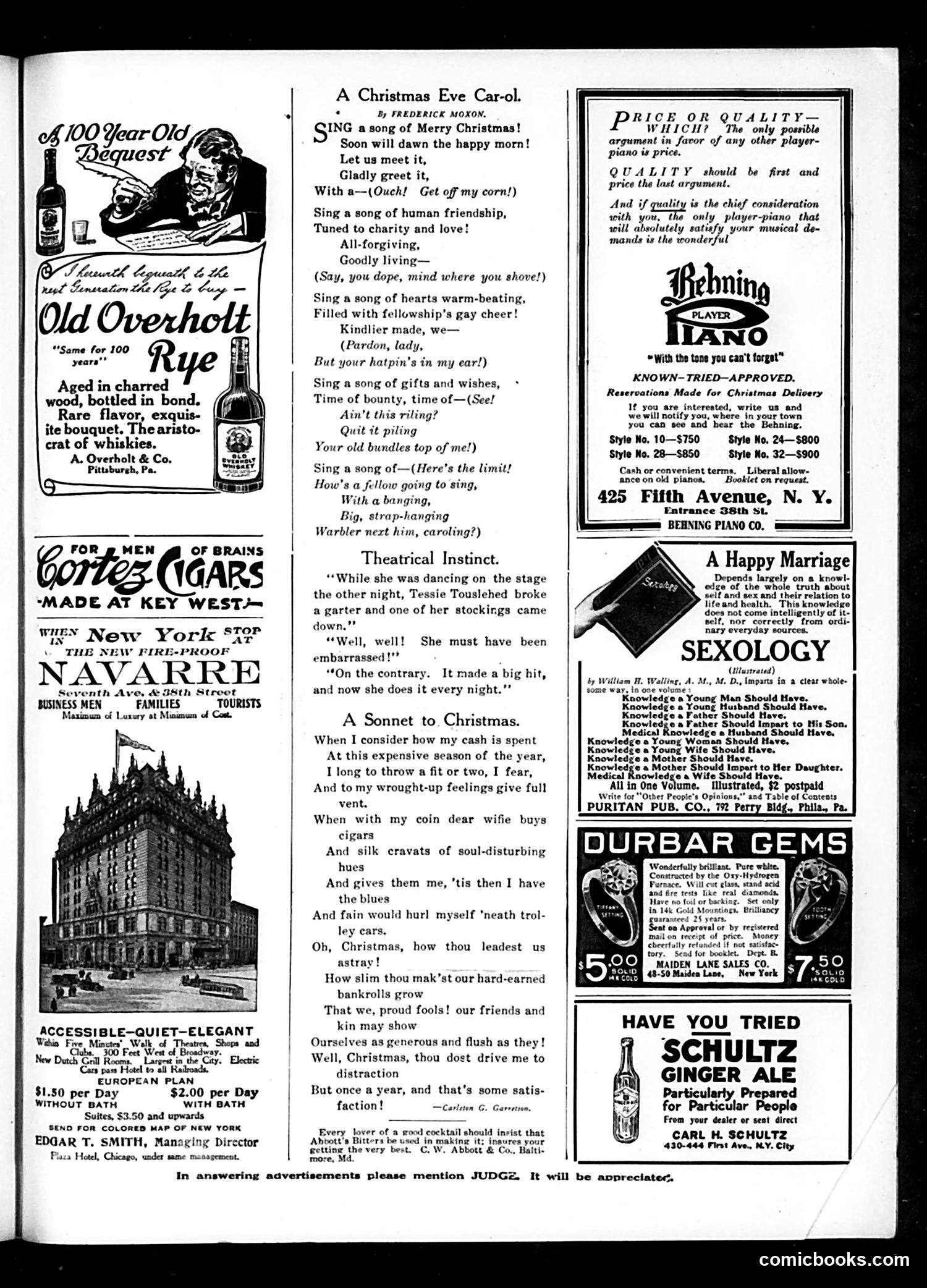
This page is primarily **advertising and light verse**, not political satire. The central content is "A Christmas Eve Carol" by Frederick Moxon—a humorous poem about singing Christmas songs while being physically jostled by crowded holiday crowds (getting stepped on, having a hatpin in one's ear, etc.). The joke plays on the contrast between noble Christmas sentiments and urban transit chaos. The page features vintage advertisements: Old Overholt Rye whiskey, Cortez cigars, the Navarre hotel, Behning player pianos, Schultz Ginger Ale, Durbar Gems (synthetic diamonds), and a "Sexology" book. A "Theatrical Instinct" anecdote mocks an actress's wardrobe mishap, and "A Sonnet to Christmas" sarcastically laments holiday spending draining the narrator's finances. The content reflects early 20th-century consumer culture and genteel humor rather than political commentary.
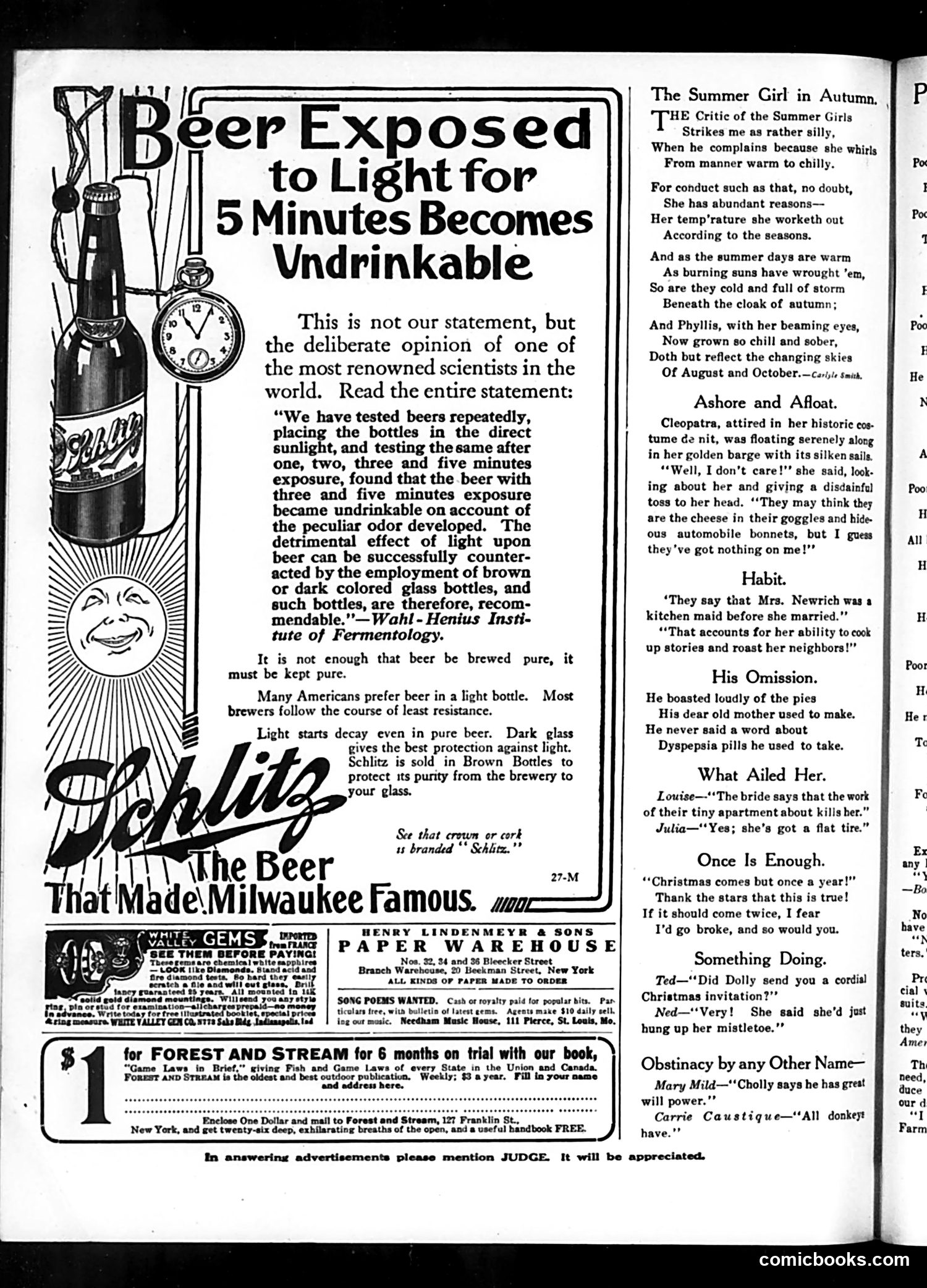
This page contains a major **Schlitz beer advertisement** (left side) and various short humorous pieces and ads (right side). The Schlitz ad cites the Wahl-Henius Institute of Fermentology to argue that beer exposed to direct sunlight for even 5 minutes becomes undrinkable due to "peculiar odor"—a legitimate concern in early 20th-century brewing. The solution: Schlitz sells beer exclusively in brown bottles to protect purity "from the brewery to your glass." This is both a genuine scientific claim and marketing advantage against competitors selling in clear bottles. The right side contains typical Judge content: light satirical poems and jokes about contemporary life. Topics include a fickle "summer girl" whose warm manner turns cold in autumn; a joke about Cleopatra's vanity versus women in automobiles; various domestic humor pieces about marriage, cooking, and Christmas. The small ads below promote sheet music sales, legal hunting guides, and music publications—typical of the era. No political figures are caricatured; this page reflects consumer culture and gender-based domestic humor of the period.
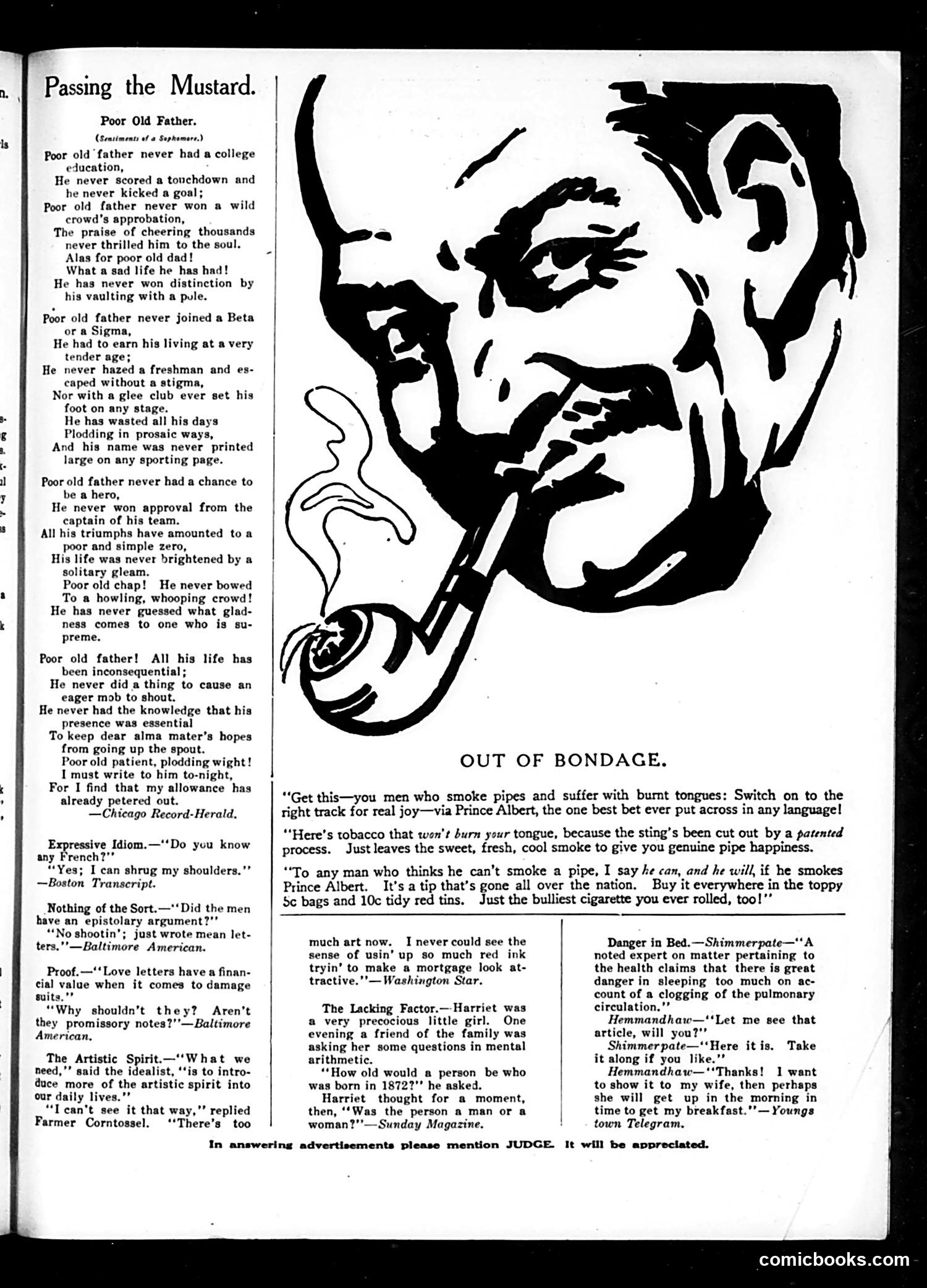
This page features a humorous poem mocking an arrogant college sophomore's condescension toward his father. The satirical verse presents the student's dismissive view: his father never attended college, never scored touchdowns, never joined fraternities (Beta, Sigma), never hazed freshmen, or appeared in sports pages. The poem builds to its punchline: the student writes home not from gratitude but because his allowance has "already petered out"—revealing the son's actual values and dependence despite his intellectual superiority complex. The accompanying illustration shows a smug young man's profile, emphasizing his arrogance. The satire targets the pretentiousness of college culture and the ingratitude of privileged youth who measure worth by collegiate achievements rather than the hard work of their parents' generation. Judge uses humor to critique the values of early-20th-century American college life.
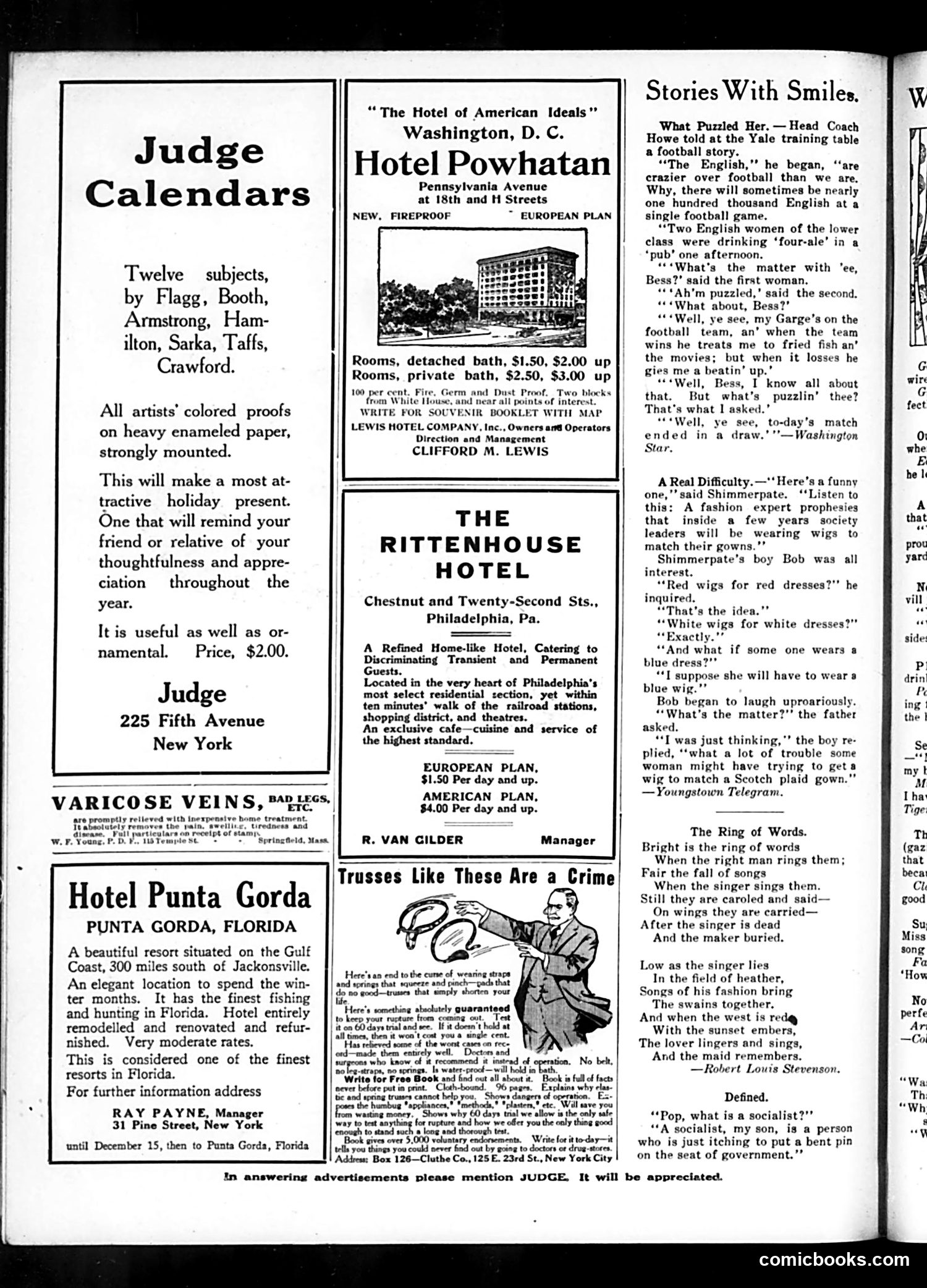
This page is primarily **advertising and filler content** rather than satirical commentary. The main elements are hotel advertisements (Powhatan, Rittenhouse, Punta Gorda) and product ads (Judge Calendars, varicose vein treatments, trusses). The only substantive content is "Stories With Smiles," a humor section. The visible story features **Head Coach Howe of Yale** contrasting American and English football enthusiasm—a mild cultural observation rather than sharp satire. The joke involves English working-class women discussing their husbands' football obsession, with the punchline playing on different attitudes toward winning versus losing ("gets a beatin' up"). The page also includes a poem, "The Ring of Words," credited to **Robert Louis Stevenson**, about how songs outlast singers. **Overall**: This appears to be a standard Judge issue page mixing advertisements with light humor and verse—typical magazine filler of the era, lacking the pointed political satire the publication was known for.
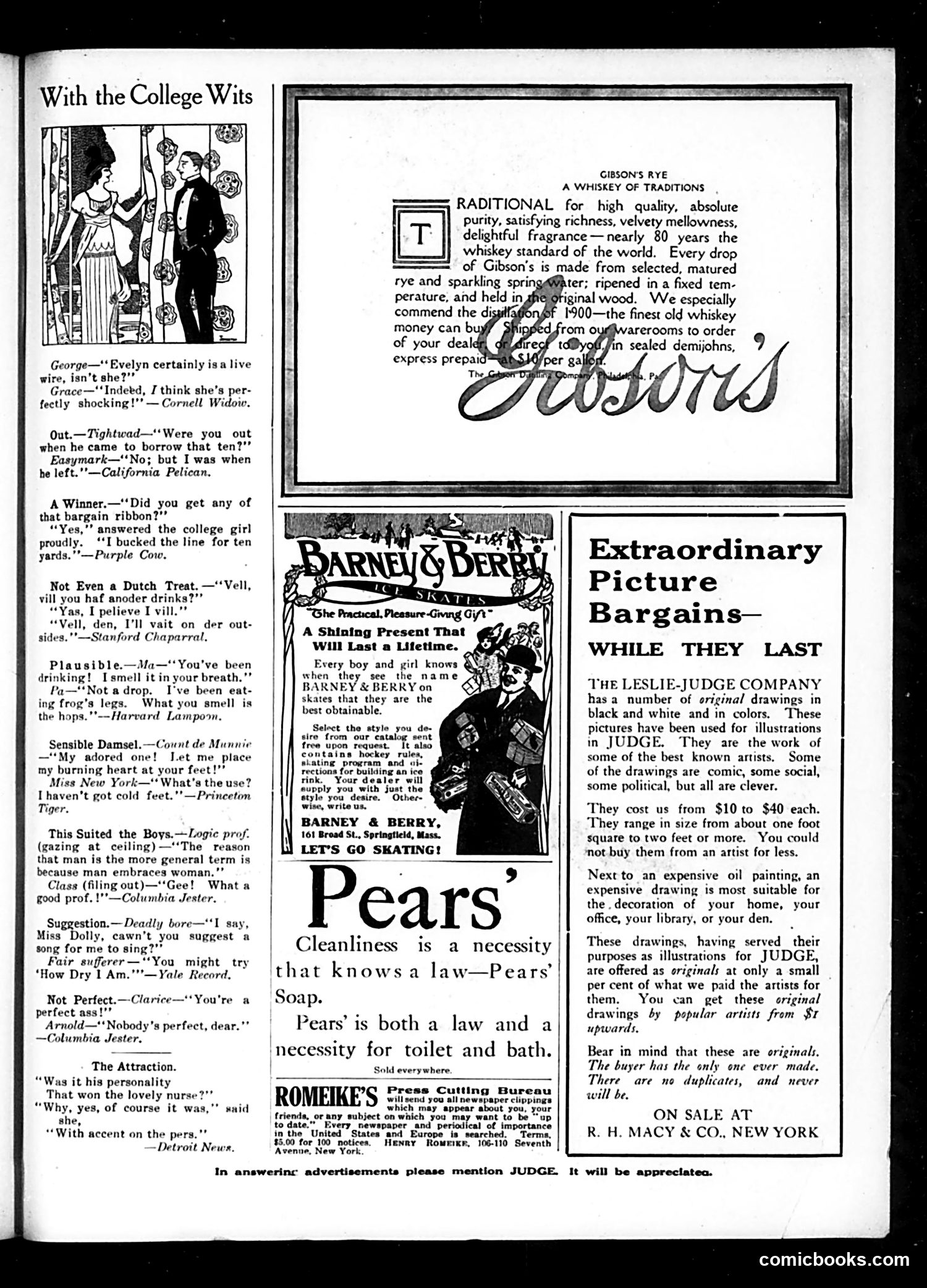
This page is primarily **advertising with humor columns**, not a political cartoon. The main content consists of: **"With the College Wits"** — A humor section featuring jokes from various college publications (Cornell Widow, California Pelican, Stanford Chaparral, etc.). These are lighthearted, often groan-worthy jokes about dating, drinking, and student life. Examples include wordplay about borrowing money and the "Dutch treat" dinner joke. **Advertisements** dominate the page: - Gibson's Rye whiskey (emphasizing 80-year tradition) - Barney & Berry ice skates - Pears' Soap - Romeike's newspaper clipping service - Leslie-Judge Company offering original drawings from *Judge* magazine artists at bargain prices ($10-$40) The page reflects early 20th-century consumer culture and collegiate humor. No specific political figures or events are referenced. The content is meant to entertain readers while promoting products and the magazine's own artwork sales.
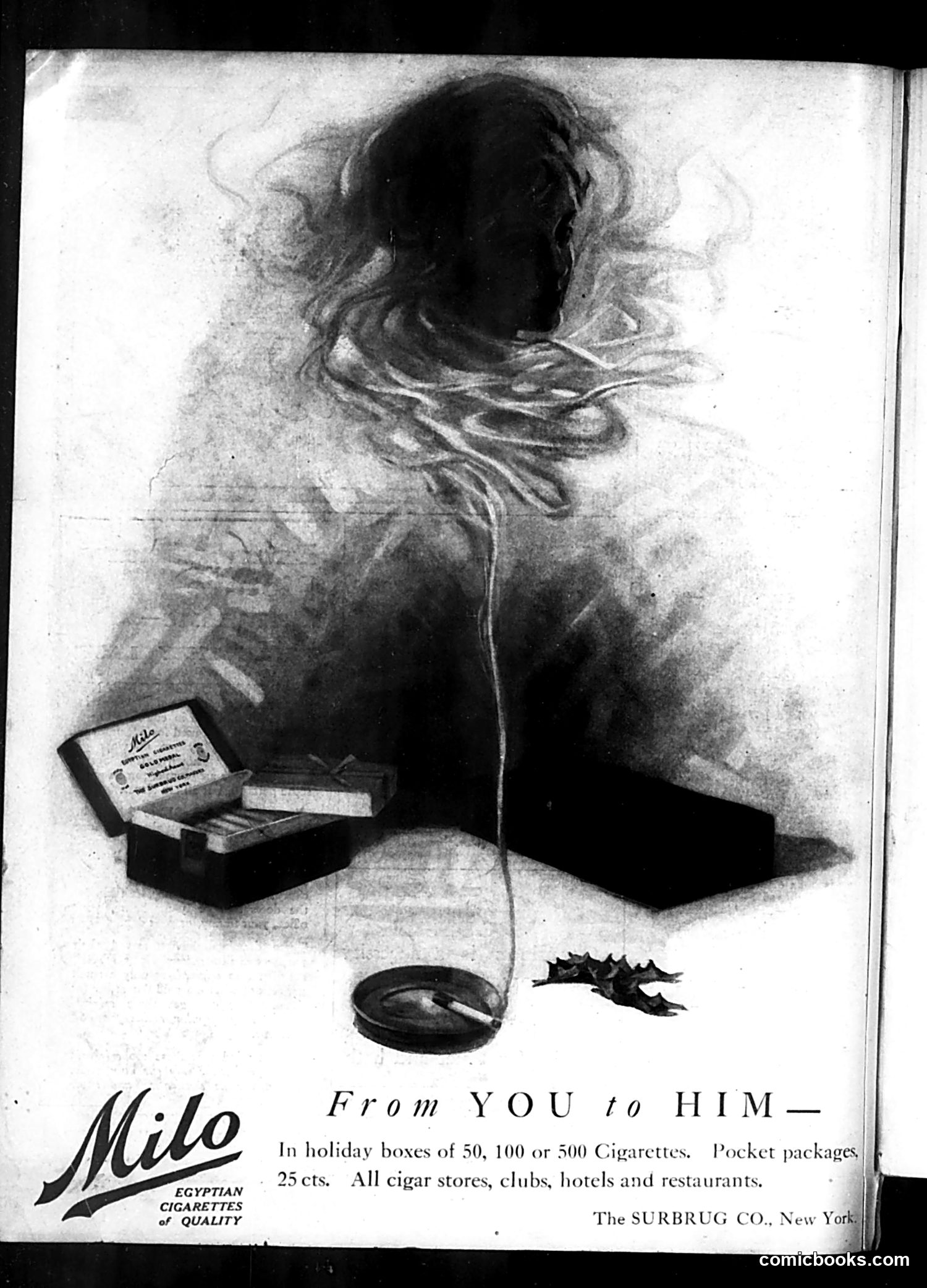
This is a **Milo Egyptian Cigarettes advertisement**, not a political cartoon. The image shows a stylized silhouette of a man's head and shoulders in profile, with ethereal smoke rising from it. Below sits an open cigarette box and a pipe with a holly leaf (suggesting Christmas gift-giving). The ad's message is straightforward holiday marketing: Milo cigarettes make ideal gifts "From YOU to HIM" during the holiday season. The text emphasizes product availability in various quantities (50, 100, or 500 cigarettes) and prices (pocket packages at 25 cents), sold through retail outlets. The artistic silhouette conveys sophistication and elegance—qualities cigarette advertisers consistently marketed in this era. There is no satire or political commentary; this is purely a commercial advertisement from an era when tobacco promotion was routine and unregulated.