
Judge, 1912-12-21 · page 8 of 24
Judge — December 21, 1912 — page 8: what you’re looking at
What you’re looking at
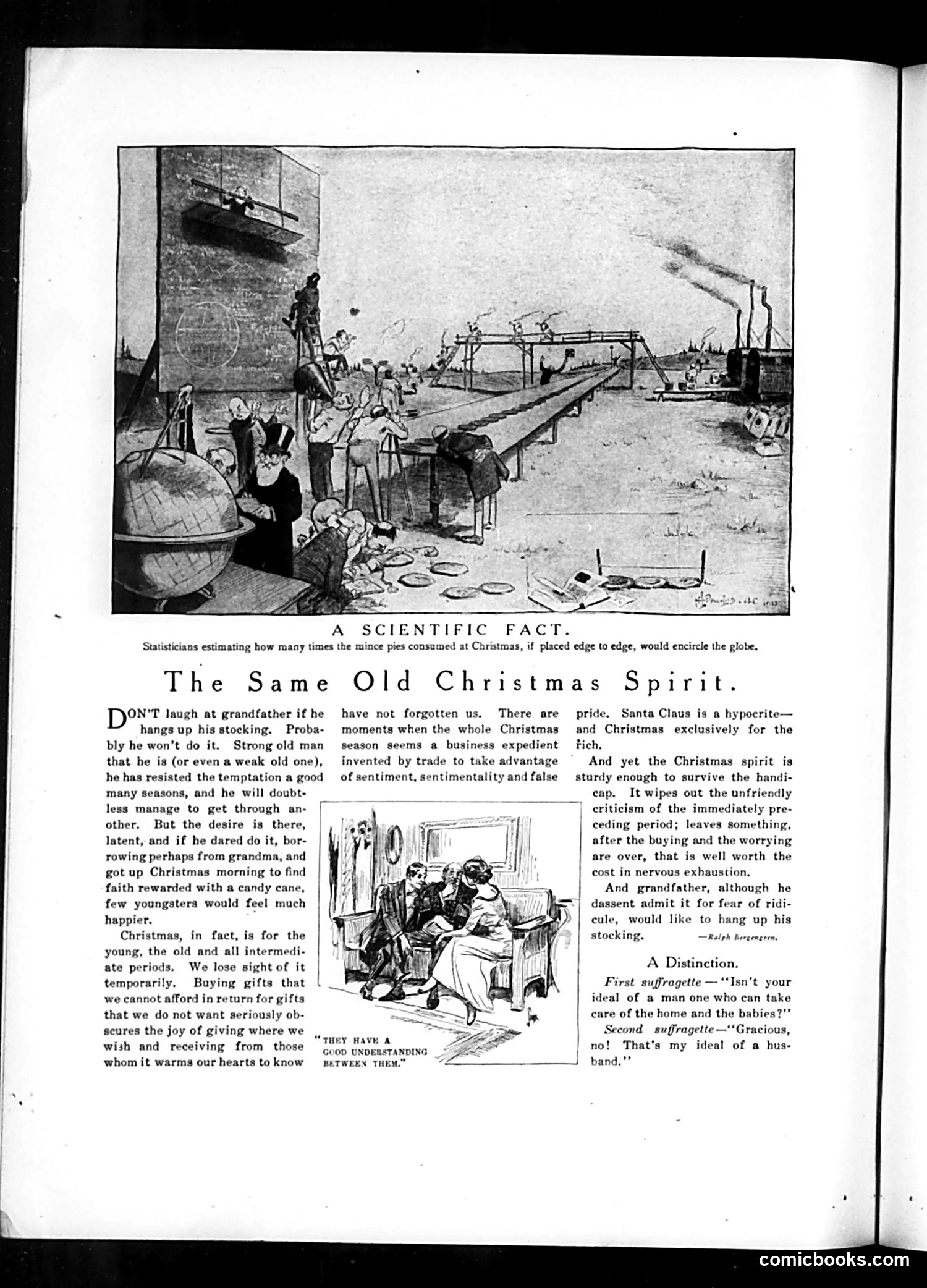
**Top cartoon ("A Scientific Fact"):** A satirical jab at statisticians and their absurd calculations. The image shows researchers measuring mince pies—a Christmas delicacy—presumably to calculate how many consumed pies, laid edge-to-edge, would circle the globe. The satire mocks the era's obsession with quantifying trivial matters through pseudo-scientific methods. **Main article ("The Same Old Christmas Spirit"):** A nostalgic defense of traditional Christmas against growing commercialism. The piece argues that while Christmas has become a "business expedient" exploited by merchants and trade, the genuine spirit of giving and familial joy persists despite commercialization's corrupting influence. It defends elderly people's childlike desire to participate in Christmas traditions. **Bottom cartoon ("A Distinction"):** Early 20th-century suffragette humor. The joke contrasts two women's ideals of men: the first suggests a man should handle domestic duties and childcare; the second clarifies *that's* her ideal of a *husband*—implying she wants independence from such responsibilities, not a man to fulfill them. It satirizes evolving feminist views on gender roles.
📄 Transcribed text from this page (OCR, searchable)
Machine-transcribed from the original scan — historical spelling and the odd misread are preserved.
Statisticians estimating how many times the mince pies consumed at Christmas, if placed edge to edge, would encircle the globe. The Same Old Christmas Spirit. Dot laugh at grandfather if he hangs up his stocking. Proba- bly he won't do it. Strong old man that he is (or even a weak old one), he has resisted the temptation a good many seasons, and he will doubt- less manage to get through an- other. But the desire is there, latent, and if he dared do it, bor- rowing perhaps from grandma, and got up Christmas morning to find faith rewarded with a candy cane, few youngsters would feel much happier. , Christmas, in fact, is for the young, the old and all intermedi- ate periods. We lose sight of it temporarily. Buying gifts that we cannot afford in return for gifts that we do not want seriously ob- scures the joy of giving where we wish and receiving from those whom it warms our hearts to know have not forgotten us. There are moments when the whole Christmas season seems a business expedient invented by trade to take advantage of sentiment, sentimentality and false pride. Santa Claus is a hypocrite— and Christmas exclusively for the tich, And yet the Christmas spirit is sturdy enough to survive the handi- cap. It wipes out the unfriendly criticism of the immediately pre- ceding period; leaves something, after the buying and the worrying are over, that is well worth the cost in nervous exhaustion, And grandfather, although he | dassent adi it for fear of ridi- cule, would like to hang up his stocking. Ralph Beremerem A Distinction. First suffragette —‘‘Isn't your ideal of a man one who can take care of the home and the babies?”” Second suffragette—‘‘Gracious, no! That's my ideal of a hus- band.”” comicbooks.com