
Judge, 1912-12-21 · page 17 of 24
Judge — December 21, 1912 — page 17: what you’re looking at
What you’re looking at
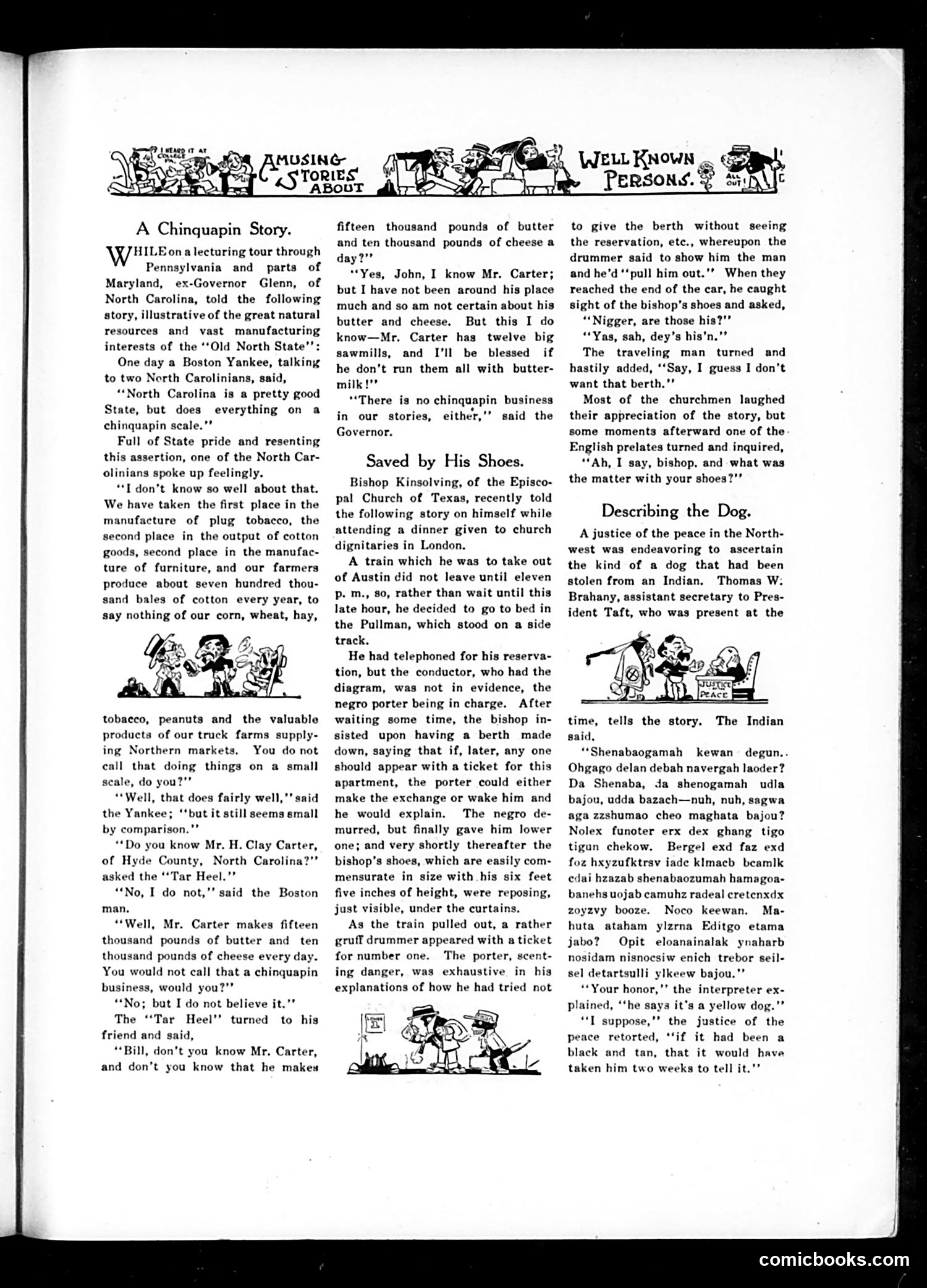
This page from *Judge* magazine contains two humorous anecdotes about regional American character types. **"A Chinquapin Story"** satirizes North Carolina's defensive boasting about its industrial output. A Boston Yankee dismisses the state's accomplishments as small-scale ("chinquapin scale"). A North Carolinian responds with inflated claims about Mr. H. Clay Carter's dairy production—fifteen thousand pounds of butter and cheese daily. The punchline: Carter actually runs the operation on *buttermilk*, undercutting the entire boast. The joke mocks Southern regional pride and tall-tale exaggeration. **"Saved by His Shoes"** features Bishop Kinsolving of Texas, a real religious figure. A railroad porter gives him a berth despite a ticket conflict. When an aggressive drummer demands the berth and threatens to "pull him out," he glimpses the bishop's enormous shoes protruding from under the curtain and immediately backs down, intimidated by their size. The humor relies on physical comedy and the assumption that large shoes signal a formidable person not worth confronting. Both stories trade in period stereotypes about regional and class types.
📄 Transcribed text from this page (OCR, searchable)
Machine-transcribed from the original scan — historical spelling and the odd misread are preserved.
A Chinquapin Story. HILEona lecturing tour through Pennsylvania and parts of Maryland, ex-Governor Glenn, of North Carolina, told the following story, illustrative of the great natural resources and vast manufacturing interests of the ‘‘Old North State’’: One day a Boston Yankee, talking to two North Carolinians, said, “North Carolina is a pretty good State, but does everything on a chinquapin scale."” Full of State pride and resenting this assertion, one of the North Car- olinians spoke up feelingly. “*I don’t know so well about that. We have taken the first place in the manufacture of plug tobacco, the second place in the output of cotton goods, second place in the manufac- ture of furniture, and our farmers produce about seven hundred thou- sand bales of cotton every year, to say nothing of our corn, wheat, hay, tobacco, peanuts and the valuable products of our truck farms supply- ing Northern markets. You do not call that doing things on a small scale, do you?” “Well, that does fairly well,’’ said the Yankee; ‘but it still seems small by comparison."” “*Do you know Mr. H. Clay Carter, of Hyde County, North Carolina?” asked the ‘Tar Heel.”” “No, I do not,’’ said the Boston man. “Well, Mr. Carter makes fifteen thousand pounds of butter and ten thousand pounds of cheese every day. You would not call that a chinquapin business, would you?”’ “No; but I do not believe it.’’ The ‘Tar Heel’? turned to his friend and said, “Bill, don’t you know Mr, Carter, and don’t you know that he makes fifteen thousand pounds of butter and ten thousand pounds of cheese a day?"” **Yes, John, I know Mr. Carter; but I have not been around his place much and so am not certain about his butter and cheese. But this I do know—Mr. Carter has twelve big sawmills, and I'll be blessed if he don’t run them all with butter- milk!" “There is no chinquapin business in our stories, either,” said the Governor. Saved by His Shoes. Bishop Kinsolving, of the Episco- pal Church of Texas, recently told the following story on himself while attending a dinner given to church dignitaries in London. A train which he was to take out of Austin did not leave until eleven p. m., so, rather than wait until this late hour, he decided to go to bed in the Pullman, which stood on a side track. He had telephoned for his reserva- tion, but the conductor, who had the diagram, was not in evidence, the negro porter being in charge. After waiting some time, the bishop in- sisted upon having a berth made down, saying that if, later, any one should appear with a ticket for this apartment, the porter could either make the exchange or wake him and he would explain. The negro de- murred, but finally gave him lower one; and very shortly thereafter the bishop’s shoes, which are easily com- mensurate in size with his six feet five inches of height, were reposing, just visible, under the curtains. As the train pulled out, a rather gruff drummer appeared with a ticket for number one. The porter, scent- ing danger, was exhaustive in his explanations of how he had tried not & WELL KNOWN » PERSONS. e * to give the berth without seeing the reservation, etc., whereupon the drummer said to show him the man and he'd ‘‘pull him out.’’. When they reached the end of the car, he caught sight of the bishop’s shoes and asked, “Nigger, are those his?’” “Yas, sah, dey’s his’n. The traveling man turned and hastily added, ‘‘Say, I guess I don’t want that berth.”” Most of the churchmen laughed their appreciation of the story, but some moments afterward one of the English prelates turned and inquired, “Ah, I say, bishop, and what was the matter with your shoes?”’ Describing the Dog. A justice of the peace in the North- west was endeavoring to ascertain the kind of a dog that had been stolen from an Indian. Thomas W: Brahany, assistant secretary to Pres- ident Taft, who was present at the time, tells the story. The Indian said, “Shenabaogamah kewan degun.. Ohgago delan debah navergah laoder? Da Shenaba, da shenogamah udla bajou, udda bazach—nuh, nuh, sagwa aga zzshumao cheo maghata bajou? Nolex funoter erx dex ghang tigo tigun chekow. Bergel exd faz exd foz hxyzufktrsv iade kImacb beamlk edai hzazab shenabaozumah hamagoa- banehs uojab camuhz radeal cretenxdx zoyzvy booze. Noco keewan. Ma- huta ataham ylzrna Editgo etama jabo? Opit eloanainalak ynaharb nosidam nisnocsiw enich trebor seil- sel detartsulli ylkeew bajou."’ “‘Your honor,’’ the interpreter ex- plained, ‘the says it’s a yellow dog."” “I suppose,’? the justice of the peace retorted, “if it had been a black and tan, that it would have taken him two weeks to tell it."’ comicbooks.com