
A complete issue · 24 pages · 1912
Judge — November 23, 1912
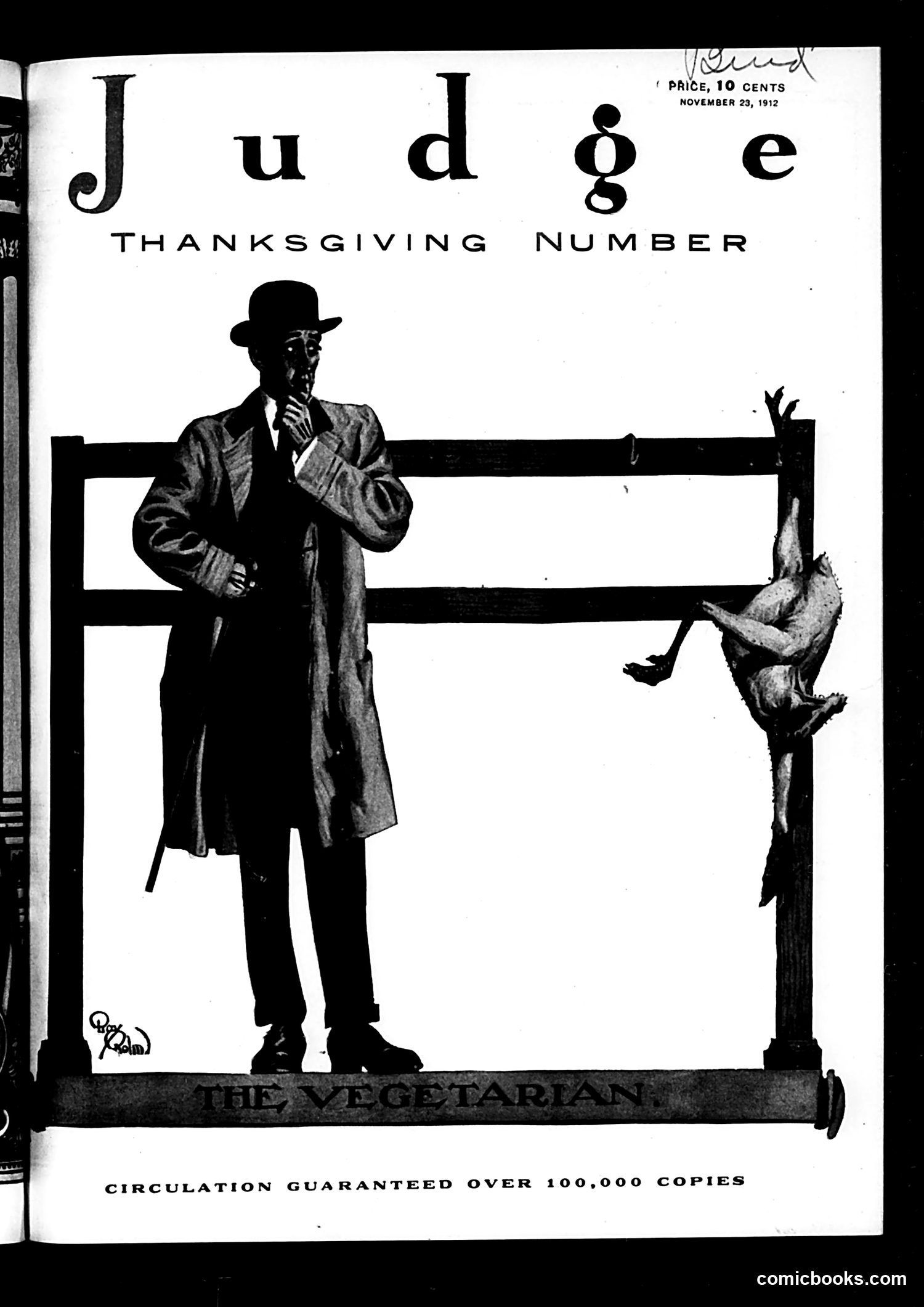
This cover cartoon, titled "The Vegetarian," depicts a well-dressed man in a bowler hat and overcoat standing beside a wooden fence, apparently conversing with or observing a rooster. The satire likely mocks vegetarianism or dietary reform movements that were gaining attention in the early 1900s. The gentleman's refined appearance contrasts humorously with his interaction with farm poultry, suggesting mockery of urban advocates promoting vegetarian lifestyles. The caption "The Vegetarian" and the Thanksgiving timing are deliberate ironies—during a holiday traditionally centered on meat consumption, the cartoon ridicules those rejecting that tradition. The illustrated signature appears to be by a recognized Judge cartoonist of the period.
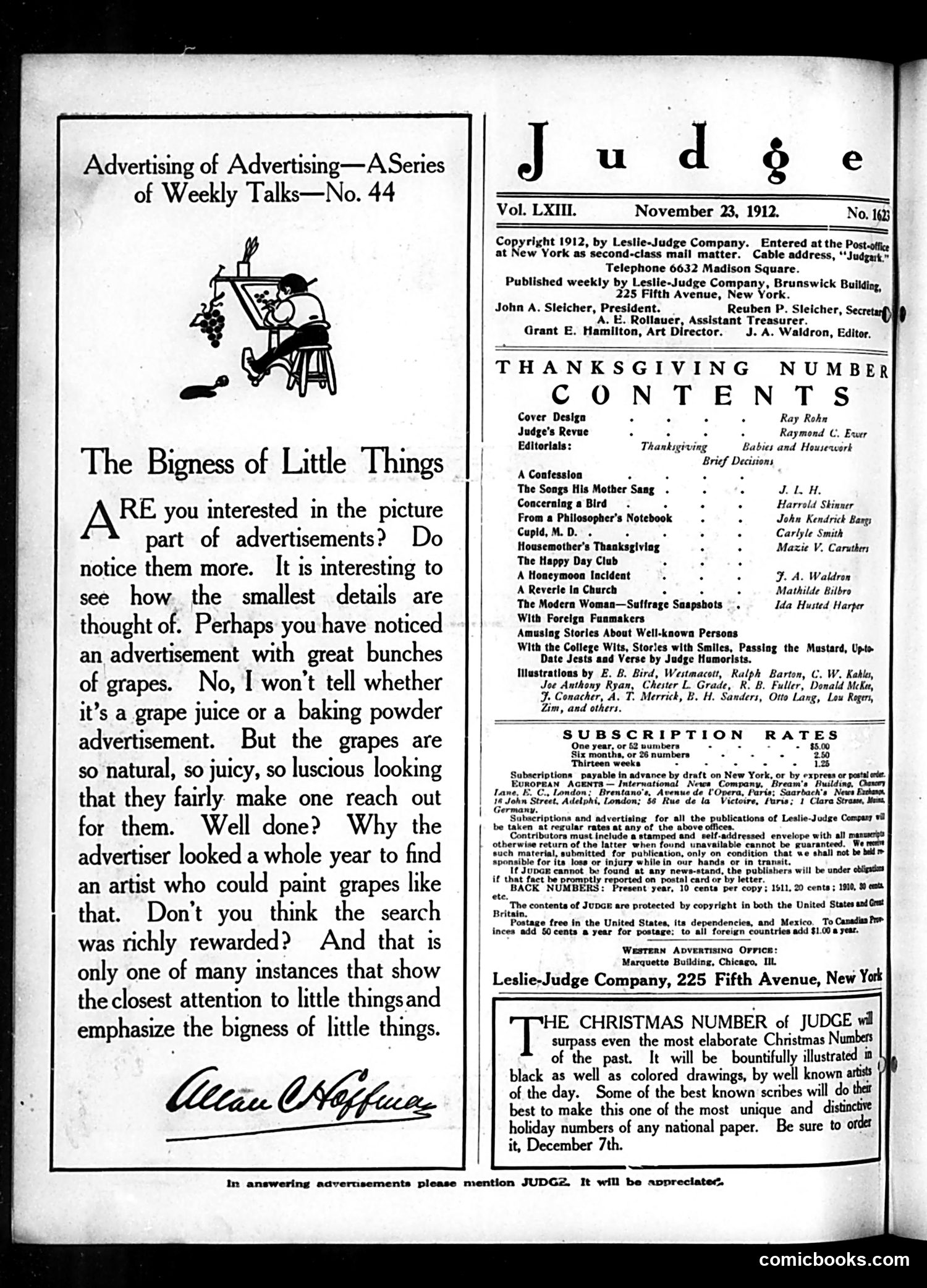
This page primarily contains **advertising content and magazine information** rather than political satire. The left side features "Advertising of Advertising—A Series of Weekly Talks, No. 44," titled "The Bigness of Little Things." The unsigned editorial (likely by Alan Dufficey, based on the signature) discusses how advertisers pay careful attention to small visual details—using grapes in advertisements as an example of naturalistic, appealing imagery that took considerable effort to perfect. The right side lists the magazine's contents, subscription rates, and a preview of the upcoming Christmas issue. This is essentially a house advertisement promoting Judge's own editorial quality and festive holiday number. No political figures or satirical commentary appears on this particular page.
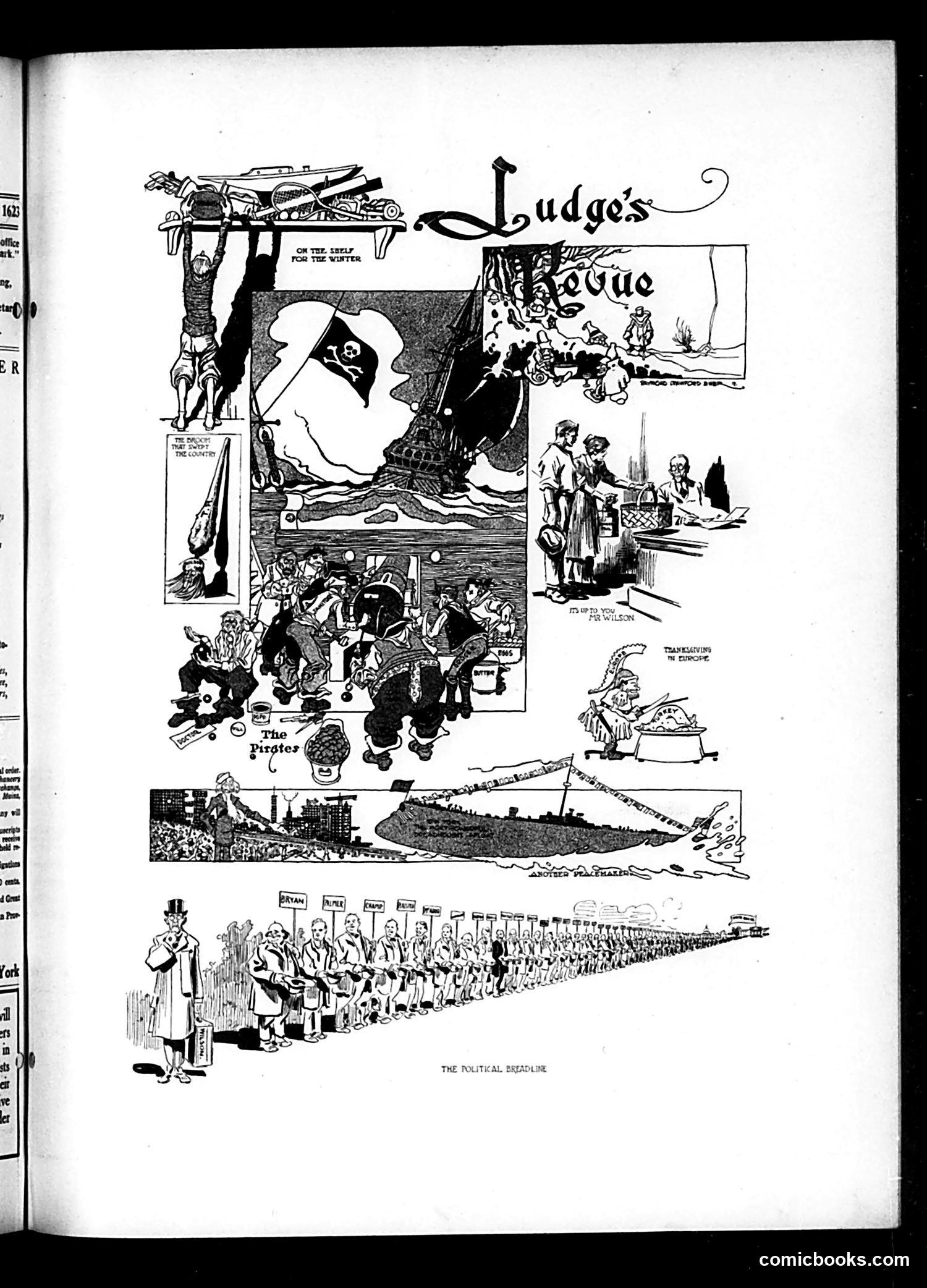
This page titled "Judge's Revue" presents multiple satirical cartoons commenting on early 20th-century American politics and society. The central image depicts "The Pirates"—likely referring to corrupt political figures or business leaders plundering the nation's resources. The "Political Parade" at bottom shows a long line of politicians or candidates following a leader, satirizing mass political movements or party conformity. Other vignettes reference "Thanksgiving in Europe" and scenes labeled "prepared for winter," appearing to comment on international affairs and domestic preparedness—possibly related to WWI-era tensions or economic conditions. The overall theme critiques political corruption, exploitation, and the theatrical nature of politics. Without clearer labels or OCR accuracy, specific figures remain unclear, though the cartoons target government malfeasance and public deception typical of Judge's satirical mission.
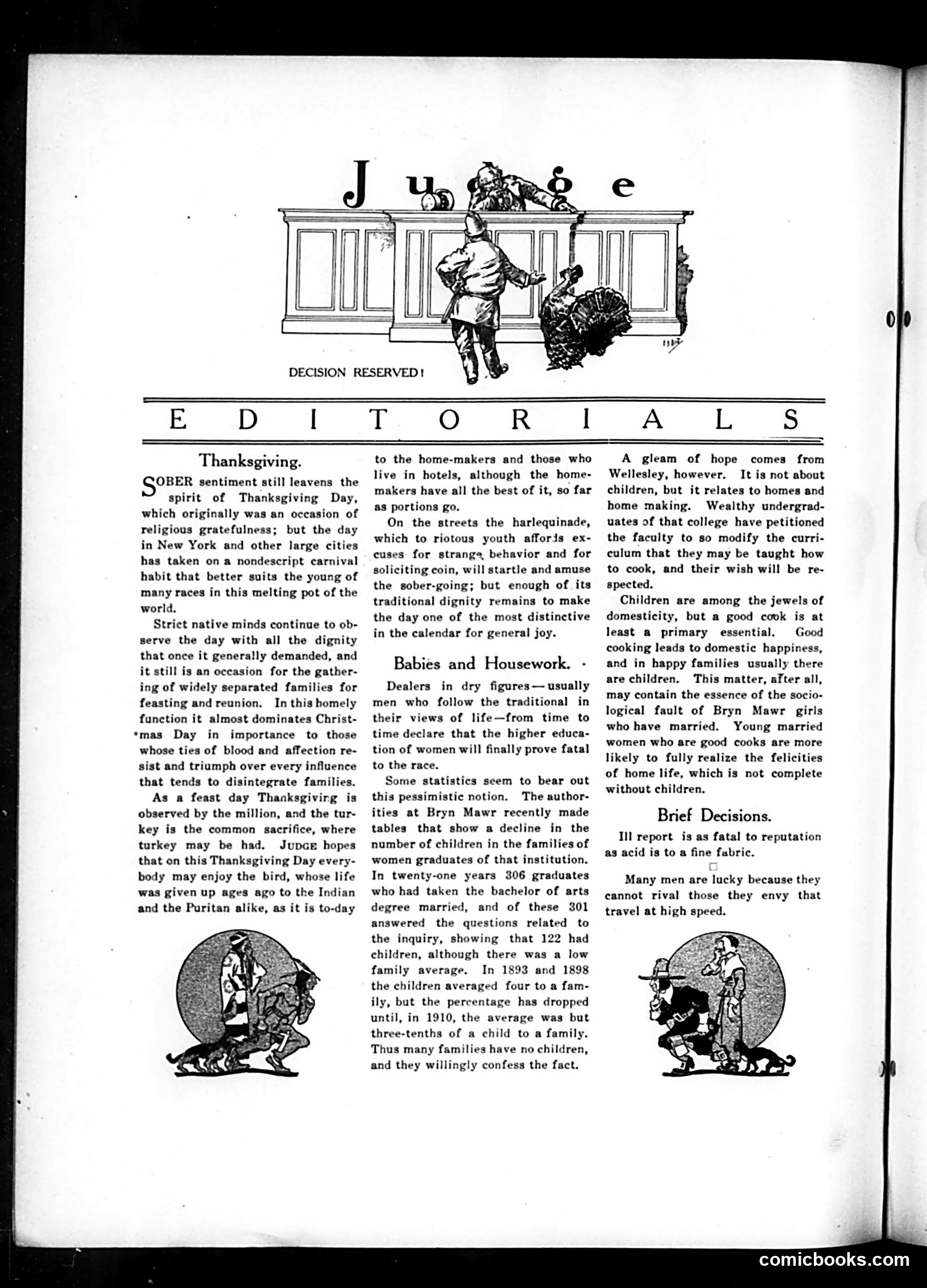
This page presents editorials on Thanksgiving traditions and social commentary on marriage and motherhood among educated women. The masthead cartoon depicts "Decision Reserved"—likely referencing a judicial or social debate about modern women's roles. The text critiques changing American attitudes: Thanksgiving has become commercialized in cities, losing religious significance. A subsection titled "Babies and Housework" discusses statistics from Bryn Mawr College showing declining birth rates among female graduates. The author presents this as evidence that higher education for women proves "fatal to the race"—a eugenic-tinged argument common in early 20th-century conservative discourse. The "Brief Decisions" section contains satirical observations about luck and social climbing. The decorative illustrations appear to be standard period ornaments rather than specific political caricatures.
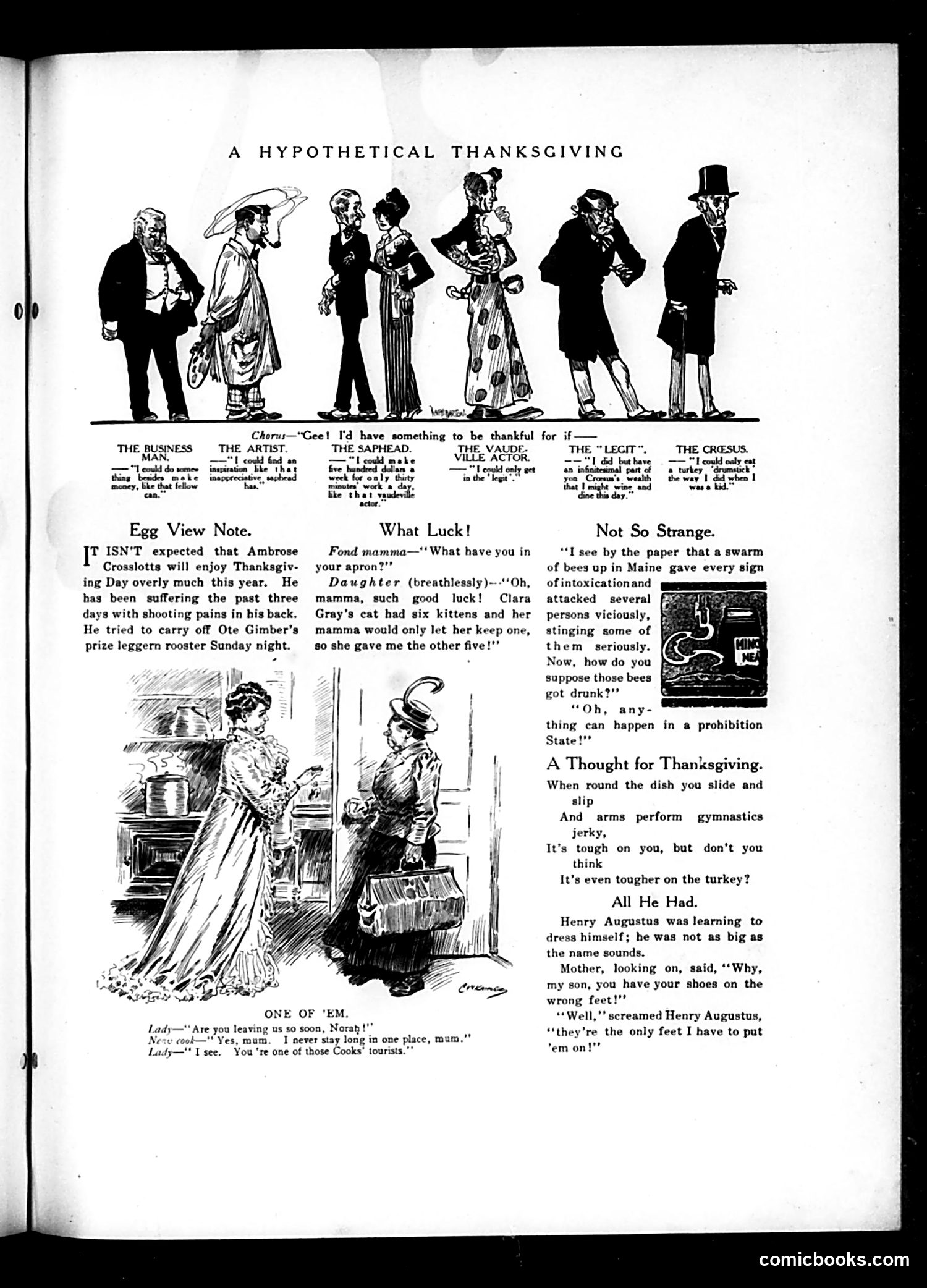
This satirical cartoon depicts seven stereotypical figures each expressing what they'd be grateful for on Thanksgiving, mocking various social types of the era: - **The Business Man**: thankful for high prices - **The Artist**: grateful for "appreciative patrons" - **The Saphead** (foolish man): hoping to find a rich wife - **The Vaudeville Actor**: thankful for packed theaters - **"The Legit"** (legitimate theater actor): hoping for a successful run - **The Census Taker**: wishing people would answer honestly Below are humorous anecdotes about Turkey Day mishaps. The satire targets contemporary greed, vanity, and the gap between what people *claim* to be grateful for versus their actual selfish desires—a timeless commentary on Thanksgiving hypocrisy packaged through period-specific professions and social anxieties.
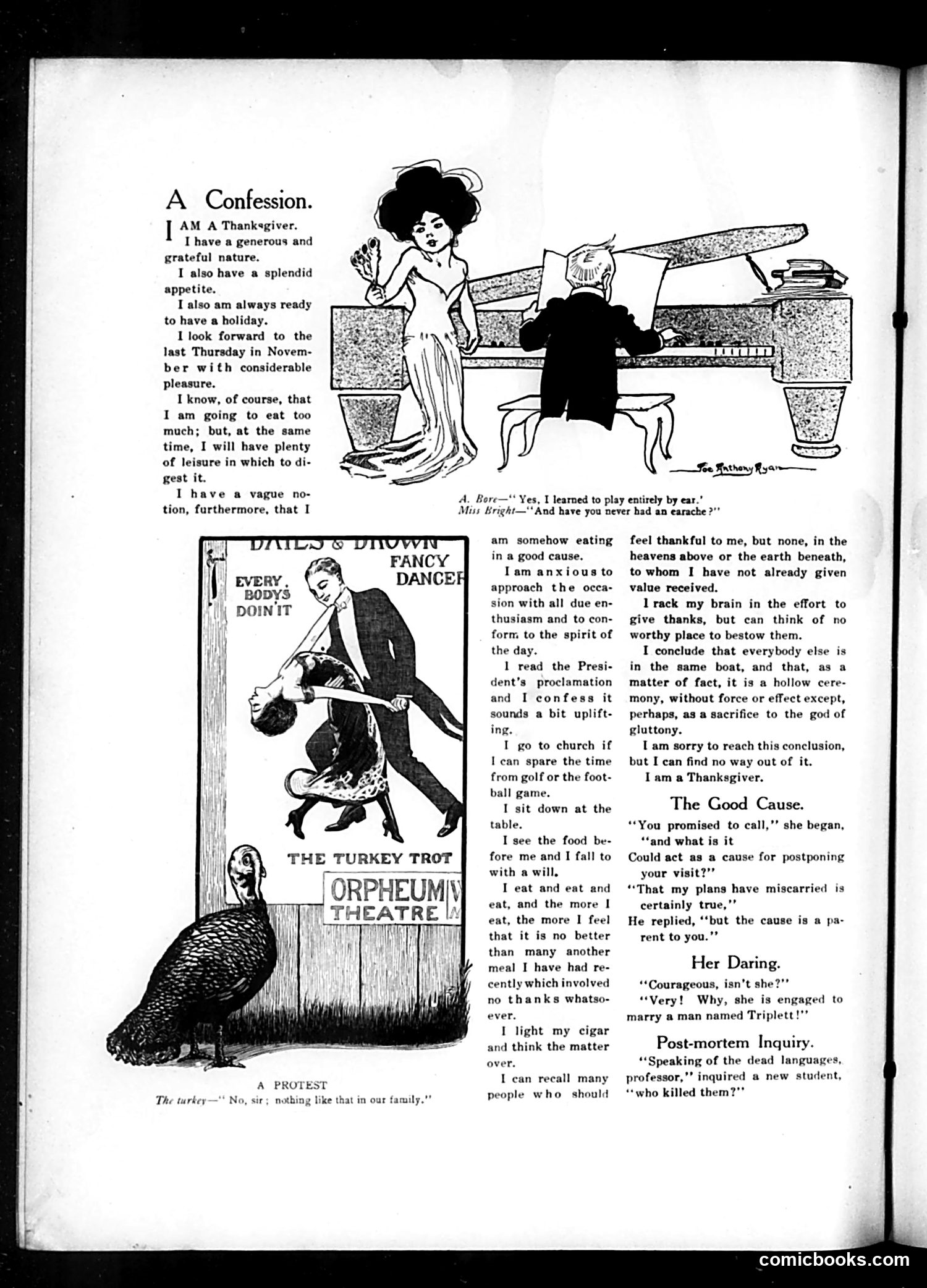
This page satirizes Thanksgiving hypocrisy and includes period humor pieces. "A Confession" mocks self-aware thanksgiving pretense: the narrator claims grateful, generous nature while admitting he'll overeat, skip church for sports, and can't find anyone genuinely deserving his thanks—concluding the holiday is hollow ceremony masking gluttony. The "Turkey Trot" cartoon references the popular 1910s dance craze, showing a turkey protesting its fate with dark humor. Three brief joke items follow: "A Bore" jokes about learning music "by ear" without earaches; "The Good Cause" plays on romantic disappointment; "Her Daring" puns on marrying someone named Triplett; "Post-mortem Inquiry" wordplays "dead languages." The page reflects early 20th-century satirical magazine conventions: cynical social commentary mixed with lightweight puns and vaudeville-style humor.
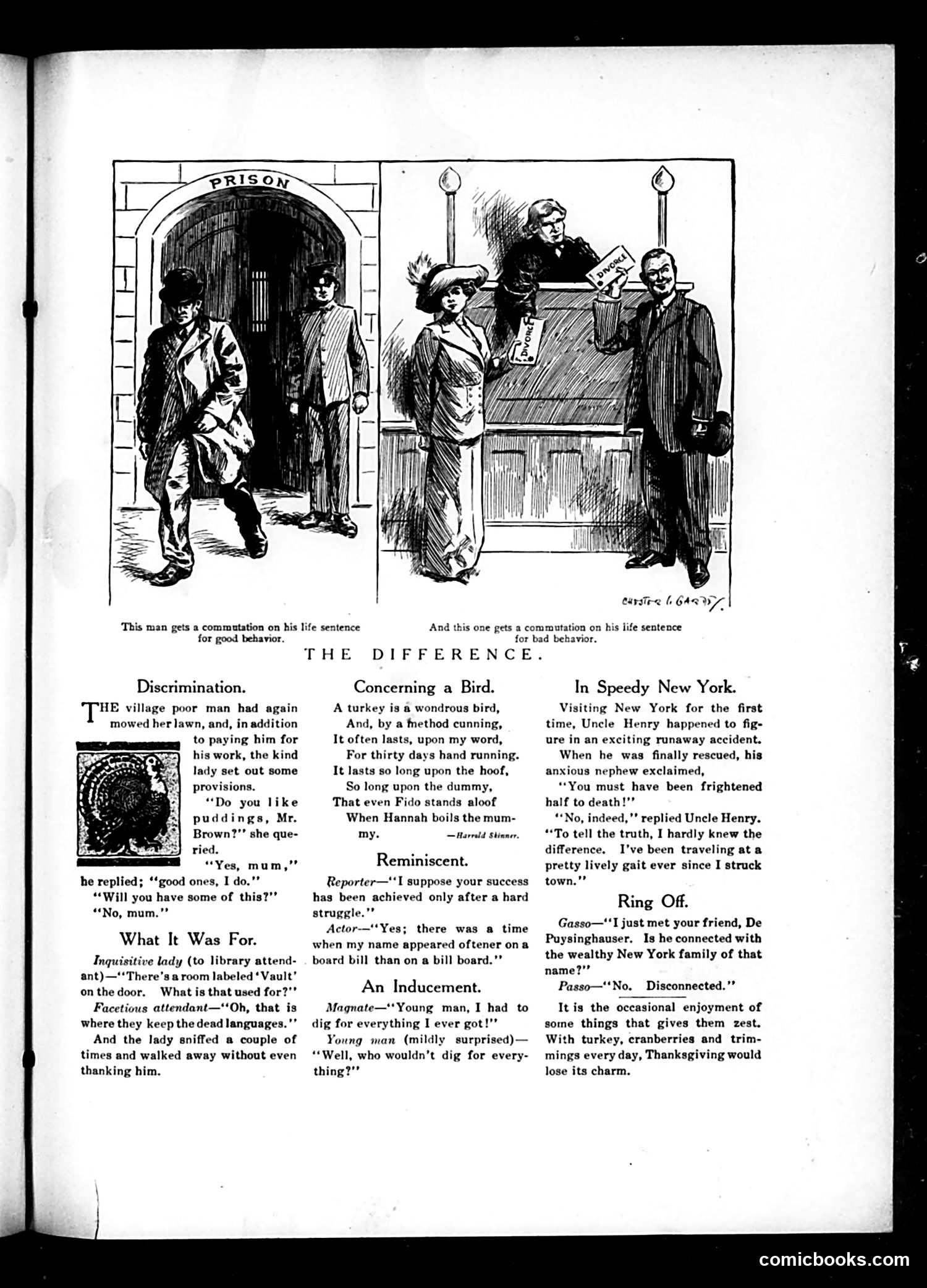
The top cartoon contrasts judicial leniency: a poor man receives commutation for "good behavior" while a wealthy man gets commutation for "bad behavior"—satirizing class discrimination in the criminal justice system where the rich escape consequences while the poor are rewarded for compliance. Below are various humorous short pieces: "Discrimination" mocks class pretension (a poor man refuses fancy pudding); "What It Was For" is a library joke about "dead languages" in a vault; "Concerning a Bird" is lighthearted verse about turkey's shelf-life; and others are mild social humor about actors, wealth, and New York's fast pace. The overarching theme critiques **inequality before the law and social hypocrisy**—the wealthy operate under different rules entirely. This reflects Progressive-era concerns about corruption and class justice that Judge frequently lampooned.
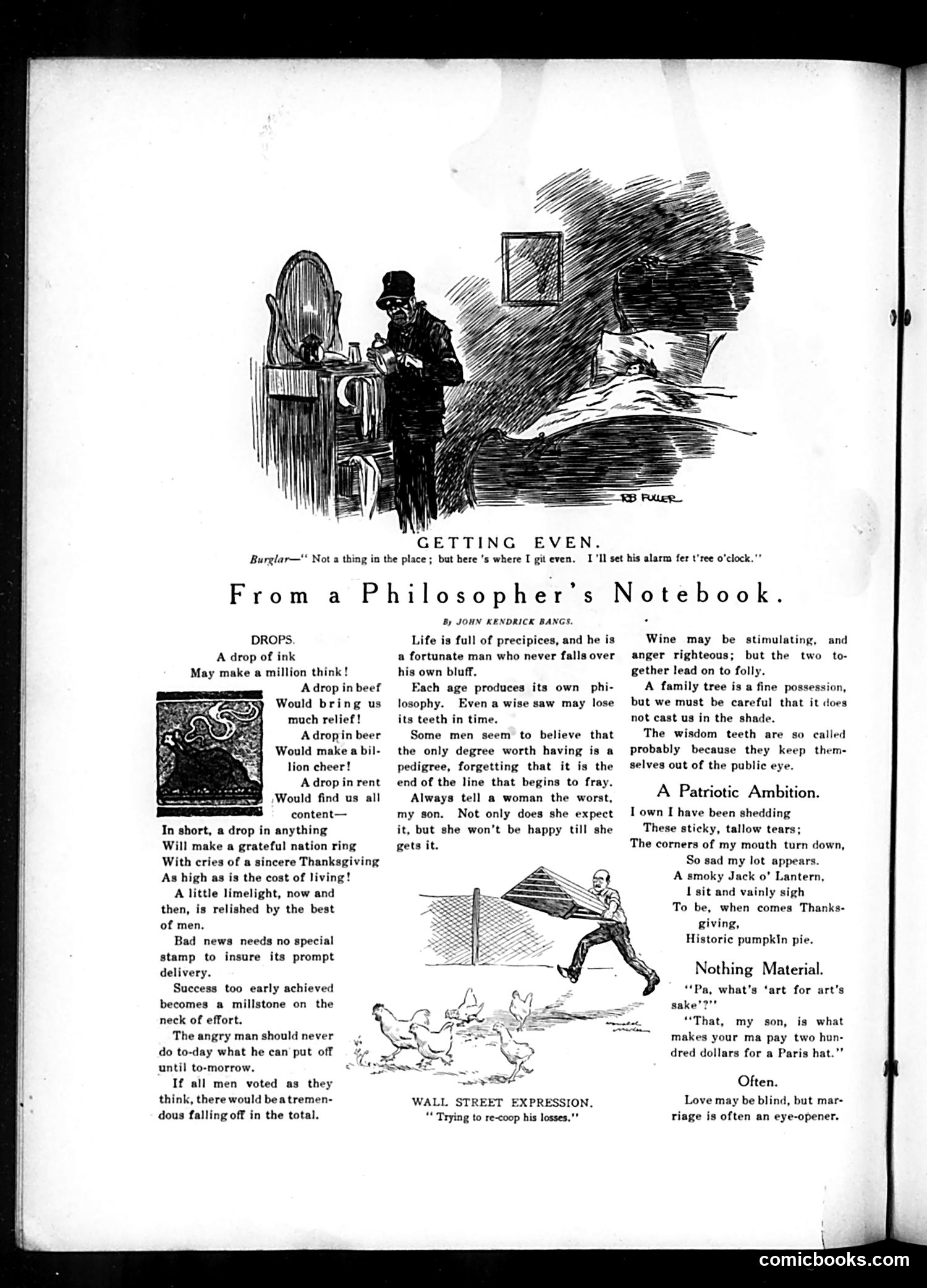
The top cartoon depicts a burglar breaking into a home and finding nothing to steal. His revenge: setting the homeowner's alarm clock for 3 a.m.—a petty but effective prank. This is humorous satire about burglary and domestic annoyance. The bulk of the page consists of philosophical aphorisms by John Kendrick Bangs, a popular humorist. These witty observations satirize contemporary American life: the obsession with cost-of-living increases ("drops" in prices would make people grateful), pretentious family trees and pedigrees, hypocrisy in voting, and materialism (defining "art for art's sake" as paying $200 for a Paris hat). The "Wall Street Expression" cartoon shows a man trying to recover financial losses—likely referencing stock market speculation common among the era's wealthy. The scattered verses mock patriotic sentimentality and romantic ideals ("love may be blind, but marriage is often an eye-opener"). Overall, this page satirizes American middle and upper-class values, consumerism, and social pretension through humor and mild cynicism typical of Judge magazine's editorial voice.
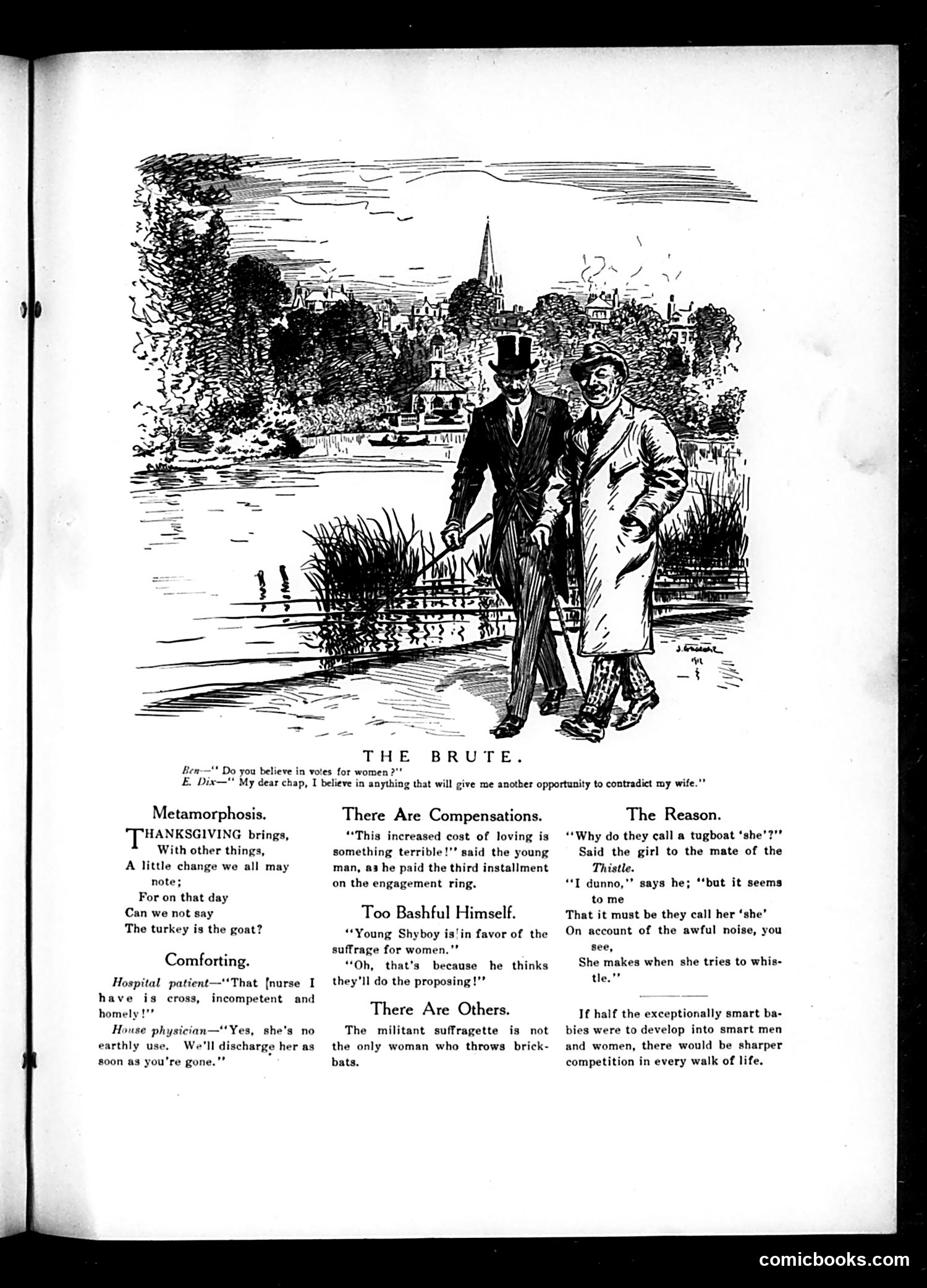
This page from the satirical magazine *Judge* contains multiple short jokes and one cartoon, all addressing contemporary social issues circa early 1900s, particularly women's rights and gender relations. **"The Brute" (main cartoon):** Two men discuss women's suffrage. One claims he supports votes for women solely because it gives him "another opportunity to contradict my wife"—satirizing men who weaponize suffrage opposition as marital control, while pretending to be reasonable. **Other jokes target:** - **"Too Bashful Himself"**: Mocks men opposing women's suffrage while being too timid to propose themselves - **"There Are Others"**: Suggests militant suffragettes aren't unique in "throwing brickbats" (criticism)—implying women in general are combative - **Gender stereotypes**: Multiple jokes equate women with noise, irrationality, and expense (engagement ring inflation) **Context**: These pieces reflect anti-suffrage sentiment dressed as humor. They ridicule both suffragists and women generally, while presenting male resistance to equality as reasonable or even noble. The satire targets progressive arguments rather than opposing them.
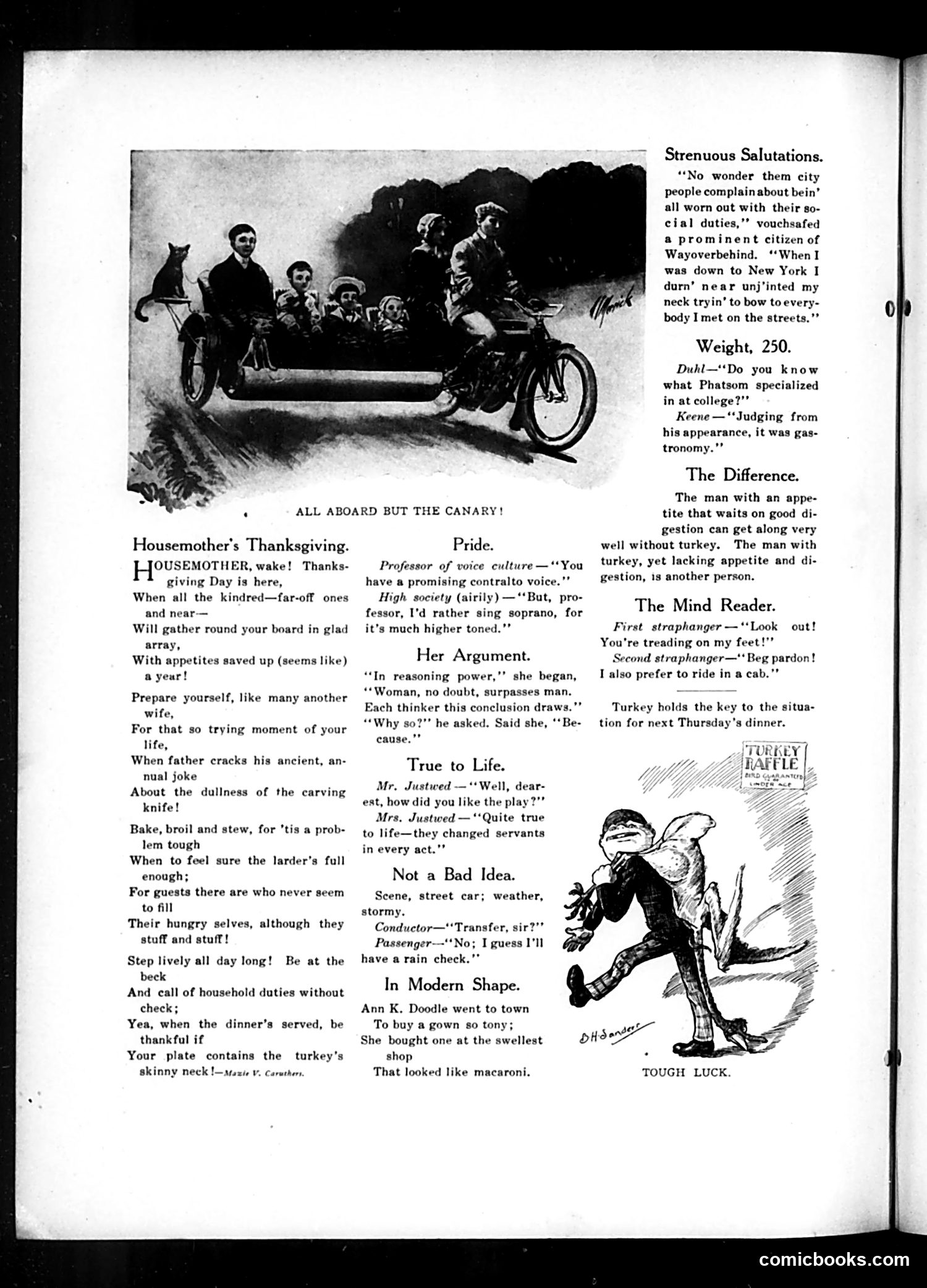
This appears to be a Thanksgiving-themed humor page from an early 20th-century *Judge* magazine. The content consists of several short satirical pieces and jokes rather than a single unified cartoon: **Main themes:** - **"Housemother's Thanksgiving"**: Mocks the exhausting labor expected of wives during holidays—cooking, hosting, serving guests, while receiving the turkey's least desirable part (the neck) as reward. - **Social satire pieces**: Includes jokes about pretentious society women, newly married couples, streetcar etiquette, and fashionable clothing. - **The cartoon "All Aboard But the Canary!"** (top): Shows a bicycle-drawn carriage crowded with passengers, satirizing either urban transportation or perhaps overcrowding. The overall message lampoons class pretension, gender role expectations, and modern urban life. The humor relies on observational comedy about Thanksgiving customs and early 1900s social anxieties—recognizable to period readers but requiring historical context for modern audiences unfamiliar with these social conventions.
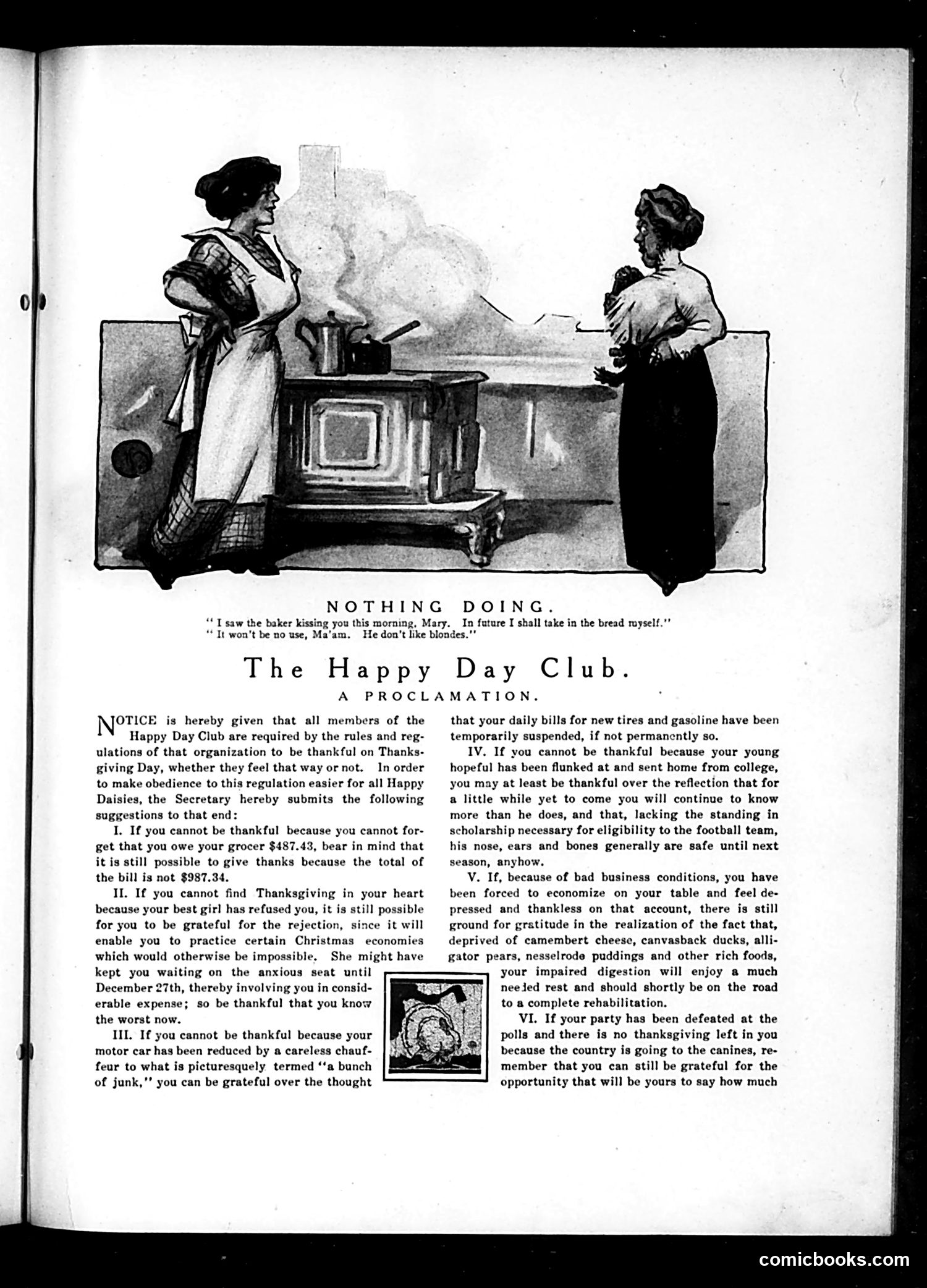
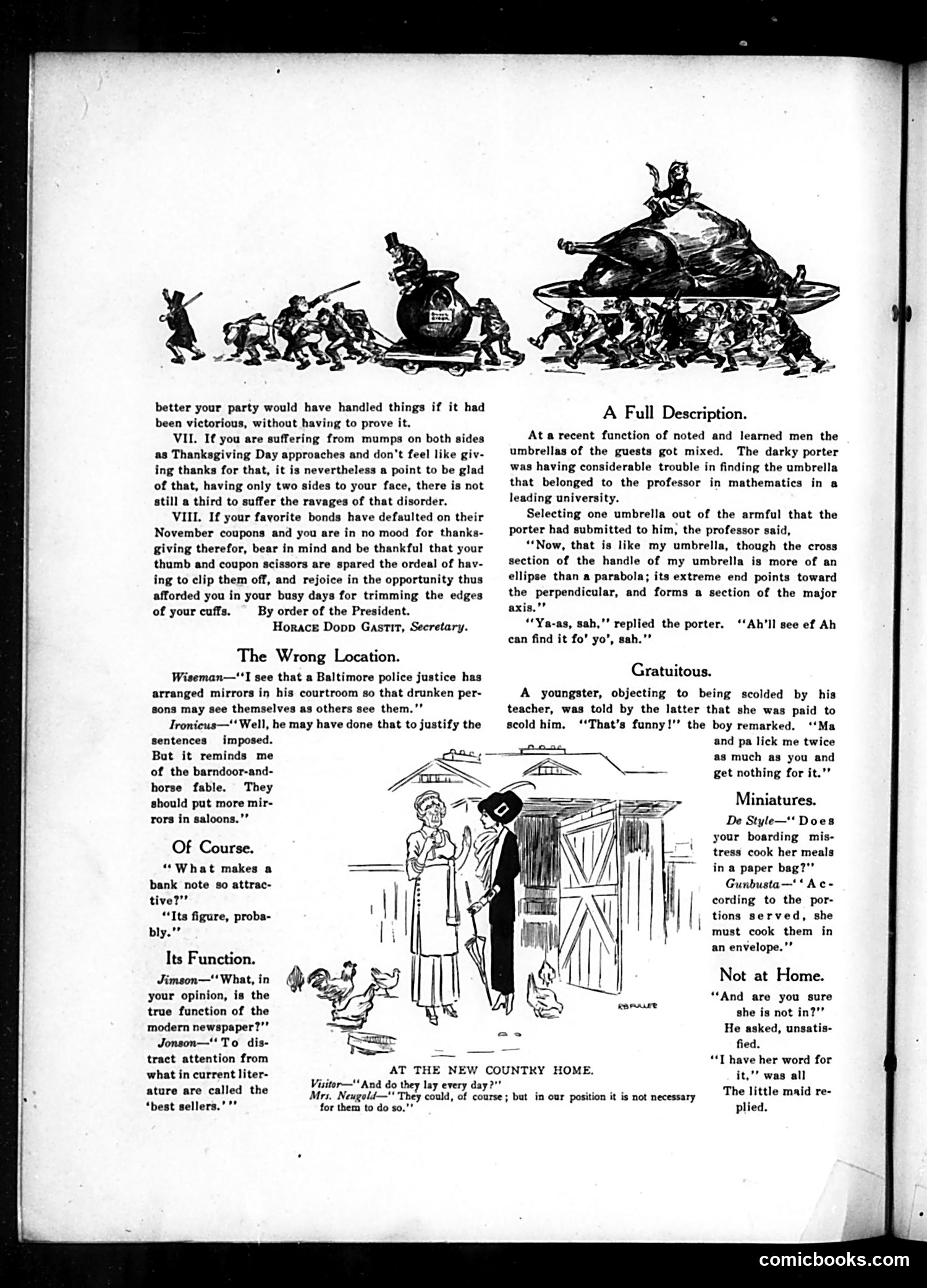
The cartoon at top shows a domestic scene where a wife warns her husband not to flirt with the baker, saying she'll bake the bread herself. It's a light joke about marital jealousy. The main content is a satirical "proclamation" mocking forced optimism during hard economic times (appears to be pre-1920s, given references to motor cars and college). The "Happy Day Club" ironically instructs members to manufacture gratitude for misfortunes: unpaid grocer bills, romantic rejection, wrecked automobiles, flunked sons, poor food quality, and electoral defeat. The satire targets both the era's relentless "positive thinking" culture and the genuine hardships people faced—debt, relationship failures, accidents, educational disappointment, and food scarcity. By listing absurd reasons to be "thankful" for disasters, Judge ridicules the notion that attitude alone solves material problems. The piece is essentially saying: *telling suffering people to smile doesn't fix their actual troubles*.
This page contains several short satirical pieces typical of Judge's humor: **"The Wrong Location"** jokes about a Baltimore judge installing mirrors so drunk defendants see themselves as others do. The satire suggests mirrors belong in saloons instead—implying alcohol consumption, not justice, is the real problem. **"A Full Description"** mocks academic pretension. A mathematics professor uses overly complex geometric language (ellipse, parabola, perpendicular, major axis) to describe his umbrella to a Black porter, who responds with resigned agreement. The joke satirizes how academics overcomplicate simple matters through jargon. **Other brief jokes** mock newspapers, bank notes, country-house pretension, and boarding-house food quality. The page reflects Judge's characteristic early-20th-century style: brief witticisms targeting social types (academics, the wealthy, newspapers) and urban life. The racial caricature in "A Full Description" reflects period prejudices common to such magazines, though the satire's target is the professor's pedantry, not the porter.
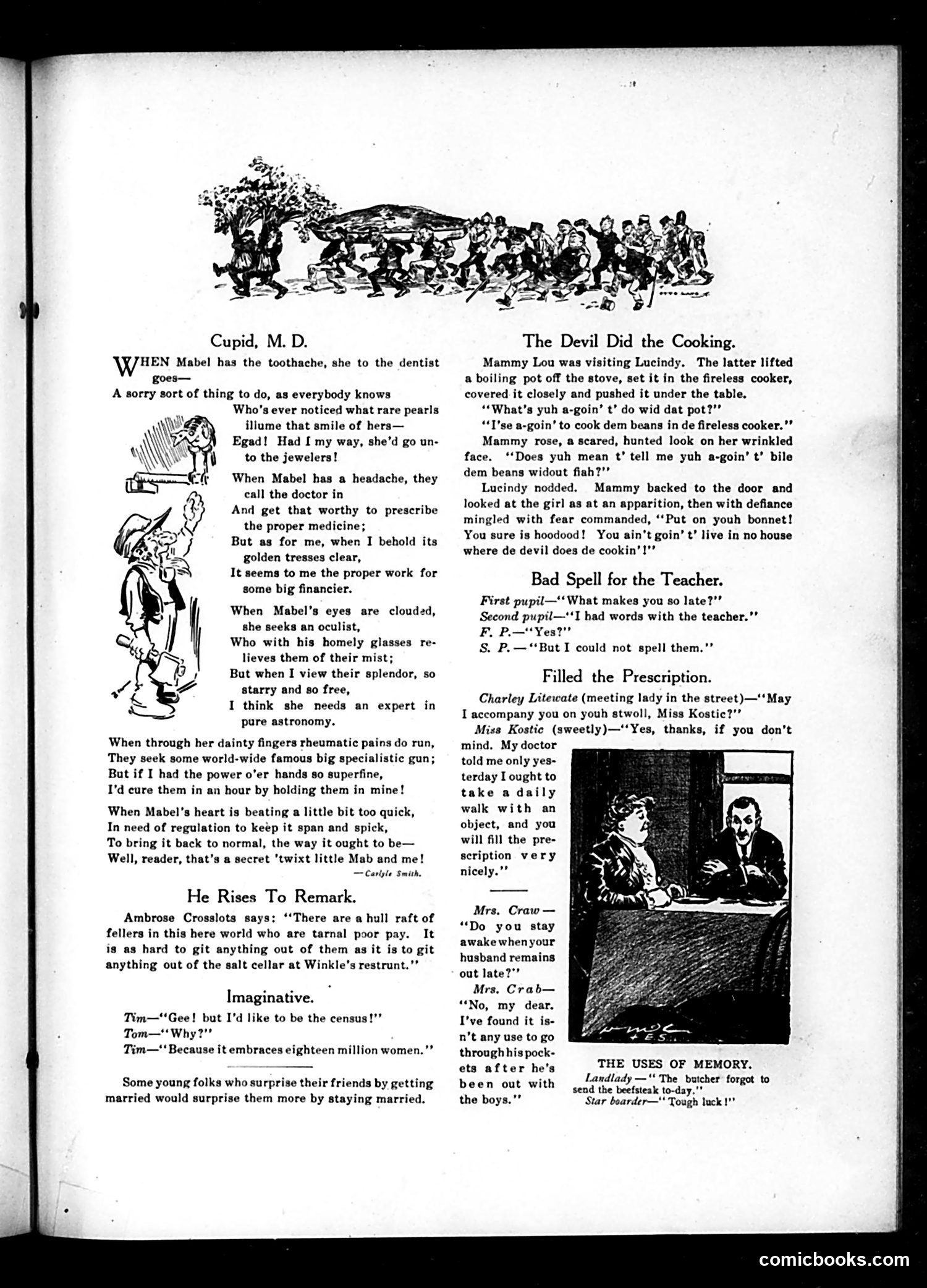
This page contains multiple short humor pieces typical of early 20th-century American satirical magazines: **"Cupid, M.D."** uses exaggerated compliments about a woman named Mabel, where the male speaker humorously suggests her physical attributes (teeth, hair, eyes, hands, heart) are so perfect they require experts from various fields—jewelers, financiers, astronomers—rather than doctors. It's flirtation disguised as absurdist praise. **"The Devil Did the Cooking"** depicts racial dialect humor (common but now offensive) where an older Black woman, Mammy Lou, reacts with superstitious horror to a "fireless cooker" (an early insulated cooking device), interpreting its lack of visible fire as demonic or supernatural. **Remaining items** ("Bad Spell for the Teacher," "He Rises To Remark," etc.) are brief joke exchanges playing on wordplay, misunderstandings, and social observations about courtship, marriage, and human nature. The page reflects period attitudes: romanticized views of women, heavy use of ethnic/racial dialect comedy, and genteel humor about courting and domestic life.
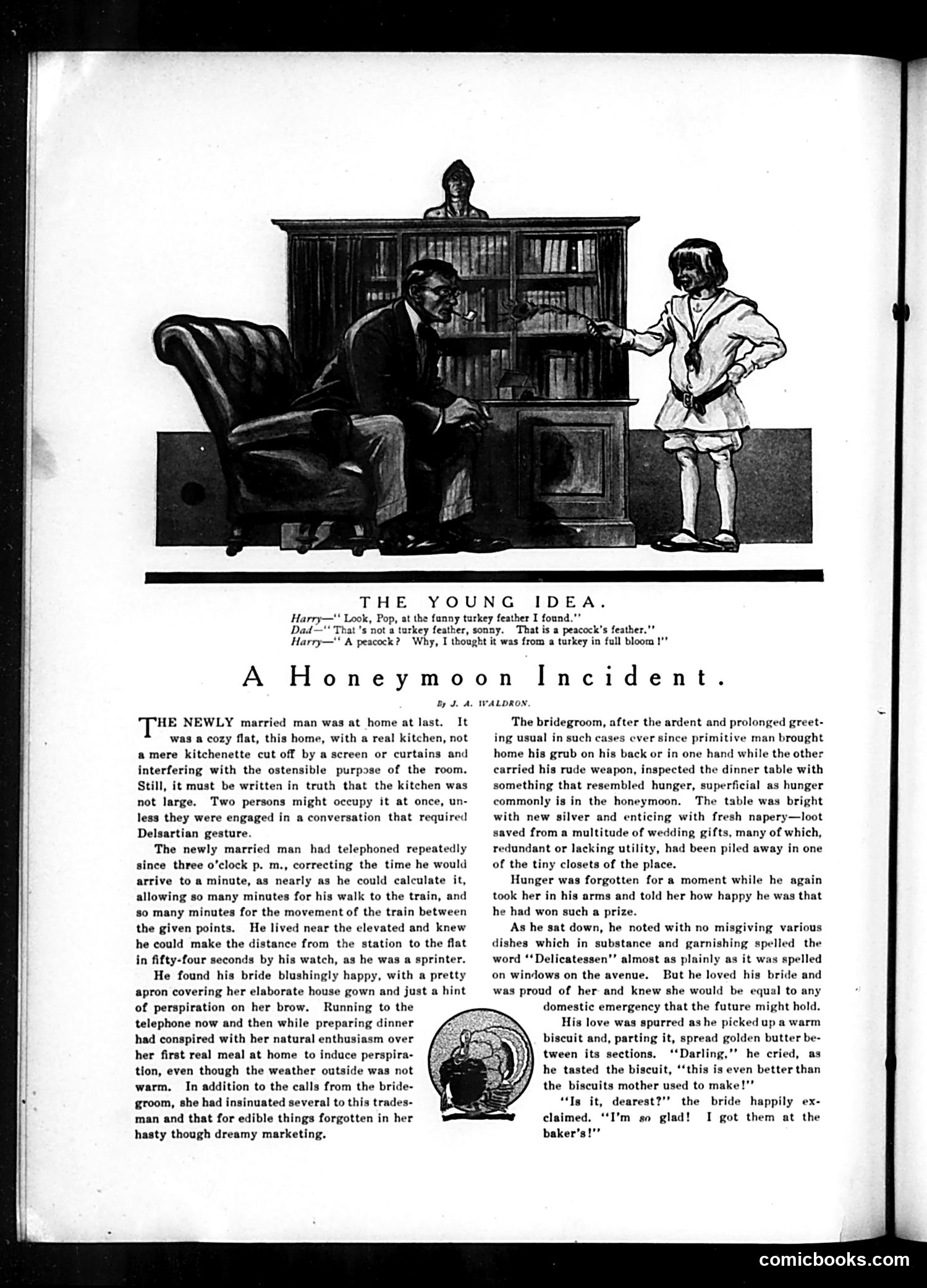
This page contains two separate pieces satirizing common domestic misunderstandings. **"The Young Idea"** (top cartoon): A child mistakes a peacock feather for a turkey feather, then absurdly suggests it came from "a turkey in full bloom." The humor targets children's innocent logical leaps and malapropisms—the joke being that a child conflates unrelated concepts without understanding them. **"A Honeymoon Incident"** (main story): A newly married man arrives home to find his bride has prepared dinner. He's impressed by what he believes are her home-cooked biscuits—until she reveals she bought them from a baker. The satire mocks newlyweds' unrealistic expectations: he romanticizes her domestic abilities while she pragmatically accepts store-bought goods as acceptable. The underlying social commentary suggests tension between idealized Victorian notions of wifely domesticity and modern convenience, presented as light marital comedy rather than genuine conflict.
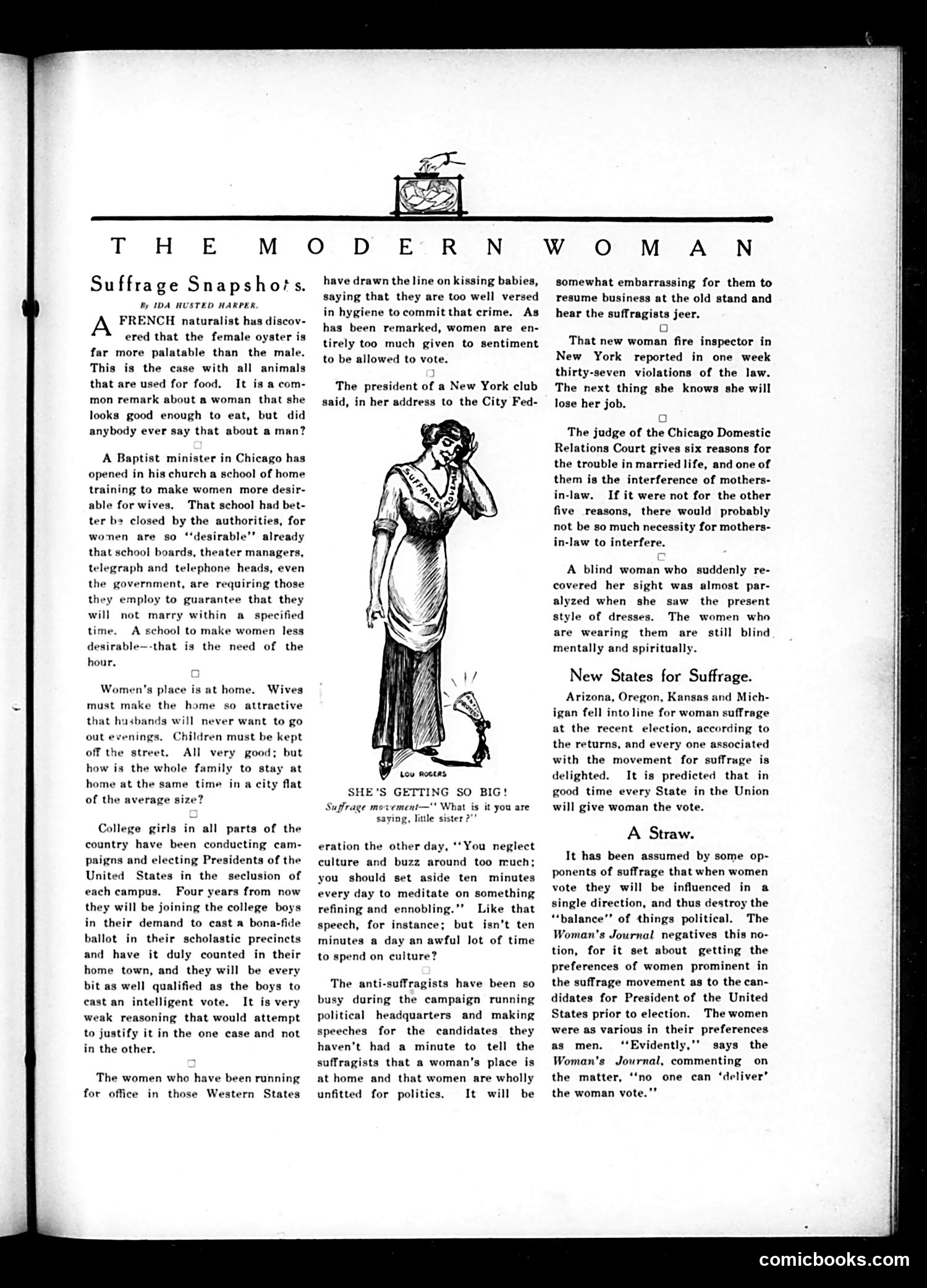
This page satirizes anti-suffrage arguments by presenting them ironically. The cartoon shows a woman growing larger, captioned "She's Getting So Big!"—mocking concerns that women's suffrage ambitions were expanding beyond their proper sphere. The text, by Ida Husted Harper (a suffragist), uses biting humor to expose the hypocrisy of anti-suffragists. Key targets include: - Claims women belong only at home (contradicted by their actual employment) - A Chicago minister's school making women "desirable" for wives (absurd paternalism) - Concerns that women are too sentimental to vote, yet suffragists refuse to kiss babies for hygiene reasons (showing women's practical judgment) - Anti-suffragists too busy campaigning to actually explain why women shouldn't vote The piece celebrates recent suffrage victories in Arizona, Oregon, Kansas, and Michigan. The satire's strategy: demonstrate that anti-suffrage arguments collapse under scrutiny and that women already participate in public life competently.
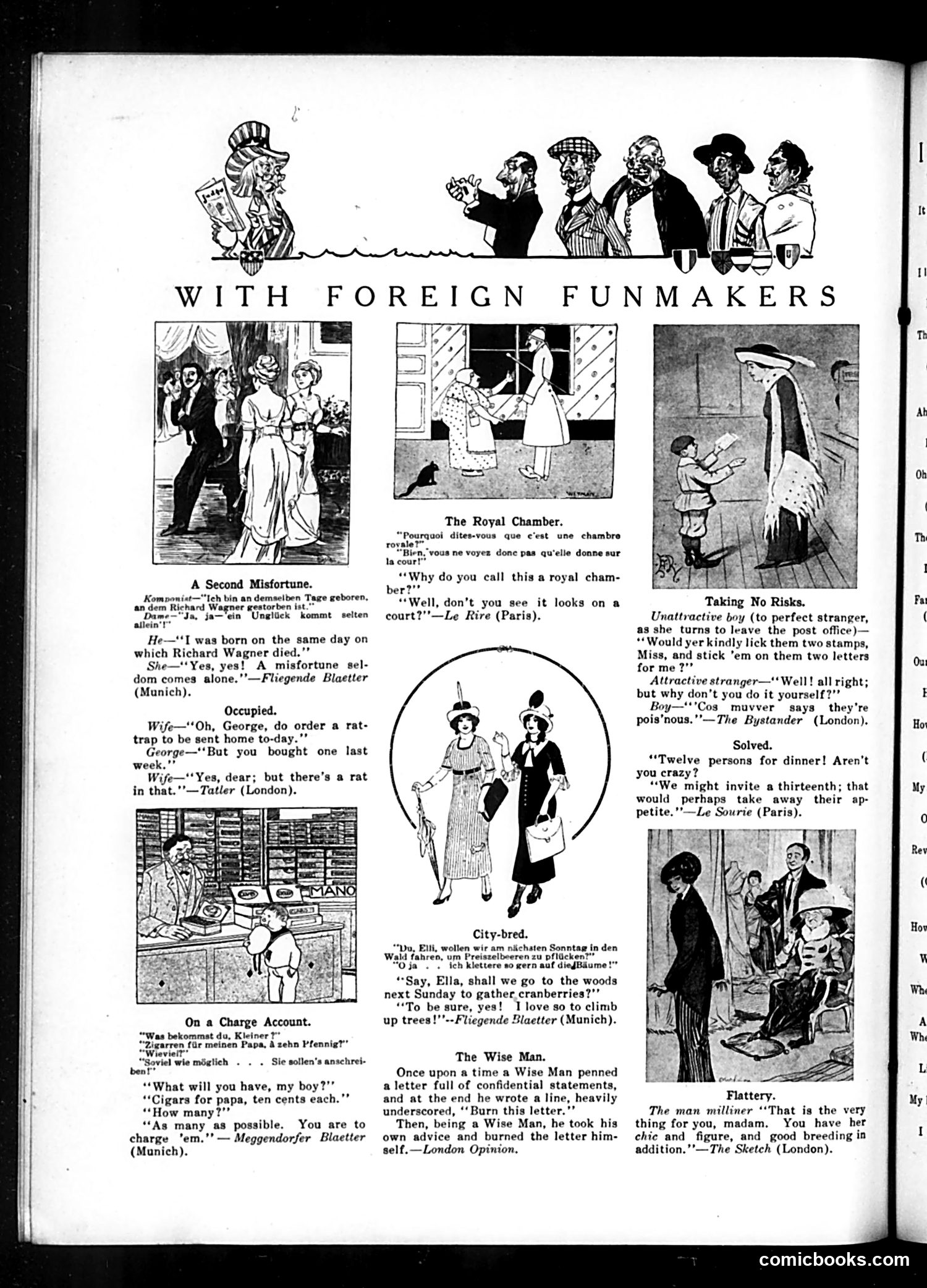
This page collects humorous one-liners and brief comic strips sourced from European satirical magazines (Munich, Paris, London). The jokes rely on wordplay and social observation rather than political commentary. The humor targets everyday absurdities: a composer born the day Wagner died (a "misfortune"), a wife needing multiple rattraps for the same rat, a boy asking a stranger to lick postage stamps because his mother says they're poisonous, and a dinner guest suggesting inviting a thirteenth person to make thirteen an "unlucky" number that might diminish appetites. One joke plays on language—a "royal chamber" that merely overlooks a courtyard (court/cour pun in French). Another mocks city children's ignorance of nature: a girl eager to climb trees while gathering cranberries. The page reflects Judge magazine's practice of reprinting continental European humor, suggesting American readers found sophistication and wit in foreign sources. The jokes are gentle social satire rather than political commentary—focused on human folly, linguistic tricks, and middle-class domestic scenarios.
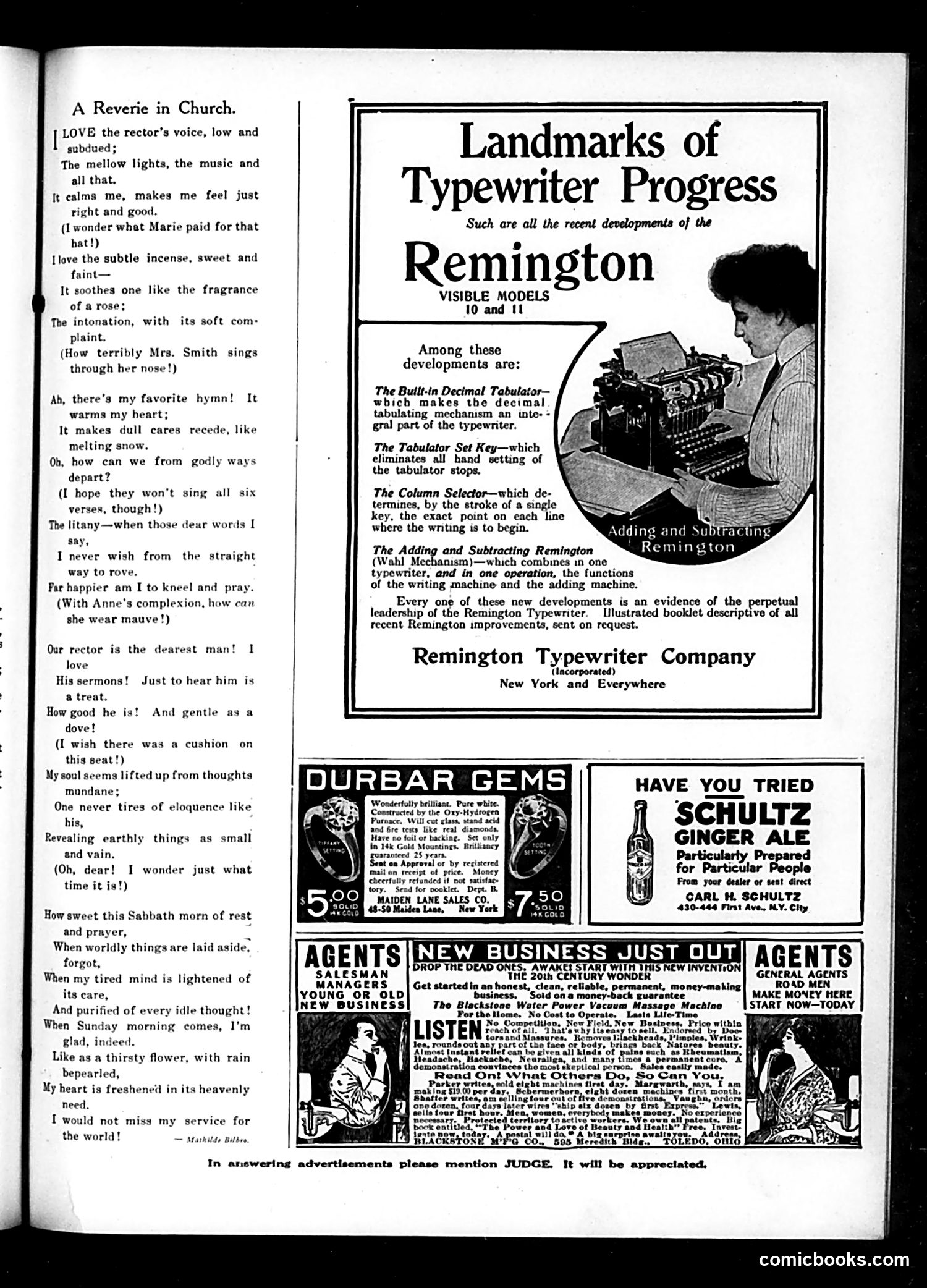
This page's main content is a humorous poem satirizing church attendance and the gap between people's pious thoughts and their actual, mundane preoccupations. The narrator claims spiritual elevation—praising the rector's sermons, the incense, the hymns—but parenthetical asides reveal their true focus: whether a hat was expensive, Mrs. Smith's nasal singing, how many verses will be sung, Anne's complexion, lack of cushions, and what time it is. The satire targets 1920s-era middle-class hypocrisy: the speaker performs religiosity while remaining entirely distracted by vanity, comfort, and gossip. The poem mocks both the speaker's self-deception and the performative nature of organized religion among the wealthy. The page also contains period advertisements (Remington typewriters, Durbar Gems, business opportunity schemes), typical of Judge magazine's format.
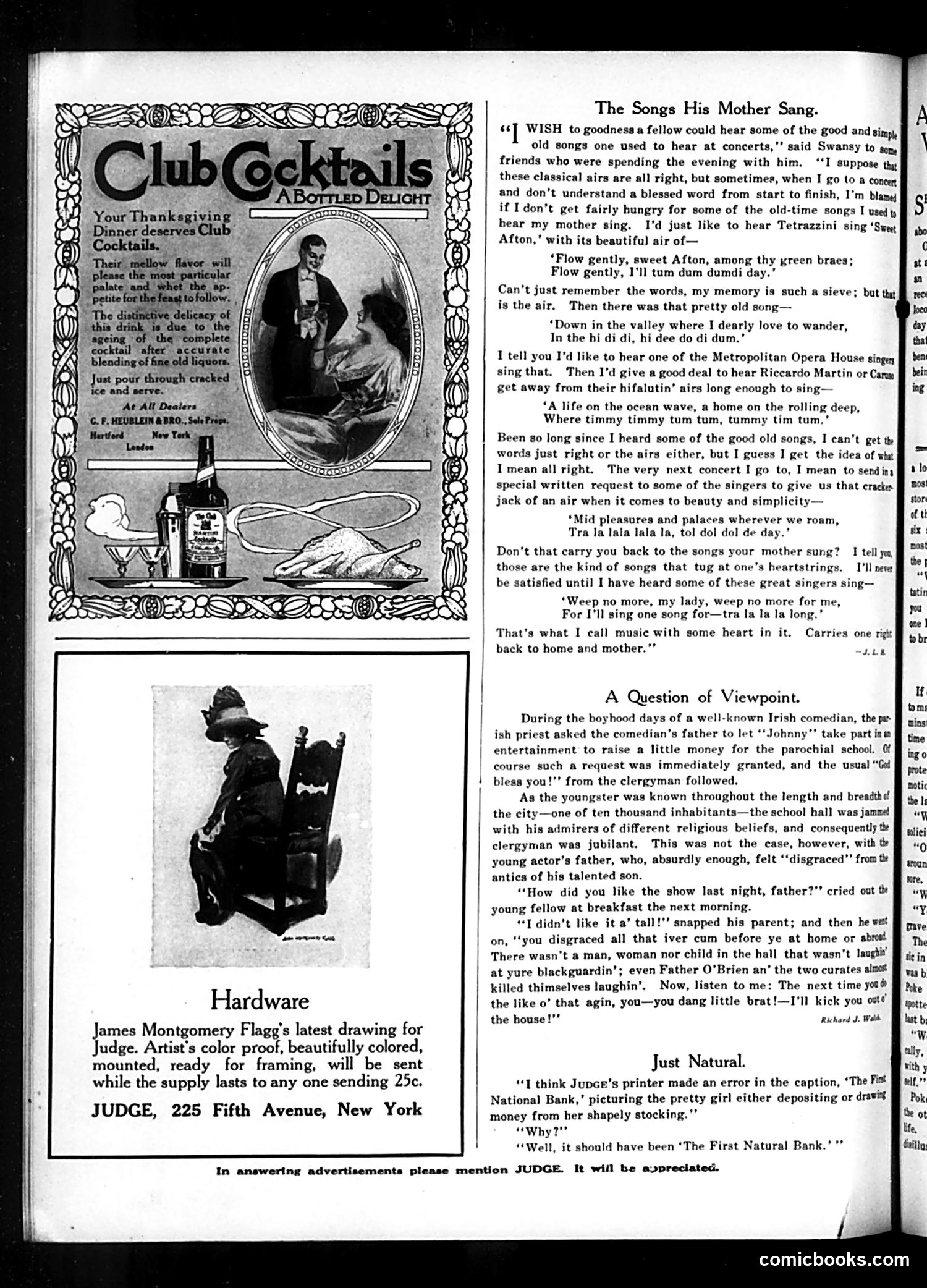
This page contains three distinct pieces: **1. "The Songs His Mother Sang"** - A nostalgic humor piece where a character laments that modern opera singers won't perform simple sentimental folk songs from his youth. He misremembers lyrics to classics like "Sweet Afton" and "A Life on the Ocean Wave," wanting famous Metropolitan Opera performers (Tetrazzini, Riccardo Martin) to sing these homey melodies. The satire mocks both the pretension of high opera culture and the sentimental nostalgia of the older generation. **2. "A Question of Viewpoint"** - An Irish immigrant humor story where a talented young performer's father is embarrassed by his son's theatrical success, feeling it's undignified despite the community's delight. The father's absurd shame at public acclaim satirizes working-class immigrant attitudes toward entertainment and respectability. **3. Advertisements** - Including James Montgomery Flagg artwork promotion and hardware store ads—typical Judge magazine content filler. The page reflects early 20th-century American attitudes toward class, culture, and immigration through gentle, character-based humor.
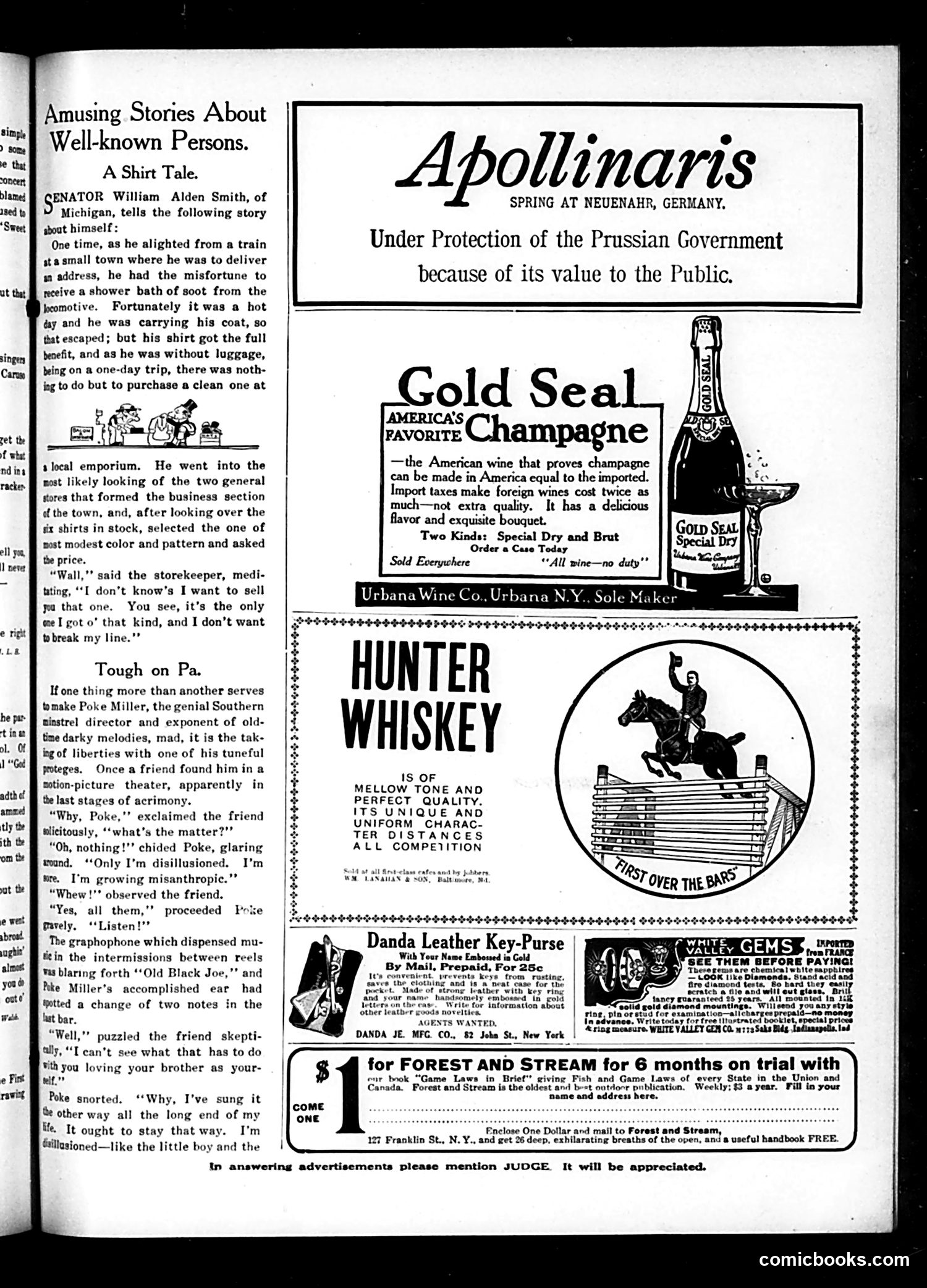
This page is primarily **advertisements** interspersed with two brief humorous anecdotes about well-known figures. **The Stories:** 1. **"A Shirt Tale"** features Senator William Alden Smith of Michigan. The joke concerns a rural storekeeper's reluctance to sell him a shirt because it's his only one of that style—he doesn't want to "break his line" (break up his inventory set). The humor lies in the absurdity of this small-town retail logic. 2. **"Tough on Pa"** describes Poke Miller, a minstrel director, becoming furious when a motion-picture theater's phonograph plays "Old Black Joe" with two altered notes in a bar. Miller is "disillusioned" because he's performed it one way for years and believes it should remain unchanged. The joke satirizes his rigidity and overwrought reaction to a trivial musical variation. **The Advertisements** promote champagne, whiskey, leather goods, and magazine subscriptions—typical period marketing with no apparent satirical content.
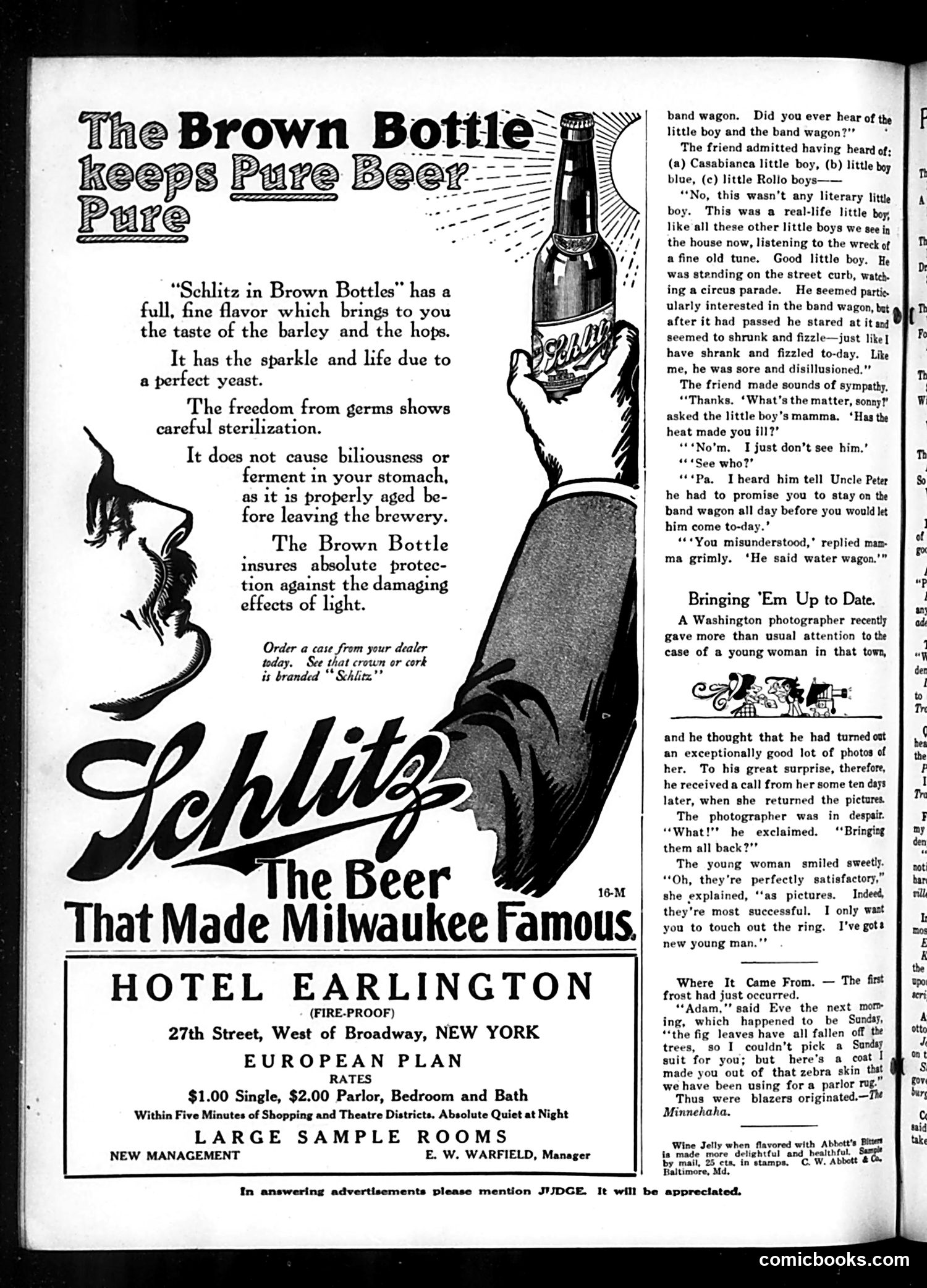
This page is primarily **advertising**, not political satire. The dominant content is a Schlitz beer advertisement featuring a large brown bottle and claims about purity, sterilization, and protection from light damage. The right column contains three short humorous anecdotes rather than political commentary: 1. **"Band Wagon" story**: A joke about a disenchanted boy who believed his father was riding a circus band wagon, only to learn he'd promised to stay on the "water wagon" (temperance/sobriety)—the humor relies on this period's drinking culture references. 2. **"Bringing 'Em Up to Date"**: A photographer's surprise when a young woman requests he remove her engagement ring from photos because she has a new boyfriend—mild social satire about modern romance. 3. **"Where It Came From"**: A frivolous origin myth for zebra-skin blazers, attributed to Eve after the Fall. The Hotel Earlington advertisement appears below. This page contains no identifiable political figures or serious satire—it's entertainment and advertising typical of Judge's lighter content.
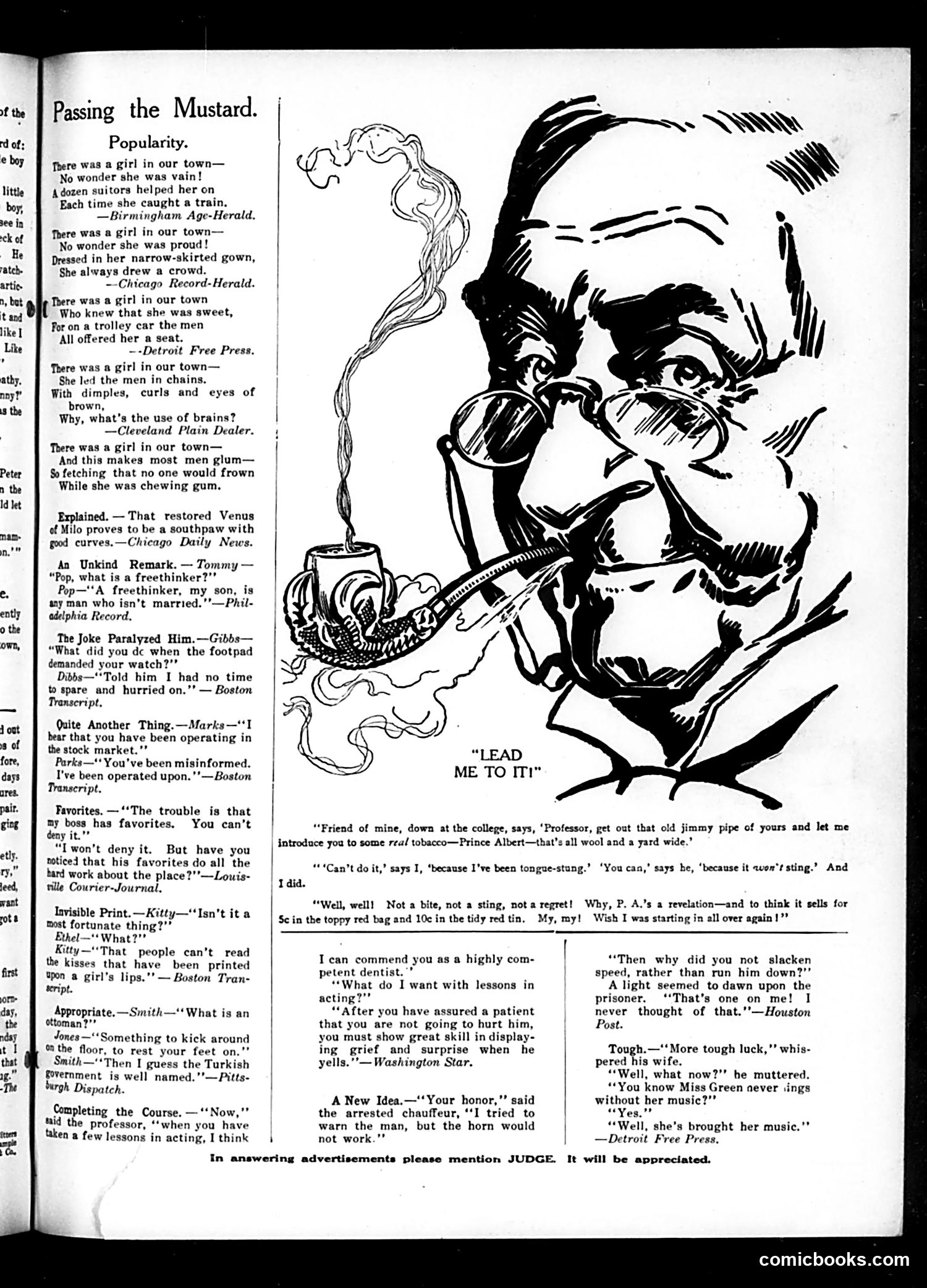
This page contains multiple humor sections typical of early 20th-century Judge magazine. The main cartoon features a caricatured man's face with exaggerated features smoking a pipe, captioned "LEAD ME TO IT!" Below, a dialogue describes someone introducing a friend to Prince Albert tobacco, claiming it won't sting or cause tongue irritation—this is **tobacco advertising disguised as editorial content**, a common practice then. The surrounding text consists of brief jokes and witticisms from various newspapers, mostly playing on: - Romantic/gender dynamics (poems about vain girls attracting male attention) - Marriage vs. bachelorhood ("freethinker" = unmarried man) - Wordplay and puns (stock market "operated upon") - Social observations about class and behavior The page reflects period preoccupations: courtship rituals, gender roles, and light mockery of human nature. The integrated advertising is notable—Prince Albert's message masquerades as genuine editorial humor to seem authentic to readers.
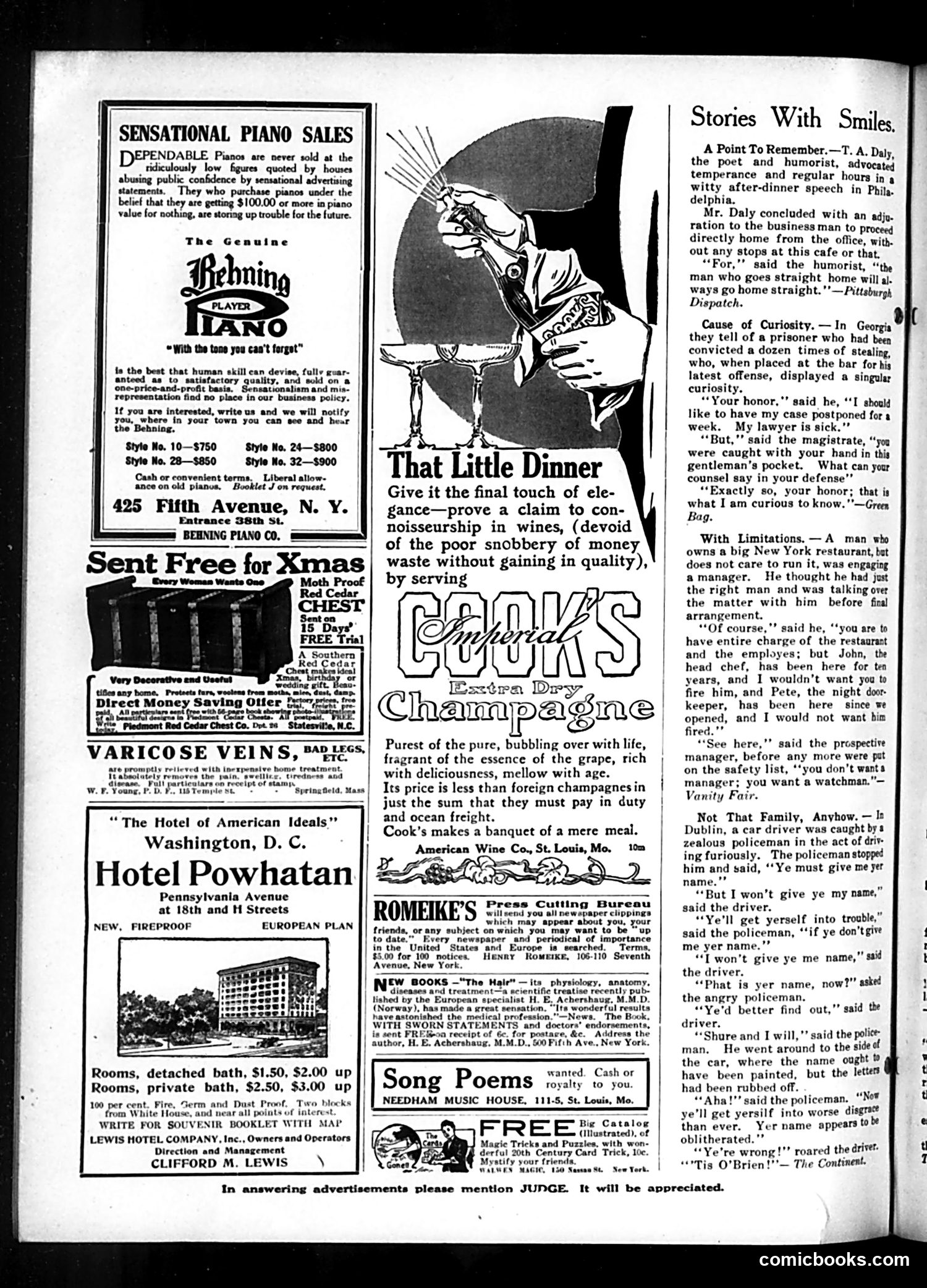
This page is primarily **advertising and light humor content**, not political cartoons. The main illustration shows a waiter presenting an elegant dinner setting, captioned "That Little Dinner" — advertising Cook's champagne by suggesting fine wine elevates even modest meals. The page contains multiple commercial advertisements (pianos, hotels, champagne, books) typical of Judge's revenue model. The **"Stories With Smiles"** section offers three brief anecdotes: - A temperance advocate's quip about going "straight home" - A Georgia prisoner's humorous delay tactic in court - A confrontation between a driver and zealous policeman over identity These are gentle, non-partisan humor pieces—the kind of light social comedy that filled such magazines. The Georgia prisoner story gently mocks the criminal justice system; the policeman story satirizes overzealous law enforcement. There is no clear political satire or identifiable caricature of public figures on this page. It represents typical early-20th-century magazine filler: advertising mixed with mild, safe humor for mainstream audiences.
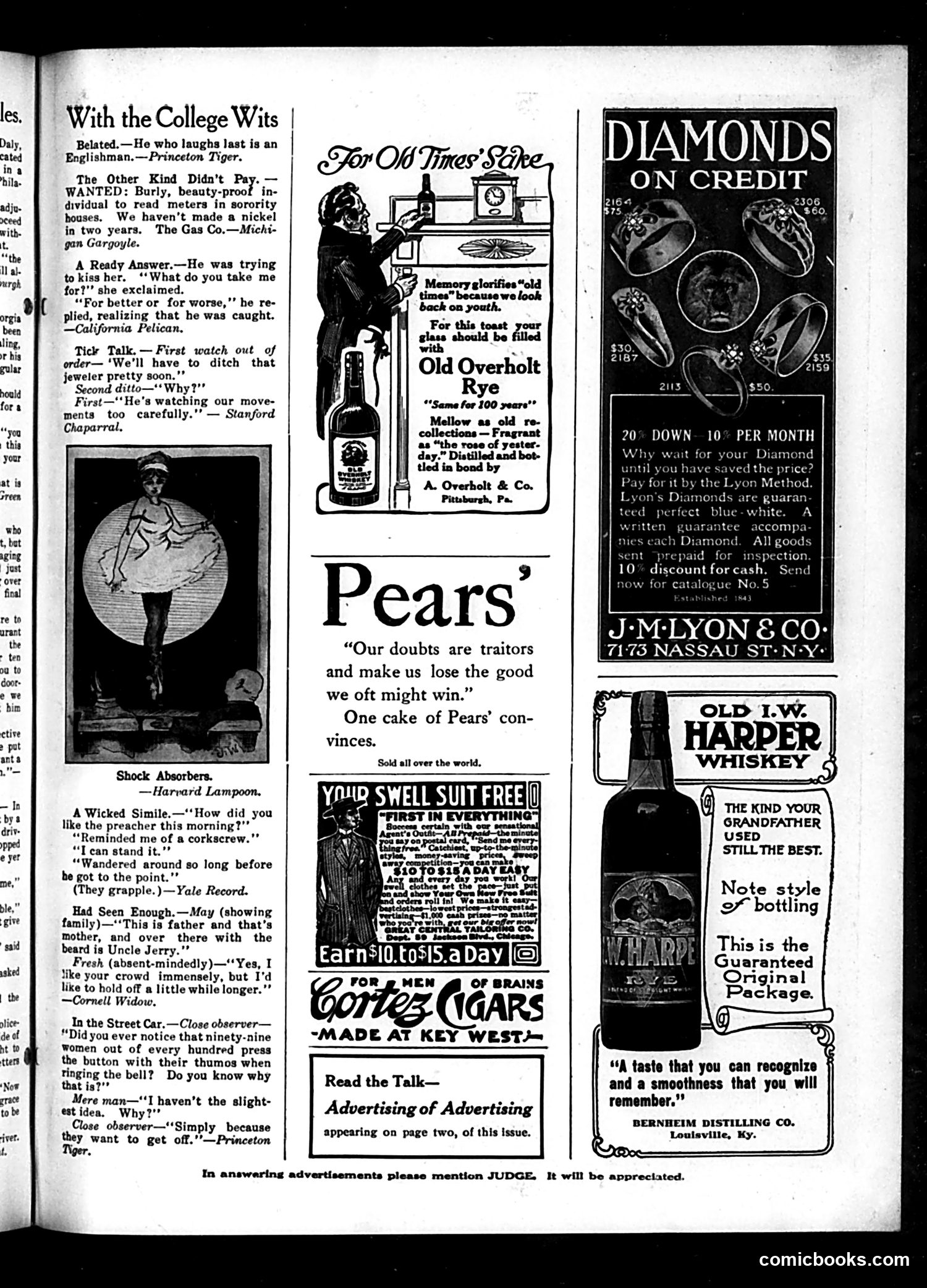
This page consists primarily of **college humor reprints** and **period advertisements** rather than political cartoons. The "With the College Wits" section reprints witty one-liners from various college magazines (Princeton Tiger, Michigan Gargoyle, Stanford Chaparral, Yale Record, etc.). These jokes target typical college-era concerns: sorority life, dating awkwardness, long-winded preachers, and subway etiquette. They're mildly risqué for the era—the meter-reader joke implies sororities aren't paying bills, and the preacher joke involves frustrated grappling. The advertisements reflect 1920s consumer culture: diamonds sold on installment plans ("20 down, 10 per month"), whiskey brands (Old Overholt, Old I.W. Harper), cigars, and suits. The whiskey ads are notable given Prohibition's timeline—this appears to be from before or during early Prohibition, marketing "bonded" spirits. There is **no significant political satire** on this page. The content is entertainment-focused, targeting young educated readers with gentle campus humor and product pitches.
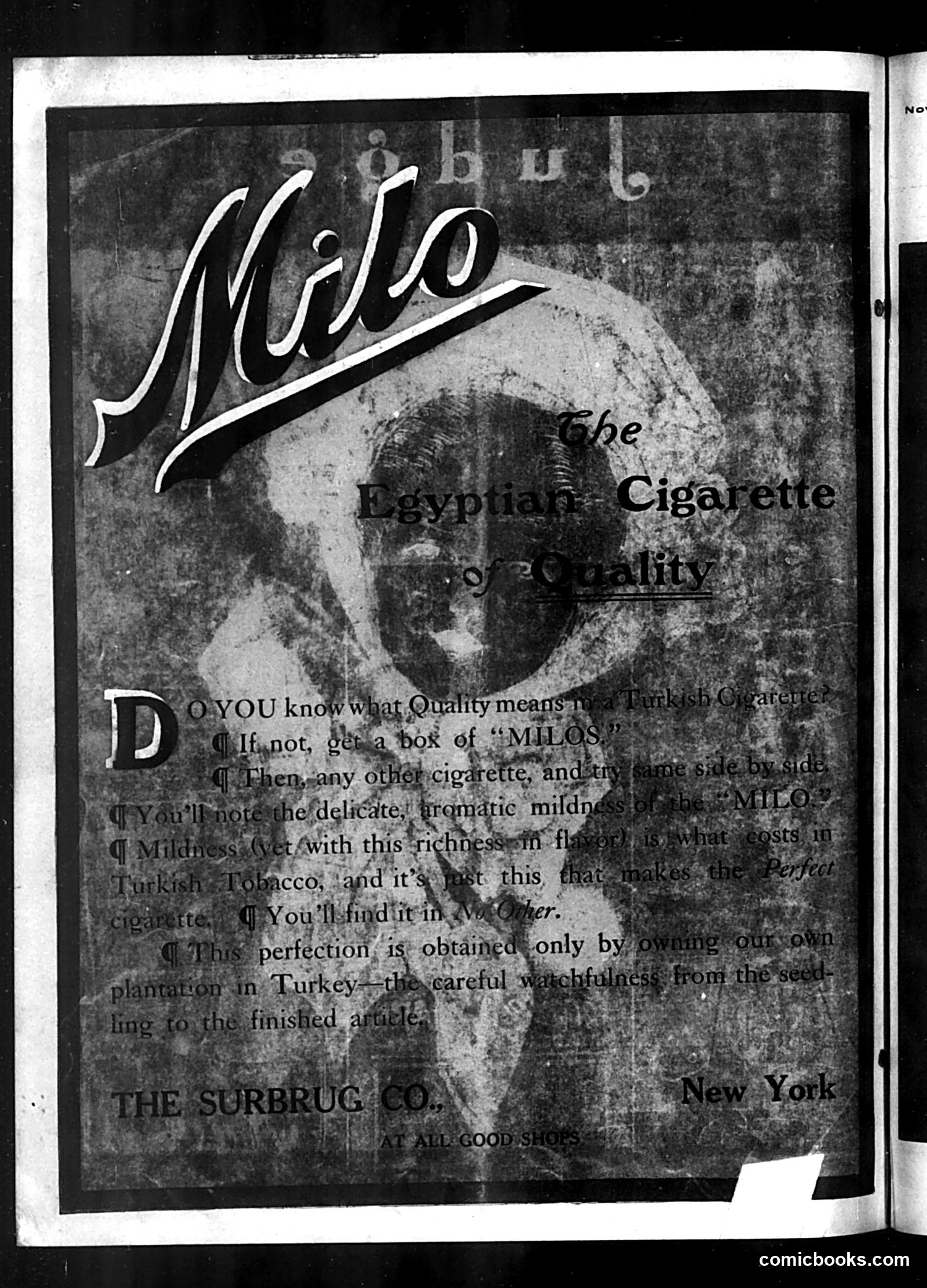
This page is primarily a **cigarette advertisement** for "Milos," an Egyptian cigarette brand from The Surbrug Co. in New York. The ad features a portrait of what appears to be a **Turkish or Middle Eastern figure** (likely meant to evoke authenticity), positioned as the face of quality. The text emphasizes that Milos' superiority derives from Turkish tobacco and careful cultivation from "seed line to finished article." The marketing strategy appeals to **consumer perception of exotic, imported products** as inherently superior—a common early 20th-century advertising approach. The ad challenges readers to compare Milos against competitors, claiming only its Turkish origin and direct plantation control ensure "perfection." There is **no satirical cartoon content** visible; this is straightforward commercial advertising using appeals to exotic authenticity and quality control.