
Judge, 1912-11-23 · page 16 of 24
Judge — November 23, 1912 — page 16: what you’re looking at
What you’re looking at
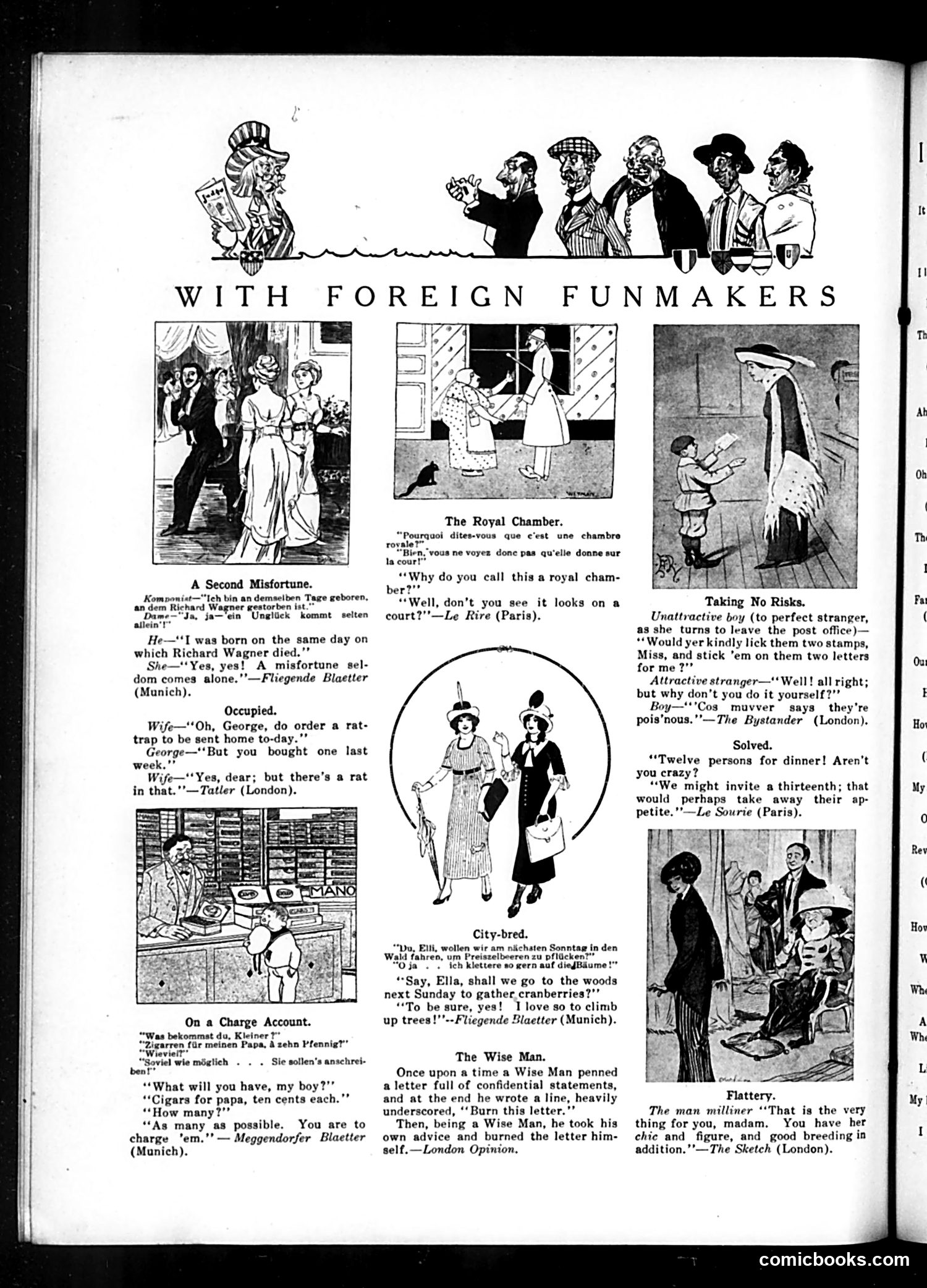
This page collects humorous one-liners and brief comic strips sourced from European satirical magazines (Munich, Paris, London). The jokes rely on wordplay and social observation rather than political commentary. The humor targets everyday absurdities: a composer born the day Wagner died (a "misfortune"), a wife needing multiple rattraps for the same rat, a boy asking a stranger to lick postage stamps because his mother says they're poisonous, and a dinner guest suggesting inviting a thirteenth person to make thirteen an "unlucky" number that might diminish appetites. One joke plays on language—a "royal chamber" that merely overlooks a courtyard (court/cour pun in French). Another mocks city children's ignorance of nature: a girl eager to climb trees while gathering cranberries. The page reflects Judge magazine's practice of reprinting continental European humor, suggesting American readers found sophistication and wit in foreign sources. The jokes are gentle social satire rather than political commentary—focused on human folly, linguistic tricks, and middle-class domestic scenarios.
📄 Transcribed text from this page (OCR, searchable)
Machine-transcribed from the original scan — historical spelling and the odd misread are preserved.
A Second Misfortune. Komponist—“Ich bin an demselben Tage geboren, an dem Richard Wagner gestorben ist.”” Dame—"Ja, ja—‘ein Unglick kommt selten allein'!” He—‘'I was born on the same day on which Richard Wagner died.” She—‘'Yes, yes! A misfortune sel- dom comes alone.'’’—Fliegende Blaetter (Munich). Occupied. Wife—'‘Oh, George, do order a rat- trap to be sent home to-day.’’ George—*But you bought one last week.” Wife—‘*Yes, dear; but there’s a rat in that.’’—Tatler (London). On a Charge Account. ‘as bekommst du, Kleiner rren fr meinen Papa, A zehn Pfennig?” ieviel?”* viel wie miglich . . . Sie sollen‘s anschrei- ben!” **What will you have, my boy?’’ “Cigars for papa, ten cents each."” **How many?” ‘As many as possible. You are to charge ‘em.’’— Meggendorfer Blaetter (Munich). The Royal Chamber. Pouraaoi dites-vous que c'est une chambro royal “Bien, ‘vous ne voyez done pas qu'elle donne sur ta cour!” “Why do you call this a royal cham- ber?”’ “‘Well, don’t you see it looks on a court?’'—Le Rire (Paris). City-bred. “Du, Elli, wollen wir am nlichsten Sonntag in den Wald fahren, um Preiszelbeeren zu pflicken? “O ja . .| ich klettere so gern auf diegBiume!” “Say, Ella, shall we go to the woods next Sunday to gather. cranberries?’’ “To be sure, yes! 1 love so to climb up trees!’’--Fliegende Blaetter (Munich). The Wise Man. Once upon a time a Wise Man penned a letter full of confidential statements, and at the end he wrote a line, heavily underscored, ‘‘ Burn this letter."’ Then, being a Wise Man, he took his own advice and burned the letter him- self.—London Opinion, Unattractive boy (to perfect stranger, as she turns to leave the post office)— **Would yer kindly lick them two stamps, Miss, and stick ’em on them two letters for me?” Attractive stranger—‘* Well! all right; but why don’t you do it yourself?"’ Boy—‘'’Cos_ muvver says they're pois’nous.”"—The Bystander (London). Solved. “Twelve persons for dinner! Aren't you crazy? “We might invite a thirteenth; that would perhaps take away their ap- Le Sourie (Paris). The man milliner ‘‘That is the very thing for you, madam. You have her chic and figure, and good breeding in addition.’”"—The Sketch (London). comicbooks.com