
A complete issue · 24 pages · 1912
Judge — October 19, 1912
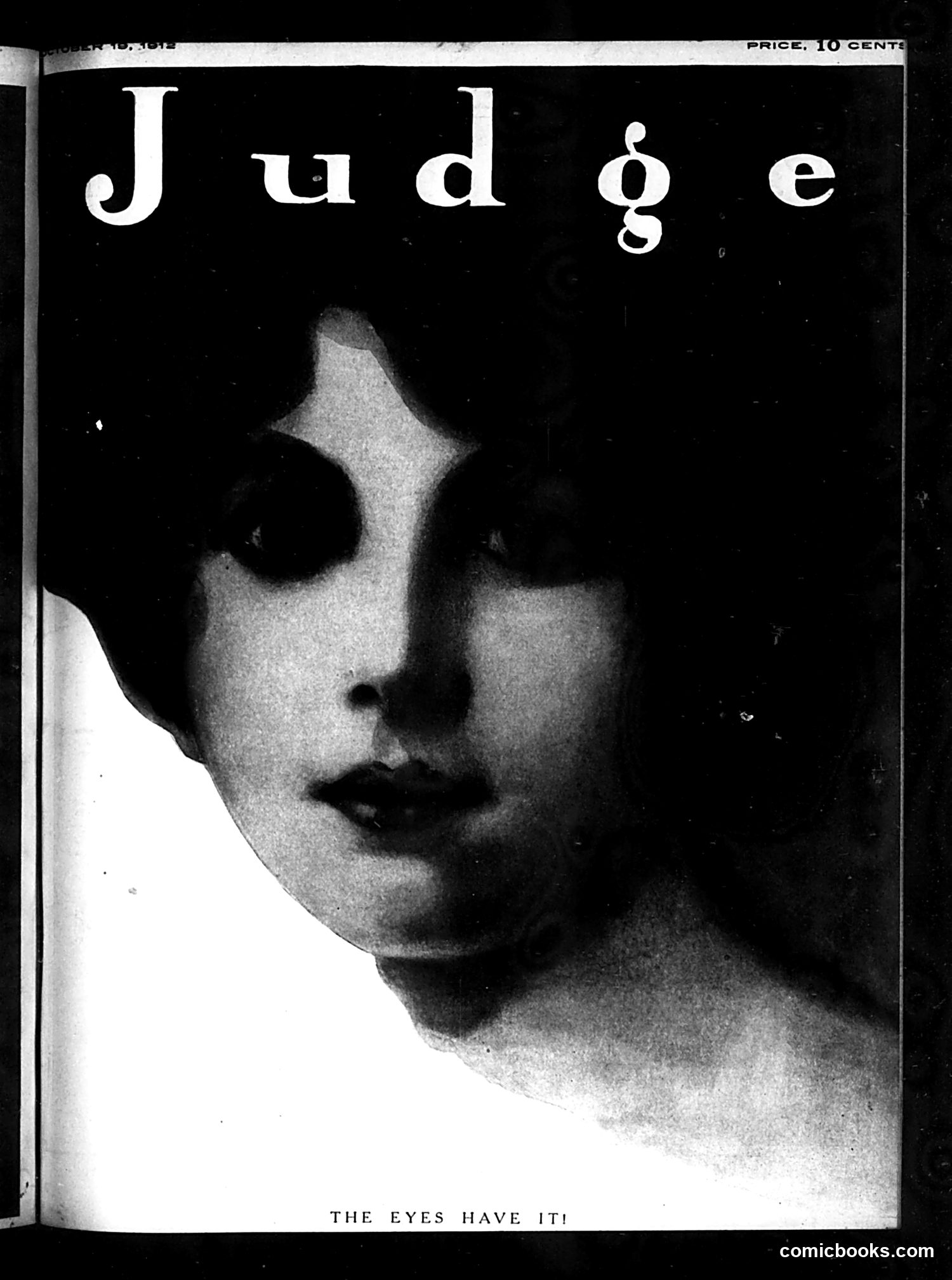
This appears to be a cover from **Judge magazine** (priced at 10 cents), featuring a striking portrait photograph of a woman's face with dramatic eye makeup or shadowing around the eyes. The caption reads "THE EYES HAVE IT!" The image likely comments on **women's changing appearance and beauty standards**, possibly referencing the fashionable eye makeup or cosmetics trends of the era when this was published. The theatrical, exaggerated eye presentation suggests satire about either: - The prevalence of women wearing bold eye makeup - Societal focus on women's appearance - Fashion or beauty industry trends Without additional context about Judge's publication date, I cannot identify the specific woman pictured or confirm whether this targets a particular public figure or general social trend. The dramatic styling suggests social commentary on contemporary beauty practices or women's presentation.
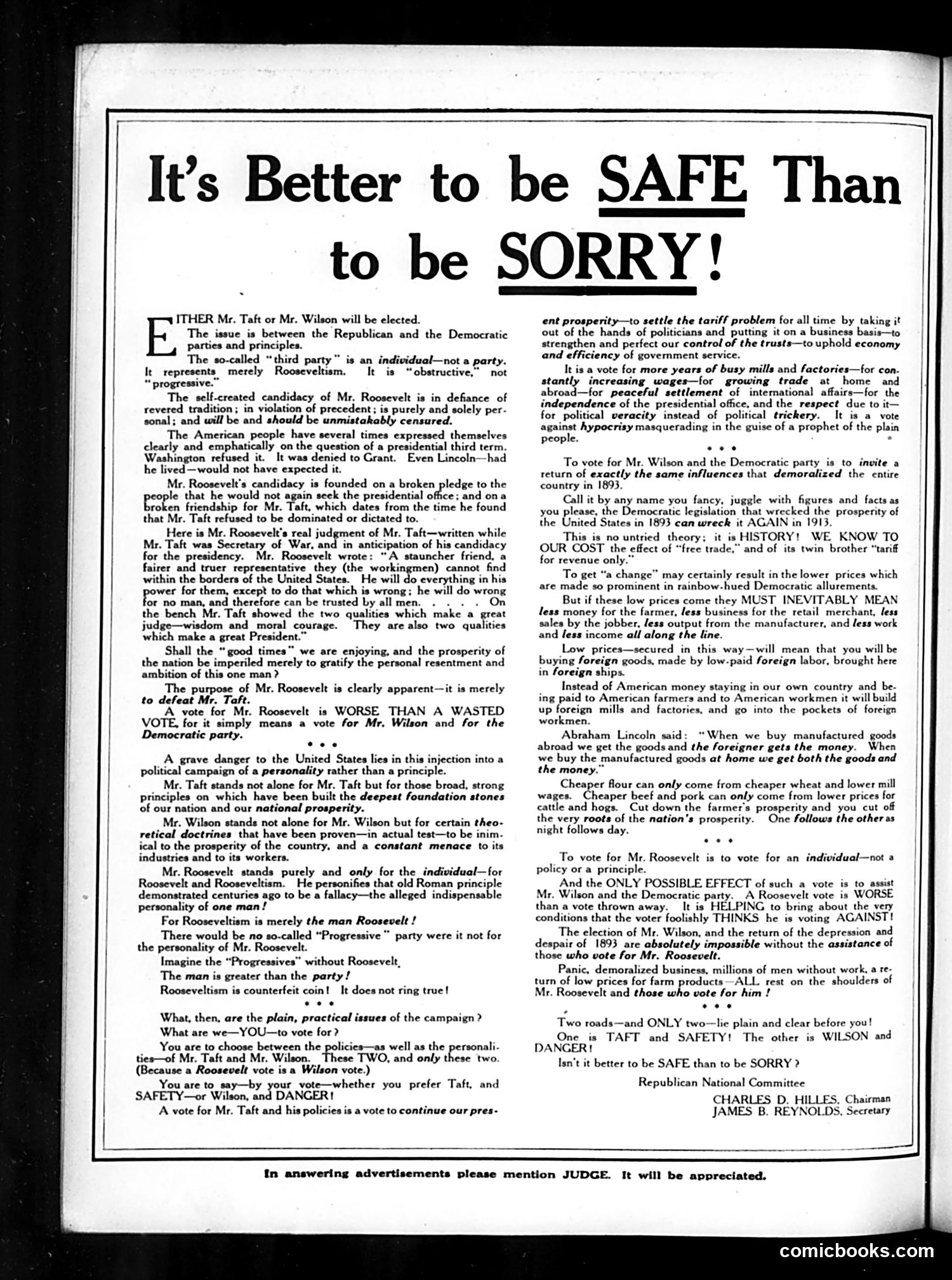
This page is primarily a **Republican National Committee advertisement** (signed by Charles D. Hilles, Chairman), not a satirical cartoon. It's a 1912 campaign piece arguing against Theodore Roosevelt's "Progressive Party" candidacy and promoting William Howard Taft for president. The text attacks Roosevelt as "merely Rooseveltianism" and claims his third-party run splits the Republican vote, benefiting Democrat Woodrow Wilson. It frames the choice as "Taft and Safety" versus "Roosevelt and Wilson and Danger." The advertisement uses economic arguments—tariffs, factory jobs, lower prices—to convince readers that Taft represents stability while Roosevelt represents recklessness. The "Judge" magazine platform gave Republicans space for this direct political messaging rather than satire.
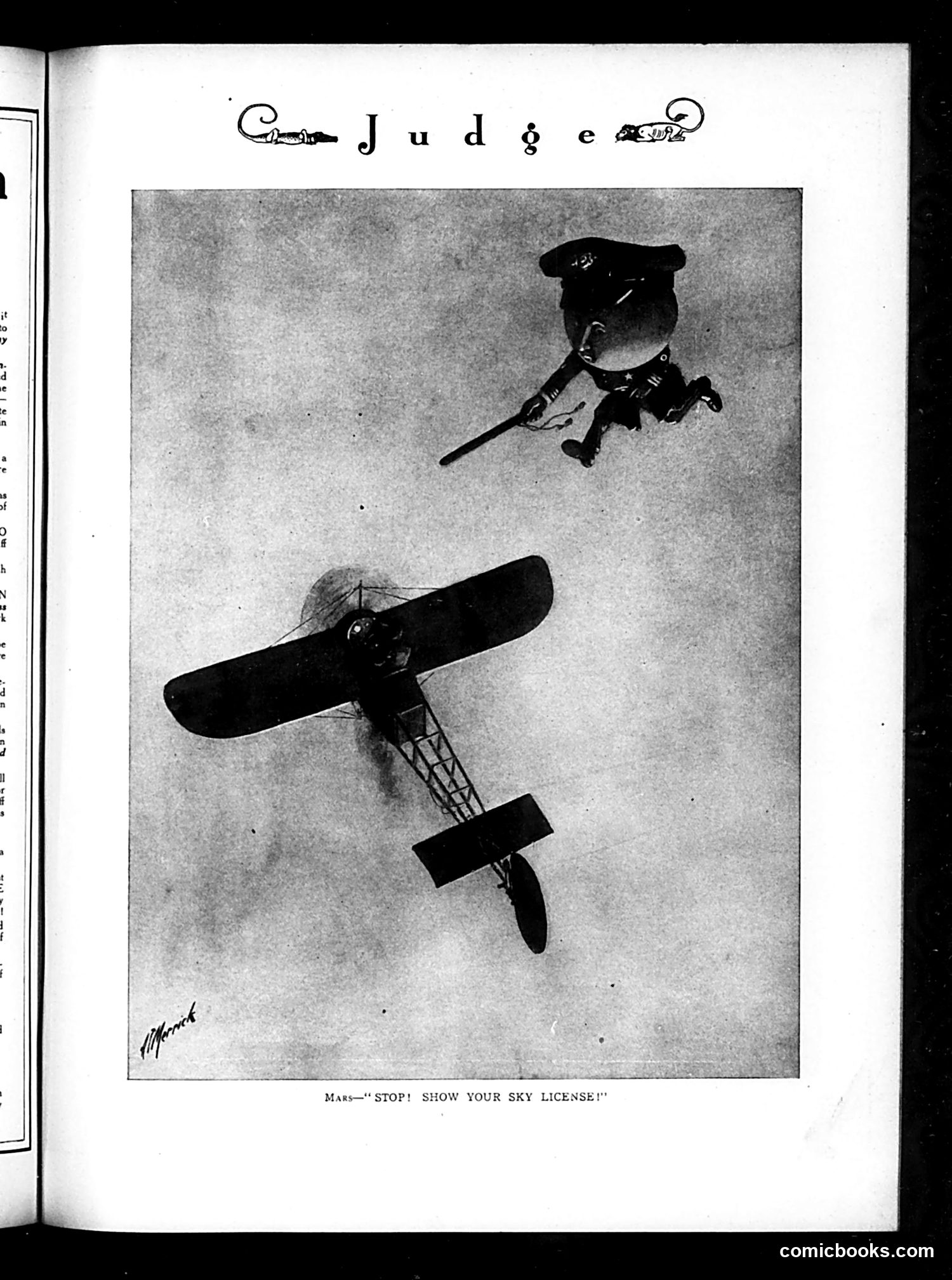
This Judge magazine cartoon depicts two aircraft overhead in a humorous aerial encounter. The caption reads "MARS—'STOP! SHOW YOUR SKY LICENSE!'"—a play on police traffic stops. The joke references early aviation regulation and the novelty of aircraft as common vehicles. By having a Martian (represented by the upper craft) demand a "sky license" from Earth aircraft, the cartoonist satirizes bureaucratic licensing requirements being applied to the new frontier of aviation. The humor relies on absurdist extrapolation: if Earth requires licenses for sky travel, why wouldn't Mars? This likely dates to aviation's early expansion period, when such regulations were novel and comic fodder. The cartoon mocks over-regulation of emerging technologies through imaginative sci-fi framing.
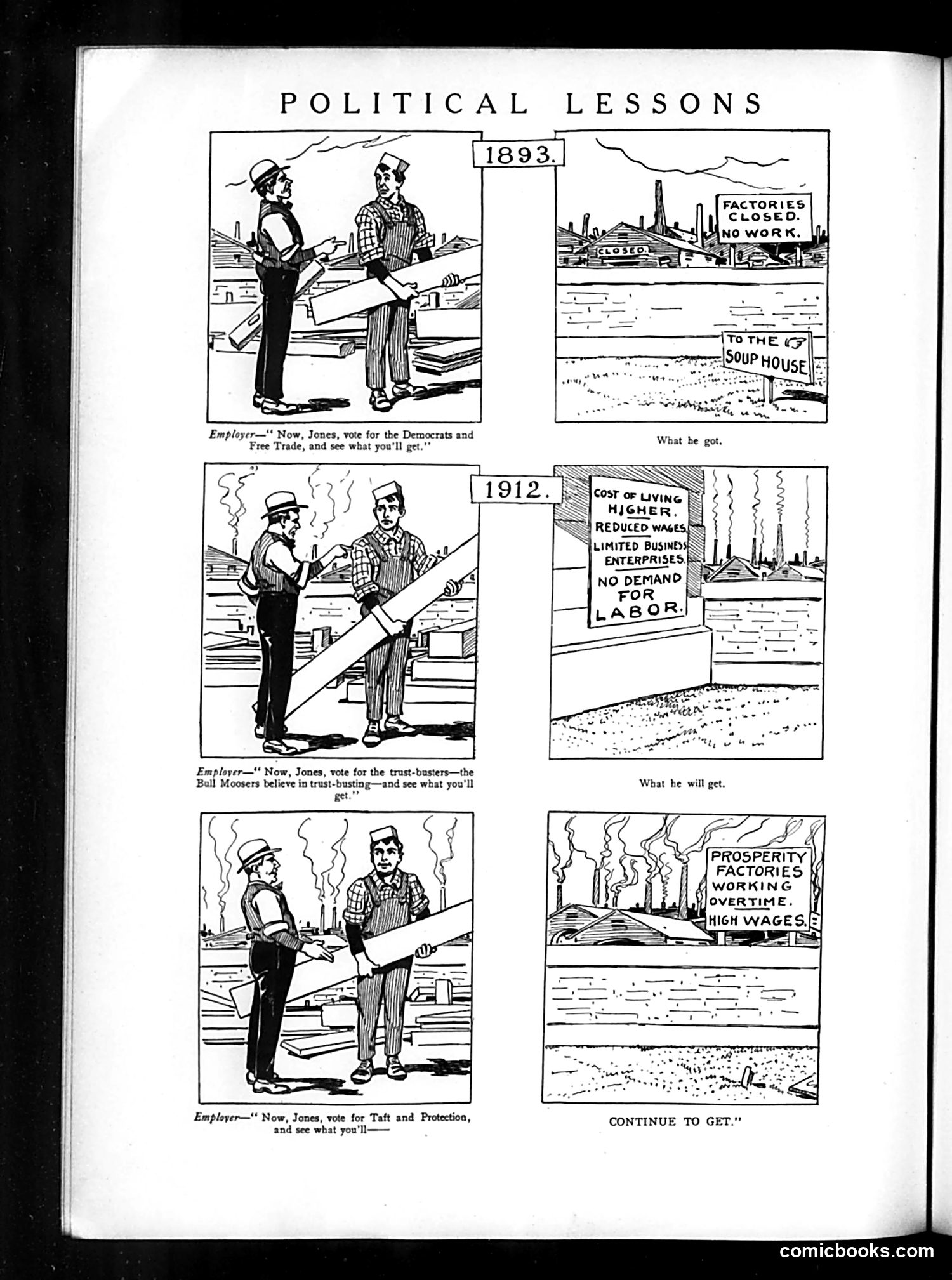
This satirical cartoon sequence from *Judge* magazine contrasts Democratic and Republican economic policies across three time periods (1893, 1912, and the present). The employer character repeatedly tells "Jones" (representing the worker) to vote for different parties, promising prosperity. Each panel shows the actual results: - **1893**: After voting Democratic for "Free Trade," Jones faces closed factories and breadlines. - **1912**: Voting for "trust-busting" Bull Moosers results in higher costs, reduced wages, and no labor demand. - **Final panel**: Only voting Republican for "Tariff and Protection" delivers prosperity—factories booming, overtime work, high wages. The satire argues that Democratic and Progressive policies harm workers, while Republican protectionism delivers genuine prosperity. This reflects the GOP's core campaign message of that era.
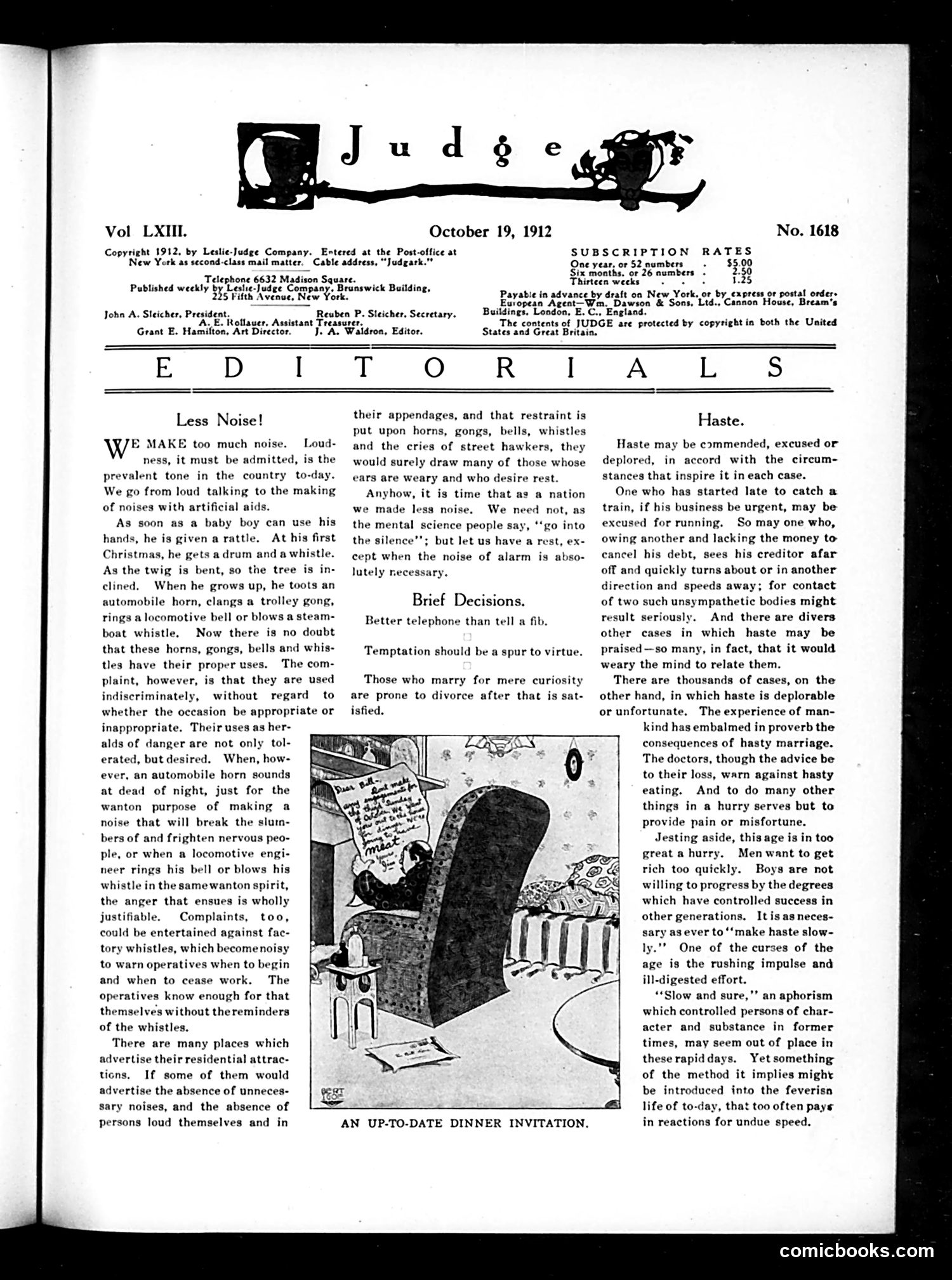
This cartoon satirizes the modern rush and busyness of early 20th-century life. The image shows a woman receiving a dinner invitation via telephone while simultaneously managing multiple domestic tasks—cooking, cleaning, and attending to household duties. The humor lies in the contrast between the formal, leisurely tradition of dinner invitations and the frenetic pace of contemporary society. The accompanying editorial "Less Noise!" and "Haste" complement this theme, criticizing the era's obsession with speed and noise pollution. The editors argue that while progress is valuable, the modern world's constant din and hurried pace create unnecessary stress. The "up-to-date" invitation ironically suggests that even social courtesies cannot escape the modern compulsion toward efficiency and multitasking, reflecting anxieties about industrialization's impact on civilized life.
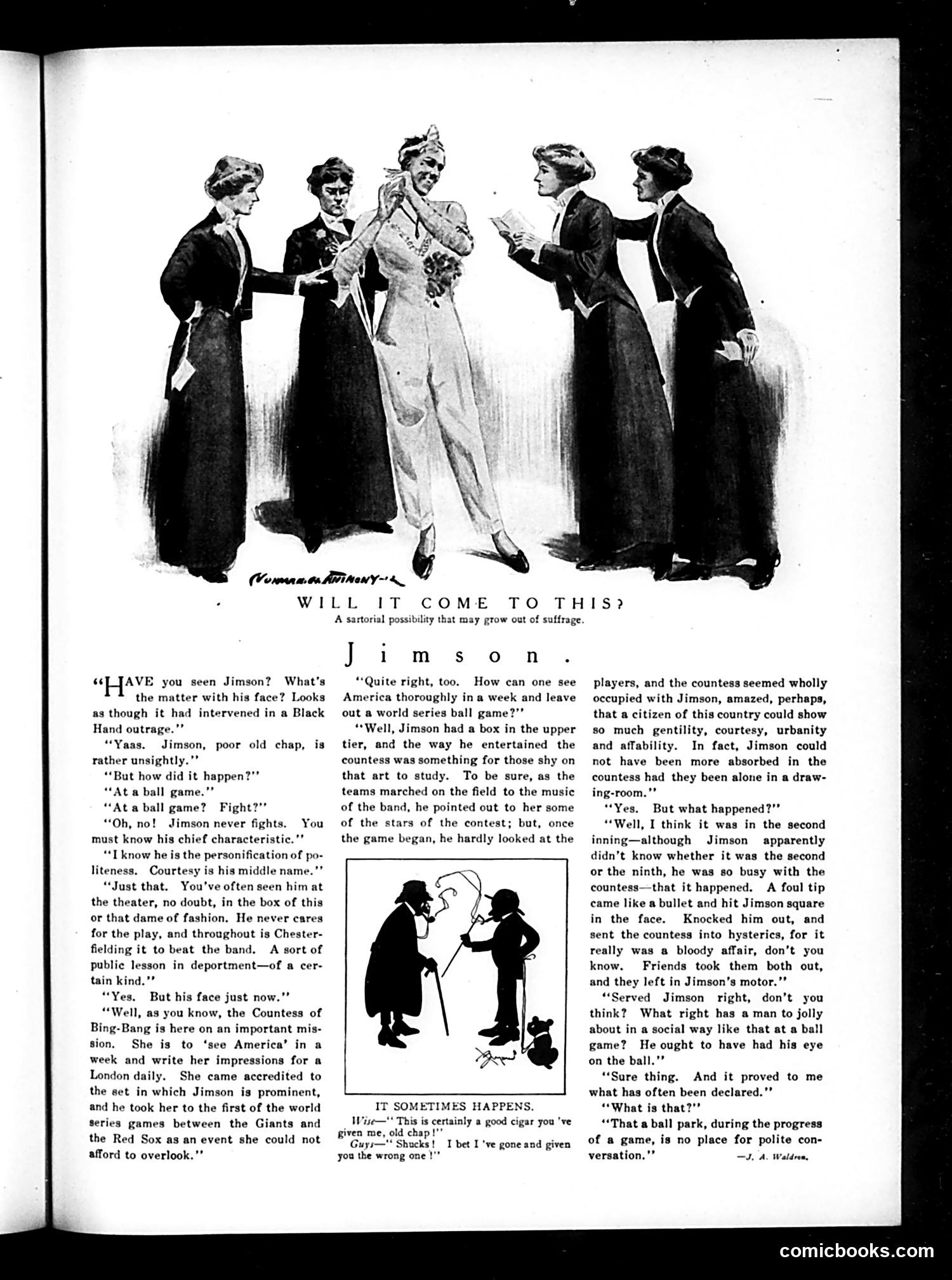
This 1910s-era piece satirizes the clash between Old World aristocratic etiquette and American casualness, specifically targeting exaggerated politeness at sporting events. **The Setup:** Jimson, a character known for excessive courtesy and gentlemanly deportment, attends a World Series game with a visiting British Countess interested in experiencing "real America." Rather than watching the game, Jimson ignores the action entirely to entertain her with elaborate social attention. **The Joke:** A foul ball strikes Jimson in the face because he's too absorbed in flirting with the Countess to pay attention to the game. The final punchline—that a ball park is "no place for polite conversation"—satirizes Jimson's inability to abandon social pretension even in inappropriate contexts. **The Satire:** The piece mocks both excessive American deference to foreign nobility and the absurdity of maintaining rigid social performance at a democratic, working-class venue like a baseball game. It suggests authentic American behavior requires dropping artificial courtesies.
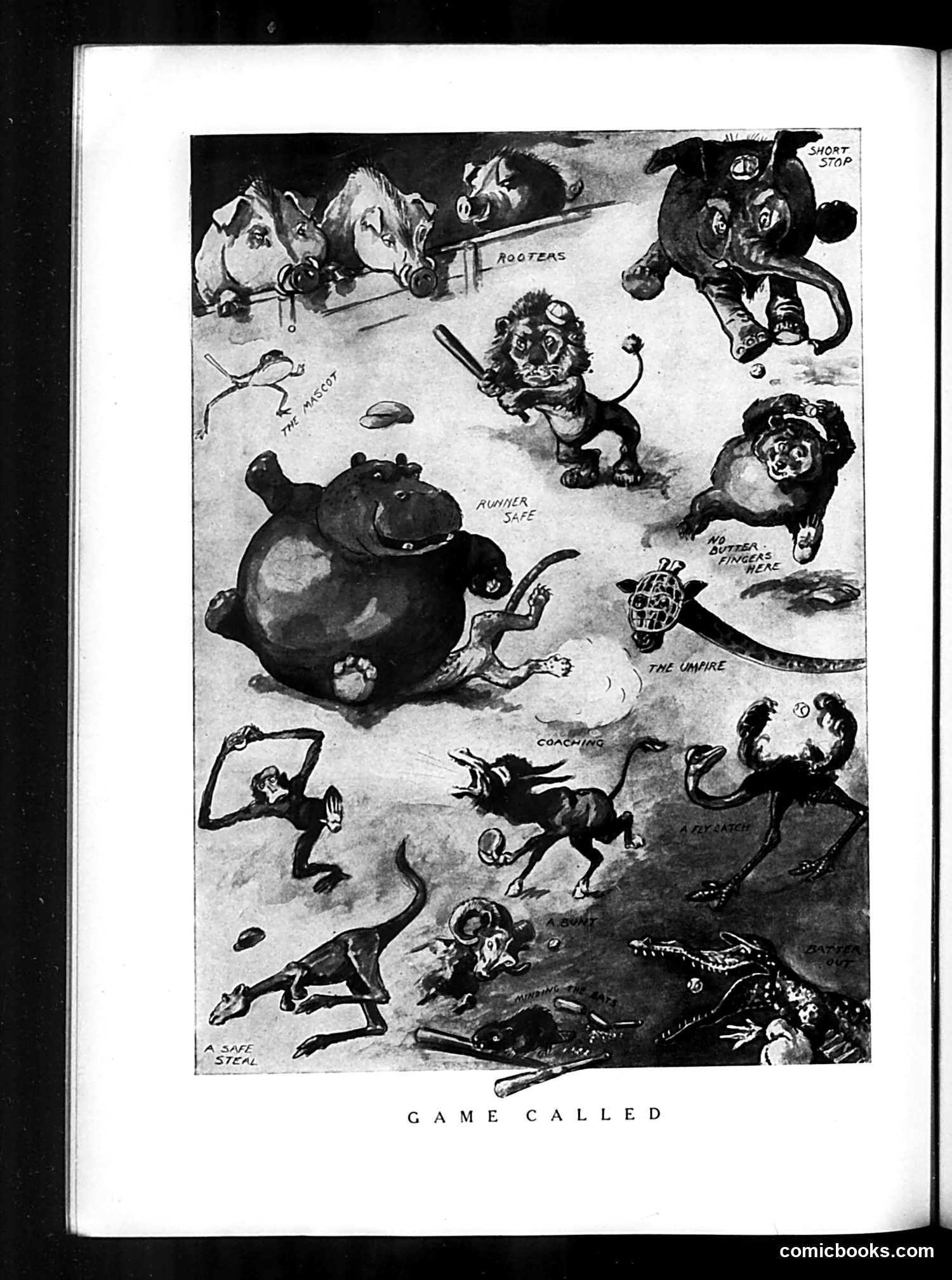
This political cartoon satirizes a baseball game as metaphor for a conflict or competition. Various animal characters labeled with terms like "Roosters," "The Argot," "Runner Safe," "The Umpire," "Coaching," "A Safe Steal," and "Fly Catch" participate in the action. The central hippo-like figure likely represents a major political or social entity. The scattered players, umpire, and coaching figures suggest competing forces or parties in some dispute. The title "Game Called" implies the contest has ended or been stopped. Without knowing Judge magazine's publication date or specific political context, the exact figures remain unclear. However, the cartoon uses baseball's familiar rules and drama to comment on contemporary political maneuvering or athletic/competitive scandals of its era.
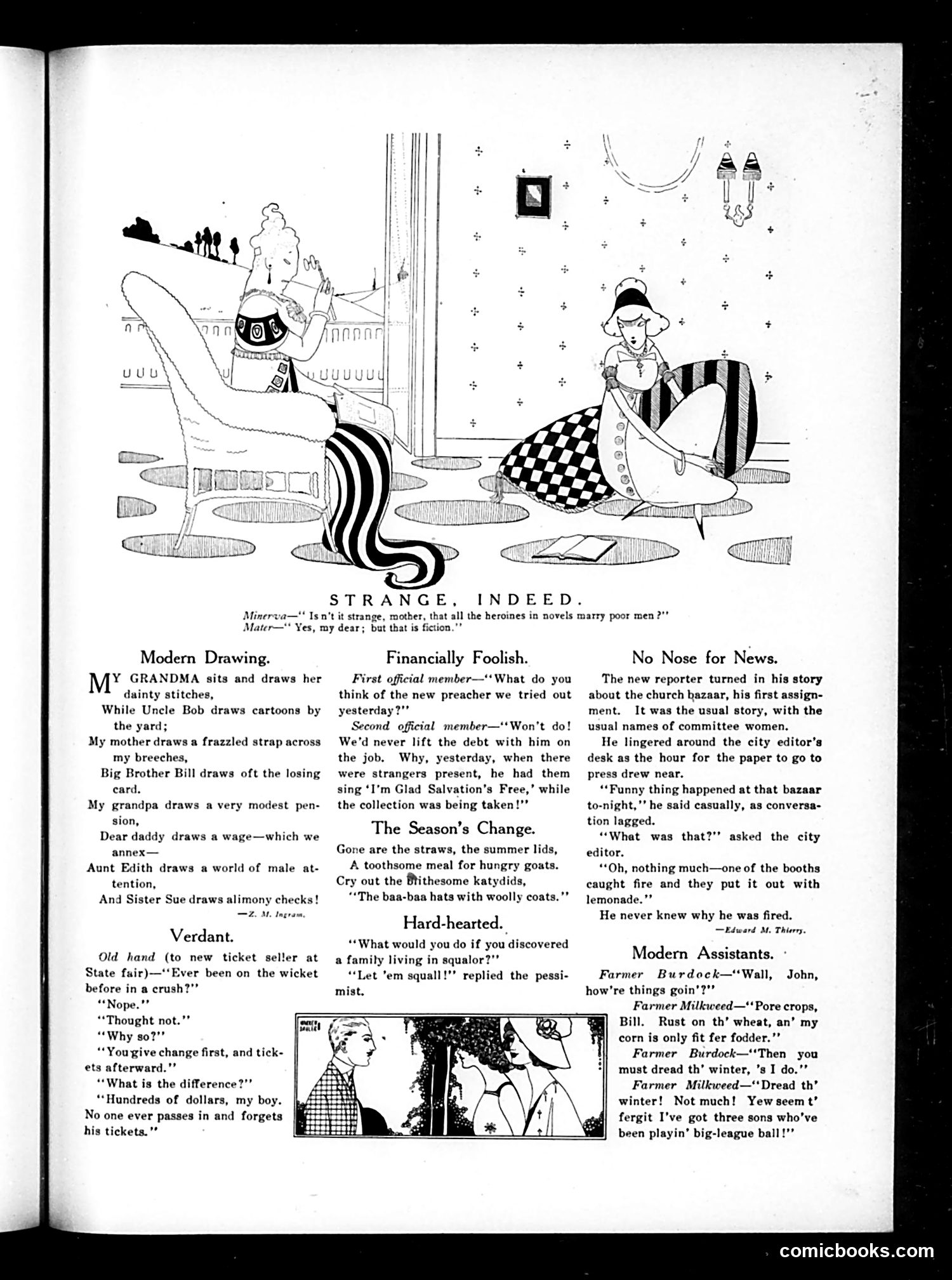
This page contains several satirical pieces typical of early 20th-century American humor: **"Strange, Indeed"** (top): A dialogue joke about fiction versus reality—novels feature poor heroes, but real life doesn't work that way. Light social commentary on romantic idealism. **"Modern Drawing"**: A punning poem listing various types of "drawing" (sketching, pulling, earning, attracting attention, receiving). Sister Sue's "alimony checks" suggests divorce—a still-scandalous topic—for comic effect. **"Verdant"** and other shorts: Quick jokes about ticket sellers, preachers discouraging donations, seasonal changes, and pessimism. **"No Nose for News"**: Satirizes a naive young reporter who misses the real story (a booth catching fire, extinguished with lemonade—absurd and newsworthy) while filing routine coverage. The editor fires him for lacking journalistic instinct. **"Modern Assistants"**: A farmer boasts his struggling farm is offset by sons playing professional baseball—a new source of family pride and income in early 20th-century America.
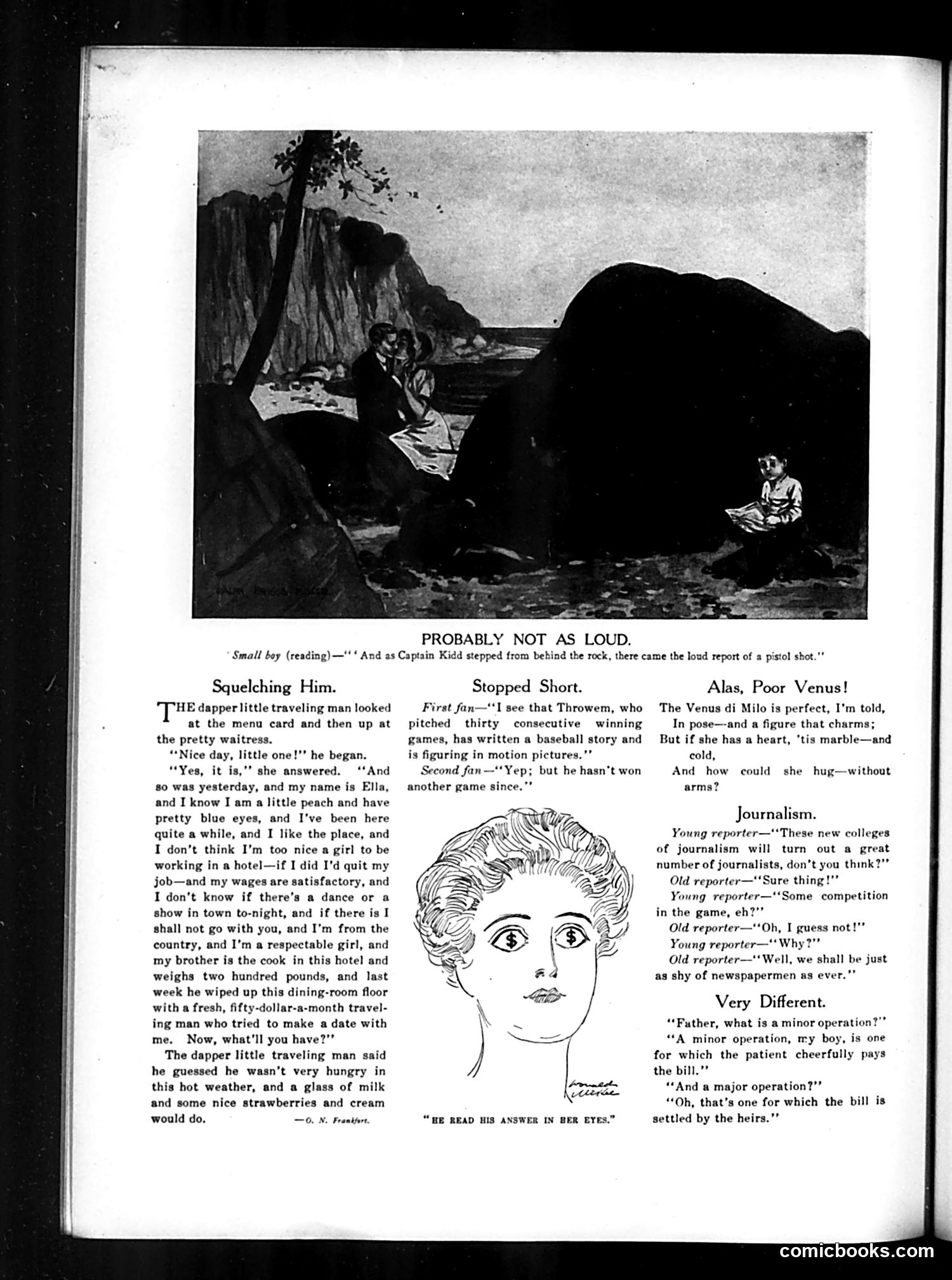
This page contains several satirical pieces typical of early 20th-century American humor: **"Squelching Him"** mocks the persistent "traveling man" (a stock character—a salesman/drifter) who attempts flirtation with a waitress. She preemptively shuts down every possible line he might use, listing her attributes, her respectability, and her protective brother (the cook) who recently beat up a similar man. The joke is her aggressive self-defense against predictable male advances. **"Stopped Short"** satirizes athlete-turned-celebrity culture: a baseball pitcher who won thirty games becomes famous writing stories and appearing in films, but immediately loses his pitching ability—suggesting that fame corrupts athletic performance. The remaining pieces mock journalism (predicting journalism schools won't actually produce journalists) and use dark humor about medical operations (distinguishing them by who pays the bill—patients for minor procedures, heirs for major ones). The top illustration shows a child reading aloud dramatic adventure fiction, with adults listening nearby.
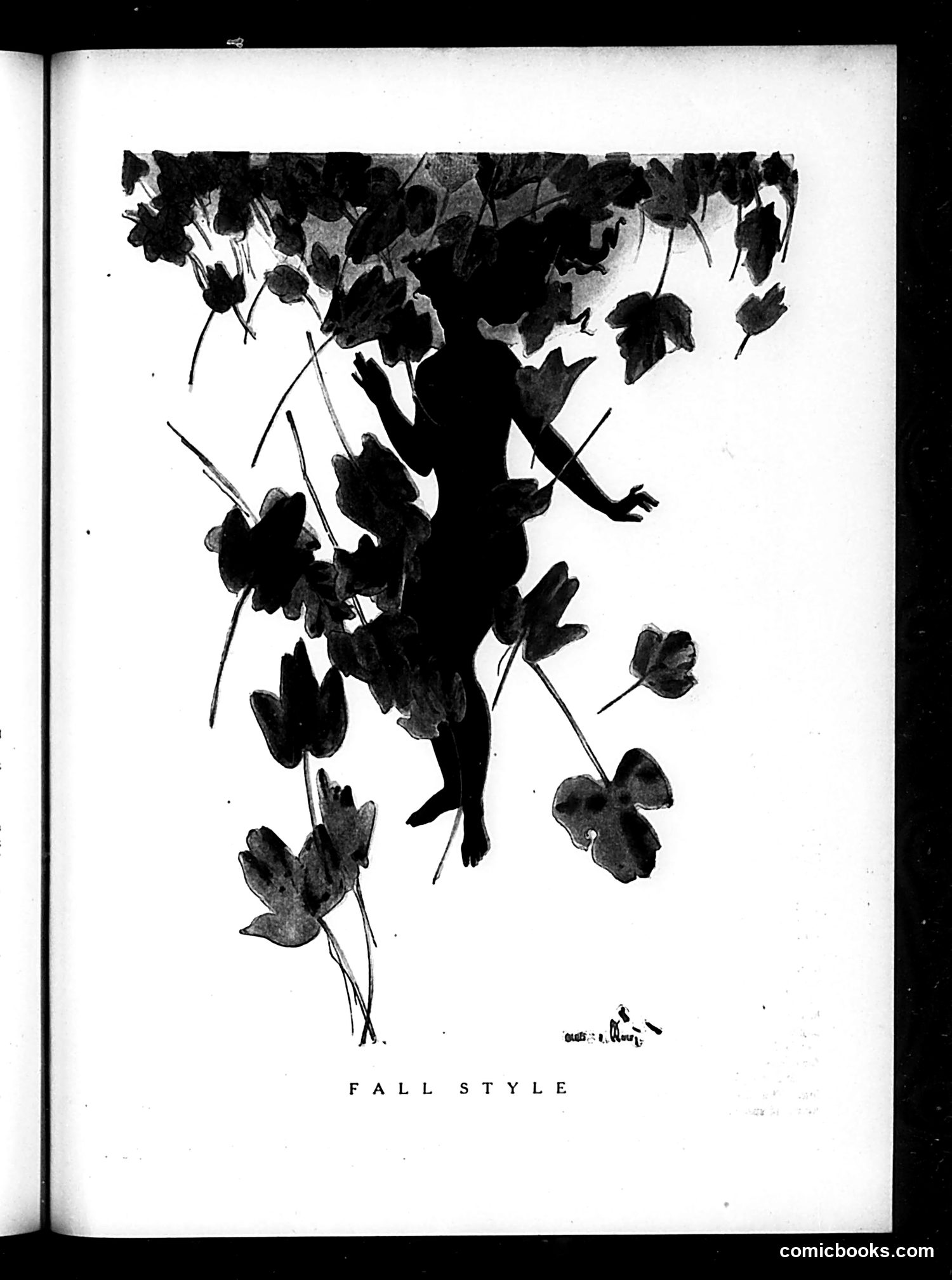
This page appears to be a botanical illustration rather than political satire. It shows a pressed or silhouetted plant specimen with multiple flowering stems and leaves arranged against a white background, labeled "FALL STYLE" at the bottom. The image resembles a scientific herbarium plate or pressed-flower documentation—common in botanical texts and educational materials. There is no visible caricature, political figure, or satirical commentary present. Without additional context from surrounding Judge magazine pages, this appears to be either a decorative botanical feature, an advertisement for a fall product or fashion item, or perhaps an unusual decorative element within the publication. The "Fall Style" label suggests a seasonal theme.
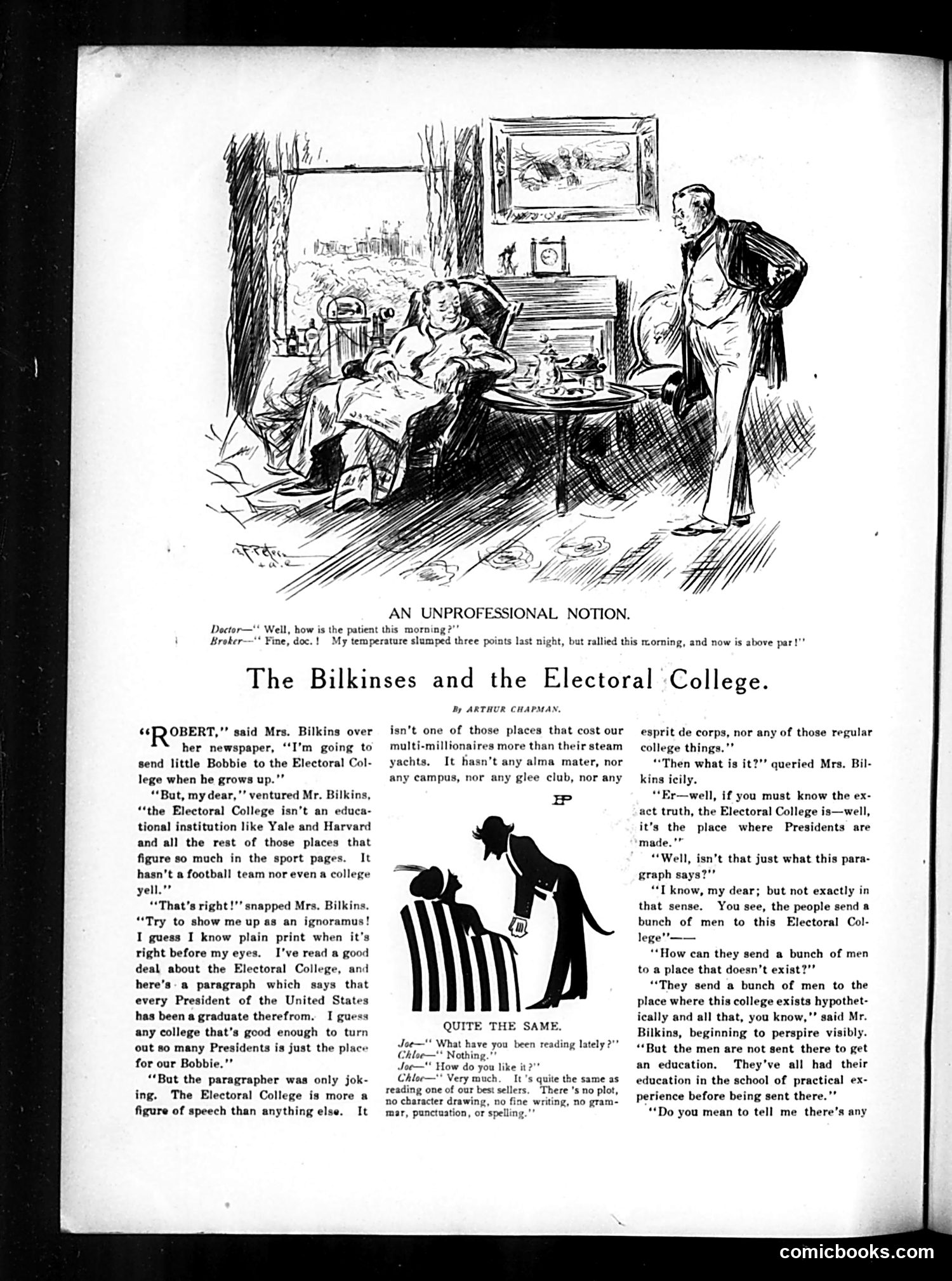
This page contains two satirical pieces from Judge magazine: **"An Unprofessional Notion"** (top): A broker describes his health like stock market performance ("temperature slumped three points... rallied... above par"), conflating financial and medical language for comic effect. **"The Bilkinses and the Electoral College"** (main story): Mrs. Bilkins misunderstands what the Electoral College is, believing it's an actual educational institution like Yale or Harvard where presidents graduate. Her husband struggles to explain that it's a figurative process—not a physical place—where citizens send electors to vote for presidents. The satire mocks widespread public confusion about how the Electoral College actually functions, presenting Mrs. Bilkins's literal interpretation as absurd while implying the system itself is so obscure and abstract that her confusion is understandable. **"Quite the Same"** (bottom): A brief joke comparing modern literature to "nothing"—both equally devoid of plot, character, grammar, etc. The humor relies on exposing institutional misunderstandings and linguistic confusion among ordinary Americans.
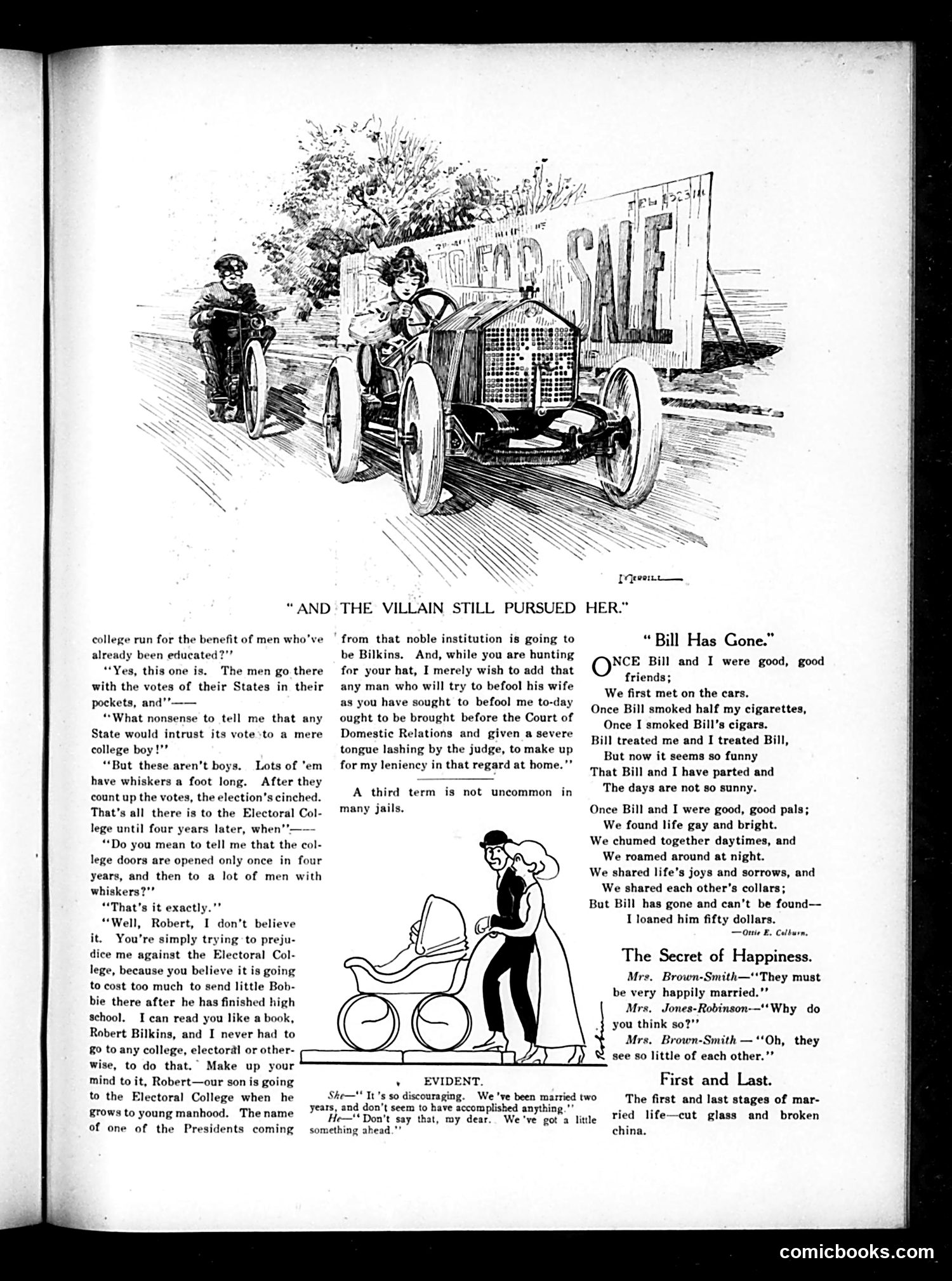
**The Electoral College Dialogue** (main cartoon): This satirizes public ignorance about the Electoral College system. A husband tries unsuccessfully to convince his wife that the Electoral College is a real college that only opens every four years, admitting older men with beards. The satire mocks both the confusing nature of American electoral mechanics and gender dynamics—the wife ultimately dismisses his "explanation" as a patronizing lie meant to discourage their son's education. The underlying critique: the Electoral College system itself is so arcane and seemingly absurd that it invites ridicule. **Supporting Content**: Smaller items address divorce/domestic relations ("Court of Domestic Relations"), marital discord ("First and Last"), and infidelity themes. These suggest Judge's broader social commentary on early 20th-century American marriage and family life. The page reflects Progressive-era skepticism toward institutions and traditional authority figures.
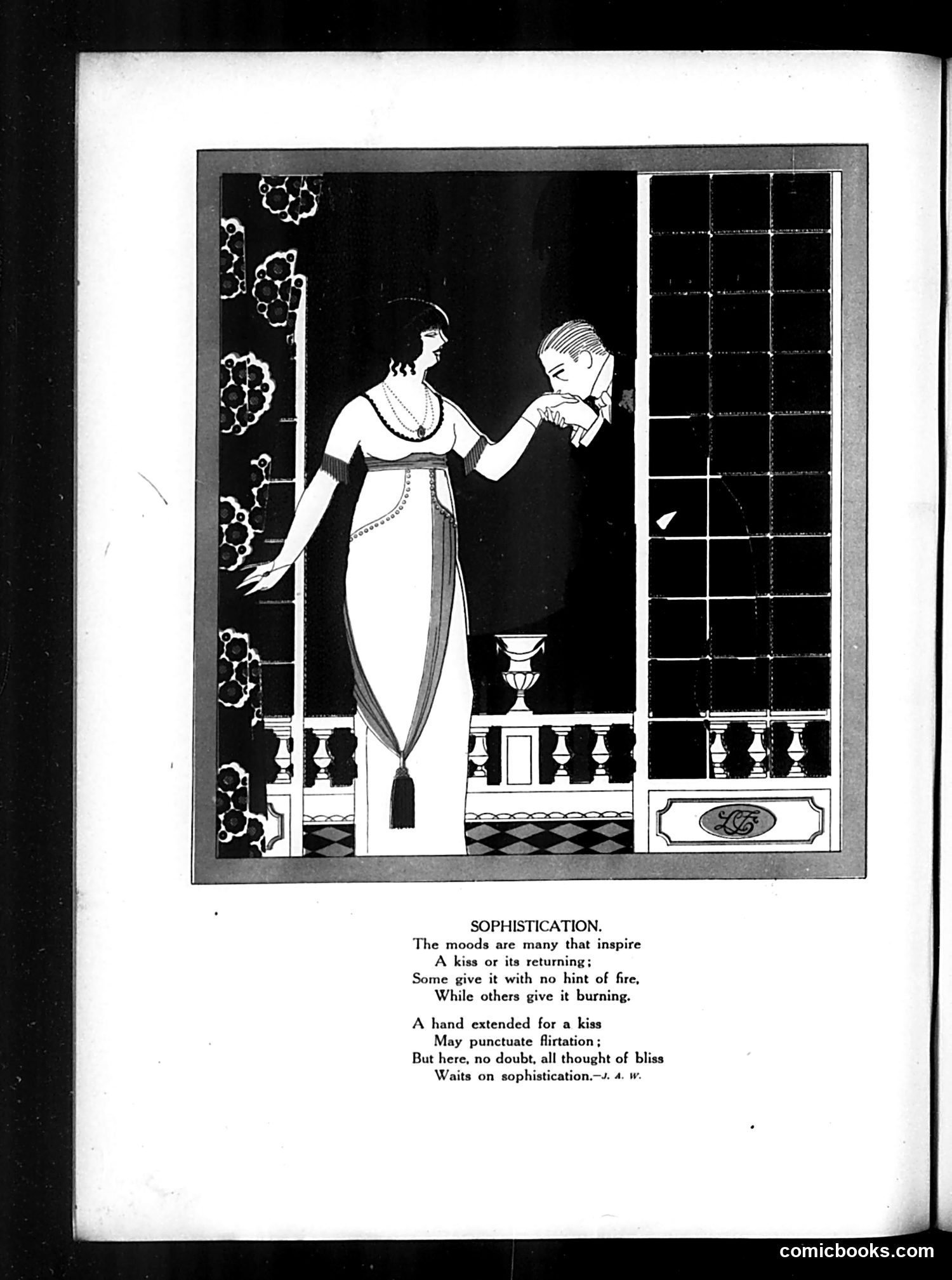
This illustration satirizes the affected mannerisms of high society. The artwork depicts two elegantly dressed figures in an Art Deco style—a woman in a classical Regency gown and a man in formal dress—exchanging a kiss in an ornate interior with draped curtains and latticed windows. The accompanying poem mocks the contrast between genuine passion and calculated sophistication. It suggests that while kisses might normally express real emotion ("burning"), here the couple's gesture is purely performative—a stylized social ritual drained of authentic feeling. The satire targets upper-class pretension: the kiss becomes merely a fashionable pose, devoid of actual "bliss," serving only as an affectation of sophisticated behavior.
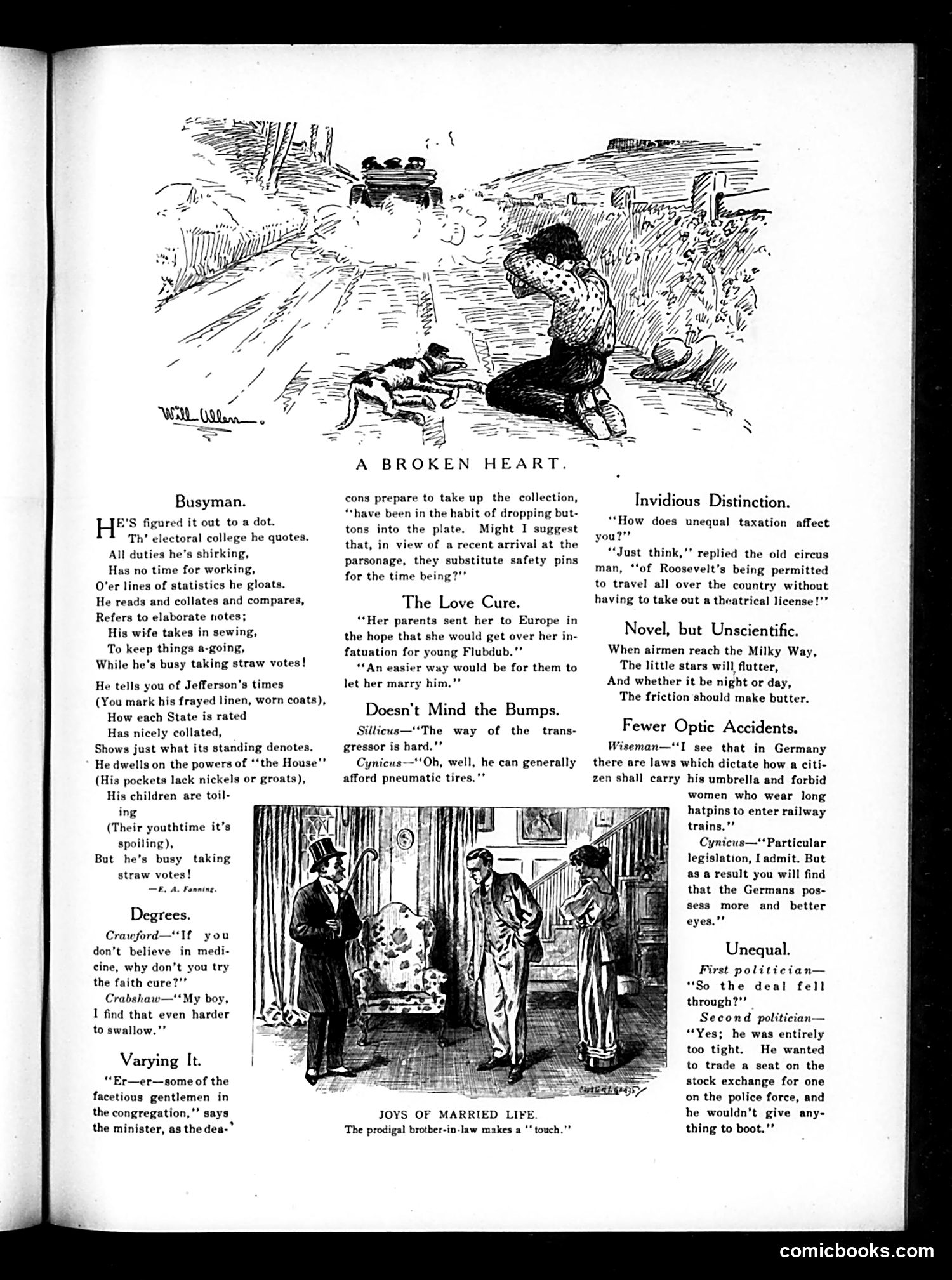
This page contains multiple short satirical pieces mocking American society and politics circa early 1900s. **"Busyman"** ridicules a man obsessed with electoral politics and statistics who neglects his actual job, leaving his wife to do sewing while he pontificates about Jefferson and state voting power—he's all talk about democracy while his family suffers. **"The Love Cure"** and other brief quips are standard domestic humor about courtship and marriage troubles. **"Invidious Distinction"** jokes that Theodore Roosevelt can travel freely without needing a theatrical license (unlike circus performers), mocking the special privileges of the wealthy and powerful. **"Fewer Optic Accidents"** satirizes German bureaucratic regulation—even umbrella-carrying is legislated—yet suggests this produces better eyesight, a darkly absurdist comment on overregulation. **"Unequal"** depicts corruption where a politician tries trading a stock exchange seat for a police position, expecting additional compensation ("boot")—commentary on patronage and graft. The page reflects Progressive-era anxieties about political excess, martial discord, regulatory overreach, and machine politics.
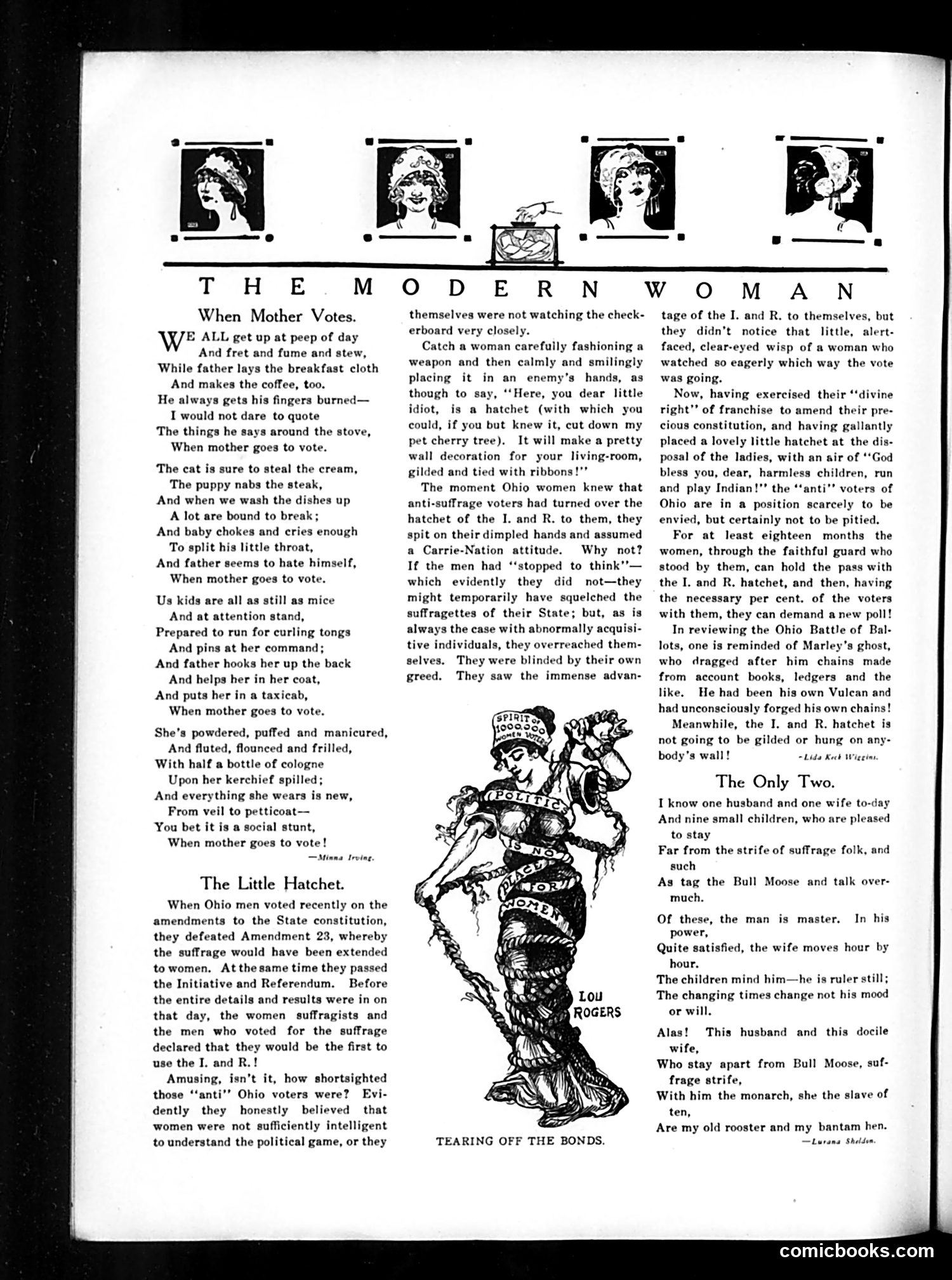
This Judge magazine page satirizes the 1912 Ohio suffrage defeat and its ironic consequences. **"When Mother Votes"** (top poem) mocks domestic chaos when wives vote—father burns breakfast, children misbehave, the household collapses—suggesting women voting disrupts proper family order. The satire is anti-suffrage, presenting voting mothers as neglectful of domestic duties. **"The Little Hatchet"** (main article) reverses this mockery. Ohio voters defeated Amendment 23 (denying women suffrage) but passed the Initiative and Referendum—giving citizens direct legislative power. The article sarcastically notes this was shortsighted: anti-suffrage men handed women a powerful "hatchet" (the I. and R. tool) to overturn their own decision. The "Tearing Off the Bonds" illustration reinforces this—women will use the Initiative/Referendum to demand a new suffrage vote within 18 months, ultimately defeating the men's own anti-suffrage stance. The page's irony: by denying suffrage while granting direct democracy tools, Ohio opponents accidentally empowered the suffrage movement.
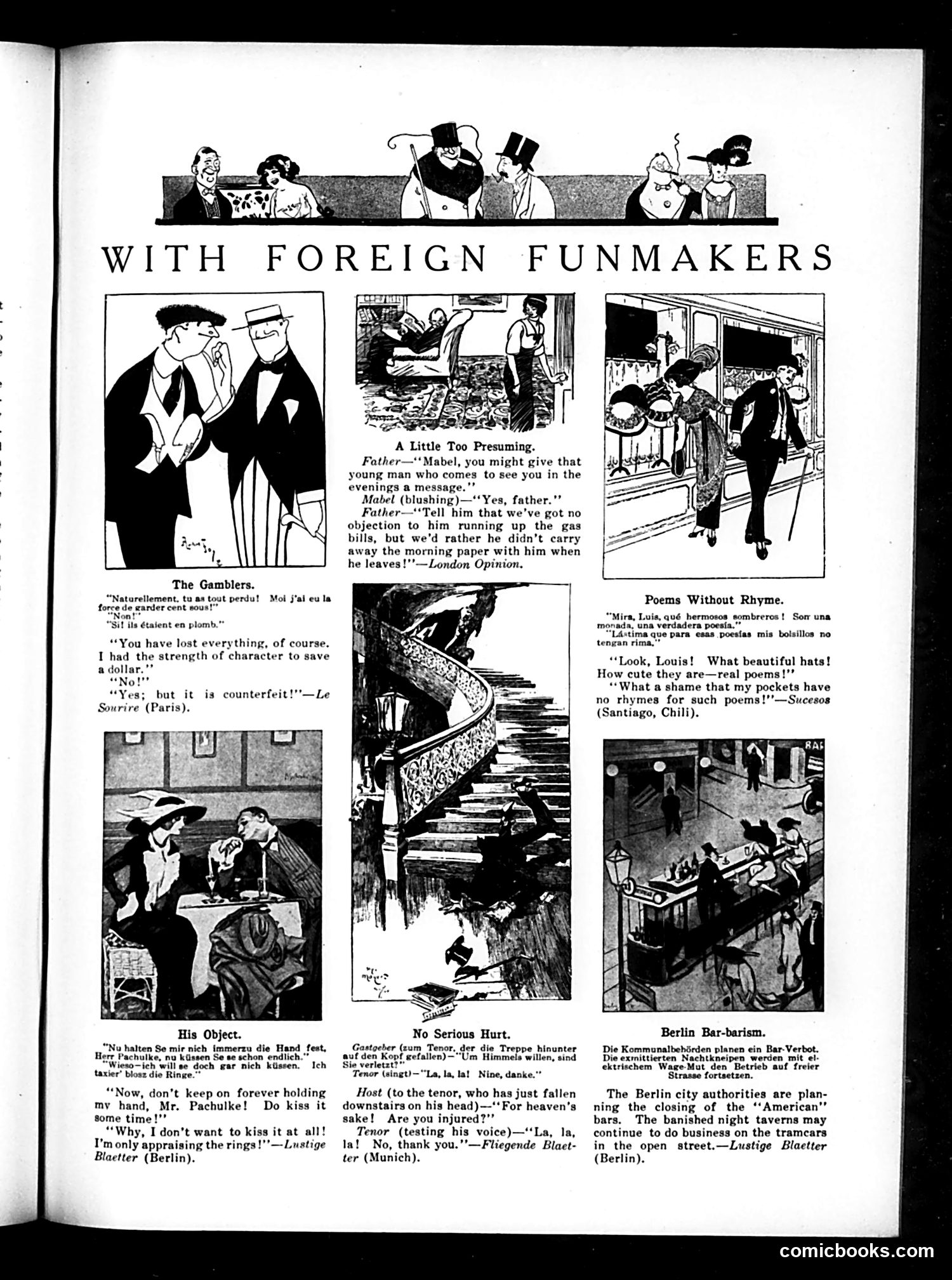
This page collects humorous cartoons and jokes from European satirical publications, translated for American readers. The content satirizes everyday social situations across different countries: **The sketches mock:** - Gambling culture (French men losing money, one claiming counterfeit coins) - Romantic pretense (German man appraising a woman's engagement rings rather than genuinely courting her) - Parental anxiety about courtship (British father annoyed a suitor wastes gas and steals newspapers during visits) - Immigrant culture (a tenor survives a fall down stairs, seemingly unbothered) - Consumer excess (Chilean man can't afford the "poetic" hats his wife admires) - Berlin's nightlife regulations (bars forced to operate from tramcars after closure orders) The page functions as cultural commentary through international humor, suggesting these social foibles—materialism, dishonesty, pretense, regulatory absurdity—were universal across Western societies.
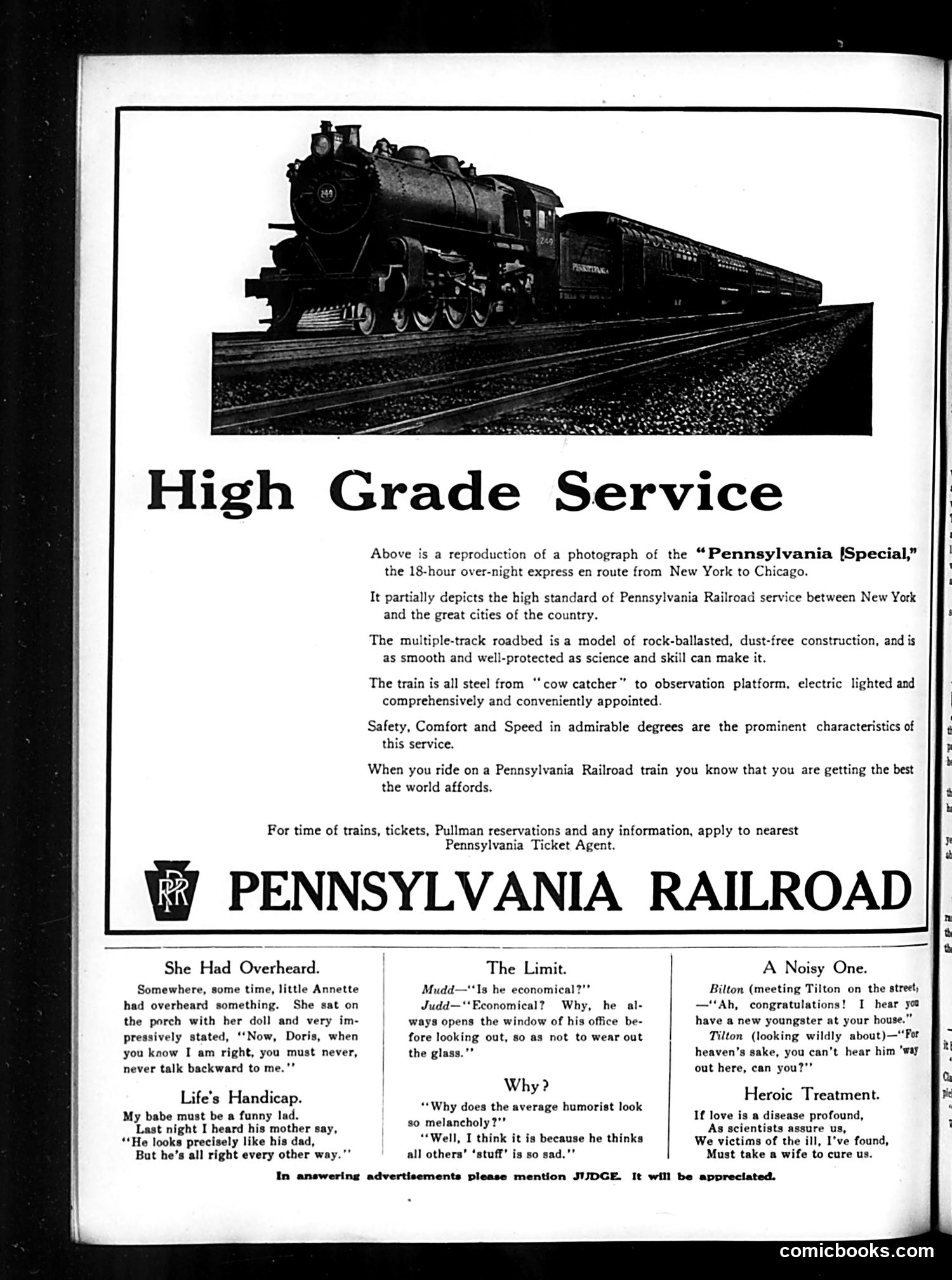
This page is primarily a **Pennsylvania Railroad advertisement** masquerading as editorial content. The large upper section features a dramatic photograph of the "Pennsylvania Special" locomotive with promotional text praising its safety, comfort, and speed for the New York-to-Chicago route. Below the ad are **six short humorous anecdotes**—typical Judge magazine filler content. These are gentle, domestic jokes with no apparent political satire: a child mimicking adult speech patterns, a father-son resemblance joke, an exaggerated cheapskate, a loud baby, a humorist's melancholy, and a joke equating love to disease requiring a "wife cure." None of these vignettes contain identifiable caricatures or political references. They represent standard early-20th-century American humor aimed at middle-class readers—the presumed Pennsylvania Railroad clientele. The page essentially demonstrates how **advertising and entertainment blended** in Judge: premium advertisers received prominent placement alongside the magazine's editorial content, targeting affluent travelers.
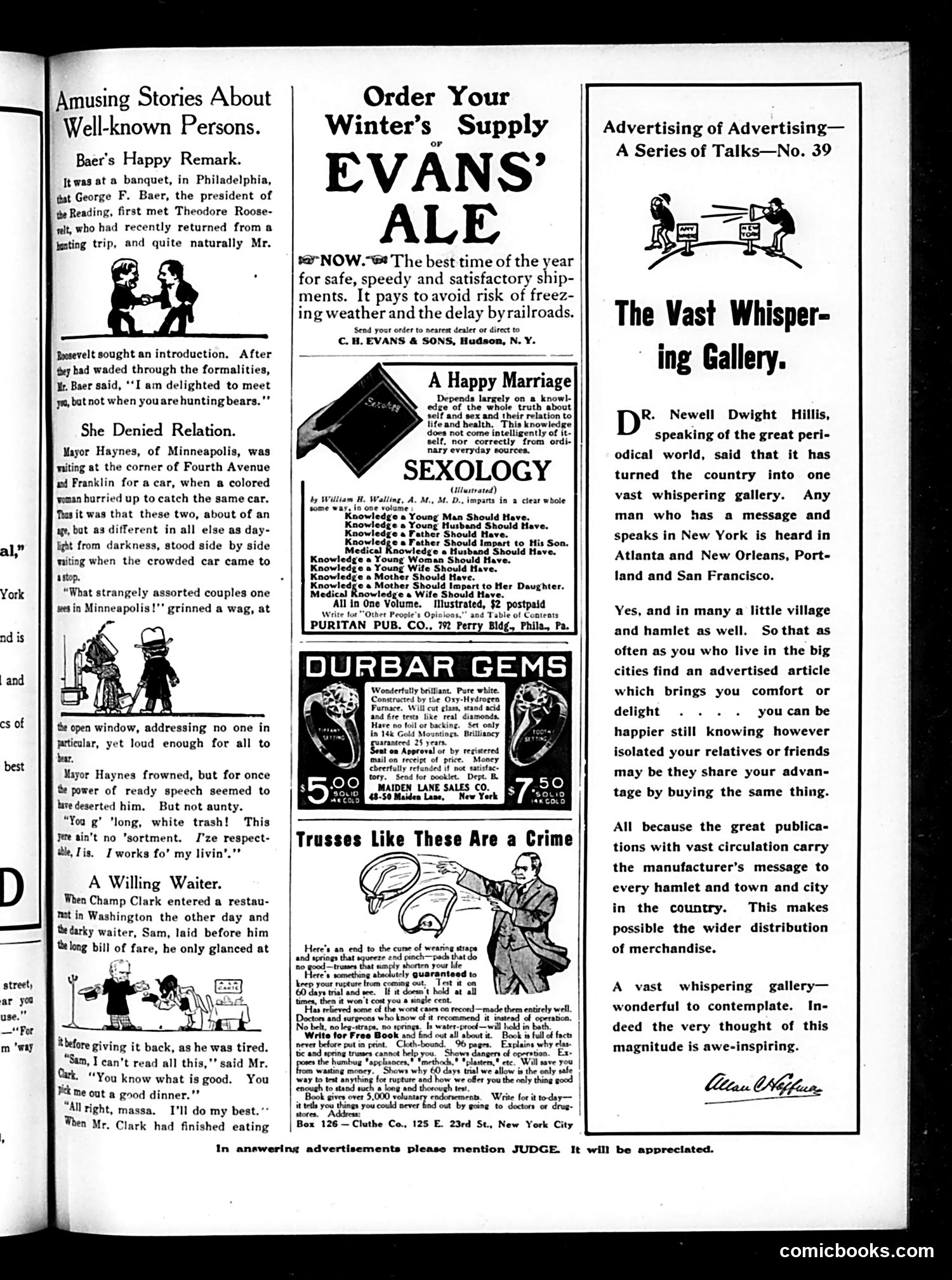
This page from Judge contains three sections: humorous anecdotes about well-known figures, advertisements, and a satirical article. **The Anecdotes**: Three brief stories mock prominent men through dialogue. "Baer's Happy Remark" depicts George F. Baer (Reading Railroad president) and Theodore Roosevelt meeting at a banquet—the joke hinges on Baer's quip about not wanting to meet Roosevelt while bear-hunting. The other two stories feature racial stereotypes typical of the era: Mayor Haynes of Minneapolis and Champ Clark (a congressman) are shown interacting with Black servants in ways meant to be humorous but reflect deeply offensive period attitudes. **"The Vast Whispering Gallery"** (right panel) explains how national advertising reaches remote areas, allowing isolated people to access the same products as city dwellers—positioning advertising as democratizing and connecting. The page reflects early 20th-century humor standards, including casual racism presented as entertainment for Judge's educated readership.
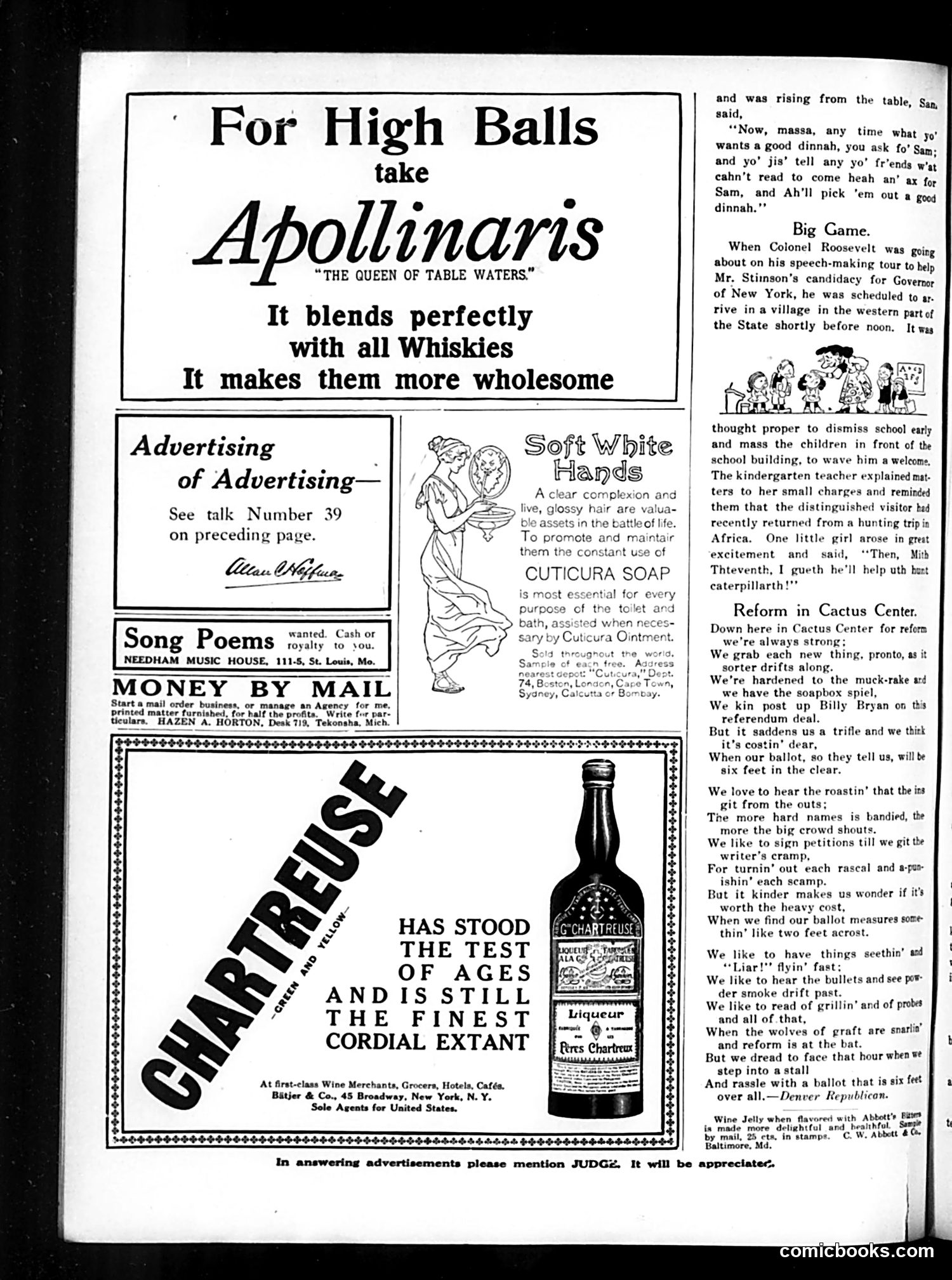
This page is primarily **advertising** with one notable satirical piece: "Reform in Cactus Center," a poem poking fun at progressive-era politics. The poem mocks **rural voters' enthusiasm for reform movements** while confessing anxiety about the practical consequences. References include: - **Billy Bryan**: William Jennings Bryan, three-time presidential candidate and populist icon - **The referendum**: direct democracy measures gaining popularity in the Progressive Era - **Ballot size complaint**: The joke—that ballots have grown to "six feet" due to numerous referendum measures—reflects real frustration with ballot complexity in early 1900s reform states The satire's point: Western reformers eagerly support anti-corruption crusades, petitions, and sensational exposés ("roastin'"), but when faced with unwieldy ballots full of complex measures they don't understand, they lose enthusiasm. It's gentle mockery of reform fervor disconnected from practical governance. The page also references **Colonel Roosevelt's 1910 campaign tour** supporting Henry Stimson for New York Governor, providing historical context for the reform-era political climate.
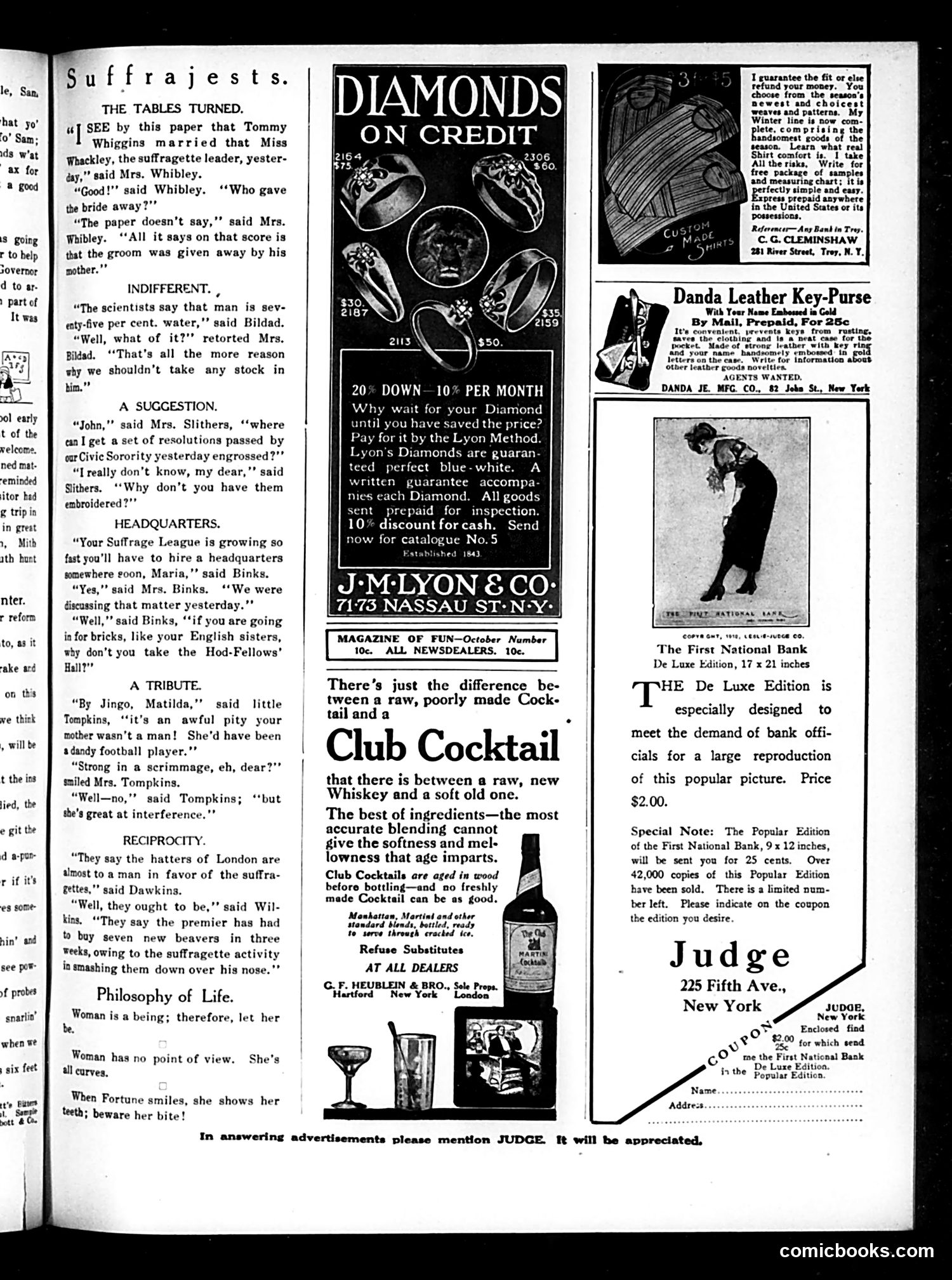
This page from Judge magazine (October issue, early 20th century) satirizes the suffragette movement through short humorous dialogues. **Key satirical points:** The jokes mock suffragettes by suggesting they are: - Domineering to men (a bride "given away by his mother" rather than father, implying maternal control) - Illogical and overly focused on resolutions and procedures ("Why don't you have them embroidered?") - Prone to violence (the "beaver" joke references women destroying men's hats during protests) - Unfeminine ("She'd have been a dandy football player") The page also includes era-appropriate advertisements (diamonds on credit, cocktails, leather goods) and a cynical "Philosophy of Life" section dismissing women's intellect ("no point of view. She's all curves"). **Context:** This reflects anti-suffrage sentiment common in American humor circa 1910-1915, when women's voting rights remained controversial. The satire treats suffragettes as absurd rather than addressing their substantive demands.
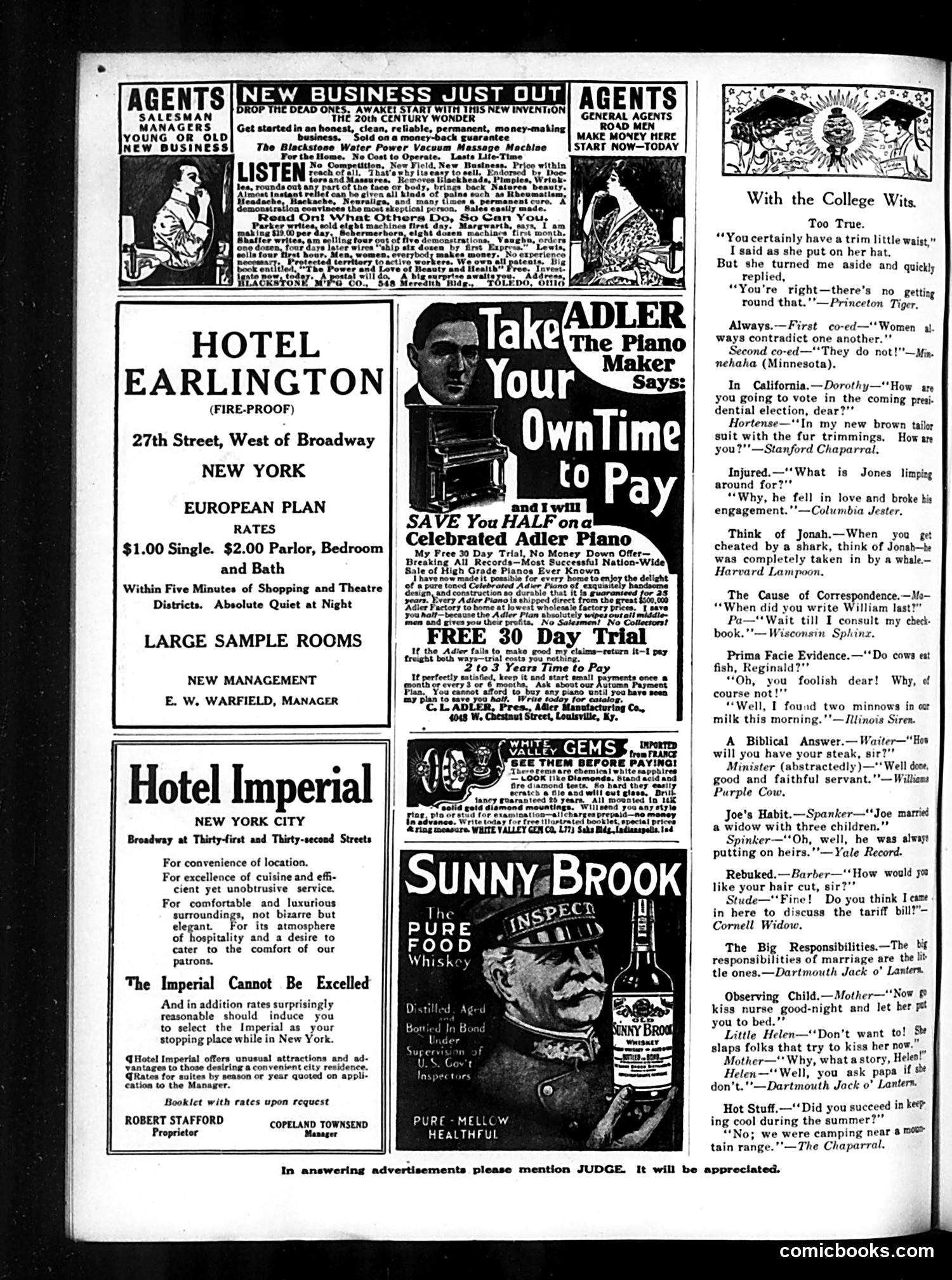
This page is primarily **advertising**, with a small "College Wit" humor section. The main content includes: **Advertisements:** - Hotel Earlington and Hotel Imperial (New York lodging) - Adler Piano sales pitch ("Take Your Own Time to Pay") - Sunny Brook Whiskey - Various business opportunity ads for salesmen/agents **Humor Section ("With the College Wits"):** A collection of brief, dated college-humor jokes from various university publications (Princeton, Stanford, etc.). These jokes play on: - Gender dynamics ("trim little waist" commentary) - Flirtation and romance mishaps - Absurdist wordplay **Historical Context for Modern Readers:** The humor reflects early 1900s attitudes toward women and courtship—somewhat patronizing by today's standards. The page demonstrates how Judge mixed serious advertising with light collegiate humor, appealing to educated, affluent readers. The whiskey and hotel ads underscore the magazine's sophisticated, urban audience. **No political cartoons or satire appear on this particular page.**
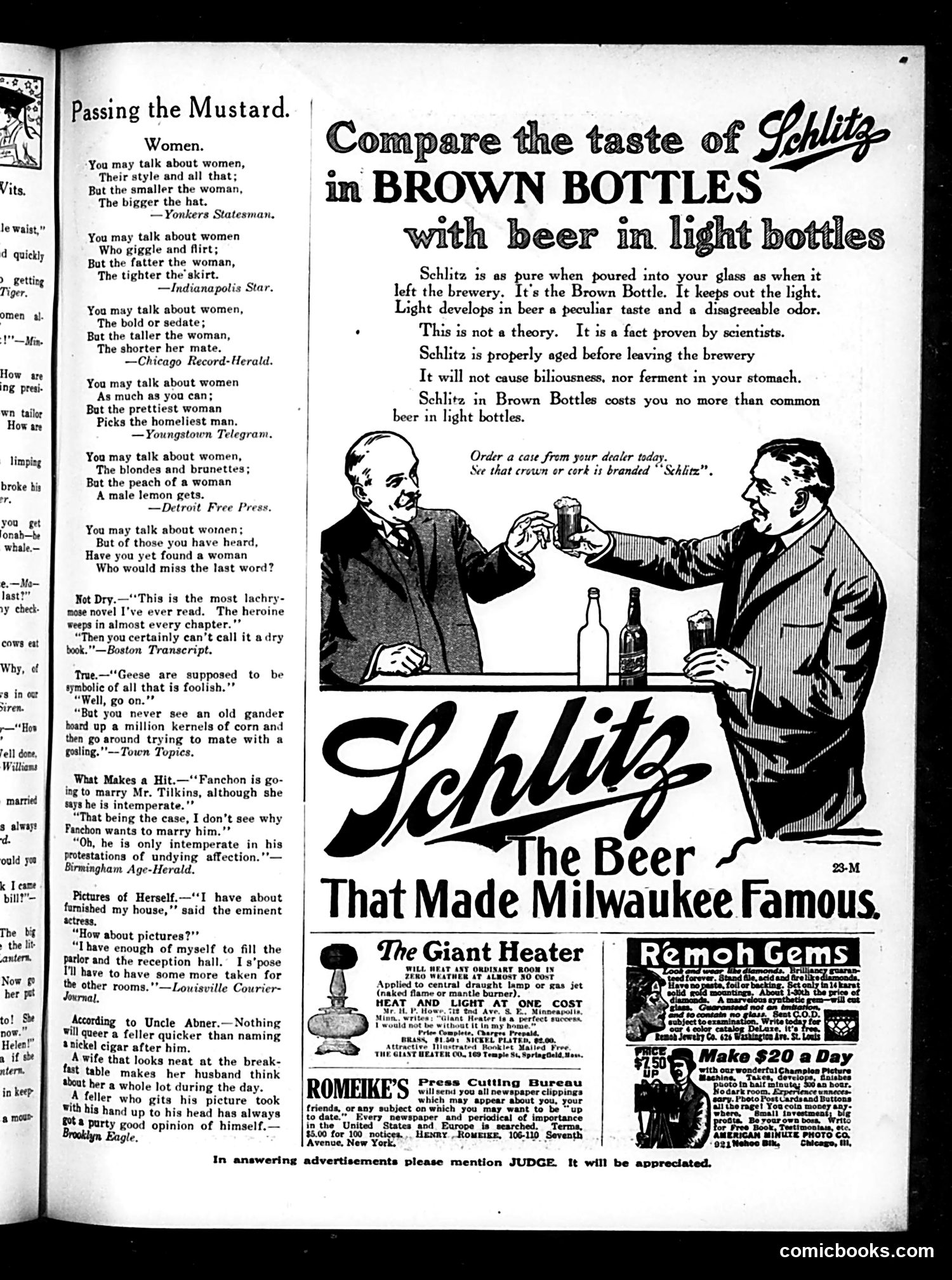
This page contains primarily **humor columns and advertising**, not political cartoons. The left side features "Passing the Mustard"—a collection of humorous one-liners about women, compiled from various newspapers. These reflect early 20th-century comedic tropes: jokes about women's fashion (oversized hats, tight skirts), romantic paradoxes (pretty women choose homely men), and gender stereotypes (women always wanting the last word). The humor relies on observations about female appearance and behavior presented as universal truths. The dominant advertisement promotes **Schlitz beer in brown bottles**, claiming the brown glass prevents light exposure that causes undesirable taste and odor in beer. This was a genuine marketing distinction—brown bottles do protect beer from light damage. Below are smaller ads for heating equipment and other services. The overall page reflects advertising-driven magazine content interspersed with lighthearted social commentary on gender relations typical of the era.
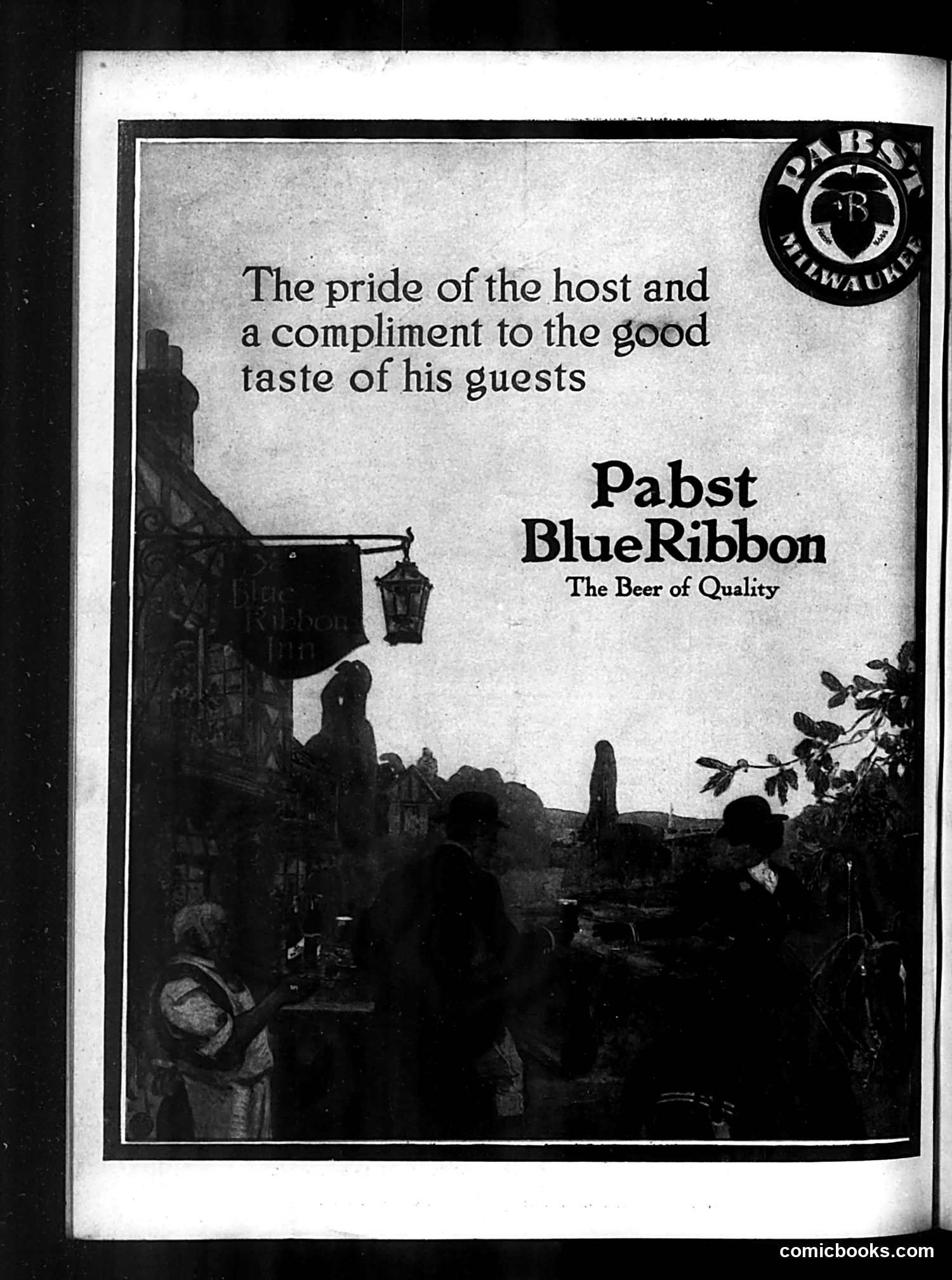
This is a **Pabst Blue Ribbon beer advertisement**, not political satire. The page features a romanticized European street scene—likely German or Bavarian, given the architectural style and lamp—with silhouetted figures in period dress. The ad's messaging appeals to hosts' pride and social standing: serving Pabst Blue Ribbon supposedly signals refined taste and honors guests. The imagery invokes Old World European heritage and tradition, reinforcing the beer's association with quality craftsmanship (Pabst was Milwaukee-based, founded by a German immigrant). For early 20th-century American readers, this nostalgic European aesthetic would have conveyed authenticity and respectability during an era when German-American brewing heritage was prestigious. The circular "Pabst Milwaukee" logo appears in the upper right.