
Judge, 1912-10-19 · page 13 of 24
Judge — October 19, 1912 — page 13: what you’re looking at
What you’re looking at
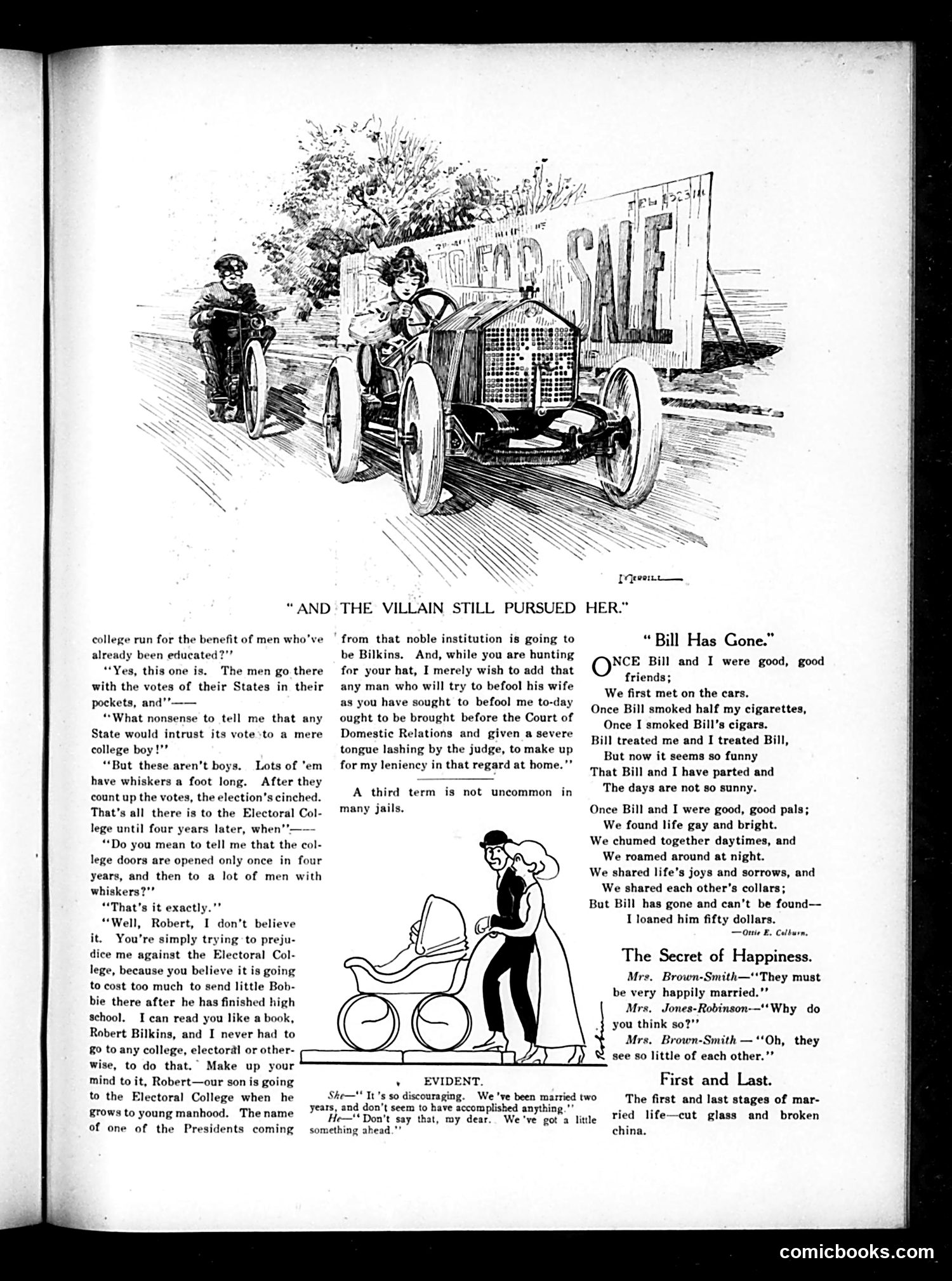
**The Electoral College Dialogue** (main cartoon): This satirizes public ignorance about the Electoral College system. A husband tries unsuccessfully to convince his wife that the Electoral College is a real college that only opens every four years, admitting older men with beards. The satire mocks both the confusing nature of American electoral mechanics and gender dynamics—the wife ultimately dismisses his "explanation" as a patronizing lie meant to discourage their son's education. The underlying critique: the Electoral College system itself is so arcane and seemingly absurd that it invites ridicule. **Supporting Content**: Smaller items address divorce/domestic relations ("Court of Domestic Relations"), marital discord ("First and Last"), and infidelity themes. These suggest Judge's broader social commentary on early 20th-century American marriage and family life. The page reflects Progressive-era skepticism toward institutions and traditional authority figures.
📄 Transcribed text from this page (OCR, searchable)
Machine-transcribed from the original scan — historical spelling and the odd misread are preserved.
[devon “AND THE VILLAIN STILL PURSUED HER.” college run for the benefit of men who've already been educated?”’ “Yes, this one is. The men go there with the votes of their States in their pockets, and’?—— “What nonsense to tell me that any State would intrust its vote sto a mere college boy!’ “But these aren't boys. Lots of 'em have whiskers a foot long. After they count up the votes, the election's cinched. That's all there is to the Electoral Col- lege until four years later, when’’——- “Do you mean to tell me that the col- lege doors are opened only once in four years, and then to a lot of men with whiskers?”’ “That's it exactly."’ “Well, Robert, I don’t believe it. You're simply trying to preju- dice me against the toral Col- lege, because you believe it is going to cost too much to send little Bob- bie there after he has finished high school. I can read you like a book, Robert Bilkins, and I never had to Ro to any college, electoral or other- wise, to do that.” Make up your mind to it, Robert—our son is going to the Electoral College when he grows to young manhood. The name of one of the Presidents coming from that noble institution is going to be Bilkins. And, while you are hunting for your hat, I merely wish to add that any man who will try to befool his wife as you have sought to befool me to-day ought to be brought before the Court of Domestic Relations and given a severe tongue lashing by the judge, to make up for my leniency in that regard at home.”” A third term is not uncommon in many jails. + EVIDENT. Ske—'* It's so discouraging. He—'*Don't say that, my dear. something ahead.” We 've been married two years, and don’t seem to have accomplished anything." We 've gota little “ Bill Has Gone.” ONCE Bill and I were good, good friends; We first met on the cars, Once Bill smoked half my cigarettes, Once I smoked Bill’s cigars. Bill treated me and I treated Bill, But now it seems so funny That Bill and I have parted and The days are not so sunny. Once Bill and I were good, good pals; We found life gay and bright. We chumed together daytimes, and We roamed around at night. We shared life’s joys and sorrows, and We shared each other's collars; But Bill has gone and can’t be found— I loaned him fifty dollars. —Ottie E. Colburn, The Secret of Happiness. Mrs. Brown-Smith—‘‘They must be very happily married.” Mrs, Jones-Robinson—'‘Why do you think so?’’ Mrs. Brown-Smith —‘‘Oh, they see so little of each other.’” First and Last. The first and last stages of mar- ried life—cut glass and broken china. comicbooks.com