
Judge, 1912-10-19 · page 16 of 24
Judge — October 19, 1912 — page 16: what you’re looking at
What you’re looking at
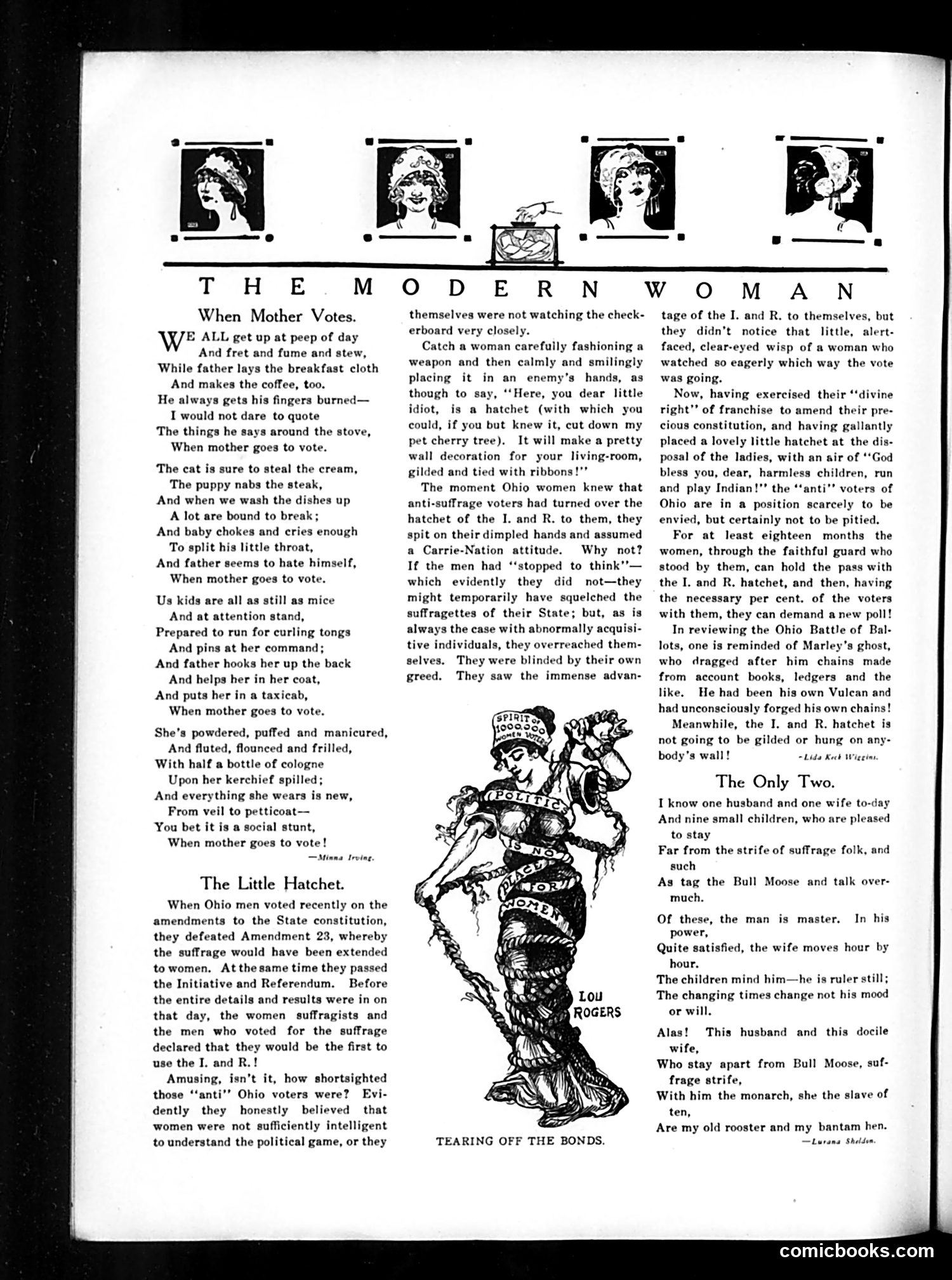
This Judge magazine page satirizes the 1912 Ohio suffrage defeat and its ironic consequences. **"When Mother Votes"** (top poem) mocks domestic chaos when wives vote—father burns breakfast, children misbehave, the household collapses—suggesting women voting disrupts proper family order. The satire is anti-suffrage, presenting voting mothers as neglectful of domestic duties. **"The Little Hatchet"** (main article) reverses this mockery. Ohio voters defeated Amendment 23 (denying women suffrage) but passed the Initiative and Referendum—giving citizens direct legislative power. The article sarcastically notes this was shortsighted: anti-suffrage men handed women a powerful "hatchet" (the I. and R. tool) to overturn their own decision. The "Tearing Off the Bonds" illustration reinforces this—women will use the Initiative/Referendum to demand a new suffrage vote within 18 months, ultimately defeating the men's own anti-suffrage stance. The page's irony: by denying suffrage while granting direct democracy tools, Ohio opponents accidentally empowered the suffrage movement.
📄 Transcribed text from this page (OCR, searchable)
Machine-transcribed from the original scan — historical spelling and the odd misread are preserved.
T HE When Mother Votes. WE ALL get up at peep of day And fret and fume and stew, While father lays the breakfast cloth And makes the coffee, too. He always gets his fingers burned— I would not dare to quote The things he says around the stove, When mother goes to vote. The cat is sure to steal the cream, The puppy nabs the steak, And when we wash the dishes up A lot are bound to break ; And baby chokes and cries enough To split his little throat, And father seems to hate himself, When mother goes to vote. Us kids are all as still as mice And at attention stand, Prepared to run for curling tongs And pins at her command; And father hooks her up the back And helps her in her coat, And puts her in a taxicab, When mother goes to vote. She's powdered, puffed and manicured, And fluted, flounced and frilled, With half a bottle of cologne Upon her kerchief spilled; And everything she wears is new, From veil to petticoat— You bet it is a social stunt, When mother goes to vote! Minna Irving. The Little Hatchet. When Ohio men voted recently on the amendments to the State constitution, they defeated Amendment 23, whereby the suffrage would have been extended to women. At the same time they passed the Initiative and Referendum. Before the entire details and results were in on that day, the women suffragists and the men who voted for the suffrage declared that they would be the first to use the I. and R.! Amusing, isn’t it, how shortsighted those ‘‘anti’’ Ohio voters were? Evi- dently they honestly believed that women were not sufficiently intelligent to understand the political game, or they MODERN themselves were not watching the check- erboard very closely. Catch a woman carefully fashioning a weapon and then calmly and smilingly placing it in an enemy’s hands, as though to say, ‘‘Here, you dear little idiot, is a hatchet (with which you could, if you but knew it, cut down my pet cherry tree). It will make a pretty wall decoration for your living-room, gilded and tied with ribbons The moment Ohio women knew that anti-suffrage voters had turned over the hatchet of the I. and R. to them, they spit on their dimpled hands and assumed a Carrie-Nation attitude. Why not? If the men had ‘stopped to think’””— which evidently they did not—they might temporarily have squelched the suffragettes of their State; but, as is always the case with abnormally acquisi- tive individuals, they overreached them- They were blinded by their own They saw the immense advan- selves, greed. Biroraod od % TEARING OFF THE BONDS. WOM AN tage of the I. and R. to themselves, but they didn’t notice that little, alert- faced, clear-eyed wisp of a woman who watched so eagerly which way the vote was going. Now, having exercised their ‘‘divine right" of franchise to amend their pre- cious constitution, and having gallantly placed a lovely little hatchet at the dis- posal of the ladies, with an air of ‘‘God bless you, dear, harmless children, run and play Indian!"’ the ‘‘anti’’ voters of Ohio are in a position scarcely to be envied, but certainly not to be pitied. For at least eighteen months the women, through the faithful guard who stood by them, can hold the pass with the I. and R. hatchet, and then, having the necessary per cent. of the voters with them, they can demand anew poll! In reviewing the Ohio Battle of Bal- lots, one is reminded of Marley's ghost, who dragged after him chains made from account books, ledgers and the like. He had been his own Vulcan and had unconsciously forged his own chains! Meanwhile, the I. and R. hatchet is not going to be gilded or hung on any- body's wall! The Only Two. I know one husband and one wife to-day And nine small children, who are pleased to stay Far from the strife of suffrage folk, and such As tag the Bull Moose and talk over- much. Lida Keck Wiggins Of these, the man is master. In his power, Quite satisfied, the wife moves hour by hour. The children mind him—he is ruler still; The changing times change not his mood or will. Alas! This husband and this docile wife, Who stay apart from Bull Moose, suf- frage strife, With him the monarch, she the slave of ten, Are my old rooster and my bantam hen. Luvana Sheldon comicbooks.com