
Judge, 1912-10-19 · page 9 of 24
Judge — October 19, 1912 — page 9: what you’re looking at
What you’re looking at
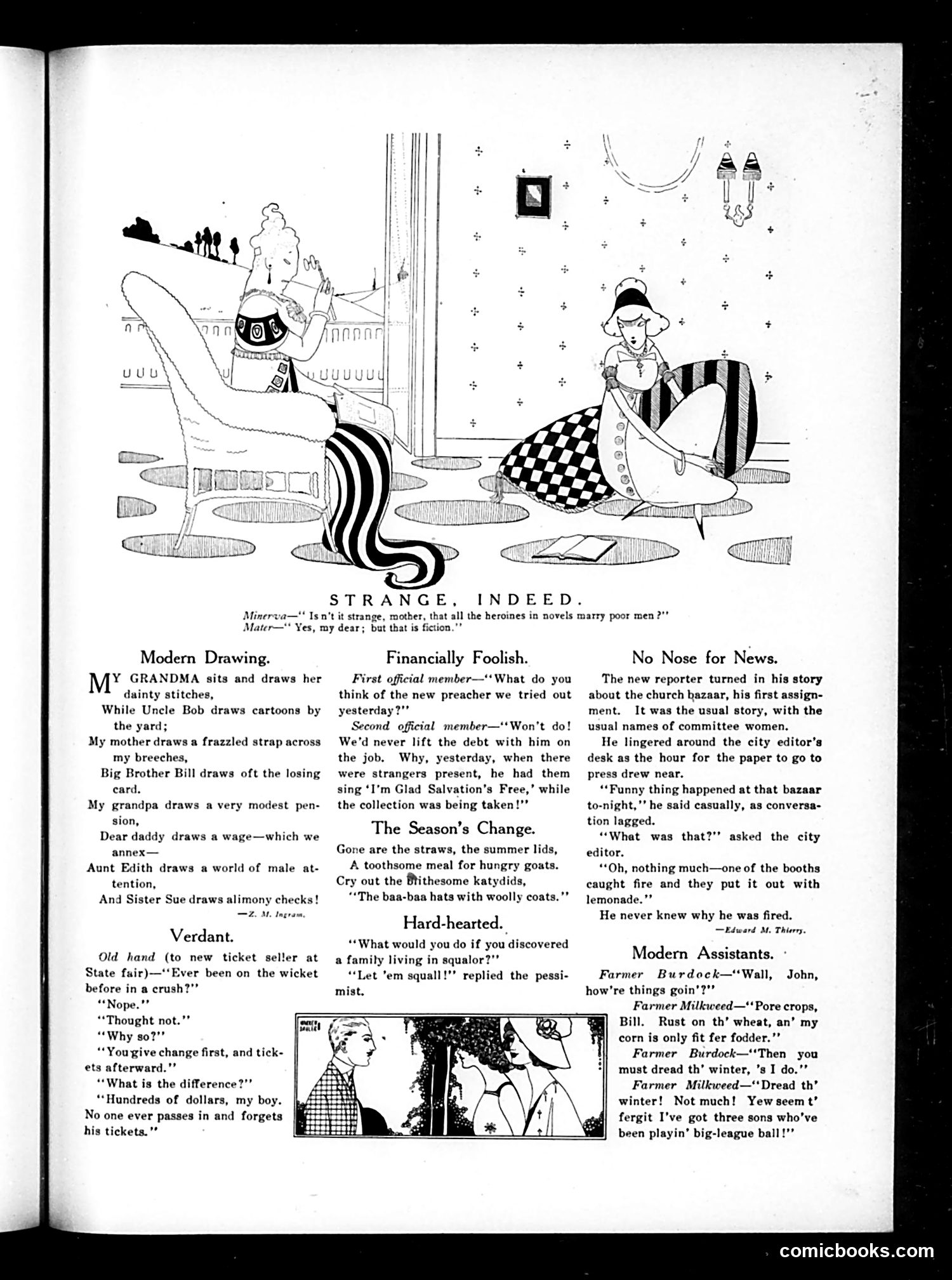
This page contains several satirical pieces typical of early 20th-century American humor: **"Strange, Indeed"** (top): A dialogue joke about fiction versus reality—novels feature poor heroes, but real life doesn't work that way. Light social commentary on romantic idealism. **"Modern Drawing"**: A punning poem listing various types of "drawing" (sketching, pulling, earning, attracting attention, receiving). Sister Sue's "alimony checks" suggests divorce—a still-scandalous topic—for comic effect. **"Verdant"** and other shorts: Quick jokes about ticket sellers, preachers discouraging donations, seasonal changes, and pessimism. **"No Nose for News"**: Satirizes a naive young reporter who misses the real story (a booth catching fire, extinguished with lemonade—absurd and newsworthy) while filing routine coverage. The editor fires him for lacking journalistic instinct. **"Modern Assistants"**: A farmer boasts his struggling farm is offset by sons playing professional baseball—a new source of family pride and income in early 20th-century America.
📄 Transcribed text from this page (OCR, searchable)
Machine-transcribed from the original scan — historical spelling and the odd misread are preserved.
STRANGE, INDEED. Minerva— Isn't it strange, mother, that all the heroines in novels marry poor men ?"* Mater—* Yes, my dear; but that is fiction. Modern Drawing. Y GRANDMA sits and draws her dainty stitches, While Uncle Bob draws cartoons by the yard; My mother draws a frazzled strap across my breeches, Big Brother Bill draws oft the losing card, My grandpa draws a very modest pen- sion, Dear daddy draws a wage—which we annex— Aunt Edith draws a world of male at- tention, And Sister Sue draws alimony checks! Z.M, Ingram Verdant. Old hand (to new ticket seller at State fair)—‘‘Ever been on the wicket before in a crush?”” “Nope.” Financially Foolish. First official member—*What do you think of the new preacher we tried out yesterday?"’ Second official member—*Won't do! We'd never lift the debt with him on the job, Why, yesterday, when there were strangers present, he had them sing ‘I’m Glad Salvation’s Free,’ while the collection was being taken!"’ The Season’s Change. Gone are the straws, the summer lids, A toothsome meal for hungry goats. Cry out the Btithesome katydids, ‘‘The baa-baa hats with woolly coats.’” Hard-hearted. “What would you do if you discovered a family living in squalor?” “Let ‘em squall!"? replied the pessi- mist. “Thought not.’” “Why so?’" “You give change first, and tick- ets afterward.’” ‘What is the difference?”’ “Hundreds of dollars, my boy. No one ever passes in and forgets his tickets." No Nose for News. The new reporter turned in his story about the church hazaar, his first assign- ment. It was the usual story, with the usual names of committee women. He lingered around the city editor’s desk as the hour for the paper to go to press drew near. “Funny thing happened at that bazaar to-night,’’ he said casually, as conversa- tion lagged. “What was that?’’ asked the city editor. “Oh, nothing much—one of the booths caught fire and they put it out with lemonade.’’ He never knew why he was fired. Edward M. Thierry. Modern Assistants. Farmer Burdock—‘Wall, how're things goin'?"” Farmer Milkweed—*‘ Pore crops, Bill. Rust on th’ wheat, an’ my corn is only fit fer fodder.’” Farmer Burdock—‘‘Then you must dread th’ winter, ’s I do.’” Farmer Milkweed—‘'Dread th’ winter! Not much! Yew seem t’ fergit I’ve got three sons who've been playin’ big-league ball !’” John, comicbooks.com